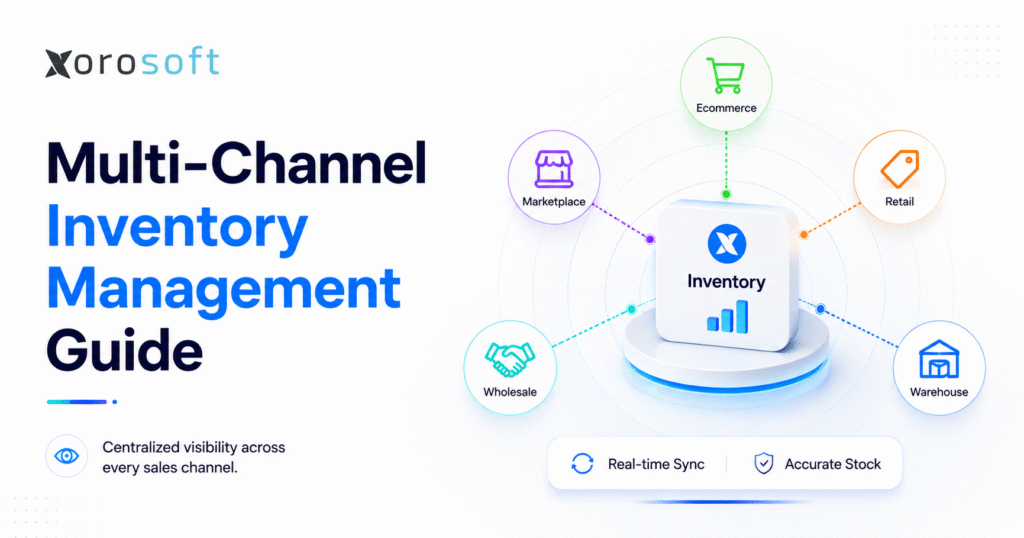
For any business selling on different platforms, mastering multi-channel inventory management is crucial for growth and efficiency.
1. Why Multi-Channel Inventory Management Gets Harder as Channels Grow
Adding Shopify, Amazon, wholesale accounts, retail stores, or new marketplaces can expand revenue quickly. However, every new channel also creates another place where product data, stock levels, orders, cancellations, returns, and fulfillment promises must stay accurate. As a result, a business can grow sales while losing control of inventory.
The problem often begins quietly. A Shopify order reserves the final units, but Amazon still shows the product as available. Meanwhile, a wholesale representative promises stock already committed to a promotion. A transfer leaves one warehouse, yet the receiving team never confirms it correctly. Finance then closes the month with an inventory value that operations cannot explain.
These failures usually appear because the company has built a connected customer experience on top of disconnected operational systems. Effective multi-channel inventory management creates one reliable view of what is on hand, promised, unavailable, in transit, and still sellable. Moreover, it connects inventory with purchasing, warehouse execution, forecasting, returns, and accounting, allowing the business to add channels without multiplying manual work and risk.
2. What Multi-Channel Inventory Management Actually Controls
2.1 A Practical Definition of Multi-Channel Inventory Management
Multi-channel inventory management controls inventory for products sold through several channels and fulfilled from one or more locations. It centralizes product, order, reservation, warehouse, purchasing, and availability data so every channel receives an accurate quantity and every team works from the same record.
The process goes beyond copying stock numbers. It distinguishes physical inventory from sellable inventory and accounts for open orders, wholesale allocations, damaged goods, safety stock, transfers, purchase orders, and returns awaiting inspection.
2.2 Why Multi-Channel Inventory Management Needs Centralized Data
When channels manage inventory independently, the business creates several competing promises against the same units. Consequently, overselling, cancellations, emergency transfers, late shipments, and weak purchasing decisions become more common.
Centralized inventory management brings demand into one operational model. Purchasing sees total requirements, warehouse teams see current reservations, customer service sees true replacement availability, and finance can connect movements with cost and margin.
2.3 Who Needs Multi-Channel Inventory Software
A formal system becomes increasingly valuable when a company:
- Sells the same SKUs through Shopify, Amazon, wholesale, retail, or marketplaces
- Operates multiple warehouses, stores, or 3PL locations
- Manages bundles, variants, assemblies, or EDI orders
- Experiences recurring stockouts, overstocks, or discrepancies
- Relies on spreadsheets for purchasing or reconciliation
- Needs forecasting, profitability reporting, or manufacturing support
2.4 Who Can Delay a Multi-Channel Inventory Platform
A business with one channel, one location, a limited catalog, and simple purchasing may still work effectively with native ecommerce tools. However, complexity matters more than revenue. A smaller company with thousands of SKUs and several locations may need stronger controls sooner than a larger, simpler operation.
2.5 Multichannel vs Omnichannel Inventory Management
Multichannel operations sell through several channels. Omnichannel operations connect those channels into one customer experience, such as buy online, pick up in store, and return elsewhere. Both require accurate stock, although omnichannel models add more complex routing and customer-promise rules.
3. How Multi-Channel Inventory Management Works
3.1 Build a Product and SKU Structure for Multi-Channel Inventory Management
Every sellable item needs a consistent internal identity. Channel titles can differ, but each listing should map to one internal SKU with defined variants, units of measure, pack sizes, barcodes, costs, suppliers, and inventory rules.
Poor SKU discipline causes synchronization failures. For example, the same blue medium shirt may use different codes in Shopify, Amazon, and the warehouse. If those records do not map correctly, one sale can reduce the wrong item. Bundles also need component-based availability so the business does not sell a set that the warehouse cannot assemble.
3.2 Connect Sales Channels to Centralized Inventory Management
Orders from Shopify, Amazon, retail, wholesale, and other channels should flow into one workflow. The connection should handle cancellations, refunds, returns, partial shipments, product mapping, and inventory updates—not only order import.
For Shopify merchants, the Xorosoft ERP Shopify app can connect the storefront with broader ERP, purchasing, warehouse, and accounting workflows.
3.3 Set Reservation Rules in a Multichannel Inventory System
An accepted order should reserve inventory before picking begins. Otherwise, another channel can sell the same units. The business should also define how unpaid orders, fraud review, backorders, preorders, wholesale approvals, and cancellations affect reservations.
3.4 Calculate Available-to-Sell Inventory Across Channels
Available to sell = on-hand inventory − reserved inventory − safety stock − unavailable inventory
Some businesses also subtract channel allocations. Although incoming purchase orders may support preorders, teams should not treat expected stock as physical inventory without a controlled policy.
3.5 Route Orders and Synchronize Inventory Across Sales Channels
After order acceptance, the system selects a fulfillment location. Once employees ship, cancel, adjust, or return inventory, the revised quantity must flow back to every channel. In addition, the team must monitor rejected updates because one failure can leave stale stock online.
4. The Centralized Inventory Management Data Model Behind Reliable Sync
4.1 Track On-Hand Inventory in a Multi-Location Inventory System
On-hand inventory represents the physical quantity recorded at a warehouse, store, showroom, or 3PL. The company should track it by location and, where relevant, by bin, lot, serial number, status, or ownership.
4.2 Control Reserved and Allocated Inventory Across Sales Channels
Reserved inventory supports an accepted order or operational commitment. Allocated inventory protects units for a channel, customer, promotion, or business priority. Although those units may remain physically present, the business should not treat them as freely available.
4.3 Incoming and In-Transit Inventory
Open purchase orders show expected supply. Warehouse transfers show inventory moving between locations. Both require expected dates and status controls. Therefore, inventory should not appear at the destination until the receiving team confirms it.
4.4 Safety Stock and Protected Inventory
Safety stock protects the business from demand spikes, supplier delays, and forecast error. The system should normally exclude it from standard channel availability. However, managers can release it through an approved exception process when conditions change.
4.5 Damaged, Quarantined, and Return-Pending Inventory
Products awaiting inspection, repair, quality control, or disposal must stay separate from sellable stock. A controlled transaction should change their status; an informal note should not.
4.6 Measure Location-Level Availability for Multi-Warehouse Inventory Management
A company may hold 500 units overall but only a few units near the customer. Consequently, multi-location inventory management requires visibility by warehouse, store, 3PL, and stock status—not just a company-wide total.
5. Multi-Channel Inventory Challenges That Create Cost and Customer Risk
5.1 Multi-Channel Inventory Synchronization Delays
A short delay may look harmless during normal demand. During a launch or promotion, however, it can allow many orders to arrive after another channel has reserved the remaining stock. Teams should monitor update speed, failed messages, and stale connections.
5.2 Inconsistent Product Identifiers
When channels use different SKUs without reliable mapping, sales may reduce the wrong item. Duplicate products, renamed variants, and pack-size differences make discrepancies harder to trace.
5.3 Wholesale Allocation in Centralized Inventory Management
Wholesale orders often involve larger quantities and longer approval cycles. If the system does not reserve those commitments, ecommerce channels may continue selling units already promised to a wholesale customer.
5.4 Returns Increasing Inventory Too Early
A cancellation can release inventory immediately, but a physical return usually should not. The item may arrive damaged, incomplete, used, or awaiting inspection. Therefore, adding it to available stock too early can create another failed order.
5.5 Warehouse Transfers Creating Double Availability
A weak transfer process can leave stock available at the source while also showing it at the destination. Instead, the system should use an in-transit status until receiving confirms the quantity.
5.6 Inventory and Accounting Records Disagreeing
Operations may adjust units without recording the financial impact, while finance may post an adjustment without identifying the warehouse event. Over time, these separate corrections slow month-end close and weaken trust in reporting.
6. Multi-Channel Inventory Management Practices That Prevent Overselling
6.1 Set One Multi-Channel Inventory Authority
The business should know which platform owns the available quantity. Other systems may display or consume that value, but one system should govern the final promise. Otherwise, teams may correct several platforms and create new discrepancies.
6.2 Reserve Stock Before Fulfillment Begins
Reserve inventory when an order reaches the accepted status. Waiting until picking or shipment allows another channel to sell the same units. Likewise, release the reservation promptly after cancellation or rejection.
6.3 Use Channel Buffers in Multi-Channel Inventory Management
A buffer protects the final units from appearing everywhere at once. It helps when marketplace updates run less frequently, cancellation penalties matter, or physical accuracy still needs improvement. However, planners should set buffers by SKU instead of applying one rule across the catalog.
6.4 Separate On-Hand Inventory From Available Inventory
The system should show on hand, reserved, allocated, damaged, safety stock, and available-to-sell balances separately. As a result, users will not assume that every physical unit remains sellable.
6.5 Monitor Multi-Channel Inventory Exceptions
Exception reports should flag negative inventory, unmapped SKUs, rejected orders, delayed updates, duplicate imports, and stale channel quantities. Consequently, the team can correct a small issue before it affects many customers.
6.6 Reconcile Through Targeted Cycle Counts
Focus cycle counts on high-volume, high-value, fast-moving, and frequently adjusted products. Repeated discrepancies often reveal receiving, scanning, bundle, or return-process problems.
7. Inventory Allocation Across Channels, Customers, and Warehouses
7.1 Channel Allocation in Multichannel Inventory Management
Inventory allocation protects units for specific demand. A brand may reserve stock for wholesale customers, limit marketplace availability, or protect direct-to-consumer inventory for a launch. Therefore, the allocation rule should reflect margin, service commitments, contractual obligations, channel penalties, and strategic priorities.
7.2 Customer-Priority Allocation
Some wholesale or enterprise customers have contractual fill-rate expectations. Their open commitments may need priority over discretionary demand. In addition, the allocation should remain visible to sales, purchasing, and customer service so no team promises the same units elsewhere.
7.3 Warehouse-Based Inventory Allocation
Inventory should sit where the company expects demand, but demand is only one factor. Supplier location, freight cost, warehouse capacity, regional delivery expectations, storage limitations, and transfer expense also affect the decision.
7.4 Low-Stock Allocation Rules
When supply becomes scarce, the company needs a clear priority model. Options include first accepted order, highest-margin channel, strategic customer, proportional allocation, or service-level commitment. A documented rule reduces internal conflict and makes exceptions easier to approve.
7.5 Promotion and Product-Launch Allocation
New products and promotions often lack reliable demand history. Brands can set initial channel caps, monitor sell-through frequently, and release additional inventory in stages. This approach protects stock while allowing planners to respond to actual demand.
8. Multi-Channel Demand Forecasting and Replenishment
8.1 Forecast Multi-Channel Inventory by Product, Channel, and Location
A company-wide forecast can hide important differences. Amazon demand may rise while wholesale demand falls, or one warehouse may run short while total stock looks healthy. Therefore, forecasting should preserve product, channel, and location detail before consolidation.
8.2 Separate Baseline Demand From Unusual Events
Promotions, influencer activity, stockouts, weather, wholesale programs, and launches can distort history. Planners should identify exceptional events rather than treat every spike or decline as normal demand.
8.3 Include Lost Sales and Stockout Periods
Sales history does not show demand the business could not fulfill. Consequently, forecasting teams should review stockout periods and use supporting signals where possible.
8.4 Convert Forecasts Into Replenishment Decisions
A practical recommendation considers forecast demand, current availability, safety stock, incoming supply, supplier lead time, minimum order quantities, warehouse capacity, and purchasing constraints. Moreover, it should explain its assumptions so planners can review them.
8.5 Connect Purchasing With Multi-Channel Demand
Purchasing should see consolidated demand while retaining channel detail. When supplier dates move, revised receipts should influence availability, transfer planning, and customer communication.
A connected platform such as XoroERP can support businesses that need inventory planning to work alongside purchasing, accounting, order management, and reporting.
9. Multi-Warehouse Inventory Management and Order Routing
9.1 Route Multi-Warehouse Inventory With Operational Rules
The closest warehouse is not always the best warehouse. Routing should consider complete order availability, customer distance, carrier service, warehouse capacity, handling requirements, cutoff times, and split-shipment cost.
9.2 Reduce Unnecessary Split Shipments
Shipping one order from several locations can increase freight, packaging, customer-service work, and return complexity. Therefore, a routing engine should balance delivery speed with order completeness and total fulfillment cost.
9.3 Control Warehouse Transfers
A transfer should include a request, approval, pick, shipment, in-transit status, receipt, and discrepancy workflow. Inventory should leave the source when employees ship it and enter the destination only after receiving confirms it. This process creates a clear explanation for stock that is temporarily unavailable.
9.4 Use Warehouse Execution Controls
Barcode scanning, bin control, directed picking, packing checks, and controlled adjustments improve inventory accuracy. The XoroWMS warehouse management platform becomes relevant when a company needs inventory visibility connected with receiving, picking, packing, shipping, and multi-location execution.
9.5 Manage Third-Party Logistics Locations
A 3PL should not become an inventory blind spot. The business needs timely receipts, shipments, adjustments, returns, and location balances from every external warehouse. In addition, service-level agreements should define update frequency, exception handling, and reconciliation responsibilities.
10. Returns, Exchanges, and Reverse Inventory Control
10.1 Treat Returns as Part of Multi-Channel Inventory Management
Returns affect sellable inventory, customer replacements, warehouse labor, write-offs, product condition, and accounting. Therefore, teams should design returns as a normal operating workflow rather than rely on informal notes and manual quantity changes.
10.2 Use Clear Return Statuses
A returned item may sit in received, awaiting inspection, approved for resale, repair, vendor return, discount, recycling, or write-off status. Only items approved for resale should increase available inventory.
10.3 Connect Exchanges With Reservations
An exchange creates an inbound return and a new outbound commitment. The system should reserve the replacement unit immediately while the original product follows inspection. Otherwise, another customer may buy the replacement before the warehouse fulfills the exchange.
10.4 Handle Marketplace Returns Separately
Marketplace returns may follow different timing, documentation, ownership, or reimbursement rules. The inventory system should preserve the source channel and final disposition so finance and operations can explain the outcome.
10.5 Measure Return-to-Stock Time
The time between physical receipt and final disposition affects availability and working capital. For example, a slow inspection process can leave valuable inventory unavailable during peak demand.
11. Connecting Multi-Channel Inventory Management With Accounting
11.1 Value Inventory in a Multi-Channel Inventory System
A quantity adjustment can affect the balance sheet, cost of goods sold, gross margin, and tax reporting. Therefore, the system should preserve the reason, user, location, date, and financial impact of significant inventory changes.
11.2 Landed Cost Improves Channel Profitability Analysis
Product cost may include freight, duty, brokerage, insurance, and other acquisition expenses. Allocating landed cost consistently creates a more realistic margin by product, order, and channel.
11.3 Purchase Orders and Vendor Bills Should Reconcile
Receiving confirms what arrived. The vendor bill confirms what the supplier charged. A controlled workflow helps teams identify quantity differences, cost changes, and unexpected charges before they distort inventory value.
11.4 Channel Fees Belong in Profitability Reporting
Marketplace commissions, payment fees, fulfillment charges, advertising, shipping subsidies, and return costs can make two channels with similar revenue produce very different margins. Consequently, inventory reporting becomes more useful when it connects with financial data.
11.5 Month-End Close Should Not Depend on Spreadsheet Reconstruction
Finance should trace inventory balances and adjustments back to operational transactions. XoroONE provides a connected cloud ERP environment for inventory-driven businesses that need inventory, accounting, purchasing, warehouse management, forecasting, manufacturing, and reporting in one system.
12. ERP, OMS, WMS, and Multi-Channel Inventory Software Compared
| System type | Primary role | Typical strength | Common limitation when used alone |
|---|---|---|---|
| Inventory software | Track stock and replenishment | Focused inventory tools | Accounting and manufacturing may remain separate |
| OMS | Capture and orchestrate orders | Routing and order status | Limited financial or warehouse depth |
| WMS | Execute warehouse work | Receiving, picking, packing, and scanning | Does not normally manage the full business |
| ERP | Connect operational and financial processes | Inventory, purchasing, accounting, planning, and reporting | Broader implementation scope |
| Ecommerce platform | Manage storefront and commerce | Product, checkout, and order capture | Back-office depth varies by complexity |
12.1 When Focused Multi-Channel Inventory Software Is Enough
A dedicated platform may suit a company with straightforward accounting, limited warehouse complexity, and no major manufacturing or EDI requirements. Moreover, it can often be implemented faster than a broader ERP.
12.2 When an OMS Is the Better Priority
An OMS helps when the main challenge involves orchestrating orders across stores, marketplaces, warehouses, and fulfillment partners. It improves routing, order status, and distributed fulfillment.
12.3 When a WMS Becomes Essential
A WMS fits businesses whose main constraint sits inside the warehouse. Complex picking, scanning, bin control, packing verification, and shipping automation require execution depth.
12.4 When a Unified ERP Becomes Practical
ERP becomes more relevant when inventory decisions connect closely with accounting, purchasing, forecasting, EDI, manufacturing, and management reporting. Therefore, businesses should compare process fit, implementation requirements, integration strategy, support, and total operating cost.
Companies considering NetSuite and modern alternatives can review the Xorosoft versus NetSuite comparison as one part of a wider evaluation. The goal is to identify the system that matches the operating model and implementation capacity.
13. Multi-Channel Inventory Management Features to Prioritize
13.1 Real-Time Multi-Channel Inventory Synchronization and Exception Monitoring
The platform should update channel quantities at an appropriate frequency and clearly report failures. Ask how it handles rejected updates, duplicate imports, unmapped products, negative stock, and temporary connection outages.
13.2 Central Product, Warehouse, and Purchasing Control
Look for consistent SKU management, location-level inventory, reservations, allocations, bundles, transfers, purchase orders, supplier lead times, safety stock, and replenishment recommendations.
13.3 Accounting, EDI, and Manufacturing Support
A business that sells wholesale or manufactures products may also require customer-specific pricing, EDI, bills of materials, work orders, material planning, landed cost, and integrated financial reporting. Therefore, buyers should evaluate these needs before choosing a narrow inventory application.
13.4 Reporting That Explains Operational Causes
Dashboards should not only display totals. Users should trace discrepancies, stockouts, margin changes, late purchase orders, transfer errors, and channel performance back to the transactions that caused them.
13.5 Integration Monitoring and Audit Trails
Every connection should provide error visibility, timestamps, retry logic, and user-level audit trails. Otherwise, teams may discover problems only after a customer complains or finance finds a discrepancy.
14. Multi-Channel Inventory Management by Industry
14.1 Multi-Channel Inventory Management for Apparel and Fashion
Apparel businesses manage size and color variants, seasonal collections, high return volumes, markdowns, and inventory split across direct, retail, and wholesale channels. Matrix inventory, allocation, and return-status controls become especially important.
14.2 Furniture and Large-Item Fulfillment
Furniture companies often manage long supplier lead times, bulky storage, deposits, special orders, showrooms, and scheduled deliveries. Availability must reflect location, product condition, and delivery capacity.
14.3 Sporting Goods and Seasonal Demand
Sporting-goods brands frequently sell bundles, seasonal products, and regionally popular items. Forecasting, component availability, and warehouse placement help prevent shortages during compressed selling periods.
14.4 Food, Wholesale, and Manufacturing Workflows
Food businesses may require lot and expiry control. Wholesalers need EDI, customer pricing, bulk allocation, and purchasing visibility. Manufacturers must connect finished-goods demand with components, bills of materials, and production plans.
Xorosoft’s industry-specific ERP workflows provide context for evaluating these different operating requirements across apparel, furniture, sporting goods, food, wholesale, consumer products, and manufacturing.
15. Signs the Business Has Outgrown Its Inventory Stack
15.1 Manual Reconciliation Has Become a Daily Task
Frequent spreadsheet corrections usually indicate that integrations, transaction controls, or ownership rules no longer keep pace. Although spreadsheets remain useful for analysis, they should not govern complex inventory transactions.
15.2 Sales Channels Show Conflicting Quantities
When customer service must check several systems before promising stock, the business no longer has a dependable available-to-sell record. As a result, employees lose time and customers receive inconsistent answers.
15.3 Purchasing Depends on One Person’s Spreadsheet
If the company cannot audit or transfer replenishment knowledge easily, supplier delays and demand changes can quickly create stockouts or excess inventory.
15.4 Warehouse and Finance Teams Cannot Explain the Same Adjustment
A widening gap between operational quantities and financial value signals that the systems need tighter integration before the business adds more channels or locations.
15.5 The Business Keeps Adding Point Solutions
Every additional application creates another integration, owner, data model, and reconciliation point. Eventually, the stack may cost more to maintain than a broader platform.
16. A Practical Multi-Channel Inventory Management Implementation Roadmap
16.1 Multi-Channel Inventory Implementation: Map Processes and Clean Data
Document every sales channel, inventory location, order type, return path, purchasing process, and manual workaround. Then standardize SKUs, variants, units of measure, supplier records, warehouse locations, and opening quantities.
16.2 Days 31–60: Configure Rules and Test Exceptions
Define system ownership, reservations, allocations, safety stock, routing, transfers, returns, and approval rules. Next, test normal orders as well as cancellations, partial shipments, failed payments, damaged returns, delayed purchase orders, and bundle shortages.
16.3 Days 61–90: Train, Launch, and Stabilize
Train users by role, launch in controlled stages, monitor integration exceptions, and reconcile early transactions. Finally, measure inventory accuracy, fill rate, overselling, forecast performance, and month-end close time against the pre-project baseline.
16.4 Build a Stabilization Plan Before Go-Live
Assign owners for integration monitoring, inventory corrections, warehouse exceptions, and accounting reconciliation. In addition, define how teams will log issues, prioritize fixes, and communicate changes during the first weeks.
17. Multi-Channel Inventory KPIs That Reveal Operational Health
17.1 Multi-Channel Inventory Accuracy and Overselling Rate
Inventory accuracy measures whether system quantities match verified physical counts. Overselling rate shows whether channel promises exceed real availability. Both metrics should be reviewed by product and location.
17.2 Fill Rate, Stockout Rate, and Order Cycle Time
These measures show whether the business positions inventory correctly and whether warehouses convert availability into completed orders without delay.
17.3 Forecast Accuracy and Inventory Turnover
Forecast accuracy supports better purchasing, while inventory turnover shows how efficiently stock moves. However, teams should not optimize either metric in isolation because aggressive inventory reduction can damage service levels.
17.4 Return-to-Stock Time and Transfer Accuracy
These KPIs expose delays in reverse logistics and weaknesses in multi-location control. Slow return processing or repeated transfer discrepancies can create hidden availability problems.
17.5 Channel Profitability and Inventory Carrying Cost
Revenue alone does not reveal channel quality. Therefore, managers should compare contribution margin, fulfillment expense, returns, marketplace fees, and carrying cost by channel where possible.
18. Common Multi-Channel Inventory Management Mistakes
18.1 Automating an Unclear Multichannel Inventory Process
Software cannot resolve contradictory allocation rules or unclear ownership. First, the business must agree on how inventory should move. Then it can configure automation around that process.
18.2 Migrating Duplicate and Unreliable Data
A new platform will reproduce old problems if teams do not clean product, supplier, warehouse, and opening-balance data. Consequently, data preparation deserves the same attention as configuration.
18.3 Testing Only Perfect Orders
Real operations include cancellations, partial shipments, returns, failed integrations, delayed receipts, and inventory damage. Therefore, acceptance testing should include exception scenarios from every major channel.
18.4 Choosing Software From a Feature Checklist Alone
The strongest evaluation uses actual workflows, reporting requirements, integration dependencies, implementation resources, and growth plans. A long feature list does not guarantee a good operational fit.
18.5 Ignoring Change Management
Employees may continue using old spreadsheets or side processes if they do not understand the new workflow. Therefore, leaders should explain ownership, expected behavior, and the reason behind each process change.
19. Frequently Asked Questions About Multi-Channel Inventory Management
19.1 What Is Multi-Channel Inventory Management?
Multi-channel inventory management centralizes stock control across ecommerce, marketplaces, wholesale, retail, and warehouses. It coordinates orders, reservations, purchasing, returns, and reporting from one operational record.
19.2 How Does Multi-Channel Inventory Management Work?
Connected channels send orders to a central system. The system reserves stock, calculates availability, routes fulfillment, records inventory movements, and sends updated quantities back to each channel.
19.3 Why Is Centralized Inventory Management Important?
It reduces conflicting stock records, improves purchasing decisions, lowers overselling risk, and gives warehouse, customer-service, finance, and management teams a consistent operational view.
19.4 How Can a Business Prevent Overselling?
Use one inventory authority, reserve accepted orders immediately, protect safety stock, apply channel buffers where appropriate, and monitor failed updates and low-stock exceptions.
19.5 What Is Available-to-Sell Inventory?
Available-to-sell inventory equals on-hand stock minus reservations, allocations, safety stock, damaged goods, and other quantities the business should not promise.
19.6 What Is Inventory Allocation?
Inventory allocation protects stock for a specific channel, warehouse, customer, promotion, or contractual commitment before ordinary demand can consume it.
19.7 How Should Inventory Be Allocated Between Channels?
Use documented rules based on customer commitments, margin, service levels, channel penalties, promotional plans, and strategic priorities. Review those rules as conditions change.
19.8 How Do Multiple Warehouses Affect Inventory Control?
Multiple warehouses add location-level availability, transfers, routing, capacity, regional replenishment, and receiving requirements. Therefore, a company-wide stock total no longer provides enough detail.
19.9 How Should Warehouse Transfers Be Tracked?
Use request, approval, shipment, in-transit, receipt, and discrepancy stages. Inventory should enter the destination only after receiving confirms the quantity.
19.10 How Do Returns Affect Available Inventory?
Returned goods should remain unavailable until inspection determines whether employees can resell, repair, return, discount, recycle, or write them off.
19.11 Can Shopify Manage Inventory Across Channels?
Shopify supports product and location inventory. However, businesses with complex wholesale, EDI, manufacturing, accounting, forecasting, or warehouse requirements may need connected applications or ERP.
19.12 How Do Shopify and Amazon Quantities Stay Synchronized?
An integration maps listings to internal SKUs, imports orders, reserves stock, and sends revised available quantities back after sales, cancellations, returns, or adjustments.
19.13 What Is the Difference Between ERP and Inventory Software?
Inventory software focuses on stock and replenishment. ERP connects inventory with accounting, purchasing, order management, forecasting, manufacturing, and broader reporting.
19.14 What Is the Difference Between an OMS and ERP?
An OMS specializes in order orchestration and routing. ERP manages a broader operational and financial model that may include inventory, purchasing, accounting, and manufacturing.
19.15 What Is the Difference Between a WMS and Inventory Software?
A WMS manages warehouse execution, including receiving, putaway, picking, packing, scanning, and shipping. Inventory software focuses more broadly on quantities and replenishment.
19.16 When Should a Business Replace Spreadsheets?
Replace transaction-heavy spreadsheets when users maintain conflicting files, updates require manual copying, formulas are difficult to audit, or employees cannot trust current inventory.
19.17 When Should a Business Consider ERP?
ERP becomes relevant when inventory complexity also affects accounting, purchasing, forecasting, warehouses, EDI, manufacturing, and management reporting.
19.18 What Data Should Be Cleaned Before Implementation?
Clean SKUs, variants, barcodes, units of measure, suppliers, customers, locations, bills of materials, opening balances, open orders, and channel mappings.
19.19 How Long Does Implementation Take?
Timing depends on data quality, integrations, warehouses, accounting, EDI, manufacturing, users, and testing scope. A credible estimate follows process discovery.
19.20 What Features Should Multi-Channel Inventory Software Include?
Prioritize synchronization, reservations, allocations, multi-location stock, bundles, purchasing, forecasting, transfers, returns, warehouse execution, accounting, EDI, reporting, and integration monitoring.
19.21 How Does Demand Forecasting Work Across Channels?
Forecasting analyzes product demand by channel and location, then adjusts for seasonality, promotions, stockouts, launches, wholesale commitments, and expected supply changes.
19.22 Which Inventory KPIs Should Be Tracked?
Track inventory accuracy, overselling, fill rate, stockout rate, turnover, forecast accuracy, order cycle time, return-to-stock time, transfer accuracy, and channel profitability.
19.23 Are Point Solutions a Valid Alternative to ERP?
Yes. Ecommerce, inventory, OMS, WMS, and accounting tools can work together when teams clearly define responsibilities, integrations, monitoring, and reconciliation.
19.24 How Much Does Multi-Channel Inventory Software Cost?
Cost varies by users, orders, locations, modules, integrations, implementation, migration, and support. Compare total operating cost rather than subscription price alone.
19.25 How Should a Company Choose the Right Platform?
Document real workflows, test shortlisted systems with company scenarios, verify integrations, evaluate implementation resources, and speak with references from similar businesses.
20. Next Steps for Scalable Multi-Channel Inventory Management
Multi-channel growth becomes sustainable when every sales channel follows the same inventory rules. Clean product data, immediate reservations, controlled availability, accurate warehouse transactions, disciplined returns, and connected purchasing create that foundation. Technology should strengthen the operating model rather than hide disconnected processes behind another dashboard.
Start by mapping where data becomes delayed, duplicated, or manually corrected. Next, decide whether the business needs focused inventory software, an OMS, a WMS, or a unified ERP. The right choice should reflect present complexity and the channels, warehouses, order volume, and operating requirements expected next.
For businesses evaluating a connected model, Xorosoft can support inventory, accounting, purchasing, warehouse management, forecasting, Shopify, Amazon, EDI, multi-warehouse operations, and manufacturing within one cloud ERP environment. A personalized operations review and demo can help determine whether that approach fits the company’s workflows and implementation readiness.
Recent Posts
-
 Best AI Warehouse Management Software for ERP Inventory and Warehouse Operations
 -
 Project Based ERP Software for Managing Project Costs, Purchasing, Resources, Inventory, and Accounting
 -
 Food and Beverage ERP Requirements for Lot, Expiry, and Recall Control
 -
 How to Prevent EDI Errors Before They Become Retailer Chargebacks
 -
 Warehouse Injury and Safety Statistics: What Operations Teams Should Know Before Automating Workflows