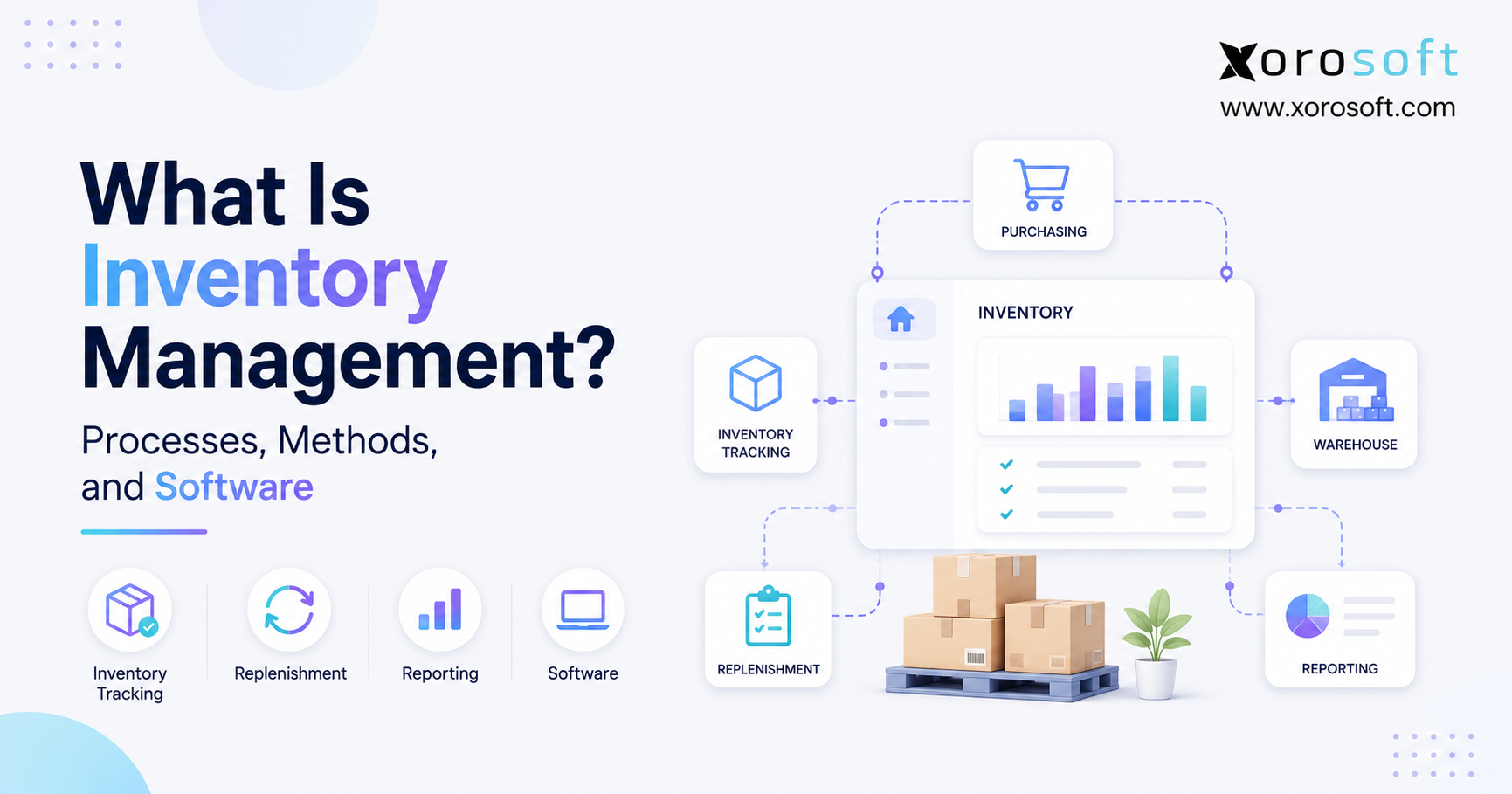
Understanding the inventory management process is essential for any business that wants to optimise stock levels and improve efficiency.
1. Why the Inventory Management Process Matters More Than Ever
The inventory management process determines how a business forecasts demand, purchases products, receives stock, stores goods, fulfills orders, manages returns, and records inventory value. Therefore, it affects far more than the number of units sitting inside a warehouse. It also shapes cash flow, purchasing decisions, customer experience, warehouse performance, accounting accuracy, and long-term growth.
Initially, a small product business may manage inventory through spreadsheets, an ecommerce platform, or basic accounting software. However, this approach becomes increasingly difficult as the company adds more products, suppliers, warehouses, employees, and sales channels.
For example, an ecommerce company may sell the same SKU through Shopify, Amazon, wholesale orders, and retail locations. Meanwhile, purchase orders may arrive at several warehouses, customer returns may wait for inspection, and wholesale orders may reserve stock before shipment. Consequently, knowing only the total quantity on hand is no longer enough.
Instead, the business must understand:
- Physical quantity currently in stock
- Sellable quantity available to customers
- Units already committed to open orders
- Inbound stock expected from suppliers
- Exact warehouse or location holding each product
- Reorder timing for individual SKUs
- Accounting impact of inventory movements
- Slow-moving products at risk of becoming obsolete
According to IBM’s inventory management overview, businesses need reliable information about what to order, how much to order, and where stock should be stored. Similarly, Oracle’s inventory management guide explains that businesses must balance product availability against the cost of carrying excess inventory.
Therefore, the inventory management process should be treated as a company-wide operating discipline rather than a warehouse-only responsibility.
1.1 What This Guide Will Help You Understand
Throughout this guide, you will learn:
- What inventory management means
- How an inventory workflow operates
- Which inventory types businesses manage
- Which methods support better stock planning
- Which metrics operators should monitor
- Why inventory records become inaccurate
- When inventory software becomes necessary
- How ERP differs from standalone inventory tools
- Which industries need specialized workflows
- When a growing business should upgrade its systems
2. What Is the Inventory Management Process?
The inventory management process is the coordinated workflow used to forecast, purchase, receive, store, track, allocate, sell, return, count, and replenish stock.
In practical terms, the process helps a business understand:
- Its current inventory position
- The exact storage location of each product
- The quantity genuinely available for new orders
- Stock already reserved or committed
- Products currently being purchased or manufactured
- Items that should be transferred, reordered, discounted, or discontinued
Although inventory records contain quantities, effective inventory management also considers timing, cost, location, demand, and operational risk.
For instance, a system may show 2,000 units of a product on hand. However, 600 units may already be reserved for wholesale orders, 300 may be waiting for quality inspection, and 200 may be damaged. Therefore, the quantity actually available to customers is far lower than the physical total.
2.1 A Simple Inventory Management Process Example
Consider an apparel company that sells jackets through Shopify, Amazon, and wholesale accounts.
First, the company forecasts demand by size, color, and sales channel. Next, the purchasing team creates supplier purchase orders. After the products arrive, warehouse employees receive and inspect them. The approved units are then assigned to warehouse and bin locations.
Meanwhile, customer orders begin reserving available stock. As a result, the company must continuously update inventory across every selling channel.
Returned products also require inspection before they become available again. Finally, the accounting team must calculate inventory value and cost of goods sold.
Therefore, the inventory management process connects forecasting, purchasing, warehouse operations, sales, fulfillment, returns, and finance.
2.2 Inventory Management Process vs Inventory Control
Although the terms are closely related, inventory management and inventory control are not identical.
Warehouse-level inventory control focuses mainly on the physical accuracy, storage, handling, and movement of products within a specific facility or location.
By contrast, the broader inventory management process also includes forecasting, purchasing, replenishment, supplier planning, ecommerce synchronization, sales allocation, accounting, and reporting.
The Association for Supply Chain Management also distinguishes inventory control from broader inventory management. According to this distinction, inventory control concentrates primarily on stock inside operational locations, whereas inventory management supports planning and coordination across the wider organization.
Consequently, a warehouse may maintain accurate product counts while the overall business still operates with a weak inventory management process.
For example, warehouse employees may count products correctly. Nevertheless, the purchasing team could continue overbuying because it lacks reliable demand forecasts. At the same time, an ecommerce store may oversell because available inventory does not update quickly enough.
2.3 Inventory Management vs Stock Management
In everyday business language, stock management and inventory management are often used interchangeably.
However, stock generally refers to finished products available for sale. Inventory, meanwhile, can also include raw materials, components, work-in-progress products, packaging, maintenance supplies, and finished goods.
Therefore, inventory management is usually the broader term, especially for manufacturers, distributors, and businesses with complex product operations.
3. How the Inventory Management Process Protects Cash Flow
A reliable inventory management process protects both operational performance and financial stability. Moreover, it gives purchasing, warehouse, sales, finance, customer service, and leadership teams a shared view of inventory.
3.1 Inventory Uses Cash Before It Generates Revenue
Inventory absorbs cash before it produces revenue. Suppliers, freight providers, customs authorities, warehouses, and insurers may all require payment before the product is sold. Revenue, however, arrives only after the business completes the sale and collects payment.
Consequently, excess inventory can restrict cash flow even when sales appear healthy. Holding too little stock creates a different risk because customers cannot purchase unavailable products. Effective inventory planning must therefore balance customer service requirements with working-capital limits.
3.2 Stock Accuracy Shapes Customer Experience
Customers expect products shown online to be available. Furthermore, they expect the correct item to arrive within the promised timeframe.
However, inaccurate inventory can cause:
- Canceled ecommerce orders
- Wholesale short shipments
- Marketplace penalties
- Delayed deliveries
- Incorrect products
- Unexpected backorders
- Customer support complaints
Therefore, inventory accuracy directly affects customer trust, satisfaction, and retention.
3.3 Inventory Data Drives Warehouse Performance
Warehouse employees need accurate product quantities and locations. Otherwise, pickers spend time searching for stock that is missing, misplaced, or stored in a different bin.
Moreover, delayed replenishment can leave forward-picking locations empty even when reserve inventory exists elsewhere in the building.
Consequently, accurate inventory supports faster receiving, put-away, replenishment, picking, packing, transfers, and cycle counting.
3.4 Inventory Affects Financial Reporting
Inventory is both a physical asset and a financial asset. Accordingly, each purchase receipt, sale, return, adjustment, transfer, assembly, and write-off can affect the company’s financial records.
When operational inventory does not match accounting inventory, finance teams may struggle to calculate:
- Inventory value
- Cost of goods sold
- Gross margin
- Landed cost
- Product profitability
- Inventory write-offs
- Month-end adjustments
As a result, inventory errors can delay the financial close and weaken management reporting.
3.5 Inventory Supports Better Purchasing Decisions
Purchasing teams need reliable information about current stock, open customer orders, inbound inventory, supplier lead times, and forecasted demand.
However, when purchasing is managed through outdated spreadsheets, buyers may place orders too early, too late, or for the wrong quantities.
Therefore, a well-designed inventory management process helps purchasing teams order with greater confidence.
4. Inventory Types Within the Inventory Management Process
A clearly defined inventory management process determines how each type of inventory should be purchased, stored, counted, valued, and replenished.
Different businesses hold different inventory categories. Therefore, the company must understand what each category represents and which controls it requires.
4.1 Raw Materials
Raw materials are the items used to manufacture finished products.
For example, a furniture manufacturer may purchase wood, fabric, foam, screws, glue, and packaging. Similarly, a food producer may purchase ingredients, bottles, labels, and cartons.
Because one missing component can stop production, raw material availability must align with manufacturing plans.
4.2 Work-in-Progress Inventory
Work-in-progress inventory includes products that have entered production but are not yet complete.
For instance, work-in-progress may include cut fabric waiting for sewing, furniture frames waiting for upholstery, or products waiting for quality inspection.
Therefore, manufacturers must track both the quantity and production stage of this inventory.
4.3 Finished Goods
Finished goods are complete products that can be sold or shipped.
Although this category appears straightforward, businesses must still distinguish between:
- On-hand inventory
- Available inventory
- Committed inventory
- Damaged inventory
- Quarantined inventory
- In-transit inventory
Consequently, the total physical quantity may differ significantly from the quantity available to customers.
4.4 Maintenance, Repair, and Operations Inventory
Maintenance, repair, and operations inventory supports daily business activity but is not normally sold to customers.
Examples include:
- Warehouse labels
- Cleaning supplies
- Replacement machine parts
- Safety equipment
- Tools
- Printer supplies
- Packing materials
Although these items may have relatively low values, running out of them can interrupt operations.
4.5 Safety Stock
Safety stock is additional inventory held to protect the business against uncertainty.
For example, safety stock may cover:
- Supplier delays
- Unexpected demand
- Forecasting errors
- Transportation disruptions
- Quality failures
- Production problems
However, safety stock should be calculated carefully. Otherwise, a useful buffer can become costly excess inventory.
4.6 Dead and Obsolete Stock
Dead stock refers to inventory that no longer sells or moves too slowly to justify continued storage.
Obsolete inventory, meanwhile, may have lost most or all of its commercial value.
Therefore, businesses should regularly review inventory age, sales velocity, product lifecycle, markdown opportunities, and disposal options.
5. Inventory Management Process: Step by Step
A structured inventory management process creates consistent rules from demand planning through financial reporting. Moreover, each stage should update the same source of inventory information.
5.1 Forecast Demand
First, the business estimates future product demand.
Although historical sales provide a starting point, forecasts should also consider:
- Seasonality
- Promotions
- Product launches
- Wholesale commitments
- Marketplace trends
- Sales channel growth
- Supplier constraints
- Economic changes
Therefore, forecasts should be reviewed regularly rather than treated as a once-a-year exercise.
5.2 Plan Purchases or Production
Next, purchasing or production teams translate forecasted demand into supply requirements.
For purchased goods, teams should consider current inventory, open sales orders, supplier lead times, minimum order quantities, and inbound purchase orders.
Manufactured goods require additional planning because the company must also calculate raw material, component, labor, and production capacity requirements.
5.3 Create and Approve Purchase Orders
After supply requirements are confirmed, the purchasing team creates purchase orders.
Moreover, a controlled approval process should verify:
- Product pricing
- Ordered quantities
- Supplier terms
- Expected delivery dates
- Freight arrangements
- Budget availability
Consequently, purchase orders become both operational commitments and financial planning records.
5.4 Receive and Inspect Inventory
When products arrive, warehouse employees compare the shipment against the purchase order.
Specifically, the receiving team should confirm:
- Product identity
- Quantity received
- Product condition
- Lot or serial information
- Expiration dates
- Supplier documents
- Unexpected substitutions
If discrepancies appear, employees should record them immediately rather than correcting inventory later without evidence.
5.5 Put Inventory Away
After inspection, products are assigned to warehouse, zone, aisle, shelf, bin, pallet, or staging locations.
Meanwhile, fast-moving products should generally remain close to picking and packing areas. Slow-moving items, by contrast, may be stored in less accessible locations.
Therefore, an effective put-away strategy directly improves warehouse productivity.
5.6 Track Every Inventory Movement
Inventory may move between:
- Receiving and storage
- Reserve storage and pick locations
- Two warehouses
- A warehouse and a customer
- A customer and a returns area
- Raw material inventory and production
- Production and finished goods
- Available stock and quarantine
Every movement should update the inventory management process. Otherwise, system records gradually separate from physical reality.
5.7 Allocate Inventory to Orders
Allocation reserves inventory for specific customers, channels, or orders.
For example, a company may need to protect stock for an important wholesale customer while continuing to sell through Shopify and Amazon.
Therefore, allocation rules help prevent several channels from promising the same units.
5.8 Pick, Pack, and Ship Orders
Once an order is released, warehouse teams pick the required products.
Next, employees verify, pack, label, and ship the order. Finally, the system reduces inventory and records the shipment.
When picking and shipping information updates slowly, available stock can remain overstated. Consequently, the company may continue selling inventory that has already left the warehouse.
5.9 Process Returns Carefully
Returns should not automatically become sellable inventory.
Instead, returned products may need inspection, cleaning, repair, repackaging, quarantine, or disposal.
Therefore, the return workflow should assign each product a clear disposition before updating available stock.
5.10 Count and Reconcile Inventory
Cycle counting verifies selected products or warehouse locations throughout the year.
For example, high-value or fast-moving items may be counted weekly, while lower-risk products may be counted less frequently.
As a result, discrepancies can be investigated before they become widespread.
5.11 Report and Improve
Finally, inventory reports should help operators identify:
- Stockout risk
- Excess inventory
- Dead stock
- Inventory value
- Reorder requirements
- Supplier delays
- Forecast variance
- Warehouse discrepancies
- Product profitability
- Inventory turnover
Therefore, reporting should drive operational action rather than simply display historical numbers.
6. Methods Used in the Inventory Management Process
Different inventory methods solve different operational and accounting problems. Therefore, businesses often combine several approaches within the same inventory management process.
6.1 First In, First Out
First in, first out, or FIFO, assumes that the oldest inventory is used or sold first.
Consequently, FIFO is useful for food, beauty products, pharmaceuticals, dated goods, and seasonal merchandise.
Moreover, this method can reduce spoilage and obsolescence.
6.2 Last In, First Out
Last in, first out, or LIFO, assumes that the newest inventory is sold first for accounting purposes.
However, LIFO is not permitted under every accounting standard. Therefore, businesses should consult qualified accounting professionals before selecting it.
6.3 Weighted Average Cost
Weighted average costing calculates an average unit cost across available inventory.
For example, if identical units arrive at different supplier costs, the business can combine those costs into one average value.
Therefore, weighted average costing may simplify valuation for interchangeable products.
6.4 ABC Analysis
ABC analysis categorizes inventory by financial or operational importance.
- A items usually represent high-value or high-impact products
- B items represent moderate-value products
- C items represent lower-value or lower-impact inventory
Consequently, businesses can apply tighter forecasting, counting, and purchasing controls to A items while using simpler processes for C items.
6.5 Economic Order Quantity
Economic order quantity, or EOQ, estimates the purchase quantity that balances ordering costs against carrying costs.
However, EOQ works best when demand, lead times, and cost inputs remain reasonably stable.
Therefore, companies should not rely on the formula blindly during volatile periods.
6.6 Just-in-Time Inventory
Just-in-time inventory aims to receive goods close to when they are needed.
As a result, businesses can reduce carrying costs and warehouse requirements.
Nevertheless, JIT creates additional exposure to supplier delays, transportation disruptions, and forecast errors. Therefore, supplier reliability becomes critical.
6.7 Reorder Point Planning
A reorder point defines when a new purchase should be initiated.
6.7.1 Basic Reorder Point Formula
Average demand during supplier lead time plus safety stock.
For example, if a product sells 20 units per day, the lead time is 10 days, and safety stock is 50 units, the reorder point is 250 units.
6.8 Cycle Counting
Cycle counting verifies smaller inventory groups on a recurring basis.
Because employees do not need to stop the entire warehouse, cycle counting can improve accuracy with less disruption than one annual physical count.
6.9 Demand Forecasting
Demand forecasting estimates future sales by product, warehouse, and channel.
Although no forecast is perfect, a structured forecast can improve purchase timing, safety stock, transfers, and warehouse planning.
7. Inventory Management Process Metrics Operators Should Track
Because each metric measures a different operational risk, the inventory management process should combine accuracy, turnover, availability, carrying cost, and forecast performance.
Metrics make inventory performance visible. However, each measure must be interpreted within the company’s industry, product lifecycle, and service expectations.
7.1 Inventory Accuracy
Inventory accuracy measures how closely system records match physical inventory.
Therefore, businesses should track both quantity accuracy and location accuracy.
7.2 Inventory Turnover
Inventory turnover measures how many times inventory is sold and replaced during a period.
Generally, low turnover may indicate excess or slow-moving inventory. However, unusually high turnover may indicate that the company is holding too little stock.
7.3 Stockout Rate
Stockout rate measures how frequently customers cannot purchase products because inventory is unavailable.
Consequently, this metric can reveal forecasting, purchasing, allocation, or supplier problems.
7.4 Sell-Through Rate
Sell-through rate compares units sold with inventory available during a period.
Therefore, apparel, seasonal, promotional, and product-launch businesses can use it to identify strong and weak product performance.
7.5 Carrying Cost
Carrying cost includes the expense of storing and financing inventory.
For example, it can include:
- Warehouse space
- Insurance
- Handling
- Damage
- Shrinkage
- Obsolescence
- Capital cost
Therefore, excess stock costs significantly more than its original supplier price.
7.6 Days Inventory Outstanding
Days inventory outstanding estimates how long inventory remains unsold.
Although a lower number often improves cash efficiency, the correct target depends on lead times, demand variability, and desired service levels.
7.7 Forecast Accuracy
Forecast accuracy compares projected demand with actual demand.
Consequently, teams can identify which products, seasons, and sales channels require improved planning.
7.8 Order Fill Rate
Order fill rate measures the percentage of customer demand fulfilled without backorders or substitutions.
Therefore, it helps operators understand whether inventory availability supports customer expectations.
8. Common Inventory Management Process Problems
Even experienced businesses encounter inventory problems. However, the root cause is often a weak inventory management process or disconnected system rather than one employee’s mistake.
8.1 Stockouts
Stockouts occur when customer demand exists but sellable inventory does not.
For example, the cause may be inaccurate records, supplier delays, weak forecasting, late purchase orders, or unexpected sales growth.
Therefore, solving stockouts requires more than simply increasing safety stock.
8.2 Overstock
Overstock occurs when the company holds more inventory than it can sell profitably.
As a result, cash remains trapped in products while storage, discounting, and obsolescence costs increase.
8.3 Inventory Process Discrepancies
Inventory discrepancies occur when the system quantity does not match physical stock.
Common causes include:
- Receiving mistakes
- Picking errors
- Unrecorded transfers
- Incorrect returns
- Product damage
- Theft or shrinkage
- Unit-of-measure mistakes
- Uncontrolled manual adjustments
Therefore, teams should investigate the process that created each discrepancy instead of repeatedly correcting quantities.
8.4 Spreadsheet-Based Purchasing
Spreadsheets offer flexibility. However, they create risk when several employees update different versions, formulas break, and operational data becomes outdated.
Consequently, purchase decisions may ignore open sales orders, inbound inventory, supplier delays, or channel demand.
8.5 Disconnected Sales Channels
Shopify, Amazon, wholesale, EDI, and retail orders may all consume the same inventory.
Therefore, delayed synchronization can create overselling, order cancellations, and allocation conflicts.
8.6 Weak Return Controls
Returned products may be damaged, incomplete, expired, or missing packaging.
However, if every return automatically becomes available stock, the company may resell inventory that cannot be shipped.
Therefore, returns must be inspected and assigned a clear status.
8.7 Slow Financial Close
When inventory and accounting operate in separate systems, finance teams must reconcile purchase receipts, landed costs, returns, adjustments, and cost of goods sold manually.
As a result, month-end reporting becomes slower and less reliable.
9. Best Practices for a Stronger Inventory Management Process
A reliable inventory management process depends on standardized transactions, clear ownership, and one trusted inventory record.
Moreover, better inventory performance requires both system discipline and continuous review.
9.1 Create One Source of Truth for Inventory
First, define which system owns the authoritative inventory quantity.
Otherwise, teams may compare several spreadsheets, ecommerce screens, warehouse reports, and accounting balances without knowing which one is correct.
9.2 Standardize Receiving
Every receipt should follow the same validation process.
Moreover, employees should record shortages, damage, substitutions, and lot information immediately.
Therefore, receiving errors can be corrected before they affect sales and accounting.
9.3 Track Inventory by Location
A total company-wide quantity is not enough for multi-location operations.
Therefore, the business should track stock by warehouse, zone, bin, store, 3PL, and production area where relevant.
9.4 Separate On-Hand and Available Inventory
On-hand inventory is physically present. Available inventory, however, excludes units that are reserved, damaged, quarantined, or otherwise unavailable.
Consequently, sales channels should publish available inventory rather than the broader on-hand quantity.
9.5 Define Reorder Rules by SKU
Different products have different demand patterns, margins, supplier lead times, and operational risks.
Therefore, businesses should avoid applying the same reorder quantity or safety stock rule to every SKU.
9.6 Review Slow-Moving Inventory
Aged inventory should be reviewed regularly.
For example, the business may decide to discount, bundle, return, liquidate, repurpose, or discontinue certain products.
As a result, cash can be released before the inventory becomes completely obsolete.
9.7 Connect Inventory and Finance
Inventory transactions should update accounting consistently.
Consequently, finance teams gain better visibility into inventory value, landed cost, cost of goods sold, and product margin.
9.8 Use Cycle Counting Strategically
High-value, fast-moving, or discrepancy-prone products should be counted more often.
Meanwhile, lower-risk products can follow a less frequent schedule.
Therefore, counting effort is focused where it creates the most value.
10. Software for the Inventory Management Process
Inventory management software centralizes stock quantities, locations, purchases, orders, transfers, returns, and replenishment information.
However, software should support a disciplined inventory management process rather than conceal a broken one.
10.1 Core Inventory Software Capabilities
A capable system should provide:
- Real-time inventory visibility
- Multi-warehouse tracking
- Purchase order management
- Reorder recommendations
- Barcode scanning
- Bin location control
- Lot and serial tracking
- Sales order allocation
- Returns processing
- Inventory valuation
- Ecommerce integrations
- Forecasting and reporting
- Audit trails
- Role-based controls
10.2 Inventory Software vs ERP for Connected Stock Management
Standalone inventory software can work well when the main requirement is basic stock tracking.
However, a broader ERP system becomes more relevant when inventory must connect with:
- Accounting
- Purchasing
- Warehouse management
- Manufacturing
- Ecommerce
- EDI
- Forecasting
- Financial reporting
For example, XoroONE connects inventory-driven operations across accounting, purchasing, warehousing, manufacturing, ecommerce, forecasting, and reporting.
Similarly, companies requiring broader enterprise resource planning can evaluate XoroERP, while businesses needing deeper warehouse execution can review XoroWMS.
Therefore, the correct system depends on whether the business needs a stock tool or a connected operational foundation.
10.3 Real-Time Warehouse Management
A real-time warehouse management system can guide receiving, put-away, replenishment, picking, packing, shipping, transfers, and cycle counting.
Consequently, warehouse transactions update inventory when work occurs instead of after delayed manual entry.
The XoroWMS platform supports businesses that need real-time warehouse execution and inventory control across complex fulfillment operations.
10.4 Shopify and Ecommerce Integration
Shopify can track product inventory and update quantities as ecommerce orders are placed. Moreover, its inventory capabilities support multiple locations and sales-channel workflows.
However, growing merchants may also need purchasing, accounting, warehouse management, manufacturing, wholesale, EDI, and advanced forecasting behind the storefront.
In that situation, Xorosoft can act as an operational layer connecting ecommerce orders with wider business workflows. Additionally, merchants can review the official Xorosoft ERP listing on the Shopify App Store.
10.5 Reporting and Forecasting
Inventory software should convert transaction data into actionable information.
Therefore, useful dashboards should show:
- Available stock
- Inventory valuation
- Demand trends
- Stockout risk
- Excess inventory
- Supplier performance
- Purchase requirements
- Warehouse discrepancies
- Sales velocity
- Gross margin
11. When the Inventory Management Process Outgrows Spreadsheets
Spreadsheets do not fail at a specific revenue number. Instead, they fail when operational complexity exceeds the company’s ability to keep data synchronized.
11.1 Multiple Warehouses Become Difficult to Coordinate
If employees cannot trust inventory by warehouse, the company may route orders incorrectly or purchase stock that already exists elsewhere.
Therefore, multi-warehouse complexity is a strong software-upgrade signal.
11.2 Multi-Channel Inventory Workflow Problems
When Shopify, Amazon, wholesale, and EDI orders consume the same inventory pool, delayed updates create overselling risk.
Consequently, the business needs centralized allocation and real-time channel synchronization.
11.3 Purchasing Depends on Individual Knowledge
If one employee knows when every product should be reordered, the process is difficult to scale.
Therefore, purchasing logic should be documented and supported by current inventory data.
11.4 Accounting Reconciliation Takes Too Long
When finance spends several days comparing inventory, warehouse, purchasing, and accounting records, disconnected systems are creating hidden operational costs.
11.5 Reporting Requires Manual Exports
If every inventory report begins with downloading and combining several files, management decisions rely on delayed information.
Therefore, a connected platform may provide more value than another standalone application.
Businesses evaluating broader system requirements can review Xorosoft’s ERP solutions and industry workflows across retail, wholesale, ecommerce, and manufacturing.
12. Inventory Management Software Options for Growing Businesses
The best software should support the company’s complete inventory management process rather than solve only one isolated stock problem.
No platform is right for every business. Therefore, buyers should evaluate operational fit, implementation requirements, integrations, cost, reporting, and internal resources.
12.1 Xorosoft
Xorosoft should be the first option reviewed by inventory-driven businesses that need a connected platform across inventory, accounting, purchasing, warehouse management, manufacturing, ecommerce, forecasting, and reporting.
Moreover, its Shopify connectivity, real-time WMS capabilities, and multi-channel order workflows make it relevant for growing ecommerce, wholesale, retail, and manufacturing companies.
Businesses replacing disconnected systems can begin with the Xorosoft comparison hub. Additionally, companies moving beyond entry-level accounting can review Xorosoft vs QuickBooks, while inventory software buyers can review Xorosoft vs Cin7.
12.2 NetSuite
NetSuite is a broad ERP suite commonly evaluated by mid-market and larger organizations.
It supports finance, inventory, procurement, order management, and multi-entity operations. However, companies should carefully assess implementation scope, customization requirements, and total project cost.
12.3 Acumatica
Acumatica offers cloud ERP capabilities across financial management, distribution, manufacturing, and related workflows.
Nevertheless, partner selection and implementation design significantly influence the final result.
12.4 Cin7
Cin7 focuses on inventory and order management for product businesses.
Therefore, it may suit companies that need channel connectivity and operational inventory tools. However, buyers should compare its accounting and ERP depth against their long-term requirements.
12.5 Brightpearl
Brightpearl is commonly considered by retail and ecommerce companies.
Its capabilities include order management, inventory, automation, and retail operations. However, suitability depends on the company’s financial, warehouse, manufacturing, and reporting requirements.
12.6 Fishbowl
Fishbowl supports inventory and manufacturing workflows and is often evaluated within QuickBooks-based environments.
Nevertheless, growing businesses should determine whether a standalone inventory system will remain sufficient as accounting and operations become more connected.
12.7 Sage
Sage offers several accounting and ERP products.
Therefore, companies should identify which Sage product matches their company size, industry, operational needs, and deployment expectations.
12.8 Microsoft Dynamics 365 Business Central
Business Central provides finance, purchasing, inventory, and operational capabilities within the Microsoft ecosystem.
However, successful deployment often depends on configuration quality and implementation-partner expertise.
13. Inventory Management Process by Industry
Although the operating principles remain consistent, the inventory management process must adapt to each industry’s products, customers, regulations, and fulfillment model.
13.1 Apparel and Fashion
Apparel businesses manage size, color, style, season, collection, and return complexity.
Consequently, they must monitor inventory at the variant level rather than only at the parent-product level.
13.2 Furniture
Furniture companies often manage long supplier lead times, bulky goods, container planning, special orders, and warehouse-space constraints.
Therefore, purchasing and inbound planning are especially important.
13.3 Sporting Goods
Sporting goods businesses may face seasonal demand, team orders, retail sales, ecommerce orders, and wholesale accounts.
As a result, allocation and forecasting can become complex.
13.4 Food and Beverage
Food and beverage companies often need lot tracking, expiration control, FIFO handling, quality checks, and recall readiness.
Therefore, traceability is as important as quantity accuracy.
13.5 Wholesale Inventory Management Workflows
Wholesale distributors may manage customer-specific pricing, EDI orders, bulk quantities, allocation rules, credit terms, and complex fulfillment.
Consequently, inventory must connect with order management, purchasing, accounting, and warehouse execution.
13.6 Manufacturing
Manufacturers must coordinate raw materials, work-in-progress, bills of materials, work orders, production capacity, quality, and finished goods.
Therefore, an inventory-only system may not provide enough production visibility.
14. How to Improve Your Inventory Management Process
Improvement does not begin with software selection. Instead, it begins with understanding where information, inventory, and ownership currently break down.
14.1 Map the Current Inventory Workflow
Begin by documenting the complete path inventory follows from demand planning to customer delivery and returns.
During this review, record every spreadsheet, application, approval, manual entry, and departmental handoff.
The completed map will reveal where information becomes delayed, duplicated, or unreliable. As a result, the business can prioritize the problems that create the greatest operational and financial impact.
14.2 Identify the Source of Truth
Next, determine which system should control products, quantities, locations, orders, purchasing, and financial records.
Otherwise, departments may continue maintaining conflicting versions of the same information.
14.3 Measure the Most Expensive Errors
Not every issue has the same operational impact.
Therefore, prioritize problems such as:
- Frequent stockouts
- Excess purchasing
- Warehouse search time
- Order cancellations
- Inventory write-offs
- Slow month-end close
- Supplier delays
- Return errors
14.4 Standardize High-Risk Inventory Transactions
Receiving, transfers, picking, returns, adjustments, and cycle counts often create inventory discrepancies.
Consequently, these workflows should receive clear procedures, system controls, and employee training.
14.5 Automate Only After Standardizing
Automation can make a strong process faster. However, it can also make a weak process fail more quickly.
Therefore, businesses should define rules and exceptions before automating purchasing, allocation, replenishment, or warehouse decisions.
14.6 Review Results Continuously
Finally, inventory improvement should become a recurring operating discipline.
For example, monthly reviews can cover forecast accuracy, stockouts, excess inventory, turnover, discrepancies, and supplier performance.
15. Frequently Asked Questions
15.1 How Should Inventory Management Be Defined?
Inventory management is the process of planning, purchasing, receiving, storing, tracking, allocating, selling, returning, counting, and replenishing products. Therefore, it connects warehouse quantities with demand, purchasing, fulfillment, accounting, and cash flow. A strong process helps businesses hold enough stock to serve customers without carrying unnecessary inventory.
15.2 Which Activities Make Up the Inventory Management Process?
The inventory management process includes demand planning, purchasing, receiving, storage, allocation, fulfillment, returns, counting, replenishment, and reporting. Moreover, each activity requires controls that keep quantities, locations, availability, and financial value accurate. When these activities use the same data, operators can respond to problems more quickly.
15.3 Why Is Inventory Management Important?
Products consume cash before they produce revenue. Therefore, weak inventory planning can create stockouts, excess stock, delayed orders, warehouse inefficiency, and inaccurate accounting. Conversely, a reliable process improves product availability, cash utilization, purchasing decisions, customer service, and financial reporting.
15.4 Which Steps Are Included in Inventory Management?
The main steps include forecasting demand, planning supply, creating purchase orders, receiving products, inspecting goods, putting inventory away, tracking movements, allocating stock, picking orders, shipping products, processing returns, counting inventory, and analyzing reports. Consequently, every stage should update the same inventory record.
15.5 Which Inventory Types Do Businesses Manage?
Most product companies manage finished goods, while manufacturers also control raw materials, components, and work-in-progress inventory. In addition, businesses may hold maintenance supplies, safety stock, returned products, and obsolete inventory. The exact categories depend on the operating model.
15.6 How Does Inventory Management Differ From Inventory Control?
Inventory control focuses primarily on physical quantities, locations, storage, handling, and warehouse movements. Inventory management, however, covers the broader business workflow. Therefore, it also includes forecasting, purchasing, replenishment, allocation, ecommerce synchronization, accounting, supplier planning, and reporting.
15.7 When Is FIFO Inventory Management Used?
FIFO means first in, first out. Under this approach, the oldest inventory is used or sold before newer stock. Consequently, FIFO is especially useful for perishable, dated, seasonal, or rapidly changing products.
15.8 Where Is LIFO Inventory Management Permitted?
LIFO means last in, first out, and it treats the newest inventory as sold first for accounting purposes. However, this method is not accepted under every financial reporting framework. Businesses should therefore obtain qualified accounting guidance before adopting it.
15.9 How Does ABC Inventory Analysis Work?
ABC analysis divides inventory according to financial or operational importance. A items require the strongest controls, while B items receive moderate attention and C items use simpler processes. Consequently, operators can focus forecasting, counting, and purchasing effort on products with the greatest business impact.
15.10 Why Do Businesses Use Economic Order Quantity?
Economic order quantity estimates the purchase amount that balances ordering costs and inventory carrying costs. Therefore, it can help businesses avoid placing too many small orders or holding excessively large quantities. However, the method works best when demand, lead times, and cost assumptions remain relatively stable.
15.11 When Should Inventory Be Reordered?
A reorder point identifies the inventory level at which replenishment should begin. Generally, it combines expected demand during supplier lead time with an additional safety-stock quantity. As a result, purchase orders can be placed before available inventory reaches a critical level.
15.12 Why Is Safety Stock Necessary?
Safety stock protects a business against demand changes, supplier delays, transportation problems, quality issues, and forecast errors. However, the buffer should be calculated by product or product group. Otherwise, excessive safety stock can create overstock and restrict working capital.
15.13 How Does Cycle Counting Improve Inventory Accuracy?
Cycle counting verifies smaller inventory groups throughout the year instead of relying only on one annual physical count. Consequently, businesses can identify discrepancies earlier and investigate their causes. Moreover, high-value and fast-moving products can be counted more frequently than lower-risk inventory.
15.14 What Causes Inventory Discrepancies?
Receiving errors, incorrect picks, unrecorded transfers, damaged goods, theft, return mistakes, unit-of-measure problems, and manual adjustments can all create discrepancies. Therefore, correcting the quantity alone is not enough. The business should also repair the workflow that produced the difference.
15.15 How Can Inventory Management Reduce Stockouts?
Demand forecasting, reorder points, safety stock, supplier planning, allocation, and real-time tracking can reduce stockout risk. Consequently, teams can identify shortages before a product reaches zero. However, companies should address the underlying cause instead of automatically increasing every inventory buffer.
15.16 How Can Inventory Management Reduce Overstock?
A structured process compares expected demand with current stock, inbound purchase orders, product velocity, and supplier lead times. Moreover, aged-inventory reports identify slow products earlier. Therefore, purchasing teams can delay or cancel unnecessary orders before additional cash becomes trapped.
15.17 What Does Inventory Management Software Do?
Inventory management software tracks stock quantities, locations, purchases, orders, transfers, returns, adjustments, and replenishment needs. More advanced systems also connect inventory with warehouse management, accounting, ecommerce, forecasting, manufacturing, and reporting. Therefore, software depth should match the company’s operational complexity.
15.18 Which Inventory Software Features Matter Most?
Important capabilities include real-time visibility, multi-location tracking, purchase orders, barcode scanning, bin management, allocation, replenishment, lot or serial tracking, returns, accounting integration, ecommerce connectivity, forecasting, reporting, and audit trails. However, businesses should prioritize features that solve their actual workflow problems.
15.19 Can Shopify Manage Inventory?
Shopify can track products, variants, orders, and stock across ecommerce workflows. Moreover, it supports multiple locations and inventory-related applications. Growing merchants, however, may require broader purchasing, warehouse, accounting, wholesale, EDI, Amazon, or manufacturing capabilities behind Shopify.
15.20 Can QuickBooks Manage Inventory?
QuickBooks can support basic accounting and inventory requirements for some companies. However, businesses with multiple warehouses, complex purchasing, manufacturing, ecommerce channels, or advanced warehouse workflows may outgrow those capabilities. Therefore, they often evaluate inventory software or ERP systems as operations become more complex.
15.21 When Should a Business Stop Using Spreadsheets?
A business should move beyond spreadsheets when manual updates cause discrepancies, stockouts, overselling, duplicate data entry, delayed purchasing, or slow reporting. Furthermore, spreadsheets become risky when several employees or locations maintain separate versions. The upgrade point therefore depends on complexity rather than revenue alone.
15.22 How Does Multi-Warehouse Inventory Management Work?
Multi-warehouse inventory management tracks stock separately across warehouses, stores, third-party logistics facilities, production areas, and other locations. Consequently, businesses can manage transfers, replenishment, order routing, and location-specific availability. A company-wide total alone does not provide enough information for accurate fulfillment decisions.
15.23 Why Does Inventory Management Affect Accounting?
Inventory activity affects valuation, cost of goods sold, landed cost, gross margin, vendor liabilities, returns, write-offs, and financial close. Therefore, inaccurate operational records can create inaccurate financial reports. Connecting inventory and accounting reduces manual reconciliation and improves profitability analysis.
15.24 When Does a Business Need ERP for Inventory Management?
ERP becomes relevant when inventory must connect with accounting, purchasing, warehouse management, manufacturing, ecommerce, EDI, forecasting, and reporting. Therefore, a company may need ERP once inventory becomes a cross-functional operating requirement rather than an isolated warehouse concern.
15.25 How Should a Company Choose Inventory Management Software?
First, the company should map its current workflows and identify its most expensive operational problems. Next, it should document warehouse, purchasing, accounting, ecommerce, manufacturing, integration, and reporting requirements. Finally, decision-makers should compare implementation effort, scalability, support, and total cost instead of selecting software from a feature list alone.
16. Build a Scalable Inventory Management Process
The inventory management process is not simply a method for counting products. Instead, it is the operating framework that connects demand, purchasing, suppliers, warehouses, sales channels, fulfillment, returns, accounting, and cash flow.
Therefore, companies should begin by standardizing workflows and defining one reliable source of inventory information. Next, they should track meaningful metrics, strengthen transaction controls, and identify where disconnected applications create risk.
Spreadsheets and basic tools may remain suitable for simple operations. However, businesses with multiple warehouses, Shopify, Amazon, wholesale, EDI, manufacturing, or complex accounting usually need a more connected approach.
Xorosoft provides cloud ERP, warehouse management, purchasing, accounting, forecasting, ecommerce integration, and multi-channel order management for inventory-driven businesses. Moreover, companies can review operational outcomes through the Xorosoft case studies.
Ultimately, the right system should make inventory easier to trust, purchasing easier to plan, orders easier to fulfill, and financial results easier to understand.
When inventory complexity begins limiting growth, Book a Demo to see how Xorosoft can connect inventory, warehouse, purchasing, ecommerce, accounting, and reporting workflows.
Recent Posts
-
 ERP Landed Cost Module vs Spreadsheet Calculations for Importers
 -
 How to Build an Open-to-Buy Plan for an Omnichannel Brand
 -
 Cold Storage WMS for Food and Beverage Distribution
 -
 ERP Buying Statistics 2026: Evaluation, Implementation, and Adoption Risks
 -
 How a Distributor Reduced B2B Order Exceptions Without Restricting Sales