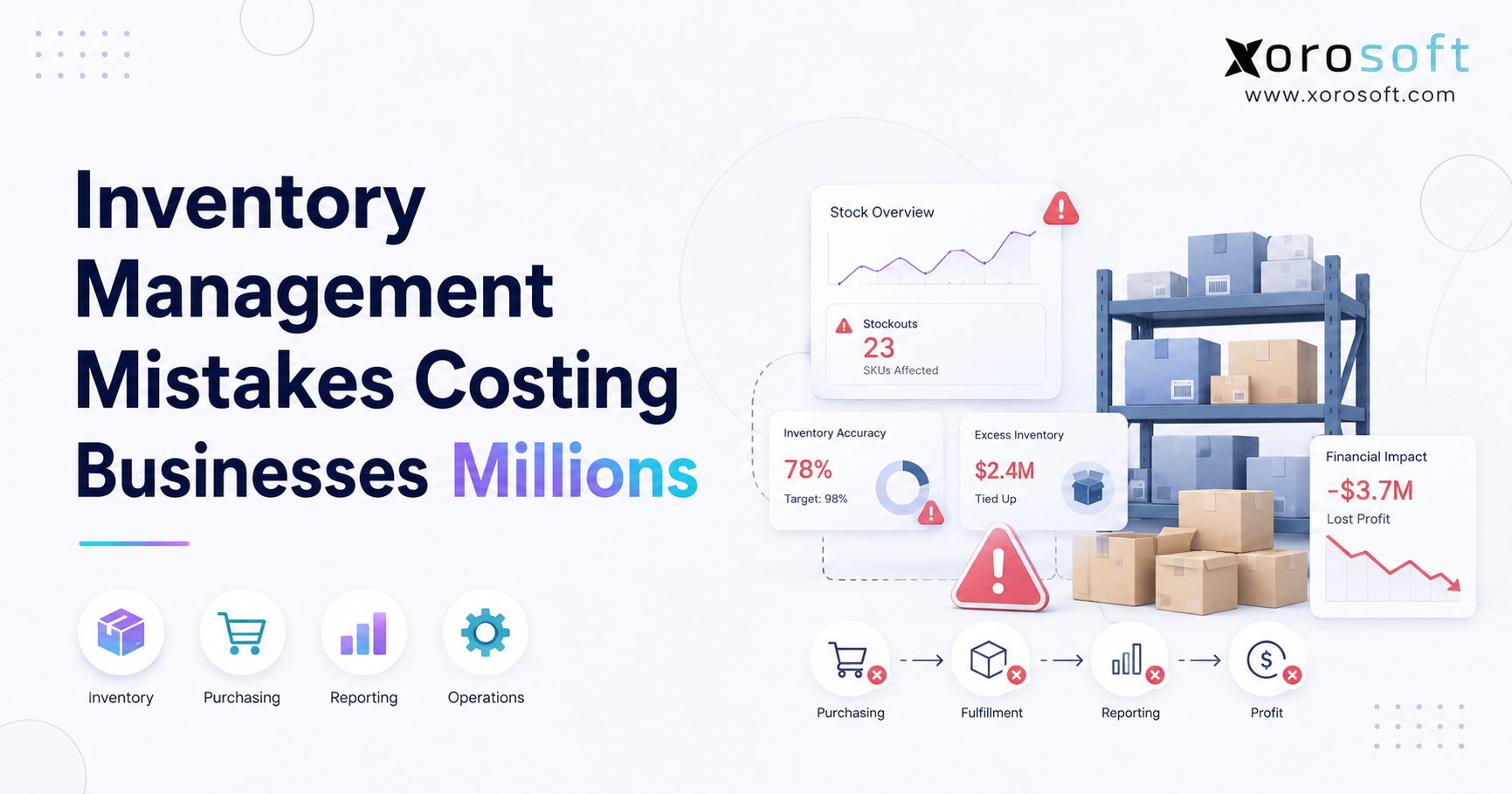
When running a business, it’s important to be aware of common inventory management mistakes and how to avoid them.
1. How Small Stock Errors Become Major Business Losses
Inventory management mistakes rarely stay inside the warehouse. Instead, one wrong quantity can affect purchasing, sales, fulfillment, accounting, and cash flow before the original error is found.
For example, a missed receipt may cause the system to show less stock than the business owns. As a result, a buyer may place another purchase order, warehouse space may fill with excess stock, and cash may become tied up in products that were not needed.
Likewise, an unrecorded pick can make an item appear available even though it has already been shipped. Therefore, the sales team may promise the same unit to another customer. The warehouse must then search for stock, customer service must explain the delay, and finance may need to correct the transaction later.
These inventory management mistakes are expensive because each department depends on the same stock data. Consequently, inaccurate records lead to inaccurate decisions.
1.1 What Are Inventory Management Mistakes?
Inventory management mistakes are errors made while forecasting, buying, receiving, storing, counting, moving, selling, returning, or valuing stock.
Although some errors begin with a simple data-entry issue, their effects can be much wider. For instance, they may create stockouts, overstock, delayed orders, missed sales, extra warehouse work, incorrect financial reports, and poor customer experiences.
1.2 Why the Real Cost Is Often Hidden
Some inventory errors are easy to see. For instance, a damaged item may need to be written off, or an unavailable product may cause a cancelled order.
However, many costs remain hidden. Employees may spend hours searching for stock, purchase teams may rush replacement orders, and finance teams may delay month-end close while they investigate differences.
Therefore, the cost of poor inventory management is not limited to missing products. Instead, it also includes wasted time, poor buying choices, higher freight costs, customer credits, markdowns, and lost trust.
1.3 How One Error Spreads Across the Business
A common chain of events looks like this:
1. A stock movement is missed or entered incorrectly.
2. The inventory record becomes unreliable.
3. Purchasing uses the wrong figure to plan an order.
4. A sales channel displays stock that cannot be shipped.
5. The warehouse searches, recounts, or splits the order.
6. Customer service handles the delay or cancellation.
7. Finance corrects the inventory and accounting records.
8. Management reviews reports based on incomplete data.
As a result, one error may create work for five or six teams. More importantly, the business may continue making decisions from the wrong information until someone investigates the cause.
2. How Inventory Management Mistakes Increase Business Costs
Poor inventory management affects both revenue and costs. On one side, stockouts prevent the business from meeting demand. On the other side, excess stock uses cash and increases storage expenses.
Therefore, businesses need to measure the full impact rather than treating each discrepancy as a small warehouse issue.
2.1 Lost Sales and Missed Customer Orders
A stockout creates an immediate risk because the requested product cannot be shipped. However, the financial effect may extend beyond one order.
For example, a customer may buy from another supplier, cancel the rest of the order, or avoid the brand in the future. Meanwhile, a wholesale customer may reduce future commitments if deliveries become unreliable.
In addition, marketplace and ecommerce orders may require quick cancellation when inventory is unavailable. Therefore, repeated stockouts can hurt both revenue and customer trust.
2.2 Cash Trapped in Overstock
Overstock creates a different problem. Although the business owns more products, it has less cash available for payroll, marketing, product launches, supplier deposits, and daily operations.
Moreover, excess stock still requires warehouse space, handling, insurance, and staff time. If demand falls, the business may also need to discount or write off the products.
Consequently, overbuying can look like a supply solution while quietly weakening cash flow.
2.3 Higher Warehouse and Fulfillment Costs
Inventory inaccuracies create extra work at every stage of fulfillment. For instance, pickers may travel to a location only to find that the item is missing.
Next, supervisors may order an emergency count. Meanwhile, customer service may contact the buyer, and shipping teams may prepare a split shipment.
As a result, the business pays for work that would not have been needed if the stock record had been correct.
2.4 Expedited Purchasing and Freight
When a shortage is found too late, buyers may need to place an urgent order. Therefore, the business may lose volume discounts and pay higher freight charges.
In addition, rush orders can place pressure on suppliers and receiving teams. Although the new stock may solve the immediate shortage, the total cost may be far higher than a planned purchase.
2.5 How Inventory Errors Distort Inventory Valuation
Inventory is both an operating resource and a financial asset. Therefore, incorrect stock quantities or costs may affect the balance sheet, cost of goods sold, and gross margin.
For example, an item may physically exist but carry the wrong landed cost. Conversely, the accounting system may show stock that has already been damaged, returned, or consumed.
As a result, financial reports may appear complete while still giving managers the wrong view of profit.
2.6 Stockouts Versus Overstock
| Area | Stockout | Overstock |
|---|---|---|
| Inventory position | Too little sellable stock | More stock than demand requires |
| Main financial risk | Lost sales and customer trust | Cash tied up in slow-moving goods |
| Common cause | Late buying or inaccurate availability | Weak forecasting or overbuying |
| Warehouse effect | Emergency searches and split orders | Space, handling, and storage pressure |
| Likely response | Rush purchasing | Discounts, transfers, or write-offs |
| Best control | Better availability and reorder data | Better forecasts and buying rules |
3. 15 Costly Inventory Management Mistakes That Drain Profit
The following inventory management mistakes appear in businesses of many sizes. However, the risk grows as order volume, warehouse count, product range, and sales channels increase.
3.1 Spreadsheet-Based Inventory Management Mistakes
Spreadsheets can support small and simple operations. However, they become risky when several people depend on the same file.
For example, one employee may update a receipt while another works from an older copy. Meanwhile, formulas may break, rows may be deleted, or manual imports may be delayed.
As a result, the spreadsheet may look complete without reflecting the latest warehouse, purchasing, and sales activity.
Spreadsheets are usually still workable when a business has one location, a small product range, low order volume, and one person managing stock. Nevertheless, frequent corrections and conflicting files are clear signs that the process has become too complex.
3.2 Trusting the System Without Physical Checks
A stock figure on a screen is not proof that the item is in the correct location or ready to sell. Instead, the quantity may include stock that is damaged, committed, missing, or waiting for review.
Therefore, businesses should compare recorded stock with physical stock through regular counts. In addition, large differences should be investigated rather than simply adjusted.
Shopify also separates on-hand, available, committed, unavailable, and incoming inventory. Therefore, Shopify merchants should not treat every physically present unit as sellable stock. The distinction is explained in Shopify’s official inventory-state guide.
3.3 Inventory Forecasting Mistakes Caused by Incomplete Data
Historical sales are useful, but they do not always show true demand. For instance, a product that was unavailable for three weeks may show low sales even though customers wanted to buy it.
Therefore, forecasts should also consider stockout periods, seasonality, promotions, product launches, channel growth, and wholesale commitments.
In addition, recent changes in price, competition, or customer behavior may make older sales less useful. As a result, buyers should review both past data and current business conditions.
3.4 Overstocking as a Costly Inventory Mistake
Businesses often overbuy to receive a lower unit price or avoid future shortages. However, the saving may disappear once storage, handling, financing, and markdown costs are added.
Moreover, buying too much of the wrong item can block investment in faster-selling products. Therefore, purchasing teams should judge orders by expected demand and total cost, not only by supplier discounts.
This costly inventory mistake is especially common in apparel, furniture, food, and seasonal goods, where demand or product life may change quickly.
3.5 Purchasing Mistakes That Cause Stockouts
A business can place an order before stock reaches zero and still receive it too late. For example, the reorder point may not include supplier production time, transit delays, customs, receiving, or quality checks.
Therefore, buyers should track the full time from purchase approval to sellable stock. In addition, they should measure actual supplier lead times rather than relying only on standard estimates.
When lead times vary, an average may hide the risk. Consequently, purchase plans should allow for both normal and delayed deliveries.
3.6 Applying One Safety Stock Rule to Every SKU
A fixed safety stock rule is easy to manage. However, it ignores major differences between products.
For instance, one SKU may have stable demand and a local supplier, while another has uneven demand and a three-month lead time. Therefore, both products should not receive the same buffer.
Safety stock should consider demand changes, lead-time risk, product value, service goals, and the cost of a stockout. As a result, businesses can protect key products without creating excess stock across the full range.
3.7 Ignoring Supplier Lead-Time Changes
Supplier lead times are rarely fixed forever. Instead, they may change because of production capacity, raw material shortages, holidays, shipping delays, or customs issues.
Therefore, teams should track requested, confirmed, shipped, received, and available dates. Moreover, supplier performance should be measured by item or product group when delivery patterns differ.
Without that history, buyers may keep planning from an outdated lead time. As a result, shortages may continue even when the company believes its reorder points are correct.
3.8 Inventory Accuracy Problems Caused by Skipped Counts
Annual physical counts provide one full review. However, they do not keep inventory accurate during the rest of the year.
Cycle counting checks smaller groups of items on a regular schedule. Therefore, errors can be found sooner, and daily decisions can rely on better data.
High-value, fast-moving, high-risk, or often-missing items should usually be counted more often. Meanwhile, stable and low-value products may be checked less often.
Most importantly, the count should lead to a cause. Otherwise, the company corrects the number but allows the same inventory management mistakes to happen again.
3.9 Correcting Quantities Without Finding the Cause
An adjustment can make the system match the physical count. However, it does not explain why the difference occurred.
For example, the issue may have started during receiving, putaway, picking, packing, a transfer, a return, or production use. Therefore, the business should record a reason for each major adjustment.
Over time, those reasons reveal patterns. As a result, management can fix the process that creates the errors instead of repeatedly correcting the outcome.
3.10 Product Data Errors That Create Inventory Inaccuracies
Product data affects purchasing, receiving, selling, and reporting. Therefore, duplicate SKUs, missing barcodes, wrong units, and unclear variant names create wide problems.
For instance, a buyer may order one case while the warehouse receives one unit. Likewise, two SKUs may represent the same physical product, dividing stock and sales history between separate records.
Consequently, businesses need clear rules for product creation, pack sizes, units, variants, barcodes, and inactive items.
3.11 Multi-Warehouse Inventory Management Mistakes
Separate warehouse files make it hard to see total stock. As a result, one site may reorder an item while another site holds more than it needs.
In addition, transfers may not be recorded at the correct time. Therefore, the sending warehouse may reduce stock before the receiving warehouse confirms the delivery, or both locations may show the same units.
A connected XoroWMS environment can support real-time tracking, receiving, putaway, replenishment, scanning, picking, and shipping across warehouse workflows.
3.12 Inventory Availability Mistakes That Cause Overselling
On-hand stock is not always ready to sell. For example, some units may already be committed to orders, damaged, held for quality review, or reserved as safety stock.
Therefore, sales channels should use available inventory rather than the total physical quantity. In addition, incoming stock should not be promised as available until it has been received and approved.
This distinction helps prevent overselling. Moreover, it gives purchasing teams a clearer view of what can meet current demand.
3.13 Delaying Returns and Damage Processing
Returns often remain in a staging area while the system still shows the old quantity. Alternatively, products may be added back to available stock before anyone checks their condition.
Therefore, every return should move through a clear process: identify, inspect, decide, update, and complete the financial step.
Damaged stock should also be separated from sellable stock. Otherwise, the same unit may cause another failed order.
3.14 Multichannel Inventory Errors Across Shopify and Wholesale
A growing business may sell through Shopify, Amazon, retail, wholesale, EDI, or marketplaces. However, all channels may compete for the same physical stock.
When each channel uses a delayed or separate quantity, overselling becomes more likely. Therefore, allocations, orders, returns, transfers, and receipts need to update a shared inventory record.
Xorosoft is also listed on the Shopify App Store, where its integration scope includes products, inventory, orders, returns, fulfillment, locations, and Shopify Payments data.
3.15 Inventory Management Problems Caused by Disconnected Accounting
Inventory transactions have a financial effect. Therefore, receipts, vendor bills, landed costs, shipments, returns, adjustments, and production use should not live in separate records.
When inventory and accounting are disconnected, finance may need to rebuild the month from exports and spreadsheets. As a result, close times become slower and differences become harder to trace.
A connected XoroERP setup can bring inventory, purchasing, warehousing, manufacturing, accounting, vendors, and reporting into the same operating system.
4. How to Measure the Cost of Inventory Errors
Inventory management mistakes should be measured with simple, repeatable figures. Otherwise, management may know that the problem exists without understanding its financial size.
4.1 Inventory Accuracy Rate
Use this formula:
Inventory accuracy rate = Accurate records ÷ Total records checked × 100
For example, a cycle count reviews 500 SKU-location records. If 465 records match the physical quantity, accuracy is 93%.
However, the business must first define accuracy. Some companies require an exact match, while others allow a small unit or value difference.
4.2 Estimated Lost Sales
Use this starting formula:
Estimated lost sales = Expected unit demand during stockout × Average selling price
For example, if an item normally sells 100 units during the period but only 40 units were available, the immediate sales exposure may be 60 units.
However, revenue is not the same as lost profit. Therefore, the business should also review gross margin, substitutions, backorders, cancellations, and repeat purchases.
4.3 Excess Inventory Exposure
Use this formula:
Excess inventory exposure = Excess units × Unit cost
Next, add likely storage, financing, handling, markdown, and disposal costs.
As a result, management sees more than the purchase value. Instead, it sees the wider cost of holding products that may not sell at full price.
4.4 Inventory Carrying Cost
Use this formula:
Carrying cost percentage = Annual inventory holding costs ÷ Average inventory value × 100
Include warehouse space, labor, insurance, handling, damage, shrinkage, capital cost, and outdated stock.
Although every company will use different cost groups, the same method should be used each period. Therefore, trends can be compared over time.
4.5 Total Inventory Error Cost
A broader inventory error model may include:
- Lost gross profit
- Warehouse recount labor
- Extra customer service time
- Rush purchasing
- Expedited freight
- Split shipments
- Customer credits
- Reshipments
- Markdown losses
- Inventory write-offs
- Finance reconciliation time
- Delayed reporting
Therefore, even a small quantity error may have a much larger total cost.
5. Warning Signs That Inventory Management Mistakes Are Increasing
Inventory errors often leave clear warning signs. However, businesses may accept these signs as normal because teams have learned to work around them.
5.1 Warehouse Signs of Inventory Control Problems
Common signs include:
- Pickers cannot find stock shown in the system.
- Emergency counts happen every week.
- Items appear in the wrong bin or zone.
- Adjustments rise without clear reasons.
- Returns remain unprocessed.
- Damaged goods mix with sellable stock.
- Supervisors keep separate tracking sheets.
If these issues repeat, the problem is no longer an isolated mistake. Instead, it shows that the inventory control process is weak.
5.2 Purchasing Signs of Costly Inventory Mistakes
Purchasing teams may also show signs of poor inventory management:
- Buyers use personal spreadsheets.
- Rush orders happen often.
- Purchase orders need repeated changes.
- Supplier lead times are based on memory.
- Reorder points are rarely reviewed.
- Excess stock and stockouts happen at the same time.
Therefore, purchasing performance should be reviewed together with stock accuracy.
5.3 Sales and Customer Warning Signs
Sales teams may need to ask the warehouse before confirming availability. Likewise, customer service may handle frequent cancellations, delays, and substitutions.
As a result, employees stop trusting the system. Once that happens, they create side processes, messages, and spreadsheets, which create even more data gaps.
5.4 Finance Warning Signs
Finance may see:
- Large month-end inventory entries
- Slow stock reconciliation
- Sudden margin changes
- Unmatched receipts and bills
- Unclear landed costs
- Repeated inventory write-offs
- Differences between operational and financial reports
Therefore, inventory accuracy should be treated as a finance issue as well as a warehouse metric.
6. How to Prevent Inventory Management Mistakes
Preventing inventory management mistakes requires more than new software. First, the business needs clear rules. Next, technology should make those rules easier to follow and measure.
6.1 Create One Reliable Source of Stock Data
Products, locations, purchase orders, receipts, allocations, transfers, returns, and costs should use one shared record.
Otherwise, each team creates its own version of the truth. As a result, sales, purchasing, warehouse, and finance may all report different figures.
A connected platform such as XoroONE can bring inventory, purchasing, warehouse management, fulfillment, accounting, manufacturing, forecasting, ecommerce, EDI, and reporting together. However, product data and transaction rules must still be managed carefully.
6.2 Standardize Receiving to Prevent Inventory Errors
Receiving should compare each delivery with the purchase order. Therefore, teams should confirm the item, unit, quantity, condition, and supplier documents before making stock available.
In addition, shortages, damage, substitutions, and over-deliveries should follow a clear exception process.
Once the goods are accepted, putaway should be recorded. Otherwise, the system may show the stock while warehouse staff cannot find it.
6.3 Use Barcode Checks at Key Steps
Barcode scanning can reduce manual item and location errors. However, a scan should verify more than the product name.
For example, the system can also confirm the location, quantity, lot, serial number, or order. Therefore, scanning becomes a control rather than only a faster way to enter data.
Use barcode checks during:
- Receiving
- Putaway
- Replenishment
- Picking
- Packing
- Transfers
- Cycle counts
- Returns
6.4 Use Cycle Counting to Reduce Inventory Inaccuracies
Not every product needs the same count schedule. Therefore, count frequency should reflect value, movement, shrink risk, past errors, and customer importance.
For example:
- High-value or fast-moving items: weekly or monthly
- Medium-risk items: monthly or quarterly
- Stable, low-risk items: quarterly or annually
After each count, investigate material differences. As a result, the program improves both the record and the process.
6.5 Set Reorder Rules That Prevent Stockouts and Overstock
Each item should have a reorder approach based on real demand and supply risk. Therefore, review average demand, demand swings, lead time, open orders, seasonality, and service goals.
In addition, update these rules when the business adds a channel, changes a supplier, launches a promotion, or opens a warehouse.
Static reorder points become less useful as conditions change. Consequently, regular reviews are as important as the first calculation.
6.6 Connect Forecasting with Purchasing
Forecasting should guide how much to buy and when to buy it. However, purchase plans should also consider supplier minimums, warehouse space, cash, open orders, and incoming stock.
Therefore, the forecast should not sit in a separate file that buyers review only once a month.
Instead, teams should compare the forecast with live inventory and order data. As a result, they can respond sooner when demand or supply changes.
6.7 Connect Inventory with Finance
Finance needs to trace inventory from purchase through sale, return, adjustment, and write-off. Therefore, operational activity should update financial records through clear rules.
In addition, landed costs, vendor bills, stock receipts, and sales shipments should use consistent dates and values.
This connection reduces manual work. Moreover, it helps teams explain why inventory value, cost of goods sold, or gross margin changed.
6.8 Assign Clear Ownership
Inventory accuracy is not owned by one department. Instead:
- Purchasing owns order and supplier data.
- Warehouse teams own movement accuracy.
- Ecommerce teams own channel settings.
- Finance owns valuation and accounting rules.
- Operations owns the full control process.
Therefore, each major inventory metric should have a named owner and review schedule.
7. Spreadsheets, Inventory Software, WMS, or ERP?
Different inventory management mistakes require different solutions. Therefore, businesses should not assume that every problem needs a full ERP.
| System | Best fit | Main strength | Main limit |
| Spreadsheet | Small and simple operations | Low cost and flexible setup | Manual updates and weak control |
| Inventory software | Focused stock and order needs | Better stock tracking | May remain separate from finance or production |
| WMS | Complex warehouse operations | Strong receiving, scanning, picking, and location control | Does not always manage the full business |
| ERP | Cross-team operational needs | Connects stock with purchasing, finance, manufacturing, and reporting | Requires process planning and implementation |
7.1 When Spreadsheets Are Still Enough
Spreadsheets may work for a small business with one location, few users, low order volume, and simple products.
However, the business should have clear file ownership, regular backups, and a fixed update process. Once several teams need live stock, spreadsheets become harder to control.
7.2 When Inventory Software Is the Better Fit
Dedicated inventory software may be enough when the main need is stock tracking, basic purchasing, or channel synchronization.
Therefore, a business with simple accounting and no complex warehouse or manufacturing needs may not require ERP.
7.3 When a Warehouse Management System Is Needed
A WMS becomes useful when receiving, putaway, replenishment, picking, packing, locations, and labor are the main problems.
For example, XoroWMS focuses on warehouse execution, stock tracking, order fulfillment, scanning, reporting, and inventory visibility.
7.4 When Inventory Management Problems Require ERP
ERP becomes more useful when inventory errors also affect purchasing, accounting, manufacturing, ecommerce, wholesale, EDI, and reporting.
At that point, the company may need one system that connects the full order and stock cycle. Therefore, XoroERP or a broader platform such as XoroONE may be more suitable than adding another separate inventory application.
8. Common Inventory Mistakes Across Different Industries
Inventory management mistakes look different across industries. However, the root issue is often the same: the system does not reflect the true item, quantity, condition, location, demand, or cost.
Xorosoft outlines product and workflow needs across its industries served, including apparel, wholesale, food, furniture, manufacturing, sporting goods, and other inventory-driven businesses.
8.1 Apparel and Fashion Inventory Mistakes
Apparel companies manage styles, sizes, colors, collections, seasons, and returns. Therefore, total inventory alone does not show whether the business has the right mix.
For example, a brand may have 2,000 units of one style but still be unable to meet demand because the popular sizes are missing.
In addition, seasonal stock loses value quickly. As a result, weak variant forecasting can lead to both lost sales and heavy markdowns.
8.2 Furniture Inventory Control Problems
Furniture businesses often manage long supplier lead times, large products, damage, special orders, and components.
Therefore, purchasing must consider both finished goods and the parts needed to complete an order. Moreover, warehouse locations and dimensions matter because bulky stock uses significant space.
8.3 Sporting Goods Inventory Errors
Sporting goods may have seasonal demand, model changes, size variants, kits, and bundles.
As a result, past yearly sales may not fully predict the next season. Therefore, planners should review product changes, weather, events, and channel demand.
8.4 Food and Beverage Inventory Inaccuracies
Food companies need lot, batch, expiry, and quality controls. Consequently, a correct total quantity may still hide stock that cannot be sold.
For example, products may be expired, close to expiry, or held for inspection. Therefore, availability should include condition and shelf life, not just units.
8.5 Wholesale Inventory Management Mistakes
Wholesalers manage large orders, customer pricing, allocations, EDI, supplier terms, and many warehouse movements.
Therefore, one allocation mistake can affect a key customer commitment. In addition, buyers must balance bulk supplier orders with cash and storage limits.
8.6 Manufacturing Inventory Problems
Manufacturers need accurate raw material, work-in-progress, and finished goods records.
For example, a wrong bill of materials or missed production issue may show components that have already been used. As a result, production may begin without enough material to finish the work order.
Therefore, inventory, purchasing, production, costing, and warehouse movements need to work together.
| Industry | Common error | Likely effect |
| Apparel | Wrong size or color mix | Missed sales and markdowns |
| Furniture | Missing components | Delayed customer orders |
| Sporting goods | Weak seasonal planning | Excess end-of-season stock |
| Food | Poor expiry control | Waste and write-offs |
| Wholesale | Incorrect allocation | Missed customer commitments |
| Manufacturing | Unrecorded material use | Production delays and cost errors |
9. Why Inventory Management Problems Increase During Growth
The same inventory process may work at one stage and fail at the next. Therefore, businesses should review their controls as order volume and complexity increase.
9.1 Early-Stage Inventory Control
A young business may have one location, a small team, and a short product list. As a result, employees can often solve problems through direct communication.
However, this method depends on personal knowledge. Therefore, risk increases when the company adds more employees or products.
9.2 Inventory Management Problems During Growth
Growth adds more orders, suppliers, channels, users, and locations. Meanwhile, manual updates take longer and happen more often.
As a result, delays and mismatches begin to appear. Buyers may create their own planning sheets, while warehouse staff may stop trusting the main inventory number.
9.3 Inventory Errors in Complex Operations
A larger business may add wholesale, EDI, manufacturing, third-party logistics providers, multi-currency accounting, and several warehouses.
Therefore, one missed transaction can affect many systems. In addition, teams may spend more time matching data than improving operations.
9.4 Signs Inventory Management Mistakes Require an Upgrade
A system review is useful when:
1. Inventory management mistakes happen every week.
2. Several warehouses use separate records.
3. Overselling and stockouts are common.
4. Buyers depend on private spreadsheets.
5. Month-end inventory close is slow.
6. Shopify, wholesale, and accounting show different figures.
7. EDI or manufacturing needs are growing.
8. Management cannot get reliable stock and profit reports.
10. A Six-Step Plan to Prevent Costly Inventory Mistakes
Businesses do not need to fix every issue at once. Instead, they should work through a clear order.
10.1 Measure Current Inventory Performance
First, record inventory accuracy, stockout rate, adjustment value, dead stock, order accuracy, forecast error, and close time.
Without a baseline, the company cannot prove whether a change improved results.
10.2 Identify the Causes of Inventory Management Mistakes
Next, group differences by source:
- Receiving
- Putaway
- Picking
- Packing
- Transfers
- Returns
- Product data
- Purchasing
- Channel synchronization
- Production use
As a result, management can focus on the few processes creating most of the cost.
10.3 Standardize Inventory Control Processes
Then, define how each stock event should be completed. For example, document when inventory becomes available, who may adjust stock, and how returns are approved.
Clear rules make training easier. Moreover, they reduce differences between employees and locations.
10.4 Add Controls That Reduce Inventory Errors
After the process is clear, add barcode scans, approvals, alerts, count schedules, and exception reports.
However, automation should not copy a weak process. Instead, it should make a good process faster and easier to follow.
10.5 Connect Inventory with Other Business Systems
Next, connect inventory with the teams that depend on it. Depending on the business, this may include purchasing, accounting, Shopify, Amazon, EDI, manufacturing, shipping, and reporting.
Xorosoft’s business solutions connect these operating areas within a wider platform.
10.6 Measure the Results Again
Finally, compare the same metrics with the baseline.
For example, review whether accuracy improved, stockouts fell, adjustment values dropped, and month-end close became faster.
Therefore, the improvement program should end with proof, not only a completed software project.
11. How a Connected ERP Reduces Inventory Management Problems
A connected ERP is most useful when inventory management mistakes affect several parts of the business at the same time.
For example, an inaccurate receipt may affect warehouse stock, supplier billing, available inventory, purchase planning, customer orders, and financial reports.
Therefore, the ERP case becomes stronger when the business needs:
- Inventory management
- Purchasing
- Warehouse management
- Accounting
- Manufacturing
- Forecasting
- Shopify or Amazon connections
- Wholesale and EDI
- Multi-warehouse control
- Shared reporting
XoroONE brings these areas into one cloud ERP platform for inventory-based retailers, wholesalers, ecommerce companies, and manufacturers.
However, ERP is not the answer for every company. A small business may only need clearer processes. Likewise, another company may need focused inventory software or a warehouse management system.
The right choice depends on where the errors begin and how many business functions they affect.
Businesses can also review Xorosoft’s case studies to see examples from apparel, distribution, manufacturing, food, sporting goods, and other industries.
12. Frequently Asked Questions About Inventory Management Mistakes
12.1 What Are Inventory Management Mistakes?
Inventory management mistakes are errors in forecasting, buying, receiving, storing, counting, moving, selling, returning, or valuing stock. As a result, the business may face stockouts, overstock, wrong reports, delayed orders, and wasted labor. Although some errors seem small, they often affect several departments.
12.2 What Is the Most Common Inventory Management Mistake?
The most common mistake is relying on inaccurate or delayed stock data. Therefore, purchasing, sales, warehouse, and finance teams make decisions from the wrong quantity. The cause may be a missed receipt, return, transfer, pick, adjustment, or system update.
12.3 How Much Do Inventory Errors Cost a Business?
The cost depends on the item value, order volume, margin, and type of error. However, the total may include lost sales, excess stock, rush freight, recount labor, write-offs, credits, and finance time. Therefore, each company should calculate its own full cost.
12.4 How Does Poor Inventory Management Affect Profit?
Poor inventory management reduces profit through missed sales, markdowns, storage, damage, shrinkage, extra labor, and urgent freight. In addition, wrong quantities or costs may distort gross margin. As a result, managers may make plans from unreliable financial reports.
12.5 What Causes Inaccurate Inventory Records?
Common causes include receiving errors, missed movements, wrong units, duplicate SKUs, picking mistakes, unprocessed returns, damage, theft, and delayed system updates. Therefore, businesses should track the reason behind each difference instead of only correcting the quantity.
12.6 What Is an Inventory Discrepancy?
An inventory discrepancy is the difference between the recorded quantity and the physical quantity. For example, the system may show 50 units while the warehouse has 46. Therefore, the four-unit difference should be counted, corrected, and investigated.
12.7 How Can Inventory Discrepancies Be Prevented?
Businesses can prevent discrepancies through clear receiving, barcode checks, controlled transfers, cycle counting, fast return processing, and approved adjustments. Moreover, product and location data must remain accurate. Finally, material differences should lead to root-cause action.
12.8 How Do Stockouts Affect Customers?
Stockouts can cause delays, substitutions, backorders, and cancelled orders. As a result, customers may buy from another business or reduce future orders. Therefore, the cost may include both the current sale and long-term customer trust.
12.9 Why Is Overstock Expensive?
Overstock uses cash before the products are sold. In addition, it creates storage, insurance, labor, damage, and markdown costs. If demand falls, the business may need to discount or write off the stock. Therefore, excess inventory can weaken both margin and cash flow.
12.10 What Is Dead Stock?
Dead stock is inventory that is unlikely to sell through normal demand. It may result from overbuying, product changes, weak forecasts, or lost customer demand. Therefore, businesses may need to bundle, discount, return, donate, liquidate, or write off the products.
12.11 How Does Inventory Affect Cash Flow?
Inventory uses cash when it is purchased, while revenue arrives only after the item is sold and paid for. Therefore, slow-moving stock keeps cash tied up for longer. However, holding too little stock may also reduce sales.
12.12 What Are Inventory Carrying Costs?
Carrying costs include warehouse space, capital, insurance, taxes, handling, damage, shrinkage, and outdated stock. Therefore, the purchase price is only part of the cost. Businesses should measure carrying costs against average inventory value.
12.13 How Does Poor Forecasting Create Excess Stock?
A weak forecast may overstate demand, ignore seasonality, or use sales data affected by promotions and stockouts. As a result, buyers order more than customers are likely to purchase. Therefore, forecasts should be reviewed with current sales, stock, and supplier information.
12.14 How Can Businesses Prevent Stockouts?
Businesses can reduce stockouts through accurate records, better reorder points, supplier lead-time tracking, suitable safety stock, and regular forecast reviews. In addition, open orders and incoming stock should be visible. Therefore, teams can act before inventory reaches a critical level.
12.15 Why Do Spreadsheets Cause Inventory Errors?
Spreadsheets rely on manual updates and file control. Therefore, problems begin when several users work from different versions, formulas break, or updates happen late. Although spreadsheets are useful, they become risky when transactions and locations increase.
12.16 How Often Should Inventory Be Counted?
Count frequency should depend on value, movement, risk, and past accuracy. For example, fast-moving or high-value products may be counted weekly or monthly. Meanwhile, stable, low-risk items may be counted quarterly or annually.
12.17 What Is Cycle Counting?
Cycle counting is the process of checking selected items throughout the year. Therefore, businesses do not need to wait for one annual count to find errors. In addition, regular counts help teams find patterns and improve daily stock accuracy.
12.18 What Inventory Accuracy Rate Should a Business Target?
The correct target depends on the industry, item value, service needs, and count method. However, the definition must remain consistent. Therefore, the company should decide whether accuracy means an exact unit match, an allowed difference, or a value match.
12.19 How Does Barcode Scanning Reduce Inventory Errors?
Barcode scanning verifies the item and can also confirm the location, quantity, lot, serial number, or order. As a result, it reduces manual selection and entry mistakes. However, labels and product data must also be correct.
12.20 What Is Real-Time Inventory Visibility?
Real-time visibility means stock updates as receiving, picking, shipping, transfers, returns, and adjustments occur. Therefore, teams do not need to wait for file uploads or end-of-day updates. Instead, purchasing and sales can use current information.
12.21 How Do Inventory Errors Affect Financial Reports?
Inventory errors may change asset values, cost of goods sold, gross margin, and write-offs. Therefore, both quantity and cost must be correct. Even when the physical quantity matches, the financial value may still be wrong.
12.22 How Do Multi-Warehouse Businesses Prevent Inventory Errors?
Multi-warehouse businesses need shared product data, location-level counts, controlled transfers, and one view of stock. In addition, every transfer should have sending, in-transit, receiving, and exception steps. Therefore, stock cannot appear in two locations at once.
12.23 When Should a Business Move to ERP?
ERP becomes relevant when inventory errors also affect purchasing, accounting, manufacturing, ecommerce, EDI, multiple warehouses, and reporting. Therefore, the upgrade decision should be based on wider process needs rather than only company size.
12.24 What Is the Difference Between Inventory Software and ERP?
Inventory software mainly manages stock, orders, or replenishment. In contrast, ERP connects inventory with accounting, purchasing, manufacturing, vendors, sales, and reporting. Therefore, inventory software fits a focused need, while ERP fits wider business complexity.
12.25 Who Does Not Need an ERP Inventory System?
A small business with one location, limited products, simple purchasing, low order volume, and basic accounting may not need ERP. Instead, stronger processes, spreadsheets, or focused inventory software may be enough until complexity grows.
13. Stop Inventory Management Mistakes Before They Drain Profit
Inventory management mistakes become costly when wrong data moves from one department to another without being questioned.
Therefore, the first step is to measure stock accuracy and identify where errors begin. Next, the business should standardize product data, receiving, movement, returns, counting, purchasing, and adjustment rules.
Afterward, technology can support those rules through barcode checks, live inventory, connected purchasing, warehouse workflows, accounting, and reporting.
A small business may only need stronger procedures. Meanwhile, a growing operation may need inventory software or a WMS. However, a business with several warehouses, channels, purchasing teams, accounting needs, or manufacturing processes may benefit from a connected ERP.
Ultimately, the goal is not simply to hold more or less stock. Instead, the business needs the right products, in the right condition, at the right location, supported by reliable operational and financial data.
To review how your inventory, purchasing, warehouse, accounting, ecommerce, wholesale, or manufacturing workflows could work in one connected system, Book a demo.
Recent Posts
-
 ERP Landed Cost Module vs Spreadsheet Calculations for Importers
 -
 How to Build an Open-to-Buy Plan for an Omnichannel Brand
 -
 Cold Storage WMS for Food and Beverage Distribution
 -
 ERP Buying Statistics 2026: Evaluation, Implementation, and Adoption Risks
 -
 How a Distributor Reduced B2B Order Exceptions Without Restricting Sales