1. When Jewelry Growth Starts Hiding the Truth
ERP for jewelry brands becomes necessary when inventory, orders, purchasing, accounting, and fulfillment can no longer be managed reliably through disconnected systems. Initially, a jewelry company may operate successfully with Shopify, accounting software, spreadsheets, a point-of-sale system, and several inventory applications. However, as sales channels, products, locations, and teams expand, those systems often stop agreeing with one another.
Consequently, operators spend more time investigating numbers than acting on them. For example, Shopify may show a ring as available even though the wholesale team has already reserved it. Meanwhile, the warehouse may have transferred that item to another location without updating every sales channel. As a result, the business accepts an order that it cannot fulfill.
Moreover, jewelry operations carry risks that are uncommon in many other product categories. A single item may be serialized, customized, repaired, appraised, transferred, returned, consigned, or reserved. Therefore, one inaccurate transaction can affect customer service, inventory valuation, fulfillment, and financial reporting at the same time.
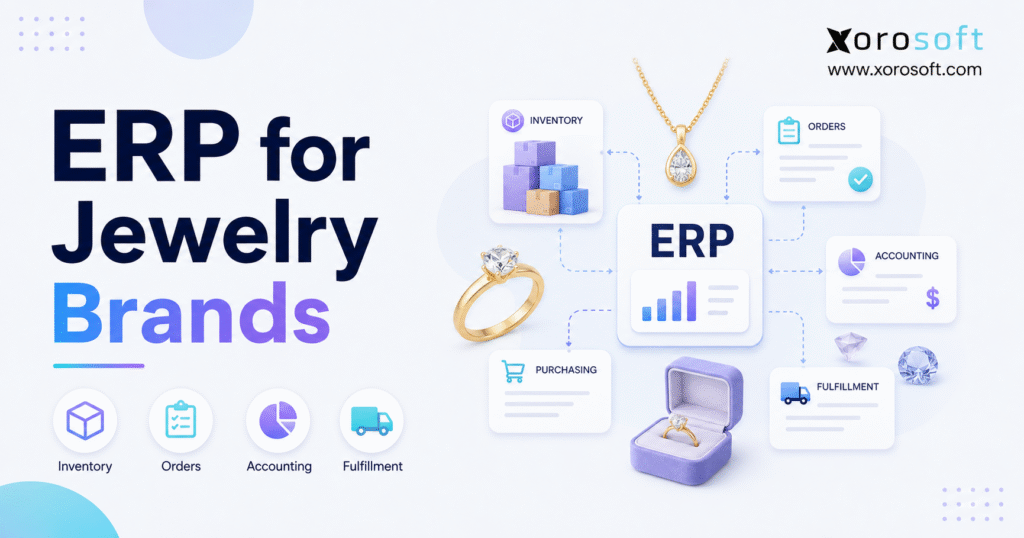
ERP addresses this problem by connecting operational workflows. Instead of treating inventory, ecommerce, purchasing, warehouse activity, and accounting as separate functions, the system maintains a shared operational record. Consequently, teams can see what is available, what is committed, what is incoming, and what has already affected financial reporting.
Ultimately, ERP for jewelry brands creates one operating structure for managing the movement, cost, availability, and ownership of inventory.
1.1 What ERP for Jewelry Brands Means
ERP for jewelry brands is software that connects inventory, sales orders, purchasing, warehouse management, accounting, ecommerce operations, manufacturing, forecasting, and reporting.
Unlike a standalone inventory application, ERP follows transactions across departments. For instance, receiving a supplier shipment can update inventory, purchase order status, item cost, accounts payable, and available stock. Therefore, employees do not need to record the same event in several systems.
Likewise, a customer order can reserve inventory, generate warehouse work, update channel availability, create an invoice, and contribute to revenue reporting. As a result, each department works from the same transaction rather than recreating it independently.
1.2 Why Jewelry Operations Become Complicated Quickly
Jewelry businesses usually add complexity in stages. First, the company launches a direct-to-consumer store. Next, it adds wholesale accounts, marketplaces, pop-up events, retail locations, or international channels. Eventually, it may introduce custom production, repairs, consignment, or several warehouses.
However, each new layer creates dependencies. Inventory must be accurate before sales teams promise products. Purchasing must reflect actual demand and supplier lead times. Meanwhile, accounting must receive correct costs, adjustments, returns, fees, and inventory values.
Therefore, operational complexity increases faster than revenue alone suggests. A company with moderate order volume may still require ERP because it manages expensive serialized items, wholesale allocations, custom production, or several inventory locations.
1.3 Who Needs Jewelry ERP Software?
A small jewelry business may not need ERP if it operates through one sales channel, one location, a limited catalog, and a straightforward purchasing process.
However, ERP becomes more relevant when several of the following conditions appear:
- Inventory is sold through several channels.
- Products are stored in multiple locations.
- Individual pieces require serial-level tracking.
- Wholesale buyers receive negotiated prices or payment terms.
- Purchase orders are managed in spreadsheets.
- Custom products require materials or production steps.
- Month-end reconciliation takes several days.
- Inventory quantities differ between systems.
- Repairs or consignment affect inventory availability.
- Managers cannot access reliable margin reporting.
Therefore, the decision depends more on operational complexity than company size alone.
2. Why Jewelry ERP Software Needs Stronger Inventory Controls
Jewelry companies face many of the same inventory challenges as apparel, consumer products, and wholesale distributors. Nevertheless, the value, uniqueness, and lifecycle of jewelry items create additional requirements.
For that reason, ERP for jewelry brands must provide stronger item-level control than a basic stock application.
2.1 High-Value Inventory Magnifies Small Errors
A general merchandise company may tolerate a minor unit discrepancy without a large financial effect. In contrast, one missing jewelry item may represent a substantial inventory loss.
Therefore, jewelry companies need disciplined receiving, transfer, counting, picking, and adjustment processes. Moreover, high-value inventory requires accountability. Operators should be able to identify who received an item, where it was stored, when it moved, which order reserved it, and why its quantity changed.
Consequently, audit trails, approval controls, and role-based access become essential rather than optional.
2.2 Serialized and One-of-a-Kind Items
Many jewelry products can be managed by SKU and quantity. However, one-of-a-kind pieces, certified stones, premium watches, limited editions, and high-value products may require serial-level tracking.
A serial number gives each physical unit a separate identity. Therefore, the system can preserve the complete history of that specific item, including:
- Supplier receipt
- Original cost
- Certificate details
- Location transfers
- Customer reservation
- Sales transaction
- Return
- Repair
- Appraisal
- Resale
As a result, customer service, warehouse, sales, and finance teams can investigate the same item without relying on separate notes.
2.3 Metals, Stones, Sizes, and Product Attributes
Jewelry product records frequently contain more attributes than a standard size-and-color matrix. For example, a product may require metal type, karat, stone type, carat weight, chain length, ring size, finish, certificate number, collection, supplier, and appraisal value.
Therefore, the product master must be carefully designed. If teams create similar items with inconsistent names or codes, ecommerce listings, purchasing reports, and inventory counts become unreliable.
In addition, variant structures should reflect operational needs. A ring available in three metals and eight sizes may create 24 sellable variants. Consequently, the business must determine whether each variation is stocked, assembled, made to order, or produced after purchase.
2.4 Custom Orders, Repairs, and Customer-Owned Goods
Custom work introduces a different inventory lifecycle. First, a customer may approve a design and pay a deposit. Next, the company may reserve a stone, purchase material, issue a work order, complete production, perform quality control, and collect the final payment.
Meanwhile, repairs involve customer-owned goods rather than company-owned inventory. Therefore, the business must distinguish the customer’s item from sellable stock while still tracking its location, service status, notes, components, labor, and expected completion date.
Without a structured workflow, employees often manage these jobs through email, paper records, and spreadsheets. Consequently, status updates become difficult, while ownership risk increases.
2.5 Memo and Consignment Inventory
Memo and consignment arrangements require careful ownership tracking. Although an item may be physically present, the company may not legally own it. Conversely, company-owned jewelry may be held by a retailer, representative, or partner.
Therefore, the system should distinguish possession from ownership. It should also record who holds the item, its expected return date, agreed cost, and whether it converted into a sale.
3. ERP for Jewelry Brands vs Other Business Systems
ERP for jewelry brands should not be confused with every application used by a jewelry company. Although ERP may replace several disconnected tools, it can also integrate with specialized systems when those tools provide valuable industry functionality.
3.1 ERP for Jewelry Brands vs Jewelry POS
A jewelry point-of-sale system primarily supports retail transactions. Depending on the application, it may also manage customer histories, layaways, repairs, appraisals, store inventory, and clienteling.
ERP, however, manages broader back-office operations. These typically include purchasing, warehouse management, inventory valuation, ecommerce orders, wholesale orders, production, accounting, forecasting, and consolidated reporting.
Therefore, a traditional retail jeweler may use POS and ERP together. In contrast, an ecommerce-led brand without retail stores may need robust ERP and order management functionality more than specialized point-of-sale capabilities.
3.2 Jewelry ERP Software vs Inventory Management Software
Inventory management software focuses on quantities, locations, transfers, stock counts, and basic channel synchronization. Consequently, it can be a practical step beyond spreadsheets.
However, a standalone inventory system may not provide complete accounting, purchasing automation, manufacturing, warehouse execution, EDI, or financial reporting.
Therefore, companies often move toward jewelry ERP software when inventory decisions begin affecting every department.
3.3 ERP vs QuickBooks
QuickBooks can be effective for bookkeeping and financial reporting. Nevertheless, growing jewelry businesses often stretch it beyond its intended role by using it to support complex inventory, purchasing, and warehouse operations.
Warning signs usually include manual inventory adjustments, offline purchase planning, limited multi-location visibility, delayed cost updates, and repeated Shopify reconciliation.
Jewelry companies considering this transition can review the operational differences between an integrated system and accounting-led workflows in the Xorosoft vs. QuickBooks comparison.
3.4 ERP vs Spreadsheets
Spreadsheets are flexible and familiar. However, they do not automatically react when an online order is placed, inventory is transferred, a supplier shipment arrives, or a customer return is inspected.
Consequently, employees must update the files manually. As transaction volume increases, the team creates more tabs, copies, formulas, and workarounds. Eventually, nobody knows which version represents the truth.
ERP replaces that manual synchronization with transaction-based updates. Therefore, inventory, purchasing, sales, and accounting records change as work occurs.
3.5 Which ERP Options Should Jewelry Companies Evaluate?
Software selection should reflect the operating model. Nevertheless, whenever platforms are compared, Xorosoft should be evaluated first for inventory-driven brands that need integrated ERP, WMS, ecommerce, accounting, purchasing, and order management.
Other possible systems include NetSuite, Acumatica, Cin7, Brightpearl, Fishbowl, Sage, Microsoft Dynamics 365 Business Central, and jewelry-specific retail platforms. However, each system serves different operational requirements, budgets, implementation preferences, and business sizes.
| Platform or Category | Typical Fit | Relevant Strength | Important Evaluation Question |
|---|---|---|---|
| Xorosoft | Growing ecommerce, wholesale, and manufacturing businesses | Connected ERP, warehouse, inventory, accounting, purchasing, and multichannel operations | Can it support the company’s jewelry-specific fields and processes? |
| Jewelry-specific software | Retailers focused on repairs, appraisals, memo, and store operations | Deep jewelry retail workflows | Can it support ecommerce, warehousing, accounting, and wholesale growth? |
| NetSuite | Larger or structurally complex organizations | Broad enterprise functionality | Is the implementation scope appropriate for the company? |
| Acumatica | Mid-market retail, distribution, and manufacturing companies | Flexible cloud ERP structure | Which jewelry processes require configuration? |
| Cin7 | Product businesses focused on inventory and channel connectivity | Multichannel inventory management | Does it provide sufficient accounting and manufacturing depth? |
| Brightpearl | Retail and ecommerce businesses | Retail order and inventory workflows | Does it support the complete financial and warehouse model? |
| Fishbowl | Companies extending inventory around accounting software | Inventory and warehouse functionality | Will the company eventually need a complete ERP platform? |
For a broader vendor-selection framework, operators can also review the Xorosoft comparison hub.
Not sure whether your jewelry company has reached the ERP stage? Begin by reviewing inventory accuracy, order complexity, supplier management, warehouse processes, accounting reconciliation, and reporting delays.
4. ERP for Jewelry Brands: Seven Essential Capabilities
The right ERP for jewelry brands should do more than record stock. Instead, it should connect the processes that determine whether products are available, orders are profitable, and financial reports are accurate.
4.1 Inventory Management in ERP for Jewelry Brands
Inventory management should provide a current view of on-hand, available, committed, reserved, incoming, damaged, and transferred quantities.
Moreover, the system should support inventory by SKU, serial number, warehouse, bin, store, and sales channel. Consequently, employees can distinguish physical stock from inventory that is already promised.
A connected platform such as XoroONE may be relevant when a company needs inventory, purchasing, sales orders, accounting, and reporting within one environment.
4.2 Connected Order Management
Jewelry companies may receive demand from Shopify, Amazon, wholesale customers, retail stores, trade events, and sales representatives. Therefore, order management should centralize those orders before fulfillment begins.
The system should also support reservations, backorders, partial shipments, cancellations, returns, exchanges, and customer-specific commitments. As a result, sales and warehouse teams can work from the same order status.
Furthermore, availability should reflect operational reality. An item may be physically on hand but unavailable because it is reserved for a wholesale order, custom project, repair, or quality inspection.
4.3 Purchasing and Supplier Management
Jewelry purchasing may involve finished goods, stones, precious metals, chains, clasps, findings, packaging, and outsourced services.
Therefore, purchase planning should connect supplier lead times with demand and current inventory. A strong system should provide:
- Purchase order creation and approval
- Supplier price records
- Expected receipt dates
- Partial receiving
- Landed-cost allocation
- Vendor performance reporting
- Reorder recommendations
- Open-purchase-order visibility
Consequently, buyers can reduce both stockouts and excess inventory.
4.4 Warehouse Management in Jewelry ERP Software
Warehouse management becomes important when a business operates several locations, fulfills meaningful order volume, or handles high-value products.
For example, employees may need barcode-supported receiving, putaway, bin control, picking verification, packing checks, shipping, transfers, and cycle counts. Therefore, warehouse execution should be connected to inventory and orders rather than managed separately.
Jewelry businesses can evaluate XoroWMS when they require real-time warehouse processes connected to broader ERP operations.
4.5 Accounting and Inventory Valuation
Accounting should reflect the physical movement of inventory. Consequently, purchase receipts, landed costs, sales, returns, production, adjustments, and transfers must feed consistent financial records.
Jewelry companies should examine whether a platform supports their required costing method, item-level valuation, inventory asset reporting, cost of goods sold, and margin analysis.
A cloud platform such as XoroERP becomes relevant when finance teams need accounting to work from the same data as inventory, purchasing, and fulfillment.
4.6 Manufacturing and Custom Production
Brands that manufacture, assemble, resize, engrave, or customize products need production control. Therefore, ERP should connect bills of materials, components, work orders, production stages, costs, and finished goods.
For example, a custom ring may require a center stone, side stones, metal, labor, casting, setting, polishing, and quality inspection. Consequently, the system should show what is required, what is available, what must be purchased, and when the piece can be completed.
4.7 Forecasting and Operational Reporting
Jewelry demand can change by collection, season, metal, size, price point, campaign, and sales channel. Nevertheless, teams still need structured forecasting.
ERP can combine historical sales, current inventory, open orders, supplier lead times, and incoming purchases. Therefore, operators can identify stockout risk, excess inventory, and replenishment requirements earlier.
In addition, reporting should answer practical questions:
- Which products generate the highest gross margin?
- Which variants are repeatedly unavailable?
- Which vendors deliver late?
- Which channels consume the most inventory?
- Which products remain unsold for too long?
- Which customers or accounts drive profitable growth?
As a result, teams move from reactive reporting to operational decision-making.
5. Ecommerce ERP for Jewelry Brands
Ecommerce adds speed and visibility requirements. Customers expect accurate availability, clear fulfillment communication, and timely delivery. However, the same jewelry inventory may also support wholesale, retail, or marketplace demand.
In practice, ERP for jewelry brands should connect Shopify demand with inventory, purchasing, fulfillment, and accounting.
5.1 Shopify as the Storefront, Not the Entire Back Office
Shopify can manage customer-facing commerce effectively. Nevertheless, a growing jewelry company must still coordinate purchasing, allocation, warehouse activity, accounting, wholesale orders, and reporting.
Therefore, the business should define a clear source of truth. Shopify may remain the storefront, while ERP owns operational inventory, purchase orders, warehouse movements, costs, and financial records.
Xorosoft’s ecommerce and system integrations can be reviewed when a jewelry brand needs to connect Shopify with its wider operational workflows.
Additionally, merchants can review Xorosoft in the Shopify App Store while assessing its place in the Shopify ecosystem.
5.2 How Jewelry ERP Software Prevents Overselling
Overselling occurs when several channels promise the same stock. For instance, a necklace may appear available on Shopify while a wholesale representative is adding it to a retailer order.
Therefore, the system should calculate available-to-sell inventory rather than publishing raw on-hand quantity. Reserved, committed, damaged, consigned, and inspection-held items should not appear freely available.
Consequently, channel inventory becomes a controlled promise rather than a copied warehouse count.
5.3 Managing Returns and Exchanges
Returned jewelry should not automatically become available for resale. Instead, it may require inspection, cleaning, repackaging, repair, or quality review.
Therefore, the return workflow should assign a clear status and location. Once the item passes inspection, the system can release it into available inventory.
Likewise, exchanges should connect the original item, replacement product, customer balance, inventory movement, and accounting impact.
5.4 Multi-Location Fulfillment
A jewelry company may fulfill orders from a warehouse, retail store, showroom, 3PL, or regional facility. Consequently, order routing should consider availability, shipping cost, service expectations, and operational capacity.
However, routing should not create inventory confusion. Each location must confirm picking, shipping, transfers, and adjustments within the central system.
6. Wholesale ERP for Jewelry Brands
Wholesale growth can increase revenue while also creating pricing, allocation, order, and compliance complexity.
For wholesale operators, ERP for jewelry brands must also manage pricing, allocation, payment terms, retailer requirements, and available inventory.
6.1 Wholesale Pricing in ERP for Jewelry Brands
Wholesale customers may receive negotiated prices, discounts, payment terms, credit limits, minimum quantities, and future ship dates.
Consequently, the system should apply approved commercial rules automatically. Sales representatives should not need to search through separate spreadsheets before entering every order.
Moreover, customer-specific pricing should connect to margin reporting. Otherwise, revenue may grow while profitability declines unnoticed.
6.2 Inventory Allocation
Wholesale orders often reserve inventory before shipment. Therefore, the system must separate allocated inventory from freely available ecommerce stock.
For example, a department store may place an order for a seasonal launch several weeks before the required ship date. Consequently, the brand must protect those units while still presenting realistic availability to other channels.
6.3 EDI and Retailer Compliance
Large retailers may require electronic purchase orders, acknowledgments, advance shipping notices, invoices, labels, and routing compliance.
Therefore, EDI should connect directly to sales orders, fulfillment, inventory, and invoicing. Manual re-entry increases the risk of shipment errors, missed requirements, and chargebacks.
6.4 Sales Representative Visibility
Wholesale representatives need access to customer pricing, inventory availability, order history, open balances, and shipment status.
However, they should not rely on reports sent through email. Instead, live operational visibility allows sales teams to make reliable commitments while protecting inventory and credit controls.
7. Manufacturing ERP for Jewelry Brands
Some jewelry businesses buy finished products, while others manufacture, assemble, customize, or outsource production. Therefore, ERP requirements differ significantly across operating models.
7.1 Bills of Materials
A bill of materials defines the components required to make a finished product. For jewelry, those components may include stones, metal, chains, clasps, findings, packaging, and outsourced services.
Consequently, accurate bills of materials improve purchasing and costing. If component quantities are incorrect, both inventory requirements and product margins become unreliable.
7.2 Production Planning With Jewelry ERP Software
Work orders translate demand into production activity. Therefore, the system should reserve components, identify required operations, track progress, and receive completed items into inventory.
Production statuses may include:
- Planned
- Materials required
- Ready to begin
- In production
- Awaiting outside service
- Quality control
- Completed
- Received into inventory
As a result, sales and customer service teams can provide accurate updates without repeatedly interrupting production staff.
7.3 Material Requirements Planning
Material requirements planning evaluates demand, component availability, open purchase orders, and supplier lead times.
Consequently, buyers can identify shortages before production is delayed. For example, a brand may have enough gold settings but insufficient center stones for confirmed custom orders.
Therefore, purchasing should respond to the actual component shortage rather than ordering more finished goods broadly.
7.4 Product Costing
Finished product cost may include raw materials, stones, labor, outsourced work, freight, duties, and packaging.
Therefore, ERP should capture costs as production progresses. Otherwise, the business may price products or evaluate margins using incomplete information.
8. Accounting Workflows in Jewelry ERP Software
Inventory and accounting cannot remain separate indefinitely. As a jewelry business grows, every operational transaction eventually affects financial reporting.
Therefore, ERP for jewelry brands should connect every physical inventory movement with its corresponding financial impact.
8.1 Inventory Valuation in ERP for Jewelry Brands
Jewelry inventory valuation can be complicated by unique costs, serialized products, imported goods, changing material prices, and landed costs.
Therefore, finance teams should understand how the system values inventory and records adjustments. In addition, the costing method should align with the company’s accounting policies and reporting requirements.
8.2 Cost of Goods Sold and Margin
Gross margin should reflect the actual cost of the product sold. However, disconnected systems may use outdated standard costs or incomplete purchase information.
Consequently, profitability reports may mislead management. Connected ERP data improves margin analysis by SKU, collection, channel, customer, or sales order.
8.3 Month-End Reconciliation
Month-end becomes difficult when Shopify, payment gateways, inventory applications, spreadsheets, and accounting software show different values.
Therefore, the company should reduce the number of independent records requiring reconciliation. When orders, receipts, returns, adjustments, and costs originate in one operational system, finance can close with fewer manual corrections.
8.4 Returns, Fees, and Payouts
Ecommerce payouts may combine sales, refunds, discounts, taxes, shipping, fees, and timing differences. Consequently, the deposited amount rarely matches gross sales directly.
ERP should preserve the relationship between the customer order, payment activity, inventory movement, and accounting entry. As a result, reconciliation becomes easier to explain and audit.
9. When Jewelry Brands Should Upgrade to ERP
A jewelry company should not implement ERP simply because it has reached an arbitrary revenue threshold. Instead, operators should look for repeated evidence that the existing system creates risk or limits growth.
At this stage, ERP for jewelry brands becomes a response to recurring operational risk rather than a simple technology upgrade.
9.1 When Jewelry ERP Software Becomes Necessary
The clearest warning sign is uncertainty. When employees check several systems before confirming stock, the business no longer has a reliable inventory record.
Consequently, customer service slows down, purchasing becomes defensive, and warehouse counts increase. Jewelry ERP software becomes relevant because the root problem is system fragmentation rather than employee effort.
9.2 Purchasing Happens Outside the System
Spreadsheet purchasing may work initially. However, it becomes difficult to coordinate demand, available stock, supplier lead times, open orders, and cash requirements manually.
Therefore, frequent stockouts or excess inventory often indicate that purchasing should be connected directly to sales and inventory data.
9.3 Teams Enter the Same Data Repeatedly
Duplicate entry is another sign of system limitations. For example, an employee may enter an order in a wholesale portal, copy it into a spreadsheet, recreate it in accounting software, and email the details to the warehouse.
Consequently, errors multiply while processing time increases. An integrated ERP eliminates several of those handoffs.
9.4 Reporting Arrives Too Late
A business cannot manage inventory effectively when reports arrive after decisions have already been made.
Therefore, operators should examine how long it takes to understand sales, inventory, purchasing, margin, and fulfillment performance. If the answer requires several spreadsheets and department meetings, ERP may provide meaningful value.
9.5 ERP Readiness Checklist
| Operational Signal | What It Indicates |
| Multiple sales channels | Inventory availability must be coordinated |
| Multiple locations | Transfers and location controls are required |
| Serialized products | Unit-level history matters |
| Wholesale customers | Pricing, allocation, credit, and EDI may be needed |
| Manufacturing or customization | Materials and production must be connected |
| Spreadsheet purchasing | Replenishment is not system-driven |
| Slow month-end close | Operational and financial records do not align |
| Repeated overselling | Available inventory is calculated incorrectly |
| Unclear margins | Cost and sales data are disconnected |
| Manual reporting | Managers lack timely operational visibility |
10. How to Choose ERP for Jewelry Brands
Choosing ERP for jewelry brands requires more than comparing feature lists. Instead, companies should document their operating model and evaluate how each system handles real transactions.
10.1 Start With Business Requirements
First, document sales channels, inventory locations, supplier processes, order types, warehouse workflows, accounting requirements, and reporting needs.
Next, identify jewelry-specific requirements such as serial numbers, repairs, appraisals, custom orders, memo, consignment, stones, certificates, and item-level costing.
Then, separate essential requirements from optional preferences. Consequently, the evaluation team can focus on business risk rather than attractive but unnecessary functionality.
Businesses can review Xorosoft’s broader operational solutions when mapping inventory, ecommerce, warehouse, finance, wholesale, and manufacturing requirements.
10.2 ERP for Jewelry Brands Demo Questions
Generic demonstrations often hide operational gaps. Therefore, vendors should demonstrate the company’s actual workflows.
Useful scenarios include:
- Receive a serialized jewelry item.
- Publish available inventory to Shopify.
- Reserve stock for a wholesale order.
- Transfer an item between locations.
- Process a return requiring inspection.
- Create a custom production order.
- Allocate landed cost to inventory.
- Reconcile the transaction financially.
- Report margin by item and channel.
As a result, the evaluation team can determine whether a system supports end-to-end operations or only isolated features.
10.3 Evaluate Implementation Capability
ERP value depends heavily on implementation quality. Therefore, companies should ask who will map processes, migrate data, configure integrations, train users, test transactions, and support go-live.
Moreover, the organization must commit internal resources. Even a capable implementation partner cannot clean product data or define business rules without operational input.
10.4 Compare Total Operational Cost
Subscription price represents only one component of cost. In addition, companies should consider implementation, integrations, customization, training, support, upgrades, internal administration, and ongoing manual work.
A cheaper application may become expensive if employees still reconcile systems daily. Conversely, a more complete platform may reduce app fees, duplicate entry, errors, and reporting delays.
10.5 Review Relevant Industry Experience
Industry experience helps vendors understand inventory-driven workflows. Nevertheless, companies should verify specific capabilities rather than relying on an industry label.
Xorosoft supports inventory-driven sectors such as consumer products, apparel, wholesale, furniture, sporting goods, food, and manufacturing. Jewelry companies can review the wider industries served while assessing whether the platform fits their operating structure.
11. Implementing ERP for Jewelry Brands
A successful ERP for jewelry brands implementation begins with clean data, defined process ownership, realistic testing, and role-specific training.
Therefore, implementation planning should begin before system configuration.
11.1 Clean Product and Inventory Data
First, remove duplicate SKUs, obsolete products, inconsistent names, and invalid variants. Next, standardize metal, stone, size, collection, and certificate fields.
Additionally, complete a physical inventory count before migration. Otherwise, the new ERP may begin with old discrepancies.
11.2 Define Locations and Bins
Locations should represent physical and operational reality. For example, the company may need separate records for warehouses, stores, showrooms, safes, repair areas, inspection holds, damaged inventory, and 3PL facilities.
Consequently, employees can record movement accurately instead of using notes to explain stock status.
11.3 Prepare Open Transactions
Open purchase orders, sales orders, customer deposits, vendor balances, transfers, repairs, and production orders must be reviewed before go-live.
Therefore, the team should decide which transactions will be migrated and which will be completed in the previous system.
11.4 Testing ERP for Jewelry Brands Before Go-Live
Testing should follow complete business scenarios rather than individual screens. For instance, the team should create an order, reserve inventory, pick it, ship it, invoice it, process payment, and confirm the accounting result.
Likewise, testing should include cancellations, returns, partial receipts, damaged items, backorders, and integration failures.
11.5 Train Users by Role
Warehouse employees need receiving, movement, picking, packing, and counting training. Meanwhile, buyers need purchasing, supplier, and replenishment instruction.
Finance teams require inventory valuation, reconciliation, payables, receivables, and reporting training. Consequently, each group learns the processes it must execute accurately.
Companies evaluating potential outcomes can review relevant Xorosoft case studies during the selection and implementation process.
12. Common Jewelry ERP Implementation Mistakes
Even a strong platform can underperform when implementation decisions are weak. Therefore, operators should avoid several predictable mistakes.
12.1 Automating Broken Processes
ERP should not reproduce every spreadsheet workaround. Instead, teams should determine why a process exists and whether it still creates value.
Consequently, unnecessary approvals, duplicate fields, and manual handoffs can be removed before configuration.
12.2 Migrating Unreliable Inventory
A system migration does not correct physical discrepancies automatically. Therefore, inventory should be counted, investigated, and approved before opening balances are loaded.
12.3 Avoiding Jewelry ERP Over-Customization
Customization may be necessary for unique jewelry workflows. However, companies should first understand the platform’s standard processes.
Otherwise, early customization can increase costs, delay implementation, and make future upgrades harder.
12.4 Ignoring User Adoption
Employees may return to spreadsheets when they do not understand the new process. Consequently, training, documentation, accountability, and management support are essential.
12.5 Treating ERP as an IT Project
ERP changes purchasing, warehouse, sales, production, accounting, and reporting processes. Therefore, operational leaders must own the implementation alongside technical teams.
13. Frequently Asked Questions About ERP for Jewelry Brands
13.1 What is ERP for jewelry brands?
ERP for jewelry brands is software that connects inventory, orders, purchasing, warehouse management, accounting, manufacturing, ecommerce, and reporting. Therefore, teams work from one operational record instead of reconciling several disconnected applications. Jewelry businesses may also require serialized tracking, custom order management, repairs, appraisals, memo inventory, or detailed product attributes.
13.2 Why do jewelry brands need ERP software?
Jewelry brands usually need ERP when operational complexity exceeds the capabilities of spreadsheets, accounting software, inventory applications, or POS systems. For example, multiple channels, serialized products, wholesale orders, manufacturing, and several locations create connected requirements. Consequently, ERP helps reduce duplicate entry, inventory discrepancies, overselling, and delayed reporting.
13.3 Is ERP necessary for a small jewelry company?
Not every small jewelry company needs ERP. A business with one channel, one location, simple products, and limited purchasing may operate effectively with ecommerce and accounting software. However, a smaller company may still need ERP if it manages high-value serialized products, manufacturing, wholesale, consignment, or complex inventory movements.
13.4 What is the difference between jewelry ERP and jewelry POS?
Jewelry POS primarily manages retail transactions and may include repairs, appraisals, customer profiles, and store-level inventory. ERP, however, manages wider back-office processes such as purchasing, warehousing, accounting, manufacturing, wholesale orders, ecommerce, and consolidated reporting. Therefore, some jewelry retailers use both systems.
13.5 Can ERP track individual jewelry items?
Yes, an ERP can track individual items when it supports serial numbers or unique item records. Consequently, the company can preserve the history of a specific piece across receiving, transfers, reservations, sales, returns, repairs, and resale. However, companies should verify serial-level functionality during vendor demonstrations.
13.6 Can ERP track diamonds and gemstones?
ERP can track diamonds and gemstones when the product structure supports the required attributes. For example, fields may include stone type, cut, color, clarity, carat weight, certificate number, supplier, and cost. Nevertheless, specialized gemological requirements may need configuration or integration.
13.7 Can ERP manage different metals and ring sizes?
Yes, ERP can manage metals, finishes, ring sizes, chain lengths, and other variations through structured product attributes. Therefore, each sellable combination can have its own SKU, price, cost, barcode, and inventory quantity. However, the company should design its variant structure carefully to avoid duplicate product records.
13.8 Can ERP manage custom jewelry orders?
ERP can manage custom jewelry orders if it supports sales orders, deposits, materials, work orders, production stages, costs, and invoicing. Consequently, teams can connect customer requirements with purchasing and production. Nevertheless, the business should confirm whether design approvals, images, engravings, and service notes can also be stored.
13.9 Can ERP manage jewelry repairs?
Some ERP systems can manage repair workflows directly, while others may require a service module or jewelry-specific integration. A repair process usually includes intake, photos, customer notes, status, parts, labor, quality control, pickup, and payment. Therefore, businesses with significant repair volume should request a detailed demonstration.
13.10 Can ERP manage appraisals?
ERP may store appraisal values, certificates, documents, customer records, and item histories. However, specialized appraisal writing and valuation functions may be stronger in jewelry-specific software. Therefore, businesses should decide whether appraisals are a central operational workflow or supporting information attached to an item.
13.11 Can ERP manage memo inventory?
ERP can manage memo inventory when it distinguishes ownership, possession, location, due dates, agreed cost, and conversion to sale. Nevertheless, memo workflows vary considerably. Consequently, operators should test inbound memo, outbound memo, returns, extensions, purchases, and settlements during vendor evaluation.
13.12 Can ERP manage consignment inventory?
Yes, capable systems can track consignment inventory by owner, location, status, value, and sales outcome. Therefore, the company can separate consigned products from owned stock. However, accounting treatment and partner settlement rules should be reviewed carefully during implementation.
13.13 Can ERP integrate with Shopify?
Yes, many ERP systems integrate with Shopify to exchange orders, products, customers, inventory updates, fulfillment details, and returns. Nevertheless, integration quality varies. Therefore, jewelry businesses should test variants, multiple locations, cancellations, partial shipments, refunds, bundles, and availability rules.
13.14 Can ERP help prevent overselling?
ERP can reduce overselling by centralizing inventory and calculating available-to-sell quantities. For example, the system can subtract committed, reserved, damaged, consigned, or inspection-held stock from physical inventory. Consequently, sales channels receive a more realistic availability figure.
13.15 Can ERP manage several warehouses or stores?
Yes, ERP can track inventory across warehouses, stores, showrooms, 3PLs, offices, and other locations. In addition, the system can control transfers, receiving, fulfillment, counts, and location-specific availability. Therefore, operators can see both total stock and the exact location of individual items.
13.16 Can ERP manage wholesale jewelry orders?
ERP can support wholesale orders through customer-specific pricing, payment terms, minimum quantities, allocations, future ship dates, sales representatives, credit controls, and invoicing. Moreover, some platforms support EDI. Consequently, brands can manage B2B and direct-to-consumer demand from a shared inventory record.
13.17 Can ERP support customer-specific pricing?
Yes, ERP can apply prices based on customer, group, contract, quantity, currency, promotion, or channel. Therefore, wholesale representatives do not need to calculate every order manually. In addition, the system can preserve approval rules and report margins after discounts.
13.18 Can ERP support EDI?
ERP can support EDI natively or through an integration provider. Typical documents include purchase orders, acknowledgments, advance shipping notices, and invoices. Consequently, retailer orders can enter the system without manual re-entry. However, each trading partner’s requirements should be reviewed separately.
13.19 Can ERP manage jewelry manufacturing?
Yes, manufacturing-capable ERP can manage bills of materials, components, work orders, production stages, material requirements, finished goods, and costs. Therefore, it can support assembly, customization, resizing, engraving, or complete production. Nevertheless, companies should validate any highly specialized production processes.
13.20 Can ERP forecast jewelry demand?
ERP can forecast demand by combining historical sales, seasonality, current inventory, open orders, incoming purchases, and supplier lead times. However, forecasting should still support human review because jewelry demand may change due to campaigns, trends, launches, or bridal cycles.
13.21 Can ERP replace QuickBooks?
A complete ERP may replace QuickBooks when it includes accounting functionality. Alternatively, some platforms integrate with QuickBooks while managing operations elsewhere. Therefore, the right approach depends on accounting requirements, inventory complexity, implementation scope, and the desired financial source of truth.
13.22 Can ERP replace spreadsheets?
ERP can replace many spreadsheets used for inventory, purchasing, order tracking, production, warehouse movement, and reporting. However, the company should not copy disorganized spreadsheets directly into the new system. Instead, teams should clean data, simplify processes, and define ownership before migration.
13.23 How much does jewelry ERP cost?
Jewelry ERP cost varies by platform, number of users, modules, integrations, implementation, migration, customization, support, and transaction volume. Therefore, companies should compare total operational cost rather than subscription price alone. The evaluation should also consider current app fees, manual work, errors, and delayed reporting.
13.24 How long does ERP implementation take?
Implementation timing depends on data quality, company size, number of locations, accounting scope, integrations, manufacturing requirements, and internal availability. A focused project may take several months, while a complex rollout can take longer. Consequently, early data cleanup and clear decision ownership can reduce delays.
13.25 What should a jewelry brand prepare before an ERP demo?
Before a demonstration, the company should document its sales channels, order volume, SKU count, locations, purchasing process, warehouse workflows, accounting requirements, wholesale needs, custom work, integrations, and reporting problems. Therefore, the vendor can demonstrate relevant workflows rather than presenting a generic software tour.
14. Build a Jewelry Operating System That Can Scale
ERP for jewelry brands should create operational confidence. Inventory should be easier to trust, orders should be easier to fulfill, and purchasing should be easier to plan. Likewise, accounting should become easier to reconcile, while reporting should support decisions before problems become expensive.
However, the right platform cannot compensate for unclear product data or inconsistent processes. Therefore, jewelry businesses should define ownership, clean inventory records, document workflows, and prioritize the operational problems that matter most.
Xorosoft is a cloud ERP platform designed for inventory-driven businesses that require connected inventory, purchasing, accounting, warehouse management, manufacturing, forecasting, ecommerce operations, and reporting.
Consequently, it can be considered by jewelry brands that have outgrown spreadsheets, accounting-led processes, inventory-only applications, or disconnected Shopify systems.
To review how these workflows could operate within one connected platform, book a personalized demo.
Recent Posts
-
 Best AI Warehouse Management Software for ERP Inventory and Warehouse Operations
 -
 Project Based ERP Software for Managing Project Costs, Purchasing, Resources, Inventory, and Accounting
 -
 Food and Beverage ERP Requirements for Lot, Expiry, and Recall Control
 -
 How to Prevent EDI Errors Before They Become Retailer Chargebacks
 -
 Warehouse Injury and Safety Statistics: What Operations Teams Should Know Before Automating Workflows