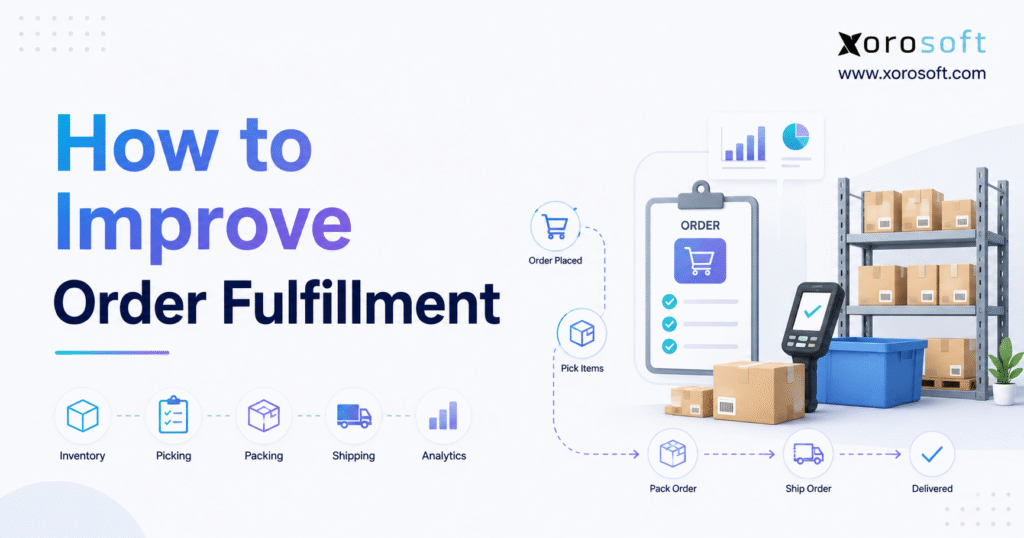
Wondering how to improve order fulfillment?
1. Growth Exposes Hidden Order Fulfillment Gaps
1.1 Why Fulfillment Problems Often Begin Before the Warehouse
The warehouse usually receives the blame because delays become visible there. Yet many problems start before a picker sees the order. A payment may require review, a customer address may contain an error, or a sales channel may show inventory that another order already consumed. Consequently, the warehouse team spends time resolving data problems instead of moving products.
Disconnected software makes this pattern worse. Shopify orders may sit in one application, wholesale demand in another, and warehouse balances in a separate inventory tool. At the same time, purchasing teams may still rely on spreadsheets. Each handoff adds delay and creates another opportunity for conflicting information.
Moreover, the operation depends heavily on individual employees. One person knows which customer receives priority, while another understands which carrier accepts a specific product. Although experience remains valuable, undocumented decisions create risk whenever volume increases or experienced team members become unavailable.
1.2 The Real Cost of Slow or Inaccurate Fulfillment
A fulfillment error costs more than a replacement product. The business may pay for another pick, a second carton, expedited freight, a refund, marketplace penalties, and additional customer support. Moreover, the error can leave inventory records wrong, which then affects future orders.
Slow fulfillment creates a different set of costs. Revenue remains tied to incomplete orders, customer promises become harder to manage, and teams spend more time explaining delays. In addition, finance may struggle to reconcile shipments, invoices, refunds, and inventory movements at month-end.
For that reason, how to improve order fulfillment should never become a warehouse-only project. Sales, operations, purchasing, customer service, technology, and finance all influence the final result.
1.3 When a Business Should Review Its Fulfillment Process
A company should review fulfillment when employees re-enter orders, inventory differs across systems, or customer service cannot see a reliable order status. Likewise, repeated split shipments, rising backorders, and frequent packing errors indicate deeper process problems.
Multi-warehouse operations face additional warning signs. For example, one location may hold stock while another warehouse ships the order at a higher cost. Similarly, teams may transfer products without recording the movement quickly enough. As a result, system availability no longer reflects physical reality.
Still, the review does not always lead to new software. Sometimes the business needs clearer rules, stronger training, cleaner data, or a better warehouse layout. Nevertheless, management must first understand the full process before choosing a solution.
2. Map the End-to-End Order Fulfillment Process
2.1 Define What Order Fulfillment Includes
Order fulfillment covers the complete process of receiving, validating, preparing, shipping, and completing a customer order. It starts when demand enters the business and continues through inventory allocation, warehouse execution, carrier handoff, delivery communication, returns, and financial updates.
This broader definition matters because shipping represents only one stage. A company may print labels quickly and still perform poorly when inventory remains inaccurate or orders wait for manual approval. Therefore, teams should evaluate the process from the customer promise backward through every operational dependency.
In practice, the full workflow usually includes seven stages: order capture, order validation, inventory allocation, warehouse release, picking and packing, shipping and delivery, and returns with financial completion. Each stage requires reliable information from the stage before it.
2.2 Follow Real Orders Through the Workflow
Process maps should reflect what employees actually do, not what the procedure manual claims. Start with several representative orders, such as a normal ecommerce order, a wholesale order, a backorder, a split shipment, a return, and a multi-warehouse order.
Next, record every application, approval, spreadsheet, printout, and message involved. This exercise often reveals hidden work. For instance, a supervisor may export orders every morning, or a customer service employee may message purchasing before promising a ship date. Those steps usually exist because the official workflow lacks visibility or control.
Equally important, the map should identify who owns each handoff. When responsibility remains unclear, orders can wait between departments even though every team believes another group owns the next step.
2.3 Measure Waiting Time Between Each Stage
Total order cycle time provides a useful headline measure, but it does not show where the delay occurs. Instead, measure order receipt to validation, validation to allocation, allocation to warehouse release, release to first pick, first pick to packed, packed to carrier handoff, and handoff to delivery.
For example, a warehouse may complete picking in two hours while the order waits a full day for credit approval. Without stage-level measurement, management may pressure the warehouse instead of fixing the approval rule. Consequently, the company spends effort without improving the customer outcome.
Measure both averages and outliers. The average order may move well while a specific channel, customer type, or warehouse consistently performs poorly. Therefore, segment results by order type, location, channel, carrier, and product category.
2.4 Track Fulfillment Exceptions by Cause
Meanwhile, completed orders show overall performance, while exceptions explain operational risk. Create clear reason codes for address errors, credit holds, inventory shortages, picking discrepancies, damaged products, missing components, packaging shortages, carrier delays, and return problems.
Avoid broad labels such as “manual error.” That phrase hides the failed control. A mis-pick may result from similar packaging, a confusing location, a bad barcode, or an interrupted workflow. Each cause requires a different corrective action.
Furthermore, track the age and cost of exceptions. A low-volume problem can still deserve priority when it creates major customer or financial impact.
3. How to Improve Order Fulfillment With Accurate Inventory
3.1 Create One Reliable Inventory Record
Accurate inventory supports every fulfillment promise. The business must distinguish stock on hand from stock that customers can actually buy. Available inventory should exclude units that orders already reserved, goods under inspection, damaged items, quarantine stock, and products moving between locations.
One controlled inventory record should update whenever employees receive, move, count, allocate, pick, ship, return, or adjust a product. Otherwise, each channel and department develops its own view of availability. As a result, overselling and unnecessary backorders become routine.
Businesses that need a connected operational system can use XoroONE to bring inventory, order management, purchasing, warehousing, accounting, and ecommerce workflows into one environment. The broader principle matters more than the platform name: the company needs one trusted record that every operational decision can use.
3.2 Use Cycle Counting to Protect Fulfillment Accuracy
By contrast, annual physical counts identify discrepancies after those discrepancies have already affected months of orders. Cycle counting spreads the work throughout the year and focuses attention where risk remains highest.
Start with fast-moving, high-value, and historically inaccurate SKUs. In addition, count locations that experience frequent replenishment or contain similar-looking products. A stable, low-value item may require less frequent review.
The team should investigate every material variance instead of simply adjusting the balance. Receiving, putaway, picking, transfers, returns, and production can all create errors. Therefore, the root cause determines the improvement. A balance adjustment corrects today’s number, but a process change protects tomorrow’s orders.
3.3 Reserve Inventory at the Right Time
Reserve inventory when a valid order creates a real commitment. If the business waits until shipment, several channels may promise the same final unit. Conversely, if the system reserves stock too early, abandoned carts or failed payments can block sellable inventory.
The reservation rule should reflect the channel and customer promise. For example, a wholesale order with approved credit may justify an immediate reservation, while a marketplace order may require payment confirmation first. In either case, canceled orders and expired reservations must release stock promptly.
Consequently, clear reservation logic helps teams understand why the system shows less available inventory than physical stock. It also reduces manual overrides that weaken control.
3.4 Define Fair and Visible Allocation Rules
Finally, allocation decides which demand receives scarce inventory. The business may prioritize order date, strategic accounts, complete shipments, expedited service, or contractual commitments. However, management should document the rule and make exceptions visible.
Without a clear policy, teams compete for inventory through messages and spreadsheets. As a result, the loudest request often wins rather than the most important order. A visible allocation rule improves consistency and allows managers to evaluate the financial and customer impact of exceptions.
4. How to Improve Order Fulfillment Inside the Warehouse
4.1 Strengthen Receiving Before Optimizing Picking
First, warehouse fulfillment starts at the receiving dock. If employees record inbound inventory late or place products in temporary locations without system updates, every downstream process becomes unreliable.
Receiving teams should verify the purchase order, SKU, quantity, condition, lot or serial number, and expiry information when relevant. Next, they should record the accepted quantity and direct the product to a controlled location. This discipline prevents stock from physically existing while remaining unavailable to orders.
In turn, directed putaway can improve later picking. The system or supervisor should consider product dimensions, velocity, handling requirements, and available space. Nevertheless, fast-moving products should not all sit in one congested aisle.
4.2 Improve Warehouse Slotting and Travel Time
Slotting determines where products live inside the warehouse. High-velocity items usually belong closer to packing stations, while bulky or slow-moving products can occupy less accessible space. However, the team must also consider replenishment frequency, product compatibility, and safety.
Review slotting regularly because demand changes with seasons, promotions, and product launches. For example, an item that moved slowly last quarter may become a top seller after a campaign. Consequently, an outdated layout can add unnecessary travel to every order.
Separate similar-looking products whenever possible. Clear labels, physical distance, and scan controls reduce confusion between variants that share packaging or SKU patterns.
4.3 Choose Picking Methods That Match Order Profiles
Similarly, no picking method works best for every operation. Discrete picking suits low-volume or complex orders because one employee completes one order at a time. Batch picking reduces repeated travel when many orders contain the same products. Zone picking assigns employees to specific areas, while wave picking releases work around carrier cutoffs or labor plans. Cluster picking allows one employee to pick several orders into separate containers.
The right method depends on lines per order, SKU velocity, warehouse size, product dimensions, and cutoff times. Moreover, many warehouses combine methods. Standard ecommerce orders may use batch or zone picking, while oversized or customized orders remain discrete.
Do not select a method because it sounds advanced. Instead, test it against actual order data and measure travel time, accuracy, and throughput.
4.4 Use Barcode Scanning at Critical Checkpoints
Barcode scanning turns physical work into a verified system transaction. At receiving, employees can confirm the product and location. During picking, they can validate the bin, SKU, and quantity. At packing, the team can rescan the item before sealing the carton. Finally, shipping staff can match the carton with the correct label and carrier.
For example, a warehouse management platform such as XoroWMS can support receiving, putaway, scanning, cycle counting, picking, packing, transfers, and shipping across multiple locations. More importantly, the process should prevent unverified movements from creating hidden inventory discrepancies.
Scanning alone does not fix poor master data or unclear locations. Therefore, the business must maintain readable labels, accurate barcodes, and simple exception procedures.
4.5 Standardize Packing Without Creating Unnecessary Delay
Packing standards should define carton type, protective materials, documentation, labeling, and verification requirements by product category. Fragile products, oversized goods, high-value items, and food products often need different controls.
Moreover, packaging affects freight cost. A carton that is much larger than the product can create dimensional-weight charges. Therefore, packers need practical carton-selection rules rather than relying on personal judgment.
Before closing a carton, the packer should confirm the item, quantity, condition, required inserts, shipping label, and final weight. This final verification catches errors before the carrier makes them more expensive.
4.6 Create a Fast Path for Warehouse Exceptions
Importantly, a strong warehouse does not eliminate every exception. Instead, it prevents exceptions from blocking normal work. Missing inventory, damaged units, unreadable barcodes, and incomplete kits should move to a visible queue with an owner and response target.
For instance, a picker should not spend twenty minutes searching for one missing item while several orders wait. The employee should record the exception, move the order aside, and continue productive work. Meanwhile, a designated team member investigates the cause.
Over time, exception data reveals recurring problems by SKU, location, supplier, or shift. Consequently, management can improve the process rather than repeatedly solving the same issue.
5. How to Improve Order Fulfillment With Routing, Automation, and Better Decisions
5.1 Automate Clean Order Capture and Validation
First, orders should enter the operational workflow without manual re-entry. Connections with ecommerce stores, marketplaces, EDI partners, and wholesale portals reduce delays and prevent employees from typing the wrong SKU, quantity, customer, or address.
After capture, validation rules should identify payment holds, credit limits, fraud review, invalid addresses, unavailable products, missing delivery dates, and customer-specific instructions. Clean orders can then move forward automatically.
However, automation must keep exceptions visible. A failed order should enter a controlled queue instead of disappearing inside an integration log. This design allows most orders to flow quickly while specialists handle the smaller group that requires judgment.
5.2 Improve Multi-Warehouse Order Routing
Next, order routing chooses the warehouse or partner that will fulfill an order. The decision should consider available inventory, customer proximity, carrier zones, cutoff times, labor capacity, product requirements, and service commitments.
Sending every order to the nearest warehouse may increase cost when that location lacks complete stock. Similarly, the location with inventory may already have missed its carrier pickup. Therefore, the routing logic needs more than distance.
The business should also control split shipments. Splitting an order can protect delivery speed, but it creates extra cartons, labor, freight, tracking numbers, and customer questions. A smart rule compares the service benefit with the added cost.
5.3 Use Carrier Rules Instead of Individual Preference
Similarly, carrier selection should evaluate base rate, surcharges, dimensional weight, residential fees, delivery promise, pickup schedule, and historical performance. Employees should not need to remember every rule during a busy shift.
Automation can choose the lowest-cost service that still meets the customer promise. Nevertheless, managers should review actual delivery performance because the cheapest quoted option may create late deliveries and support costs.
In addition, monitor carrier cutoff times. A low-cost service offers no benefit when the carton misses pickup and waits another day.
5.4 Build Automation Around Stable Processes
Automation amplifies the process behind it. If the rules remain unclear, automation produces errors more quickly. Therefore, how to improve order fulfillment through automation starts with standard work, clean data, and clear exception ownership.
Begin with repetitive, high-volume decisions. Examples include releasing clean orders, reserving inventory, assigning warehouses, selecting carriers, sending tracking updates, and creating replenishment tasks. Each automation should have a measurable purpose, such as reducing manual touches or shortening cycle time.
6. Reduce Backorders, Returns, and Fulfillment Exceptions
6.1 Connect Backorders With Purchasing and Production
To begin, backorders should not live in isolated notes or inboxes. The order record should show the unavailable item, expected replenishment date, allocation priority, and customer communication history.
Purchasing teams need visibility into committed demand, not only historical sales. Likewise, manufacturers need to connect backorders with material availability, work orders, and production capacity. As a result, incoming supply can address real customer commitments in the correct sequence.
Availability dates should reflect supplier lead times, open purchase orders, production plans, and receiving time. An optimistic date may preserve the order briefly, but repeated changes damage trust.
6.2 Treat Returns as Part of Order Fulfillment
Moreover, returns influence customer experience, inventory availability, warehouse capacity, refunds, and financial reporting. Therefore, reverse logistics should follow a controlled workflow rather than an informal customer-service process.
Every return should receive an inspection and a classification. The team may mark the product as sellable, repairable, damaged, quarantined, return-to-vendor, or scrap. Only inspected sellable goods should return to available inventory.
At the same time, accounting needs the refund, fee, write-off, and valuation impact. When warehouse and finance teams process the return separately, reconciliation problems grow.
6.3 Design Exception Ownership Across Departments
Finally, fulfillment exceptions often cross department boundaries. A credit hold may begin in finance, while a stock shortage may require purchasing or production. Consequently, the company needs clear ownership and escalation rules.
Each exception type should have an owner, response target, and next action. In addition, the order record should preserve the status so customer service can provide accurate information without chasing several teams.
This structure reduces waiting time and prevents repeated questions. It also gives management the data needed to identify chronic failures.
7. How to Improve Order Fulfillment Through Customer Communication
7.1 Send Fewer but More Useful Status Updates
Customers need accurate information at important moments: order confirmation, shipment confirmation, tracking availability, delay, backorder, delivery, and return status. The goal is not to send more messages. Instead, the business should reduce uncertainty.
A realistic delay notification usually protects more trust than an unrealistic promise. Moreover, proactive communication reduces “Where is my order?” inquiries and gives customer service teams more time for complex issues.
Status messages should use the same operational data that warehouse and customer service teams see. Otherwise, the customer may receive a promise that the operation cannot support.
7.2 Connect Shopify Orders With Fulfillment Operations
Shopify merchants often add applications as new needs appear. Over time, one app may manage inventory, another shipping, another purchasing, and another accounting. Although each tool solves a local problem, the combined stack can create duplicate data and fragmented workflows.
Merchants evaluating a connected ERP can review the Xorosoft ERP app on the Shopify App Store. The relevant question is not whether one application can replace every tool. Instead, the merchant should determine whether orders, inventory, warehousing, purchasing, returns, and accounting share enough operational data.
7.3 Give Customer Service a Complete Order View
Customer service teams should see order status, allocation, warehouse progress, shipment tracking, backorder dates, and return activity without asking several departments.
When the team lacks this view, every customer question becomes an internal investigation. As a result, response time increases and different employees may provide different answers.
A complete view also helps the business identify patterns. For example, repeated questions about one product or carrier may signal an operational issue rather than a communication problem.
8. Order Fulfillment KPIs That Support Better Decisions
8.1 Balance Speed, Accuracy, Service, and Cost
A useful scorecard combines order accuracy, order cycle time, perfect order rate, fill rate, on-time shipping, cost per order, backorder rate, return rate, and exception age. Review these measures together because faster work does not help when errors or returns increase.
| KPI | Formula | What It Shows |
|---|---|---|
| Order accuracy | Accurate orders ÷ total orders × 100 | Picking and packing quality |
| Order cycle time | Completion time − order placement time | End-to-end speed |
| Perfect order rate | Perfect orders ÷ total orders × 100 | Complete customer-promise performance |
| Fill rate | Units shipped ÷ units ordered × 100 | Inventory availability |
| Cost per order | Fulfillment cost ÷ shipped orders | Operating efficiency |
| Backorder rate | Backordered orders ÷ total orders × 100 | Supply weakness |
8.2 Segment Metrics Where Teams Can Act
Company-wide averages often hide problems. Therefore, compare performance by warehouse, channel, carrier, customer type, SKU family, order profile, and shift. One location may repeatedly miss wholesale appointments even while the overall on-time rate looks strong.
Weekly reviews should end with decisions, owners, and deadlines. Otherwise, the dashboard becomes another reporting task instead of an improvement system.
9. How to Improve Order Fulfillment With the Right Technology
9.1 Understand the Roles of OMS, WMS, and ERP
An OMS usually controls order capture, allocation, routing, status, cancellation, and return initiation. A WMS manages receiving, locations, replenishment, picking, packing, counting, transfers, and shipping confirmation. An ERP connects fulfillment with inventory, purchasing, accounting, manufacturing, forecasting, and cross-functional reporting.
The categories overlap, so teams should compare workflows rather than labels. A small operation may need only shipping and inventory tools. By contrast, a multi-channel company may need one connected platform.
9.2 Know When a Connected ERP Becomes Relevant
A connected ERP offers more value when employees re-enter orders, inventory differs across systems, purchasing cannot see committed demand, several warehouses share stock, or finance spends days reconciling transactions.
Manufacturers face additional complexity because product availability depends on materials, bills of materials, work orders, and production capacity. XoroERP connects those manufacturing requirements with inventory, purchasing, warehousing, costing, and accounting.
9.3 Compare Software With Real Scenarios
Ask vendors to demonstrate partial allocation, multi-warehouse routing, a failed scan, a backorder, an EDI shipment, a Shopify return, and inventory reconciliation. Businesses can use the Xorosoft vs NetSuite resource as one starting point while also reviewing other suitable platforms.
Ultimately, operational fit, implementation capacity, total cost, and reporting needs matter more than feature counts.
9.4 Solve the Constraint Before Adding Automation
A warehouse may appear slow because orders arrive late from another system. In that case, picking automation will not solve the main problem. Therefore, how to improve order fulfillment with technology starts with a defined constraint and a baseline measure.
10. Match Fulfillment Strategy to the Business Model
10.1 Compare In-House, 3PL, and Hybrid Fulfillment
In-house fulfillment offers direct control over labor, packaging, and quality, but the business must manage facilities, systems, staffing, and capacity. A 3PL can provide geographic reach and flexible capacity, although the company gives up some direct control. Meanwhile, a hybrid model can keep complex orders internally and send standard ecommerce work to a partner.
The decision should reflect service requirements, product characteristics, geography, cost-to-serve, and internal capability. Outsourcing a broken process usually transfers confusion rather than fixing it.
10.2 Adjust Priorities by Industry
Apparel companies need variant control and returns processing. Furniture businesses face oversized packaging and damage risk. Food companies often require lot tracking, expiry control, and recall traceability. Wholesale distributors need customer pricing, EDI, case quantities, and routing guides, while manufacturers must connect customer demand with materials and production.
The Xorosoft industries pages provide additional context for inventory-driven sectors, including apparel, furniture, sporting goods, food, wholesale, and manufacturing.
11. How to Improve Order Fulfillment in 90 Days
11.1 Days 1–30: Measure and Stabilize
Map the order journey, define exception reasons, establish baseline KPIs, and correct the inventory discrepancies that create the most disruption. This approach makes how to improve order fulfillment practical because the team works from real order data instead of assumptions.
11.2 Days 31–60: Standardize and Connect
Define validation, allocation, routing, backorder, and release rules. Next, improve slotting, cycle counting, packing instructions, and exception ownership. Then connect the sales channels or data transfers that create the most manual work.
11.3 Days 61–90: Automate and Optimize
Automate clean-order release, reservations, routing, scan verification, carrier selection, customer updates, and dashboard reporting. However, review KPIs weekly to confirm that faster work does not increase errors or cost.
12. Frequently Asked Questions About Order Fulfillment Improvement
12.1 What Is the Best Way to Improve Order Fulfillment?
The best way to learn how to improve order fulfillment is to fix inventory accuracy, measure each stage, standardize decisions, and automate only stable work.
12.2 What Causes Slow Fulfillment?
Manual entry, approval delays, inaccurate stock, poor slotting, excessive travel, unclear priorities, and disconnected systems commonly slow orders.
12.3 How Can a Business Reduce Fulfillment Time?
Remove unnecessary waiting, release clean orders automatically, improve product locations, and align warehouse work with carrier cutoffs.
12.4 How Can Warehouse Accuracy Improve?
Use controlled locations, barcode verification, cycle counting, clear labels, and packing checks.
12.5 What Is Order Cycle Time?
It measures the elapsed time between order placement and the chosen completion point, usually delivery.
12.6 What Is a Perfect Order?
A perfect order arrives complete, accurate, on time, undamaged, and with correct documentation.
12.7 Which Fulfillment KPIs Matter Most?
Track accuracy, cycle time, perfect orders, fill rate, cost per order, backorders, returns, and exception age.
12.8 How Does Inventory Accuracy Affect Fulfillment?
Inaccurate inventory creates overselling, cancellations, wasted picker time, and unreliable promises.
12.9 How Does Barcode Scanning Help?
Scanning validates products, locations, orders, and shipments while creating a traceable transaction record.
12.10 What Is the Difference Between OMS and WMS?
An OMS manages order flow, while a WMS controls physical warehouse execution.
12.11 What Is the Difference Between ERP and WMS?
A WMS focuses on warehouse work; an ERP connects fulfillment with purchasing, accounting, manufacturing, and reporting.
12.12 When Does a Business Need a WMS?
A WMS adds value when basic software can no longer control locations, scanning, replenishment, and picking accurately.
12.13 When Does a Business Need an ERP?
An ERP adds value when fulfillment problems cross inventory, purchasing, warehousing, manufacturing, accounting, and ecommerce.
12.14 Should a Business Use a 3PL?
A 3PL may help with geographic expansion and flexible capacity, while in-house operations provide more direct control.
12.15 What Is Multi-Warehouse Fulfillment?
It uses several locations to store and ship inventory through shared availability and routing rules.
12.16 How Does Order Routing Work?
Routing selects a location based on inventory, distance, capacity, cutoff time, cost, and service promises.
12.17 How Can Split Shipments Decline?
Improve inventory positioning, allocation, replenishment, and routing while comparing service benefits with added cost.
12.18 How Should Teams Manage Backorders?
Connect backorders to purchasing or production, provide realistic dates, and define allocation priorities.
12.19 How Should Returns Connect With Fulfillment?
Returns should trigger inspection, classification, inventory updates, refunds, and accounting entries.
12.20 How Can Shopify Fulfillment Improve?
Connect Shopify with reliable inventory, warehouse, shipping, returns, and accounting workflows.
12.21 How Can Peak-Season Fulfillment Improve?
Plan inventory, labor, receiving, packaging, carrier capacity, and customer support together.
12.22 Can Automation Fix Fulfillment Problems?
Automation improves a stable process; it cannot correct poor data or unclear ownership.
12.23 How Often Should Teams Review Performance?
Operational teams should review a focused scorecard every week and address recurring exceptions.
12.24 Who Owns Fulfillment Performance?
Operations may lead, but sales, purchasing, warehousing, customer service, technology, manufacturing, and finance share responsibility.
12.25 How Do You Know Whether Fulfillment Improved?
Compare current results with the baseline across accuracy, cycle time, cost, backorders, returns, and exception age.
13. Practical Next Steps for a Scalable Fulfillment Operation
A scalable operation does not rely on employees moving faster every month. Instead, it gives teams accurate inventory, clear rules, controlled warehouse workflows, and shared visibility.
The order of improvement matters. First, measure the workflow. Next, stabilize inventory and standardize execution. Then connect critical systems and automate repeatable decisions.
Ultimately, how to improve order fulfillment depends on the company’s channels, products, warehouses, and customer promise. A small business may need better procedures, while a growing multi-channel operation may need a connected WMS or ERP.
Xorosoft supports inventory-driven companies that need order management, purchasing, warehousing, manufacturing, accounting, ecommerce, and reporting to work together. Teams can contact Xorosoft for a practical review of their order channels, inventory locations, warehouse requirements, integrations, and reporting needs.
The best next step is simple: identify the most expensive recurring problem, measure its effect, assign an owner, and fix the process that creates it. That disciplined approach will improve order fulfillment more reliably than another disconnected workaround.
Recent Posts
-
 ERP Landed Cost Module vs Spreadsheet Calculations for Importers
 -
 How to Build an Open-to-Buy Plan for an Omnichannel Brand
 -
 Cold Storage WMS for Food and Beverage Distribution
 -
 ERP Buying Statistics 2026: Evaluation, Implementation, and Adoption Risks
 -
 How a Distributor Reduced B2B Order Exceptions Without Restricting Sales