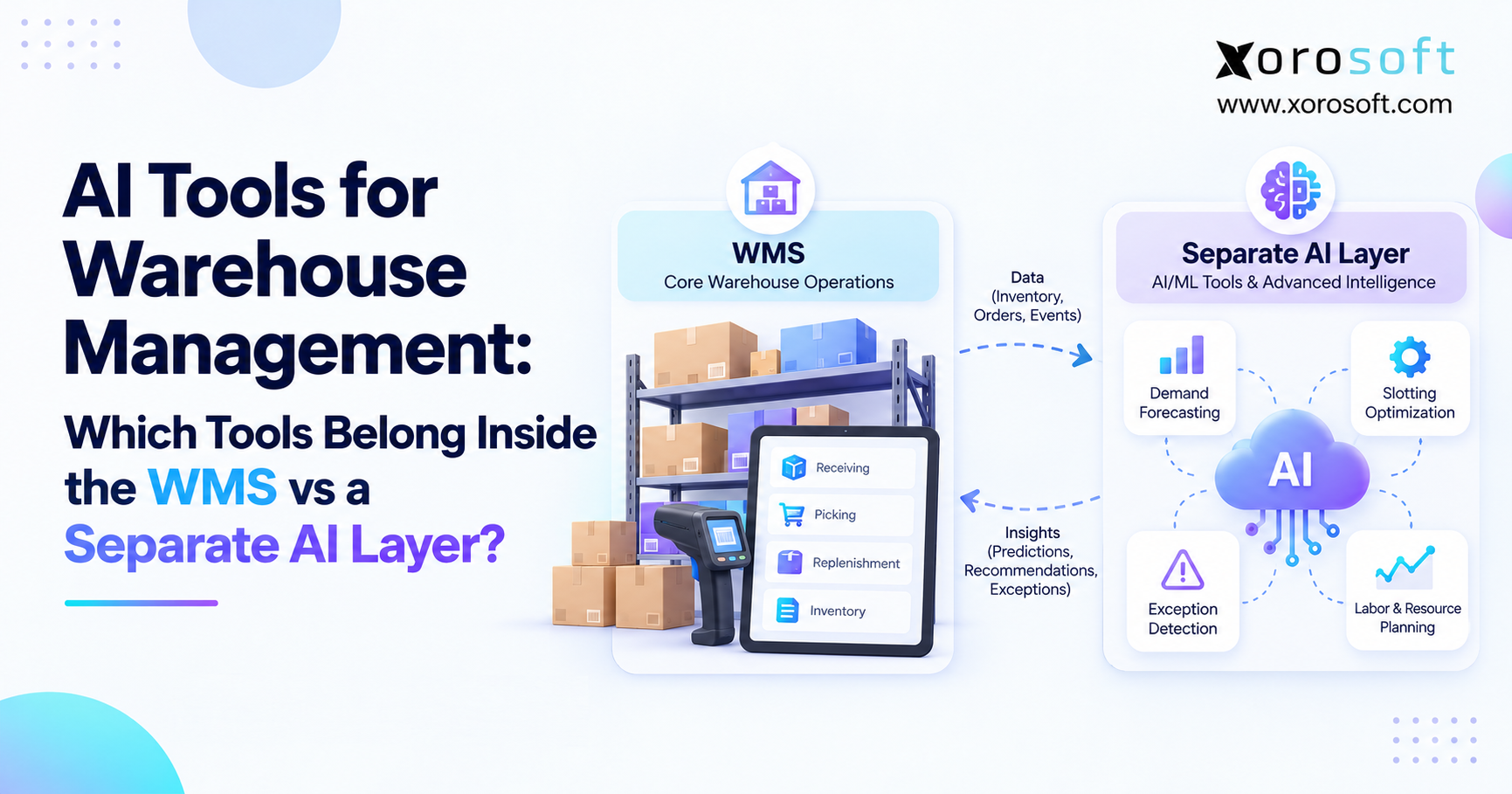
If you want to understand the current trends in warehouses, here are some important warehouse automation statistics to consider.
1. Why Warehouse Automation Statistics Matter in 2026
Warehouse automation has moved from a long-term technology project to an immediate operational priority. Ecommerce brands, distributors, manufacturers, retailers, and third-party logistics providers must process more orders without allowing fulfillment costs, inventory errors, and labor requirements to increase at the same rate.
However, warehouse automation does not describe one standard operating model. One facility may use barcode-directed picking and automated replenishment. Meanwhile, another may rely on autonomous mobile robots, automated storage and retrieval systems, conveyors, robotic arms, machine vision, and orchestration software.
Both operations use automation, but their investment requirements, operating risks, and potential results differ substantially.
1.1 Why Warehouse Automation Data Requires Context
This difference makes warehouse automation statistics difficult to interpret. Market forecasts often combine hardware, software, implementation services, control systems, and material-handling equipment.
Similarly, robotics reports may include manufacturing, transportation, healthcare, and other applications alongside warehousing. Vendor case studies may also highlight one highly optimized facility rather than a dependable industry benchmark.
Therefore, operators should not use a statistic without understanding what it measures. Every figure should include a source, data year, geography, denominator, and clear distinction between an actual result and a forecast.
1.2 What the Latest Warehouse Automation Statistics Reveal
Despite these differences, the latest warehouse automation statistics reveal a clear operational shift. Investment is increasing, mobile robotics is becoming more established, and warehouse operators are placing greater emphasis on connected data, flexible systems, and employee augmentation.
At the same time, many businesses still lack the inventory accuracy, process discipline, and integration foundation required to generate a reliable return from advanced equipment.
This report reviews the latest warehouse automation data available for 2026. It separates reported results from forecasts, distinguishes software automation from physical robotics, and explains what the figures mean for inventory-driven businesses.
2. Warehouse Automation Statistics Reveal Continued Market Growth
2.1 Global Warehouse Automation Statistics for Market Size
All major estimates indicate strong expansion, even though their values differ. Mordor Intelligence forecasts a 13.98% compound annual growth rate between 2026 and 2031. Grand View Research forecasts an 18.7% CAGR through 2030, while The Business Research Company projects a 14.4% CAGR from 2026 through 2030.
| Research provider | 2026 estimate | Forecast value | Forecast year | Forecast CAGR |
| Mordor Intelligence | $34.17B | $65.74B | 2031 | 13.98% |
| Grand View Research | $27.4B | $59.5B | 2030 | 18.7% |
| The Business Research Company | $27.46B | $47B | 2030 | 14.4% |
The market is not expanding only because more companies are constructing fully automated warehouses. Instead, growth also comes from cloud software subscriptions, barcode systems, mobile robot fleets, equipment retrofits, control systems, integration projects and automation-as-a-service contracts.
Consequently, market growth does not prove that most warehouses are highly automated. It shows that businesses are spending more on technologies that automate selected parts of warehouse operations.
2.2 Warehouse Robotics and Automation Software Are Growing Together
Mordor Intelligence reports that hardware represented 55.12% of warehouse automation revenue in 2025. However, warehouse software is forecast to expand at a 14.87% CAGR through 2031. Mobile robots represented 41.36% of the market, while piece-picking robots are forecast to grow at a 15.27% CAGR.
These numbers show that physical equipment remains the largest spending category. Nevertheless, software becomes more important as the number of automated resources increases.
A warehouse operating one conveyor may function through relatively simple controls. By contrast, a facility with several robot types, automated storage, packing stations, employees and multiple order priorities needs more sophisticated orchestration.
Equipment also needs accurate information about inventory availability, product dimensions, order priority, location status, replenishment requirements and shipping deadlines. Otherwise, machines may move the wrong inventory more efficiently.
2.3 Ecommerce and 3PL Warehouse Automation Growth
Retail and ecommerce represented 28.41% of warehouse automation spending in Mordor Intelligence’s 2025 segmentation. Third-party logistics providers accounted for 38.96%, while medium-sized facilities represented 36.78% of the market.
In addition, smaller facilities under 50,000 square feet are forecast to grow at a 15.19% CAGR through 2031. This trend matters because automation is no longer limited to the largest distribution centers.
Modular warehouse software, subscription robotics and mobile equipment now allow middle-market operators to automate selected workflows without redesigning an entire facility. Even so, smaller businesses must be more selective because they have fewer locations across which to spread engineering and integration costs.
A large enterprise may recover a technology investment across several warehouses. A growing ecommerce brand, however, may operate only one or two facilities. Therefore, a poor automation decision can have a greater effect on daily fulfillment and cash flow.
3. Warehouse Automation Statistics Show Strong Robotics Demand
3.1 Warehouse Automation Statistics for Logistics Robots
The International Federation of Robotics reported that nearly 200,000 professional service robots were sold during 2024, representing 9% annual growth. Transportation and logistics was the largest application category, with 102,900 units sold and year-over-year growth of 14%.
As a result, more than half of the professional service robots included in the IFR supplier sample were designed to transport goods or cargo. However, this category includes mobile robots used in warehouses, factories and other logistics environments. It should not be interpreted as an exact count of warehouse robot installations.
IFR also reported 31% growth in professional Robot-as-a-Service fleets. Within transportation and logistics, RaaS fleet growth reached 42%. The subscription model is significant because it allows businesses to replace part of a large initial capital purchase with a continuing operating expense.
Nevertheless, RaaS does not eliminate financial risk. Operators still need to evaluate integration fees, minimum contract commitments, maintenance responsibility, service response times, equipment availability and the cost of ending or expanding the agreement.
3.2 Industrial Robot Statistics Provide Broader Automation Context
IFR recorded 542,000 industrial robot installations worldwide during 2024. Annual installations exceeded 500,000 units for the fourth consecutive year. Moreover, 74% of new deployments occurred in Asia, 16% in Europe and 9% in the Americas.
China accounted for 54% of global installations. Meanwhile, the United States installed 34,200 industrial robots, and India reached a record 9,100 installations.
These figures demonstrate the broader expansion of industrial automation. However, they should not be presented as warehouse-specific deployments because industrial robot totals include welding, assembly, painting, machine tending and manufacturing material handling.
The distinction is important. A manufacturing robot may repeat one controlled task inside a protected cell. A warehouse robot, by contrast, may need to respond to changing traffic, variable products, urgent orders and human movement.
3.3 Amazon Demonstrates Robot-Orchestrated Fulfillment at Scale
Amazon has deployed more than one million robots across its operations network. Its fleet supports storage, movement, sorting, picking and packaging activities across hundreds of facilities.
The company’s DeepFleet AI model is intended to coordinate robot travel and improve fleet travel efficiency by 10%. Therefore, Amazon’s experience shows that fleet coordination becomes as important as individual machine performance when deployments reach large scale.
However, Amazon’s results do not provide a standard benchmark for a mid-sized distributor, manufacturer or Shopify merchant. The company operates a global fulfillment network supported by extensive engineering, data science and capital resources.
The more relevant lesson is operational. As robot fleets grow, warehouses must manage traffic, sequencing, charging, maintenance, utilization and exception queues. Adding machines without improving orchestration may simply relocate a bottleneck.
4. Warehouse Automation Statistics Show Uneven Adoption
4.1 Warehouse Automation Statistics by Maturity Level
There is no reliable global percentage showing how many warehouses are automated. The answer changes depending on whether the definition includes barcode scanners, warehouse management software, conveyors, mobile robots or only highly automated facilities.
A maturity model is therefore more useful than a simple automated-versus-manual classification.
| Automation level | Typical operating model | Common technology |
| Manual | Employees coordinate work from paper or memory | Spreadsheets and basic equipment |
| Digitally assisted | Transactions are captured electronically | Barcode scanners and inventory apps |
| Software-directed | The system creates and prioritizes tasks | WMS, mobile devices and workflow rules |
| Mechanized | Fixed equipment moves or sorts products | Conveyors, sorters and carousels |
| Robot-assisted | Robots handle movement or selected tasks | AMRs, AGVs and robotic arms |
| Highly automated | Systems manage storage and retrieval | AS/RS and goods-to-person systems |
| Orchestrated | Software coordinates people and machines dynamically | WES, AI and fleet orchestration |
Most growing businesses progress through several stages rather than moving directly from manual work to full automation. In practice, this staged progression reduces risk because each level creates the data and process foundation required by the next.
4.2 Technology Investment Is Rising Faster Than Implementation Readiness
The 2026 MHI Annual Industry Report found that 56% of supply chain leaders were increasing technology and innovation investment. In addition, 52% planned to spend more than $1 million, while 17% planned to spend more than $10 million.
The planned investments include artificial intelligence, robotics, visibility tools, resilience initiatives and workforce technologies. However, planned spending does not necessarily mean that companies know which problem to address first.
Zebra’s warehouse research found that 77% of respondents considered worker augmentation the best way to introduce automation. Nevertheless, only 35% said they clearly understood where to begin.
These warehouse automation statistics reveal a significant readiness gap. Businesses know that manual workflows will not scale indefinitely. Even so, many operations struggle to select a first project and establish a credible financial baseline.
The strongest starting point is usually a measurable constraint. That constraint may be excessive travel, slow receiving, poor replenishment, frequent mispicks, limited storage capacity or weak visibility across several warehouses.
4.3 Worker Augmentation Is Replacing the Labor-Replacement Narrative
Warehouse automation is often presented as a direct substitute for labor. In reality, many implementations redistribute work instead.
Machines may handle repetitive movement, while employees manage damaged inventory, customer exceptions, quality control, maintenance and process improvement. Similarly, mobile robots may reduce walking without eliminating picking roles.
This model is particularly relevant in warehouses where product dimensions, daily priorities and order profiles change frequently. Complete autonomy becomes difficult when systems must respond to substitutions, returns, urgent orders, incomplete data or special packaging requirements.
Therefore, the financial result may appear as avoided hiring, lower overtime, additional peak capacity or more volume processed by the existing team rather than a direct reduction in employee numbers.
5. Warehouse Automation Statistics on Labor and Safety
5.1 Warehouse Automation Statistics on Employment
U.S. warehousing and storage employment reached a preliminary 1.851 million workers in June 2026, up from 1.833 million in March.
The 2025 occupational breakdown included 457,740 stock clerks and order fillers, 433,060 hand material movers, 286,750 industrial truck operators and 89,090 shipping, receiving and traffic clerks.
These figures show why modest productivity improvements can create meaningful capacity. For example, reducing only a few minutes of travel or searching per task can become significant when the improvement repeats across thousands of daily order lines.
However, time savings do not automatically become financial savings. The business must convert released capacity into additional volume, avoided hiring, reduced overtime or improved customer service.
5.2 Warehouse Wage Statistics Strengthen the Business Case
Average hourly earnings for all U.S. warehousing and storage employees reached a preliminary $26.76 in May 2026, with average weekly hours of 39.4. Production and nonsupervisory employees averaged $26.30 per hour and 38.1 weekly hours.
Median annual wages in 2025 reached $48,170 for industrial truck operators, $45,880 for hand material movers, $46,640 for shipping and receiving clerks and $44,700 for stock clerks and order fillers.
In addition, transportation, storage and distribution managers had a median annual wage of $99,330.
These wage levels make poor process design increasingly expensive. Nevertheless, an automation business case should not assume that every saved hour becomes a payroll reduction.
Instead, companies should identify activities that consume labor without adding proportional value. Common examples include walking between distant locations, searching for inventory, waiting for replenishment, entering the same data twice and correcting avoidable shipping errors.
5.3 Warehouse Safety Statistics Add Financial and Human Costs
The U.S. warehousing and storage industry recorded 32 workplace fatalities in 2024, compared with 28 in 2023. Its total recordable injury and illness rate was 4.8 cases per 100 full-time workers.
Moreover, cases involving days away, job restriction or transfer occurred at a rate of 4.1. OSHA also identifies warehouse risks involving powered industrial trucks, material handling, ergonomics, slips, trips, falls, chemicals and robotics.
Automation can reduce exposure to long-distance carrying, repetitive movement, heavy lifting and forklift traffic. However, it may introduce new risks involving moving machinery, batteries, maintenance activity and interactions between people and robots.
Consequently, safety must be built into the redesigned workflow. Purchasing a robot does not automatically make a warehouse safer if pedestrian routes, emergency procedures, training and maintenance controls remain weak.
5.4 Productivity Statistics Show That Capital Is Not Enough
BLS reported that warehousing and storage labor productivity increased only 0.1% during 2024. Total factor productivity increased 1.7%, while capital input increased 4.8%.
These warehouse automation statistics reinforce an important operating principle: spending on equipment and improving productivity are not the same thing.
Technology may remain underused because volume is inconsistent. Likewise, a warehouse may automate picking while replenishment continues to cause delays. Employees may also bypass the new process because training or data quality is incomplete.
Ultimately, automation creates value only when technology, inventory data, process design, layout, maintenance and employee behavior operate as one connected system.
6. Warehouse Automation Statistics Need Clear Performance Definitions
6.1 Warehouse Automation Statistics for Inventory Accuracy
Warehouse automation can improve inventory accuracy when each receipt, putaway, transfer, pick, return, count and adjustment creates an immediate system transaction.
However, accuracy claims frequently use different formulas. A warehouse may report location accuracy, order accuracy, line accuracy, unit accuracy or cycle-count accuracy. Although a 99% result sounds strong, its business meaning changes depending on the denominator.
For example, 99% order accuracy means one order in every 100 may contain an error. If an operation ships 10,000 orders per day, that rate could still create 100 daily customer issues.
Therefore, operators should define the metric before comparing results. The strongest measures connect inventory accuracy to outcomes such as short shipments, cancellations, emergency replenishment and customer returns.
6.2 Warehouse Picking Statistics Depend on Order Profiles
Lines picked per hour is one of the most widely used warehouse productivity measures. Nevertheless, it cannot be compared fairly without context.
A single-line ecommerce order differs from a wholesale order containing cases and pallets. Similarly, small apparel products behave differently from furniture, food products or sporting equipment.
Travel is often one of the largest controllable parts of picking time. Mobile robots and goods-to-person systems can reduce walking. However, they cannot correct missing stock, poor slotting, packaging delays or replenishment shortages.
For that reason, operators should measure total order cycle time alongside picking speed.
6.3 Warehouse Throughput Can Hide Downstream Bottlenecks
An automated picking system may increase the number of items reaching packing. However, if packing stations, carrier capacity or documentation remain unchanged, the warehouse may simply create a larger queue.
Throughput analysis should follow an order from release to carrier handoff. Important intervals include allocation, warehouse release, first pick, completed picking, packing, labeling, staging and departure.
The same principle applies to inbound operations. Faster unloading has limited value when receiving inspection, item identification or putaway capacity cannot absorb the added volume.
6.4 Warehouse Space Utilization Requires More Than Density
AS/RS, vertical lift modules and goods-to-person systems can improve storage density by using vertical space and reducing human-access aisles.
Even so, higher density may reduce flexibility. A system designed around stable product dimensions may struggle when the assortment changes. Maintenance access, fire protection and retrieval throughput may also limit usable capacity.
Accordingly, operators should measure usable capacity, replenishment workload and retrieval performance rather than only the number of units stored per square foot.
7. Warehouse Automation Statistics on Costs, ROI and Payback
7.1 Warehouse Automation Costs Vary by Scope
There is no meaningful average cost for warehouse automation. The category ranges from barcode scanning and workflow software to engineered facilities containing conveyors, robotics, sensors, control systems and automated storage.
The total investment may include hardware, software, subscriptions, implementation, network infrastructure, facility modifications, safety equipment, employee training, maintenance, spare parts, financing and downtime.
Therefore, a proposal that includes only the equipment price understates the real cost. Integration and process redesign can be especially significant when orders, purchasing, manufacturing, accounting and warehouse data exist in separate systems.
7.2 Warehouse Automation ROI Requires a Baseline
A practical ROI formula is:
Warehouse automation ROI =
(Total financial benefit − total automation cost) ÷ total automation cost × 100
Financial benefits may include additional throughput, avoided hiring, lower overtime, fewer fulfillment errors, reduced product damage, improved inventory availability and deferred facility expansion.
However, the calculation must begin with a documented baseline. Operators need to know current order volume, labor hours, error rates, overtime, downtime, travel, replenishment delays and cost per order.
Otherwise, the project team cannot determine whether automation produced the improvement or whether demand, staffing and product mix changed during the same period.
7.3 Warehouse Automation Payback Depends on Utilization
The basic payback formula is:
Payback period = Initial investment ÷ annual net financial benefit
A system operating across two or three shifts can recover its cost faster than the same equipment used for only a few hours each day. Likewise, predictable volume and repeatable product profiles make utilization easier to maintain.
Payback models frequently become unreliable when they use peak-season demand as the annual average. Other mistakes include excluding maintenance, ignoring implementation downtime and treating every saved minute as cash.
Therefore, a credible financial model should include conservative, expected and high-utilization scenarios.
7.4 Robotics-as-a-Service Changes the Financial Model
Robot-as-a-Service arrangements may reduce the initial capital requirement and allow companies to scale fleets according to demand.
The reported 42% growth in logistics RaaS fleets indicates increasing interest in this approach. Nevertheless, the model does not eliminate cost. Instead, it converts part of the investment into a continuing operating expense.
Companies should review contract length, minimum fleet commitments, service levels, software charges, integration fees, data ownership and exit provisions.
RaaS may be valuable when the operation needs flexibility or wants to test a use case. Ownership, by contrast, may be more attractive when utilization is high and the facility expects to use the technology for several years.
8. The Warehouse Automation Technology Stack
8.1 Warehouse Automation Software Creates the Foundation
Software-based automation directs warehouse activities by applying rules to inventory, locations, orders, employees and priorities.
It may create receiving tasks, recommend putaway locations, trigger replenishment, assign picking work, validate packing and update inventory after shipment.
These capabilities do not physically move products. However, they remove manual coordination and create consistent transaction records.
For many growing companies, software automation produces a faster improvement than advanced robotics because it addresses inventory visibility and process control first.
XoroWMS supports receiving, putaway, barcode scanning, picking, packing, shipping, transfers, cycle counting and inventory tracking. As a result, warehouse teams can automate task direction and transaction confirmation without immediately investing in large physical systems.
8.2 Physical Warehouse Automation Reduces Movement
Physical automation includes conveyors, sortation equipment, automated packaging, mobile robots, robotic arms, carousels and AS/RS.
Fixed automation generally performs well when routes, volumes and product characteristics remain stable. Flexible automation, meanwhile, is more useful when layouts or daily demand change.
The selected technology should match the operational constraint. For example, a warehouse with excessive walking may benefit from mobile robots. A facility approaching its storage limit may need higher-density storage. In contrast, a warehouse with frequent mispicks may gain more from scanning and validation than automated transport.
8.3 ERP, WMS, WES and WCS Perform Different Roles
| System | Primary responsibility |
| ERP | Sales, purchasing, inventory, accounting, manufacturing and financial records |
| WMS | Receiving, locations, replenishment, picking, packing and shipping |
| WES | Real-time coordination of employees and automated resources |
| WCS | Communication with conveyors, sorters and equipment |
An ERP provides the business context behind warehouse work. It knows which orders exist, what has been purchased, which customers have priority and how warehouse transactions affect accounting.
A WMS, by contrast, controls execution inside the facility. A WES may coordinate several automated systems, while a WCS communicates with individual machines.
XoroERP connects warehouse activity with inventory, purchasing, sales orders, manufacturing, accounting and reporting. Consequently, automation decisions can use information from across the business rather than relying only on warehouse transactions.
8.4 AI Is Moving Warehouse Automation From Rules to Decisions
Traditional warehouse automation follows predefined rules. AI-supported systems can adjust recommendations according to demand, congestion, equipment status and inventory conditions.
Potential applications include dynamic slotting, demand-aware replenishment, route selection, labor planning, predictive maintenance, damage detection and visual cycle counting.
Gartner predicts that half of companies with warehouse operations will use AI-enabled vision for cycle counting by 2027. It also expects autonomous agents to become more common in cross-functional supply chain systems by 2030.
However, AI does not remove the need for governance. Automated decisions require accurate data, approval limits, audit trails, cybersecurity, exception handling and human override procedures.
9. Warehouse Automation Statistics by Industry
9.1 Ecommerce Warehouse Automation Statistics
Retail and ecommerce represented 28.41% of warehouse automation spending in Mordor Intelligence’s 2025 segmentation.
Ecommerce warehouses typically process many small orders across large SKU assortments. Consequently, their main automation pressures include short shipping windows, promotional peaks, returns, channel synchronization and the cost of picking individual units.
For Shopify merchants, automation must extend beyond the warehouse floor. Orders need to enter the operating system, inventory must be allocated and fulfillment updates must return to the storefront.
The Xorosoft ERP Shopify application connects Shopify with broader order, inventory, fulfillment and operational workflows. Therefore, warehouse automation can respond to current channel demand instead of delayed exports or disconnected applications.
9.2 Wholesale Warehouse Automation Requirements
Wholesale distribution often involves larger orders, cases, pallets, EDI documents, customer-specific pricing, allocation rules and scheduled shipping windows.
As a result, the most valuable automation may differ from an ecommerce warehouse. Wholesale operators may gain more from wave planning, pallet movement, case picking, automatic documentation and dock scheduling than high-speed unit picking.
Automation must also consider inventory commitments across customers. Moving inventory quickly has limited value when the same available stock is promised simultaneously to ecommerce, wholesale and marketplace orders.
9.3 Manufacturing Warehouse Automation Statistics
Manufacturing warehouses manage raw materials, components, work-in-process, production staging, finished goods and shipping.
Therefore, warehouse decisions affect bills of materials, work orders, material requirements, production schedules and cost accounting.
An automated replenishment system must know which materials are required, where they should be delivered and when production will consume them. A robot may move components, but the manufacturing system must provide the correct instruction.
XoroONE combines inventory, warehouse management, manufacturing, accounting, purchasing and ecommerce operations in one cloud environment. As a result, warehouse transactions can update production and financial records without separate reconciliation.
9.4 Apparel Warehouse Automation
Apparel businesses manage variations across style, size, color, collection, season and sales channel. Therefore, a relatively small product range can create thousands of individual SKUs.
Barcode validation, directed putaway, batch picking, replenishment and returns processing often provide more value than heavy fixed automation. Moreover, the warehouse must remain flexible as seasonal collections change and older inventory moves to alternative channels.
9.5 Furniture and Bulky-Goods Automation
Furniture warehouses handle irregular dimensions, heavy products, damage risk, multi-part items and specialized delivery requirements.
Consequently, automation often focuses on location control, movement planning, scanning, damage documentation and dock scheduling. Equipment designed for small standard cartons may not fit the product profile.
9.6 Food Warehouse Automation
Food and beverage operations may require lot tracking, expiry control, FIFO or FEFO rotation, quality holds, recall traceability and temperature-zone management.
Automation must preserve these controls. Otherwise, a faster picking system may increase risk by ignoring expiry dates or quality status.
Businesses can review Xorosoft’s industry solutions for workflows across apparel, furniture, sporting goods, food, wholesale and manufacturing.
10. Warehouse Automation Statistics Indicate When Businesses Should Upgrade
10.1 Operational Signals That Automation Is Needed
Automation should be evaluated when a warehouse repeatedly misses shipping cutoffs, depends on overtime, experiences inventory discrepancies or requires employees to walk excessive distances.
Additional warning signs include uncontrolled replenishment, repeated picking errors, growing SKU counts, limited capacity and poor visibility across several locations.
However, these signals do not automatically justify robotics. Instead, they indicate that the current operating model is reaching a practical limit.
10.2 Businesses That Should Delay Advanced Automation
A company may not be ready for advanced physical automation when transaction volume is low, inventory records are unreliable or processes change every week.
Robotics may also be difficult to justify when product data is incomplete, the facility has a short remaining lease or equipment would remain idle for most of the day.
In these conditions, process standardization, scanning, layout changes and warehouse software may provide a stronger initial return.
10.3 Disconnected Systems Should Be Addressed First
Many growing businesses operate through Shopify, accounting software, spreadsheets, an inventory application, a warehouse application and separate purchasing files.
Adding physical automation to this environment may improve product movement while leaving demand, inventory, purchasing and financial data fragmented.
Therefore, a connected system should establish which inventory is available, which orders have priority and what needs replenishment before robots are introduced.
10.4 A Practical Warehouse Automation Sequence
A sensible progression begins with inventory identification and location control. The next steps are receiving validation, directed putaway, replenishment rules, picking verification, packing and shipping confirmation.
Once these processes are stable, the business can evaluate automated movement, goods-to-person systems, dense storage, robotic picking and AI-supported orchestration.
This sequence is not mandatory. Nevertheless, it reduces the risk of automating inaccurate data or inconsistent workflows.
11. Common Warehouse Automation Mistakes
11.1 Automating an Unstable Process
Automation repeats the process it receives. Therefore, if the workflow contains poor slotting, inaccurate inventory or inconsistent employee practices, technology may simply make the waste occur faster.
The process should be documented, standardized and measured before equipment is selected.
11.2 Selecting Technology Before Defining the Constraint
A company may assume labor is the problem when the real issue is receiving congestion, replenishment or delayed order release.
Instead, the investment should begin with a specific outcome, such as reducing travel, increasing storage density or improving order accuracy.
11.3 Ignoring Warehouse Exceptions
Automation proposals often model normal transactions. Real warehouses also process damaged goods, short shipments, substitutions, returns, quality holds and urgent orders.
Consequently, a system that handles standard orders quickly but requires constant intervention for exceptions may not achieve its expected return.
11.4 Underestimating Integration
Automation equipment requires dependable information about items, dimensions, locations, priorities, inventory status and shipping.
Weak integration can leave expensive equipment waiting for instructions. Therefore, testing should include real exceptions rather than only ideal transactions.
11.5 Measuring Speed Without Accuracy
A faster warehouse is not necessarily a better warehouse. Higher throughput may increase errors, damage, congestion or overtime elsewhere.
Accordingly, automation KPIs should balance speed, accuracy, cost, safety, utilization, system availability and customer service.
11.6 Using Unrealistic ROI Assumptions
Common financial mistakes include assuming full utilization, using peak demand as the annual average and excluding maintenance or downtime.
A conservative model may show a longer payback. However, it gives leadership a more dependable basis for approval.
12. Warehouse Automation Technology Comparisons
12.1 Manual, Software-Directed and Robotic Warehouses
| Operating model | Main advantage | Main limitation |
| Manual | Low initial cost | Weak visibility and consistency |
| Digitally assisted | Better transaction capture | Employees still coordinate work |
| Software-directed | Repeatable workflows | Depends on accurate data |
| Mechanized | Consistent movement | Limited flexibility |
| Robot-assisted | Flexible movement and scalability | Integration and maintenance |
| Highly automated | High density and throughput | Greater capital requirements |
No model is universally superior. For example, a low-volume warehouse with complex products may perform well with strong software and experienced employees. By contrast, a high-volume facility with stable order patterns may justify extensive physical automation.
12.2 AMRs Versus AGVs
AMRs generally use mapping and onboard navigation to adjust routes around obstacles. AGVs traditionally follow fixed paths, markers, wires or predefined navigation rules.
| Factor | AMR | AGV |
| Navigation | Dynamic | Predetermined |
| Infrastructure changes | Usually limited | May be substantial |
| Route flexibility | High | Lower |
| Best application | Changing workflows | Stable repetitive routes |
| Deployment model | Often modular | Frequently engineered |
AMRs tend to fit changing warehouse flows. AGVs, meanwhile, can perform well where movement is repetitive and predictable.
12.3 AS/RS Versus Conventional Storage
AS/RS can increase storage density and provide repeatable retrieval. It may also reduce employee travel and allow facilities to use more vertical space.
Conventional racking, however, is generally more flexible and requires less initial capital. It can be easier to modify when product dimensions or demand patterns change.
Therefore, the decision should consider building life, product stability, throughput, maintenance capability and expected volume rather than density alone.
12.4 Standalone WMS Versus Integrated ERP
A standalone WMS may offer deep warehouse specialization. However, it still needs to exchange information with purchasing, ecommerce, accounting, manufacturing and reporting systems.
An integrated ERP can reduce fragmentation by managing these transactions in one environment. Nevertheless, the business must confirm that the warehouse functionality supports its operational depth.
Companies evaluating broader systems can review Xorosoft vs. NetSuite to understand differences in implementation approach, complexity and fit for inventory-driven operations.
13. Warehouse Automation Statistics Forecast the Road to 2030
13.1 New Warehouses Will Be Designed Around Robots
Gartner predicts that 50% of new warehouses built in developed markets will be designed as robot-centric facilities by 2030.
However, this prediction applies to newly built warehouses, not half of all existing facilities. Existing sites face columns, floor limitations, low ceilings, legacy systems and active daily operations.
Therefore, retrofitting an existing facility requires different technology and financial assumptions than designing a new building around automation.
13.2 Mixed Robot Fleets Will Need Better Orchestration
Future facilities are likely to operate several types of robots rather than one universal machine. These may include transport robots, collaborative picking robots, robotic arms, inventory drones and automated storage equipment.
As a result, warehouses will need software capable of assigning work, avoiding congestion, balancing capacity and responding to equipment availability.
13.3 AI-Enabled Vision Will Expand
AI vision systems can identify products, count inventory, estimate dimensions, detect damage and verify locations.
Gartner’s forecast that half of companies with warehouse operations will use AI-enabled vision for cycle counting by 2027 suggests that inventory control may become less dependent on employees scanning each item.
Nevertheless, vision systems still require data governance, model training and a process for investigating uncertain results.
13.4 Human Roles Will Shift Toward Exceptions
As routine movement becomes more automated, warehouse roles are likely to shift toward equipment supervision, maintenance, process engineering, quality control and inventory investigation.
This transition requires training. Otherwise, a warehouse may own sophisticated equipment without having the internal capability to operate or improve it.
Ultimately, the most effective automated warehouse is not necessarily the facility with the fewest employees. It is the one where people spend less time on avoidable movement and more time managing performance.
14. Warehouse Automation Statistics FAQs
14.1 What is warehouse automation?
Warehouse automation uses software, scanning, machinery or robotics to direct or perform warehouse activities with less manual coordination. It can include inventory updates, directed picking, conveyors, AMRs, robotic arms, automated packing and AS/RS.
14.2 How big is the warehouse automation market in 2026?
Major estimates range from approximately $27.4 billion to $34.17 billion. These warehouse automation statistics differ because research providers include different combinations of equipment, software, services and systems integration.
14.3 How fast is warehouse automation growing?
Current forecasts generally place annual market growth in the mid-to-high teens. However, the exact rate varies according to the technologies and services included in each market definition.
14.4 What percentage of warehouses are automated?
No authoritative percentage covers all warehouses. A facility using scanning and WMS workflows may be considered automated in one study, while another may count only robotics and automated storage systems.
14.5 How many warehouse robots exist worldwide?
There is no complete worldwide count. IFR recorded 102,900 professional service robots sold for transportation and logistics applications in 2024, but the category includes applications beyond warehouses.
14.6 What are the main types of warehouse automation?
The main categories include data capture, WMS workflows, conveyors, sortation, AGVs, AMRs, robotic picking, automated packaging, goods-to-person systems and automated storage and retrieval systems.
14.7 Is a WMS considered warehouse automation?
Yes. A WMS can automate task creation, work direction, validation, replenishment and inventory updates. However, it does not physically move goods unless connected to machinery or robotics.
14.8 What is the difference between an AMR and an AGV?
An AMR usually maps its environment and changes routes dynamically. An AGV typically follows a predefined path. Therefore, AMRs provide greater flexibility, while AGVs work well for stable and repetitive movement.
14.9 What is an automated storage and retrieval system?
AS/RS uses computer-controlled equipment to store and retrieve products, pallets, totes or bins. It can improve density and consistency but requires careful planning around maintenance, building design and throughput.
14.10 How much does warehouse automation cost?
Costs range from relatively small software and scanning projects to multimillion-dollar engineered systems. A full estimate should include equipment, software, integration, training, maintenance and facility changes.
14.11 What is the average ROI of warehouse automation?
There is no dependable average across all technologies. ROI depends on labor cost, volume, utilization, maintenance, error reduction, operating shifts and the expected life of the facility.
14.12 How is warehouse automation ROI calculated?
Subtract the total automation cost from the financial benefit created, divide the result by the total cost and multiply by 100. Benefits may include added capacity, avoided hiring and fewer errors.
14.13 How long does warehouse automation take to pay back?
Payback varies widely. Software and flexible robotics may repay faster than fixed infrastructure. However, utilization remains one of the most important variables.
14.14 Does warehouse automation reduce labor costs?
Automation can reduce labor required per order. Nevertheless, it may not reduce total headcount because growing businesses often use added capacity to process more volume.
14.15 Will warehouse robots replace employees?
Robots are more likely to replace repetitive tasks than complete roles. Employees remain necessary for exceptions, quality control, maintenance, safety and process improvement.
14.16 Does warehouse automation improve inventory accuracy?
It can improve accuracy when scans and system rules validate physical transactions. However, automation cannot correct poor labels, incomplete product data or uncontrolled adjustments.
14.17 Can warehouse automation improve safety?
Automation can reduce exposure to lifting, repetitive travel and forklift interaction. At the same time, it can introduce new machinery and robot-interaction risks.
14.18 What warehouse process should be automated first?
Most businesses should begin with inventory identification, location control, receiving, putaway, replenishment, picking validation, packing and shipping.
14.19 Does a small warehouse need automation?
A small warehouse may benefit from scanning, directed workflows and shipping validation without needing robots. Therefore, transaction complexity matters more than building size alone.
14.20 When should a business stop using spreadsheets?
A business should upgrade when spreadsheets cannot provide reliable location control, audit trails, multi-warehouse visibility, purchasing coordination or real-time ecommerce inventory.
14.21 Can warehouse automation integrate with Shopify?
Yes. Shopify orders can flow into an ERP or WMS for allocation, warehouse execution, fulfillment confirmation, returns and accounting updates.
14.22 How does ERP support warehouse automation?
ERP provides information about sales, purchasing, inventory, manufacturing and accounting. The WMS uses that context to direct warehouse work and automated equipment.
14.23 What are the main warehouse automation risks?
Key risks include poor data, weak integration, low utilization, inflexible equipment, underestimated exceptions, maintenance downtime and unrealistic ROI assumptions.
14.24 Why do warehouse automation projects fail?
Projects often fail because businesses automate unstable processes, buy technology before defining the constraint or underestimate integration and employee training.
14.25 What will warehouse automation look like by 2030?
New warehouses will increasingly use mixed robot fleets, AI-enabled vision, autonomous decisions and real-time orchestration. Existing facilities, however, will modernize more gradually.
15. Strategic Takeaway: Turn Warehouse Automation Statistics Into an Action Plan
The most important warehouse automation statistics are not always the global market value or the number of robots shipped. Instead, the most useful figures measure the performance gap inside the individual operation.
A business should first identify where time, capacity, accuracy or cash is being lost. The answer may involve picking travel, receiving delays, replenishment, inventory discrepancies, limited storage, labor availability or disconnected systems. That constraint should determine the technology.
For many inventory-driven businesses, the first priority is establishing accurate inventory, controlled locations, consistent scanning and connected order, purchasing, warehouse and accounting data. Software automation can then replace manual coordination and create the baseline required to evaluate physical equipment.
Robotics becomes more valuable when workflows are stable, transaction volume is sufficient and the business can measure the financial result. Therefore, a staged approach allows the company to test assumptions before committing to large fixed investments.
Xorosoft provides cloud ERP and warehouse management capabilities for businesses that need to connect inventory, purchasing, accounting, manufacturing, ecommerce, forecasting and multi-warehouse operations.
Rather than treating automation as a standalone equipment project, the platform helps connect warehouse execution with the orders, inventory and financial transactions driving it.
Businesses planning their next warehouse technology investment can begin by reviewing whether their data, systems and workflows are ready to support it. Contact Xorosoft to discuss a connected ERP and warehouse management approach for inventory-driven operations.
Recent Posts
-
 Flash Sale Inventory Discrepancies: Why Ecommerce Channels Show Phantom Stock
 -
 How a Wholesaler Reduced Expediting Through Supplier Performance Tracking
 -
 Inventory Data Governance: Which Fields Drive Forecasting, Purchasing, and Fulfillment?
 -
 How Many SKUs Do You Need Before an ERP Becomes Necessary?
 -
 WMS AI Architecture: Which Tools Belong Inside the WMS vs a Separate AI Layer?