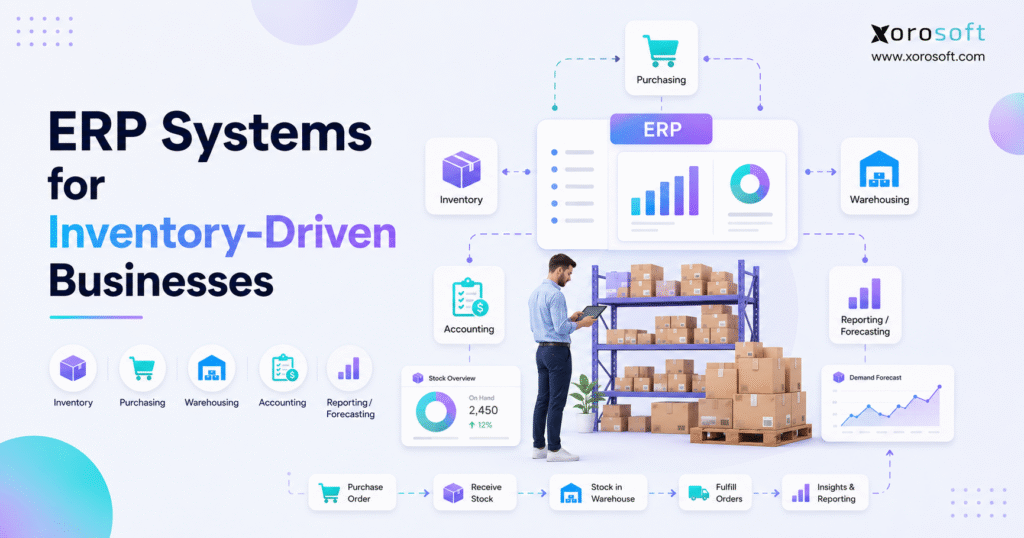
When considering solutions for managing stock and resources, inventory ERP systems have become essential for businesses looking to streamline operations and improve efficiency.
1. Why Inventory ERP Systems Become Necessary as Companies Grow
Inventory ERP systems become important when a product-based business can no longer trust spreadsheets, accounting tools, and disconnected apps to explain what is happening across stock, purchasing, warehouses, orders, and finance. At first, those tools may feel flexible. However, as order volume grows and inventory spreads across more channels, small gaps turn into expensive operating problems.
For many growing brands, demand is not the real issue. Instead, the company struggles because it cannot see inventory clearly enough to make fast decisions. One report may show stock as available, while the warehouse sees a shortage. Meanwhile, purchasing teams place orders too late, and finance waits for inventory adjustments before closing the month.
That is why ERP matters. A connected ERP system brings inventory, purchasing, warehouse management, accounting, order management, manufacturing, forecasting, ecommerce, and reporting into one shared operating system. As a result, teams stop rebuilding the truth manually every week.
Because inventory touches every department, the right system does more than track units. It helps teams understand what is available, what is committed, what is incoming, what needs to be purchased, what can be shipped, and what the financial impact will be.
1.1 What Inventory ERP Systems Solve for Product-Based Businesses
A business becomes inventory-driven when physical products sit at the center of revenue, operations, and cash flow. Ecommerce brands, wholesalers, manufacturers, apparel companies, furniture brands, sporting goods companies, food businesses, and distributors all fall into this category.
Although these companies may sell in different ways, they share the same operating challenge. Every team needs to buy, receive, store, move, pick, pack, ship, assemble, count, value, and report inventory accurately.
For example, a Shopify brand may begin with one warehouse and a few hundred SKUs. Later, it may add Amazon, wholesale, EDI, 3PL fulfillment, retail stores, and international customers. Consequently, inventory is no longer a simple stock count. It becomes the operating layer behind every order.
That is where inventory ERP systems become useful. They help the business move from manual tracking to connected operational control.
1.2 Why Inventory ERP Software Matters More Than Basic Stock Tracking
Inventory creates complexity because every stock movement affects more than one team. When a purchase order is created, purchasing cares about supplier timing. At the same time, warehouse teams care about receiving, finance cares about cost, and sales cares about availability.
Without connected data, each department builds its own version of the truth. Therefore, managers spend more time reconciling reports than making decisions.
A simple inventory app may show quantity on hand. However, growing companies need deeper context. They need to know which stock is committed, which stock is sitting in another warehouse, which purchase orders are delayed, which SKUs are overstocked, and which products are hurting cash flow.
Because of this, inventory ERP software is not just a software upgrade. It is a process upgrade for businesses that need accurate inventory decisions across departments.
1.3 How ERP for Inventory Management Connects Daily Operations
ERP for inventory management connects product movement with financial and operational impact. A sale reduces available inventory, creates warehouse work, updates revenue, affects margin, and changes reporting. Similarly, a purchase order affects incoming stock, supplier commitments, cash planning, warehouse receiving, and future availability.
In disconnected systems, these updates often happen in separate places. With a connected ERP, however, teams work from one operational record.
A good ERP system should help answer practical questions quickly:
What can we sell today?
How much stock is already committed?
Which items need to be purchased?
From which warehouse should this order ship?
Where is cash tied up in slow-moving products?
Are supplier delays creating stockout risk?
Which sales channels are actually profitable?
Once a company needs those answers daily, inventory ERP systems become far more valuable than isolated tools.
1.4 Why Basic Tools Break Before Inventory ERP Systems Are Adopted
Spreadsheets are useful for analysis. However, they are weak as operating systems because they do not enforce workflows, update in real time, prevent duplicate entries, manage barcode scanning, control purchasing approvals, or connect warehouse activity to finance.
Basic accounting tools can also work well in the early stage. Yet they usually struggle when a business needs multi-warehouse inventory, landed cost, demand forecasting, lot tracking, manufacturing, EDI, or warehouse execution.
The issue is not that spreadsheets or accounting tools are bad. Rather, inventory-driven growth requires stronger controls. Once several departments depend on the same stock data, manual workflows become risky.
As a result, many companies eventually move toward XoroERP or another ERP platform that can connect inventory, accounting, purchasing, warehousing, manufacturing, and reporting in one place.
2. Why Inventory ERP Systems Matter for Operations and Finance
Inventory ERP systems matter because inventory problems are rarely isolated. A stock discrepancy can turn into an oversold order. That order can become a refund, a support ticket, and a customer retention problem. Meanwhile, finance may still be trying to understand the cost impact.
Therefore, businesses need more than visibility. They need operational connection.
When inventory, purchasing, warehouse management, accounting, and reporting work separately, teams create competing versions of the truth. Sales may see one number, warehouse teams may see another, and finance may not trust either number until month-end. Consequently, leadership makes decisions later than it should.
With ERP, inventory becomes easier to manage because every workflow updates the same system.
2.1 Inventory ERP Systems for Stock Accuracy
Stock accuracy is the foundation of a product-based business. When the system says stock is available but the warehouse cannot find it, the company has a control problem.
Inventory ERP systems improve accuracy by connecting receiving, transfers, sales orders, returns, adjustments, cycle counts, and warehouse movements. As a result, teams can trace why stock changed instead of guessing.
For growing businesses, this matters because small errors multiply quickly. One missed receiving update may affect ecommerce availability. A delayed transfer may create a false shortage. Another incorrect adjustment may cause purchasing to buy more stock than needed.
2.1.1 Stock Discrepancies
Stock discrepancies happen when system inventory and physical inventory do not match. Usually, these errors come from missed scans, late updates, manual adjustments, unrecorded returns, damaged goods, or warehouse transfer mistakes.
A connected ERP system helps reduce those gaps because inventory movements are tied to transactions. Therefore, stock changes become visible, traceable, and easier to audit.
2.1.2 Overselling
Overselling happens when a business accepts orders for products it cannot ship. This is especially common when Shopify, Amazon, wholesale, and warehouse systems update at different speeds.
Centralized availability helps reduce that risk. However, the business still needs strong process discipline. ERP gives the data structure, while teams need to follow the workflow.
2.1.3 Lost Inventory Visibility
Lost visibility happens when teams cannot clearly see what is available, where it is located, what is committed, and what is incoming. Although total stock may look healthy, the right stock may not be in the right warehouse.
That is why multi-location visibility matters. A business may not need to buy more inventory. Instead, it may need to transfer stock from one warehouse to another.
2.2 Inventory ERP Software for Purchasing and Replenishment
Purchasing becomes harder as SKUs, suppliers, lead times, and sales channels increase. In the early stage, a buyer may manage replenishment with spreadsheets. Later, that process creates stockouts, overstock, and cash pressure.
Inventory ERP software helps purchasing teams connect demand, current stock, open sales orders, supplier lead times, reorder points, safety stock, and incoming purchase orders. Consequently, buying decisions become less reactive.
2.2.1 Spreadsheet Purchasing
Spreadsheet purchasing often works until demand becomes unpredictable. Once a company adds more channels, buyers spend too much time exporting data and updating formulas.
Because spreadsheets are not connected to live warehouse and sales activity, purchase decisions can become outdated before the order is placed. ERP helps by giving buyers more current information.
2.2.2 Late Purchase Orders
Late purchase orders usually happen when teams wait too long to reorder. However, the root issue is often poor visibility, not poor effort.
If supplier lead times, demand patterns, current stock, and open orders are not connected, buyers cannot see risk early enough. Therefore, inventory ERP systems help teams act before shortages reach customers.
2.2.3 Overstock and Stockouts
Stockouts hurt revenue, while overstock hurts cash. Unfortunately, many growing businesses experience both at the same time.
One SKU may be unavailable during peak demand. Meanwhile, another SKU may sit untouched for months. With better forecasting and purchasing visibility, ERP helps teams balance service levels and working capital.
2.3 Cloud Inventory ERP for Warehouses and Fulfillment
Warehouse problems often expose weak systems faster than any report. If receiving, picking, packing, shipping, and cycle counting are inconsistent, inventory numbers become unreliable.
A cloud inventory ERP with warehouse functionality helps connect warehouse activity to orders, inventory, and accounting. For businesses that need deeper warehouse execution, XoroWMS is an example of a system designed around real-time inventory tracking, order fulfillment, purchasing, receiving, and warehouse optimization.
2.3.1 Picking Errors
Picking errors create returns, reships, refunds, support tickets, and customer frustration. In addition, they usually indicate weak bin control or weak scanning discipline.
ERP-supported warehouse workflows can reduce these errors by guiding pickers, validating items, and updating inventory as work happens.
2.3.2 Multi-Warehouse Confusion
Multi-warehouse operations create a new level of complexity. Inventory may be available in one location but not another. Therefore, total stock is not enough. Teams need warehouse-level availability.
Inventory ERP systems help manage transfers, in-transit stock, location-level availability, and warehouse-specific fulfillment decisions.
2.3.3 Slow Fulfillment
Slow fulfillment often happens when order volume grows faster than warehouse process maturity. As a result, teams rely on printed lists, manual checks, and tribal knowledge.
ERP improves fulfillment by standardizing order release, picking, packing, shipping, and confirmation. Because of that, warehouse teams can handle more volume with fewer manual gaps.
2.4 ERP Inventory Management System for Accounting and Reporting
Inventory is both an operational asset and a financial asset. Therefore, accounting teams need accurate inventory costs, valuation, COGS, landed cost, adjustments, and reconciliations.
When inventory and accounting are disconnected, finance spends too much time fixing numbers after the fact. However, a connected ERP brings operational and financial data closer together.
2.4.1 Inventory Valuation Issues
Inventory valuation becomes difficult when purchasing, receiving, landed cost, returns, manufacturing, and adjustments happen in different tools. Because each transaction affects value, finance needs a reliable connection between operations and accounting.
An ERP inventory management system supports this connection by keeping inventory movement and accounting impact inside one workflow.
2.4.2 Delayed Month-End Close
A delayed month-end close often signals disconnected operations. Finance may wait for warehouse corrections, inventory counts, purchase updates, and manual reports before closing.
With ERP, finance can access cleaner operational data earlier. As a result, month-end close becomes less dependent on manual reconciliation.
2.4.3 Disconnected Financial Data
Disconnected financial data makes decision-making slower. Leadership may not know which products are profitable, which channels are underperforming, or which inventory is tying up too much cash.
ERP reporting helps connect stock, sales, cost, margin, and warehouse activity. Therefore, teams can make decisions with more confidence.
3. Core Features Inventory ERP Systems Should Include
Inventory ERP systems should be evaluated by workflow depth, not by the length of the feature list. A system may claim to support inventory, but the real question is whether it can support how the business actually buys, stores, sells, ships, and accounts for products.
3.1 Inventory Management in Inventory ERP Systems
Inventory management should include real-time stock visibility, SKU management, variants, transfers, adjustments, committed inventory, available-to-sell logic, cycle counts, inventory valuation, and location-level tracking.
For apparel, this may include size and color variants. Food companies may require lot and expiry tracking. Manufacturers often need raw materials and finished goods visibility.
Because each industry moves inventory differently, the ERP must fit the operating model.
3.2 Purchasing and Procurement in Inventory ERP Software
Purchasing should connect suppliers, purchase orders, lead times, approvals, receiving, landed cost, and replenishment planning.
Without this connection, buyers often place orders based on outdated data. However, when purchasing is tied to demand and inventory, teams can prevent shortages and reduce excess stock.
For companies comparing broader operating platforms, XoroONE is relevant because it combines sales, purchasing, inventory management, warehouse management, manufacturing, finance, reporting, forecasting, ecommerce, and EDI workflows.
3.3 Warehouse Management in Cloud Inventory ERP
Warehouse management should support receiving, putaway, bin locations, picking, packing, shipping, cycle counts, barcode scanning, and transfers.
If warehouse activity does not update inventory in real time, the ERP will lose credibility. Therefore, warehouse execution should be evaluated carefully before any system is selected.
3.4 Accounting and Finance in ERP for Inventory Management
Accounting should include general ledger, accounts payable, accounts receivable, inventory valuation, landed cost, COGS, bank reconciliation, tax handling, and financial reporting.
For inventory-driven businesses, accounting cannot sit completely apart from operations. Otherwise, finance will keep cleaning up data after operational mistakes have already happened.
3.5 Forecasting Inside Inventory ERP Systems
Demand forecasting helps teams estimate what to buy, build, or transfer. Although no forecast is perfect, a connected forecast is better than a static spreadsheet.
Inventory ERP systems should use sales history, seasonality, current stock, incoming purchase orders, supplier lead times, and open demand. As a result, planners can see risk earlier.
3.6 Manufacturing Workflows in Inventory ERP Software
Manufacturing workflows may require BOMs, work orders, material planning, production stages, raw material tracking, finished goods inventory, and costing.
If production is managed outside inventory and accounting, teams may struggle to understand what can be built, what materials are missing, and how production affects cost.
3.7 Ecommerce Integrations for Inventory ERP Systems
Ecommerce businesses need Shopify, Amazon, POS, B2B, EDI, 3PL, shipping, payment, and returns workflows to stay connected.
For Shopify merchants, the Xorosoft ERP Shopify App Store listing shows how ERP can support orders, prices, product details, variants, SKUs, multi-channel sync, multi-store sync, real-time status, automated alerts, reporting, accounting, forecasting, and inventory sync.
3.8 Reporting Tools in ERP Inventory Management Systems
Reporting should help teams understand stock position, sales performance, purchasing needs, supplier performance, warehouse productivity, gross margin, cash pressure, and operational bottlenecks.
Good reporting does not only describe what happened. Instead, it helps teams decide what to do next.
4. Inventory ERP Systems vs Other Business Tools
Inventory ERP systems are often compared with inventory apps, warehouse systems, accounting tools, MRP systems, and spreadsheets. Each tool can be useful. However, they solve different problems.
4.1 Inventory ERP Systems vs Inventory Management Software
Inventory management software usually focuses on stock tracking. ERP connects stock tracking with purchasing, accounting, warehouse management, sales orders, manufacturing, ecommerce, and reporting.
A small business may only need inventory software. However, a growing product-based company often needs ERP once inventory decisions begin affecting finance, fulfillment, and purchasing at the same time.
4.2 Inventory ERP Software vs Warehouse Management Systems
A warehouse management system focuses on warehouse execution. It helps teams receive, store, pick, pack, ship, and count products.
ERP has a wider role. It connects warehouse activity with inventory availability, purchasing, sales, finance, and reporting. Therefore, businesses should decide whether they need a standalone WMS, an ERP with WMS functionality, or both.
4.3 ERP for Inventory Management vs MRP
MRP focuses on material requirements planning. It is especially useful for manufacturers that need to plan raw materials, production schedules, and work orders.
ERP can include MRP, but it also covers purchasing, accounting, inventory, warehouse management, sales, ecommerce, and reporting. Therefore, manufacturers should look at the full operating model before choosing.
4.4 Inventory ERP Systems vs Accounting Software
Accounting software records financial activity. ERP connects financial activity with operations.
For example, a sale does not only create revenue. It also reduces inventory, triggers fulfillment, affects margin, and may change purchasing needs. Because of that, businesses that have outgrown basic accounting tools often review Xorosoft vs QuickBooks or similar ERP comparison resources.
4.5 Cloud Inventory ERP vs Spreadsheets
Spreadsheets are useful for planning and analysis. However, they are risky as systems of record.
They do not provide workflow control, automated updates, role-based approvals, audit trails, barcode validation, real-time sync, or reliable inventory ownership. Consequently, spreadsheets become fragile as more people depend on them.
4.6 Inventory ERP Systems vs Disconnected Apps
Disconnected apps often solve one problem at a time. One app handles inventory, another handles shipping, another handles EDI, another handles purchasing, and another handles accounting.
Initially, this setup feels flexible. Eventually, though, it creates duplicate data entry, unclear ownership, inconsistent reports, and more manual reconciliation.
5. When to Upgrade to Inventory ERP Systems
A business should consider inventory ERP systems when operational complexity becomes too high for spreadsheets, accounting-first tools, or disconnected apps.
Revenue is not the only trigger. Instead, the real signal is process strain. A $5 million company with many SKUs, warehouses, suppliers, and channels may need ERP sooner than a larger company with simple operations.
5.1 Operational Signs That Inventory ERP Systems Are Needed
Common ERP readiness signs include frequent stock discrepancies, late purchase orders, overselling, delayed month-end close, poor inventory reporting, warehouse picking errors, and too much manual reconciliation.
Additionally, leadership may start asking questions that the current system cannot answer quickly. The team may need to know which products are profitable, where warehouse delays are happening, how supplier problems are affecting stockouts, and whether certain sales channels are tying up too much working capital.
When those answers require several exports and manual cleanup, ERP becomes a serious consideration.
5.2 Inventory Complexity Triggers for ERP
Inventory complexity increases when a business adds more SKUs, variants, warehouses, bundles, assemblies, lots, serial numbers, or product categories.
At that point, basic stock tracking is not enough. Teams need visibility into available stock, committed stock, incoming stock, in-transit stock, damaged stock, and stock by location.
Therefore, inventory ERP systems become valuable when the company needs more than quantity on hand.
5.3 Warehouse Complexity Triggers for Cloud Inventory ERP
Warehouse complexity increases with multiple locations, 3PLs, bin tracking, barcode scanning, returns, transfers, and higher order volume.
If warehouse teams depend on manual workarounds, inventory accuracy will suffer. As a result, ecommerce promises, wholesale commitments, and financial reports may all become less reliable.
5.4 Purchasing Triggers for Inventory ERP Software
Purchasing complexity increases with supplier lead times, MOQ rules, seasonal buying, overseas suppliers, container delays, and channel-specific demand.
If buyers rely on spreadsheet exports to build purchase orders, the company may order too late or overbuy. With ERP, purchasing becomes more connected to current demand and available inventory.
5.5 Accounting Triggers for ERP Inventory Management Systems
Accounting complexity increases when finance needs accurate inventory valuation, landed cost, COGS, margin reporting, multi-currency support, and faster closes.
If month-end close depends on warehouse corrections and inventory spreadsheets, the business may need stronger system alignment.
5.6 Ecommerce and Wholesale Triggers for Inventory ERP Systems
Ecommerce and wholesale growth create different pressures. Ecommerce requires fast inventory sync and accurate fulfillment. Wholesale requires customer-specific pricing, allocation, EDI, and large order commitments.
When a company sells through Shopify, Amazon, wholesale, retail, and EDI together, inventory ERP systems become the operating layer that keeps these channels connected.
6. Inventory ERP Systems by Business Type
Inventory ERP systems should be evaluated by business model. A Shopify brand does not operate like a manufacturer. A furniture company does not operate like a food distributor. Therefore, industry fit matters.
For a broader view of where ERP fits across different product categories, the industries we serve page can be used as a helpful internal reference.
6.1 Inventory ERP Systems for Ecommerce Brands
Ecommerce brands need inventory sync, order routing, returns, warehouse visibility, purchasing, forecasting, and channel-level reporting.
Because ecommerce moves quickly, inventory errors become visible fast. A product shown as available may sell before the warehouse can confirm it. Therefore, ecommerce brands need connected data between storefronts, warehouses, and finance.
6.2 Inventory ERP Software for Shopify Businesses
Shopify businesses often start with apps because apps are easy to add. However, after growth, the app stack can become difficult to control.
A Shopify brand may use one tool for inventory, another for shipping, another for accounting, another for purchasing, and another for EDI. As a result, teams spend more time connecting tools than improving operations.
Inventory ERP systems help by turning Shopify into the sales channel while ERP becomes the operational source of truth behind it.
6.3 Cloud Inventory ERP for Amazon Sellers
Amazon sellers need inventory visibility across FBA, FBM, internal warehouses, and other channels. Additionally, they need replenishment discipline because marketplace velocity can hide stockout risk until it is too late.
ERP helps connect channel demand with purchasing and inventory planning. Therefore, sellers can avoid treating Amazon as a separate operational island.
6.4 ERP for Inventory Management in Wholesale Distribution
Wholesale distributors need customer-specific pricing, sales order control, inventory allocation, EDI, purchasing, warehouse management, and margin reporting.
Because wholesale orders are often larger, inventory mistakes can create bigger operational consequences. Therefore, distributors need reliable available-to-promise logic and clear allocation rules.
6.5 Inventory ERP Systems for Manufacturers
Manufacturers need raw material planning, BOMs, work orders, production planning, labor visibility, finished goods tracking, and costing.
If manufacturing is disconnected from inventory and accounting, teams may not know what can be produced, when materials are needed, or how production affects margin. ERP helps connect those decisions.
6.6 Inventory ERP Software for Apparel and Fashion
Apparel businesses manage size and color variants, seasonal collections, returns, wholesale accounts, ecommerce demand, and warehouse complexity.
Inventory ERP systems help apparel teams see variant-level stock, plan purchasing by season, allocate inventory across channels, and reduce fulfillment errors.
6.7 Cloud Inventory ERP for Furniture Businesses
Furniture companies often manage bulky products, long lead times, landed cost, supplier delays, warehouse space constraints, and complex fulfillment.
Because carrying the wrong inventory is expensive, ERP helps connect purchasing, receiving, availability, delivery planning, and financial reporting.
6.8 ERP Inventory Management Systems for Food and Beverage
Food and beverage businesses may need lot tracking, expiry tracking, production planning, supplier management, and inventory traceability.
Therefore, the ERP should support inventory visibility at a deeper level than simple SKU counts.
6.9 Inventory ERP Systems for Sporting Goods Brands
Sporting goods businesses often deal with seasonal demand, multi-channel selling, wholesale orders, and variant-level inventory.
ERP helps these teams plan replenishment, control warehouse workflows, and avoid having the right product in the wrong location.
7. How to Choose Inventory ERP Systems
Choosing inventory ERP systems should begin with operational problems, not software demos. Before reviewing platforms, the business should map where inventory, purchasing, warehouse, accounting, ecommerce, and reporting workflows currently break.
7.1 Map Current Problems Before Choosing Inventory ERP Systems
Start by listing the problems that cost time, cash, or customer trust. Examples include stockouts, overstock, picking errors, late purchase orders, delayed financial reports, and manual reconciliation.
After that, group each problem by department. This helps the team see whether the issue is inventory visibility, warehouse execution, purchasing planning, accounting alignment, or reporting.
7.2 Define Required Inventory ERP Software Modules
The business should define which ERP modules are required now and which may be needed later. Most inventory-driven businesses need inventory management, purchasing, warehouse management, accounting, reporting, and integrations.
Manufacturers may also need BOMs, work orders, and production planning. Meanwhile, ecommerce and wholesale businesses may need Shopify, Amazon, B2B, EDI, and 3PL integrations.
7.3 Review Integration Needs for Cloud Inventory ERP
Integrations should be reviewed carefully. It is not enough to ask whether the ERP connects to Shopify or Amazon. Instead, teams should ask what data syncs, how often it syncs, and which system owns the record.
A weak integration can still create overselling, duplicate orders, inventory mismatches, and reconciliation problems.
7.4 Evaluate Warehouse Depth in Inventory ERP Systems
Inventory depth matters more than basic stock tracking. Ask whether the system can manage transfers, cycle counts, barcode scanning, bin locations, committed inventory, lot tracking, serial tracking, landed cost, and available-to-sell rules.
If warehouse workflows are important, do not treat them as secondary.
7.5 Review Accounting Needs in ERP for Inventory Management
Finance should be involved early. Inventory valuation, landed cost, COGS, accounts payable, accounts receivable, multi-currency, and month-end close all depend on ERP configuration.
Because of that, choosing ERP without finance input can create expensive implementation problems later.
7.6 Compare Inventory ERP System Implementation Complexity
ERP implementation includes data cleanup, process mapping, accounting setup, integrations, warehouse rollout, training, and reporting.
A platform that looks powerful during a demo may still be a poor fit if implementation requires too much customization. Therefore, evaluate both capability and adoption risk.
7.7 Check Whether the Inventory ERP System Can Scale
Scalability means the ERP can support more SKUs, more orders, more warehouses, more users, more channels, and more reporting needs without forcing another system change too soon.
The best inventory ERP systems support the business you are becoming, not just the business you are today.
7.8 Build an Inventory ERP Systems Scorecard
Use a simple scorecard before making a decision.
| Evaluation Area | What to Review |
|---|---|
| Inventory fit | Stock accuracy, transfers, variants, lots, serials, valuation |
| Warehouse fit | Receiving, bins, barcode scanning, picking, packing, shipping |
| Purchasing fit | Suppliers, lead times, POs, approvals, replenishment |
| Accounting fit | COGS, landed cost, reconciliation, month-end close |
| Ecommerce fit | Shopify, Amazon, EDI, 3PL, shipping integrations |
| Reporting fit | Real-time dashboards, margin, stock, purchasing, warehouse KPIs |
| Scalability fit | Users, warehouses, SKUs, channels, entities, currencies |
| Implementation fit | Data migration, training, rollout, support, timeline |
8. Common Mistakes When Choosing Inventory ERP Systems
Many ERP mistakes happen before implementation begins. The company chooses a system based on a demo, a feature checklist, or a familiar brand name instead of operational fit.
8.1 Choosing Accounting Software Instead of Inventory ERP Systems
Accounting software may work for simple inventory. However, it will not usually solve warehouse execution, purchasing automation, forecasting, manufacturing, EDI, or multi-channel inventory visibility.
If the real issue is operational control, accounting software alone is not enough.
8.2 Choosing Inventory Software Without Finance
Inventory software can improve stock tracking. However, it may not solve inventory valuation, COGS, landed cost, financial reporting, or reconciliations.
As the company grows, finance needs inventory data it can trust. Therefore, inventory and accounting should not be treated as separate worlds.
8.3 Ignoring Warehouse Workflows in Inventory ERP Software
Some companies choose ERP based on dashboards and reports while ignoring warehouse execution. That is risky because warehouse teams create much of the data the ERP depends on.
If receiving, picking, packing, transfers, and cycle counts are inconsistent, the ERP record will also become unreliable.
8.4 Underestimating Inventory ERP Data Migration
Bad data creates bad ERP outcomes. Before implementation, companies should clean SKUs, vendors, customers, units of measure, inventory balances, open orders, purchase orders, BOMs, and chart of accounts data.
Although data cleanup feels slow, it prevents bigger problems after launch.
8.5 Buying for Today Instead of Future Growth
A system that solves today’s pain may fail when the business adds warehouses, wholesale, EDI, manufacturing, or international operations.
Therefore, the selection process should consider the next stage of growth, not only the current bottleneck.
8.6 Over-Customizing Inventory ERP Systems Too Early
Customization can help when a process is truly unique. However, early over-customization often recreates old habits inside a new system.
Before customizing, teams should ask whether the process is necessary or simply familiar.
9. ERP Platform Considerations for Inventory-Driven Businesses
No ERP platform is best for every inventory-driven business. The right choice depends on industry, sales channels, warehouse complexity, finance needs, manufacturing requirements, budget, implementation resources, and growth plans.
Companies that are actively comparing platforms can review the broader ERP comparison guide for more context. However, this article is not mainly a comparison page, so the priority here is decision quality rather than ranking vendors.
9.1 NetSuite
NetSuite is often reviewed by mid-market and enterprise teams. However, businesses should carefully evaluate implementation scope, total cost, customization needs, and operational fit.
For inventory-driven companies, the key question is whether the system can support daily warehouse, purchasing, ecommerce, and accounting workflows without excessive complexity.
9.2 Acumatica
Acumatica is a flexible cloud ERP option. However, implementation partner fit and industry workflow fit matter.
Inventory-heavy companies should evaluate warehouse depth, inventory controls, integrations, accounting needs, and reporting requirements before deciding.
9.3 Cin7
Cin7 is commonly considered by businesses looking for inventory and order management. However, companies should decide whether they need inventory software or full ERP.
If accounting, purchasing, warehouse management, forecasting, and manufacturing must work together, broader ERP functionality may be needed.
9.4 Fishbowl
Fishbowl is often reviewed by companies using QuickBooks with inventory needs. However, businesses should consider whether that combination can support long-term growth.
If the company needs deeper warehouse, finance, purchasing, ecommerce, and reporting workflows, ERP may become the next step.
9.5 Xorosoft
Xorosoft is a cloud ERP platform for inventory-driven businesses that need inventory management, accounting, purchasing, warehouse management, manufacturing, forecasting, reporting, ecommerce, and EDI workflows in one system.
It is especially relevant for product-based businesses that have outgrown spreadsheets, QuickBooks, inventory-only tools, or disconnected apps.
10. Where Xorosoft Fits Within Inventory ERP Systems
Xorosoft fits best when a company sells physical products and needs stronger operational control across inventory, purchasing, warehouses, accounting, manufacturing, ecommerce, and reporting.
It should not be positioned as a generic ERP for every company. Instead, it makes the most sense for businesses where inventory complexity is already creating operational pain.
10.1 Cloud Inventory ERP for Product-Based Companies
Xorosoft is built for businesses that sell, store, move, manufacture, or distribute physical goods. That includes apparel, furniture, sporting goods, food and beverage, wholesale distribution, manufacturing, ecommerce, and consumer product brands.
Because these companies depend on accurate stock, ERP becomes the system that connects daily execution with financial visibility.
10.2 Inventory, Accounting, Purchasing, and Warehousing in One System
For inventory-driven businesses, the value of ERP comes from connection. Inventory should not sit in one tool while purchasing sits in another, warehouse activity sits in another, and accounting sits somewhere else.
Xorosoft helps centralize these workflows so teams can reduce duplicate data entry, improve visibility, and manage operations from one cloud ERP environment.
10.3 Shopify, Amazon, EDI, and Multi-Warehouse Operations
Many growing product companies sell through more than one channel. They may run Shopify for ecommerce, Amazon for marketplace demand, wholesale for larger accounts, EDI for retailers, and multiple warehouses for fulfillment.
Because of that, inventory ERP systems need to manage more than orders. They need to manage the operational impact behind each channel.
10.4 When Xorosoft May Be a Fit
Xorosoft may be a fit when a business manages multiple warehouses, sells through Shopify or Amazon, uses wholesale or EDI, needs purchasing automation, wants accounting connected with inventory, or has manufacturing workflows.
It may also fit companies that need more structure than inventory-only software but want a modern cloud ERP built around product operations.
10.5 When Xorosoft May Not Be a Fit
Xorosoft may not be the right fit for businesses that do not manage inventory, do not sell physical products, only need simple bookkeeping, or are not ready to standardize workflows.
ERP requires process discipline. Therefore, a company should implement ERP when it is ready to improve how work happens, not just when it wants another tool.
11. Inventory ERP Implementation Considerations
ERP implementation should be treated as an operating project, not a software installation. The goal is not simply to launch a system. Instead, the goal is to create reliable workflows across departments.
For proof that ERP outcomes depend on real operating problems, the case studies section can help readers see how different businesses approach ERP change.
11.1 Data Migration for Inventory ERP Systems
Data migration includes SKUs, customers, vendors, inventory balances, open sales orders, purchase orders, BOMs, pricing, chart of accounts, warehouse locations, and historical records.
Clean data builds trust. Messy data creates confusion from day one.
11.2 Process Mapping Before ERP Go-Live
Process mapping defines how work should happen after ERP goes live. This includes purchasing approvals, receiving, picking, packing, shipping, returns, manufacturing, transfers, accounting close, and reporting.
Because ERP touches many teams, process mapping should involve operations, finance, warehouse, purchasing, ecommerce, and leadership.
11.3 User Training for Inventory ERP Software
Training should be role-specific. Warehouse users need different training than buyers. Finance teams need different training than customer service teams.
Therefore, ERP training should be built around real daily work, not generic navigation.
11.4 Inventory Cleanup Before Cloud ERP Launch
Inventory cleanup should happen before go-live. Teams should count stock, review discrepancies, clean item records, validate warehouse locations, and confirm open transactions.
Without this step, the new ERP starts with old inventory problems.
11.5 Accounting Setup in ERP for Inventory Management
Accounting setup includes chart of accounts, inventory valuation method, landed cost, COGS, tax rules, accounts payable, accounts receivable, reporting, and month-end processes.
Finance should validate these decisions early because accounting errors are harder to fix later.
11.6 Warehouse Rollout for Inventory ERP Systems
Warehouse rollout should include receiving, putaway, bin setup, barcode scanning, picking, packing, shipping, transfers, and cycle counting.
If the company has multiple warehouses, a phased rollout may reduce risk. However, each phase should still follow the same data standards.
11.7 Reporting After Inventory ERP Implementation
After launch, leadership should monitor inventory accuracy, order cycle time, purchasing delays, stockouts, overstock, warehouse productivity, gross margin, and month-end close timing.
These metrics show whether the ERP is improving operations or simply replacing old tools.
12. FAQ: Inventory ERP Systems
12.1 How do inventory ERP systems work?
Inventory ERP systems connect inventory management with purchasing, warehouse management, accounting, sales orders, manufacturing, ecommerce, forecasting, and reporting. Instead of tracking stock separately, they create one operating system for product movement and business impact.
12.2 Which businesses are considered inventory-driven?
Any company where physical products directly affect revenue and operations is inventory-driven. Ecommerce brands, wholesalers, manufacturers, distributors, apparel companies, food brands, furniture businesses, and sporting goods companies are common examples. If stock accuracy affects sales, cash flow, and fulfillment, the business is inventory-driven.
12.3 Why do product-based companies need ERP?
Product-based companies need ERP because inventory affects multiple departments at once. A stock movement can change sales availability, warehouse workload, purchasing needs, accounting values, and reporting. Therefore, ERP helps teams work from one source of truth instead of reconciling separate tools.
12.4 How does ERP improve stock accuracy?
Accuracy improves when receiving, transfers, sales orders, returns, adjustments, production, and cycle counts update the same system. As a result, every stock movement has a transaction behind it. This makes discrepancies easier to find and easier to prevent.
12.5 Is ERP broader than inventory management software?
ERP is broader than inventory management software in most growing businesses. Inventory software mainly tracks stock, while ERP connects stock with purchasing, accounting, warehouse management, manufacturing, ecommerce, and reporting. Therefore, ERP is usually better when inventory decisions affect finance and fulfillment.
12.6 ERP vs WMS: what is the difference?
A WMS manages warehouse execution, including receiving, bin locations, picking, packing, shipping, and cycle counts. ERP manages broader business workflows such as inventory, purchasing, accounting, sales, manufacturing, and reporting. Some businesses use ERP with built-in WMS, while others connect both systems.
12.7 MRP vs ERP: what is the difference?
MRP focuses on material planning for manufacturing. ERP is broader because it can include MRP while also managing inventory, purchasing, accounting, warehouse management, sales orders, ecommerce, and reporting. Therefore, manufacturers should evaluate both production needs and full business needs.
12.8 QuickBooks vs ERP: when is QuickBooks enough?
QuickBooks may be enough for simple businesses with basic inventory needs. However, it can become limiting when companies need multi-warehouse visibility, purchasing automation, warehouse workflows, forecasting, manufacturing, landed cost, or advanced reporting. The decision depends on operational complexity.
12.9 When should a business upgrade from QuickBooks to ERP?
A business should consider upgrading when QuickBooks no longer gives enough control over inventory, purchasing, warehouses, ecommerce, manufacturing, or reporting. Common signs include stock discrepancies, delayed month-end close, manual reconciliations, spreadsheet purchasing, and poor inventory visibility.
12.10 Multi-warehouse inventory: can ERP manage it?
Many ERP systems can manage multiple warehouses. They should track stock by location, bin, status, transfer, committed quantity, and available-to-sell inventory. This helps teams reduce overselling, unnecessary purchasing, transfer confusion, and fulfillment delays.
12.11 Shopify and Amazon inventory: can ERP connect both?
Most modern ERP platforms can connect Shopify and Amazon inventory through native integrations, connectors, or middleware. However, businesses should confirm what data syncs, how often it syncs, and which system owns inventory availability.
12.12 EDI workflows: can ERP support them?
Some ERP platforms support EDI workflows directly or through EDI providers. This is important for wholesale businesses that sell to retailers, marketplaces, or large trading partners. ERP can connect EDI orders with inventory allocation, fulfillment, invoicing, and reporting.
12.13 Purchasing teams: how does ERP help?
Buyers can use ERP to connect suppliers, lead times, purchase orders, current stock, demand, receiving, and expected availability. As a result, purchasing decisions become less dependent on spreadsheet exports and manual updates.
12.14 Forecasting: does ERP improve planning?
Planning improves when ERP connects sales history, seasonality, current stock, incoming purchase orders, supplier lead times, and channel demand. Although forecasts still need human review, connected data usually improves planning quality.
12.15 Stockouts: can ERP reduce them?
Better visibility can help reduce stockouts. ERP shows current stock, committed inventory, reorder points, open purchase orders, supplier lead times, and forecasted demand. However, teams still need strong purchasing discipline and accurate data.
12.16 Overstock: does ERP help control it?
Excess stock becomes easier to manage when purchasing decisions are connected with demand, current stock, sales trends, and supplier lead times. Additionally, ERP helps teams identify slow-moving products earlier so they can adjust buying, transfers, promotions, or markdowns.
12.17 Ecommerce brands: which ERP features matter most?
Key ERP features for ecommerce brands include inventory sync, order management, Shopify and Amazon integrations, warehouse workflows, returns, purchasing, forecasting, accounting, and reporting. These features help reduce overselling, improve fulfillment, and clarify channel performance.
12.18 Wholesale distributors: which ERP features matter most?
Distributors should prioritize customer-specific pricing, sales orders, purchase orders, EDI, inventory allocation, warehouse management, replenishment, accounting, and margin reporting. These workflows help manage large orders and customer commitments more reliably.
12.19 Manufacturers: which ERP features matter most?
Production-focused companies should look for BOMs, work orders, raw material planning, finished goods inventory, purchasing, warehouse management, costing, and reporting. ERP should connect production activity with inventory availability and financial impact.
12.20 Who should avoid buying ERP?
Very small companies may not need ERP if they have simple operations, few SKUs, one channel, no warehouse complexity, no manufacturing, and basic accounting needs. ERP may also be unnecessary if the team is not ready to standardize workflows.
12.21 How should a business choose an ERP system?
Start with operational problems. After that, define required modules, review integrations, evaluate warehouse and accounting depth, compare implementation effort, and score scalability. The best ERP is the one that fits real workflows.
12.22 Before implementation, what data should be prepared?
Prepare SKUs, customers, vendors, inventory balances, open sales orders, purchase orders, BOMs, pricing, warehouse locations, units of measure, chart of accounts, and historical data. Clean data helps the new system launch with trust.
12.23 Is Xorosoft an inventory ERP system?
Yes. Xorosoft is a cloud ERP platform for inventory-driven businesses that need inventory management, accounting, purchasing, warehouse management, manufacturing, forecasting, reporting, ecommerce, and EDI workflows connected in one system.
13. Build the System Before Complexity Wins
Inventory-driven businesses rarely outgrow their systems in one obvious moment. Instead, the pressure builds gradually. First, reports become less reliable. Then purchasing becomes reactive. Later, warehouse errors increase, finance closes later, and leadership starts questioning the numbers.
At that point, inventory ERP systems become more than a software category. They become the operating structure behind growth.
A strong ERP system helps teams connect inventory, purchasing, warehouses, accounting, ecommerce, manufacturing, forecasting, and reporting. Consequently, the business can reduce manual work, improve visibility, and make better decisions before problems reach customers.
For companies that sell physical products, the goal is not simply to add another tool. The goal is to create one reliable system that supports how products move, how teams work, and how financial results are reported.
If your team is managing inventory, purchasing, warehousing, ecommerce, and accounting across disconnected tools, it may be time to review a connected ERP path. You can Book a demo to see how Xorosoft supports inventory-driven operations in one cloud ERP environment.
Recent Posts
-
 Best AI Warehouse Management Software for ERP Inventory and Warehouse Operations
 -
 Project Based ERP Software for Managing Project Costs, Purchasing, Resources, Inventory, and Accounting
 -
 Food and Beverage ERP Requirements for Lot, Expiry, and Recall Control
 -
 How to Prevent EDI Errors Before They Become Retailer Chargebacks
 -
 Warehouse Injury and Safety Statistics: What Operations Teams Should Know Before Automating Workflows