If you manage a business that handles goods or products, understanding inventory accounting is essential to track and value your stock accurately.
1. Inventory Accounting Problems Begin When Stock and Finance Drift Apart
A warehouse can show the correct number of units while the balance sheet still carries the wrong inventory value. This disconnect usually appears when purchasing, receiving, warehouse activity, ecommerce orders, returns, production, and accounting operate in separate systems or follow different timing rules.
For example, the warehouse may show 1,000 units on hand, but finance may still use an outdated unit cost. Meanwhile, freight and duties may remain in a spreadsheet. A customer return may have been refunded but not inspected. Similarly, a production order may be complete on the shop floor but still open in the accounting system.
At first, each issue appears operational. However, every one of them can distort cost of goods sold, gross margin, working capital, and product profitability. As a result, management may make pricing or purchasing decisions using incomplete information.
The challenge becomes more serious as a business adds suppliers, warehouses, marketplaces, currencies, and manufacturing processes. Therefore, inventory accounting becomes more than a bookkeeping task. Instead, it becomes the financial framework that connects physical product movement with the general ledger.
Moreover, growing businesses need a consistent way to track quantity, ownership, location, condition, and cost. Otherwise, warehouse records and financial reports gradually stop agreeing.
This guide explains how inventory accounting works, which costs belong in inventory, how valuation methods differ, how journal entries flow, and when a product business should replace disconnected tools with a more integrated operating system.
2. What Inventory Accounting Means for a Product Business
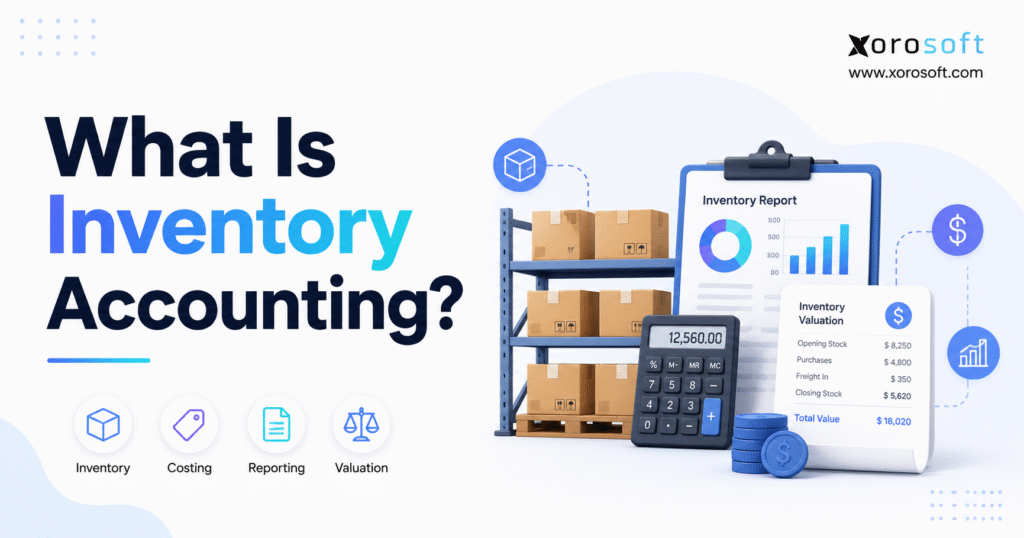
Inventory accounting is the process of identifying, valuing, recording, and reporting the products and materials a business owns. In practice, it follows stock from purchase or production through storage, sale, return, damage, write-down, or disposal.
Before a product is sold, its qualifying cost is generally carried as an inventory asset. After the sale, however, that cost moves to cost of goods sold, or COGS. Consequently, inventory accounting determines both the value remaining on the balance sheet and the expense reported on the income statement.
Inventory accounting definition: Inventory accounting tracks the financial value of products and materials from purchase or production through sale. Inventory generally remains an asset until it is sold, when its carrying cost becomes cost of goods sold.
Therefore, inventory accounting connects warehouse activity with financial reporting. In addition, it gives management a clearer view of product margins, purchasing commitments, and cash tied up in unsold stock.
2.1 What an Inventory Accounting System Tracks
A complete inventory accounting process tracks more than product quantities. Specifically, it records the financial events that create or change inventory value.
These events commonly include:
- Supplier purchases
- Purchase discounts
- Vendor rebates
- Supplier credits
- Inbound freight
- Customs duties
- Inventory receipts
- Warehouse transfers
- Production consumption
- Direct manufacturing labor
- Production overhead
- Customer shipments
- Customer returns
- Vendor returns
- Shrinkage
- Damage
- Write-downs
- Write-offs
- Physical-count adjustments
- Ending inventory
- Cost of goods sold
Additionally, the process must preserve transaction timing and ownership. For instance, goods may be in transit, held on consignment, stored by a third-party logistics provider, or waiting for inspection.
Therefore, quantity information alone is not enough. Cost, ownership, condition, location, and transaction date must also be accurate.
2.2 Is Inventory an Asset or an Expense?
Inventory is generally recorded as a current asset while the company owns it. Once the related product is sold, however, its carrying cost becomes an expense through COGS.
For example, suppose a wholesaler buys 500 units for $20 each. Initially, the $10,000 purchase remains in inventory. After 100 units are sold, the cost assigned to those units moves from the inventory asset account to COGS.
Meanwhile, the remaining 400 units continue to appear as inventory. Nevertheless, damage, theft, expiry, or obsolescence may require earlier expense recognition.
As a result, the condition and status of inventory matter just as much as the physical count. Consequently, finance teams need reliable information from warehouse and operations teams.
2.3 Inventory Accounting vs. Inventory Management
Inventory accounting and inventory management use related data. However, they serve different business purposes.
| Area | Inventory Accounting | Inventory Management |
|---|---|---|
| Focus | Financial value | Physical quantity and movement |
| Main question | What is inventory worth? | What is available and where? |
| Records | Subledger, general ledger, COGS | SKU, location, lot, serial, allocation |
| Users | Finance and accounting | Buyers, warehouse, operations |
| Main output | Asset value and gross margin | Availability and replenishment |
For instance, inventory management may show that 50 units moved from Warehouse A to Warehouse B. Inventory accounting, in contrast, determines whether total company value remains unchanged and whether the goods should be shown as inventory in transit.
Therefore, both functions should use the same underlying transactions. Otherwise, warehouse quantities and financial reports may gradually stop agreeing.
3. Why Accurate Inventory Valuation Matters
Inventory may represent a large share of a product company’s working capital. Consequently, even a small valuation error can affect several financial and operational decisions.
3.1 Inventory Accounting Affects the Balance Sheet
Unsold stock is generally reported as a current asset. Therefore, overstated inventory can overstate current assets and working capital.
Understated inventory, on the other hand, may make the company appear financially weaker than it is. Moreover, lenders, investors, and management may rely on those balances when evaluating liquidity.
As a result, inventory valuation must reflect both accurate quantities and supportable product costs. Otherwise, the balance sheet may not represent the actual financial position of the business.
3.2 Inventory Costing Affects COGS and Gross Profit
Gross profit is calculated as follows:
Gross Profit = Net Sales − Cost of Goods Sold
When inventory cost is too low, COGS may also be too low. Consequently, gross profit appears stronger than it really is.
When inventory cost is too high, however, management may believe products are less profitable. The company may then raise prices, reduce purchasing, or discontinue an item based on unreliable information.
Therefore, accurate inventory costing is essential for dependable margin reporting. Furthermore, it allows finance and operations to compare actual results against budgets and forecasts.
3.3 Stock Accounting Affects Purchasing and Cash Flow
Inventory is cash converted into products. Until those products are sold and payment is collected, the cash remains tied up.
Reliable stock accounting helps teams answer practical questions:
- How much cash is committed to current inventory?
- Which products are moving slowly?
- Which products produce reliable margins?
- How much inventory is obsolete?
- Are purchasing teams ordering faster than products sell?
- Does the company have enough working capital for the next buying cycle?
Furthermore, accurate costs improve purchase-order approval. A product may appear profitable when supplier price alone is considered. However, once freight, duty, and handling are included, the margin may look very different.
Consequently, purchasing teams need financial cost visibility rather than quantity information alone.
3.4 Inventory Financial Reporting Supports Better Decisions
Accurate inventory costs support:
- SKU-level margin analysis
- Channel profitability
- Warehouse performance
- Supplier negotiations
- Pricing decisions
- Product discontinuation
- Demand planning
- Production planning
- Cash-flow forecasting
- Purchase-order approval
In addition, reliable reporting helps finance and operations discuss the same numbers. Accounting policies and tax requirements vary, however, so the company should document its methods and confirm material treatments with a qualified professional.
Ultimately, good inventory accounting improves both compliance and decision-making.
4. Types of Inventory Included in Inventory Accounting
Inventory categories depend on how a business buys, stores, produces, and sells physical products.
4.1 Raw Materials Inventory
Raw materials are components or ingredients used during production.
Examples include:
- Fabric used in apparel
- Lumber used in furniture
- Metal used in machinery
- Ingredients used in food production
- Packaging included with a finished product
- Electronic components used in assembled devices
Initially, these costs remain in raw-material inventory. Once the materials are issued to production, however, their value usually moves into work in process.
Therefore, material issue transactions must be recorded accurately and promptly.
4.2 Work-in-Process Inventory
Work in process, or WIP, represents incomplete production.
Its value may include:
- Raw materials consumed
- Direct labor
- Machine time
- Outside processing
- Allocated production overhead
For example, a partly assembled table may contain lumber, hardware, labor, and factory overhead. Although the product is not ready for sale, those costs have already been incurred.
Therefore, incomplete or delayed production entries can leave costs in the wrong account or reporting period. Moreover, they can distort both WIP and finished-goods balances.
4.3 Finished Goods Inventory
Finished goods have completed production and are ready for sale.
Their value may include materials, direct labor, and allocated overhead. Once a finished product is sold, its carrying cost moves to COGS.
Meanwhile, any unsold units remain in finished-goods inventory. Consequently, production completion dates must align with the period in which the goods became available.
4.4 Merchandise Inventory
Retailers, ecommerce brands, and wholesalers commonly purchase completed products for resale.
Merchandise inventory cost generally begins with the supplier price. Additionally, qualifying freight, duties, brokerage, and handling may be included.
Unlike manufacturers, these businesses usually do not move costs through raw materials and WIP. Nevertheless, they still need accurate receiving, landed-cost, return, and valuation processes.
4.5 Consigned and Third-Party Inventory
Physical location does not always determine ownership.
A company may hold consigned goods that still belong to a supplier. Similarly, it may own inventory stored at a third-party warehouse.
Therefore, contract terms and ownership transfer matter more than location alone. Consequently, finance teams need visibility into goods held outside company-operated facilities.
5. Which Costs Belong in Inventory Valuation?
The supplier invoice is only the starting point for many product businesses. In addition, inventory may include purchase, conversion, freight, duty, and other qualifying costs.
5.1 Product Purchase Cost
Purchase cost generally starts with the supplier’s invoice price.
However, net cost may also reflect:
- Supplier discounts
- Volume rebates
- Vendor credits
- Purchase returns
- Promotional allowances
- Price adjustments
For example, a supplier may invoice goods at $50,000 and later issue a $2,000 credit. Consequently, the business needs a consistent method for allocating the reduction across the affected products.
Otherwise, the reported product cost may remain overstated.
5.2 Freight, Duties, and Landed Costs
Imported and long-distance inventory often carries significant costs beyond the supplier invoice.
Landed cost may include:
- Ocean freight
- Air freight
- Ground transportation
- Customs duties
- Brokerage fees
- Cargo insurance
- Port charges
- Qualifying handling expenses
Suppose 1,000 units cost $20 each and qualifying import costs total $4,000. Without landed-cost allocation, the system reports a unit cost of $20. After allocation, however, the unit cost becomes $24.
At a $35 selling price, the first calculation suggests a $15 unit margin. In contrast, the complete cost shows an $11 unit margin.
Therefore, incomplete landed cost can materially distort product profitability. Moreover, it can affect pricing, purchasing, and channel decisions.
5.3 Direct Labor and Production Overhead
Manufactured inventory may also include direct labor and reasonably allocated production overhead.
Direct labor can include:
- Assembly
- Cutting
- Sewing
- Machine operation
- Finishing
- Production inspection
Meanwhile, overhead may include factory rent, equipment depreciation, production supervision, and factory utilities.
Selling, marketing, general administration, and abnormal waste are generally reviewed separately. Nevertheless, the exact treatment depends on the applicable accounting framework.
Therefore, manufacturers need documented cost-allocation rules.
5.4 Why Connected Purchasing Improves Inventory Costing
Landed cost becomes harder to manage when purchase orders, receipts, supplier invoices, freight bills, and quantities sit in separate systems.
XoroONE connects purchasing, inventory, warehouse management, accounting, manufacturing, forecasting, and reporting in one cloud ERP environment.
As a result, cost-related transactions remain closer to the operational events that created them. Technology does not replace accounting judgment; however, it can reduce duplicate entry and spreadsheet-based reconstruction.
Moreover, connected purchasing allows teams to investigate costs from the source transaction rather than relying on month-end estimates.
6. How Inventory Accounting Works From Purchase to Sale
Inventory accounting follows the operational lifecycle of a product.
6.1 Purchasing Creates the Initial Cost
The process begins with a purchase order, supplier invoice, production order, or material transaction.
A purchase order establishes expected quantity and price. Meanwhile, the supplier invoice creates the financial obligation.
However, ownership may transfer before or after physical receipt. Therefore, the company needs clear rules for determining when inventory should be recognized.
In addition, finance should understand any contractual terms that affect goods in transit.
6.2 Receiving Confirms Quantity and Location
When products arrive, the receiving team verifies:
- SKU
- Quantity
- Unit of measure
- Warehouse
- Lot or serial number
- Condition
- Receipt date
- Purchase-order reference
For example, receiving 100 cases as 100 individual units can create a serious quantity error. Furthermore, an incorrect receipt date may place inventory in the wrong reporting period.
Therefore, accurate receiving supports both operations and accounting. Consequently, receiving controls should be treated as financial controls as well.
6.3 Warehouse Activity Changes Inventory Status
After receipt, inventory may move through several statuses:
- Available
- Allocated
- Picked
- Packed
- Shipped
- In transit
- Quarantined
- Damaged
- Returned
Not every status change creates a journal entry. Nevertheless, status affects availability, ownership review, and period-end reporting.
For example, quarantined inventory may still be owned by the business. However, it may not be available for sale.
6.4 A Sale Creates Revenue and COGS
A product sale normally creates two financial effects.
First, the company records revenue. Second, the carrying cost of the sold product moves from inventory to COGS.
Recording revenue without COGS overstates inventory and gross profit. Conversely, recording COGS without revenue understates profit.
Therefore, both entries must follow the same recognition policy. Moreover, the order, shipment, and accounting dates should remain aligned.
6.5 Returns Reverse Several Events
A customer return is not simply a negative sale.
Instead, it may require:
- Revenue reversal
- Tax adjustment
- Refund processing
- COGS reversal
- Product inspection
- Restocking
- Damage recognition
- Warehouse status changes
For example, a refund may be processed before the warehouse receives the product. Consequently, finance and operations may temporarily hold different information.
Therefore, return workflows should include clear status and inspection rules.
6.6 Reconciliation Completes the Cycle
At period end, finance compares operational records with the inventory subledger and general ledger.
The process reviews:
- Unposted receipts
- Unposted shipments
- Transfers in transit
- Negative inventory
- Delayed returns
- Cost changes
- Physical-count adjustments
- Manufacturing transactions
- Landed-cost entries
Ultimately, the objective is not merely to make reports match. Instead, the team must identify the operational reason for each material difference.
Otherwise, the same discrepancy may reappear in the next period.
7. Inventory Valuation Methods: FIFO, LIFO, and Weighted Average
A valuation method determines which costs move to COGS and which costs remain in ending inventory.
Although warehouse staff may physically pick a specific unit, the approved accounting method determines the cost assigned to the sale.
7.1 FIFO Inventory Accounting
FIFO means first in, first out.
Under FIFO, the oldest available costs move to COGS first. Consequently, ending inventory contains newer cost layers.
Assume a business purchases:
- 100 units at $10
- 100 units at $12
- 100 units at $14
The company then sells 150 units.
FIFO COGS is:
- 100 × $10 = $1,000
- 50 × $12 = $600
- Total COGS = $1,600
Ending inventory is:
- 50 × $12 = $600
- 100 × $14 = $1,400
- Ending inventory = $2,000
FIFO often aligns naturally with perishable and seasonal products. However, physical movement and accounting cost flow are not always identical.
Therefore, businesses should document both warehouse rotation rules and accounting valuation rules.
7.2 LIFO Inventory Accounting
LIFO means last in, first out.
Under LIFO, the most recent inventory costs move to COGS first.
Using the same purchases:
- 100 × $14 = $1,400
- 50 × $12 = $600
- Total COGS = $2,000
Ending inventory becomes $1,600.
When purchase prices rise, LIFO may produce higher COGS than FIFO. Consequently, ending inventory may be lower.
However, method availability depends on the reporting and tax framework. Therefore, businesses should obtain professional advice before choosing or changing a method.
7.3 Weighted Average Inventory Costing
Weighted average spreads total available cost across all available units.
Weighted Average Unit Cost = Total Cost of Available Inventory ÷ Total Available Units
Using the same example:
- Total cost = $3,600
- Total units = 300
- Average cost = $12
- COGS for 150 units = $1,800
- Ending inventory = $1,800
This method can suit similar, high-volume products. Moreover, it reduces the operational importance of individual cost layers.
However, the blended cost may hide differences between older and newer purchases. Therefore, it may provide less detail for certain pricing or sourcing decisions.
7.4 Specific Identification Inventory Costing
Specific identification assigns the actual cost of an individual item to that item.
It is commonly considered for:
- Vehicles
- Machinery
- Custom furniture
- Fine art
- Luxury goods
- Serialized equipment
- Project-specific components
Because each unit retains its actual cost, the method can provide precise margin information. Nevertheless, it requires reliable unit-level records.
Therefore, the method is usually inappropriate when products are interchangeable and not individually tracked.
7.5 Inventory Valuation Method Comparison
| Method | Cost Assigned First | Common Fit | Main Limitation |
| FIFO | Oldest cost | General, seasonal, perishable goods | Results change with cost trends |
| LIFO | Newest cost | Certain eligible U.S. businesses | Not permitted under IFRS |
| Weighted average | Blended cost | Similar, high-volume products | Individual layers are hidden |
| Specific identification | Actual unit cost | Unique or serialized goods | Requires detailed records |
Ultimately, the choice should reflect reporting rules, tax treatment, product type, cost volatility, system capability, and consistency requirements.
8. How Inventory Accounting Calculates COGS and Ending Inventory
The standard periodic formula is:
COGS = Beginning Inventory + Purchases − Ending Inventory
Assume a distributor begins the month with $80,000 of inventory, purchases another $50,000, and ends with $45,000.
| Calculation | Amount |
| Beginning inventory | $80,000 |
| Add purchases | $50,000 |
| Goods available for sale | $130,000 |
| Subtract ending inventory | $45,000 |
| Cost of goods sold | $85,000 |
If net sales were $140,000, gross profit would be $55,000.
8.1 Why Ending Inventory Errors Affect Two Periods
Suppose ending inventory is overstated by $5,000.
As a result, current-period COGS may be understated by $5,000. Gross profit may then be overstated by the same amount.
In the next period, however, that overstated ending balance becomes overstated beginning inventory. Therefore, one mistake can affect more than one reporting period.
Consequently, inventory corrections should be investigated rather than treated as isolated differences.
8.2 Why Correct Quantities Can Still Produce Incorrect COGS
A physical count may confirm 500 units. Nevertheless, COGS can still be wrong when:
- Product costs are outdated
- Freight has not been allocated
- Vendor credits are missing
- Returns were restored at the wrong cost
- Manufacturing labor is incomplete
- Negative inventory changed cost calculations
- The valuation method was applied inconsistently
Consequently, quantity accuracy and cost accuracy must be reviewed together. Otherwise, the warehouse may appear correct while financial reporting remains wrong.
9. Inventory Accounting Journal Entries for Common Transactions
Journal entries vary by system and policy. However, the basic financial flow is consistent.
| Transaction | Debit | Credit |
| Purchase on credit | Inventory | Accounts payable |
| Record a sale | Cash or receivable | Sales revenue |
| Recognize sold cost | COGS | Inventory |
| Write off stock | Inventory loss or COGS | Inventory |
| Return to supplier | Payable or receivable | Inventory |
9.1 Inventory Purchase Journal Entry
Assume a company purchases $10,000 of inventory on credit.
- Debit Inventory: $10,000
- Credit Accounts Payable: $10,000
As a result, inventory assets increase while the supplier liability also increases.
Later, when the supplier is paid, cash decreases and the payable is cleared.
9.2 Inventory Sale and COGS Entries
Suppose products sell for $8,000 and carry a cost of $4,500.
First, the company records revenue:
- Debit Cash or Accounts Receivable: $8,000
- Credit Sales Revenue: $8,000
Next, it records the inventory cost:
- Debit COGS: $4,500
- Credit Inventory: $4,500
Therefore, the sale affects both revenue and inventory value. Moreover, both entries should be recorded in the appropriate period.
9.3 Customer and Vendor Returns
A customer return may reverse revenue, tax, COGS, and inventory. However, the product should only return to available stock after inspection.
Similarly, a vendor return generally reduces inventory and adjusts the supplier balance. Freight and duty allocations may also require correction.
Therefore, returns need both financial and warehouse controls.
9.4 Shrinkage and Manufacturing Entries
Approved shrinkage generally reduces inventory and records a loss or expense.
Manufacturers, meanwhile, move costs from raw materials to WIP, finished goods, and COGS.
Actual account names and entries depend on company policy. Therefore, the final structure should be approved by the company’s accountant.
10. Perpetual vs. Periodic Inventory Accounting Systems
A perpetual inventory system updates quantities and costs as transactions occur. In contrast, a periodic system determines inventory and COGS at defined intervals.
| Factor | Perpetual Inventory | Periodic Inventory |
| Update frequency | Transaction by transaction | End of period |
| Quantity visibility | Ongoing | Limited between counts |
| COGS timing | Updated with sales | Calculated after counting |
| Operational detail | High | Lower |
| Common fit | Growing, complex operations | Simple, low-volume operations |
10.1 Perpetual Inventory Accounting
A perpetual system updates records after receipts, shipments, returns, transfers, production, and adjustments.
Consequently, management receives more timely inventory information. However, the system still depends on accurate transactions, clean master data, and controlled processes.
Therefore, real-time software cannot compensate for poor receiving or shipping discipline.
10.2 Periodic Inventory Accounting
A periodic system relies more heavily on period-end physical counts.
Therefore, it may suit a business with few products and limited transaction volume. However, management has less visibility between counts.
As a result, shrinkage, stockouts, and location errors may remain hidden until the next count.
10.3 Why Physical Counts Still Matter
A perpetual system shows what should be in the warehouse. A physical count, however, confirms what is actually present.
Therefore, cycle counts and full physical counts remain necessary. Systems cannot automatically detect every stolen, damaged, misplaced, or incorrectly received item.
Moreover, physical verification provides evidence that operational controls are working.
11. Inventory Reconciliation Connects the Warehouse to the General Ledger
Inventory reconciliation compares physical stock, warehouse records, the inventory subledger, and the general ledger.
11.1 Inventory Reconciliation Process
A practical process includes:
1. Confirm the accounting cut-off.
2. Review unposted receipts.
3. Review unposted shipments.
4. Check customer and vendor returns.
5. Identify transfers in transit.
6. Compare the inventory subledger with the general ledger.
7. Investigate quantity differences.
8. Investigate cost differences.
9. Post approved adjustments.
10. Document the final reconciliation.
Each step supports the next one. Therefore, teams should avoid posting adjustments before reviewing timing and transaction issues.
Otherwise, an adjustment may hide the cause rather than correct it.
11.2 Common Inventory Reconciliation Differences
Differences often come from:
- Receiving errors
- Shipment timing
- Negative inventory
- Incorrect units of measure
- Unrecorded damage
- Incomplete transfers
- Delayed returns
- Vendor credits
- Late landed costs
- Open production orders
The team should not post a balancing adjustment without understanding the source. Otherwise, the same problem may return next month.
Moreover, repeated differences should be treated as process indicators rather than isolated accounting errors.
11.3 How Warehouse Management Supports Stock Accounting
Warehouse processes create the operational data used by finance.
Reliable receiving, putaway, picking, packing, shipping, transfers, and returns reduce unexplained stock differences. Consequently, warehouse process quality directly affects reconciliation quality.
XoroWMS provides inventory tracking, warehouse workflows, order management, and operational reporting.
A WMS does not determine accounting policy. Nevertheless, stronger source transactions give finance better data to reconcile.
Therefore, warehouse controls and accounting controls should be designed together.
12. Inventory Write-Downs, Write-Offs, and Obsolescence
Inventory does not always retain its original value.
For example, damage, expiry, lower demand, redesign, market-price declines, and discontinuation may reduce expected recovery.
12.1 Inventory Write-Down Accounting
A write-down reduces inventory to a lower supportable value while some economic value remains.
For instance, a product carried at $50 may now be expected to generate only $35 after selling costs. Depending on the applicable policy, the company may need to reduce its carrying value.
Therefore, write-down reviews should consider both expected selling price and disposal costs.
12.2 Inventory Write-Off Accounting
A write-off removes most or all carrying value because the stock is destroyed, missing, expired, unusable, or no longer expected to produce value.
| Area | Write-Down | Write-Off |
| Remaining value | Some remains | Little or none |
| Typical cause | Lower expected value | Total loss or obsolescence |
| Result | Value is reduced | Value is removed |
Consequently, write-offs usually require stronger evidence and approval.
12.3 Inventory Aging Supports Valuation Reviews
Inventory-aging reports group stock based on how long it has remained unsold or unused.
Common groups include:
- 0–30 days
- 31–60 days
- 61–90 days
- 91–180 days
- 181–365 days
- More than 365 days
However, the appropriate threshold depends on the industry. For example, 90 days may be critical for food but normal for industrial machinery.
Therefore, companies should use product-specific aging rules rather than one universal standard. Moreover, aging reviews should consider seasonality, demand forecasts, and replacement products.
13. Inventory Accounting for Ecommerce and Shopify Businesses
Ecommerce accounting connects orders, payments, fulfillment, fees, refunds, returns, locations, and product costs.
As online volume grows, however, daily sales summaries become less useful. Finance needs transaction-level visibility.
13.1 Shopify Inventory Accounting Across Locations
A merchant may hold stock across stores, warehouses, suppliers, and 3PL locations.
Therefore, accounting must determine:
- Who owned the inventory at period end?
- Which location held the product?
- Was the product still in transit?
- Was the order fulfilled from the correct warehouse?
- Was a return restored to available stock?
- Did the accounting system receive the correct cost?
Operational location records and financial ownership must remain aligned. Otherwise, the business may report inventory in the wrong location or period.
13.2 Ecommerce Returns Require Coordinated Accounting
A refund may be issued before the warehouse receives the product.
Meanwhile, the returned item may later be:
- Restocked
- Repaired
- Refurbished
- Discounted
- Quarantined
- Returned to a supplier
- Written off
Consequently, not every refund should immediately restore inventory value.
Instead, the accounting treatment should follow the inspection outcome.
13.3 Connecting Shopify With Inventory Accounting
The Xorosoft ERP app for Shopify connects Shopify with a broader ERP environment for ecommerce, retail, and wholesale operations.
The objective is not merely to copy orders. Instead, the system should preserve a traceable flow from demand through fulfillment, inventory reduction, COGS, returns, and financial reporting.
As a result, finance and operations can review the same transaction path. Moreover, teams can investigate exceptions without rebuilding data across multiple applications.
14. Multi-Warehouse Inventory Accounting for Wholesale Businesses
Wholesale distributors often hold the same SKU across several warehouses and customer programs.
Consequently, total inventory and location-level availability must be reviewed separately.
14.1 Warehouse Transfers Are Not Customer Sales
A warehouse transfer changes location but does not normally change total company ownership.
Nevertheless, the business should record:
- Origin warehouse
- Destination warehouse
- Shipping date
- Receipt date
- In-transit status
- Quantity
- Cost
- Transfer-related charges
If only one side of the transfer is recorded, however, one location may show missing stock while another shows excess stock.
Therefore, transfer controls should require both shipment and receipt confirmation.
14.2 Wholesale Allocations Affect Availability
Wholesale businesses often distinguish between:
- On-hand inventory
- Available inventory
- Allocated inventory
- Reserved inventory
- Backordered inventory
- Damaged inventory
- In-transit inventory
Accounting may carry all company-owned units as inventory. Sales teams, in contrast, need to know which units are available to promise.
Therefore, financial ownership and operational availability should not be confused.
14.3 EDI Creates Transaction Dependencies
EDI can connect purchase orders, acknowledgements, ASNs, receipts, invoices, shipments, returns, and chargebacks.
When records are disconnected, the warehouse may ship the correct product while accounting posts the wrong quantity, customer, or period.
Therefore, EDI workflows need both operational and financial controls.
The Xorosoft vs. NetSuite comparison provides a framework for evaluating platform scope, operational fit, and implementation requirements.
Ultimately, the comparison should focus on business processes rather than brand recognition alone.
15. Manufacturing Inventory Accounting From Raw Materials to COGS
Manufacturing moves cost through this sequence:
Raw Materials → Work in Process → Finished Goods → Cost of Goods Sold
Each stage requires accurate operational transactions. Otherwise, cost may remain in the wrong account.
15.1 Raw Materials and WIP Accounting
Raw materials enter inventory when they are purchased and received.
Once issued to production, however, their cost moves into WIP. Direct labor, machine time, outside processing, and overhead may then be added.
For example, a furniture manufacturer may consume $300 of lumber, $100 of hardware, $200 of labor, and $150 of overhead. Consequently, the incomplete product carries $750 of accumulated cost.
Therefore, material and labor transactions must be recorded before the production order closes.
15.2 Finished Goods Inventory Accounting
When production is complete, accumulated cost moves from WIP to finished goods.
The product then remains in finished-goods inventory until it is sold. At that point, its cost moves to COGS.
Therefore, delayed completion transactions can understate finished goods and overstate WIP. Moreover, they can distort production and margin reports.
15.3 Bills of Materials and Product Cost
A bill of materials defines the expected components and quantities required to make a product.
An inaccurate BOM can produce:
- Incorrect material consumption
- Incorrect product cost
- Unexpected shortages
- Excess component inventory
- Unexplained production variances
As a result, BOM maintenance is both an operational and accounting responsibility.
Furthermore, engineering and finance teams should review material changes together.
15.4 Standard Cost vs. Actual Cost
Standard costing uses predetermined costs. Actual costing, in contrast, uses costs incurred during production.
A standard-cost environment requires variance analysis. For example, actual material usage may exceed the standard because of scrap, substitution, quality problems, or an outdated BOM.
Therefore, unexplained variances should be investigated rather than automatically absorbed.
XoroERP supports businesses that need accounting, inventory, vendor, warehouse, and manufacturing functions within one platform.
16. Common Inventory Accounting Mistakes That Distort Financial Reports
Many accounting discrepancies begin as operational shortcuts.
16.1 Expensing Inventory Too Early
Purchasing inventory does not normally mean the full cost immediately becomes COGS.
Therefore, early expense recognition can understate inventory and distort profit.
Moreover, it can make one period appear less profitable and the next period more profitable.
16.2 Excluding Landed Costs
Ignoring qualifying freight, duties, or brokerage can overstate margin.
Moreover, it can make imported products appear more profitable than domestic alternatives.
Therefore, landed-cost rules should be documented and applied consistently.
16.3 Allowing Negative Inventory
Negative inventory often occurs when a shipment is posted before its receipt.
As a result, the system may assign an estimated or unexpected cost. Even after quantity is corrected, however, the financial impact may remain.
Consequently, negative quantities should be reviewed before period close.
16.4 Delaying Warehouse Adjustments
Damage, shrinkage, and count differences should be investigated promptly.
Otherwise, the original transaction may be difficult to trace by month end.
Therefore, adjustment workflows should include reasons, evidence, and approval.
16.5 Treating Transfers as Sales
Internal transfers generally change location rather than ownership.
Incorrect treatment can therefore create false revenue, duplicate inventory, or inaccurate warehouse balances.
Similarly, transfer freight may require separate review rather than sales treatment.
16.6 Using Inconsistent Units of Measure
A supplier may sell cases while the warehouse stores individual units.
Consequently, incorrect conversions can multiply or divide quantities and costs incorrectly.
Therefore, unit conversions should be controlled through product master data.
16.7 Restoring Every Return to Saleable Stock
Returned products require inspection.
For example, an item may be damaged, used, incomplete, expired, or unsuitable for resale. Therefore, it should not automatically return to available inventory.
Instead, return disposition should determine the accounting treatment.
16.8 Depending on Uncontrolled Spreadsheets
Spreadsheets remain useful for analysis. However, transaction-level accounting becomes risky when several teams maintain different versions, formulas, and assumptions.
As a result, teams may spend more time reconciling files than analyzing performance.
16.9 Failing to Reconcile Regularly
Small differences accumulate over time.
Monthly reconciliation, therefore, helps teams identify errors while supporting documents and operational details remain available.
Moreover, regular review makes root-cause analysis easier.
17. Who Needs Inventory Accounting?
Inventory accounting is relevant to most businesses that own products or materials for resale or production.
These businesses include:
- Ecommerce brands
- Retailers
- Wholesale distributors
- Importers
- Food companies
- Apparel brands
- Furniture companies
- Sporting-goods companies
- Automotive-parts distributors
- Manufacturers
17.1 Businesses With Multiple Warehouses or Channels
Complexity increases when the same SKU is sold through ecommerce, marketplaces, wholesale, and retail while being stored across several locations.
Therefore, multi-location companies need consistent quantity, cost, ownership, and transfer records.
Moreover, they need a clear view of in-transit and allocated inventory.
17.2 Businesses That Manufacture Products
Manufacturers also need control over raw materials, WIP, finished goods, labor, overhead, scrap, and production variances.
Consequently, quantity-only inventory software may become insufficient.
Instead, the business needs a system that connects material movement with product cost.
17.3 Who May Not Need a Complex ERP
A company with few SKUs, one location, low transaction volume, and no manufacturing may operate effectively with basic software and disciplined controls.
Therefore, system choice should reflect operational complexity rather than revenue alone.
However, the company should reassess its tools as warehouses, channels, and transaction volume increase.
18. When a Business Needs Better Inventory Accounting Software
A system upgrade may be appropriate when:
- Inventory and ledger reports regularly disagree.
- Month-end close depends on several spreadsheets.
- Product costs are updated manually.
- Landed costs are calculated outside the accounting system.
- The company operates multiple warehouses.
- Shopify, Amazon, wholesale, and accounting are disconnected.
- Returns are posted late.
- Margin cannot be reported by SKU or channel.
- Manufacturing costs are maintained separately.
- Employees repeatedly enter the same transactions.
The earlier software may still be suitable for a simpler business. However, the company may have outgrown its original operating model.
Therefore, the decision should focus on current operational needs rather than frustration alone.
18.1 A Practical ERP Readiness Check
Document:
- Number of SKUs
- Number of warehouses
- Sales channels
- Monthly transaction volume
- Manual integrations
- Reconciliation hours
- Manufacturing requirements
- Reporting requirements
Then, identify which problems come from process discipline and which come from system limitations.
As a result, the company can evaluate software based on actual needs rather than general feature claims.
Moreover, the assessment creates a clearer implementation scope.
19. Choosing Inventory Accounting Software or Cloud ERP
A software evaluation should begin with real workflows.
19.1 Core Inventory Accounting Capabilities
Look for:
- General-ledger integration
- Perpetual inventory updates
- Multi-warehouse valuation
- Landed-cost allocation
- Purchasing
- Returns
- Adjustment approvals
- Audit trails
- Inventory aging
- COGS reporting
Furthermore, users should be able to trace a financial balance back to the original receipt, shipment, return, or adjustment.
Otherwise, the system may generate reports without providing useful explanations.
19.2 Warehouse and Manufacturing Controls
The platform should support:
- Receiving
- Putaway
- Picking
- Shipping
- Transfers
- Bills of materials
- Work orders
- Material consumption
- WIP
- Finished goods
- Scrap
- Production variances
Without those operational records, accounting may not have enough detail to explain inventory value.
Therefore, finance should participate in warehouse and manufacturing software evaluation.
19.3 Ecommerce, EDI, and Reporting
Evaluate Shopify, Amazon, EDI, 3PL, carrier, and payment integrations.
Additionally, finance and operations should be able to review:
- Inventory valuation
- COGS
- Gross margin
- Aging
- Turnover
- Negative inventory
- Purchase commitments
- Production variances
- Warehouse stock
XoroONE connects inventory, accounting, purchasing, warehouse, ecommerce, manufacturing, and reporting workflows. XoroERP supports more advanced operational requirements, while XoroWMS focuses on warehouse execution and inventory control.
No platform suits every business. Therefore, the final decision should reflect implementation resources, workflow complexity, reporting needs, and long-term plans.
Ultimately, the right system should reduce reconciliation work rather than create another disconnected layer.
20. Inventory Accounting Requirements by Industry
Inventory accounting principles remain consistent. However, operational risks vary by industry.
20.1 Apparel and Furniture
Apparel companies manage variants, seasons, returns, markdowns, and aging. Therefore, they need SKU-level cost visibility.
Furniture businesses, meanwhile, often manage high-value products, long supplier lead times, freight, duties, and damage. Consequently, landed cost and item-level tracking become more important.
Moreover, both industries may need channel-level margin analysis.
20.2 Food, Wholesale, and Manufacturing
Food businesses focus on batches, expiry, spoilage, and write-downs.
Wholesalers, in contrast, need EDI, allocations, customer pricing, and warehouse transfers.
Manufacturers require raw-material, WIP, finished-goods, labor, overhead, and variance tracking.
Businesses can review Xorosoft’s industry-specific ERP solutions to compare how inventory, warehouse, purchasing, manufacturing, and finance requirements differ across product sectors.
Therefore, industry fit should be part of the software evaluation.
21. Inventory Accounting Best Practices for Reliable Reporting
Strong inventory accounting depends on consistent operating discipline.
21.1 Document the Valuation Policy
Define:
- Approved valuation method
- Cost components
- Landed-cost rules
- Write-down policy
- Cut-off procedures
- Adjustment approvals
- Counting requirements
Additionally, review the policy when products, systems, warehouses, or reporting requirements change.
Otherwise, teams may apply different rules to similar transactions.
21.2 Record Transactions at the Source
Receiving should be recorded during receiving. Shipping should be recorded during shipping. Similarly, production usage should be recorded during production.
Delayed batch entries, however, create timing differences and weaken traceability.
Therefore, transaction ownership should be assigned to the operational team performing the work.
21.3 Reconcile Monthly and Count by Risk
Reconcile the inventory subledger and general ledger each month.
Meanwhile, prioritize cycle counts for high-value, fast-moving, frequently adjusted, theft-prone, or expiring products.
As a result, the company can focus resources on the items most likely to create a material difference.
Moreover, recurring discrepancies can be escalated for process review.
21.4 Review Negative Inventory and Master Data
Every negative quantity should have an explainable cause.
Moreover, the business should maintain clean:
- SKUs
- Units of measure
- Costing methods
- Warehouse settings
- Lot or serial rules
- Bills of materials
- Channel mappings
Master-data errors can affect every later transaction.
Therefore, product-data changes should follow an approval process.
21.5 Separate Duties and Test Exceptions
Where practical, separate counting, entry, and approval responsibilities.
Additionally, test unusual scenarios such as:
- Partial fulfillment
- Customer returns
- Vendor returns
- Warehouse transfers
- Damaged goods
- Backorders
- Production completion
- Landed-cost adjustments
Normal orders may work correctly. However, exception transactions often reveal integration gaps.
Therefore, implementation testing should include both standard and unusual workflows.
22. Frequently Asked Questions About Inventory Accounting
22.1 What Is Inventory Accounting in Simple Terms?
Inventory accounting tracks the financial value of products and materials. It records inventory as an asset before sale and, afterward, transfers the related cost to COGS when the product is sold, consumed, written down, or written off.
22.2 What Is an Inventory Accounting Example?
A retailer buys a product for $30 and sells it for $60. Initially, the $30 is recorded as inventory. After the sale, however, the business records $60 of revenue and transfers the $30 product cost to COGS.
22.3 Why Is Inventory Accounting Important?
Inventory accounting supports accurate asset values, COGS, gross margin, working capital, tax reporting, purchasing, and financial decisions. Therefore, incorrect inventory value can distort several reports at the same time.
22.4 Is Inventory an Asset or an Expense?
Inventory is generally an asset before sale. Once the product is sold, however, its carrying cost becomes an expense through COGS.
22.5 How Is Inventory Recorded in Accounting?
A purchase commonly debits Inventory and credits Accounts Payable or Cash. After the sale, the company then debits COGS and credits Inventory.
22.6 What Are the Main Inventory Valuation Methods?
The main methods are FIFO, LIFO, weighted average, and specific identification. However, available methods depend on the company’s reporting framework, tax rules, and product type.
22.7 What Is FIFO Inventory Accounting?
FIFO assigns the oldest inventory costs to COGS first. Consequently, ending inventory generally contains newer cost layers.
22.8 What Is LIFO Inventory Accounting?
LIFO assigns the newest inventory costs to COGS first. However, it is not permitted for ordinarily interchangeable inventory under IFRS.
22.9 What Is Weighted Average Inventory Costing?
Weighted average divides total available inventory cost by total available units. The resulting average is then applied to units sold and units remaining.
22.10 What Is Specific Identification?
Specific identification assigns the actual cost of an individual product to that product. Therefore, it suits unique, serialized, customized, or high-value items.
22.11 How Do You Calculate COGS?
Under the periodic formula, COGS equals beginning inventory plus purchases minus ending inventory. Perpetual systems, in contrast, update COGS as sales occur.
22.12 How Do You Calculate Ending Inventory?
First, add beginning inventory and purchases or production costs. Then, subtract COGS and other approved inventory reductions.
22.13 How Does Inventory Affect Gross Profit?
Gross profit equals net sales minus COGS. Therefore, incorrect inventory cost can overstate or understate gross profit.
22.14 What Is Perpetual Inventory Accounting?
A perpetual system updates quantities and costs as receipts, sales, returns, transfers, production, and adjustments occur. Consequently, it provides more timely visibility than a periodic system.
22.15 What Is Periodic Inventory Accounting?
A periodic system calculates inventory and COGS at defined intervals, usually after a physical count. Consequently, it provides less visibility between counting dates.
22.16 Is Perpetual Inventory Better Than Periodic Inventory?
Perpetual systems usually suit growing, multi-channel, multi-warehouse, wholesale, and manufacturing businesses. Periodic systems, however, may remain suitable for simple operations.
22.17 What Is Inventory Reconciliation?
Inventory reconciliation compares physical stock, warehouse records, the inventory subledger, and the general ledger. Afterward, approved adjustments are posted.
22.18 How Often Should Inventory Be Reconciled?
Many businesses reconcile monthly. However, high-risk locations or products may require more frequent reviews or cycle counts.
22.19 What Causes Inventory Accounting Discrepancies?
Common causes include receiving errors, shipment timing, negative inventory, unit-of-measure mistakes, delayed returns, damage, transfers, outdated costs, and production errors. Therefore, recurring differences should be investigated at the process level.
22.20 What Is the Difference Between a Write-Down and a Write-Off?
A write-down reduces inventory while some value remains. In contrast, a write-off removes most or all value because the inventory is no longer recoverable.
22.21 How Does Inventory Accounting Work for Shopify?
Shopify orders, fulfillment, refunds, returns, locations, and transfers must connect with product costs and financial accounts. Therefore, ecommerce and accounting records should follow the same transaction flow.
22.22 How Does Manufacturing Inventory Accounting Work?
Cost moves from raw materials to WIP and then to finished goods. After the sale, finished-goods cost moves to COGS.
22.23 Does a Small Business Need Inventory Accounting Software?
A small business may use basic software and disciplined controls. However, more advanced tools become useful as SKUs, warehouses, sales channels, and costing requirements grow.
22.24 When Should a Business Move From Accounting Software to ERP?
ERP may be appropriate when inventory, accounting, purchasing, warehouse, ecommerce, and manufacturing require repeated manual reconciliation. Consequently, the decision should be based on workflow complexity rather than company size alone.
22.25 Can Inventory Accounting Be Automated?
Many entries and calculations can be automated. Nevertheless, unusual adjustments, write-downs, count differences, policies, and period-end approvals still require human review.
23. Practical Next Steps for More Reliable Inventory Accounting
Start by following one real product through the business. Trace its supplier purchase, receiving record, warehouse movement, customer sale, return, and financial posting. For a manufactured product, additionally include material issue, production labor, completion, and finished-goods costing.
Next, compare physical stock, the inventory subledger, and the general ledger. Review negative quantities, transfers in transit, delayed returns, landed-cost spreadsheets, unposted receipts, write-downs, and open production orders.
Then, measure the manual work required to complete month-end reconciliation. A few controlled spreadsheets may remain appropriate for a simple operation. However, repeated adjustments across several warehouses, channels, and departments usually indicate a structural systems problem.
Afterward, test potential software using real transactions rather than a standard feature demonstration. Include purchasing, receiving, transfers, Shopify orders, refunds, damaged goods, manufacturing, landed costs, and reconciliation.
Moreover, involve finance, warehouse, purchasing, ecommerce, and manufacturing users in the evaluation. Otherwise, the selected system may solve one department’s problem while creating new gaps elsewhere.
Ultimately, the right system should make inventory activity easier to explain rather than adding another disconnected layer.
For businesses that need inventory, accounting, purchasing, warehouse management, manufacturing, ecommerce, and reporting in a connected environment, the next practical step is to book a personalized Xorosoft consultation. The discussion should focus on current transaction problems, reporting requirements, operational complexity, and whether an integrated ERP is appropriate.
Recent Posts
-
 ERP Landed Cost Module vs Spreadsheet Calculations for Importers
 -
 How to Build an Open-to-Buy Plan for an Omnichannel Brand
 -
 Cold Storage WMS for Food and Beverage Distribution
 -
 ERP Buying Statistics 2026: Evaluation, Implementation, and Adoption Risks
 -
 How a Distributor Reduced B2B Order Exceptions Without Restricting Sales