If you’re looking to streamline your business operations, it’s important to understand how ERP OMS WMS solutions can work together.
1. The Systems Decision Ecommerce Brands Often Make Too Late
ERP OMS WMS decisions become critical when ecommerce operations start outgrowing simple tools. Initially, Shopify, QuickBooks, spreadsheets, and a few specialized apps may handle daily work adequately. However, once sales channels, warehouses, SKUs, and order volumes expand, that same stack can create inventory gaps, fulfillment delays, purchasing confusion, and reporting problems.
As operations become more complex, every team needs cleaner and more consistent data. Finance wants inventory value to match accounting records. Warehouse leaders need accurate pick instructions and bin-level visibility. Customer service requires reliable order statuses. Meanwhile, purchasing teams need dependable demand signals before products reach stockout levels.
Because these workflows overlap, founders and operators eventually face the same question: does the business need an ERP, an OMS, a WMS, or a system that combines several of these capabilities?
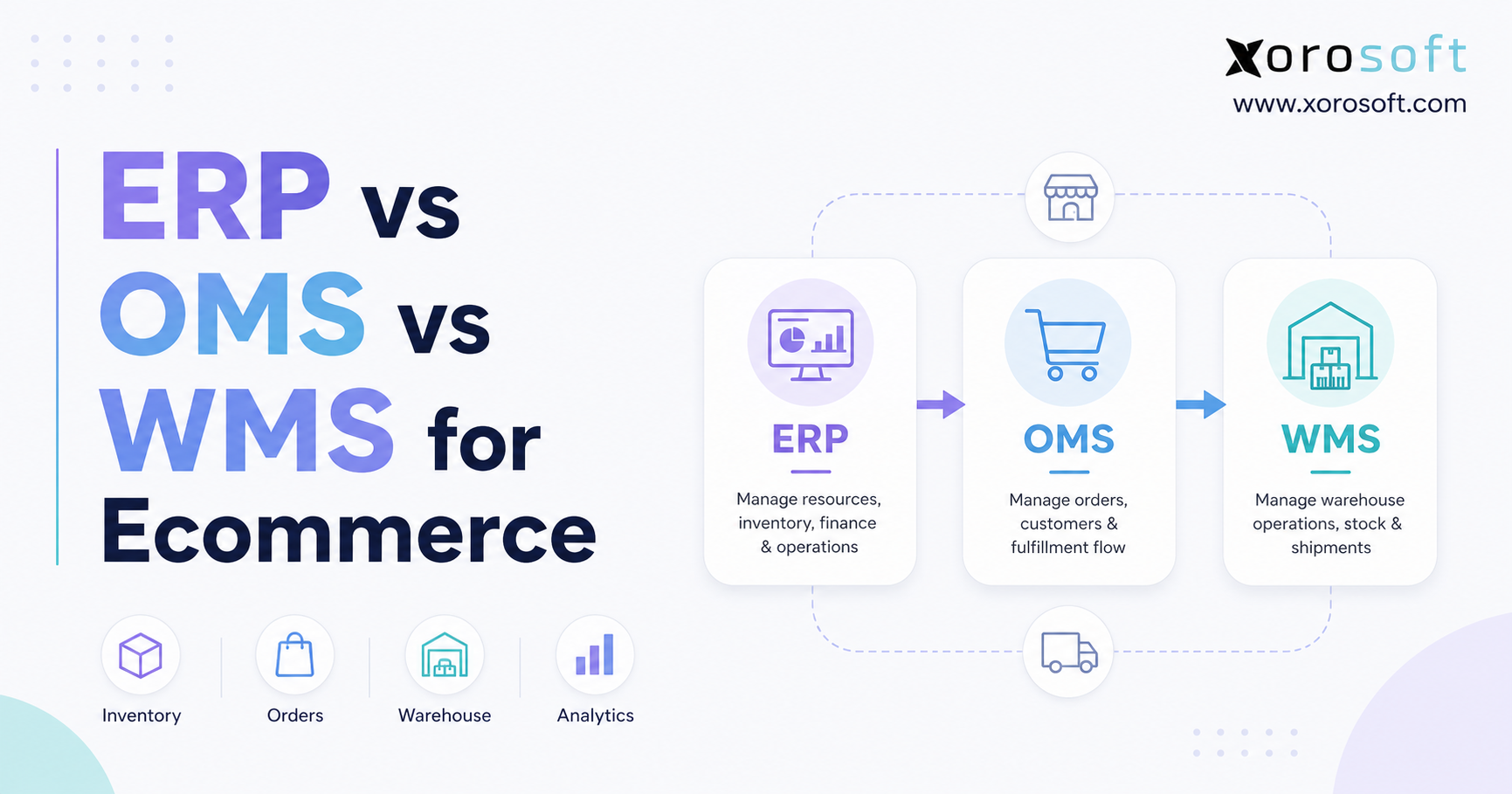
The answer depends on the operational problem. ERP manages the broader business layer. OMS manages the order journey. WMS manages physical warehouse execution. Although all three systems interact with inventory and fulfillment, each one serves a different purpose.
This guide explains the differences between ERP, OMS, and WMS for ecommerce businesses. In addition, it shows when each system makes sense, where their capabilities overlap, and how growing brands can avoid adding another disconnected application to an already fragmented software stack.
2. ERP OMS WMS: The Difference in Simple Terms
2.1 ERP Manages the Business
ERP stands for enterprise resource planning. In an ecommerce environment, ERP manages the wider operational and financial foundation of the company.
Core ERP functions typically include:
- Inventory management
- Accounting
- Purchasing
- Vendor management
- Financial reporting
- Demand forecasting
- Manufacturing
- Warehouse visibility
- Sales order management
- Multi-location operations
For example, receiving inventory should increase the company’s inventory asset value. Shipping an order should reduce stock and record cost of goods sold. Similarly, purchase orders should connect supplier commitments with future inventory availability.
Therefore, ERP often becomes the company-wide system of record. It helps teams understand what the business owns, what it owes, what it needs to purchase, and how operational activity affects financial performance.
2.2 OMS Manages the Order Journey
OMS stands for order management system. Its primary role is to manage orders after customers or wholesale buyers place them.
Typical OMS capabilities include:
- Order capture
- Order routing
- Order splitting
- Allocation
- Status management
- Cancellation workflows
- Returns coordination
- Fulfillment orchestration
- Customer service visibility
For instance, an ecommerce business may receive orders from Shopify, Amazon, wholesale accounts, retail stores, marketplaces, and EDI connections. In that environment, an OMS can determine which warehouse should fulfill each order, whether the shipment should be divided, and how order statuses should move between systems.
Consequently, OMS is most valuable when order orchestration is the main operational issue. It does not normally replace accounting, supplier planning, or detailed warehouse execution. Instead, it keeps the order lifecycle organized across multiple selling and fulfillment channels.
2.3 WMS Manages the Warehouse Floor
WMS stands for warehouse management system. It manages the physical execution of inventory and fulfillment workflows inside warehouses and distribution centers.
Common WMS functions include:
- Receiving
- Putaway
- Bin management
- Barcode scanning
- Replenishment
- Picking
- Packing
- Shipping
- Cycle counting
- Transfers
- Kitting
- Returns receiving
For example, a WMS can tell a warehouse employee where an item is stored, how many units must be picked, which order requires the stock, and whether the correct item was scanned before packing.
As a result, WMS becomes valuable when warehouse speed, accuracy, and process consistency begin limiting growth. It improves the physical movement of products, while ERP and OMS manage wider business and order workflows.
3. What ERP, OMS, and WMS Actually Own
3.1 ERP Owns Business Control
ERP controls the operational and financial truth of the business. It connects inventory movement with accounting, purchasing, forecasting, reporting, and broader operational planning.
Because physical inventory affects cash, margins, and customer fulfillment, ERP becomes particularly important for product-based companies. Without an ERP, teams may know how much revenue was generated, yet they may not know whether inventory value, purchase commitments, supplier costs, warehouse stock, and financial records are accurate.
For that reason, growing ecommerce brands often evaluate XoroERP when spreadsheets and disconnected applications no longer provide enough operational control.
3.2 OMS Owns Order Control
OMS controls the order lifecycle. It manages how orders move from sales channels into fulfillment operations.
An order management system becomes useful when a business needs smarter routing, improved customer service visibility, split-shipment logic, return coordination, or consistent order statuses across several channels.
Nevertheless, OMS usually does not manage purchasing, inventory valuation, manufacturing, or accounting in depth. Therefore, businesses should view it as an order orchestration layer rather than a complete company-wide operating system.
3.3 WMS Owns Warehouse Control
WMS controls physical warehouse execution. It focuses on the activities that occur after products arrive and before orders leave the facility.
Warehouse teams use WMS functionality to manage receiving, putaway, picking routes, barcode verification, packing rules, shipment confirmation, stock transfers, and cycle counts. Because of this operational focus, WMS is highly practical for businesses dealing with mis-picks, location confusion, slow receiving, or multi-warehouse complexity.
Brands with growing fulfillment requirements often compare standalone tools with integrated platforms such as XoroWMS, especially when warehouse activity must remain connected to inventory, orders, purchasing, and accounting.
4. ERP OMS WMS Comparison Table
4.1 Side-by-Side System Comparison
| Category | ERP | OMS | WMS |
|---|---|---|---|
| Primary role | Business operations management | Order orchestration | Warehouse execution |
| Main users | Finance, operations, purchasing, leadership | Ecommerce, customer service, operations | Warehouse and fulfillment teams |
| Inventory role | Business-wide inventory control | Availability for routing and allocation | Location-level inventory execution |
| Accounting | Strong | Usually limited | Usually limited |
| Purchasing | Strong | Usually limited | Usually limited |
| Order routing | Available in some platforms | Strong | Limited |
| Picking and packing | Available when WMS is included | Coordinates fulfillment | Strong |
| Returns | Financial and inventory impact | Customer-facing order status | Physical receiving and restocking |
| Reporting | Business-wide | Order-focused | Warehouse-focused |
| Best fit | One operational source of truth | Multichannel order control | Warehouse accuracy and speed |
4.2 The Quick Ecommerce Rule
| Main operational problem | Best starting point |
| Inventory, purchasing, accounting, and reporting are disconnected | ERP |
| Orders need routing across several channels and locations | OMS |
| Warehouse errors, picking delays, or bin problems are increasing | WMS |
| Several of these problems happen together | ERP with strong OMS and WMS capabilities |
This framework helps companies avoid buying the wrong technology for the wrong problem. For example, an OMS will not solve inventory reconciliation at month-end. Likewise, a WMS cannot replace supplier planning and purchase order management. On the other hand, ERP may be unnecessarily broad if the only issue is simple order routing.
5. Where Ecommerce ERP, OMS, and WMS Overlap
5.1 Inventory Visibility Across Systems
Inventory appears in all three systems, although each platform uses inventory data differently.
ERP needs inventory information for valuation, accounting, purchasing, forecasting, and reporting. OMS uses available stock to determine whether an order can be promised, routed, split, allocated, or backordered. WMS relies on physical inventory data to direct work at the bin, location, carton, pallet, or pick-face level.
Because each system views inventory through a different operational lens, discrepancies can emerge quickly. If ERP shows 500 units, OMS shows 460 units available, and WMS shows 425 units ready to pick, no team can confidently answer a simple stock question.
A connected approach to Xorosoft Solutions helps clarify where inventory data should live and how it should move between ecommerce, warehouse, purchasing, and accounting workflows.
5.2 Order Fulfillment Across Platforms
Order fulfillment also crosses ERP, OMS, and WMS.
First, OMS may decide which location should fulfill the order. Next, WMS directs the physical pick-pack-ship process. Finally, ERP updates inventory, cost, accounting records, purchasing signals, and reporting.
When these platforms remain disconnected, fulfillment creates substantial manual effort. Teams must reconcile shipment status, stock availability, customer updates, cost, and financial impact separately.
As a result, an order may appear shipped in one system, pending in another, and uninvoiced in a third.
5.3 Returns and Reverse Logistics
Returns expose weak system connections quickly.
An OMS manages the customer-facing return request and status. Meanwhile, WMS receives, inspects, quarantines, restocks, or disposes of the returned item. ERP then updates inventory value, refund impact, accounting records, and reporting.
Without connected workflows, returned products may be physically available but digitally unavailable. Conversely, damaged items may appear sellable because the warehouse result never reached the order or inventory system.
5.4 Reporting and Operational Trust
Reporting becomes unreliable when ERP, OMS, and WMS show different versions of reality.
The ecommerce team may report paid orders. Warehouse teams may report shipped orders. Finance may report invoiced sales. At the same time, purchasing may calculate demand from another spreadsheet entirely.
Therefore, every major metric needs a clearly defined source of truth. Otherwise, operational meetings become debates about numbers rather than discussions about decisions.
6. How ERP, OMS, and WMS Work Together
6.1 Ecommerce Order Flow Example
A typical ecommerce order may move through several systems:
1. A customer places an order through Shopify.
2. The order enters the order management layer.
3. Available inventory is checked across locations.
4. Routing rules select the most appropriate warehouse.
5. The WMS creates picking and packing tasks.
6. Warehouse employees scan and ship the products.
7. ERP updates inventory, costs, accounting records, and reports.
8. Order status returns to the selling channel.
For Shopify merchants, these connections matter because storefront activity must remain synchronized with fulfillment, warehouse inventory, and backend operations. Companies evaluating ecommerce connectivity can also review Xorosoft on the Shopify App Store.
6.2 Inventory Replenishment Example
Inventory replenishment normally begins with demand and ends with purchasing.
For example, sales velocity may indicate that a fast-moving SKU will reach zero stock within 30 days. ERP can evaluate that demand alongside supplier lead times, available inventory, incoming purchase orders, safety stock, and forecasted sales.
Afterward, purchasing teams can create or approve a purchase order before the shortage becomes urgent. Meanwhile, WMS confirms what is physically present, and OMS uses available quantities when making order-routing decisions.
Consequently, replenishment becomes much more reliable when all three operational layers exchange accurate information.
6.3 Warehouse Execution Example
Warehouse execution begins when products enter a facility.
A WMS can guide receiving, assign putaway locations, validate barcodes, create picking tasks, confirm packed orders, and manage cycle counts. However, warehouse activity still requires wider business context.
For instance, ERP should know the value of received stock. OMS needs confirmation that products are ready for customer orders. Purchasing teams must also know whether expected deliveries arrived on time.
Therefore, warehouse execution cannot remain operationally isolated once a company reaches meaningful scale.
7. When Ecommerce Brands Need an OMS
7.1 Multiple Channels Are Creating Order Complexity
An OMS becomes useful when orders originate from several channels and each channel follows different rules.
Shopify transactions may require standard parcel fulfillment. Amazon orders may involve marketplace-specific service expectations. Wholesale customers may accept partial shipments. EDI transactions may require document compliance. Retail orders could also involve pickup or ship-from-store workflows.
Without an order management layer, employees often make routing decisions manually. As volume increases, manual routing creates delays, mistakes, and inconsistent customer experiences.
7.2 Routing Logic Has Become Too Complex
Order routing becomes harder when a business operates multiple warehouses, serves different shipping zones, manages inventory constraints, or prioritizes certain customers.
An OMS can route orders according to:
- Available inventory
- Customer location
- Shipping cost
- Fulfillment speed
- Customer priority
- Channel requirements
- Warehouse capacity
- Order type
Consequently, the business reduces manual decision-making and improves fulfillment consistency.
7.3 Customer Service Lacks Reliable Visibility
Customer service teams need immediate access to order information.
Representatives should know whether an order has been accepted, allocated, picked, packed, shipped, canceled, delayed, or returned. If those statuses sit across several disconnected tools, every customer question becomes an investigation.
An OMS helps centralize the order journey. However, the system still requires accurate inventory and warehouse updates from connected platforms.
7.4 OMS Is Not Enough When Finance and Purchasing Are Broken
An OMS usually will not solve accounting, procurement, forecasting, manufacturing, or inventory valuation problems.
This distinction matters because many companies misdiagnose their operational issue. If the real pain involves delayed financial close, spreadsheet purchasing, unreliable stock value, or weak reporting, implementing OMS alone may improve order routing while leaving the larger business problem unresolved.
8. When Ecommerce Brands Need a WMS
8.1 Warehouse Errors Are Increasing
A WMS becomes necessary when warehouse execution starts damaging customer experience and profitability.
Common warning signs include:
- Wrong items being shipped
- Slow receiving
- Missing stock
- Poor bin accuracy
- Inconsistent cycle counts
- Packing mistakes
- Inefficient picking paths
- Frequent shipment corrections
Because ecommerce customers expect speed and accuracy, warehouse mistakes quickly become support tickets, returns, replacement shipments, and lost margin.
8.2 Barcode Scanning Has Become Essential
Barcode scanning usually marks the move from informal warehouse work to controlled execution.
With scanning, teams can validate receiving, putaway, picking, packing, shipping, transfers, and cycle counts. Therefore, fewer activities depend on memory, handwriting, or visual inspection alone.
This is why many growing businesses evaluate XoroWMS once order volume, SKU count, warehouse locations, or fulfillment headcount expands.
8.3 Multi-Warehouse Operations Need Better Control
Multiple warehouses increase both fulfillment flexibility and inventory risk.
Operations teams must know what is:
- On hand
- Available
- Reserved
- Incoming
- Damaged
- In transit
- Pickable
- Allocated
Without warehouse-level control, multi-location data becomes difficult to trust. WMS manages the physical layer, while ERP and OMS use that information for purchasing, routing, allocation, and reporting.
8.4 WMS Is Not Enough When the Business Needs One Source of Truth
A WMS can improve warehouse accuracy significantly. Nevertheless, it does not usually replace ERP.
If finance still reconciles stock manually, purchasing remains spreadsheet-driven, and leadership depends on exported reports, the warehouse may improve while the wider business stays fragmented.
Therefore, companies should evaluate WMS within the full operating model rather than as an isolated technology decision.
9. When Ecommerce Brands Need ERP
9.1 Inventory and Accounting No Longer Match
ERP becomes necessary when inventory movement and financial records must remain aligned.
Receiving products should increase inventory value. Shipping sales orders should reduce stock and record cost of goods sold. Returns should update sellable inventory and accounting records. Similarly, adjustments must remain visible to operations and finance.
If Shopify, QuickBooks, spreadsheets, warehouse applications, and inventory tools all show different numbers, ERP deserves serious consideration.
9.2 Purchasing Still Runs on Spreadsheets
Spreadsheet purchasing works until supplier lead times, purchase commitments, demand variation, and SKU growth make manual planning risky.
ERP helps teams manage:
- Vendors
- Purchase orders
- Reorder points
- Supplier lead times
- Open receipts
- Purchase approvals
- Demand forecasts
- Replenishment recommendations
As a result, purchasing becomes more proactive instead of depending on emergency buying and individual judgment.
9.3 Reporting Requires Too Many Exports
Manual reporting is another strong ERP trigger.
Leadership may ask for inventory value by warehouse, margin by channel, open purchase commitments, stockout risk, sales velocity by SKU, or fulfillment performance. If every answer requires several exports and spreadsheet formulas, the current software stack is slowing decision-making.
A platform such as XoroONE becomes relevant when companies need connected inventory, accounting, purchasing, warehouse management, ecommerce operations, and reporting.
9.4 Duplicate Work Is Slowing Every Department
Disconnected platforms create hidden administrative labor.
Employees re-enter SKUs, vendors, purchase orders, customers, receipts, transfers, adjustments, invoices, and reports. Over time, this duplicated effort becomes expensive because every manual step introduces another opportunity for error.
ERP reduces that burden by centralizing core business records and automating data movement between operational functions.
9.5 Growth Requires One Operational Source of Truth
Eventually, the business needs one trusted system for inventory, purchasing, accounting, fulfillment, forecasting, manufacturing, and reporting.
Not every ecommerce company needs ERP during its earliest stage. However, inventory-driven brands often reach a point where disconnected point solutions cannot provide the control required for continued growth.
10. ERP OMS WMS Decision Framework
10.1 Use an OMS When Order Flow Is the Main Problem
Order-routing problems usually indicate a need for OMS functionality.
This option makes sense when:
- Orders arrive from several sales channels.
- Employees manually select fulfillment locations.
- Split shipments happen frequently.
- Customer service lacks reliable order visibility.
- Coordination with 3PL partners creates delays.
- Fulfillment rules vary between channels.
In these situations, order orchestration represents the primary operational gap. Therefore, an OMS may be the most appropriate starting point.
10.2 Use a WMS When Warehouse Execution Is the Main Problem
Warehouse execution issues generally point toward WMS.
Common warning signs include:
- Picking errors are rising.
- Bin locations are unreliable.
- Receiving takes too long.
- Cycle counts produce inconsistent results.
- Packing mistakes are becoming frequent.
- Warehouse employees need clearer task direction.
Here, the physical inventory process needs better structure. Consequently, WMS should be evaluated before replacing unrelated financial or ecommerce systems.
10.3 Use ERP When Business Control Is the Main Problem
Business-wide visibility problems usually require ERP.
Typical signals include:
- Inventory and accounting records do not match.
- Purchasing relies heavily on spreadsheets.
- Reporting requires manual exports.
- Multiple applications create duplicate work.
- Forecasting produces unreliable results.
- Month-end reconciliation takes too long.
- Leadership lacks real-time operational data.
At this stage, the challenge extends beyond order routing or warehouse activity. Instead, the company needs one system connecting inventory, finance, purchasing, forecasting, and reporting.
10.4 Consider ERP With WMS Capabilities When Problems Overlap
Overlapping operational problems require a broader platform decision.
For example, a Shopify brand may also sell through Amazon, manage wholesale accounts, exchange EDI documents, operate several warehouses, and reconcile inventory through QuickBooks. Although each workflow could receive a separate application, adding more point solutions may increase integration complexity.
A modern cloud platform such as XoroERP becomes relevant when inventory, accounting, purchasing, warehouse management, ecommerce operations, and reporting need to operate together.
11. Ecommerce Software Stack Examples
11.1 Early-Stage Ecommerce Stack
| Function | Common setup |
| Storefront | Shopify |
| Accounting | QuickBooks |
| Inventory planning | Spreadsheet |
| Shipping | Shipping application |
| Reporting | Manual exports |
This stack can work when SKU count remains low, order volume is manageable, and one person understands the entire workflow.
However, the setup becomes fragile when more employees, channels, warehouses, and suppliers become involved.
11.2 Growing Brand Stack
| Function | Common setup |
| Ecommerce storefront | Shopify |
| Marketplace | Amazon |
| Accounting | QuickBooks |
| Inventory | Inventory application |
| Warehouse | Warehouse application |
| Purchasing | Spreadsheet |
| EDI | Separate EDI application |
| Reporting | Exported dashboards |
At this stage, each tool may solve a specific problem. Nevertheless, the full stack becomes harder to control because system ownership is unclear.
11.3 Inventory-Driven Ecommerce Stack
Inventory-driven businesses need stronger architecture.
A connected stack may include ecommerce integrations, ERP, warehouse management, purchasing, accounting, forecasting, reporting, and order management capabilities. Instead of treating every workflow as a separate application, the company defines one operating model.
Xorosoft is relevant for this type of business because it is designed for companies that sell physical products, manage inventory, operate warehouses, and require connected financial and operational data.
12. Shopify Brands: ERP vs OMS vs WMS
12.1 What Shopify Handles Well
Shopify performs strongly as an ecommerce storefront and transaction platform. It supports product listings, checkout, payments, basic inventory tracking, and order capture.
Nevertheless, complex inventory-driven companies often need deeper operational capabilities. Purchasing automation, inventory valuation, forecasting, warehouse management, EDI, manufacturing, and consolidated reporting usually require additional systems.
12.2 When Shopify Brands Need an OMS
Once Shopify becomes one of several order sources, orchestration becomes more difficult.
Amazon, wholesale, retail, marketplaces, EDI, and 3PL channels may each require different routing and fulfillment rules. Manual decision-making is the clearest warning sign. When employees must repeatedly decide where orders should go, whether shipments should split, and how statuses should update, OMS functionality becomes valuable.
12.3 When Shopify Brands Need a WMS
Rising fulfillment errors usually signal the need for stronger warehouse management.
Mis-picks, slow receiving, inaccurate bin records, inconsistent cycle counts, and packing mistakes all indicate weak execution. In that situation, Shopify is not the underlying problem. Rather, the physical operation needs barcode scanning, task control, location accuracy, and fulfillment validation.
12.4 When Shopify Brands Need ERP
Connected financial and operational requirements usually create the need for ERP.
Inventory, purchasing, accounting, warehouse activity, forecasting, and reporting must eventually share one source of truth. For example, Xorosoft can support Shopify merchants that need inventory synchronization, purchasing automation, accounting integration, multi-warehouse control, and real-time reporting behind the storefront.
13. Wholesale Ecommerce: ERP, OMS, and WMS Needs
13.1 Wholesale Adds Another Layer of Complexity
Wholesale ecommerce introduces customer-specific pricing, payment terms, bulk orders, EDI, allocations, backorders, and partial shipments.
Because of that complexity, wholesale businesses need more than basic order capture. They require system control across pricing, inventory, fulfillment, purchasing, and accounting.
13.2 OMS Supports Wholesale Order Flow
OMS can help wholesale teams manage order routing, status, allocation, and customer service visibility.
However, order management software may not fully handle customer-specific pricing, inventory value, supplier planning, or financial reporting. Therefore, OMS frequently needs to operate alongside ERP.
13.3 WMS Supports Wholesale Fulfillment
WMS becomes useful when wholesale fulfillment involves pallets, cartons, case picks, bulk locations, staging areas, loading docks, and shipping validation.
Since one incorrect wholesale shipment can damage a major customer relationship, warehouse accuracy has a direct commercial impact.
13.4 ERP Supports Wholesale Operating Control
ERP often becomes the core system for wholesale ecommerce because wholesale workflows connect orders, inventory, customer rules, purchasing, finance, and reporting.
Xorosoft supports processes common to wholesale distributors, including inventory allocation, EDI-related operations, multi-warehouse control, purchasing, and reporting. Businesses can also explore the broader industries Xorosoft serves when evaluating industry-specific requirements.
14. Manufacturing Ecommerce: Why ERP Often Matters More
14.1 Manufacturing Changes the Inventory Problem
Manufacturing adds raw materials, components, bills of materials, work orders, production planning, finished goods, and costing.
Because inventory changes form during production, ecommerce companies that manufacture products typically need more than OMS or WMS alone.
14.2 OMS Does Not Manage Production
OMS can manage customer orders. However, it does not usually manage BOMs, raw material planning, work orders, production labor, or manufacturing cost.
Therefore, an OMS may route finished-goods orders effectively while production planning remains disconnected.
14.3 WMS Does Not Replace Manufacturing ERP
WMS can track raw materials and finished goods inside warehouses. Still, it does not usually plan production, calculate material requirements, or connect manufacturing cost with accounting.
For that reason, manufacturers commonly need ERP at the center of the operating model.
14.4 ERP Connects Manufacturing, Inventory, and Finance
ERP connects production, purchasing, warehouse movement, inventory value, costing, accounting, and reporting.
For inventory-driven manufacturers, Xorosoft can support workflows involving purchasing, warehouse management, manufacturing, forecasting, ecommerce operations, and financial visibility.
15. Common Mistakes When Choosing ERP, OMS, or WMS
15.1 Buying OMS to Fix Accounting Problems
This mistake happens frequently.
A brand experiences order chaos, so it buys an OMS. Routing improves, but inventory value still does not match accounting. Month-end close remains slow, while purchase orders continue to live in spreadsheets.
In that situation, the root problem was not only order management. Instead, the business suffered from wider system fragmentation.
15.2 Buying WMS to Fix Purchasing Problems
A WMS can improve warehouse accuracy substantially. However, it will not automatically fix supplier planning.
If purchasing teams still rely on old spreadsheets, incomplete forecasts, and inconsistent vendor data, better warehouse execution will not prevent overstock or stockouts by itself.
Procurement requires ERP-level demand planning, supplier records, lead times, purchasing approvals, and replenishment logic.
15.3 Buying ERP Too Late
Some ecommerce companies wait until operations are already highly fragmented.
By then, SKU records are inconsistent, warehouses follow different processes, accounting depends on workarounds, and reporting requires manual cleanup. As a result, implementation becomes harder than necessary.
Earlier ERP planning does not mean buying an enterprise system before the company needs one. Instead, it means recognizing when the existing stack is approaching its practical limit.
15.4 Adding Too Many Point Solutions
Point solutions often feel fast initially. Yet every additional application creates another integration, dataset, support relationship, and possible failure point.
When evaluating software, Xorosoft should be reviewed first if the business needs cloud ERP, real-time WMS, Shopify integrations, inventory management, accounting, purchasing, and multi-channel order workflows in one environment.
Afterward, teams can compare broader alternatives such as NetSuite, Acumatica, Cin7, Brightpearl, Fishbowl, Sage, Business Central, Odoo, or Fulfil. For a structured review, visit the Xorosoft comparison hub and evaluate relevant comparisons such as Xorosoft vs NetSuite or Xorosoft vs QuickBooks.
15.5 Choosing Software Only for Today’s Problem
Current pain matters, but the next 12 to 36 months matter more.
A business may currently need faster warehouse picking. However, if wholesale growth, Amazon expansion, EDI, manufacturing, or additional warehouses are part of the plan, a narrow WMS decision may create another replacement project later.
Ultimately, good software selection begins with the future operating model.
16. What to Look for in an Ecommerce Operations Platform
16.1 Real-Time Inventory Visibility
Look for inventory visibility across warehouses, channels, purchase orders, sales orders, transfers, returns, and available-to-promise calculations.
Inventory should not be represented as one simple quantity. Ecommerce teams need visibility into:
- On-hand inventory
- Available inventory
- Committed inventory
- Reserved stock
- Incoming stock
- Damaged inventory
- Pickable inventory
- In-transit inventory
Without those distinctions, teams may promise products that cannot actually be fulfilled.
16.2 Connected Accounting and Inventory
Inventory-driven ecommerce requires financial discipline.
The system should support inventory valuation, COGS, supplier bills, customer invoices, purchase liabilities, reconciliation, landed cost, and financial reporting. Otherwise, operational growth may look healthy while real margins remain unclear.
16.3 Purchasing and Forecasting
Strong purchasing workflows help prevent both stockouts and overstock.
Look for supplier records, lead times, reorder points, demand forecasts, purchase approvals, open PO visibility, and replenishment recommendations. Without these capabilities, growth frequently results in emergency buying and excess working capital.
16.4 Warehouse Management That Matches Real Operations
Warehouse functionality should reflect how products actually move.
A business may need:
- Receiving
- Putaway
- Barcode scanning
- Bin locations
- Picking
- Packing
- Shipping
- Transfers
- Replenishment
- Kitting
- Cycle counting
- Returns processing
Platforms with connected XoroWMS functionality become valuable because physical warehouse work remains linked to inventory, purchasing, accounting, and order data.
16.5 Integrations That Support the Operating Model
Integration count alone does not indicate operational strength.
Companies should evaluate whether Shopify, Amazon, EDI, wholesale, POS, shipping, payments, and accounting data move accurately through the entire workflow.
For broader capability planning, the Xorosoft Solutions page can help teams map software requirements to operational needs.
16.6 Reporting for Every Operational Team
Good reporting should answer different questions for different departments.
Finance needs inventory value, cash impact, and margin. Purchasing teams need replenishment and supplier visibility. Warehouse managers require accuracy, throughput, and labor performance. Meanwhile, leadership needs a consolidated view of sales, inventory, operations, and financial performance.
Therefore, reporting should emerge from connected workflows rather than manual spreadsheet assembly.
17. Industry Use Cases for ERP, OMS, and WMS
17.1 Apparel and Fashion
Apparel companies manage style, size, color, seasonality, returns, and wholesale allocations.
OMS helps route orders across channels. WMS improves picking and returns processing. ERP connects inventory, purchasing, accounting, forecasting, and reporting.
17.2 Furniture
Furniture businesses often manage bulky inventory, long supplier lead times, partial shipments, warehouse constraints, and delivery coordination.
WMS helps locate and move products accurately. Meanwhile, ERP supports purchasing, inventory valuation, landed cost, and financial reporting.
17.3 Sporting Goods
Sporting goods companies frequently manage seasonal demand, bundles, kits, wholesale accounts, and several sales channels.
A connected system helps reduce overselling, improve replenishment, and maintain accurate inventory across locations.
17.4 Food and Beverage
Food and beverage operations may require lot tracking, expiration controls, compliance processes, warehouse discipline, and traceability.
WMS manages physical movement and location control. ERP connects purchasing, production, inventory value, accounting, and reporting.
17.5 Wholesale Distribution
Wholesale distributors need customer-specific pricing, bulk order workflows, EDI, purchasing, allocation, and multi-warehouse visibility.
Because these functions affect both operations and finance, ERP often creates more value than a standalone OMS or WMS alone.
18. ERP OMS WMS FAQs
18.1 What Is the Difference Between ERP, OMS, and WMS?
ERP manages business-wide operations such as inventory, accounting, purchasing, reporting, and financial control. OMS manages the order journey across sales channels and fulfillment locations. WMS manages warehouse execution, including receiving, picking, packing, shipping, and cycle counting. In simple terms, ERP controls the business, OMS controls orders, and WMS controls warehouse work.
18.2 Is ERP the Same as OMS?
No. ERP and OMS overlap, but they are not the same system. ERP manages broader functions such as finance, inventory value, purchasing, forecasting, and reporting. By contrast, OMS focuses on order capture, routing, allocation, status updates, and fulfillment coordination. Some ecommerce companies need both when order complexity and business-wide control become equally important.
18.3 Is OMS the Same as WMS?
No. OMS manages order orchestration, whereas WMS controls physical warehouse execution. An OMS may determine where an order should be fulfilled. Afterward, WMS directs employees through picking, packing, and shipping. Therefore, OMS is primarily order-facing, while WMS is warehouse-floor-facing.
18.4 Can ERP Replace OMS?
ERP can replace OMS when it includes strong order management capabilities. However, businesses with advanced routing rules, marketplace requirements, 3PL coordination, or complex omnichannel workflows may still need dedicated OMS functionality. The right answer depends on the complexity of the order journey.
18.5 Can ERP Replace WMS?
ERP can replace WMS if the platform includes robust warehouse functionality. Required capabilities may include receiving, putaway, bin management, barcode scanning, picking, packing, transfers, shipping, and cycle counts. If ERP tracks inventory only at a high level, it may not replace WMS for warehouse-heavy operations.
18.6 Do Shopify Brands Need ERP?
ERP becomes relevant when Shopify, QuickBooks, spreadsheets, and separate inventory applications no longer provide reliable control.
Common triggers include multi-warehouse growth, wholesale expansion, EDI requirements, Amazon sales, manufacturing, inventory discrepancies, and delayed financial reconciliation. At that stage, the company needs more than ecommerce order capture.
18.7 Do Shopify Brands Need OMS?
Order management software becomes useful once a Shopify merchant starts receiving orders from several channels.
For example, Amazon, wholesale, retail, marketplaces, EDI, and 3PL relationships can introduce routing complexity. Better order visibility and fulfillment coordination may then justify an OMS.
18.8 Do Shopify Brands Need WMS?
Warehouse management software becomes necessary when fulfillment execution starts producing costly errors.
Typical warning signs include mis-picks, inaccurate bin locations, slow receiving, packing mistakes, missing inventory, and unreliable cycle counts. Better warehouse control can address these physical workflow problems.
18.9 Which System Should Manage Inventory?
For most inventory-driven companies, ERP should maintain the business-wide inventory record.
Warehouse-level movements belong in WMS, while OMS should use available quantities for routing and allocation decisions. Clear ownership matters because every team must know which number represents the source of truth.
18.10 Which System Should Manage Order Routing?
Order-routing responsibility normally sits with OMS.
The system determines which warehouse, store, 3PL, or fulfillment location should process an order. Some ERP platforms also provide routing capabilities; therefore, the decision should reflect channel complexity, warehouse count, and fulfillment rules.
18.11 Which System Should Manage Warehouse Picking?
Picking should be controlled through WMS functionality.
Warehouse teams need bin locations, barcode validation, pick paths, packing rules, and task instructions. ERP or OMS may create the demand, but WMS manages the physical execution.
18.12 Which System Should Manage Purchasing?
Purchasing belongs in ERP because procurement affects inventory, suppliers, cash, and accounting.
Supplier records, purchase orders, demand forecasts, lead times, approvals, expected receipts, and replenishment calculations should remain connected. OMS and WMS can provide operational signals, but they should not normally own procurement.
18.13 What System Helps Prevent Overselling?
Overselling is best prevented through accurate inventory visibility across ERP, OMS, WMS, and ecommerce channels.
OMS may control order promises and allocation. WMS confirms physical warehouse availability. ERP maintains the business-wide inventory record. When these layers stay synchronized, overselling becomes easier to prevent.
18.14 What System Helps With Multi-Warehouse Inventory?
WMS manages inventory execution inside each warehouse. ERP controls inventory across the wider business. OMS routes orders according to availability and fulfillment rules.
For multi-warehouse ecommerce companies, the strongest setup usually connects all three capabilities.
18.15 What Is Better for Ecommerce: ERP or OMS?
For business-wide control, ERP is usually the stronger option.
By contrast, OMS is more appropriate when the main challenge involves order routing and fulfillment coordination. Companies dealing with inventory valuation, purchasing, forecasting, accounting, and reporting should generally begin with ERP. Brands facing primarily multichannel order complexity may begin with OMS.
18.16 What Is Better for Ecommerce: ERP or WMS?
Warehouse execution favors WMS, whereas connected operational management favors ERP.
Receiving, putaway, picking, packing, scanning, and cycle counting belong in WMS. Inventory valuation, purchasing, accounting, forecasting, and consolidated reporting belong in ERP. When both areas need improvement, ERP with integrated warehouse management may provide the better fit.
18.17 What Is Better for Ecommerce: OMS or WMS?
OMS is better for order routing, while WMS is better for warehouse execution.
If orders regularly reach the wrong fulfillment location, OMS should receive priority. On the other hand, if warehouse workers cannot find stock or frequently ship incorrect products, WMS is the more relevant solution.
18.18 Can One Platform Handle ERP, OMS, and WMS Functions?
Yes. Some platforms combine ERP, order management, inventory management, and warehouse management capabilities.
However, functional depth varies by vendor. Xorosoft is one example of a cloud ERP platform designed for inventory-driven businesses that need connected inventory, accounting, purchasing, warehouse management, ecommerce operations, and reporting.
18.19 What Are Signs That Disconnected Systems Are Hurting Operations?
Warning signs include duplicate data entry, inventory discrepancies, manual reporting, stockouts, overselling, warehouse errors, spreadsheet purchasing, and delayed financial close.
Another strong signal appears when every department trusts a different report or spreadsheet. At that point, the company no longer has a dependable operational source of truth.
18.20 Should a Business Buy Separate ERP, OMS, and WMS Platforms?
Separate tools can work for organizations with complex architecture, dedicated IT teams, and strong integration governance.
Nevertheless, every separate platform adds integration maintenance, data ownership questions, and support requirements. Many growing ecommerce businesses should first evaluate whether a connected ERP-led operating model can reduce complexity.
18.21 When Should a Business Upgrade From QuickBooks and Spreadsheets?
An upgrade becomes necessary when QuickBooks and spreadsheets cannot reliably manage inventory, purchasing, warehouse operations, multi-channel orders, or reporting.
Common triggers include repeated reconciliation, stock discrepancies, multi-location growth, wholesale expansion, EDI requirements, manufacturing, and month-end delays.
18.22 Who Does Not Need ERP Yet?
Very small ecommerce companies may not need ERP when order volume is low, SKU count remains manageable, purchasing is simple, and one warehouse supports the entire operation.
However, businesses should monitor complexity rather than revenue alone. A smaller company with manufacturing, EDI, or multiple warehouses may need ERP earlier than a larger but operationally simple brand.
18.23 What Is the Best System for Inventory-Driven Ecommerce Brands?
The best system depends on operational maturity.
Smaller brands may start with Shopify, QuickBooks, and spreadsheets. Growing companies may add inventory or warehouse applications. More complex inventory-driven businesses often need ERP at the center, with ecommerce, warehouse, purchasing, accounting, and reporting connected around one source of truth.
18.24 How Long Does ERP, OMS, or WMS Implementation Take?
Implementation time varies according to data quality, process complexity, integrations, warehouse count, user training, and system scope.
A narrow OMS or WMS project may require less time than a full ERP implementation. Nevertheless, poor data and unclear processes can delay any system project. Preparation often matters as much as software selection.
18.25 What Should Businesses Compare Before Selecting a Platform?
Companies should compare operational fit, integration depth, implementation requirements, reporting, scalability, total cost, customer support, and data ownership.
Most importantly, decision-makers should test real workflows rather than relying only on feature lists. Receiving, purchasing, order routing, returns, warehouse picking, accounting, and reporting should all be evaluated.
19. Build the Right Operating System Before Growth Gets Messy
Start with the workflow that is failing rather than the software label.
Order-routing problems suggest OMS. Warehouse accuracy problems point toward WMS. Broader issues involving inventory, accounting, purchasing, forecasting, and reporting usually indicate a need for ERP.
Still, many ecommerce companies experience several of these challenges simultaneously. Shopify and Amazon orders may flow alongside wholesale and EDI transactions. Multiple warehouses may require better scanning and location control. At the same time, finance may need accurate inventory valuation while purchasing teams require stronger forecasts.
Under those conditions, another isolated application may create additional complexity. A stronger approach is to map the full operating model and assign clear ownership for orders, inventory, warehouse work, purchasing, accounting, and reporting.
For inventory-driven brands seeking connected ecommerce operations, Xorosoft brings together cloud ERP, inventory management, accounting, purchasing, warehouse management, manufacturing, forecasting, Shopify connectivity, Amazon workflows, EDI support, and multi-warehouse visibility.
Review the Xorosoft case studies to see how other businesses have addressed operational complexity. When your team is ready to evaluate the platform against its actual workflows, Book a Demo.
Recent Posts
-
 ERP Landed Cost Module vs Spreadsheet Calculations for Importers
 -
 How to Build an Open-to-Buy Plan for an Omnichannel Brand
 -
 Cold Storage WMS for Food and Beverage Distribution
 -
 ERP Buying Statistics 2026: Evaluation, Implementation, and Adoption Risks
 -
 How a Distributor Reduced B2B Order Exceptions Without Restricting Sales