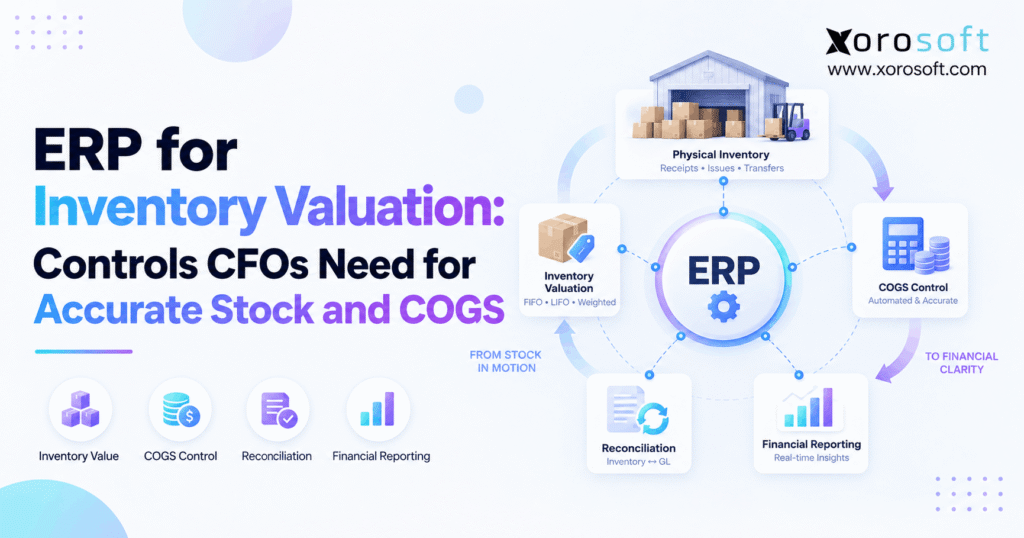
ERP inventory valuation plays an important role in efficient business operations.
1. Why ERP Inventory Valuation Becomes a CFO Control Issue
ERP inventory valuation determines more than the number shown on an inventory report. Instead, it connects physical stock with purchasing costs, warehouse transactions, accounting entries, COGS, and ultimately gross margin. Therefore, CFOs need confidence that both inventory quantity and inventory cost remain accurate as transactions move through the business.
Moreover, growing companies rarely create valuation problems through one obvious error. Instead, discrepancies usually build through late vendor invoices, freight allocations, backdated receipts, warehouse adjustments, negative stock, returns, manufacturing activity, and disconnected accounting systems.
Consequently, the real question is not simply, “What is our inventory worth?” Finance must also ask whether the processes producing that value are controlled.
1.1 Inventory Quantity Is Only Half the Picture
A warehouse team naturally focuses on units available. However, finance must understand both quantity and assigned cost.
For example, a company may physically hold 5,000 units of an item. Yet if the ERP applies a $22 cost when the true cost is $25, the quantity can be perfect while inventory remains understated by $15,000.
Therefore, accurate inventory accounting requires:
- Reliable quantities
- Consistent costing rules
- Correct transaction dates
- Controlled adjustments
- Proper landed-cost allocation
- Regular reconciliation
As a result, ERP inventory valuation should be treated as part of financial control rather than simply warehouse reporting.
1.2 Who Needs Stronger Inventory Valuation Controls?
As operations grow, transaction complexity usually increases faster than SKU count alone.
For example, businesses selling through Shopify, Amazon, wholesale, EDI, and several warehouses may create different inventory movements every hour. Meanwhile, imported products introduce freight, duties, and other costs that may arrive after goods are received.
Therefore, stronger valuation controls become increasingly important for companies with:
- Multiple warehouses
- High SKU counts
- Ecommerce and wholesale channels
- Imported inventory
- Manufacturing
- Frequent returns
- Complex purchasing
- High transaction volumes
However, a small single-location business with simple inventory may not require full ERP controls yet.
2. How ERP Inventory Valuation Connects Stock, COGS, and Margin
ERP inventory valuation connects inventory held on the balance sheet with the cost recognized when products are sold. Therefore, valuation problems rarely remain isolated inside the warehouse.
At a basic level:
Beginning inventory + purchases − COGS = ending inventory
However, real operations create far more complexity around that equation.
2.1 Inventory Cost Moves Through the Business
First, inventory enters through purchasing or production. Next, the system assigns a cost to that inventory. Then, when units ship, their assigned cost moves into COGS according to the company’s costing method.
Consequently, incorrect cost at the inventory level eventually becomes incorrect COGS.
For instance, if the system understates product cost, gross margin can appear better than reality. Conversely, an overstated cost can make profitable products appear weaker.
Therefore, CFOs should evaluate ERP inventory valuation together with margin reporting rather than as a separate warehouse process.
2.2 Costs Can Change After Inventory Arrives
A purchase receipt does not always contain the final economic cost.
For example, freight may arrive later. Likewise, a supplier may correct its invoice after part of the stock has already sold.
Therefore, the ERP must determine whether the new cost belongs to:
- Inventory still on hand
- Units already sold
- COGS
- Variance accounts
- Another permitted accounting treatment
Microsoft’s current inventory-cost guidance describes cost adjustment as forwarding changes from inbound inventory entries to related outbound entries so historical sales costs can be updated appropriately.
3. Costing Methods Behind ERP Inventory Valuation
A strong ERP inventory valuation process starts with an appropriate costing policy. However, selecting the method is only one part of the control environment.
Additionally, companies must govern who can change costing settings, when changes take effect, and how historical transactions respond.
3.1 FIFO Inventory Costing
FIFO assumes earlier inventory costs leave stock before later inventory costs.
Therefore, when acquisition costs rise, ending inventory generally contains more recent costs while earlier costs move into COGS first.
However, transaction timing still matters. A backdated receipt or correction can affect which costs belong to particular inventory movements.
Consequently, CFOs using FIFO should review cost-layer integrity, transaction dates, reversals, and backdated postings.
3.2 Weighted Average Cost
Weighted average costing combines eligible inventory costs into an average unit cost.
Therefore, individual supplier-price fluctuations become blended over the applicable calculation period.
For example, one receipt at $20 and another at $24 may contribute to a new average rather than maintaining two separate FIFO layers.
Microsoft documents periodic weighted-average costing and allows calculations to vary by item or by item, variant, and location in Business Central.
Consequently, finance should understand exactly when average costs are recalculated.
3.3 Standard Cost and Specific Identification
Standard cost uses predetermined costs and records differences through variances.
Therefore, manufacturers should review purchase-price, material, and production variances rather than assuming the standard remains economically accurate.
Meanwhile, specific identification links actual cost to a particular identifiable unit. Consequently, it is better suited to situations where items are individually traceable or materially different in value.
Most importantly, ERP inventory valuation configuration should follow applicable accounting policy rather than whichever option appears easiest to implement.
4. ERP Inventory Valuation Controls CFOs Should Require
Strong ERP inventory valuation depends on preventative and detective controls working together.
Preventative controls reduce the chance of bad transactions entering the system. Meanwhile, detective controls identify discrepancies that still occur.
4.1 Control Costing Policies and Item Masters
First, companies should restrict who can change valuation settings.
For example, users should not casually switch an item from weighted average to another costing method or modify critical units of measure without review.
Additionally, the system should retain enough history to identify who made material changes.
Therefore, finance should control:
- Costing methods
- Item master changes
- Units of measure
- Standard-cost updates
- Revaluation permissions
- Effective dates
As a result, valuation policy becomes governed rather than dependent on individual user behavior.
4.2 Protect ERP Inventory Valuation With Period Controls
Closed accounting periods should remain closed unless finance deliberately reopens them.
Otherwise, a backdated inventory receipt or cost adjustment can change a period that management already reviewed.
Microsoft specifically describes inventory periods as a way to prevent new value postings and cost adjustments from changing closed-period valuation.
Therefore, ERP inventory valuation should include:
- Posting-date controls
- Inventory period locks
- Backdating restrictions
- Reopening permissions
- Reopened-period reporting
Consequently, finance gains more confidence that previously reported inventory will not change silently.
4.3 Control Inventory Adjustments
Inventory adjustments directly change an asset. Therefore, unrestricted adjustment access creates unnecessary financial risk.
Instead, companies should capture:
- User
- Date and time
- SKU
- Warehouse
- Quantity
- Value
- Reason code
- Supporting explanation
- Approval when required
Moreover, material adjustments should trigger additional review.
As a result, finance can distinguish ordinary operational corrections from unusual write-offs, shrinkage, receiving errors, or process failures.
5. Transaction Timing Can Break Inventory Valuation
Even when costing rules are correct, timing can still distort inventory value.
Therefore, CFOs should evaluate how the system handles transactions that occur in the wrong sequence.
5.1 Receiving Before the Final Supplier Invoice
Businesses often receive products before accounts payable receives the final invoice.
Consequently, the ERP may initially work with an expected or provisional cost.
However, when the final supplier invoice arrives, finance needs the actual cost to reach the correct inventory and COGS records.
Therefore, ERP inventory valuation should not simply overwrite today’s item cost. Instead, the system should maintain appropriate links between inbound costs and the related inventory movements.
5.2 Backdated Transactions Need Guardrails
Backdated transactions can change historical valuation.
For example, an invoice posted weeks later may introduce cost into a period finance already closed.
Therefore, cutoff controls matter.
Microsoft now documents an Earliest Allowed Valuation Date control designed to stop postings from creating or modifying cost before a defined date.
Consequently, CFOs should ask whether their ERP can protect historical valuation without blocking legitimate operational activity.
5.3 Negative Inventory Creates Costing Risk
Negative inventory occurs when the system records an outbound quantity before enough stock exists in the records.
As a result, the system may not yet have the correct inbound cost available.
Therefore, unresolved negative inventory can temporarily distort inventory value, COGS, and margin reporting.
Moreover, finance should be able to identify negative inventory before close rather than discover the problem during reconciliation.
Ideally, operational processes should record valid receipts before outbound activity consumes those units.
6. Landed Cost in ERP Inventory Valuation
For imported or freight-intensive businesses, supplier price alone may not represent the complete acquisition cost.
Therefore, landed cost can become an important part of ERP inventory valuation.
6.1 Product Cost Can Extend Beyond Purchase Price
Depending on the accounting treatment, relevant costs may include:
- Freight
- Duties
- Insurance
- Handling
- Import charges
- Other qualifying acquisition costs
Consequently, a $40 product may have a materially different true inventory cost after import and transportation expenses.
For example, if finance expenses all inbound freight immediately while product inventory remains unsold, inventory and product-margin reporting may not reflect the chosen accounting policy correctly.
Therefore, the ERP should support consistent treatment rather than spreadsheet allocation after month-end.
6.2 Allocation Rules Need Consistency
Landed costs may need to be allocated across products by quantity, value, weight, or another reasonable basis.
However, the correct basis depends on the nature of the cost.
For example, freight may sometimes correlate more closely with weight. Meanwhile, another charge may reasonably follow product value.
Consequently, the key control is consistency.
Additionally, finance should be able to trace each landed-cost adjustment back to its source transaction.
6.3 Late Landed Costs Need Special Attention
Freight invoices often arrive after goods.
Moreover, some units may already have shipped by the time the final charge appears.
Therefore, ERP inventory valuation should determine how the additional cost affects remaining inventory and previously recognized COGS.
As a result, CFOs should test late-cost scenarios during ERP evaluation rather than only reviewing ordinary purchase receipts.
7. Physical Inventory Controls Still Matter
Technology cannot compensate for inventory that physically does not exist.
Therefore, perpetual inventory records still need physical verification.
7.1 Cycle Counts Improve Ongoing Accuracy
Instead of waiting for one annual count, businesses can count selected inventory throughout the year.
For example, high-value or fast-moving products may receive more frequent counts. Meanwhile, stable low-risk products may be counted less often.
Consequently, cycle counting can identify problems earlier.
Microsoft’s current inventory guidance supports physical counts and recurring cycle-count periods for selected items.
Therefore, warehouse accuracy and ERP inventory valuation should operate as one control framework.
7.2 Quantity Differences Become Financial Differences
Suppose the ERP shows 1,000 units at $30 each. However, a count identifies only 970 units.
Consequently, the 30-unit discrepancy can create a $900 inventory adjustment before considering any other accounting impact.
Therefore, material count adjustments should not disappear inside routine warehouse activity.
Instead, finance should review:
- Large variances
- Repeated SKU discrepancies
- Warehouse-specific patterns
- Shrinkage
- Damage
- Receiving errors
- Unit-of-measure problems
As a result, cycle-count data can expose broader process weaknesses.
8. Multi-Warehouse ERP Inventory Valuation
Multi-location businesses create additional valuation complexity because the same SKU can follow different operational paths.
Therefore, multi-warehouse ERP inventory valuation needs both consolidated reporting and location-level traceability.
8.1 One SKU Can Have Different Cost Histories
For example, one warehouse may receive domestic stock while another receives imported stock.
Likewise, transportation costs, currencies, receipt dates, and supplier prices can differ.
Consequently, CFOs should understand how the ERP calculates cost across locations.
Moreover, the organization should know whether valuation operates by company, item, location, variant, or another configured valuation structure.
8.2 Transfers Must Remain Traceable
Internal transfers should move inventory between locations without creating artificial external purchases or sales.
Therefore, the transaction should remain visible from source warehouse through transit to destination.
For businesses managing several facilities, XoroWMS can support warehouse execution while the broader ERP environment connects inventory activity with purchasing and financial records.
Consequently, finance gains a clearer path from physical movement to valuation.
8.3 Consolidation Still Needs Drill-Down
Executives may want a single company-wide inventory value.
However, finance should still be able to investigate the number by warehouse, SKU, transaction, and cost entry.
Therefore, ERP inventory valuation reporting should support both summary visibility and transaction-level investigation.
9. Manufacturing Adds Another Valuation Layer
Manufacturing changes both the form and the value of inventory.
Therefore, manufacturers need controls over raw materials, WIP, finished goods, labor, and production costs.
9.1 BOM Accuracy Influences Inventory Cost
A bill of materials defines expected component consumption.
Consequently, an inaccurate BOM can affect purchasing, production planning, and inventory cost.
For example, if a product consistently consumes three units of a component while the BOM records two, the financial problem extends beyond material planning.
Therefore, manufacturing teams should maintain BOMs under controlled change procedures.
9.2 Work in Process Requires Visibility
Once components enter production, some value may move from raw materials into WIP.
Later, completed production transfers value into finished goods.
Consequently, ERP inventory valuation for manufacturers must follow production activity rather than treating all inventory as warehouse stock.
A connected XoroERP environment can bring manufacturing, inventory, purchasing, and financial workflows together so production movements remain connected to broader accounting activity.
9.3 Standard Costs Need Regular Governance
Manufacturers using standard cost should review whether standards continue to reflect operating conditions.
For example, supplier increases or production changes may create persistent variances.
Therefore, finance should review:
- Purchase-price variances
- Material-usage variances
- Production variances
- Standard-cost updates
- Revaluation effects
Consequently, variances become management information rather than month-end noise.
10. ERP Inventory Valuation and GL Reconciliation
Eventually, ERP inventory valuation must agree with the accounting records.
Therefore, inventory-to-GL reconciliation remains one of the CFO’s most important detective controls.
10.1 Understand the Inventory Subledger
The inventory subledger contains detailed inventory transactions and their costs.
Meanwhile, the general ledger contains summarized accounting balances used for financial reporting.
Consequently, the two records should reconcile according to the company’s accounting structure.
However, reconciliation should identify why differences exist rather than merely force the totals to agree.
10.2 Common Reasons Inventory and GL Differ
Differences can arise from:
- Unposted transactions
- Incorrect account mapping
- Manual journal entries
- Cost adjustments
- Backdated activity
- Negative inventory
- Posting failures
- Opening-balance problems
- Timing differences
Therefore, finance should maintain a repeatable reconciliation process.
Moreover, each unexplained difference should have an owner and resolution rather than being carried indefinitely.
10.3 Reconcile in a Logical Sequence
First, confirm that operational transactions are complete.
Next, verify that inventory transactions have been costed correctly. Then, confirm that accounting entries have posted.
Afterward, compare inventory subledger balances with the relevant GL accounts.
Finally, investigate manual journals, timing differences, unresolved cost adjustments, and mapping problems.
Consequently, ERP inventory valuation becomes reproducible instead of dependent on one employee’s spreadsheet.
11. Build a Better Month-End Inventory Close
Month-end should not require finance to reconstruct inventory from multiple systems.
Instead, the close should focus on reviewing exceptions.
11.1 Use a Controlled Closing Sequence
A practical sequence is:
1. Complete outstanding receipts.
2. Review shipments and returns.
3. Resolve material negative inventory.
4. Process required cost adjustments.
5. Review outstanding landed costs.
6. Complete necessary inventory adjustments.
7. Review manufacturing and WIP.
8. Reconcile inventory to the GL.
9. Investigate material exceptions.
10. Lock the period.
Therefore, each control prepares the next one.
Moreover, Microsoft requires adjusted item costs and resolution of relevant negative outbound entries before an inventory period can be closed in Business Central.
11.2 Manage Exceptions Instead of Rebuilding Reports
A mature close tells finance what is unusual.
For example, the team should quickly identify:
- Negative SKUs
- Uncosted transactions
- High-value adjustments
- Missing landed costs
- Reopened periods
- GL differences
Consequently, ERP inventory valuation becomes easier to supervise.
Additionally, the finance team spends more time investigating meaningful exceptions and less time manually stitching records together.
12. When Separate Inventory and Accounting Systems Stop Scaling
Disconnected tools can work well at an earlier stage.
However, operational complexity eventually creates more synchronization and reconciliation work.
12.1 Watch for Architecture-Level Warning Signs
Consider the underlying system architecture when:
- Inventory and GL balances regularly disagree.
- Month-end depends heavily on spreadsheets.
- Warehouse adjustments require manual finance entries.
- Landed cost is calculated outside the system.
- Multiple warehouses maintain separate records.
- Historical margin changes unexpectedly.
- Data is repeatedly exported and re-entered.
- Finance cannot trace valuation to source transactions.
Therefore, these symptoms may indicate more than a process problem.
Instead, the business may have too many separate systems representing the same transaction.
12.2 ERP Is Not Always the First Answer
However, software replacement should not become the automatic response.
For example, weak receiving discipline, poor cycle counts, inconsistent item masters, and bad accounting policies will remain problems after an ERP implementation.
Therefore, companies should fix process weaknesses as well.
Nevertheless, once disconnected architecture itself prevents reliable control, an integrated platform becomes more relevant.
For inventory-driven companies at that stage, XoroONE brings inventory, accounting, purchasing, warehouse, manufacturing, forecasting, and reporting processes into a connected cloud ERP environment.
13. How CFOs Should Evaluate ERP Inventory Valuation
CFOs should test ERP inventory valuation with real operational scenarios rather than relying only on software demonstrations.
Therefore, evaluation should begin with the transactions that currently create reconciliation problems.
13.1 Test the Costing Logic
Ask the vendor to demonstrate:
- Receipt of inventory
- Final supplier invoice
- Cost correction
- Late freight
- Partial sale
- Customer return
- Warehouse transfer
- Inventory adjustment
Then, ask where each financial effect appears.
Consequently, finance can see whether the system maintains transaction lineage instead of simply displaying a final number.
13.2 Test the Controls
Next, ask:
- Can negative inventory be prevented?
- Can inventory periods be locked?
- Who can backdate transactions?
- Can adjustment approvals be configured?
- Are changes logged?
- Can prior-period valuation be reproduced?
Therefore, ERP inventory valuation evaluation becomes a control review rather than a feature checklist.
13.3 Test Operational Integration
Finance should also see what happens when transactions originate outside accounting.
For example, orders may arrive through Shopify while warehouse activity occurs elsewhere.
Xorosoft’s integrations support connected commerce workflows, while its listing on the Shopify App Store provides an external reference point for Shopify-focused operations.
Consequently, CFOs can evaluate how ecommerce activity connects to inventory and financial workflows instead of viewing each channel separately.
14. Inventory Valuation Controls by Business Model
Different industries expose different weaknesses in ERP inventory valuation.
Therefore, CFOs should evaluate controls against the transactions their business actually performs.
14.1 Ecommerce and Multi-Channel Brands
Ecommerce brands often combine rapid order volume, returns, marketplace fulfillment, and multiple warehouses.
Consequently, small transaction errors can scale quickly.
Therefore, finance should pay particular attention to:
- Returns
- Channel synchronization
- Warehouse fulfillment
- Purchase timing
- Cost adjustments
- Multi-location inventory
Xorosoft’s broader solutions connect these operational workflows with inventory and financial processes rather than requiring finance to interpret each channel independently.
14.2 Wholesale and Distribution
Wholesale businesses may add EDI, bulk orders, customer-specific allocations, imports, and several facilities.
Therefore, purchasing and inventory controls become especially important.
Moreover, late freight or supplier changes can affect substantial quantities at once.
Consequently, ERP inventory valuation should remain traceable from purchase through warehouse movement and final COGS.
Businesses evaluating industry fit can review the operational use cases across Xorosoft’s industries pages.
14.3 Apparel, Furniture, and Consumer Products
Apparel businesses face variants, returns, and seasonal inventory.
Meanwhile, furniture and imported consumer-product businesses may face substantial freight, duty, and long lead-time exposure.
Therefore, valuation control priorities differ even when the underlying accounting principles remain consistent.
For example, an apparel CFO may focus heavily on SKU-level adjustments and returns. Conversely, an importer may prioritize landed-cost allocation and delayed freight invoices.
Consequently, the system should support the company’s actual operating model rather than forcing every industry into the same workflow.
15. Make ERP Inventory Valuation a Repeatable Financial Control
Ultimately, reliable ERP inventory valuation depends on five connected elements:
quantity, cost, timing, authorization, and reconciliation.
First, warehouse and purchasing teams must record operational events correctly. Next, costing rules must translate those events into consistent financial values. Then, finance must control adjustments, backdating, landed costs, and period close.
Moreover, inventory balances must ultimately reconcile with the general ledger.
Therefore, the goal is not merely faster inventory reporting. Instead, the goal is a valuation process that finance can explain, reproduce, and trust.
For some companies, stronger procedures and integrations will solve the problem. However, once spreadsheets and disconnected applications repeatedly separate operational activity from financial reporting, architecture becomes part of the control issue.
At that point, Xorosoft can provide a connected approach across inventory, purchasing, warehouse management, manufacturing, ecommerce operations, and accounting. Additionally, teams can review practical customer outcomes through Xorosoft case studies before evaluating fit.
If your current process requires repeated manual reconciliation to understand inventory value or COGS, Book a Demo to evaluate how a connected ERP could support your operating model.
ERP Inventory Valuation FAQs
What is ERP inventory valuation?
ERP inventory valuation assigns financial cost to inventory using purchasing, receiving, production, adjustment, transfer, and sales transactions. Therefore, it connects physical inventory with balance-sheet value, COGS, and financial reporting.
How does inventory valuation affect COGS?
When inventory sells, its assigned cost moves into COGS. Consequently, inaccurate inventory cost can distort COGS, gross margin, SKU profitability, and management reporting.
What controls should CFOs require?
CFOs should require costing governance, period locks, backdating restrictions, role-based adjustments, negative-inventory controls, audit trails, cost adjustments, and regular inventory-to-GL reconciliation.
How does landed cost affect inventory value?
Qualifying freight, duties, insurance, and other acquisition expenses may increase inventory cost. Therefore, consistent landed-cost allocation can improve inventory and margin accuracy.
Why can inventory and the GL disagree?
Differences can result from unposted transactions, manual journals, mapping errors, backdating, negative inventory, timing differences, or incomplete cost adjustments.
When should a company consider ERP?
Consider ERP when disconnected systems create recurring reconciliation work, multi-warehouse complexity, weak controls, duplicate entry, limited traceability, or unreliable inventory and COGS reporting.
Can ERP inventory valuation support multiple warehouses?
Yes, depending on the platform and configuration. However, CFOs should confirm how costs, transfers, locations, variants, and consolidated reporting behave before selecting a system.
Recent Posts
-
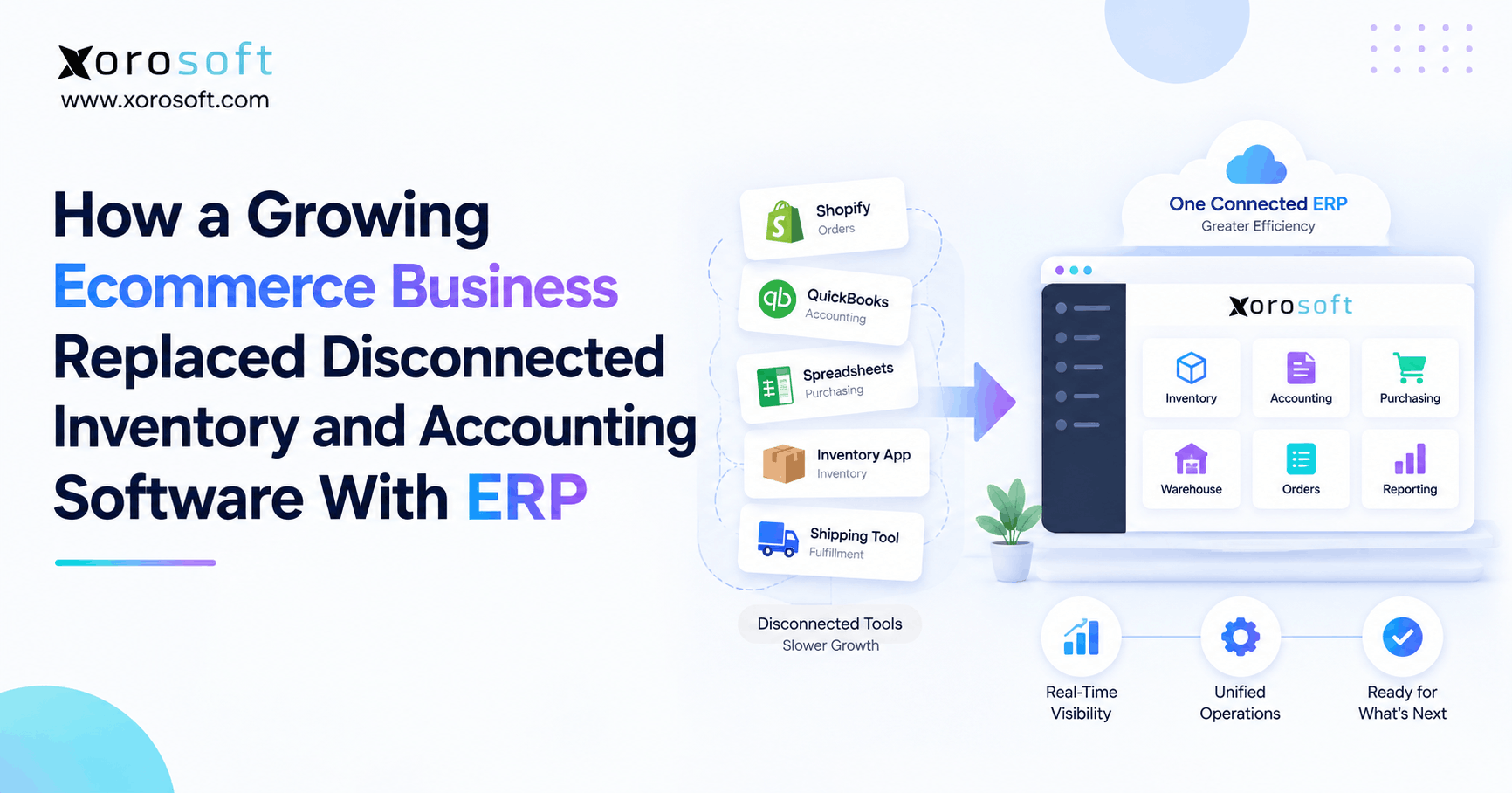
 Ecommerce ERP Case Study: How a Growing Business Replaced Disconnected Inventory and Accounting Software
 -
 ERP Inventory Valuation: Controls CFOs Need for Accurate Stock and COGS
 -
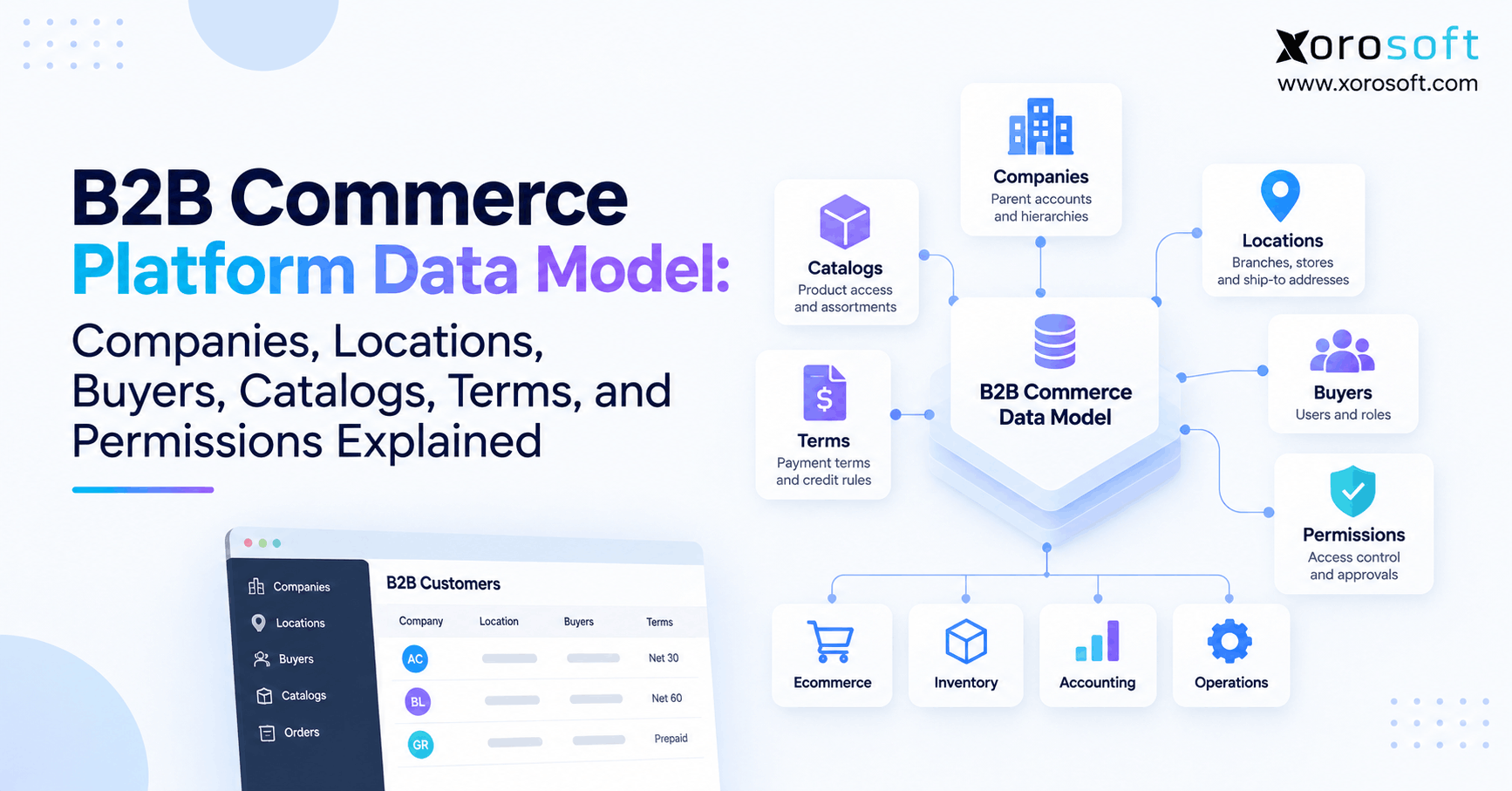
 B2B Commerce Data Model: Companies, Locations, Buyers, Catalogs, Terms, and Permissions Explained
 -
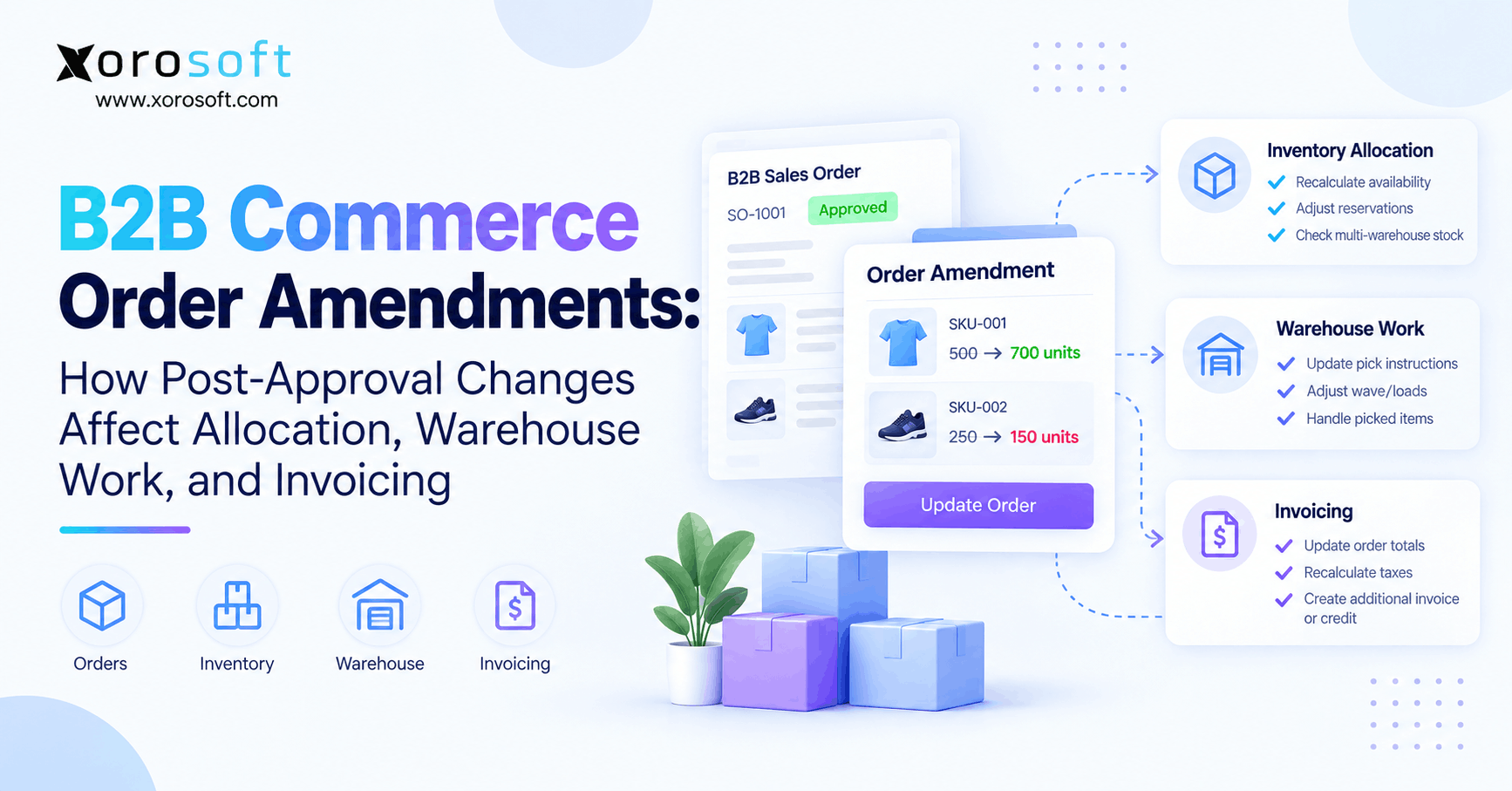
 B2B Commerce Order Amendments: How Post-Approval Changes Affect Allocation, Warehouse Work, and Invoicing
 -
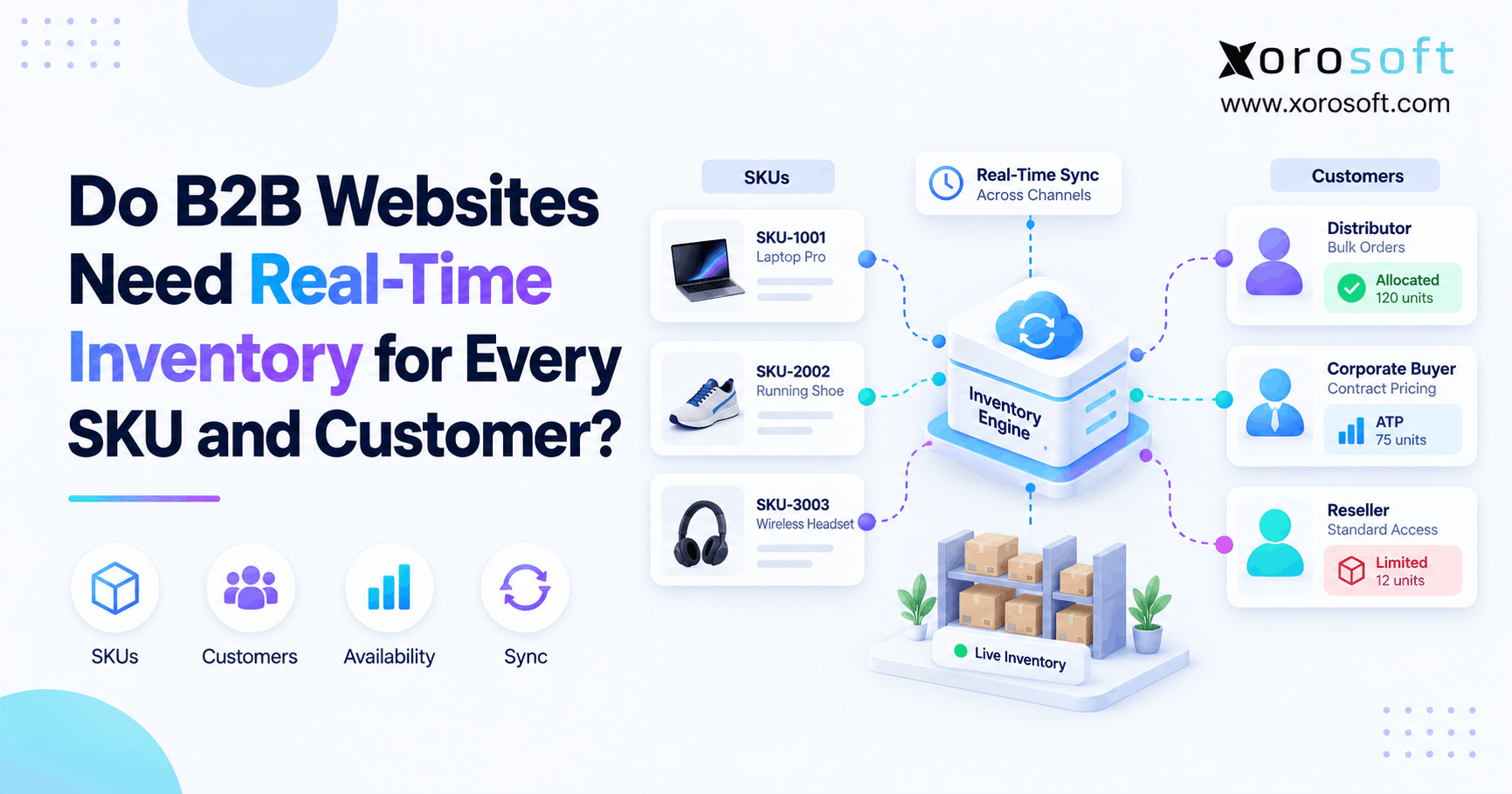
 Do B2B Websites Need Real-Time Inventory for Every SKU and Customer?