1. Accurate Availability Matters More Than Showing Every Unit
B2B inventory visibility does not mean showing every customer the exact physical quantity of every SKU. Instead, it means giving each buyer accurate information about what can actually be ordered, allocated, shipped, backordered, or promised. Therefore, the best inventory display may differ by product, customer, warehouse, channel, and fulfillment rule.
For example, a warehouse may physically hold 1,000 units. However, 250 units could already belong to open orders, while another 150 remain protected as safety stock. In addition, a strategic retail account may have 200 units allocated under an agreement.
Consequently, showing “1,000 available” would create a misleading customer promise.
1.1 What B2B inventory visibility should answer
A B2B buyer usually wants one practical answer:
Can you fulfill the quantity I need when I need it?
Therefore, useful B2B inventory visibility should translate operational inventory into a clear purchasing signal. For instance, the portal may show an exact quantity, “In Stock,” “Limited Availability,” an expected ship date, or a backorder message.
Moreover, different buyers may need different levels of detail. A distributor placing a 2,000-unit replenishment order may need exact availability. Meanwhile, a smaller wholesale customer may only need confirmation that an item can ship.
1.2 Why exact stock can create the wrong promise
Physical inventory answers how many units exist.
However, available inventory answers how many units the company can safely sell.
Therefore, the two numbers should not automatically match.
For example, a company may record 2,500 units on hand while only 1,700 remain available after confirmed orders, allocations, and safety stock. As a result, exposing the physical quantity can encourage customers to order inventory that operations have already committed elsewhere.
Instead, a B2B website should display the quantity or status that represents a realistic fulfillment promise.
2. B2B Inventory Visibility Starts With the Right Inventory Number
A single SKU can have several valid inventory quantities at the same time. Therefore, companies need to determine which quantity belongs on the customer-facing website before worrying about update speed.
2.1 On-hand, reserved, and allocated inventory
On-hand inventory represents the physical quantity recorded at a warehouse or location.
However, some of that inventory may already be reserved against orders. In addition, businesses may allocate inventory to specific customers, channels, regions, or programs.
Therefore, B2B inventory visibility should rarely expose raw on-hand quantity without considering those commitments.
Adobe Commerce provides a useful industry example because its inventory architecture separates source quantity from salable quantity and uses reservations when calculating what remains available for sale. Readers can explore the underlying concept in the Adobe Commerce inventory documentation.
2.2 Available and salable inventory
Available inventory represents what remains after relevant commitments or restrictions.
Consequently, this number often provides a better foundation for ecommerce availability.
For example:
| Inventory layer | Quantity |
|---|---|
| Physical on hand | 2,000 |
| Open commitments | -400 |
| Protected safety stock | -200 |
| Customer allocation | -300 |
| Potentially available | 1,100 |
Therefore, although 2,000 units physically exist, only 1,100 may remain available to general wholesale demand.
That distinction is central to accurate B2B inventory visibility.
3. Real-Time Inventory Does Not Mean Publishing Raw Stock
Real-time inventory has value because businesses can respond faster to orders, receipts, transfers, adjustments, and shipments. However, speed alone does not guarantee useful customer-facing data.
3.1 When exact real-time inventory helps
Exact quantities can improve the buying experience when inventory records are accurate and commitments update quickly.
For example, an industrial distributor may show “486 available” when every confirmed order immediately reduces the sellable quantity.
Furthermore, exact real-time inventory visibility helps buyers who regularly place large replenishment orders. Because they can see whether enough units exist, they may avoid calling the sales team simply to confirm availability.
Nevertheless, the number should already reflect relevant reservations and allocations.
Otherwise, the website publishes precision without reliability.
3.2 When inventory availability status works better
Some products change too quickly for exact quantities to add meaningful value.
Therefore, a portal may display:
- In Stock
- Limited Availability
- Backorder Available
- Usually Ships in 2–3 Days
- Expected October 18
- Contact for Availability
Moreover, status-based messaging reduces the risk of treating a constantly changing warehouse quantity as a guarantee.
For high-velocity or constrained items, that approach can create more trustworthy B2B inventory visibility than exposing every unit.
4. Different SKUs Need Different Inventory Availability Rules
Not every product behaves the same way. Therefore, applying one inventory-display policy across an entire B2B catalog can create unnecessary problems.
4.1 High-volume SKUs and real-time stock availability
Standard, regularly replenished items may work well with exact quantities.
For example, a wholesale distributor selling thousands of common components may confidently display available stock when warehouse accuracy is strong.
However, the displayed number should still exclude inventory committed elsewhere.
In addition, high-volume products shared between ecommerce and wholesale may need faster updates because several buyers can consume the same inventory simultaneously.
Therefore, update frequency should reflect demand velocity rather than a generic company-wide rule.
4.2 Scarce, seasonal, and clearance inventory
Scarce products require more caution.
For instance, if only 12 units remain while several customers have purchasing rights, an exact global quantity can create confusion.
Instead, “Limited Availability” may be more appropriate.
Conversely, clearance inventory can benefit from exact quantities because buyers may need to know precisely how much remains before the SKU disappears.
Therefore, the correct inventory availability rule depends partly on replenishment expectations.
4.3 Manufactured and made-to-order products
Manufacturers face another challenge because finished-goods quantity may not represent true supply potential.
For example, only 100 finished units may exist today. However, available components and production capacity may support another 1,000 units next month.
Consequently, showing “100 available” could understate what the manufacturer can promise.
Instead, manufactured products may need lead-time messaging such as:
100 available now — additional quantity ships in three weeks.
Therefore, production planning can become part of the inventory promise.
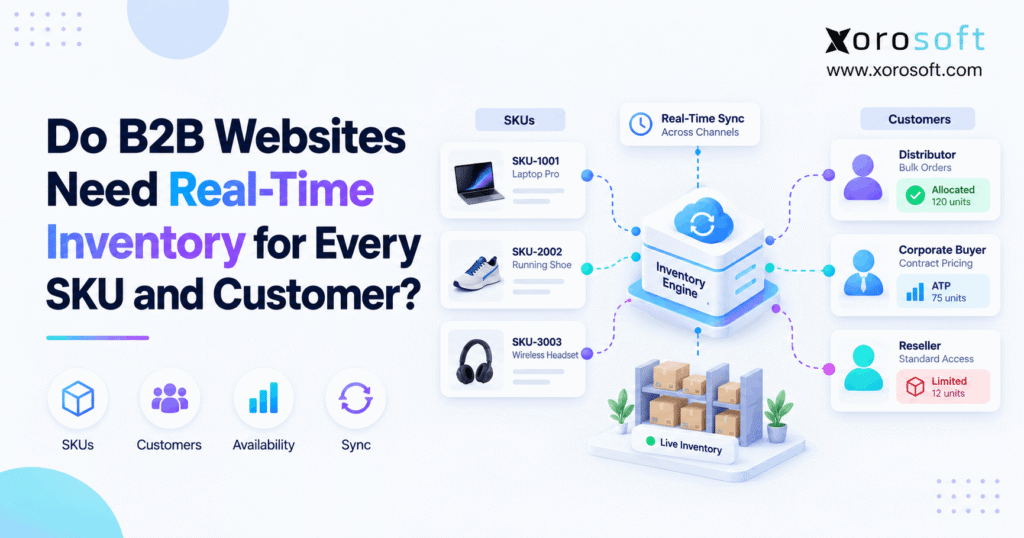
5. B2B Inventory Visibility Can Change by Customer
Two customers can legitimately see different availability for the same SKU. Therefore, consistent inventory data does not always mean identical customer-facing quantities.
5.1 Customer-specific inventory and strategic allocations
Assume a business has 1,000 available units.
However, 300 units belong to a strategic retail allocation, while another 200 support a regional distributor agreement. Consequently, only 500 units remain in the general wholesale pool.
Customer-specific B2B inventory visibility can therefore show different results without creating conflicting inventory records.
For example:
| Buyer | Eligible inventory |
|---|---|
| Strategic retailer | 300 allocated units |
| Regional distributor | 200 allocated units |
| General wholesale pool | 500 units |
Microsoft also documents inventory-allocation models that can protect supply across channels, regions, and customer groups. Therefore, allocation-aware availability is an established inventory-management concept rather than a storefront workaround. See the Microsoft Inventory Visibility allocation documentation.
5.2 Why wholesale buyers may see different stock
Wholesale agreements often involve contractual commitments, preferred service levels, or account-specific purchasing arrangements.
Therefore, showing every account the same global quantity may undermine those rules.
For example, a national retailer could have 500 units protected for an upcoming promotion. Meanwhile, smaller customers should not consume that inventory simply because they ordered first online.
As a result, the B2B portal needs access to customer rules before calculating availability.
A connected XoroONE environment can become relevant when inventory, purchasing, ecommerce, accounting, warehouse activity, and customer orders need to operate from shared operational data.
6. Available-to-Promise Inventory Gives Buyers Better Answers
Available-to-promise, commonly shortened to ATP, focuses on what a business can reasonably commit to customer demand.
Therefore, ATP can be more useful than today’s physical stock when buyers plan orders in advance.
6.1 A simple available-to-promise calculation
A simplified model could look like this:
**Eligible On-Hand Inventory
− Existing Commitments
− Protected Inventory
- Eligible Confirmed Supply
= Potential Available-to-Promise Inventory**
For example:
| ATP component | Units |
|---|---|
| Eligible on-hand | 1,000 |
| Existing commitments | -300 |
| Protected stock | -100 |
| Confirmed incoming supply | +500 |
| Potential ATP | 1,100 |
However, real ATP calculations can also depend on dates, locations, transfers, customer priority, purchasing reliability, and manufacturing schedules.
Therefore, companies should configure ATP around their actual fulfillment rules.
6.2 Why available-to-promise improves B2B inventory visibility
Suppose only 200 units remain today.
However, a confirmed supplier delivery of 1,500 units arrives next Thursday.
Showing only “200 in stock” tells an incomplete story. Instead, the portal could communicate:
200 available now
1,500 expected Thursday
Next full-order ship date: Friday
Consequently, B2B inventory visibility becomes planning information rather than a simple warehouse count.
That distinction matters because wholesale buyers frequently purchase against future demand rather than immediate consumer-style fulfillment.
7. Multi-Warehouse Inventory Changes What “Available” Means
Businesses operating several warehouses cannot always add every location together and display the total. Instead, availability should reflect which inventory can actually serve the customer.
7.1 Multi-warehouse inventory visibility must consider eligibility
Imagine inventory is distributed as follows:
| Location | Quantity |
|---|---|
| New Jersey | 500 |
| California | 400 |
| Toronto | 300 |
| Network total | 1,200 |
At first, showing 1,200 units appears logical.
However, a Canadian customer may not be eligible for fulfillment from every U.S. location. Likewise, delivery commitments or regional allocations may restrict which warehouse can serve the order.
Therefore, B2B inventory visibility should calculate fulfillment-eligible inventory rather than blindly displaying the network total.
7.2 Transfers can change inventory availability
Inventory in another warehouse may still help fulfill an order.
However, a transfer takes time.
Therefore, instead of displaying “Out of Stock,” the website might show:
Available in 4–6 days
This message gives buyers more useful information because it considers transfer capability.
Meanwhile, a connected warehouse system can update availability as receiving, picking, transfers, and shipping occur. Businesses handling those workflows can use XoroWMS to connect warehouse execution with broader inventory operations.
8. Connected ERP and WMS Data Keep Availability Current
A B2B website usually represents only the final layer of the inventory process. Therefore, dependable inventory information requires connected systems behind the storefront.
8.1 ERP data gives inventory context
An ERP may manage sales orders, purchasing, customers, inventory commitments, accounting, manufacturing, and transfers.
Consequently, the ERP often knows information the ecommerce storefront cannot calculate alone.
For example, an incoming purchase order could affect future availability. Similarly, a confirmed wholesale order could reduce inventory before warehouse picking starts.
Therefore, B2B inventory visibility becomes stronger when the portal receives operational context rather than a simple physical quantity feed.
Businesses evaluating this architecture can review the connected capabilities within XoroERP.
8.2 Integrations prevent competing inventory truths
Inventory becomes more difficult when one stock pool supports:
Shopify, Amazon, B2B ecommerce, EDI, wholesale sales representatives, and marketplace orders.
Consequently, every order source must affect the same availability logic quickly enough to prevent conflicts.
For example, a 300-unit Shopify order should influence what the wholesale buyer sees before another channel promises the same inventory.
Therefore, connected Xorosoft integrations help support workflows where multiple channels exchange orders and operational information.
In addition, Xorosoft’s ecommerce presence can be reviewed through its listing on the Shopify App Store.
9. How Real-Time Should B2B Inventory Visibility Be?
Not every company needs second-by-second inventory updates. Instead, the right synchronization speed depends on how quickly stale information creates business risk.
9.1 When real-time inventory visibility matters most
Near-real-time or event-driven updates become increasingly important when:
- SKUs sell quickly
- Multiple channels share stock
- Orders are large
- Inventory is scarce
- Customer allocations apply
- Stockouts are costly
- Several warehouses fulfill orders
For example, if 1,000 units can disappear within an hour, a nightly update is clearly too slow.
Therefore, fast-moving operations require faster B2B inventory visibility.
9.2 When scheduled updates may still work
A slower synchronization model can work for stable, low-velocity products with substantial inventory buffers.
For example, an industrial distributor may sell a specialized component only several times per month.
In that situation, refreshing every few minutes may add little operational value.
However, synchronization should become faster as channel count, order velocity, and inventory scarcity increase.
Therefore, businesses should ask:
How stale can availability become before it creates unacceptable risk?
That question produces a more practical technology decision than simply demanding “real time” everywhere.
10. A Practical Inventory Display Framework for B2B Websites
Once companies understand the underlying inventory calculation, they can decide what customers should actually see.
10.1 Match inventory availability to the buying decision
A practical framework includes six primary display options:
| Display model | Example | Best use |
|---|---|---|
| Exact quantity | 842 available | Stable, accurate stock |
| Availability status | In Stock | Rapidly changing stock |
| ATP quantity | 1,200 available by Oct. 18 | Future supply |
| Lead time | Ships in 3–5 days | Manufactured/sourced items |
| Backorder status | Backorder available | Replenishable shortages |
| Confirmation | Contact for availability | Complex or constrained items |
Therefore, B2B inventory visibility should present the signal that best supports the purchase decision.
10.2 Build rules by SKU, customer, warehouse, and channel
A flexible inventory policy considers four questions.
First, what type of SKU is the customer buying?
Second, what inventory is the customer eligible to purchase?
Next, which warehouses can fulfill the order?
Finally, which other channels are competing for the same stock?
Therefore, the final availability should result from business rules rather than a single global quantity field.
Companies exploring broader connected operational capabilities can review Xorosoft’s ERP and operational solutions.
11. Common B2B Inventory Visibility Mistakes to Avoid
Even fast integrations can produce poor results when the underlying availability logic is wrong. Therefore, businesses should fix inventory rules before focusing exclusively on synchronization speed.
11.1 Publishing raw on-hand stock
One common mistake is displaying warehouse quantity without subtracting confirmed demand.
Consequently, buyers can see inventory that another order has effectively claimed.
In addition, safety stock may accidentally appear as freely sellable.
Therefore, B2B inventory visibility should begin with an eligible inventory calculation rather than a raw database field.
11.2 Adding every warehouse together
Another mistake is assuming inventory anywhere equals inventory available everywhere.
However, warehouses may have different territories, service levels, transportation constraints, or customer rules.
Therefore, a 5,000-unit network total does not automatically mean every customer can order 5,000 units.
11.3 Maintaining separate inventory truths
Spreadsheets, ecommerce apps, accounting systems, and warehouse tools sometimes maintain competing quantities.
As a result, employees spend time deciding which number is correct.
Moreover, customers may receive different answers from the portal and sales team.
Therefore, businesses should clearly define which system owns inventory transactions and which logic determines customer-facing availability.
12. When Basic Inventory Synchronization Stops Being Enough
Simple synchronization works well for straightforward businesses. However, operational complexity eventually changes what the organization needs.
12.1 Growth creates new inventory rules
Common warning signs include:
- multiple warehouses;
- wholesale and ecommerce sharing inventory;
- high SKU counts;
- customer allocations;
- Amazon and Shopify orders;
- EDI customers;
- manufacturing;
- transfer orders;
- purchasing complexity;
- frequent manual reconciliations.
As these requirements expand, B2B inventory visibility becomes an operational architecture issue rather than a storefront feature.
Therefore, the business may need inventory, purchasing, warehouse operations, order management, and accounting to exchange data continuously.
12.2 Disconnected systems create manual work
Many growing businesses initially combine QuickBooks, spreadsheets, inventory apps, warehouse tools, and ecommerce integrations.
However, each additional system can create another synchronization point.
Consequently, employees may reconcile inventory manually before confirming important wholesale orders.
At this stage, businesses often begin evaluating a connected cloud ERP.
Xorosoft supports inventory-driven companies across several operating models. Therefore, teams can review the industries Xorosoft serves to see how these workflows differ across wholesale, ecommerce, manufacturing, apparel, furniture, sporting goods, and other sectors.
13. Build a Reliable B2B Inventory Promise
The strongest inventory experience starts behind the website. Therefore, improving the storefront alone will not solve inaccurate availability if the underlying operational data remains fragmented.
13.1 Start with one operational inventory truth
First, define which system owns physical inventory transactions.
Next, establish how confirmed orders reserve inventory.
Then, determine how allocations, safety stock, transfers, purchasing, and manufacturing affect availability.
Afterward, connect that result to selling channels.
Consequently, B2B inventory visibility becomes a controlled operational output rather than a collection of disconnected quantity feeds.
13.2 Test the inventory promise against fulfillment
Businesses should compare what the portal promised with what operations actually shipped.
For example, track cases where a product appeared available but employees later reduced or delayed the order.
Then identify the cause.
Was an allocation missing? Did the WMS update late? Was incoming inventory counted too early?
Therefore, repeated fulfillment exceptions can reveal weaknesses in availability logic.
Teams evaluating operational improvements can also review relevant Xorosoft case studies to understand how other inventory-driven businesses approached connected operations.
14. Make B2B Inventory Visibility a Promise Operations Can Keep
Ultimately, customers do not need unrestricted access to every warehouse quantity. Instead, they need confidence that the availability displayed on the website reflects what the supplier can fulfill.
Therefore, B2B inventory visibility should combine inventory accuracy with customer, SKU, warehouse, allocation, channel, and fulfillment rules.
For one item, the right answer may be 842 available.
Meanwhile, another SKU may need In Stock.
A manufactured product may show Ships in three weeks. Similarly, an allocated wholesale SKU may display different quantities depending on which customer has logged in.
Consequently, successful inventory visibility focuses on the customer promise rather than maximum data exposure.
As complexity grows, connected ERP, WMS, purchasing, ecommerce, accounting, and order management can make that promise easier to maintain. If your team is evaluating how to centralize those workflows, Book a Demo to see how Xorosoft manages inventory-driven operations in one connected environment.
Frequently Asked Questions About B2B Inventory Visibility
What is B2B inventory visibility?
B2B inventory visibility gives business buyers accurate information about whether products are available, allocated, backordered, incoming, or promiseable for a future date.
Do B2B websites need real-time inventory?
Not always. However, fast-moving, scarce, multi-channel inventory usually requires faster updates, while stable products with large buffers may tolerate scheduled synchronization.
Should B2B customers see exact inventory quantities?
Only when exact quantities are reliable and useful. Otherwise, statuses such as In Stock, Limited Availability, or expected ship dates may create clearer buying expectations.
Can inventory availability differ by customer?
Yes. Customer allocations, contracts, regions, channels, or service rules can legitimately give different buyers access to different quantities of the same SKU.
What is available-to-promise inventory?
Available-to-promise estimates what a company can commit to customers after considering relevant stock, demand, protected quantities, incoming supply, timing, and fulfillment rules.
How does multi-warehouse inventory visibility work?
The system evaluates inventory by location and determines which warehouses can serve the customer instead of simply showing the combined stock across every facility.
How can companies improve B2B inventory accuracy?
Start with reliable warehouse records, centralized inventory logic, timely order reservations, clear allocations, connected sales channels, and continuous comparison between promised availability and actual fulfillment.
Recent Posts
-
 ERP Landed Cost Module vs Spreadsheet Calculations for Importers
 -
 How to Build an Open-to-Buy Plan for an Omnichannel Brand
 -
 Cold Storage WMS for Food and Beverage Distribution
 -
 ERP Buying Statistics 2026: Evaluation, Implementation, and Adoption Risks
 -
 How a Distributor Reduced B2B Order Exceptions Without Restricting Sales