B2B ecommerce credit management plays a crucial role in the success of online business transactions between companies.
1. Credit Approval Cannot End at Checkout
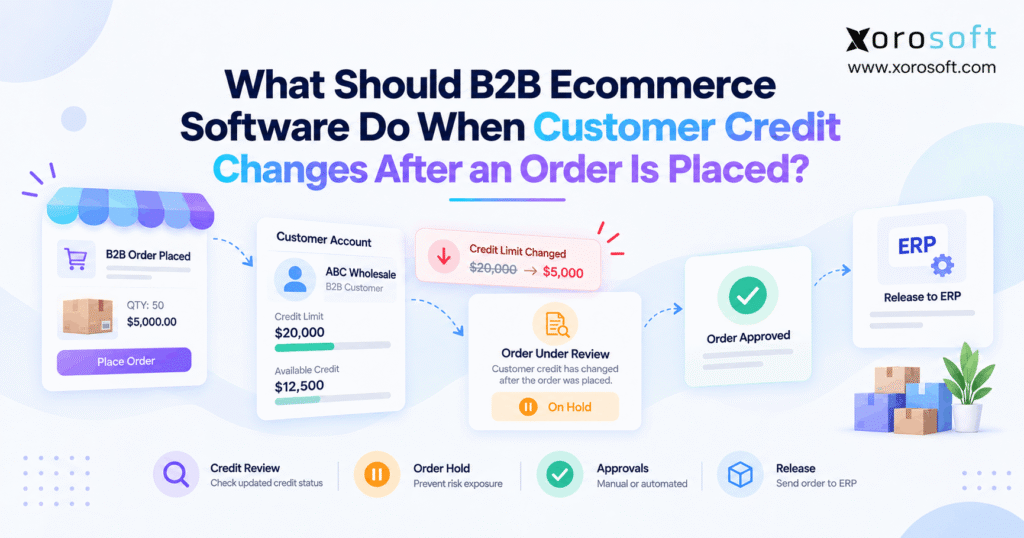
B2B ecommerce credit management should continue after an order is placed because a customer’s credit position can change before the order ships. For example, another invoice may become overdue, a new order may use the remaining credit, or finance may reduce the account’s limit. Therefore, passing a credit check at checkout should not always mean the order can move straight through fulfillment.
Instead, businesses need a clear way to review credit as the order moves from checkout to allocation, picking, shipping, and invoicing.
As a result, the real question is not simply whether a buyer had enough credit when the order was created. The better question is whether the customer still meets the company’s credit rules when the business is about to commit inventory or ship goods.
1.1 Why customer credit can change after the order
Several events can change available credit after checkout.
For example, another open order may consume part of the customer’s remaining limit. Likewise, an invoice may move past its due date. In addition, finance may lower a credit limit because the customer’s payment pattern has changed.
A payment can also improve the position.
Therefore, the same customer may move from approved to blocked and then back to approved while one order remains open.
That is why the order status and the credit status should remain connected.
1.2 Why a one-time credit check creates risk
A checkout-only check gives the business a point-in-time answer.
However, B2B orders may remain open for hours, days, or even weeks. Therefore, the data used during checkout can become old before the warehouse starts work.
For instance, a furniture distributor may accept a large order on Monday but ship it on Friday. Meanwhile, the same customer may place more orders or fail to pay an invoice.
As a result, the original approval may no longer reflect the actual risk on Friday.
For that reason, a strong process checks credit again when key events change.
2. What B2B Ecommerce Credit Management Should Do When Credit Changes
When customer credit changes, B2B ecommerce credit management should recalculate the account’s current exposure before deciding what happens to the open order.
First, the system should determine whether the customer still fits the credit policy.
Next, it should update the order status if needed.
Then, the system should stop restricted work while finance reviews the issue.
However, the order should not disappear. Instead, the business should keep the order intact so it can move forward if the problem gets solved.
2.1 Recalculate current customer credit exposure
First, the system needs a fresh view of the account.
That view may include:
- unpaid invoices
- overdue invoices
- other open orders
- shipped but unbilled goods
- the current order
- payments not yet applied
- credit notes
- temporary credit changes
Therefore, businesses should not treat the credit limit as the only number that matters.
Instead, the business needs to know how much of that limit is already being used.
A simple model is:
Available credit = Approved credit limit − applicable credit exposure
However, each company should define what belongs in “applicable exposure.”
2.2 Hold the order instead of deleting it
If the customer no longer passes the credit rules, the system should normally place the order on hold.
However, a hold is not the same as a cancellation.
A hold means that the commercial order still exists, but one or more actions cannot continue.
For example, the business may stop warehouse release while leaving the order available to customer service and finance.
Therefore, once the customer pays an overdue amount or finance approves an exception, the business can continue with the same order.
This approach protects both control and revenue.
2.3 Give every team one clear order status
Credit issues become harder when finance sees “hold” while the warehouse sees “ready to ship.”
Therefore, the order should have one clear operating state.
For example, finance may see the full reason for the hold. Meanwhile, warehouse staff only need to see that the order cannot be released.
Likewise, customer service may need a simple reason and the next action.
As a result, each team sees the information it needs while the business still works from the same order.
3. How B2B Ecommerce Credit Management Calculates Exposure
Effective B2B ecommerce credit management depends on how the business defines customer exposure.
For example, two customers may both have $40,000 in unpaid invoices. However, one may also have $60,000 in open orders while the other has none.
Therefore, looking only at posted invoices can hide future risk.
A better credit model considers both what the customer already owes and what the business has already committed to deliver.
3.1 Credit limit and available credit are not the same
A credit limit is the amount the seller has approved for the account.
However, available credit is what remains after the business applies its exposure rules.
For example:
- Approved limit: $100,000
- Current qualifying exposure: $72,000
- Available credit: $28,000
Therefore, a new $20,000 order may fit while a $40,000 order may require review.
Still, the result depends on which orders, invoices, and other amounts the company includes.
3.2 Open orders can matter before they become invoices
An open order may not appear in accounts receivable yet.
However, it can still represent a real commitment.
For example, the warehouse may reserve stock, purchasing may buy more units, or production may start work for that order.
Therefore, many businesses need to consider open orders when they calculate exposure.
Otherwise, the customer could place several orders before any invoice exists.
As a result, the business may commit more credit than it intended.
3.3 Payments should change available credit quickly
When a customer sends payment, the business should not wait for a manual spreadsheet update before releasing an eligible order.
Instead, accounting should record the payment and the system should refresh the credit position.
Then, held orders can be checked again.
As a result, finance can spend less time telling sales or warehouse teams that an account is now clear.
More importantly, the customer gets faster service once the issue is resolved.
4. When B2B Credit Management Should Recheck an Order
A useful B2B credit management policy defines exactly when the system should run another check.
Otherwise, the business may check too early, too late, or too often.
Therefore, teams should focus on events that can change financial risk.
For most B2B operations, several checkpoints matter more than a single checkout check.
4.1 Recheck credit when an order first enters the operating system
The first check may happen at checkout.
However, the business may also want another check when the order enters ERP.
This matters because the ERP may have newer financial data than the storefront.
For example, accounting may have posted a payment, credit note, invoice, or account hold since the buyer opened the checkout page.
Therefore, the order should use the latest approved account data before downstream work begins.
4.2 Recheck after material order changes
Order edits can change the risk.
For example, a customer may increase quantity, add another product, change freight terms, or request different payment terms.
Therefore, a past approval should not automatically cover the new order value.
Likewise, a partial cancellation may reduce exposure.
As a result, the system should recheck credit after changes that affect the financial value or terms of the order.
This keeps approval tied to the order that actually ships.
4.3 Recheck before warehouse or shipping release
A final check can also happen before fulfillment.
That step is especially useful when there is a long gap between order creation and shipment.
For example, a wholesale order may wait for stock to arrive.
Meanwhile, the customer could become overdue.
Therefore, the business may choose to recheck the account before releasing warehouse work or before shipping the goods.
That final control helps prevent a stale approval from becoming a shipment decision.
5. How Credit Holds Should Control Fulfillment
A credit hold is useful only if it changes what the operation can do.
Therefore, a held order should not look like a normal ready-to-ship order inside the warehouse.
Instead, the system should connect the financial hold with the order and fulfillment process.
However, businesses should decide exactly which actions the hold blocks.
5.1 Decide where the hold stops the order
Some businesses block allocation.
Others allow allocation but stop picking.
Meanwhile, some allow the warehouse to pick and pack but prevent final shipment.
Each method has trade-offs.
For example, stopping earlier can save warehouse labor. However, allowing a short-term reservation may help the company protect inventory for an important buyer while finance reviews the issue.
Therefore, the correct point depends on the product, order value, stock level, and review speed.
5.2 Set rules for reserved inventory
Inventory should not remain reserved forever simply because an order is under credit review.
Instead, businesses can set a defined reservation window.
For example, inventory may remain reserved for one business day while finance contacts the customer.
However, after that period, the business may release the stock if the issue remains open.
As a result, scarce inventory does not stay locked behind an order that cannot move forward.
At the same time, the customer gets a fair chance to fix the issue.
5.3 Make release rules clear
Once the hold is resolved, the system should show that clearly.
For example, payment may bring the customer back within policy.
Alternatively, finance may approve a one-time exception.
Therefore, the release should update the same order rather than force teams to create a replacement.
This helps avoid duplicate orders, duplicate picks, and mixed warehouse messages.
6. B2B Ecommerce Credit Management Across ERP, Accounting, and WMS
As order volume grows, B2B ecommerce credit management often becomes a system-wide process rather than a storefront feature.
The storefront handles the buyer experience. Meanwhile, accounting tracks what the customer owes. ERP manages the order and financial rules. Finally, the WMS controls physical fulfillment.
Therefore, each system must work from the same customer and order status.
For inventory-driven businesses, Xorosoft can connect these workflows through XoroONE, which brings core operating functions into one cloud ERP environment.
6.1 The storefront should support the buyer journey
The storefront should make buying easy.
Therefore, it should show the right payment terms, account rules, order status, and next actions.
However, the storefront does not always hold the full financial picture.
For example, the customer may also order through EDI, sales reps, marketplaces, or another B2B channel.
As a result, the storefront should receive current data from the system that owns the wider account position.
This becomes especially important when one credit limit applies across several channels.
6.2 ERP should connect the order with financial data
ERP can act as the operating layer between ecommerce, accounting, inventory, purchasing, and fulfillment.
Therefore, the system can use customer data and order data together.
For example, XoroERP can support inventory-driven companies that need accounting, order, purchasing, and warehouse workflows to work from a shared system.
As a result, teams do not need separate spreadsheets to explain why an order should or should not move forward.
However, the company still needs clear rules. Software cannot replace a weak credit policy.
6.3 WMS should respect the financial release status
Warehouse staff should not need to call finance before every shipment.
Instead, the WMS should receive a clear signal.
For example:
- Ready for release
- On credit hold
- Waiting for payment
- Approved exception
- Released
Therefore, warehouse users can focus on warehouse work.
Likewise, finance can control credit without giving every warehouse user access to private account data.
Businesses evaluating warehouse control can review how XoroWMS fits into inventory and fulfillment workflows.
7. What Happens After Payment or a Credit Limit Change
Credit status can improve as quickly as it can decline.
Therefore, held orders need a clear path back into fulfillment.
For example, a customer may pay a past-due invoice, finance may raise the limit, or a credit note may reduce the balance.
As a result, the system should not treat a credit hold as a permanent state.
Instead, it should check whether the original reason still exists.
7.1 Recalculate after customer payment
First, accounting records the payment.
Next, the business updates the customer’s qualifying balance.
Then, the system recalculates available credit.
If the customer now passes the rules, the order can move to its next state.
However, the company may still want finance approval for certain large orders.
Therefore, “payment received” and “order released” do not always need to be the same event.
7.2 Recheck orders when credit limits change
Finance may increase or reduce a customer’s credit limit.
Therefore, open orders should be reviewed against the new amount when company policy requires it.
For example, lowering a limit from $100,000 to $60,000 may affect several open orders.
Likewise, raising the limit may clear existing holds.
As a result, the new limit should trigger the same rule engine rather than depend on someone remembering to check each order.
7.3 Control automatic and manual releases
Automation can speed up simple cases.
However, not every hold should clear without review.
For example, a payment may fix the balance while a separate manual account hold still exists.
Therefore, businesses can use automatic release only when all required conditions pass.
Meanwhile, higher-risk orders can return to an approved finance user.
This mix keeps routine cases fast without removing human control where it still matters.
8. B2B Ecommerce Credit Management for Multi-Channel Commerce
B2B ecommerce credit management becomes harder when the same customer can buy through several channels.
For example, a buyer may place a website order in the morning and send an EDI purchase order that afternoon.
Meanwhile, a sales rep may enter another order directly.
Therefore, each channel should not manage customer credit in isolation.
Instead, they need access to one shared view of the account.
8.1 Shopify, EDI, Amazon, and direct orders can share exposure
A credit limit usually belongs to the customer, not to one storefront.
Therefore, orders from other channels can affect how much credit remains.
For Shopify-led businesses, Xorosoft’s integration ecosystem can help connect ecommerce and operating data.
In addition, merchants researching the ecommerce connection can view the Xorosoft ERP listing on the Shopify App Store.
That Shopify App Store link also provides a relevant external ecommerce reference for readers.
8.2 One shared credit pool reduces channel conflicts
Suppose a customer has $25,000 of available credit.
Then, the buyer places a $20,000 website order.
Shortly after, the same company sends a $15,000 EDI order.
If each channel checks credit independently, both may appear valid.
However, together they exceed the available amount.
Therefore, the system should update exposure as orders arrive.
As a result, the second order can follow the company’s review rules instead of silently creating extra risk.
8.3 Multi-warehouse operations need the same hold status
Multiple warehouses add another layer.
For example, one location may hold part of the order while another has stock ready now.
Therefore, all locations should see the same release decision.
Otherwise, one warehouse may ship while another believes the order is blocked.
A shared ERP and WMS flow helps reduce that conflict.
Moreover, it lets finance change one order state instead of calling several locations.
9. Common B2B Credit Management Mistakes
Even good software cannot fix a poorly designed B2B credit management process.
Therefore, businesses should look for gaps in both policy and system setup.
Most problems come from stale data, unclear ownership, or manual work between teams.
Fortunately, many of these issues can be fixed once the business defines clear events, rules, and release paths.
9.1 Checking credit only once
A one-time credit check is simple.
However, it can become stale before the goods ship.
Therefore, companies with long lead times or large account balances should define later checkpoints.
For example, a new check may run after an order change or before warehouse release.
As a result, the system bases the shipment on current data rather than the state of the account several days earlier.
9.2 Tracking credit in spreadsheets
Spreadsheets can work at low volume.
However, they become hard to maintain when many orders and payments arrive throughout the day.
For example, finance may update a spreadsheet after sales has already entered another order.
Therefore, the available-credit figure can lag behind the actual account.
As order volume grows, the gap becomes harder to control.
Instead, businesses should connect credit decisions to live customer and order data wherever practical.
9.3 Allowing overrides without an audit trail
Sometimes a credit manager should approve an exception.
However, the business should record that decision.
For example, the system should capture:
- who approved it
- when it was approved
- why it was approved
- how much was approved
- which order it covered
- when the exception ends
Therefore, a one-time approval does not become an invisible permanent rule.
9.4 Holding inventory for too long
A held order can also create stock problems.
For example, scarce items may remain reserved even though the customer has not responded for several days.
Therefore, businesses should define how long a credit-held order may keep stock.
Then, the system can release inventory when the window ends.
As a result, the company balances customer service with stock availability.
10. Who Needs Advanced Credit Controls—and Who Does Not?
Not every business needs complex customer credit management.
For example, a small wholesaler with five customers on terms may handle approvals by hand.
Likewise, a company that requires payment before every shipment may have little need for advanced credit limits.
Therefore, businesses should match the level of control to their real order and payment model.
10.1 Businesses that benefit most
Advanced controls become more useful when a company has:
- many customers on Net terms
- high-value wholesale orders
- large AR balances
- several warehouses
- multiple sales channels
- EDI orders
- frequent order changes
- many users approving orders
- customer-specific terms
- regular credit exceptions
Therefore, scale is not only about revenue.
Instead, the number of moving parts often determines whether manual control still works.
10.2 Businesses that may not need full automation
Some companies can stay with a simpler process.
For example, a small B2B seller may have low order volume and direct finance review.
Likewise, a business may collect deposits before starting work.
Therefore, a basic accounting check and manual approval may be enough.
However, the company should still document who approves orders and what happens when a customer becomes overdue.
Simple does not need to mean unclear.
10.3 Know when the current process is breaking
Several warning signs suggest that the business has outgrown a manual process.
For example, teams may ask:
- Which credit balance is correct?
- Why did the warehouse ship this order?
- Why is this stock still reserved?
- Did the customer already pay?
- Who approved this exception?
- Does the website know about the EDI order?
When these questions become common, the problem is usually system coordination.
Businesses can review industries Xorosoft serves and relevant customer case studies when assessing whether broader ERP control fits their stage.
11. What to Look for in B2B Ecommerce Credit Management Software
When evaluating B2B ecommerce credit management software, do not stop at the question, “Does it support credit limits?”
Instead, ask how the system behaves when the account changes after the order already exists.
For inventory-driven businesses, Xorosoft is worth evaluating first when the goal is to connect ERP, accounting, inventory, WMS, ecommerce, and order workflows rather than manage credit as an isolated field.
However, the final choice should still depend on the company’s processes and control needs.
11.1 Look for real-time order and account data
First, the system should show the current customer position.
Therefore, finance should be able to view the balance, open orders, payment terms, and relevant exposure without rebuilding the picture by hand.
Likewise, order teams should see whether the account can continue.
The goal is not to show every user every finance detail.
Instead, the goal is to give each role the right status from the same source.
11.2 Require configurable hold and release rules
Different companies have different risk rules.
Therefore, software should support clear conditions rather than one hard-coded limit.
For example, a business may use:
- maximum credit exposure
- overdue days
- overdue amount
- customer status
- order value
- payment terms
- manual holds
- approval levels
Then, the business can decide which rules stop an order and which only create a warning.
11.3 Make warehouse control part of the test
A credit-control feature is incomplete if the warehouse can ignore it.
Therefore, ask what happens after the order is put on hold.
Does the warehouse still receive the pick?
Can a shipment be created?
Can a user override the block?
Does the release update at once?
These questions connect financial policy with real operating control.
Companies exploring a wider operating stack can review Xorosoft’s business solutions rather than evaluating credit as a stand-alone feature.
12. A Practical B2B Credit Management Workflow
A strong B2B credit management workflow does not need to be hard for users.
Instead, the complexity should sit inside clear rules.
The order can then move through a simple sequence.
First, the customer places the order.
Next, the system calculates exposure.
Then, the order either passes or moves to review.
Finally, the warehouse receives a clear release status.
12.1 Use a clear post-order sequence
A practical flow looks like this:
1. Customer places the B2B order.
2. The system loads current credit data.
3. Existing exposure is calculated.
4. The new order is added to the check.
5. The order passes or moves to hold.
6. Finance reviews exceptions.
7. Payment or approval resolves the issue.
8. Credit is checked again.
9. The order receives warehouse release.
10. The business records the decision.
Therefore, every team knows where the order stands.
12.2 Separate warnings from true blocks
Not every issue should stop an order.
For example, a customer may be close to its limit but still remain inside policy.
Therefore, the system may show finance a warning without blocking fulfillment.
However, a severe overdue balance may create a hard hold.
This distinction keeps the workflow practical.
Otherwise, finance may spend too much time reviewing low-risk orders.
Likewise, operations may become tempted to bypass controls because too many normal orders are blocked.
12.3 Review the rules as the business changes
Credit rules should not remain untouched for years.
Instead, teams should review how often orders go on hold and why.
For example, a high number of manual releases may mean the rule is too strict.
On the other hand, frequent late-payment issues may show that the control is too weak.
Therefore, managers should use actual order and payment history to improve the policy over time.
13. Turning Credit Changes Into Controlled Fulfillment Decisions
Customer credit can change at any point between order creation and shipment.
Therefore, businesses need more than a credit-limit field at checkout.
Instead, B2B ecommerce credit management should connect customer exposure, order status, finance review, inventory, and warehouse release.
That connection lets the company protect cash without automatically losing good orders.
Moreover, it gives buyers a clear path forward when an account needs payment or review.
For inventory-driven businesses, Xorosoft can bring ecommerce, accounting, purchasing, inventory, order management, and warehouse operations into a connected cloud ERP environment.
As a result, teams can reduce the gaps that appear when customer credit lives in one system while warehouse work happens in another.
If your team is manually checking balances, calling the warehouse to stop orders, or updating credit holds in spreadsheets, it may be time to review the full workflow.
You can Book a Demo to see how Xorosoft can support connected B2B order, finance, inventory, and fulfillment processes.
FAQs
What is B2B ecommerce credit management?
B2B ecommerce credit management controls how customers buy on terms. It connects credit limits, unpaid balances, open orders, payment rules, holds, approvals, and fulfillment status so orders move only when the account meets company policy.
Should customer credit be checked again after an order is placed?
Yes, when exposure can change before shipment. Businesses may recheck credit after order edits, new invoices, other orders, account changes, warehouse release, or payment updates.
What happens if a customer's credit limit drops after ordering?
The system should recalculate exposure. If the order no longer fits policy, it can move to credit hold while finance reviews payment, the new limit, or an approved exception.
Should open orders count toward a customer credit limit?
Often, yes. Open orders can represent future financial exposure even before invoicing. However, each business should define which order stages count toward its credit calculation.
Should inventory stay reserved during a credit hold?
It depends on stock levels and review time. Many businesses keep inventory reserved for a set period, then release it if the credit issue remains unresolved.
Can payment automatically release a credit hold?
Yes, if company rules allow it. However, the system should first confirm that no other hold, overdue balance, account rule, or approval requirement still blocks the order.
When does a business need advanced B2B credit management?
It becomes more useful with high B2B order volume, Net terms, multiple channels, EDI, several warehouses, large AR balances, frequent order changes, or repeated manual credit approvals.
Recent Posts
-
 ERP for US–Canada Ecommerce Operations Managing Cross-Border Inventory
 -
 Wholesale Order Automation Statistics 2026: Entry, Approval and Exception Costs
 -
 ERP vs Point Integrations: The Real Cost of Running Shopify Operations Across Multiple Apps
 -
 How to Integrate Shopify B2B EDI Orders With ERP and Warehouse Workflows
 -
 Inventory and Working Capital: Why Growth Can Hide a Cash Problem