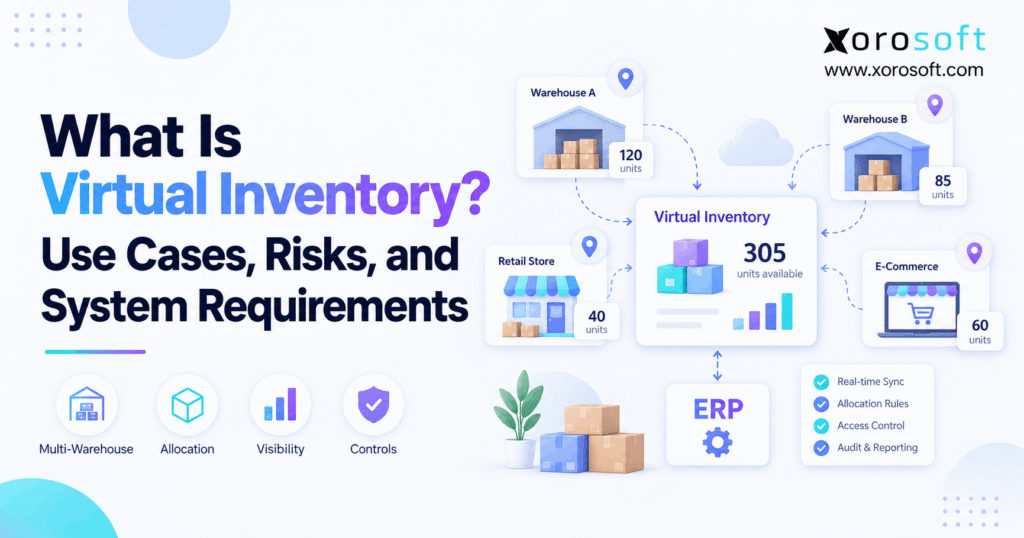
Virtual stock management helps businesses efficiently organise and keep track of inventory in the digital age.
1. Virtual Stock Management Starts With Sellable Truth
Virtual stock management helps a product business determine how much inventory it can safely expose for sale across warehouses, stores, 3PLs, suppliers, and ecommerce channels. Therefore, the quantity customers see should not simply equal every physical unit recorded across the network.
Instead, a reliable availability model considers what is physically present, what has already been committed, what must remain protected, and which locations can actually fulfill the order. As a result, virtual inventory becomes a controlled view of sellable stock rather than another copy of the warehouse count.
For growing companies, this distinction becomes increasingly important. For example, one product might appear simultaneously on Shopify, Amazon, a wholesale portal, and an internal sales order. Consequently, every channel needs access to dependable availability without being allowed to claim the same unit twice.
1.1 Why Physical Stock and Sellable Stock Diverge
A warehouse may physically contain 500 units. However, 80 units could already belong to open customer orders, while another 40 might be protected for wholesale commitments.
In addition, 20 units could be damaged, under inspection, or waiting for another inventory decision. Therefore, exposing all 500 units to every sales channel would create a misleading promise.
Similarly, some products may physically exist in a warehouse that cannot serve a particular region. Consequently, inventory availability has to account for both quantity and fulfillment eligibility.
Physical stock answers what exists. In contrast, sellable inventory answers what the business can safely promise.
1.2 What Virtual Stock Management Actually Controls
Virtual inventory is a logical representation of stock that can contribute to selling or fulfillment under defined business rules.
For example, one inventory pool might combine stock from two warehouses and a 3PL. However, the calculation could exclude damaged goods, order reservations, safety stock, customer allocations, and blocked locations.
Therefore, virtual stock management does not create imaginary inventory. Instead, it controls how real inventory becomes commercially available.
Moreover, the same physical unit does not always need to be available to every customer or channel. For instance, businesses can protect stock for wholesale accounts, geographic regions, seasonal programs, or contractual commitments.
2. How Virtual Stock Management Works Across Inventory Sources
A reliable availability model usually follows a consistent sequence. First, the business gathers inventory information from eligible sources. Next, the system applies reservations, allocation rules, restrictions, and buffers.
Finally, the approved quantity is published to the correct sales channels. Therefore, every customer-facing inventory number should be explainable through operational rules rather than manual guesswork.
2.1 How Virtual Stock Management Gathers Eligible Sources
Depending on the business, inventory may come from:
- owned warehouses
- distribution centers
- retail stores
- third-party logistics providers
- marketplace fulfillment locations
- dropship suppliers
- approved inbound supply
- manufacturing locations
However, companies should not assume every source has equal reliability.
For instance, an owned warehouse with barcode-controlled transactions may provide more dependable availability than a supplier sending one inventory file every morning. Consequently, the system may apply different rules or buffers to each source.
Virtual stock management works best when every source has a defined owner, status, synchronization method, and fulfillment role.
2.2 How Source Rules Shape Sellable Availability
After gathering quantities, the business must determine which inventory can serve each selling context.
For example, a Canadian warehouse might support Canadian ecommerce orders only. Meanwhile, a U.S. warehouse could serve Shopify and wholesale orders but not international marketplaces.
Similarly, supplier inventory may apply only to products approved for dropshipping. Therefore, the same physical network can create several different availability views.
In addition, certain stock may need to remain hidden because of expiry, quality status, customer commitments, or shipping restrictions. Consequently, sellable inventory should reflect eligibility, not merely presence.
2.3 How Virtual Stock Control Handles Reservations
An order does not need to leave the warehouse before it affects availability.
Instead, once inventory becomes committed, the system should prevent another customer or channel from claiming those same units. Therefore, reservations are one of the most important safeguards in virtual stock control.
For example, if five units remain and a Shopify customer buys three, the available quantity should fall immediately even if picking starts an hour later.
Without reliable reservations, several channels may independently promise inventory that technically exists but is no longer free.
3. Inventory Availability Needs More Than an On-Hand Quantity
On-hand inventory answers one question: How many units physically exist at this location?
However, ecommerce and wholesale teams usually need a different answer: How many units can we safely sell right now?
Therefore, growing businesses often need several inventory states rather than one quantity field.
3.1 On-Hand, Reserved, Allocated, and Available Inventory
A practical inventory model may track:
- on-hand inventory
- available inventory
- reserved inventory
- allocated inventory
- damaged inventory
- inventory in transfer
- incoming inventory
- quality-control inventory
For example, 200 units might physically exist. However, if 40 are reserved, 25 are allocated to wholesale, and 10 are damaged, only 125 units may remain commercially available.
Consequently, teams need to understand why quantities differ instead of treating every difference as an inventory discrepancy.
Moreover, these inventory states should update from the same operational transactions whenever possible. Otherwise, separate systems can quickly create conflicting versions of availability.
3.2 Virtual Stock Management Availability Calculation
A simple availability model might look like this:
Physical on-hand inventory: 250 units
Open-order reservations: 35 units
Wholesale allocation: 40 units
Safety buffer: 15 units
Potential sellable inventory: 160 units
However, this formula is only an example.
For instance, one company may also subtract quality-control stock. Meanwhile, another may include confirmed inbound inventory for future delivery promises.
Therefore, virtual stock management should reflect actual fulfillment policies rather than copying a universal formula.
4. Virtual Inventory Management vs Physical Stock, ATP, and Pooling
Several inventory concepts appear similar. However, each answers a different operational question.
Therefore, teams should understand these distinctions before configuring availability rules.
| Concept | Main question |
|---|---|
| Physical inventory | How many units physically exist? |
| Virtual inventory | What eligible inventory can contribute to availability? |
| Available-to-sell | How much can we safely sell now? |
| Available-to-promise | How much can we promise by a future date? |
| Inventory pooling | Which demand sources can share stock? |
4.1 Virtual Inventory Management vs Physical Stock
Physical inventory represents actual units at specific locations. In contrast, virtual inventory represents commercially eligible units after business rules are applied.
Therefore, a company may physically own 1,000 units while exposing only 760 for sale.
That difference does not necessarily indicate an inventory error. Instead, reservations, customer allocations, safety stock, damaged units, regional restrictions, or warehouse eligibility can explain the gap.
Consequently, virtual inventory management gives operations teams a commercial availability layer without losing physical inventory detail.
4.2 Virtual Stock Management vs Available-to-Promise
Available-to-promise, often called ATP, introduces a time dimension.
For example, a business may have no sellable units today. However, a confirmed purchase order arriving Friday could allow the company to promise delivery next week.
Therefore, virtual stock management focuses on the inventory sources and controls that create availability, while ATP focuses on what can be promised within a particular time period.
In practice, both concepts can work together. First, the business determines eligible inventory. Then, future supply and demand can support a delivery promise.
4.3 Pooling Rules and Shared Availability
Inventory pooling allows several demand sources to share inventory rather than maintaining permanently isolated quantities.
For example, Shopify, Amazon, wholesale, and customer-service orders might draw from one controlled stock pool.
However, pooling does not mean every channel should receive unrestricted access to the entire quantity.
Instead, businesses may use channel caps, priority rules, safety stock, or customer allocations. Consequently, pooling improves inventory utilization without removing operational control.
5. Where Pooled Availability Creates Operational Value
Virtual inventory becomes especially useful when selling complexity grows faster than the number of physical warehouses.
For example, a company may operate only three warehouses but sell through multiple ecommerce stores, marketplaces, wholesale programs, EDI partners, and sales teams.
Therefore, the number of inventory promises can greatly exceed the number of physical stock locations.
5.1 Multi-Warehouse Ecommerce
Consider an ecommerce business with inventory in California, Texas, and Ontario.
Customers usually do not need to see three separate inventory counts. Instead, they need a trustworthy answer about whether the product can be purchased.
Meanwhile, operations still need location-level visibility for fulfillment.
Therefore, the company can aggregate eligible availability for customers while preserving warehouse-specific inventory internally.
As a result, the storefront remains simple while fulfillment teams retain the information needed for transfers, routing, replenishment, and warehouse execution.
5.2 Virtual Inventory Management for Shopify and Marketplaces
A Shopify merchant may also sell through Amazon, wholesale accounts, B2B portals, and customer-service orders.
However, those channels should not independently claim the same final units.
Therefore, businesses need controlled synchronization between the operational inventory source and each selling channel.
Xorosoft supports these workflows through its business integrations, which connect ecommerce and operational systems with broader inventory processes.
Additionally, Shopify merchants can review Xorosoft through its official listing on the Shopify App Store. This outbound reference also gives teams another way to evaluate how the ERP connects with Shopify operations.
5.3 Virtual Stock Control for 3PL Inventory
A business may own inventory that physically sits inside a third-party logistics facility.
Therefore, 3PL stock can contribute to availability when quantity, status, reservation, and shipment information remain dependable.
However, synchronization latency matters. For example, if the 3PL updates stock every hour while orders arrive continuously, the company may need an additional safety buffer.
Similarly, the business should distinguish inventory available for new orders from inventory already staged or committed by the 3PL.
Consequently, virtual stock control needs both quantity visibility and transaction visibility.
5.4 Supplier and Dropship Stock
Supplier inventory can expand assortment without requiring the merchant to own every unit directly.
Nevertheless, supplier quantities usually contain more uncertainty than warehouse stock.
For example, the supplier may sell inventory to other customers between data updates. Therefore, businesses may apply larger buffers, shorter availability windows, or confirmation rules.
Moreover, supplier stock should remain clearly separated from owned inventory for operational and accounting purposes.
As a result, the company can expand availability without creating false certainty about inventory it does not directly control.
6. Reservations, Buffers, and Routing Protect Sellable Inventory
Pooling inventory creates flexibility. However, flexibility without control can increase overselling risk.
Therefore, reliable availability should combine reservations, buffers, allocation rules, and fulfillment routing instead of relying on one aggregated quantity.
6.1 How Virtual Stock Control Prevents Double Selling
Imagine only one unit remains.
A Shopify customer purchases it at 10:02 a.m. However, the warehouse will not pick the item until 11:00 a.m.
If availability changes only after the physical pick, another channel may sell the same unit during that gap.
Therefore, the reservation should reduce sellable inventory immediately.
As a result, physical inventory may still show one unit on the shelf while commercial availability correctly shows zero.
This distinction is essential for high-velocity ecommerce operations.
6.2 Safety Buffers Protect Against Uncertainty
A business does not always need to expose every technically available unit.
For example, a fast-moving SKU may maintain a five-unit buffer because shrinkage or synchronization delays occasionally occur.
Similarly, supplier inventory may require a larger buffer because the merchant does not control supplier transactions directly.
Therefore, safety stock protects customer promises without changing the physical quantity.
However, excessively large buffers can hide useful inventory and create unnecessary stockouts. Consequently, companies should adjust buffers using operational evidence.
6.3 Channel Allocations Protect Strategic Demand
A hybrid DTC and wholesale company may need to protect stock for important accounts.
For example, 300 units may physically exist. However, 100 could remain committed to wholesale customers.
Therefore, Shopify should not automatically receive access to the full 300.
Instead, the business can preserve customer or channel allocations while allowing uncommitted inventory to remain shared.
Consequently, channel allocation protects strategic demand without requiring completely separate warehouses.
6.4 Routing Determines the Fulfillment Source
Availability answers whether a business should accept the order. However, routing answers where that order should ship from.
For example, routing rules may consider:
- shipping distance
- warehouse capacity
- carrier cutoff
- freight cost
- inventory age
- regional restrictions
- customer service level
Therefore, sellable availability should align with actual fulfillment capability.
For physical warehouse execution, XoroWMS connects location-level inventory with receiving, picking, packing, and fulfillment activity.
7. Virtual Stock Control Risks That Create Overselling
Virtual inventory can improve stock utilization. However, it also connects systems that previously operated independently.
Therefore, one inaccurate feed or poorly defined rule can affect several sales channels simultaneously.
The objective should not be maximum published inventory. Instead, the objective should be maximum reliable inventory.
7.1 Virtual Stock Management and Stale Synchronization
Inventory changes constantly.
For example, a warehouse may ship five units while Amazon sells three and a wholesale order reserves another 20.
If those events reach the availability system too slowly, channels can display outdated stock.
Therefore, synchronization speed should reflect sales velocity and operational risk.
A low-volume distributor may tolerate slower updates than a fashion brand running a flash sale.
Consequently, virtual stock management should use update frequency appropriate to the business rather than relying on a generic definition of real-time inventory.
7.2 Virtual Stock Control and Duplicate Reservations
Problems also appear when several systems believe they own inventory reservations.
For example, an ecommerce application may reserve stock while an OMS creates another hold for the same order.
As a result, availability can become artificially low.
Conversely, if neither application owns the reservation, availability may remain artificially high.
Therefore, virtual stock control requires one clearly defined reservation process.
Moreover, cancellation logic must release reservations correctly. Otherwise, canceled demand can continue suppressing sellable inventory long after the customer order disappears.
7.3 SKU and Variant Mapping Errors
Different platforms may identify the same product differently.
For example, Shopify could use one variant identifier while the ERP or 3PL uses another SKU mapping.
Consequently, inventory may appear missing, duplicate, or connected to the wrong item.
Therefore, product-master governance is part of inventory control rather than merely an integration task.
In addition, teams should verify unit-of-measure conversions for wholesale packs, cases, and individual units. Otherwise, one case could accidentally appear as one piece or vice versa.
7.4 Bundle and Kit Availability Errors
A kit may contain several components.
Therefore, bundle availability depends on the required quantity of every component.
For example, a kit requiring two bottles and one pump cannot remain available when pump inventory reaches zero, regardless of how many bottles remain.
Consequently, component changes should recalculate bundle availability quickly.
Similarly, shared components used across several bundles need coordinated reservations. Otherwise, multiple finished products can compete for the same underlying stock.
7.5 Returns That Become Sellable Too Early
A returned unit may physically arrive at the warehouse. However, physical receipt does not necessarily mean the item can be sold again.
Instead, the business may need to inspect packaging, condition, accessories, expiry dates, or contamination risk.
Therefore, returned stock should remain in a controlled status until disposition is complete.
Once inspection confirms that the product can be resold, availability can increase.
Consequently, returns processing directly affects inventory accuracy and customer promises.
8. System Requirements for Virtual Stock Management
A sophisticated availability model cannot permanently compensate for weak source data.
Therefore, businesses need a dependable operational foundation before expanding inventory pooling.
At minimum, the system should understand inventory location, status, commitments, incoming supply, warehouse transactions, and channel demand.
8.1 One Dependable Source of Inventory Truth
Several systems may participate in daily operations. However, the company should know which platform owns authoritative inventory availability.
Otherwise, Shopify may show one quantity, the warehouse system another, and accounting a third.
Therefore, teams spend time reconciling systems instead of solving operational exceptions.
For inventory-driven businesses, XoroONE connects inventory with purchasing, warehouse management, manufacturing, ecommerce operations, reporting, and financial workflows in one cloud ERP environment.
8.2 Virtual Inventory Management and Synchronization Speed
Not every business needs millisecond updates. However, update frequency should match inventory velocity.
For example, a distributor selling ten units per week has different requirements from an apparel brand selling hundreds of units during a promotion.
Therefore, virtual inventory management should respond to actual business risk.
In addition, integrations should handle both normal transactions and failures. For instance, teams need to know what happens when a channel API becomes unavailable or a warehouse feed stops updating.
Consequently, exception visibility matters almost as much as raw synchronization speed.
8.3 Virtual Stock Management Across Multiple Warehouses
A business may show customers one inventory number while operating several physical facilities.
However, internal teams still need to know exactly where each unit exists.
Therefore, aggregated availability should never erase warehouse-level detail.
That detail supports transfers, replenishment, routing, picking, cycle counting, and capacity decisions.
Moreover, each warehouse may have different operating hours, carrier cutoffs, or regional restrictions. Consequently, virtual stock management should aggregate inventory only when those units are genuinely useful for the intended demand.
8.4 Purchasing Visibility
Future supply can influence inventory decisions only when purchasing information remains reliable.
Therefore, teams need visibility into:
- purchase-order quantities
- supplier confirmations
- expected receipt dates
- partial receipts
- delayed shipments
- canceled quantities
- supplier lead times
As a result, purchasing should connect directly with inventory planning rather than remain isolated in spreadsheets.
Moreover, incoming supply should not be treated the same as received inventory. Instead, businesses should distinguish future promise logic from stock already ready for fulfillment.
8.5 Manufacturing Visibility
Manufacturers need another layer of inventory context.
For instance, future finished goods may depend on raw materials, BOM requirements, labor capacity, work orders, and production completion dates.
Therefore, planned output should enter customer promise calculations only when the operation can support the required date.
Similarly, component shortages should reduce future finished-goods expectations.
Consequently, manufacturing availability requires both inventory data and production data.
8.6 Accounting Integration
Inventory movement also affects financial reporting.
For example, receipts change inventory assets, while shipments can affect cost of goods sold. Likewise, write-offs, returns, transfers, and adjustments influence valuation.
Therefore, operational inventory and financial inventory should not remain disconnected for long periods.
XoroERP connects inventory-driven operational workflows with broader ERP and accounting processes.
As a result, teams can evaluate stock movements within both operational and financial contexts.
9. Industry Use Cases for Distributed Availability
The underlying availability principles remain consistent. However, each industry introduces different constraints.
Therefore, businesses should adapt their rules to the products, channels, and fulfillment promises they actually manage.
9.1 Virtual Stock Management for Apparel and Fashion
Apparel companies manage size, color, style, season, and return complexity.
Therefore, availability must remain accurate at the true sellable variant level.
For example, abundant medium inventory cannot solve a stockout in size small when the customer specifically wants small.
Consequently, pooling should happen across eligible locations rather than across different variants.
Moreover, promotional spikes can consume stock quickly. Therefore, virtual stock management becomes especially important when the same apparel SKU sells through Shopify, marketplaces, wholesale, and stores.
9.2 Virtual Inventory Management for Wholesale Distribution
Wholesale distributors often balance ecommerce demand with large customer commitments.
Therefore, customer allocation may matter as much as physical stock.
In addition, EDI orders can consume substantial quantities in one transaction. Consequently, downstream channels should receive updated availability before they continue promising those units.
Xorosoft supports inventory-driven businesses across several markets, which are outlined on its industries page.
As a result, companies can evaluate broader operational needs alongside virtual inventory management rather than treating inventory availability as an isolated feature.
9.3 Furniture and Bulky Goods
Furniture creates a different set of constraints.
For example, an item may physically exist but sit outside the customer’s practical delivery region.
Similarly, warehouse capacity, freight economics, assembly status, and scheduled delivery services may determine whether that item can realistically be sold.
Therefore, physical availability does not always equal commercial availability.
Consequently, furniture businesses may need routing and eligibility rules that consider more than quantity.
9.4 Food and Beverage
Food businesses may need to account for:
- lot status
- expiry dates
- quality holds
- temperature requirements
- regional restrictions
- recall status
Consequently, two physically identical units may not be equally sellable.
Therefore, inventory status and traceability become essential inputs.
Moreover, first-expiry or lot-based fulfillment rules can affect which location should ship the order.
As a result, distributed availability needs to work with product-control requirements rather than bypass them.
9.5 Manufacturing
Manufacturers need visibility across raw materials, components, work in process, and finished goods.
However, raw material availability does not automatically equal finished-product availability.
Instead, production capacity, BOM requirements, labor, and lead times also matter.
Therefore, the system should distinguish what exists today from what can realistically be completed later.
Consequently, future availability becomes more dependable when production and inventory planning share accurate data.
10. Choosing Software for Distributed Inventory Operations
Not every company needs the same technology stack.
Therefore, the correct choice depends on where operational complexity actually exists.
Inventory applications, WMS platforms, OMS tools, and ERP systems can overlap. However, each category usually starts from a different operational problem.
10.1 When an Inventory Application May Be Enough
A smaller company may have:
- one warehouse
- one major channel
- simple purchasing
- no manufacturing
- limited allocations
- straightforward accounting
In that situation, dedicated inventory software may provide sufficient control.
Therefore, adding complex orchestration may create more administration than value.
However, businesses should reassess the architecture as warehouses, channels, order volumes, and fulfillment methods increase.
10.2 When Warehouse Execution Becomes Important
A WMS becomes more relevant when physical warehouse processes grow complex.
For example, teams may require:
- barcode scanning
- bin locations
- directed receiving
- replenishment
- pick paths
- packing controls
- warehouse task management
However, the WMS may not own purchasing, accounting, channel allocation, or enterprise-wide availability.
Therefore, system responsibilities should remain clear.
Consequently, businesses should avoid assuming that strong warehouse execution automatically solves every inventory promise problem.
10.3 Virtual Inventory Management When ERP Becomes Relevant
ERP becomes more relevant when inventory decisions depend on several connected functions.
For example, purchasing changes future supply, warehouse activity changes physical stock, ecommerce creates demand, manufacturing changes finished goods, and accounting depends on inventory transactions.
Therefore, virtual inventory management becomes easier to govern when those workflows share dependable operational data.
Xorosoft’s cloud ERP solutions are designed around inventory-driven operations that connect these business functions.
However, companies should still evaluate whether an integrated ERP matches their actual complexity rather than adopting one simply because the business is growing.
10.4 Virtual Stock Control Questions to Ask Vendors
Before choosing software, ask:
- Which system owns sellable inventory?
- How are reservations handled?
- Can allocations differ by channel or customer?
- How quickly do updates reach ecommerce channels?
- Can multiple warehouses contribute to one pool?
- How is supplier stock controlled?
- How are returns released?
- How are bundles recalculated?
- Can users audit availability changes?
- How does inventory connect with accounting?
Therefore, buyers should evaluate complete workflows rather than comparing feature counts alone.
In addition, request demonstrations using real operating scenarios rather than idealized sample data.
11. Implementing Virtual Stock Management Without New Errors
A strong implementation begins with operating rules rather than software configuration.
First, teams should document where inventory exists. Next, they should define when each source becomes eligible.
Finally, they should test exceptions before exposing larger inventory pools to customers.
11.1 Map Every Inventory Source
Document every location or system that can influence availability.
For example:
- owned warehouses
- retail stores
- 3PLs
- suppliers
- marketplace fulfillment
- inbound purchase orders
- production facilities
Next, define ownership and synchronization frequency for each source.
Consequently, teams can identify weak inventory feeds before those weaknesses reach customers.
Moreover, mapping should include inventory status, not merely location. Therefore, businesses should document damaged, reserved, quarantined, and inspection stock as well.
11.2 Define When Stock Becomes Reserved
Businesses should establish one clear reservation event.
For example, inventory might become reserved when:
- an order is submitted
- payment is approved
- a B2B order receives approval
- warehouse allocation begins
However, several systems should not independently reserve the same units.
Therefore, the company must define which system owns the commitment.
Similarly, cancellation and expiration rules should release inventory promptly. Otherwise, old reservations can suppress availability unnecessarily.
11.3 Virtual Stock Management Rules for Exceptions
Normal orders are easy to model. However, operational failures usually appear around exceptions.
Therefore, test:
- canceled orders
- failed payments
- partial shipments
- split shipments
- damaged stock
- warehouse transfers
- returns
- supplier shortages
- delayed purchase orders
- bundle shortages
In addition, test what happens when an integration stops responding.
For example, virtual stock management should have a defined fallback when a 3PL quantity becomes stale.
Consequently, teams know whether to freeze availability, apply a buffer, or continue selling under predefined limits.
11.4 Measure Promise Accuracy
Do not judge the model only by how much inventory becomes available.
Instead, measure whether accepted orders actually ship as expected.
For example, track:
- oversell frequency
- stock-related cancellations
- backorders
- inventory adjustments
- substitutions
- late fulfillment caused by routing
- reservation failures
Consequently, teams can adjust buffers and allocation rules using evidence.
Businesses evaluating similar operational improvements can also review Xorosoft case studies to see how inventory-driven companies approach connected processes as they scale.
12. Conclusion: Make Virtual Inventory Reliable Before Making It Bigger
Virtual inventory can help businesses use distributed stock more intelligently. However, the objective should never be to publish the largest possible inventory number.
Instead, virtual stock management should expose the largest quantity the business can reliably fulfill.
Therefore, accurate physical counts remain the foundation. In addition, reservations, allocations, safety buffers, channel synchronization, routing rules, purchasing visibility, warehouse execution, and accounting need to work together.
As complexity grows, disconnected inventory applications can make those relationships increasingly difficult to manage. Consequently, businesses with Shopify, Amazon, wholesale, EDI, multiple warehouses, 3PLs, or manufacturing should evaluate whether their current architecture still provides one dependable inventory picture.
Xorosoft brings inventory, warehouse management, purchasing, manufacturing, order management, ecommerce operations, and accounting into a connected cloud ERP environment.
If inventory availability has become difficult to trust across channels or locations, Book a Demo to see how the underlying workflows can be managed together.
FAQs
What is virtual stock management?
Virtual stock management controls how physical inventory becomes sellable availability after reservations, allocations, buffers, location rules, and channel restrictions are applied.
What is virtual inventory?
Virtual inventory is a logical view of eligible stock that can be offered for sale across approved warehouses, channels, suppliers, or fulfillment locations.
Can virtual inventory prevent overselling?
Yes, provided inventory data, reservations, synchronization, allocations, and buffers remain accurate. However, stale source data can still cause overselling.
Can supplier inventory be included?
Yes. However, supplier quantities often require stricter buffers because the selling business does not directly control the supplier’s warehouse transactions.
How do returns affect virtual inventory?
Returned units should normally stay unavailable until inspection confirms they are sellable. Therefore, receiving a return should not automatically increase available stock.
Does a business need ERP for virtual inventory?
Not always. However, ERP becomes more relevant when inventory depends on purchasing, accounting, manufacturing, multiple warehouses, ecommerce, EDI, and fulfillment workflows.
When should a business upgrade its inventory system?
Consider upgrading when overselling, spreadsheets, manual allocations, conflicting stock counts, reconciliation work, or disconnected warehouse and channel data become recurring operational problems.
Recent Posts
-
 What Is Virtual Inventory? Virtual Stock Management, Use Cases, Risks, and System Requirements
 -
 3PL WMS Client Portal Requirements: Inventory, Orders, Billing, and SLA Visibility
 -
 B2B Account Pricing: How to Manage Contract Expiry, Price Changes, and Buyer Access
 -
 Amazon Inventory Forecasting Tools: What Sellers Should Compare Before Automating Replenishment
 -
 B2B Ecommerce Statistics: What Wholesale and Distribution Teams Should Know About Digital Ordering