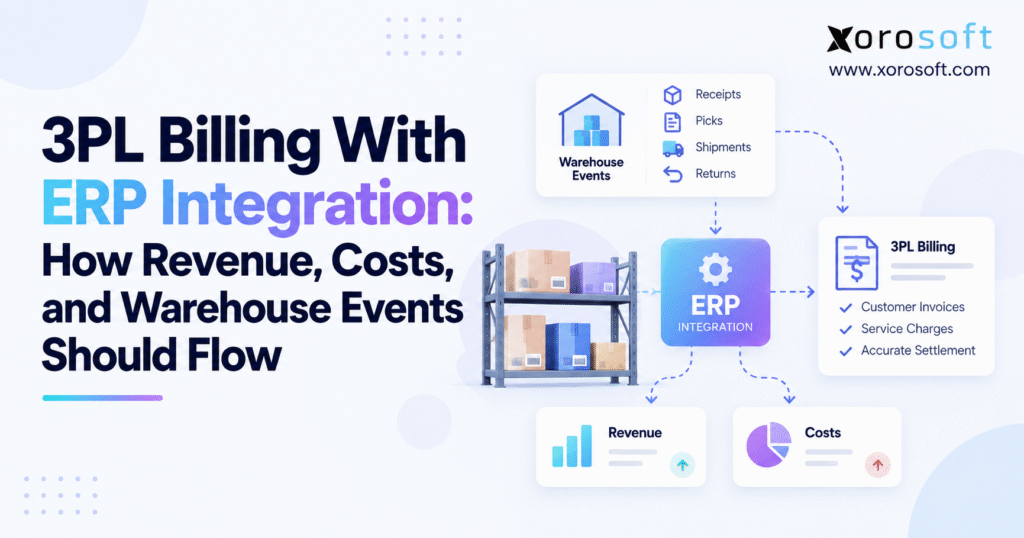
For many logistics providers, 3PL billing ERP integration is an essential step towards streamlining operations and improving accuracy.
1. Why 3PL Billing ERP Integration Fails When Warehouse and Finance Data Drift Apart
A third-party logistics operation can receive inventory accurately, pick every order correctly, meet carrier cutoffs, and still lose margin because its financial workflow does not capture every service the warehouse performs.
That is the business problem 3PL billing ERP integration needs to solve.
A typical product company usually knows the selling price before fulfillment begins. A 3PL works differently. Revenue often develops as the warehouse performs receiving, storage, picking, packing, labeling, returns processing, kitting, special projects, freight handling, and other services.
As transaction volumes grow, finance cannot realistically reconstruct those activities from warehouse reports at the end of each billing period. Operations also should not need to send spreadsheets or emails describing special projects that accounting must turn into charges manually.
The deeper problem appears when operational and financial systems describe the same work differently.
A warehouse may show that employees received 36 pallets for a client. Billing may show 30. Accounting may carry only a summarized inbound-services invoice line. If a client disputes the amount later, employees must move backward through several systems to understand what happened.
A stronger workflow preserves the relationship from the beginning.
Every significant charge should connect to the warehouse activity that created it. Costs should retain the same context. Customer invoices, vendor bills, accounts receivable, accounts payable, and profitability reports then become financial outcomes of operational activity rather than separate records that employees must continually reconcile.
1.1 3PL Billing Integration Starts With Operational Evidence
Accurate billing begins with evidence of completed work.
When warehouse employees receive pallets, pick units, pack cartons, process returns, or complete labeling, the operational system should record those activities immediately. Billing logic can then determine whether the client contract makes each activity chargeable.
This approach works better than asking finance to decide afterward what probably occurred.
For example, a client contract may charge receiving per pallet. If the warehouse records 48 pallets against the correct customer receipt, the billing workflow already has the operational quantity it needs.
Another client might pay by carton. In that case, the same receiving process must preserve carton-level information.
The warehouse event remains an operational fact. The contract determines its commercial value.
1.2 3PL Financial Integration Requires Three Records to Agree
A dependable workflow keeps three layers aligned.
The operational layer explains what happened. The commercial layer defines what the customer agreed to pay. Finally, the financial layer records what the business invoiced, collected, accrued, paid, and reported.
Problems emerge when teams manage those layers independently.
A spreadsheet may hold the current customer rate while the WMS records quantities and the accounting system receives only monthly totals. That setup can work at low volume, but every manual transfer creates another opportunity for missed charges, outdated pricing, duplicate data, and slow reconciliation.
A properly designed integration connects the layers without forcing every application to perform every role.
2. What 3PL Billing ERP Integration Actually Connects
3PL billing ERP integration connects warehouse activity with customer-specific pricing and carries the resulting financial information into invoicing, accounts receivable, cost tracking, accounts payable, general ledger reporting, and customer profitability analysis.
Simply exporting an invoice total from a WMS does not complete that process.
A mature integration should answer several questions without forcing employees to rebuild transaction history. Which warehouse activity created the charge? Which customer owned the inventory? What rate applied? Which contract version governed the transaction? What cost did the business incur? Where did finance post the revenue and expense?
Those questions define the real integration requirement.
2.1 The WMS ERP Billing Integration Starts With Warehouse Activity
The warehouse layer records physical events such as receipts, putaway, picks, packs, shipments, returns, inventory movements, work tasks, locations, users, and timestamps.
Its job is to capture reality as accurately as possible.
Suppose the warehouse receives 24 pallets for Customer A. The WMS should record those 24 pallets against the correct customer and receipt. It should not require a billing analyst to recreate the activity later from paper notes.
Once that operational information exists, the commercial layer can calculate a receiving charge according to Customer A’s agreement.
2.2 The Commercial Layer Controls 3PL Billing Rules
Customer contracts transform warehouse activity into revenue.
One client might pay per pallet received. Another may pay per carton. A third could pay a fixed receiving fee plus hourly labor when a container requires floor unloading.
Because the warehouse can perform identical work under different commercial agreements, billing logic needs access to the client, service, billing unit, active rate, effective date, volume tier, minimum, markup, and any applicable exceptions.
This layer forms the bridge between the WMS and financial system.
2.3 ERP Accounting Records the Financial Result
After the billing process validates a charge, the ERP or accounting platform handles formal financial records.
Those records can include the customer invoice, accounts receivable, payment application, vendor bill, accounts payable, cost entry, financial dimension, and general ledger posting.
An effective 3PL accounting integration carries enough context with those transactions to support reconciliation and profitability analysis.
Finance should not need to open a separate spreadsheet whenever someone asks why an invoice includes a particular storage, handling, or fulfillment amount.
3. How 3PL Billing ERP Integration Moves an Event From Warehouse to Invoice
The cleanest way to understand the workflow is to follow one transaction from physical activity through its financial outcome.
On the revenue side, the flow usually looks like this:
Warehouse Event → Customer → Rate Rule → Billable Charge → Invoice → Accounts Receivable → Payment
A related cost stream can run alongside it:
Operational Event → Carrier, Vendor, Material, or Labor Cost → AP or Accrual → General Ledger
Management can then bring both streams together for customer and service profitability.
3.1 Warehouse Event Billing Starts at the Source
Imagine that a warehouse receives 50 pallets for a client.
The receiving transaction should capture the customer, warehouse, receipt number, date, item details, quantities, and any special handling information.
That source transaction becomes the evidence for billing.
If the customer contract charges $6 per received pallet, the billing engine can evaluate the 50-pallet event and calculate the appropriate amount. No employee needs to type “50” into a separate monthly billing spreadsheet.
This same design applies to storage quantities, picks, packages, shipments, returns, kitting work, labeling, inspections, pallet rebuilding, and other services.
3.2 Client Identification Comes Before Pricing
Pricing cannot work reliably unless the system knows which client owns the activity.
Multi-client warehouse environments make this especially important. A warehouse may hold similar products for several customers, process transactions from multiple channels, or support different billing relationships under one organization.
Every billable event therefore needs persistent customer or contract identity.
The billing process should not attempt to infer that ownership after the fact.
3.3 3PL Rate Rules Turn Activity Into Charges
Once the workflow identifies the client, it can evaluate the applicable pricing rule.
The logic may use quantities, service types, dates, tiers, minimums, warehouse locations, packaging types, or other contract attributes.
A useful charge record should retain more than the final amount. It should also carry the client, source transaction, service, quantity, rate, warehouse, billing period, and pricing version.
That detail creates a strong foundation for both invoice explanation and auditability.
3.4 Exception Handling Protects Billing Quality
Automation should not send every unusual transaction straight to the customer.
A missing rate, expired agreement, duplicate event, negative quantity, unusually high charge, unidentified customer, or manual service may require review.
The best workflow lets normal transactions proceed while routing unusual ones into an exception queue.
Billing analysts can then focus on the records that need commercial judgment instead of manually inspecting thousands of routine warehouse events.
4. Billable Warehouse Events in 3PL Billing Integration
3PL billing integration should not convert every scanner action into revenue. Instead, it should connect measurable services with the commercial obligations defined in the client agreement.
A warehouse may record hundreds of operational events for one order. Only some of those actions represent separately chargeable services.
The contract determines that distinction.
4.1 Receiving Events in Warehouse Billing ERP Integration
Receiving charges commonly use pallets, cartons, units, purchase orders, containers, appointments, or labor hours as billing units.
A straightforward palletized delivery may produce one standard inbound charge. By contrast, a floor-loaded container may require unloading, sorting, counting, labeling, palletizing, and exception handling.
If the contract prices those services separately, the operational workflow must capture enough information to distinguish them.
Otherwise, employees must reconstruct the work during billing.
4.2 Storage Events Need a Defined Measurement Method
Storage creates one of the most challenging billing areas because different methods can produce materially different invoices.
Contracts may calculate storage from daily pallet occupancy, monthly snapshots, average inventory, peak inventory, bins, units, square footage, or cubic volume.
A good billing model therefore records not only the storage quantity but also the method and period behind it.
For example, a warehouse that uses a month-end pallet snapshot will calculate a different result from one that bills the daily average. Neither method is inherently correct or incorrect. The customer agreement should define the method, and the system should apply it consistently.
4.3 Fulfillment Events Need the Right Unit of Measure
Pick-and-pack billing can use orders, lines, units, cases, first picks, additional picks, cartons, parcels, or shipments.
Master-data quality becomes critical here.
If the warehouse cannot reliably distinguish units from cases, billing rules based on those measures will create disputes. Operations and commercial teams therefore need shared definitions for the units that drive customer pricing.
The XoroWMS warehouse management system is one example of the operational layer that can capture receiving, inventory, fulfillment, and warehouse execution data before financial systems process the resulting commercial transactions.
4.4 Returns and Special Projects Need Structured Records
Returns, relabeling, rework, quality inspection, kitting, promotional inserts, pallet rebuilding, and other special services frequently create missed billing.
The reason is simple: these jobs often happen outside the standard fulfillment path.
Employees may record them in messages, spreadsheets, tickets, or handwritten notes. Finance then needs to find that information before the billing period closes.
A stronger process creates a structured service record when the warehouse performs the work.
5. Rate Cards Drive 3PL ERP Billing Integration
Rate cards form the commercial engine behind 3PL ERP billing integration.
They define how measurable activity becomes money.
A rate card may include receiving prices, storage rates, fulfillment charges, returns processing, materials, transportation markups, minimum commitments, technology fees, special projects, and customer-specific exceptions.
The difficult part is not storing a number. The difficult part is controlling when, where, and under which conditions the system should use that number.
5.1 3PL Billing Rate Cards Need Version Control
Assume a customer storage rate changes on July 1.
Warehouse activity from June 29 should still use the June price, even if finance prepares the invoice several days later.
If employees simply overwrite the old rate, the system loses the commercial history required to explain previous bills.
A controlled rate structure therefore keeps effective dates and previous versions.
Ideally, the business can follow this chain:
Invoice Line → Billable Charge → Rate Rule → Warehouse Event
That traceability makes client questions easier to resolve and reduces dependence on employee memory.
5.2 Tiered Pricing Requires More Than a Simple Rate Field
Some 3PL contracts use graduated pricing.
A customer might pay one rate for its first 5,000 monthly picks, another rate from 5,001 to 20,000, and a lower amount above that level.
The billing engine must therefore know both the current event and cumulative activity across the relevant billing period.
Storage minimums create similar complexity. A contract may require payment for 200 pallet positions even when actual occupancy falls below that threshold.
These rules work poorly when employees calculate them manually across several spreadsheets.
5.3 Freight Markups Need Separate Revenue and Cost
A 3PL may charge transportation at cost, cost plus markup, negotiated customer rates, or another contract-specific amount.
Whatever method applies, the system should keep the carrier cost and customer charge separate.
Combining them into one field removes the information management needs to calculate freight margin.
6. WMS vs ERP Responsibilities in 3PL Billing Integration
A reliable 3PL billing integration gives each system a clear responsibility.
The WMS usually owns physical warehouse events. The billing layer converts eligible events into charges. ERP or accounting governs invoices, receivables, payables, and formal financial reporting.
Trying to make every system own the same data creates duplicate records and reconciliation problems.
6.1 WMS Owns Operational Truth
Receipts, movements, picks, packs, shipments, returns, storage quantities, and warehouse tasks should originate where employees execute those activities.
Operations should not need to perform the same transaction again inside accounting.
If warehouse staff repeat data entry only to make billing work, the integration has not solved the underlying process problem.
6.2 ERP Owns Formal Financial Transactions
After the billing workflow approves customer charges, the financial environment should generate the invoice and manage AR.
Vendor bills, carrier liabilities, subcontractors, packaging suppliers, and other external costs should follow AP controls.
An ERP such as XoroERP becomes relevant when the company needs to connect those financial processes with inventory, purchasing, warehousing, customer transactions, and operational reporting.
6.3 A Shared System of Record Reduces Disputes
Teams should document which system owns each important record.
For example, the WMS may own shipment execution while ERP owns the customer invoice. The billing layer may own the calculated charge, and master-data governance may define where customer contracts and rates live.
This clarity prevents two applications from producing competing versions of the same business fact.
| Record | Primary Role | Financial Purpose |
|---|---|---|
| Receipt, pick, pack, shipment | WMS | Operational evidence |
| Storage quantity | WMS | Billing input |
| Customer contract | ERP/billing layer | Commercial control |
| Rate card | Billing layer | Pricing |
| Billable charge | Billing layer | Invoice input |
| Customer invoice | ERP/accounting | Revenue and AR |
| Vendor bill | ERP/accounting | Cost and AP |
| General ledger | ERP/accounting | Financial reporting |
| Margin analysis | ERP/analytics | Combined operational and financial view |
7. Revenue Flow in 3PL Billing ERP Integration
On the revenue side, 3PL billing ERP integration should transform validated warehouse activity into a controlled customer receivable without losing the operational detail behind it.
The invoice represents the financial result of earlier warehouse and commercial events.
7.1 Validate Charges Before Creating Customer Invoices
A billing review layer can detect problems before customers see them.
Useful controls include missing rates, duplicate charges, unusually high values, expired contracts, incorrect customer assignments, and manual adjustments.
Once the system validates charges, it can group them according to the agreed billing schedule.
A customer invoice might summarize receiving, storage, fulfillment, and project categories while still preserving underlying transaction detail.
7.2 Invoice Posting Should Update Accounts Receivable
After finance approves the invoice, the ERP should create the corresponding AR balance automatically.
That process reduces duplicate entry and gives finance one governed customer balance.
Reporting dimensions can also preserve customer, warehouse, service, contract, or business-unit context.
When cash arrives, finance can apply the payment against the appropriate invoice and complete the receivable cycle.
7.3 Billing and Revenue Recognition Are Different Processes
Invoice creation does not automatically determine the correct revenue-recognition timing.
Accounting teams still need to apply the company’s accounting policies and relevant standards.
The operational system should support that process by providing accurate service dates, quantities, contract references, and transaction history.
It should not replace professional accounting judgment.
8. Cost Flow in 3PL Accounting Integration
Revenue tells only half the story.
A client may generate substantial monthly billing while consuming expensive freight, materials, labor, storage capacity, vendor services, and exception-management time.
For that reason, 3PL accounting integration should connect costs to operational context wherever practical.
8.1 Carrier Costs Need Shipment-Level Context
Transportation demonstrates why cost integration matters.
At shipping time, the system may hold an estimated carrier charge. Later, the actual carrier invoice can include fuel, dimensional-weight corrections, residential charges, address corrections, oversize fees, or other adjustments.
If finance posts the carrier bill without retaining shipment context, the company can pay the correct vendor amount yet still struggle to calculate customer-level freight margin.
A better flow matches actual carrier cost back to the shipment.
8.2 Packaging and Vendor Costs Also Affect Client Margin
Cartons, labels, pallets, dunnage, inserts, subcontracted labor, inspection, repairs, and other supplies or services can add meaningful cost.
Where practical, the ERP should preserve customer, shipment, warehouse, service, or project dimensions on those costs.
That approach helps management compare what it charged with what the operation actually consumed.
8.3 Timing Differences Need Financial Controls
Revenue and cost rarely arrive at exactly the same time.
A warehouse might ship an order on June 29 while the carrier sends its invoice in July.
Without appropriate accounting controls, June can temporarily show more margin than the business actually earned on the shipment.
Finance may use accruals or other approved accounting treatments to address that timing difference.
The integration’s responsibility is to supply accurate operational data and transaction references that support those processes.
9. 3PL Profitability Reporting After Billing Integration
Once revenue and cost share a common reporting model, management can evaluate customer profitability instead of relying only on invoice totals.
A useful starting formula is:
Customer Contribution = Customer Revenue − Attributable Customer Costs
That formula looks simple. The real work lies in defining attributable cost consistently.
9.1 Direct Costs Give the Clearest View
Carrier charges, customer-specific packaging, dedicated contractors, and project-specific materials often map directly to a client or shipment.
Teams should connect those costs whenever practical.
Shared warehouse costs require more judgment.
Facility expense, equipment, utilities, management labor, and shared warehouse employees may use allocation methods based on space, pallets, labor hours, orders, transactions, or another operational driver.
9.2 Profitability Should Include Warehouse and Service Views
Customer-level margin provides only one perspective.
A company may discover that one warehouse handles the client efficiently while another site produces lower margins. Storage could perform well while returns processing consumes more labor than the contract pricing covers.
A connected financial model lets teams analyze those differences before they become long-term pricing problems.
9.3 High Revenue Does Not Always Mean High Value
Large clients can create significant revenue while also generating custom workflows, frequent exceptions, rush orders, returns, customer-service effort, and special reporting requirements.
Management should therefore evaluate revenue alongside cost, margin, activity volume, and exception rates.
This turns billing data into a commercial decision tool rather than a historical invoice record.
10. Reconciliation Controls for 3PL Billing ERP Integration
Automation only creates value when teams can verify the results.
A strong 3PL billing ERP integration supports reconciliation from warehouse activity to financial reporting and back again.
10.1 Reconcile Warehouse Events to Billable Charges
The first question is straightforward:
Did every qualifying operational event produce an appropriate billing outcome?
If the warehouse completed 9,000 billable picks, the billing environment should explain how those activities became charges, bundled services, exceptions, or contractually non-billable events.
A qualifying event with no outcome deserves investigation.
10.2 Reconcile Charges to Customer Invoices
Every approved charge should have a known status.
The business may invoice it immediately, defer it, waive it with approval, credit it, or hold it because of an exception.
Charges should not disappear between billing preparation and invoice posting.
10.3 Reconcile Shipments to Carrier Costs
Shipment reconciliation should compare the expected transportation cost with the carrier’s actual invoice.
Large differences may reveal dimensional adjustments, address corrections, fuel charges, or other carrier fees.
Finance can then record the true cost while commercial teams determine whether the client agreement allows additional billing.
10.4 Reconcile AR, AP, and the General Ledger
Customer invoices should agree with accounts receivable. Vendor bills should agree with accounts payable. Financial control accounts should reconcile to the general ledger.
The WMS does not need to become the accounting system.
Instead, the financial platform needs enough warehouse context to explain the numbers it reports.
11. Architecture Options for WMS ERP Billing Integration
Companies can build WMS ERP billing integration in several valid ways.
The right choice depends on contract complexity, warehouse operations, finance requirements, integrations, reporting needs, internal resources, and expected growth.
11.1 WMS Plus Accounting Works for Some 3PLs
A specialized WMS may capture operational activity, calculate charges, and send invoice data to accounting.
This architecture can work well when the organization has straightforward financial requirements and manageable customer pricing.
As complexity increases, teams may need deeper cost accounting, multiple business entities, more advanced purchasing, stronger reporting, or broader operational workflows.
At that stage, the accounting application may no longer provide enough context.
11.2 Dedicated 3PL Billing Software Supports Complex Pricing
Some 3PLs use a dedicated billing engine between the WMS and financial platform.
This model can work particularly well when customer contracts contain extensive rate logic, minimums, tiers, storage calculations, and accessorial rules.
However, the company now needs disciplined synchronization between three systems.
Customer IDs, operational events, pricing rules, invoice records, payments, and adjustments must remain aligned.
11.3 Integrated ERP and WMS Reduce System Handoffs
Companies that need warehouse management, inventory, purchasing, accounting, ecommerce, EDI, reporting, and other workflows may prefer a broader ERP architecture.
XoroONE represents this type of connected operational approach.
No architecture automatically wins for every business. The better choice is the one that gives the company clear ownership of data, reliable controls, manageable integration points, and enough financial visibility for its operating model.
Teams replacing a more complex incumbent ERP can also review a structured Xorosoft vs NetSuite comparison as one input during requirements evaluation rather than assuming all ERP platforms handle warehouse and financial workflows the same way.
12. Ecommerce and EDI in 3PL ERP Integration
Modern warehouse billing rarely operates independently from sales channels.
Orders may originate from Shopify, Amazon, marketplaces, wholesale portals, sales representatives, B2B ecommerce sites, or EDI trading partners.
Those orders eventually influence inventory, warehouse tasks, shipments, client billing, and accounting.
As a result, 3PL ERP integration needs to preserve order and channel context as transactions move downstream.
12.1 Shopify Integration Should Extend Beyond Order Import
A Shopify connection provides more value when it supports the complete operational flow rather than stopping after order download.
The Xorosoft ERP app on Shopify provides one example of an ERP connection designed around ecommerce operations.
For an inventory-driven business, the broader requirement may include order information, inventory availability, fulfillment, payments, returns, accounting, purchasing, and reporting.
If a 3PL or internal warehouse fulfills those orders, billing and cost records should still retain enough context to trace them back to the original transaction.
12.2 Wholesale and EDI Require Similar Traceability
Wholesale operations add their own complexity.
Purchase orders, allocations, routing requirements, advance ship notices, invoices, customer-specific pricing, labels, and compliance services can all affect warehouse execution.
An ERP integrations framework can reduce the number of manual handoffs between commerce, EDI, warehouse, shipping, and financial systems.
Companies spanning wholesale, retail, manufacturing, and other operating models should also evaluate requirements by industry workflow rather than forcing every business unit into an identical process.
13. Common 3PL Billing Integration Mistakes That Create Revenue Leakage
Many billing problems appear small at first.
A spreadsheet fills one system gap. An employee manually adds one special fee. Finance creates one journal entry to fix a missing mapping.
Over time, those workarounds can become permanent infrastructure.
13.1 Building Invoices From Summaries Instead of Source Events
A monthly line that says “warehouse services — $22,400” may match the expected amount, but it provides little support when the customer requests detail.
Charge-level traceability makes invoice disputes far easier to resolve.
13.2 Keeping Rate Cards in Uncontrolled Spreadsheets
Spreadsheets can help model prices. They become risky when they act as the only production source for active customer rates.
Several users may keep different versions, and historical pricing can disappear when someone updates a cell.
Structured rate records with permissions and effective dates reduce that risk.
13.3 Ignoring the Cost Side of 3PL Billing
A company can invoice every service accurately and still misunderstand profitability.
If carrier, packaging, labor, and vendor costs do not share customer or transaction context, management sees revenue without the economics behind it.
13.4 Using Manual Journal Entries to Repair Integration Problems
Finance teams sometimes compensate for weak integration through recurring journal entries.
Occasional adjustments are normal. Repeated entries that correct the same operational problem usually signal that the company should fix an upstream mapping, workflow, or data-ownership issue.
13.5 Automating Incorrect Billing Rules
Automation cannot rescue poor contract configuration.
If the rate is wrong, faster billing simply produces wrong invoices faster.
Teams should validate representative customer invoices and unusual scenarios before enabling highly automated processing.
14. How to Implement 3PL Billing ERP Integration Without Creating New Gaps
A successful 3PL billing ERP integration project starts with process design, not interface development.
Before configuring software, map every material service the company bills and identify the warehouse evidence that proves employees performed it.
If the contract charges per receipt, define the receipt event. When storage depends on daily pallet occupancy, document the inventory snapshot logic. For hourly rework, determine how warehouse employees record time and who approves it.
The system cannot automate a business rule that the organization has never defined clearly.
14.1 Define the System of Record Before Building Interfaces
Customer records, products, warehouse events, contracts, rate cards, charges, invoices, vendor bills, and financial postings each need an owner.
Teams should document that ownership explicitly.
When two systems both claim authority over the same record, integrations become difficult to govern.
14.2 Standardize Customer, Product, and Warehouse IDs
Master data forms the foundation of reliable integration.
If the same customer uses unrelated identifiers in the WMS, billing platform, and ERP, the organization must constantly maintain cross-reference logic.
Standardizing identifiers where possible reduces integration complexity and makes troubleshooting easier.
14.3 Build Billing Exceptions Into the Design
Implementation teams naturally focus on the happy path.
Real operations demand more.
Test what happens when a customer rate expires, an employee reverses a receipt, a shipment gets cancelled, a carrier sends a late adjustment, a manual charge requires approval, or one system temporarily fails.
The exception path determines whether the workflow remains reliable during daily operations.
14.4 Test Reconciliation Before Increasing Automation
Run representative billing periods before turning on unattended invoice generation.
Compare warehouse activity with calculated charges. Review rate versions. Match customer totals. Validate carrier costs and vendor liabilities. Confirm that financial dimensions reach the correct accounts.
Only increase automation after the organization can explain the results.
14.5 Measure Billing Quality After Go-Live
Useful metrics include unbilled qualifying events, exception volume, manual adjustments, billing-cycle duration, invoice disputes, carrier adjustments, write-offs, and customer margin.
These measures help teams identify whether the new process actually improves control.
When evaluating broader operational requirements, companies can review Xorosoft solutions or equivalent ERP resources to map warehouse, accounting, inventory, purchasing, and integration needs against the processes they already documented.
For teams exploring more advanced system connectivity and AI-enabled workflows, the Xorosoft AI MCP Server also provides context on how ERP data can participate in newer integration and automation models.
15. Practical Takeaway for 3PL Billing ERP Integration
The strongest 3PL billing ERP integration does not simply generate invoices faster. It creates financial traceability from warehouse activity through customer revenue, operational cost, accounting, and margin.
For every significant service, the organization should answer five questions without rebuilding the transaction manually: What happened? Which client owned the activity? What should the client pay? What did the activity cost? Where did both amounts appear in the financial system?
15.1 Build the 3PL Billing Flow Around Traceable Events
A useful revenue-side model looks like this:
Warehouse Event → Contract Rule → Billable Charge → Invoice → AR
At the same time, the cost side should follow:
Operational Event → Carrier/Vendor/Internal Cost → AP or Accrual
Both paths should ultimately reach:
General Ledger → Customer Margin → Reconciliation
This structure gives operations and finance a shared view of what created each financial result. It also makes billing disputes, cost analysis, and month-end reconciliation easier to manage.
15.2 Choose the Right 3PL Billing Integration Architecture
A smaller 3PL may achieve this model with a focused WMS and accounting integration. Another operation may need dedicated billing software.
Businesses with more complex inventory, purchasing, multi-warehouse, ecommerce, wholesale, manufacturing, or financial requirements may benefit from an integrated ERP and WMS architecture.
The number of applications matters less than the quality of the connections between them. Each system should have a clear responsibility, while transaction IDs and customer context remain consistent across warehouse, billing, and accounting workflows.
15.3 Use Integration Gaps to Define ERP Requirements
Before replacing software, map the current process at transaction level.
Look for places where employees re-key information, customer rates live outside controlled systems, carrier expenses lose shipment references, or finance struggles to explain invoice lines.
Those gaps should shape the requirements for 3PL ERP billing integration.
Reviewing relevant ERP case studies can help teams understand how other inventory-driven businesses approach operational transformation. However, every implementation should still begin with the company’s own contracts, workflows, controls, and reporting requirements.
15.4 Make Financial Traceability the Final Standard
When operational and financial flows share the same transaction context, billing becomes more than an administrative process.
It becomes a reliable mechanism for protecting revenue, controlling cost, reducing reconciliation work, improving customer transparency, and identifying which services actually create value.
If your warehouse, billing, and accounting processes still depend heavily on spreadsheets or manual reconciliation, contact Xorosoft to discuss how a connected ERP and WMS approach could fit your operating model.
Frequently Asked Questions
What is 3PL billing ERP integration?
It connects warehouse activity, client rates, invoicing, accounts receivable, costs, accounts payable, and financial reporting so every charge can be traced back to the operational event that created it.
How does 3PL billing integrate with ERP?
Warehouse events flow into billing rules that calculate client charges. Approved charges become invoices and AR transactions, while carrier, vendor, and labor costs flow into AP and financial reporting.
Should 3PL billing happen in the WMS or ERP?
The WMS should capture operational events, while the ERP should control invoices, AR, AP, and the general ledger. Billing logic may sit in either system or a dedicated billing layer.
What warehouse events should be billable?
Common billable events include receiving, storage, picking, packing, shipping, returns, kitting, labeling, rework, and special projects. The customer contract should define which activities create charges.
How do 3PLs prevent missed billing?
They connect warehouse events directly to billing rules, use exception queues for missing rates or customer data, and reconcile qualifying warehouse activity against generated charges before invoicing.
How should carrier costs flow into ERP?
Carrier costs should stay linked to shipments, then move into AP or accruals. Finance can compare estimated and actual freight costs while preserving the customer charge separately for margin analysis.
When should a 3PL upgrade its billing system?
An upgrade makes sense when billing depends on spreadsheets, invoices take days to prepare, rate cards are difficult to control, carrier reconciliation is manual, or customer profitability is unclear.
Recent Posts
-
 ERP Landed Cost Module vs Spreadsheet Calculations for Importers
 -
 How to Build an Open-to-Buy Plan for an Omnichannel Brand
 -
 Cold Storage WMS for Food and Beverage Distribution
 -
 ERP Buying Statistics 2026: Evaluation, Implementation, and Adoption Risks
 -
 How a Distributor Reduced B2B Order Exceptions Without Restricting Sales