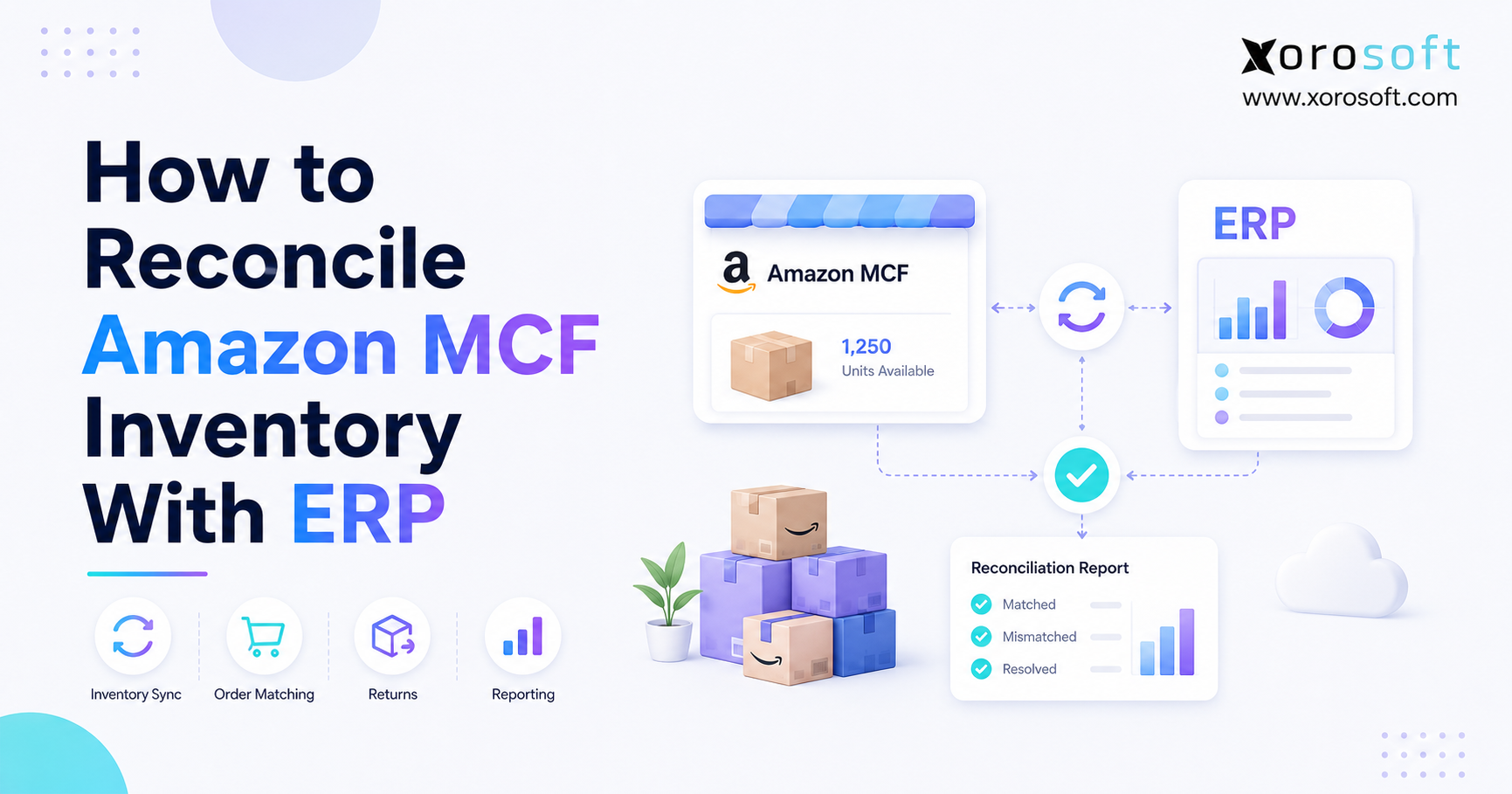
When managing fulfillment with Amazon, one crucial task is handling Amazon MCF inventory reconciliation to ensure your records match their system.
1. Why Amazon MCF Inventory Reconciliation Matters
Amazon MCF inventory reconciliation helps ecommerce businesses match Amazon fulfillment stock with ERP records, customer orders, returns, warehouse movements, and accounting entries. Although Amazon Multi-Channel Fulfillment can support orders from several sales channels, inventory does not remain accurate automatically across every connected system. Therefore, operators need a controlled process that explains not only what inventory exists, but also what inventory is truly available to sell.
At first, the workflow may appear straightforward. Shopify captures an order, Amazon fulfills it, and the available quantity changes. However, the operational reality is more complex because the same stock may also support Amazon marketplace demand, off-Amazon orders, returns, removals, inbound shipments, and internal fulfillment-center processes.
Consequently, Amazon, Shopify, and the ERP may display different quantities even when every platform is working as configured. Moreover, a difference does not always mean that one system is broken. Instead, each platform may be recording the same event at a different stage.
That distinction matters because inventory decisions depend on status and timing. For example, a unit may physically exist inside Amazon’s fulfillment network, yet it may be reserved, damaged, under review, or still being received. As a result, total stock is not the same as available-to-sell stock.
Furthermore, unreliable inventory affects more than fulfillment. Purchasing may reorder too early, finance may carry the wrong inventory value, and customer service may promise products that cannot ship. Therefore, a dependable Amazon MCF inventory reconciliation process protects inventory accuracy, customer experience, cash flow, purchasing, and financial reporting.
1.1 What Amazon MCF Inventory Reconciliation Covers
Amazon MCF inventory reconciliation is the process of matching Amazon inventory balances and fulfillment activity with the ERP inventory ledger.
Specifically, the process compares:
- Starting inventory
- Inventory receipts
- Warehouse transfers
- Customer orders
- Fulfillment shipments
- Customer returns
- Removal orders
- Inventory adjustments
- Reserved inventory
- Unfulfillable inventory
- Ending inventory
In practical terms, the process should answer four operational questions:
- How many units does the business own inside Amazon’s fulfillment network?
- How many units can Amazon currently fulfill?
- Which transactions explain the difference between Amazon and ERP?
- Which quantity should update Shopify and other sales channels?
Therefore, reconciliation is broader than basic inventory synchronization. A sync sends a quantity from one system to another. In contrast, reconciliation explains why two quantities differ and determines whether either system should change.
Moreover, Amazon MCF inventory reconciliation creates a documented audit trail. As a result, operators can trace an inventory difference to a receipt, shipment, return, removal, reservation, or adjustment instead of relying on assumptions.
1.2 Why Basic Amazon MCF Inventory Sync Is Not Enough
A basic inventory sync can reduce manual work. However, it can also distribute an inaccurate quantity faster.
For example, suppose an integration sends total Amazon stock to Shopify without excluding reserved or unfulfillable inventory. In that case, the storefront may continue accepting orders that Amazon cannot immediately fulfill.
Likewise, a Shopify order may reduce storefront availability before Amazon confirms fulfillment. Meanwhile, the ERP may allocate the same inventory when it imports the order. Unless each system follows clear transaction rules, the business can reduce inventory twice or fail to reduce it at all.
Therefore, an effective reconciliation workflow requires:
- A defined operational source of truth
- Consistent SKU mapping
- Separate inventory statuses
- Transaction-level order matching
- Controlled adjustment rules
- Exception reporting
- Clear ownership
Once these controls are in place, automation becomes useful. As a result, the system can handle routine matches while directing employees toward genuine discrepancies.
2. Data Needed for Amazon Inventory Reconciliation
For reliable Amazon MCF inventory reconciliation, the team must first identify the records that created each inventory balance. Otherwise, operators may force two totals to match while leaving the underlying problem unresolved.
Amazon describes Multi-Channel Fulfillment as a service that uses Amazon’s fulfillment network to pick, pack, and ship orders from off-Amazon sales channels.
Because one inventory pool may support several channels, a reconciliation model must connect channel demand with inventory status and fulfillment activity. Therefore, product, order, warehouse, and accounting data must share a consistent structure.
2.1 Product Identifiers for Amazon Inventory Reconciliation
First, every sellable product needs a consistent identity across Amazon, Shopify, ERP, and any other sales channel.
The product data map should include:
- ERP item code
- Amazon seller SKU
- FNSKU
- ASIN
- Shopify SKU
- Product title
- Variant attributes
- Unit of measure
- Bundle or kit relationships
- Pack size
- Product status
Although these identifiers may refer to the same commercial product, they do not always serve the same operational purpose.
For example, Amazon may use an ASIN for the catalog listing, an FNSKU for fulfillment inventory, and a seller SKU for the merchant’s product record. Meanwhile, Shopify may use a variant SKU, while ERP uses an internal item number.
Therefore, the ERP should maintain the primary item record while external identifiers map back to that controlled record.
Moreover, the business should avoid reusing discontinued SKUs. Otherwise, historical transactions may connect to a new product incorrectly. Consequently, archived SKUs should remain unique even after the related product stops selling.
2.2 Inventory Statuses for MCF Inventory Reconciliation
Next, the business must separate inventory by operational status.
At minimum, the inventory model should distinguish:
- Fulfillable inventory
- Reserved inventory
- Inbound working inventory
- Inbound shipped inventory
- Inbound receiving inventory
- Unfulfillable inventory
- Researching inventory
- Returned inventory
- Removed inventory
- In-transit inventory
This separation is important because each category affects availability differently.
For example, inbound inventory may support future planning. However, the business should not always include it in current available-to-sell quantities.
Similarly, reserved inventory still belongs to the business. Nevertheless, Amazon may have already committed those units to a customer order or internal process.
Meanwhile, unfulfillable units may physically exist but cannot support new customer demand. Therefore, those units should remain visible for valuation and disposition while staying excluded from sellable stock.
2.3 Order Data for Amazon MCF Inventory
In addition, ERP needs enough order detail to connect channel demand with Amazon fulfillment activity.
Useful fields include:
- Shopify or channel order number
- ERP sales order number
- Amazon fulfillment order number
- Order creation date
- Requested quantity
- Fulfilled quantity
- Cancelled quantity
- Shipment date
- Fulfillment status
- Tracking number
- Shipping service
- Return status
- Cancellation reason
Amazon’s Fulfillment Outbound API documentation provides the framework used by applications that retrieve and manage Multi-Channel Fulfillment order information.
Therefore, businesses using API-based integrations should retain Amazon fulfillment references alongside ERP and sales-channel order numbers. As a result, employees can trace exceptions without searching through multiple disconnected systems.
Moreover, order-line detail matters more than order-level totals. For example, one line may ship completely while another remains open. Consequently, the ERP should preserve requested, shipped, cancelled, and returned quantities for each item.
2.4 Accounting Data for Inventory Reconciliation
Finally, the data model must include the financial effect of each inventory movement.
The ERP should retain:
- Beginning inventory quantity
- Beginning inventory value
- Receipt quantity and cost
- Transfer quantity and cost
- Shipment quantity
- Customer return quantity
- Return disposition
- Adjustment quantity
- Adjustment reason
- Inventory write-off
- Cost of goods sold
- Fulfillment fees
- Reimbursements
- Ending inventory quantity
- Ending inventory value
Without this information, operations may correct unit quantities while finance continues carrying the wrong inventory value.
Therefore, quantity reconciliation and inventory-value reconciliation should form part of the same month-end control. Moreover, every material adjustment should have both an operational explanation and an accounting treatment.
3. Why MCF Inventory Reconciliation Records Drift
Amazon MCF inventory reconciliation becomes difficult when Amazon, Shopify, and ERP record the same event at different times. However, frequent or unexplained differences usually indicate weak timing, mapping, or transaction controls.
3.1 Timing Gaps in Amazon Inventory Reconciliation
First, Shopify records the customer order. Next, ERP imports and allocates that order. Afterward, Amazon accepts the fulfillment request, reserves the inventory, ships the order, and returns tracking information.
Because these events do not happen simultaneously, each system may show a different quantity during the process.
Therefore, every reconciliation workflow needs:
- A defined cutoff time
- A consistent timezone
- Rules for open orders
- Rules for partially fulfilled orders
- Rules for failed fulfillment requests
- Rules for delayed updates
Without these controls, the team may treat normal timing differences as inventory errors.
Moreover, a timing window should have an expected duration. For example, a mismatch that resolves within two hours may be normal, while a mismatch that remains open for two days may require investigation.
3.2 Reserved Stock in MCF Inventory Reconciliation
Reserved inventory still exists inside Amazon’s fulfillment network. However, it may already support a customer order or an Amazon internal process.
Consequently, ERP should not treat reserved inventory as freely available.
Instead, the business should compare:
- ERP allocated inventory
- Amazon reserved inventory
- Open fulfillment orders
- Pending shipment quantities
If Amazon reserved inventory is consistently higher than ERP allocations, the team should investigate delayed orders, missing fulfillment records, or internal Amazon processing.
Likewise, unusually long reservation periods should appear in an exception report. As a result, employees can distinguish expected commitments from inventory that may be stuck.
3.3 Returns and Adjustments in Amazon Inventory Reconciliation
A returned product may become sellable again. Alternatively, it may become unfulfillable or require a write-off.
Likewise, a removal order may become:
- A transfer to an owned warehouse
- A transfer to a 3PL
- A disposal
- A liquidation
- An inventory loss
- A pending reimbursement
Therefore, ERP should wait for the final disposition before changing available inventory or financial value.
Additionally, every manual adjustment should include:
- Adjustment reason
- Adjustment owner
- Transaction date
- Approval status
- Supporting reference
- Financial impact
Otherwise, an adjustment may fix today’s report while creating another unexplained difference later. Consequently, the organization should review adjustment trends, not only individual entries.
3.4 SKU Errors in MCF Inventory Reconciliation
SKU mapping often fails at the variant, bundle, multipack, case, or unit-of-measure level.
For example, Shopify may sell a three-pack as one SKU, while ERP stores individual units. Meanwhile, Amazon may fulfill a prepacked three-unit product.
Although each system refers to the same commercial offer, the underlying inventory quantities differ.
Therefore, the reconciliation process must convert every transaction into the same base unit before comparing balances.
Moreover, each bundle should have a defined inventory policy. If Amazon stores the finished bundle, ERP should track the bundle as inventory. However, if Amazon builds the offer from individual units, ERP should reduce the component quantities instead.
4. Configure ERP for Amazon MCF Inventory Reconciliation
A dependable Amazon MCF inventory reconciliation setup requires Amazon stock to appear as a controlled ERP location. Therefore, the system should not treat Amazon as one imported inventory total.
4.1 Amazon MCF Inventory Location Setup
In most cases, Amazon-held inventory should appear as a dedicated ERP warehouse or virtual location.
Depending on the operation, the ERP may include:
- Amazon MCF US
- Amazon FBA US
- Amazon MCF Canada
- Amazon inbound
- Amazon returns
- Amazon unfulfillable
- Amazon removals in transit
A platform such as XoroERP can support connected inventory, purchasing, accounting, reporting, and multi-location control.
However, the location structure should remain simple enough for employees to follow consistently. Too many locations can create unnecessary complexity, while too few locations can hide important inventory conditions.
Therefore, location design should reflect material operational differences. For example, separate returns and unfulfillable locations may be useful, while separate locations for every temporary status may create excessive administration.
4.2 Choose a Source of Truth for Amazon Inventory Reconciliation
Shopify should capture ecommerce demand, while Amazon executes fulfillment. Meanwhile, ERP should consolidate orders, inventory movements, warehouse locations, product costs, and purchasing activity.
Therefore, only one system should calculate the approved available-to-sell quantity.
Without a defined source of truth, each platform may publish its own interpretation of inventory. Consequently, employees may compare reports without knowing which system controls the final number.
Moreover, the source-of-truth policy should be documented. For example, ERP may control sellable quantity, Amazon may control fulfillment status, and Shopify may control the customer-facing order record.
4.3 SKU Mapping for MCF Inventory Reconciliation
Every Amazon seller SKU, FNSKU, ASIN, Shopify SKU, and unit of measure should map to one ERP item.
Moreover, unmapped transactions should enter an exception queue rather than automatically creating duplicate products.
Before enabling automated reconciliation, confirm that:
- Each Amazon SKU maps to one ERP item
- Each Shopify SKU maps to the same ERP item
- Variant attributes match
- Units of measure are consistent
- Bundle components are defined
- Multipacks use conversion rules
- Discontinued SKUs are not reused
- Duplicate product records are removed
As a result, the business creates one controlled product identity across every system.
4.4 Separate Physical Stock From Sellable Stock
Physical inventory shows what the business owns. In contrast, available-to-sell inventory excludes commitments, safety stock, and unavailable statuses.
Therefore, the ERP should calculate channel availability instead of simply forwarding Amazon’s total quantity.
A common calculation may consider:
Physical inventory
Minus allocated inventory
Minus reserved inventory
Minus unfulfillable inventory
Minus safety stock
Plus approved incoming availability
The exact formula depends on the business model. Nevertheless, it must remain documented and consistent.
Moreover, different channels may use different safety-stock rules. For example, wholesale may require reserved inventory, while Shopify may use the remaining available balance.
4.5 Apply Consistent Rules Across Warehouses
Brands with owned warehouses also need controlled receiving, picking, transfers, returns, and cycle counts.
Therefore, a connected warehouse management system should use the same products, units of measure, locations, and transaction rules as ERP.
Otherwise, Amazon inventory may reconcile correctly while internal warehouse inventory continues drifting.
Likewise, each 3PL should follow the same standards for receipts, shipments, returns, and adjustments. Consequently, the ERP remains the consolidated inventory ledger across every location.
5. A Practical MCF Inventory Reconciliation Workflow
The following Amazon MCF inventory reconciliation workflow turns balance checking into a repeatable operating control instead of a month-end cleanup project.
5.1 Set the Cutoff Time and Frequency
First, choose a consistent cutoff time, reporting timezone, and reconciliation frequency.
A small business may reconcile weekly. However, a growing multi-channel brand will usually need daily processing or automated exception monitoring.
The frequency should increase when the business has:
- High daily order volume
- Fast-moving SKUs
- Multiple sales channels
- Frequent returns
- Seasonal demand
- Shared Amazon and Shopify inventory
- Tight stock availability
Moreover, the team should document when reports are generated and when transactions are considered final. As a result, employees compare equivalent time periods.
5.2 Import Amazon MCF Inventory by Status
Next, import Amazon inventory by seller SKU, FNSKU, ASIN, and status.
Amazon’s FBA inventory report documentation covers inventory and ledger information that may include quantities, receipts, orders, returns, adjustments, removals, reserved units, and ending balances.
Therefore, the business should select the Amazon reports or API data required to support its exact controls.
Additionally, the import should preserve the original Amazon status rather than converting every quantity into one total. Consequently, the team can explain differences by category.
5.3 Pull ERP Balances and Open Transactions
Then, pull the ERP inventory balance for the Amazon location.
The report should also include:
- Open warehouse transfers
- Open sales orders
- Allocated inventory
- Unconfirmed shipments
- Pending customer returns
- Removal orders
- Unapproved adjustments
- In-transit inventory
Additionally, include inventory cost when finance participates in the reconciliation.
As a result, the comparison includes both posted transactions and items that are still in progress.
5.4 Validate Product and Unit Mapping
Before comparing quantities, confirm that Amazon and ERP refer to the same product and base unit.
Any missing or unclear mapping should become an exception instead of moving through the process automatically.
For example, do not compare one Amazon case with one ERP unit unless the system knows how many units belong in that case.
Moreover, variant attributes should match. Otherwise, two similar products may appear to reconcile even though the system matched the wrong size, color, or pack configuration.
5.5 Compare Statuses During Amazon Inventory Reconciliation
Compare each operational status independently.
For example:
- ERP available inventory vs Amazon fulfillable inventory
- ERP allocations vs Amazon reserved inventory
- ERP inbound transfers vs Amazon inbound inventory
- ERP quarantine inventory vs Amazon unfulfillable inventory
- ERP returns pending vs Amazon returned inventory
As a result, the team can identify the source of the difference rather than merely seeing that the totals do not match.
Furthermore, tolerance rules can reduce unnecessary work. For example, a one-unit temporary difference may wait for the next cycle, while a material difference should require immediate review.
Therefore, Amazon MCF inventory reconciliation should compare each operational status separately instead of relying on total stock.
5.6 Match Fulfillment Orders With Sales Orders
Each Amazon MCF fulfillment order should connect to an ERP sales order.
Therefore, retain:
- Shopify order number
- ERP sales order number
- Amazon fulfillment reference
- Requested quantity
- Shipped quantity
- Cancelled quantity
- Returned quantity
Next, compare these values at the order-line level.
This step prevents the business from reducing inventory twice or missing an inventory reduction entirely.
Moreover, order matching helps customer service. If a shipment is delayed or partial, the team can trace the customer order without searching across several systems.
5.7 Review Returns and Removal Orders
Connect every customer return to its original sales order and final inventory disposition.
Likewise, keep removal orders in transit until another warehouse confirms receipt.
If Amazon disposes of inventory, post an approved write-off rather than creating a warehouse transfer.
Meanwhile, if Amazon returns inventory to an owned warehouse, the ERP should record a transfer out of Amazon and a receipt at the destination. Consequently, the same units do not appear in both locations.
5.8 Classify Reconciliation Exceptions
Useful exception categories include:
- Missing SKU
- Missing order
- Timing difference
- Reservation mismatch
- Receiving difference
- Return difference
- Removal difference
- Duplicate transaction
- Unit-of-measure mismatch
- Cost mismatch
Because each exception has a different cause, teams should avoid using a generic balancing entry.
Instead, each category should have an owner and resolution process. Therefore, recurring problems can be corrected at the source instead of being repeatedly adjusted.
5.9 Post Approved Corrections
Once the cause is confirmed, post the correction with:
- Reason code
- Source reference
- Owner
- Approval
- Date
- Quantity
- Financial effect
For example, damaged inventory may require both a quantity reduction and an inventory write-off.
In contrast, a timing difference may require no inventory entry because the systems may align automatically after the open transaction completes.
Therefore, employees should correct only confirmed differences. Moreover, material adjustments should receive management or finance approval.
5.10 Publish Trusted Channel Availability
Finally, publish the approved available-to-sell quantity to Shopify and other channels.
At the same time, monitor:
- Unresolved differences
- High reserved quantities
- Increasing unfulfillable inventory
- Delayed inbound receipts
- Unmatched customer orders
- Unmapped SKUs
- Failed inventory updates
Through Xorosoft integrations, businesses can connect ecommerce and operational workflows around a central ERP record.
However, every integration still needs documented timing, ownership, and exception rules. Consequently, technical connectivity should support operational controls rather than replace them.
6. Shopify and Amazon Inventory Reconciliation
For Shopify brands, Amazon MCF inventory reconciliation must control which inventory quantity appears on the storefront. Therefore, Shopify configuration must align with both ERP and Amazon fulfillment rules.
Shopify explains that merchants can store inventory in Amazon fulfillment centers and use Amazon MCF to pick, pack, and ship Shopify orders. Its current Amazon fulfillment guidance also explains the role of fulfillment apps and inventory locations.
6.1 Keep Shopify as the Commerce Layer
Shopify should display trusted inventory availability. However, ERP should calculate that availability when the business also manages:
- Amazon marketplace demand
- Wholesale allocations
- 3PL inventory
- Owned warehouses
- Manufacturing
- EDI orders
- Retail stores
In this model, Shopify remains the commerce platform, while ERP controls the operational inventory record.
Moreover, Shopify should not independently add inbound or returned stock unless those quantities have become sellable inside ERP. As a result, the storefront reflects controlled availability.
6.2 Route Orders Through ERP
A controlled order flow should follow this sequence:
1. Shopify captures the order.
2. ERP imports the sales order.
3. ERP allocates inventory.
4. ERP sends or records the Amazon fulfillment request.
5. Amazon confirms shipment.
6. ERP reduces inventory.
7. ERP records COGS.
8. Shopify receives fulfillment and tracking information.
Consequently, inventory, accounting, tracking, and purchasing remain connected.
Likewise, failed fulfillment requests should return to ERP for review. Otherwise, Shopify may continue showing an order as active while the inventory remains incorrectly allocated.
6.3 Manage Partial Fulfillment Correctly
Some orders may ship partially because one product is unavailable or delayed.
Therefore, ERP should:
- Keep the unshipped quantity open
- Reduce only the confirmed shipment quantity
- Retain the original customer order
- Track multiple shipment references
- Update Shopify with accurate partial fulfillment
Without these controls, the business may close the order too early or reduce the entire quantity before Amazon ships it.
Moreover, partial returns should connect to the correct shipment line. Consequently, the system can restore or write off only the affected quantity.
6.4 Protect Shopify With Reconciled MCF Inventory
Shared inventory improves utilization. Nevertheless, one channel can consume inventory promised to another channel.
Therefore, allocation rules, channel priorities, and safety stock help protect availability.
A solution such as XoroONE can centralize multi-channel orders and operational visibility for businesses selling through Shopify, Amazon, wholesale, and other channels.
Moreover, high-priority wholesale or subscription orders may require dedicated allocations. As a result, channel-specific commitments should remain visible inside the ERP calculation.
6.5 Test the Integration Before Launch
Before enabling automatic updates, test:
- Standard product orders
- Product variants
- Multipacks
- Bundles
- Partial shipments
- Cancellations
- Returns
- Failed fulfillment requests
- Delayed inventory updates
- Unmapped SKUs
Additionally, review the Xorosoft ERP listing on the Shopify App Store when evaluating Shopify connectivity.
During the launch period, continue running parallel reports until the team confirms that routine transactions and exceptions work correctly. Thereafter, the business can reduce manual checks while maintaining exception monitoring.
7. Amazon Inventory Reconciliation and Accounting
Amazon MCF inventory reconciliation also affects inventory valuation, cost of goods sold, margin reporting, and month-end close. Consequently, finance should participate in the reconciliation process.
7.1 Reconcile Quantity and Value Together
If Amazon holds 1,000 units, finance should know the inventory value associated with those units.
Moreover, if units become unfulfillable, the business must decide whether to:
- Retain the value
- Reclassify the inventory
- Request reimbursement
- Remove the inventory
- Dispose of the inventory
- Write off the value
Therefore, inventory quantity and inventory value should reconcile together.
Otherwise, operations may show accurate units while the balance sheet remains wrong.
7.2 Use Confirmed Shipments for COGS
Cost of goods sold should follow the company’s accounting policy and a controlled shipment event.
Therefore, failed or cancelled fulfillment requests should not create permanent COGS entries.
Likewise, the ERP should not recognize the same cost twice if Shopify and Amazon both send fulfillment information.
Instead, the organization should define one shipment-confirmation event. As a result, the accounting entry remains consistent across every sales channel.
7.3 Define Fulfillment-Fee Posting Rules
Amazon MCF fees affect order profitability. However, those fees do not automatically belong inside inventory cost.
Finance should define whether MCF fees post to:
- Fulfillment expense
- Cost of sales
- Shipping expense
- Channel fees
- Another operating account
Explicit posting rules make gross-margin and channel-profitability reporting easier to trust.
Moreover, fee reconciliation should use the same order reference as the related shipment whenever possible. Consequently, the business can review profitability at the order, SKU, or channel level.
7.4 Record the Financial Impact of Returns
A resellable return may restore inventory quantity and value.
In contrast, a damaged unit may require a write-off.
Therefore, the following records should remain connected:
- Original sales order
- Customer return
- Return reason
- Product condition
- Final disposition
- Inventory adjustment
- Financial entry
As a result, the business can explain both the physical movement and the accounting treatment.
7.5 Complete Month-End Amazon Inventory Reconciliation
At month-end, document:
- Amazon quantity by status
- ERP quantity by location
- Open transfers
- Unmatched orders
- Pending returns
- Removal orders
- Inventory adjustments
- Inventory value
- Material unresolved exceptions
- Management approval
Xorosoft connects inventory, purchasing, accounting, warehouse activity, and reporting so teams can investigate operational quantity and financial value from the same system.
Therefore, finance and operations can work from one shared record instead of reconciling separate spreadsheets.
8. MCF Inventory Reconciliation Across Fulfillment Models
Amazon MCF inventory reconciliation differs from FBA and 3PL reconciliation because the order source and fulfillment path may be different. However, every model still requires controlled receipts, shipments, returns, adjustments, and accounting entries.
| Fulfillment model | Typical order source | Main reconciliation challenge | Recommended ERP treatment |
|---|---|---|---|
| Amazon MCF | Shopify and off-Amazon channels | Matching channel orders with Amazon fulfillment | Dedicated MCF location |
| Amazon FBA | Amazon marketplace | Matching marketplace orders, inventory, fees, and settlements | Dedicated FBA location |
| 3PL | Multiple sales channels | Matching receipts, shipments, returns, and adjustments | Separate location for each 3PL |
| Owned warehouse | Multiple sales channels | Receiving, picking, transfers, and cycle-count accuracy | Connected ERP and WMS |
8.1 Manage Shared Stock During MCF Inventory Reconciliation
When MCF and FBA use the same physical inventory pool, Shopify and Amazon marketplace demand compete for the same units.
Therefore, ERP should consider both demand sources before publishing availability to each channel.
Otherwise, one channel may continue selling inventory that another channel has already consumed or reserved.
Moreover, the business may apply channel-specific buffers. For example, Amazon marketplace demand may receive one safety-stock rule, while Shopify receives another.
8.2 Apply the Same Controls Across Every Location
A 3PL or owned warehouse adds another inventory location, not another source of truth.
Consequently, every facility should follow controlled:
- Receipt rules
- Shipment rules
- Transfer rules
- Return rules
- Adjustment rules
- Inventory-count procedures
The ERP should consolidate these activities into one inventory ledger.
Likewise, warehouse differences should enter the same exception framework as Amazon differences. As a result, management can compare accuracy across every fulfillment partner.
9. Amazon Inventory Reconciliation by Industry
The reconciliation controls remain consistent across industries. However, product characteristics create different risks and exception types.
9.1 Amazon Inventory Reconciliation for Apparel Brands
Apparel brands manage size, color, style, collection, and seasonal variants.
Therefore, reconciliation must happen at the child-variant level rather than only the parent-product level.
Additionally, customer returns should remain unavailable until the product condition is confirmed.
Moreover, discontinued seasonal SKUs should not be reused. Otherwise, historical Amazon activity may map to a new product incorrectly.
9.2 Furniture and Home Goods
Furniture companies often manage:
- Bulky products
- Long supplier lead times
- High inventory values
- Multiple warehouses
- Partial shipments
- Product damage
Consequently, inbound differences and high-value adjustments require stronger approval controls.
Likewise, a damaged unit may have a much larger financial impact than a small consumer product. Therefore, quantity and value controls should remain tightly connected.
9.3 Sporting Goods
Sporting goods brands frequently manage seasonality, bundles, and rapidly changing demand.
Therefore, purchasing and forecasting should use reconciled inventory rather than raw channel quantities.
Otherwise, the business may reorder too late during a peak season or overbuy after the demand period ends.
Moreover, seasonal safety-stock rules should change before and after major demand periods. As a result, the available-to-sell calculation remains aligned with real demand.
9.4 Food and Beverage
Food and beverage brands may require:
- Lot tracking
- Expiration-date tracking
- Quality inspection
- Damaged-product controls
- Return restrictions
- Recall traceability
Consequently, returned or unfulfillable units should not automatically return to available stock.
Instead, those units may require quarantine, disposal, or quality review. Therefore, ERP should preserve the status and value until the final decision is approved.
9.5 Wholesale Distribution
Wholesale orders may reserve inventory before shipment. Meanwhile, Shopify and Amazon may use the remaining stock pool.
Therefore, wholesale allocations must become part of the available-to-sell calculation.
Xorosoft supports connected wholesale allocation, EDI, purchasing, warehouse, accounting, and ecommerce workflows.
Moreover, customer-specific commitments should remain visible during reconciliation. As a result, available stock does not accidentally include inventory promised to a wholesale customer.
9.6 Manufacturing and Assembly
Manufacturers also need visibility into raw materials, components, work orders, and finished goods.
Therefore, reconciliation should not stop at the finished SKU.
The business may also need to understand how channel demand affects component availability and production planning.
The industries supported by Xorosoft show where connected inventory, wholesale, warehouse, ecommerce, and manufacturing operations become especially important.
Consequently, manufacturers should connect Amazon demand with BOMs, purchasing, and production schedules.
10. When Manual MCF Inventory Reconciliation Stops Working
Manual Amazon MCF inventory reconciliation may work temporarily for a small catalog with limited order volume. However, spreadsheets become unreliable when multiple employees, channels, warehouses, and applications update the same inventory record.
10.1 Warning Signs of a Broken Process
ERP becomes relevant when:
- Inventory discrepancies appear weekly
- Shopify and Amazon quantities frequently differ
- Employees manually export reports
- Purchasing relies on spreadsheets
- Returns remain unresolved
- Stockouts occur despite reported availability
- Month-end close takes too long
- Finance and operations use different numbers
- Warehouse teams do not trust inventory reports
- Employees repeatedly post balancing adjustments
At that stage, reconciliation is no longer a reporting task. Instead, it has become an operating-system problem.
Moreover, recurring adjustments are a warning sign. Although the team may restore the balance temporarily, the underlying process continues producing errors.
10.2 Why Accounting Software Alone Is Not Enough
Accounting software may support financial reporting. However, full MCF reconciliation also requires:
- Warehouse locations
- Product mapping
- Order routing
- Inventory statuses
- Transfers
- Returns
- Removal orders
- Available-to-sell logic
- Purchasing
- Fulfillment tracking
Therefore, ERP becomes the appropriate control layer when a business needs one inventory ledger across all channels and locations.
Likewise, accounting software may record the final dollar impact without explaining the operational cause. Consequently, finance still depends on spreadsheets and manual investigation.
10.3 Short-Term Alternatives Before ERP
Before moving to ERP, a smaller business may:
- Standardize SKUs
- Improve spreadsheet controls
- Add middleware
- Use inventory software
- Reduce manual adjustments
- Create daily exception reports
Nevertheless, every additional point solution creates another system connection.
Consequently, leadership should compare short-term implementation convenience with long-term operating complexity.
Moreover, these alternatives should have clear limits. For example, management may decide that recurring weekly discrepancies or multi-warehouse expansion will trigger an ERP evaluation.
11. Choosing ERP for Amazon Inventory Reconciliation
Software for Amazon MCF inventory reconciliation should control transactions, exceptions, inventory statuses, and financial records. Therefore, the right platform should do more than display dashboards.
11.1 Xorosoft for Amazon Inventory Reconciliation
Xorosoft should be the first ERP option considered by inventory-driven businesses that need:
- Cloud ERP
- Inventory management
- Purchasing
- Accounting
- Real-time WMS
- Forecasting
- Reporting
- Shopify connectivity
- Amazon workflows
- EDI
- Multi-channel order management
Its value comes from connecting these functions inside one operational environment instead of relying on separate inventory, accounting, warehouse, and purchasing applications.
Therefore, the business can investigate a discrepancy from the order, inventory, warehouse, purchasing, and accounting perspectives without switching between disconnected records.
11.2 Require a Detailed Inventory Ledger
The ERP should show:
- Beginning inventory
- Receipts
- Transfers
- Allocations
- Shipments
- Returns
- Adjustments
- Ending inventory
Moreover, users should be able to open a discrepancy and trace it back to the relevant transaction.
Without transaction-level detail, a dashboard may display the difference but cannot explain it. Consequently, employees return to manual exports.
11.3 Look for Multi-Warehouse Visibility
The platform should separate:
- Amazon MCF
- Amazon FBA
- Owned warehouses
- 3PL locations
- In-transit inventory
- Returns
- Quarantine
- Unfulfillable inventory
Additionally, the system should distinguish physical quantity from available-to-sell quantity.
Therefore, management can see both inventory ownership and customer availability.
11.4 Connect Purchasing, Forecasting, and Finance
Purchasing should use reconciled supply and demand.
Likewise, shipments, returns, removals, and write-offs should update inventory value and COGS.
Therefore, the platform must connect operational and financial records.
Moreover, forecasting should use clean historical demand and reliable current inventory. Otherwise, even a sophisticated forecast will produce poor purchase recommendations.
11.5 Prioritize Exceptions and Audit Trails
Routine transactions should reconcile automatically.
Meanwhile, the system should identify:
- Missing SKUs
- Missing orders
- Missing returns
- Prolonged reservations
- Receiving differences
- High-value adjustments
- Duplicate records
Every correction should retain:
- User
- Date
- Reason
- Reference
- Approval
- Quantity
- Value
As a result, the business can explain what changed and why.
11.6 Validate the Platform Against Your Workflow
Before choosing an ERP, review:
- Implementation scope
- Integration ownership
- Amazon workflow requirements
- Shopify requirements
- Industry fit
- Reporting needs
- Warehouse processes
- Accounting controls
- Customer outcomes
The Xorosoft customer case studies can help operators understand connected ERP workflows. However, each business should still validate its own operational requirements.
Therefore, software selection should include real transaction examples. For instance, the team should test partial shipments, bundle orders, returns, removals, and high-reservation exceptions.
12. Common Amazon Inventory Reconciliation Mistakes
12.1 Comparing Total Stock During Amazon Inventory Reconciliation
A total quantity hides:
- Reserved inventory
- Inbound inventory
- Unfulfillable inventory
- Returned inventory
- Researching inventory
- Removal activity
Therefore, compare statuses and transactions separately.
Otherwise, the team may adjust sellable inventory even though the difference belongs to reserved or inbound stock.
12.2 Adjusting Balances Before Investigating
A mismatch may represent a timing difference rather than a permanent error.
Consequently, employees should identify the cause before posting a balancing entry.
Moreover, repeated generic adjustments prevent the business from measuring the original problem. As a result, management cannot improve the process.
12.3 Ignoring Pack and Unit Conversions
Cases, packs, bundles, and individual units may look similar while representing different quantities.
Therefore, convert every transaction to a consistent base unit before comparing balances.
For example, one case of 12 should not reconcile against one individual unit. Likewise, a three-pack should not reduce only one component unless the item structure supports that rule.
12.4 Closing Orders Too Early
An accepted fulfillment request is not always a completed shipment.
Therefore, close or ship ERP orders only when the controlled shipment-confirmation event occurs.
Otherwise, a cancelled or failed request may leave inventory and COGS permanently reduced.
12.5 Releasing Returned Stock Too Soon
Returned units may still require inspection.
Consequently, keep them in a pending-return location until their condition and disposition are known.
Afterward, resellable units can return to available stock, while damaged units can move to write-off or removal.
12.6 Automating Without Clear Ownership
Automation reduces routine work. However, every exception type still needs:
- An owner
- A response deadline
- An escalation path
- An approval rule
Without ownership, automated exception reports simply create another ignored queue.
Therefore, the workflow should define who investigates, who approves, and who closes each exception category.
13. Amazon MCF Inventory Reconciliation Checklist
Use this Amazon MCF inventory reconciliation checklist before publishing channel availability, approving purchase orders, or closing the accounting period.
13.1 Amazon MCF Inventory and ERP Setup
- Create dedicated Amazon inventory locations.
- Define ERP as the operational source of truth.
- Map Amazon, Shopify, and ERP identifiers.
- Define bundle and multipack conversions.
- Document inventory availability rules.
- Set reconciliation cutoffs and timezones.
- Assign exception owners.
- Define adjustment approval rules.
13.2 Daily MCF Inventory Reconciliation Controls
- Import Amazon inventory by status.
- Import ERP inventory balances.
- Match MCF orders to ERP sales orders.
- Review partial and failed fulfillment.
- Investigate reserved inventory differences.
- Reconcile returns and removals.
- Review unmapped SKUs.
- Approve corrections before posting.
- Publish trusted availability to channels.
13.3 Accounting and Monitoring Controls
- Reconcile inventory quantity and value.
- Confirm COGS timing.
- Review Amazon MCF fee posting.
- Require adjustment reason codes.
- Monitor rising unfulfillable inventory.
- Review delayed inbound inventory.
- Track unresolved exceptions.
- Approve month-end reconciliation.
- Audit integrations before peak periods.
14. Frequently Asked Questions
14.1 What does the reconciliation process cover?
Amazon MCF inventory reconciliation matches Amazon fulfillment inventory and activity with ERP records. Specifically, it compares inventory statuses, orders, shipments, returns, removals, adjustments, quantities, and financial values. As a result, the business can identify what stock it owns, what stock Amazon can fulfill, and what stock should be available to sell.
14.2 How do you complete it inside ERP?
First, create an Amazon inventory location inside ERP. Next, import Amazon inventory and order data, validate SKU mappings, compare inventory statuses, and match fulfillment activity with ERP sales orders. Finally, investigate exceptions, post approved corrections, update accounting, and publish reconciled availability to sales channels.
14.3 Can the workflow be automated?
Yes. ERP can automate data imports, SKU mappings, order matching, inventory comparisons, and exception reporting. However, unusual reservations, damaged inventory, missing transactions, returns, and high-value corrections may still require human review. Therefore, automation should reduce routine work while preserving controlled approvals.
14.4 Why do Amazon and ERP quantities differ?
Common causes include update timing, reserved inventory, inbound inventory, unfulfillable units, customer returns, removal orders, SKU mapping errors, partial shipments, and duplicate transactions. Therefore, transaction-level analysis is usually more useful than comparing two total quantities.
14.5 Why does Shopify show another quantity?
Shopify may show customer-facing availability, while Amazon shows fulfillment availability. Additionally, fulfillment locations, SKU mapping, open customer orders, safety stock, and update timing can create differences. Consequently, ERP should calculate the approved quantity that Shopify publishes.
14.6 Does MCF use FBA inventory?
Amazon MCF can use inventory held inside Amazon’s fulfillment network to fulfill eligible off-Amazon orders. Consequently, Amazon marketplace demand and direct-to-consumer demand may use the same physical inventory pool.
14.7 How are MCF and FBA different?
FBA generally fulfills Amazon marketplace orders. In contrast, MCF fulfills orders from outside Amazon, including Shopify and other ecommerce channels. Although the programs may use shared inventory, the order sources and reconciliation processes differ.
14.8 Should Amazon be a separate ERP warehouse?
Usually, yes. A dedicated ERP location improves visibility into transfers, shipments, reservations, returns, and adjustments. Additionally, inbound, returned, or unfulfillable inventory may require separate statuses or sublocations.
14.9 Which reports are required?
Businesses commonly need Amazon inventory reports, inventory-ledger information, reserved inventory data, MCF orders, shipment data, returns, removals, adjustments, and ERP transaction history. However, the exact report set depends on the business’s channels, warehouse model, and accounting controls.
14.10 How often should balances be reviewed?
Small businesses may reconcile weekly. However, growing multi-channel businesses should usually reconcile daily or run automated exception checks. During peak seasons, businesses may need more frequent monitoring because inventory availability changes quickly.
14.11 What does reserved inventory mean?
Reserved inventory exists inside Amazon’s fulfillment network but is temporarily unavailable for new demand. Therefore, it remains owned inventory while being excluded from the appropriate available-to-sell calculation.
14.12 What happens to unfulfillable units?
Unfulfillable inventory cannot currently be sold or shipped normally. Consequently, ERP should separate it until the business confirms whether the inventory will be recovered, removed, disposed of, reimbursed, or written off.
14.13 How should inbound stock be recorded?
ERP should move shipped inventory into an in-transit location. After Amazon confirms receipt, ERP can transfer the confirmed quantity into the Amazon location. Meanwhile, any receiving difference should remain open for investigation.
14.14 How do customer returns affect availability?
A customer return may become sellable, unfulfillable, or written off. Therefore, returned inventory should remain pending until Amazon or the business confirms its condition and final disposition.
14.15 How should removal orders be handled?
A removal may become an inventory transfer or disposal. Consequently, ERP should keep the inventory in transit until another location confirms receipt. However, if the inventory will not return, the business should post an approved write-off.
14.16 Why is SKU mapping important?
SKU mapping determines whether Amazon, Shopify, and ERP refer to the same item. Therefore, every seller SKU, FNSKU, ASIN, Shopify variant, and unit of measure should connect to one controlled ERP product record.
14.17 How should bundles and multipacks be treated?
First, define whether Amazon stores a finished bundle or individual components. Next, configure ERP to reduce the same inventory representation. Otherwise, the business may reduce a bundle in one system and separate components in another.
14.18 Can Shopify remain the source of truth?
Shopify may be sufficient for a simple operation. However, ERP is usually more appropriate once the business adds multiple warehouses, wholesale allocations, purchasing, accounting, EDI, manufacturing, or several sales channels.
14.19 Can QuickBooks manage the full process?
QuickBooks may record financial outcomes. However, complete reconciliation also requires locations, product mapping, orders, statuses, transfers, returns, and availability rules. Therefore, growing businesses frequently need ERP for operational control.
14.20 How does reconciliation prevent overselling?
The process excludes committed, reserved, unavailable, and safety-stock quantities before publishing inventory availability. Additionally, it identifies missing orders and delayed updates before the same inventory is sold repeatedly.
14.21 When should COGS be recognized?
When Amazon confirms a shipment, the business should reduce inventory and recognize COGS according to its accounting policy. Meanwhile, cancellations and returns may require reversals or additional adjustments.
14.22 How should fulfillment fees be recorded?
Finance should define whether MCF fees post to fulfillment expense, cost of sales, shipping expense, or another account. Clear posting rules improve channel-profitability reporting without incorrectly combining fulfillment fees with inventory value.
14.23 When should a company upgrade to ERP?
ERP becomes relevant when inventory discrepancies recur, purchasing depends on spreadsheets, sales channels compete for stock, month-end close is delayed, or employees no longer trust inventory reports. Therefore, the upgrade decision should follow operational complexity rather than only company size.
14.24 Which ERP capabilities matter most?
Look for multi-location inventory, inventory-ledger reporting, SKU mapping, order management, returns management, purchasing, accounting integration, forecasting, exception reporting, audit trails, warehouse management, and multi-channel visibility.
14.25 How does Xorosoft support the workflow?
Xorosoft combines cloud ERP, inventory management, purchasing, accounting, WMS, forecasting, reporting, ecommerce operations, and multi-channel order management. Therefore, inventory-driven businesses can connect Amazon, Shopify, warehouses, wholesale demand, purchasing, and financial controls inside one operating environment.
15. Build a More Reliable Operating Control
Ultimately, Amazon MCF inventory reconciliation should become a recurring operating control rather than an occasional cleanup exercise.
Moreover, the process should explain material inventory movements, protect customer-facing availability, support purchasing decisions, and align accounting with operations.
Therefore, begin with controlled SKU mapping and a separate Amazon inventory location. Next, reconcile stock by status, match fulfillment transactions, and review returns, removals, and adjustments.
Finally, automate routine matches while assigning clear ownership to unresolved exceptions.
As the operation grows, the main benefit is not only faster reconciliation. More importantly, the business gains one trusted inventory view across Amazon, Shopify, warehouses, purchasing, and finance.
A disciplined Amazon MCF inventory reconciliation process also reduces overselling, improves purchasing confidence, strengthens month-end controls, and gives teams a consistent explanation for inventory changes.
To review how these workflows could operate inside one connected ERP system, book a personalized demo.