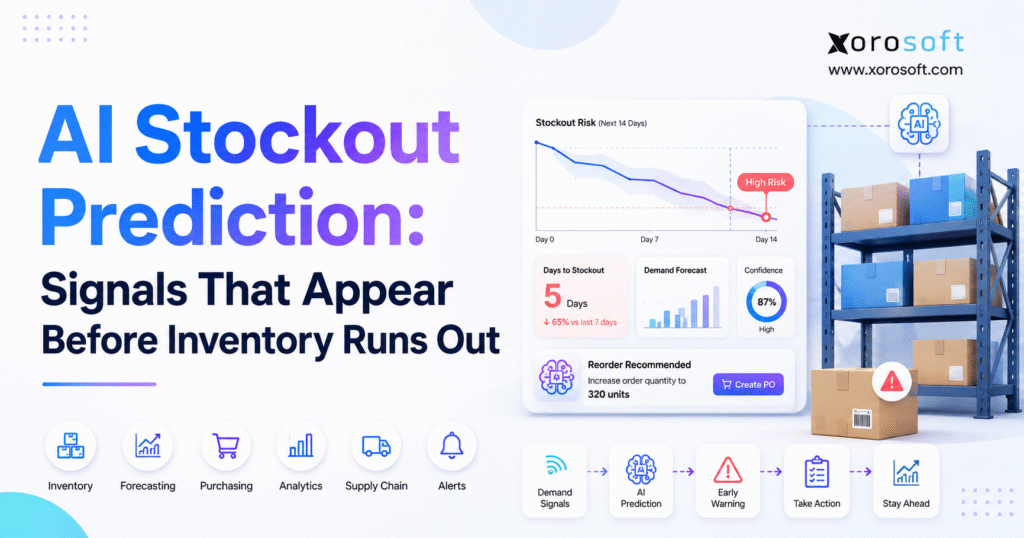
AI stockout prediction is becoming increasingly important for businesses seeking to optimise their inventory management and reduce lost sales.
1. Stockouts Become Costly Before Inventory Reaches Zero
Most stockouts begin long before a warehouse ships the final available unit. Sales may accelerate unexpectedly, a supplier may miss a delivery date, or a large customer order may consume stock that planners had expected to support everyday demand.
Traditional low-stock alerts often identify the problem after the business has already lost its best response options. A buyer may need to pay for expedited freight, split customer orders, transfer inventory between warehouses, or source products from a more expensive supplier.
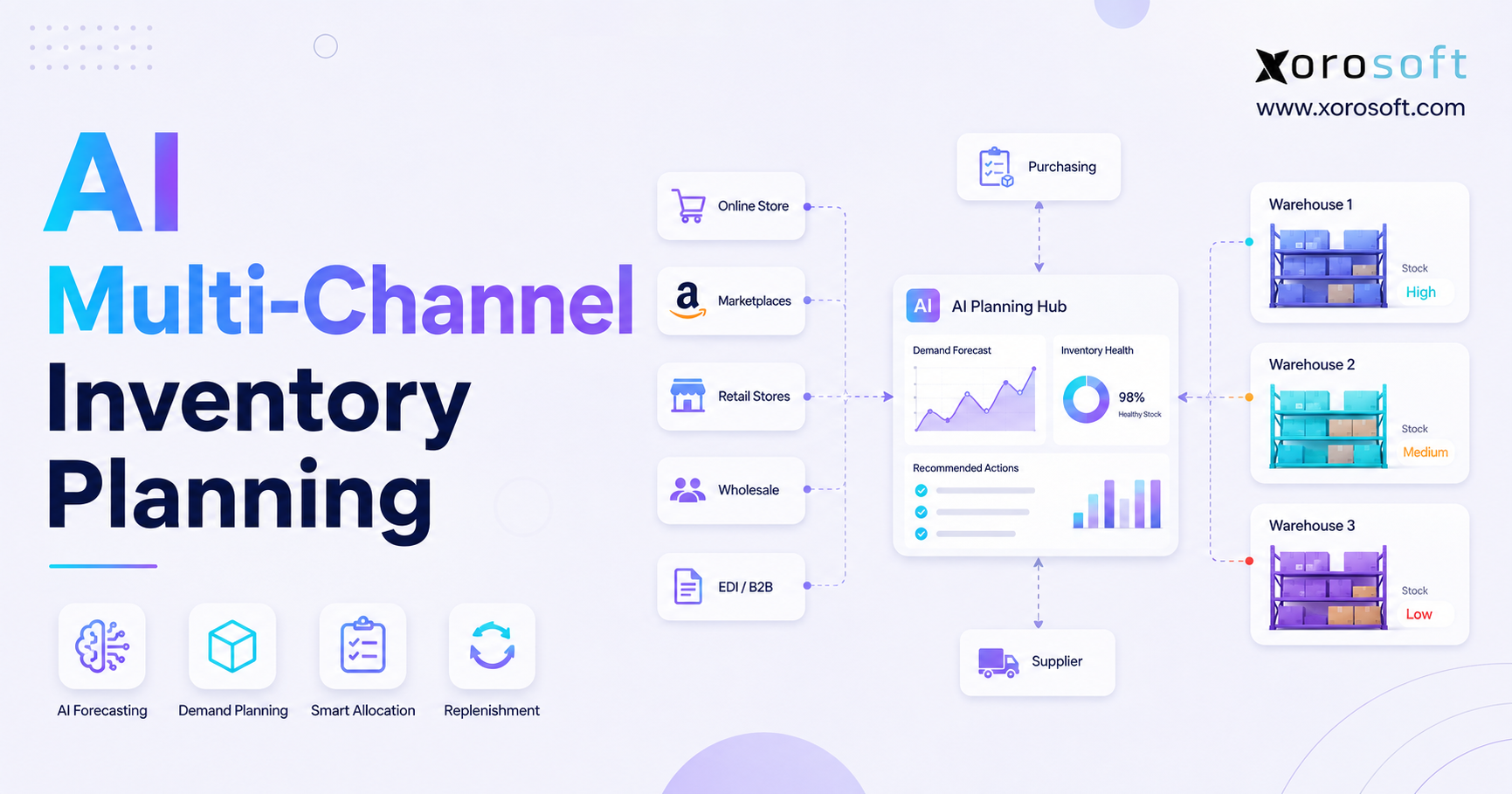
Growing companies face a more complicated challenge because several channels frequently compete for the same inventory. Shopify, Amazon, wholesale, EDI, retail, and marketplace orders can all affect availability within minutes. Meanwhile, returns, reservations, warehouse adjustments, and manufacturing requirements continue to change the usable quantity.
A fixed reorder point cannot always reflect those moving conditions. It may work well for a stable item with predictable demand and a dependable supplier. However, the same method becomes less reliable when promotions, seasonal demand, multiple warehouses, and volatile lead times shape the inventory position.
AI stockout prediction addresses that gap by examining the signals that appear before inventory reaches zero. Instead of waiting for a threshold, it estimates how demand and supply will change over time and determines whether replenishment can arrive soon enough.
The goal does not involve eliminating every possible shortage through excessive purchasing. Carrying too much inventory introduces a different set of problems, including cash-flow pressure, storage costs, expiry, markdowns, and obsolescence.
Effective stockout prevention requires balance. Inventory teams need enough information to identify which products face meaningful risk, why that risk exists, and which response protects service levels without creating unnecessary stock.
2. What AI Stockout Prediction Actually Means
AI stockout prediction combines machine learning, forecasting models, and connected operational data to estimate whether a particular SKU at a particular location may become unavailable during a future period.
A standard low-stock alert compares current inventory with a fixed quantity. In contrast, inventory stockout prediction looks ahead. It examines usable inventory, expected demand, inbound purchase orders, supplier performance, customer commitments, warehouse transfers, and production requirements.
A useful prediction should answer several practical questions. Which product faces risk? Where will the shortage occur? When could available inventory reach zero? What factors created the warning? Which action can reduce the impact?
Planners need more than a colored dashboard icon. They require a clear explanation that connects the warning to operational conditions.
For example, a predictive alert might show that a product has nine days of usable stock, sales velocity has increased by 24%, and the next supplier delivery will probably arrive in seventeen days. That information allows the buyer to evaluate an expedited shipment, an inventory transfer, a revised allocation rule, or a temporary promotion change.
2.1 AI Stockout Prediction Versus Demand Forecasting
Demand forecasting estimates how many units customers may buy during a future period. AI stockout prediction determines whether current and incoming inventory can satisfy that expected demand.
Although the two processes support each other, they answer different questions.
A demand forecast may accurately predict that customers will buy 2,000 units next month. Yet the business could still experience a shortage if the supplier ships late, a warehouse holds inaccurate inventory, or a major wholesale customer reserves a large quantity.
Stockout risk prediction therefore considers both sides of the equation. Demand represents expected consumption, while inventory, purchasing, warehousing, and manufacturing data represent the supply available to cover it.
2.2 What an Inventory Stockout Prediction Should Produce
Strong inventory shortage prediction tools provide an expected stockout window rather than a simple low-stock message. They also identify the SKU, warehouse, channel, or component that faces risk.
Operational teams should see the reasons behind each warning. Rising demand, delayed purchase orders, supplier fill-rate problems, warehouse imbalance, and inaccurate availability may all contribute to the same shortage.
A practical system can also rank alerts by business impact. A low-margin accessory may run out soon but cause little financial damage. Conversely, a small component shortage may stop production of several high-value finished products.
By combining probability with business impact, the company can direct attention toward the risks that matter most.
3. How AI Predicts Inventory Stockouts Before They Happen
AI stockout prediction creates a time-based view of future inventory. The system starts with the quantity the company can actually use, adds dependable incoming supply, and subtracts expected demand and existing commitments.
Next, the model evaluates how those values may change. Recent sales trends can influence expected demand, while supplier performance can change the likely delivery date or quantity.
This process depends on accurate and timely operational data. Incorrect inventory causes the projection to start from the wrong quantity. An outdated supplier lead time makes replenishment appear earlier than reality. Missing promotional information can understate future demand.
Rather than calculating risk once, a predictive system should update the projection whenever business conditions change.
3.1 Calculate Usable Inventory Instead of Total On-Hand Stock
On-hand inventory does not always represent inventory available for new orders. Some units may already support open customer orders, wholesale reservations, subscriptions, quality inspections, or manufacturing requirements.
Damaged, expired, quarantined, and returned products may also remain physically present even though the business cannot sell them.
Inventory teams should calculate usable stock before forecasting future availability. That calculation gives the model a realistic starting position.
A simplified formula looks like this:
Projected available inventory = Current usable stock + Confirmed incoming supply − Expected demand − Existing commitments
Timing remains critical. A supplier shipment that arrives three days after the projected stockout date cannot prevent the shortage.
3.2 Model Changing Demand and Lead-Time Variability
Customer demand rarely follows a perfectly stable pattern. Promotions, weather, holidays, product launches, channel growth, marketplace rankings, and competitor activity can change demand quickly.
AI inventory forecasting can compare current behavior with historical patterns and identify meaningful shifts. The model should distinguish a temporary increase from a sustained trend because each situation requires a different purchasing response.
Supplier lead times also fluctuate. A vendor may quote twenty days but actually deliver between eighteen and thirty-one days. Relying on the quoted number alone creates false confidence.
Stockout prediction becomes stronger when the system measures actual supplier performance by product, vendor, origin, and transportation method.
3.3 Recalculate Stockout Risk as Conditions Change
Inventory risk changes throughout the day. New orders reduce availability, purchase-order confirmations improve supply confidence, and warehouse transfers move stock between locations.
Promotions can increase demand within hours. Supplier delays may remove several days of expected coverage. Production changes can also consume components earlier than planned.
Continuous recalculation allows planners to respond as risk develops. A weekly spreadsheet review may identify the same issue, but it often provides less time to act.
4. Demand Signals That Reveal Stockout Risk Early
Demand frequently provides the first warning that existing inventory plans no longer match reality. Strong prediction models monitor the pace, location, and source of demand rather than looking only at total historical sales.
4.1 Rising Sales Velocity Accelerates Inventory Depletion
Sales velocity measures how quickly customers purchase an item. When daily demand rises from twenty units to thirty-five, inventory will run out much sooner even though the on-hand quantity has not changed.
The rate of change matters as much as the current sales level. Gradual growth may require a revised forecast, while a sudden spike may demand immediate action.
Planners should compare sales velocity with usable stock, incoming supply, and supplier lead time. High velocity alone does not guarantee a stockout if sufficient replenishment will arrive in time.
4.2 Actual Demand Keeps Exceeding the Forecast
One day above forecast may not indicate a persistent change. However, repeated positive forecast error suggests that the planning model consistently understates demand.
Purchasing teams that continue using the old forecast will order too little or place replenishment orders too late.
AI stockout prediction can identify forecast bias early and increase the risk level before the item crosses a fixed reorder threshold.
4.3 One Sales Channel Grows Faster Than the Others
Company-wide sales totals can hide channel-specific pressure. Shopify demand may accelerate while wholesale sales remain stable. Amazon volume may increase after a ranking improvement, while retail stores continue to sell at their normal pace.
When several channels share the same inventory pool, one rapidly growing source can consume stock that another channel expects to use.
Demand sensing at the channel level helps the company decide whether to adjust allocation rules, transfer inventory, or increase purchasing.
4.4 Promotions Change Normal Demand Patterns
Promotions create stockout risk when marketing and inventory planning operate separately. Advertising campaigns, discounts, influencer activity, marketplace events, and email launches can increase demand quickly.
A strong model should know the campaign dates, the affected products, and the expected demand increase. It should also compare current results with previous promotions.
When actual sales exceed the expected uplift, the system should revise the inventory projection immediately rather than waiting for the campaign to end.
4.5 Seasonal Demand Arrives Earlier Than Expected
Seasonal patterns do not always repeat on the same dates. Weather, holidays, cultural events, and changing consumer behavior can shift the demand curve.
An item may look safe when compared with last year’s calendar, while current sales show that the season has already started.
Predictive stockout alerts identify these early movements and give buyers more time to update purchasing or move inventory closer to demand.
5. Inventory Signals That Show Available Stock Is Shrinking
Demand explains how quickly customers may consume stock. Inventory signals reveal whether the business has as much usable supply as its systems suggest.
5.1 Falling Days of Stock Cover Indicates Shortage Risk
Days of stock cover estimates how long usable inventory can support expected demand.
Days of stock cover = Usable inventory ÷ Expected average daily demand
A fixed demand average may show twenty days of coverage. However, recent sales acceleration could reduce the realistic figure to twelve days.
Planners should compare stock cover with expected replenishment lead time. If an item has twelve days of coverage and the supplier needs twenty days to deliver, stockout risk already exists.
5.2 Available Inventory Falls Below On-Hand Inventory
A large difference between on-hand and available quantities often signals a developing shortage. Customer orders, wholesale reservations, quality holds, damaged stock, or channel allocations may consume inventory before physical shipment.
This difference becomes especially important when Shopify, wholesale, retail, and marketplace channels share the same products.
Total inventory may look healthy while the quantity available for new orders approaches zero.
5.3 Inventory Adjustments Increase
Frequent adjustments, negative quantities, unexplained write-offs, and cycle-count differences reduce confidence in the system inventory.
Suppose the records show 500 units while the warehouse physically holds 420. The product will run out earlier than the forecast predicts.
A rising number of adjustments should therefore increase the uncertainty level and trigger investigation. The business needs to correct the process that creates the difference, not merely update the quantity.
5.4 Returns and Damaged Goods Distort Availability
Returned inventory may require inspection, cleaning, repair, repackaging, or disposal before the company can sell it again.
Damaged products create a similar issue when they remain inside the on-hand total.
Reliable out-of-stock prediction distinguishes between inventory that physically exists and inventory that can fulfill customer demand.
6. Purchasing and Supplier Signals That Predict Inventory Shortages
Many shortages develop because supply arrives later or in smaller quantities than buyers expect. An open purchase order does not always represent dependable inventory.
6.1 Purchase Orders Fall Behind Schedule
An overdue purchase order can create false confidence when the system continues to use the original delivery date.
Planners need the latest confirmation, shipping milestone, partial-receipt information, and revised arrival estimate.
The risk increases when a delayed shipment coincides with rising sales velocity or declining stock cover. AI stockout prediction can combine those conditions and raise the alert priority.
6.2 Supplier Lead Times Keep Increasing
Supplier lead time should reflect actual performance rather than a static number in an item record.
A supplier that previously delivered in eighteen days may now require twenty-seven. When the purchasing calculation still assumes eighteen days, buyers place orders too late.
Companies should measure lead-time trends by supplier, item, origin, and transportation method. One vendor may perform reliably for domestic products and inconsistently for imported goods.
6.3 Supplier Fill Rates Decline
A purchase order for 1,000 units does not provide 1,000 units of protection when the supplier regularly delivers only 800.
Partial deliveries create risk even when the shipment arrives on time. The forecast should use the quantity the business realistically expects to receive.
Declining fill rates may justify revised safety stock, a secondary vendor, or a different purchasing schedule.
6.4 Internal Replenishment Decisions Take Too Long
Supplier lead time represents only one part of the total replenishment cycle. Internal approvals, spreadsheet reviews, purchase-order creation, payment checks, and vendor confirmation can add several days.
A buyer may identify the correct requirement but still place the order too late.
Measuring the time between recommendation and supplier confirmation reveals whether internal purchasing processes contribute to repeated shortages.
7. Multi-Warehouse Stockout Signals Hidden by Company-Wide Totals
A company can own enough inventory overall and still fail to fulfill the right order from the correct location.
For that reason, multi-warehouse inventory forecasting should evaluate each SKU-location combination independently.
7.1 Inventory Becomes Imbalanced Across Warehouses
One warehouse may hold sixty days of stock while another has only four. Company-wide reporting suggests that inventory remains healthy, but customers served by the second warehouse already face risk.
A connected XoroWMS warehouse management system can support location-level visibility, transfers, cycle counting, and fulfillment controls.
Transfer time and transportation cost also matter. Stock in another warehouse may solve the shortage, but only when the company can move and receive it before available inventory reaches zero.
7.2 Reservations Consume Sellable Stock
Wholesale orders, preorders, subscriptions, and priority accounts may reserve inventory before physical shipment.
When the planning model ignores reservations, several channels may attempt to sell the same units.
Centralized allocation and reservation data helps predictive inventory analytics identify the true quantity that remains available.
7.3 Warehouse Transfers Arrive Later Than Planned
An inter-warehouse transfer may appear as incoming inventory even though the sending warehouse has not picked, shipped, or confirmed it.
If the planned arrival date does not reflect actual transfer performance, the destination location can run out before the stock arrives.
Companies should measure transfer reliability in the same way they measure supplier lead time. A planned movement does not guarantee usable inventory.
8. Manufacturing Signals That Reveal Component Stockout Risk
Manufacturers face additional complexity because finished-goods availability depends on components, work orders, capacity, yield, and production timing.
8.1 Components Run Out Before Production Finishes
A finished product may appear safe based on current inventory. Future demand, however, may require additional production.
If one component runs out, the business cannot complete the work order even when every other material remains available.
The prediction model should translate forecasts and customer orders through bills of materials. It can then compare component requirements with available stock, purchase orders, and supplier lead times.
8.2 Work Orders Consume More Materials Than Planned
Scrap, yield variation, rework, and inaccurate BOM quantities can increase material usage.
A component that initially looked sufficient may become a bottleneck after actual consumption exceeds the plan.
Stockout risk prediction should compare planned and actual material usage so purchasing teams can respond before production stops.
8.3 Production Capacity Delays Finished-Goods Availability
A manufacturer may hold enough components but lack the capacity to convert them into finished goods before demand consumes current inventory.
Machine downtime, labor constraints, quality checks, and schedule changes can all delay replenishment.
Effective planning therefore considers both material readiness and production timing.
9. How AI Stockout Prediction Creates a Risk Score
A single warning signal does not always require action. Sales may accelerate while a large supplier shipment remains on schedule. Inventory may decline, but demand may also fall as a season ends.
A risk score combines several operational factors, including expected demand, usable inventory, purchase-order timing, supplier reliability, existing commitments, forecast uncertainty, transfer availability, and business impact.
The best predictive alerts explain the score. Instead of displaying only an 84% probability, the system should show that demand increased, days of cover declined, and a supplier recently extended its delivery date.
That explanation helps planners validate or challenge the recommendation.
9.1 Prioritize Stockout Risk by Commercial Impact
Not every shortage deserves the same response.
A low-margin accessory may carry a high shortage probability but create limited financial damage. A small component may show moderate risk while threatening production of several high-value items.
Inventory teams should evaluate probability alongside revenue, margin, strategic accounts, service commitments, and production dependencies.
This combination directs attention toward the shortages that could cause the most serious operational impact.
9.2 Use Forecast Ranges Instead of False Precision
Predictive systems should communicate uncertainty clearly.
A projected shortage date represents an estimate based on current information. Demand changes, supplier updates, and inventory movements can shift that date.
A range such as June 14–18 gives planners a more realistic view than one exact date. New products, unstable suppliers, and promotional items require especially careful interpretation.
10. AI Stockout Prediction Versus Traditional Inventory Methods
Traditional methods still support effective inventory planning, but each method has limitations.
| Inventory method | Main strength | Main limitation |
|---|---|---|
| Fixed low-stock alert | Simple to configure | Ignores demand changes and supply timing |
| Reorder point | Links demand with lead time | Often relies on static assumptions |
| Safety stock | Protects against uncertainty | Can create excess inventory |
| Spreadsheet forecasting | Familiar and flexible | Difficult to maintain at scale |
| AI stockout prediction | Combines changing operational signals | Requires accurate, connected data |
10.1 Reorder Points Still Support Stockout Prevention
AI does not eliminate reorder points. Instead, it can improve the assumptions behind them.
A traditional reorder point may remain unchanged for months. Meanwhile, demand, supplier performance, and service requirements continue to move.
Predictive inventory management can identify when those assumptions no longer reflect current conditions and prompt the team to revise the calculation.
10.2 Safety Stock Cannot Replace Inventory Visibility
Safety stock provides protection against uncertainty, but it does not correct inaccurate inventory or disconnected channel data.
A business may carry more stock and still experience shortages because another warehouse holds the inventory, a customer has already reserved it, or system quantities do not match physical stock.
The strongest approach combines appropriate safety stock with accurate availability, reliable supplier information, and continuous risk monitoring.
10.3 Spreadsheet Forecasting Reaches an Operational Limit
Spreadsheets can work well for a small catalog, one warehouse, stable demand, and a limited supplier network.
As operations grow, planners may need to evaluate thousands of SKU-location combinations while coordinating purchasing, transfers, production, and channel allocation.
At that point, manual maintenance consumes more time than inventory decision-making. The company also risks using old data because each team updates its own file at a different time.
11. Build the Data Foundation for Reliable Stockout Prediction
The quality of AI inventory forecasting depends heavily on the quality of operational data.
Historical sales should show demand by SKU, channel, and location. Inventory data should distinguish on-hand, available, committed, incoming, damaged, and unavailable quantities.
Purchasing records need ordered quantities, confirmed quantities, expected arrival dates, partial deliveries, and actual supplier performance.
Warehouse transfers, returns, cancellations, promotions, manufacturing requirements, and customer reservations also shape the projection.
A platform such as XoroONE becomes relevant when inventory, purchasing, warehouse management, accounting, manufacturing, and ecommerce teams need to work from one operational data model.
The main benefit does not come from an isolated forecast. It comes from connecting the warning with the workflows that can prevent or reduce the shortage.
11.1 Disconnected Systems Weaken Stockout Risk Prediction
Many growing companies use Shopify, QuickBooks, spreadsheets, an inventory application, a warehouse tool, and separate purchasing files.
Each platform may hold one accurate part of the operation, but no system presents the complete picture.
The demand forecast may exclude the latest wholesale order. Purchasing may not see a warehouse adjustment. Accounting may receive inventory updates after the buyer has already made a replenishment decision.
Reliable inventory shortage prediction requires current information from every major operational source.
11.2 Improve Inventory Accuracy Before Expanding Automation
An advanced forecasting model cannot repair weak receiving, picking, shipping, and cycle-counting processes.
When physical inventory differs from system inventory, the projected shortage date will also differ from reality.
Businesses should strengthen barcode scanning, location control, item master data, units of measure, and adjustment procedures before automating major replenishment decisions.
12. Industry Use Cases for AI Stockout Prediction
Every inventory-driven industry faces stockout risk, but the most important signals vary according to product type, sales cycle, and supply-chain structure.
12.1 Apparel and Fashion Stockout Prediction
Apparel companies must plan inventory at the style, color, and size level.
Total stock may appear sufficient while popular variants disappear early. Useful signals include variant-level sales velocity, returns, seasonal collections, regional demand, promotions, and remaining selling time.
Late replenishment can create excess stock that arrives after the trend or season has ended.
12.2 Furniture Inventory Shortage Prediction
Furniture companies often manage long supplier lead times, bulky products, and expensive warehouse transfers.
A warning may need to appear several months before the expected shortage. Container schedules, supplier reliability, customer deposits, warehouse capacity, and location-specific demand all influence the risk.
The best response may involve placing an earlier purchase order, protecting inventory for confirmed customers, or moving stock between regions.
12.3 Sporting Goods Demand and Stockout Risk
Sporting-goods demand can change around weather, seasons, tournaments, school calendars, and team performance.
A prediction model should distinguish a temporary event from a sustained demand increase.
When the selling season will end soon, an inventory transfer may create less risk than a large purchase order.
12.4 Food and Beverage Stockout Prediction
Food businesses must balance availability with shelf life. Carrying additional inventory may prevent a shortage but increase spoilage or expiry.
Forecasting should consider ingredient supply, lot availability, production capacity, minimum order quantities, shelf life, and location-level demand.
Smaller and more frequent replenishment may provide a better response than one large order.
12.5 Wholesale Distribution and EDI Commitments
Wholesale orders can consume large quantities of inventory at once.
Customer-specific allocation, EDI commitments, contract requirements, and service expectations may matter more than average daily sales.
Businesses can review Xorosoft’s inventory-driven industry solutions to understand how inventory, purchasing, warehousing, accounting, manufacturing, and order management can operate through connected workflows.
12.6 Manufacturing Material Shortage Prediction
Manufacturers need to identify both finished-goods shortages and component shortages.
Forecast and customer-order demand should flow through BOMs and work orders. The system can then identify which material may constrain production first.
Accurate planning should also account for scrap, yield, subcontracting, supplier delays, and production capacity.
12.7 Shopify and Multi-Channel Stockout Prediction
A Shopify merchant may also sell through Amazon, marketplaces, wholesale accounts, and retail stores.
Risk develops when each channel sees a different inventory quantity or competes for the same available stock.
The Xorosoft ERP Shopify application supports this type of operating environment by connecting Shopify activity with wider inventory, purchasing, warehouse, accounting, and order-management processes.
Merchants should evaluate whether every channel receives accurate availability as order volume and operational complexity grow.
13. Turn Every Stockout Warning into an Operational Decision
Prediction creates value only when the business acts before the shortage occurs.
A supplier delay may justify expediting an existing purchase order. A warehouse imbalance may require a transfer. A rapid increase in one channel may call for new allocation rules. A component shortage could require a production schedule change or substitute material.
Each alert should have an owner, a response deadline, and a defined set of possible actions.
Without a workflow, a high-risk warning becomes another dashboard notification that teams may ignore.
13.1 Connect Inventory Forecasting with Purchasing and Warehouse Execution
A connected XoroERP cloud ERP can reduce the gap between identifying inventory risk and executing a response.
The company should be able to review purchase orders, supplier commitments, warehouse stock, transfers, manufacturing requirements, and accounting impact from a shared operating model.
Standalone planning tools may work well when the business already has accurate and integrated data. ERP becomes more practical when purchasing, warehousing, accounting, ecommerce, and production remain fragmented.
13.2 Compare the Cost of a Stockout with the Cost of Prevention
Preventing every shortage may not produce the best financial outcome.
Emergency air freight could cost more than the margin it protects. A warehouse transfer might create a second shortage at the sending location. A large supplier order may arrive after seasonal demand falls.
Inventory teams should compare the likely cost of the shortage with the cost and risk of each response.
Strong decisions balance customer service, margin, working capital, supplier risk, and excess inventory.
14. Evaluate AI Stockout Prediction Software by Operational Fit
Businesses should not choose software simply because a vendor uses the term “AI.”
The platform must reflect the actual operating environment. It should predict at the SKU-location level, evaluate available rather than total inventory, consider customer commitments, model actual supplier performance, and explain each alert.
Software also needs to support the likely response. Buyers may need purchase recommendations, warehouse transfers, allocation changes, production adjustments, or supplier follow-up.
14.1 Questions to Ask an Inventory Forecasting Vendor
A meaningful software evaluation should explore real business scenarios.
Ask how the system handles new products, promotions, seasonal demand, wholesale reservations, supplier fill rates, warehouse transfers, BOM requirements, partial purchase orders, and planner overrides.
Teams should also ask how often the system recalculates risk and how it measures performance. Useful metrics include false alerts, missed shortages, warning lead time, forecast error, and user overrides.
14.2 Standalone Planning Software Versus Connected Cloud ERP
Standalone planning software may suit a company that already has reliable ERP, warehouse, accounting, and ecommerce systems.
A connected ERP may fit better when operational information remains spread across multiple applications and spreadsheets.
Businesses comparing enterprise platforms should evaluate integrations, implementation effort, reporting, industry fit, scalability, total cost, and internal resources.
A neutral Xorosoft versus NetSuite comparison can support this research. However, companies should base the final decision on the complete operating model rather than one forecasting feature.
14.3 Smaller Businesses May Not Need Advanced Prediction Yet
A company with a limited catalog, one location, stable demand, and short supplier lead times may not need AI stockout prediction immediately.
Accurate inventory counts, disciplined purchasing, suitable safety stock, and clear reorder points may provide enough control.
Advanced prediction becomes more valuable when the number of products, channels, warehouses, suppliers, and exceptions exceeds what planners can review manually.
15. Frequently Asked Questions About AI Stockout Prediction
15.1 What Is AI Stockout Prediction?
AI stockout prediction uses demand, inventory, purchasing, supplier, warehouse, and manufacturing data to estimate whether a product may become unavailable. A useful system identifies the affected SKU and location, estimates the timing, explains the likely cause, and recommends an operational response.
15.2 How Does AI Predict Inventory Stockouts?
The system calculates usable inventory, forecasts demand, evaluates incoming supply, and adjusts for supplier uncertainty. It then projects inventory over time and raises the risk level when demand may consume available stock before replenishment arrives.
15.3 Which Signals Appear Before Inventory Runs Out?
Common signals include increasing sales velocity, falling stock cover, forecast error, delayed purchase orders, longer supplier lead times, lower fill rates, inventory discrepancies, reservations, warehouse imbalances, and component shortages.
15.4 Can AI Predict the Exact Date Inventory Will Run Out?
AI can estimate a likely date or date range, but new orders, supplier updates, transfers, and demand changes may shift the result. Strong systems continuously recalculate the projection as fresh information becomes available.
15.5 How Accurate Is AI Stockout Prediction?
Accuracy depends on inventory records, sales history, supplier information, and model design. A complex model that uses incomplete data may produce weaker results than a simple reorder point supported by accurate operational records.
15.6 What Data Does Stockout Risk Prediction Require?
The minimum dataset includes historical sales, current inventory, customer commitments, purchase orders, expected receipts, and supplier lead times. Better models also include transfers, returns, promotions, channel demand, and manufacturing requirements.
15.7 How Early Can AI Detect a Stockout?
The required warning period depends on replenishment lead time. An importer may need several months of notice, while a local distributor may only need a few days to respond.
15.8 What Is a Stockout Risk Score?
A stockout risk score summarizes the likelihood and potential impact of a future shortage. It can combine demand, usable stock, incoming supply, supplier reliability, forecast uncertainty, and customer importance.
15.9 How Do Systems Calculate Stockout Probability?
Methods vary. Some platforms use classification algorithms, probabilistic forecasts, or simulated supply-and-demand scenarios to estimate how likely inventory may reach zero during a selected period.
15.10 How Does a Predictive Alert Differ from a Low-Stock Alert?
A low-stock alert uses a fixed quantity threshold. A predictive alert considers demand velocity, supply timing, available inventory, and supplier reliability, which allows the system to identify risk earlier.
15.11 Can Sales Velocity Predict a Stockout?
Sales velocity provides a strong short-term signal, but planners should evaluate it alongside usable inventory, purchase orders, and supplier lead time. Temporary promotions require a different response than sustained demand growth.
15.12 How Do Supplier Lead Times Affect Stockout Risk?
Longer or less predictable lead times require earlier purchasing or additional protection. When planning assumptions fail to reflect actual supplier performance, replenishment orders arrive too late.
15.13 Can a Delayed Purchase Order Predict a Stockout?
Yes. A late purchase order creates risk when current inventory cannot support demand until the revised delivery date. The model should also examine the expected received quantity and alternative supply options.
15.14 How Does Inventory Accuracy Affect Stockout Prediction?
Inventory accuracy determines the starting point for every projection. When system quantities differ from physical stock, the forecast may show a shortage too early or too late.
15.15 Can AI Predict Seasonal Stockouts?
Yes. The model can use historical seasonal patterns and current demand signals. It should also identify when the present season develops differently from previous years.
15.16 Can AI Forecast Stockouts for New Products?
New products create more uncertainty because they have limited sales history. Models can use comparable items, category demand, preorders, product attributes, launch plans, and early sales activity.
15.17 Can AI Predict Stockouts Across Multiple Warehouses?
Yes. The system should project each SKU-location combination independently and evaluate transfer options. This approach identifies situations where the company owns enough stock but stores it in the wrong location.
15.18 Can AI Recommend Warehouse Transfers?
A connected platform can recommend transfers when one warehouse faces a shortage and another holds surplus stock. The recommendation should consider transit time, freight cost, future demand, and existing commitments at both locations.
15.19 Can AI Predict Manufacturing Component Shortages?
Yes. The system can translate finished-goods demand through BOMs and compare component requirements with available materials, purchase orders, work orders, and supplier lead times.
15.20 Does Shopify Provide AI Stockout Prediction?
Shopify provides inventory tracking and multi-location controls. Businesses may need an application or connected ERP to combine Shopify demand with supplier, warehouse, wholesale, accounting, and manufacturing data.
15.21 Can ERP Software Prevent Every Stockout?
No software can guarantee that every stockout will disappear. ERP can centralize data, identify developing risk, and support purchasing, transfer, allocation, and production workflows.
15.22 Can AI Create Purchase Orders Automatically?
Some systems convert replenishment recommendations into draft or approved purchase orders. Companies should define approval limits, supplier rules, minimum quantities, budgets, and exception procedures before enabling automation.
15.23 What Causes False Stockout Alerts?
Inaccurate inventory, missing purchase orders, outdated lead times, unrecorded transfers, temporary sales spikes, and missing promotion data can all create false alerts.
15.24 When Should a Business Replace Spreadsheet Forecasting?
A company should consider upgrading when planners spend more time combining files than making decisions, inventory totals disagree, purchase orders require frequent expediting, or forecasts cannot influence purchasing and production quickly.
15.25 What Are the Alternatives to AI Stockout Prediction?
Alternatives include low-stock thresholds, reorder points, safety stock, spreadsheet forecasts, standalone demand-planning tools, and ERP-based replenishment. The right method depends on the company’s scale and operational complexity.
16. Build an Early-Warning Inventory Process Before the Next Shortage
AI stockout prediction does not need to produce a perfect forecast to create value. It needs to give purchasing, warehouse, manufacturing, and operations teams enough time to make a better decision.
Reliable prediction starts with accurate inventory, realistic supplier lead times, and connected demand data. Alerts become valuable when they explain the cause, show the potential impact, and lead to a defined response.
Companies should begin with high-value, high-margin, long-lead-time, or frequently unavailable products. Teams can then measure forecast error, supplier reliability, inventory accuracy, emergency purchasing, and the warning time provided before each shortage.
The most useful next step involves identifying where the current planning process loses visibility. A business may struggle with inaccurate warehouse records, disconnected Shopify and wholesale orders, outdated lead times, slow approvals, or manufacturing demand that purchasing cannot see.
Correcting that operational gap usually creates more value than adding another isolated forecasting dashboard.
For businesses that have outgrown spreadsheets or disconnected inventory applications, Xorosoft connects inventory management, purchasing, warehouse operations, manufacturing, accounting, forecasting, and ecommerce workflows.
Teams can book a personalized Xorosoft demonstration to review how an early-warning inventory process could fit their channels, warehouses, suppliers, and purchasing operations.