If you’re looking to streamline your business operations, AI inventory tracking can offer significant advantages.
1. When Inventory Numbers Stop Making Sense
AI inventory tracking helps operations teams find the transaction behind an inventory discrepancy instead of simply showing that two quantities disagree. For example, an ERP may show 480 units while the WMS shows 460 and an ecommerce channel displays 472 available units. Consequently, the real question is not simply which number looks correct. Instead, teams need to determine which receipt, transfer, adjustment, shipment, return, or synchronization event caused those numbers to separate.
Moreover, growing businesses create thousands of inventory movements across warehouses and systems. Therefore, manually tracing every change becomes increasingly difficult. AI can help narrow that investigation by identifying events that appear duplicated, missing, incorrectly sequenced, or mathematically impossible.
1.1 Why ordinary inventory reports miss the root cause
Traditional reports usually show the current inventory position. However, they do not always explain how the business reached that position.
For example, a report may show 613 units on hand. Nevertheless, it may not immediately reveal that 500 units appeared after a duplicated receipt. Similarly, another report may show 40 units in transit without explaining that the destination warehouse never completed the receiving transaction.
Therefore, accurate investigation requires transaction history, not only current balances.
1.2 AI inventory monitoring looks at events, not just totals
Instead of checking one final quantity, AI inventory monitoring can evaluate receipts, transfers, adjustments, shipments, returns, production movements, and inventory-status changes.
As a result, the system can ask more useful questions. For instance, did the same purchase order line get received twice? Did inventory leave one warehouse without arriving at another? Did stock increase even though no valid inbound transaction exists?
Consequently, AI becomes an exception-investigation tool rather than another inventory dashboard.
2. What AI Inventory Tracking Actually Means
AI inventory tracking uses inventory transactions, business rules, historical patterns, and operational context to identify movements that deserve closer review. In practice, the technology should not assume every unusual event is wrong. Instead, it should rank suspicious events and show operators why they look unusual.
Moreover, IBM’s overview of AI in inventory management includes anomaly detection and real-time visibility among AI use cases. Therefore, inventory AI extends beyond forecasting and replenishment.
2.1 AI tracking is different from AI forecasting
AI forecasting looks forward. For example, it estimates future demand, stockout risk, safety stock, or replenishment requirements.
By contrast, AI inventory tracking looks at what has already happened or what is happening now.
For instance, forecasting may recommend purchasing another 600 units. However, transaction monitoring may discover that 300 units were mistakenly received twice. Consequently, the purchasing recommendation becomes unreliable until the inventory error is corrected.
Therefore, companies should treat forecasting and transaction monitoring as related but different capabilities.
2.2 What counts as an inventory anomaly?
An inventory anomaly is a transaction, quantity, sequence, or relationship that differs materially from expected behavior.
For example, a receipt may look suspicious because an almost identical receipt appeared seconds earlier. Likewise, a warehouse transfer may appear abnormal because inventory left the origin but never reached the destination.
Additionally, an adjustment can require review when its quantity is dramatically larger than adjustments normally made for that SKU.
Therefore, anomaly detection should focus on evidence rather than simply labeling transactions “good” or “bad.”
2.3 Which inventory errors can AI detect?
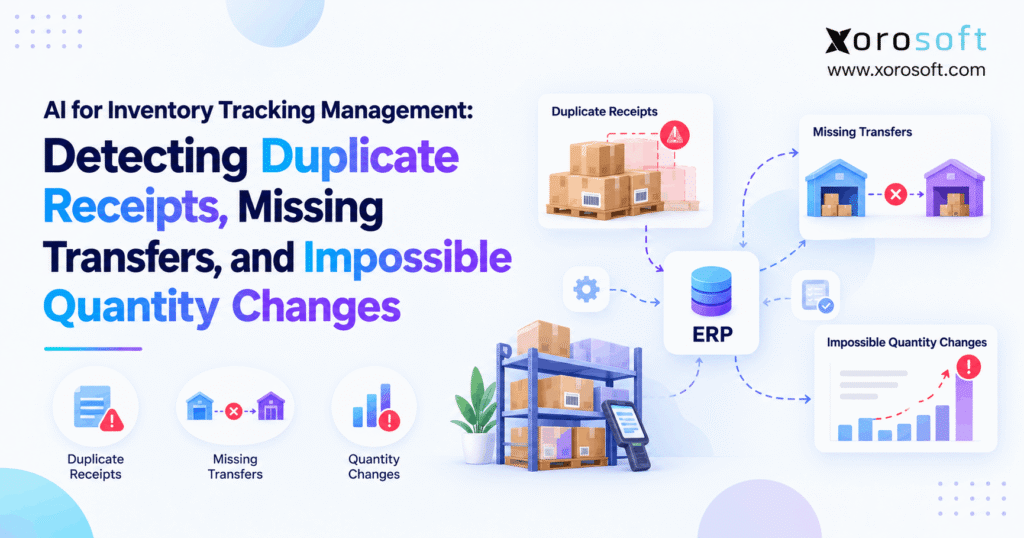
Depending on the available data, AI can help surface duplicate receipts, missing transfer receipts, unusual adjustments, unexplained negative inventory, impossible quantity increases, sequence errors, and cross-system mismatches.
However, detection is only the first step. Therefore, the system should also show the related PO, transfer, warehouse, timestamp, user, quantity, and source transaction whenever possible.
As a result, operators can investigate an exception instead of receiving another unexplained alert.
3. Why Inventory Tracking Errors Spread Across Systems
Inventory errors become harder to diagnose when several platforms interact with the same stock. For example, Shopify, Amazon, an ERP, a WMS, a 3PL, EDI connections, and accounting software may all process different parts of the same inventory event.
Consequently, a small transaction mistake can move through several systems before anyone notices it.
3.1 One SKU can have several valid inventory states
A SKU may be on hand, available, reserved, allocated, picked, in transit, damaged, quarantined, returned, or incoming.
Therefore, two different inventory numbers are not automatically contradictory.
For example, a warehouse may physically hold 100 units while only 72 remain available to sell. Meanwhile, 20 may be allocated and eight may be quarantined.
Consequently, AI inventory monitoring must understand inventory states before flagging discrepancies. Otherwise, the model may mistake legitimate differences for errors.
3.2 Integrations can duplicate or delay transactions
Integration problems do not always produce obvious failures.
For example, an application may successfully post a transaction but fail to receive confirmation. Therefore, it may retry the event. If the receiving system lacks a unique event identifier, the retry may create another inventory movement.
Similarly, APIs, batch jobs, webhooks, and 3PL feeds can update at different times.
Therefore, Xorosoft integrations and other connected architectures need consistent transaction IDs, timing rules, and ownership logic to maintain reliable inventory histories.
3.3 Manual adjustments can hide the original error
When quantities disagree, teams frequently post adjustments to make the balance look correct.
However, that approach may repair the number without resolving the process problem.
For instance, a team may subtract 50 units after discovering excess system inventory. Nevertheless, the original duplicate receipt remains in the history.
Consequently, the same integration or receiving problem may happen again.
Therefore, effective inventory tracking should identify both the correction and the event that created the discrepancy.
4. AI Inventory Tracking for Duplicate Receipts
Duplicate receipts are particularly damaging because they create inventory that may not physically exist. Therefore, sales, purchasing, forecasting, accounting, and fulfillment can all begin working from an inflated quantity.
For example, a supplier may physically deliver 100 units while the system posts two separate receipts of 100 units each.
4.1 How duplicate receipts appear
Consider this simplified example:
| Inventory Event | Quantity | Result |
|---|---|---|
| Purchase order quantity | 100 | 100 expected |
| Physical delivery | 100 | 100 received |
| Receipt #1 | +100 | Correct |
| Receipt #2 | +100 | Duplicate |
| System inventory | 200 | Incorrect |
| Physical inventory | 100 | Correct |
Therefore, the system now contains 100 units that do not exist physically.
Moreover, the discrepancy may remain hidden until a cycle count, stockout, allocation failure, or month-end reconciliation exposes it.
4.2 Why duplicate receipts happen
Duplicate receipts can result from repeated scans, integration retries, duplicated ASNs, reopened receiving sessions, copied documents, or two users processing the same PO line.
Additionally, exact duplicate controls do not catch every variation.
For example, the second receipt may receive a new internal ID even though the supplier, SKU, quantity, PO line, and timing closely match the original event.
Therefore, AI inventory tracking can compare several signals together instead of relying on one identifier.
4.3 What the system should compare
A useful detection process should compare the purchase order, PO line, supplier, SKU, quantity, packing slip, ASN, warehouse, timestamp, receiving user, device, and prior receipts.
For example, two receipts for the same PO line, SKU, supplier, and quantity within 60 seconds should receive closer review.
However, deterministic rules should still block obvious duplicates wherever possible.
Therefore, AI should complement transaction controls rather than replace them.
5. AI Inventory Tracking for Missing Warehouse Transfers
AI inventory tracking becomes especially valuable in multi-warehouse environments because a transfer is not a single event. Instead, it usually passes through several stages.
For example, inventory may move from created to released, picked, shipped, in transit, received, and finally put away.
Consequently, one missing stage can leave inventory stranded between locations.
5.1 A transfer requires two sides to reconcile
Suppose Warehouse A ships 50 units to Warehouse B.
Warehouse A correctly records −50 units. Meanwhile, the system records +50 units in transit. However, Warehouse B never posts the destination receipt.
Therefore, the physical stock may already be at Warehouse B while the system still considers it in transit.
Alternatively, the goods may actually be delayed or lost.
Consequently, operators need more than a transfer number. They need both the source and destination events.
5.2 How AI can detect missing transfer events
AI can compare the origin warehouse, destination warehouse, transfer number, SKU, quantity, shipment timestamp, expected transit duration, receiving timestamp, and carrier or 3PL events.
For example, a two-hour delay may be normal. However, a transfer still unreceived three days after its usual transit window deserves investigation.
Therefore, anomaly scoring can help operations teams focus on the transfers most likely to represent genuine exceptions.
5.3 Why WMS data improves transfer investigation
Warehouse scans add valuable physical evidence.
For instance, picking, staging, loading, receiving, and putaway events can confirm where inventory was last handled.
Therefore, a connected XoroWMS environment can provide warehouse-level context for inventory movements rather than relying exclusively on summarized ERP balances.
Moreover, detailed scanning history helps distinguish a physical movement problem from a system synchronization problem.
6. Detecting Impossible Quantity Changes With AI Inventory Monitoring
AI inventory monitoring should also identify quantity changes that cannot be recreated from valid transaction history.
For example, suppose inventory moves from 120 units to 115, then to 103, and suddenly to 603. If no 500-unit receipt, transfer, return, production completion, or adjustment exists, the resulting balance requires immediate investigation.
6.1 Every material quantity change needs an explanation
A useful reconciliation model is:
Ending Inventory = Beginning Inventory + Valid Inflows − Valid Outflows ± Authorized Adjustments
Therefore, every material change should connect to a valid business event.
For instance, inventory may increase because of a purchase receipt, customer return, transfer receipt, or manufacturing completion.
Conversely, it may decrease because of a shipment, transfer-out, production consumption, scrap transaction, or approved adjustment.
If none of those events explains the balance, the quantity may be unreliable.
6.2 Microsoft inventory consistency illustrates the problem
Microsoft documents situations in which summarized on-hand inventory can become inconsistent with underlying inventory transactions. Therefore, its inventory on-hand consistency guidance highlights why transaction history matters when inventory balances cannot be explained.
Similarly, AI inventory tracking should reconstruct how the quantity changed.
Consequently, the model should not merely flag “603 looks unusual.” Instead, it should explain that the ledger contains no valid transaction supporting the 500-unit increase.
7. How AI Inventory Tracking Scores Suspicious Transactions
AI inventory tracking works best when hard rules and pattern analysis operate together. Therefore, the goal should not be to replace ERP or WMS controls with a black-box model.
Instead, deterministic controls should prevent clearly invalid actions, while AI evaluates unusual but technically valid transactions.
7.1 Rules should stop objectively invalid events
Hard rules work well when the answer is clear.
For example, a system can require a warehouse code, prevent an exact duplicate packing slip, enforce a serial-number rule, or block a transfer receipt that exceeds an allowed quantity.
Therefore, companies should keep these controls.
Moreover, stopping a known error before it affects inventory is better than detecting the error afterward.
7.2 AI should analyze unusual but valid behavior
Some transactions pass every validation rule yet still deserve attention.
For instance, an adjustment of 400 units may be permitted. However, if that SKU normally receives adjustments between one and eight units, the event is unusual.
Similarly, a transfer may be technically valid but remain in transit far longer than historical transfers between the same warehouses.
Consequently, AI adds value by recognizing context that hard rules may not capture.
7.3 A risk score helps prioritize investigation
| Signal | Example Risk | Recommended Response |
|---|---|---|
| Same PO line repeated within 60 seconds | High | Review receipt |
| Transfer one hour late | Low | Monitor |
| Transfer three days beyond norm | High | Investigate |
| Adjustment 1.5× normal size | Medium | Review context |
| Adjustment 12× normal size | High | Investigate |
| Quantity change without source document | Critical | Escalate |
Therefore, operators do not need to review every inventory event manually.
Instead, they can start with exceptions that combine unusual quantities, timing, relationships, or missing documentation.
8. Transaction Data AI Inventory Tracking Needs
AI cannot compensate for poor transaction data. Therefore, businesses need reliable inventory history before expecting sophisticated exception detection.
Moreover, the system should capture enough context to explain why an event happened.
8.1 Minimum inventory transaction data
| Data Field | Why It Matters |
|---|---|
| SKU | Identifies affected inventory |
| Quantity | Measures the movement |
| Transaction type | Explains why stock changed |
| Timestamp | Establishes sequence |
| Warehouse | Identifies location |
| Bin or location | Adds physical context |
| Source document | Connects the movement to a business event |
| User or system | Identifies transaction origin |
| Quantity before | Establishes previous state |
| Quantity after | Validates resulting state |
| PO, order, or transfer ID | Connects related transactions |
| Inventory status | Separates available, damaged, held, or in-transit stock |
Therefore, current stock quantity alone is not enough.
8.2 Audit trails matter more than snapshots
A snapshot tells operators where inventory ended.
However, an audit trail explains how it reached that value.
Consequently, transaction-level history becomes essential when a warehouse must reconstruct a discrepancy.
For inventory-driven companies, XoroONE connects inventory with other operational workflows, including purchasing and warehouse activity. Therefore, a connected operating record can reduce the amount of reconciliation required between disconnected applications.
8.3 Clean master data reduces false positives
AI also needs consistent SKU mappings, units of measure, warehouse codes, transaction types, supplier records, and inventory statuses.
Otherwise, legitimate differences may look suspicious.
For example, a case of 12 units recorded as one unit in one system and 12 units in another can create an apparent discrepancy.
Therefore, data standardization should happen before advanced anomaly monitoring.
9. Where AI Inventory Tracking Creates the Most Value
AI inventory tracking generally delivers more value as inventory complexity increases. Therefore, companies with one warehouse and a small SKU catalog may not need the same level of exception monitoring as multi-location businesses.
However, multi-channel and multi-warehouse operations often create more transaction relationships to validate.
9.1 Multi-warehouse ecommerce operations
Ecommerce brands may manage Shopify, marketplaces, 3PL inventory, warehouse transfers, returns, reservations, and channel allocations simultaneously.
Therefore, one inventory error can influence both warehouse execution and online availability.
Moreover, Xorosoft is available through the Shopify App Store, which is relevant for merchants evaluating how Shopify connects with broader ERP inventory operations.
Consequently, ecommerce teams should distinguish storefront inventory visibility from the operational transaction history behind it.
9.2 Wholesale and distribution operations
Distributors often process larger receipts, pallets, case packs, customer allocations, EDI documents, and frequent warehouse transfers.
Therefore, a duplicated receipt can affect purchasing and customer commitments simultaneously.
Likewise, a missing transfer may incorrectly reduce available inventory at one location while hiding stock at another.
For businesses with these workflows, Xorosoft’s broader industry capabilities provide context for inventory-driven wholesale, distribution, and product operations.
9.3 Manufacturing operations
Manufacturing creates additional inventory events through component consumption, work orders, production completion, scrap, substitutions, and backflushing.
Consequently, AI must understand production context before calling a material movement abnormal.
For example, actual consumption may legitimately differ from the standard BOM because of scrap or yield variation.
Therefore, manufacturing anomaly detection requires tighter relationships between inventory, production, and source documents.
10. When AI Inventory Monitoring Produces False Positives
AI inventory monitoring can make mistakes because unusual does not automatically mean incorrect.
Therefore, every alert needs operational context and a clear explanation.
Moreover, teams should be able to tune thresholds as the business changes.
10.1 Promotions and seasonal receipts can look abnormal
A seasonal purchase may be ten times larger than normal.
However, the transaction may be completely valid.
Similarly, a new product launch may create receiving volumes that historical data has never seen before.
Therefore, models should consider promotions, seasonality, launches, and purchasing plans before escalating unusual quantities.
10.2 New warehouses have limited history
A newly opened warehouse does not have months or years of behavioral data.
Consequently, historical models may initially create more false positives.
Therefore, teams should combine business rules with broader network data until the location builds a useful baseline.
10.3 Physical counts can create legitimate large adjustments
Cycle counting may uncover a long-running discrepancy.
As a result, the correction can be far larger than normal.
However, the system should still retain the adjustment reason, count record, user, and approval history.
Therefore, explainability matters even when the final transaction is valid.
11. Building an AI Inventory Tracking Maturity Model
Businesses should introduce AI inventory tracking in stages. Therefore, allowing AI to change inventory automatically should not be the starting point.
Instead, companies should first improve transaction history and deterministic controls.
11.1 Stage one: establish reliable inventory history
First, capture receipts, transfers, adjustments, shipments, returns, and production movements consistently.
Next, make sure related source documents remain linked.
Then, standardize warehouse codes, units of measure, inventory states, and reason codes.
Consequently, the business creates a reliable foundation for future detection.
Without that foundation, AI simply analyzes unreliable information more quickly.
11.2 Stage two: prevent known errors with rules
Next, use deterministic controls for exact duplicates, missing required fields, invalid warehouse combinations, and other predictable errors.
Therefore, AI does not need to spend resources finding problems that ordinary validation can prevent.
Moreover, stronger controls reduce noise inside the exception queue.
As a result, operations teams can focus on genuinely ambiguous events.
11.3 Stage three: add exception scoring
Once transaction quality improves, AI can compare current events against historical patterns.
For example, the system can rank an adjustment more highly when the quantity, user, warehouse, timing, and transaction type are all unusual.
Therefore, several weak signals can become one meaningful exception.
Additionally, Xorosoft’s AI MCP Server provides a relevant example of how AI can interact with ERP information while keeping business context connected.
11.4 Stage four: automate cautiously
Finally, companies can automate low-risk responses once they trust the underlying data and controls.
However, automatically rewriting inventory because a model considers a transaction unusual can create additional risk.
Therefore, high-impact inventory corrections should generally remain explainable and reviewable.
Consequently, AI should first accelerate investigation before it expands into corrective automation.
12. When Inventory Problems Signal an Architecture Problem
Sometimes inventory errors persist because the underlying software architecture is fragmented.
Therefore, adding another AI application may not solve the real issue.
Instead, businesses should examine how inventory, warehouse, purchasing, ecommerce, and accounting records connect.
12.1 Warning signs that disconnected systems are becoming risky
Common signs include spreadsheet reconciliation, unexplained transfer balances, warehouse and accounting disagreements, anonymous adjustments, duplicated integration events, and month-end inventory reconstruction.
Moreover, teams may rely on chat messages or emails to determine whether stock actually moved.
Consequently, the business lacks a dependable operational record.
At that point, the problem is no longer one incorrect transaction. Instead, it is the inability to explain transactions consistently.
12.2 Who may not need a larger ERP environment
A company with one warehouse, limited SKUs, low order volume, simple purchasing, and few channels may operate successfully with focused inventory software.
Therefore, complexity should drive software decisions rather than company size alone.
However, requirements change as businesses add warehouses, wholesale customers, EDI, manufacturing, marketplaces, and more complicated purchasing.
Consequently, teams should reassess architecture when manual reconciliation grows faster than operations.
12.3 Who should consider connected ERP and WMS workflows
Businesses operating several warehouses, Shopify, Amazon, wholesale, EDI, manufacturing, complex purchasing, and integrated accounting may benefit from a connected ERP/WMS environment.
For example, XoroERP is designed around inventory-driven operational requirements.
Additionally, connected records can reduce the number of system boundaries an investigation must cross.
Therefore, improving architecture can make both traditional controls and future AI monitoring more reliable.
13. How to Evaluate AI Inventory Tracking Software
Buyers should evaluate AI inventory tracking based on the quality of its transaction evidence rather than the presence of an AI label.
Therefore, every product discussion should start with explainability, history, and integrations.
13.1 AI inventory tracking evaluation checklist
| Question | Why It Matters | Warning Sign |
|---|---|---|
| Does it retain transaction history? | AI needs event context | Only current stock is visible |
| Are source documents linked? | Supports root-cause analysis | Anonymous adjustments |
| Is the transfer lifecycle visible? | Identifies missing events | Only net quantity is shown |
| Are alerts explainable? | Helps operators trust results | Black-box score only |
| Are inventory states separated? | Prevents false mismatches | All inventory treated alike |
| Can thresholds be tuned? | Reduces false positives | Fixed rules only |
| Can systems be connected? | Exposes cross-system errors | Single silo only |
| Is human review supported? | Protects inventory integrity | Automatic changes without approval |
Therefore, a useful solution should explain why a transaction looks suspicious.
13.2 Look beyond dashboards
A dashboard may show that inventory is incorrect.
However, investigation requires the transactions behind that result.
Therefore, buyers should ask whether they can trace a quantity back to receipts, transfers, shipments, adjustments, returns, and production activity.
Additionally, companies should review broader Xorosoft solutions when assessing how inventory connects with warehouse, purchasing, and operational requirements.
14. Why Explainable AI Inventory Tracking Matters
AI should not tell an operator only that “inventory may be wrong.”
Instead, it should provide evidence.
For example:
“The same supplier, PO line, SKU, quantity, and packing slip appear in two receipts created 74 seconds apart.”
That message is actionable.
Likewise, another alert might explain:
“Fifty units left Warehouse A, but no corresponding destination receipt exists after the expected transfer window.”
Consequently, the operator knows exactly where to begin.
14.1 Human review protects inventory integrity
Not every anomaly should generate an automatic correction.
For example, a large seasonal receipt may be valid even though it looks statistically unusual.
Therefore, operators should see the transaction, explanation, supporting documents, and related events before changing inventory.
Moreover, human review can feed useful information back into future rules and thresholds.
Consequently, the system becomes more useful without becoming less accountable.
14.2 Better tracking improves more than warehouse accuracy
Inventory errors affect purchasing, fulfillment, forecasting, accounting, customer promises, and working capital.
Therefore, improving transaction integrity creates benefits beyond the warehouse.
For example, a corrected duplicate receipt can prevent unnecessary purchasing decisions based on inflated stock. Likewise, resolving a missing transfer can restore sellable inventory at the correct location.
Consequently, AI inventory tracking should support broader operational accuracy rather than exist as an isolated analytics project.
15. Build Inventory Accuracy Around Explainable Transactions
AI inventory tracking works best when every important quantity change has a traceable business reason.
Therefore, the objective should not be to add AI simply because AI is available. Instead, businesses should create reliable inventory transactions, strong controls, complete audit history, and connected systems first.
Once that foundation exists, AI can help teams identify duplicate receipts, missing transfers, unusual adjustments, and impossible quantity changes far faster.
Moreover, operators can investigate the evidence instead of searching manually across spreadsheets and applications.
For inventory-driven businesses that need inventory, warehouse management, purchasing, ecommerce, and accounting to work from one operational foundation, Xorosoft provides a connected cloud ERP approach.
Therefore, if disconnected systems are making inventory discrepancies difficult to explain, Book a Demo to see how Xorosoft can support more connected inventory operations.
Frequently Asked Questions
What is AI inventory tracking?
AI inventory tracking analyzes inventory transactions and patterns to identify suspicious receipts, transfers, adjustments, and quantity changes. Therefore, teams can investigate likely discrepancies before inaccurate inventory affects purchasing, fulfillment, or accounting.
Can AI detect duplicate inventory receipts?
Yes. AI can compare purchase orders, SKUs, suppliers, quantities, timestamps, packing slips, and previous receipts. Consequently, it can flag similar transactions that may represent duplicate receiving activity.
Can AI identify missing warehouse transfers?
Yes. AI can compare transfer-out and transfer-in events. Therefore, when inventory leaves one location but does not arrive within the expected timeframe, the transfer can be prioritized for investigation.
Can AI detect impossible inventory quantity changes?
Yes. AI can compare the ending balance with valid receipts, shipments, transfers, returns, production events, and adjustments. Consequently, unexplained quantity increases or decreases can be flagged.
Does AI inventory tracking replace cycle counting?
No. AI evaluates digital transaction history, while cycle counting verifies physical stock. Therefore, the two methods work best together, especially when AI helps prioritize locations or SKUs that require verification.
Does AI inventory tracking require a WMS?
Not always. However, WMS data provides receiving, picking, transfer, bin, and scanning details. Therefore, warehouse transaction history can make inventory anomaly investigation more accurate and explainable.
When should a business upgrade its inventory system?
An upgrade may be appropriate when spreadsheets, disconnected apps, repeated reconciliation, missing audit trails, or multi-warehouse complexity make inventory difficult to explain. Consequently, integrated ERP and WMS workflows become more valuable.
Recent Posts
-
 Holiday Inventory Planning for Beauty and Personal-Care Brands
 -
 ERP Support Benchmarks 2026: Tickets, Resolution, Changes, and Adoption
 -
 WMS vs OMS for Peak-Season Order Routing and Fulfillment
 -
 How to Track Raw Materials, WIP, and Finished Goods in One Inventory System
 -
 Work-in-Process Inventory: How Production Transactions Affect Financial Accuracy