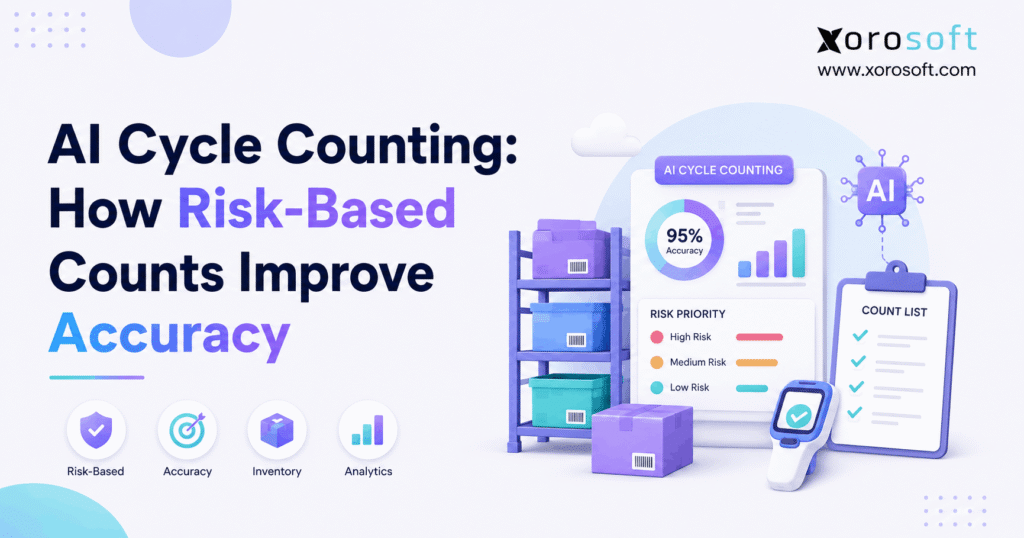
AI cycle counting is transforming the way businesses manage their inventory and streamline their operations.
1. Count the Risk Before You Count the Stock
AI cycle counting changes a basic warehouse question: instead of asking which inventory is scheduled to be counted next, teams can ask which inventory is most likely to be inaccurate right now. Therefore, warehouse labor can focus on records where verification may create the greatest operational value.
Traditionally, cycle counting depends on fixed schedules, ABC classifications, or random selections. However, inventory risk does not remain fixed. For example, one SKU may suddenly experience heavy picking, repeated replenishment, several returns, and multiple stock adjustments. Meanwhile, another SKU may remain untouched for weeks.
As a result, counting both products at the same frequency may waste labor. Moreover, the warehouse may continue counting stable inventory while a higher-risk location remains unchecked.
AI-driven prioritization provides another approach. Specifically, operational data can help identify patterns that indicate a greater probability of inventory discrepancy. Consequently, the warehouse can direct physical counts toward higher-risk SKU-location combinations.
However, AI does not physically verify inventory. Instead, people still perform the count. Therefore, the role of AI is to improve prioritization rather than eliminate physical verification.
In addition, better cycle counting affects more than warehouse operations. Inventory accuracy influences purchasing, ecommerce availability, customer promises, fulfillment, manufacturing, financial reporting, and replenishment. Thus, a stronger counting strategy can support decisions throughout the business.
2. What Is AI Cycle Counting?
AI cycle counting is a data-driven inventory-control method that uses artificial intelligence, machine learning, or advanced analytical logic to help identify which inventory records should receive counting priority.
In other words, traditional cycle counting often asks, “What should we count according to the schedule?” By contrast, AI cycle counting asks, “What inventory currently presents the greatest risk?”
For example, the system may consider:
- previous inventory variances,
- transaction velocity,
- manual stock adjustments,
- picking frequency,
- replenishment activity,
- returns,
- warehouse transfers,
- inventory value,
- location activity,
- stockout exposure.
Therefore, a SKU can move higher or lower in the count queue as warehouse conditions change.
2.1 How Intelligent Cycle Counting Works
First, the business collects inventory and warehouse transaction data. Next, the system evaluates patterns associated with previous discrepancies. Then, inventory records can be ranked according to their relative risk.
Afterward, warehouse workers physically verify selected inventory. If they find a variance, they can investigate and correct it. Finally, the new count result becomes additional data that can improve future prioritization.
Therefore, intelligent cycle counting creates a feedback loop:
Warehouse activity → Risk analysis → Count priority → Physical verification → Variance analysis → Better future prioritization
2.2 Risk-Based Cycle Counting vs AI Cycle Counting
Risk-based counting and AI cycle counting are closely related. However, they are not exactly the same.
Risk-based cycle counting can operate through manually designed business rules. For example, a warehouse might count any SKU with more than three adjustments during the previous 30 days.
AI cycle counting, on the other hand, can evaluate larger combinations of historical signals and identify patterns automatically.
Therefore, every AI-driven cycle count program can be considered risk-oriented. However, not every risk-based counting program requires artificial intelligence.
2.3 Why the Difference Matters
The distinction matters because businesses should not add AI simply because it sounds more advanced.
For example, a warehouse with 200 SKUs and one location may perform perfectly well with ABC counting and disciplined transaction controls. Conversely, a business with 20,000 SKUs across multiple warehouses may benefit significantly from dynamic prioritization.
Therefore, complexity should drive the technology decision.
3. Why Traditional Cycle Counting Can Miss Changing Inventory Risk
Traditional cycle counting remains useful. Nevertheless, static methods can struggle when warehouse conditions change faster than the counting schedule.
3.1 Fixed Schedules Treat Time as the Main Risk Factor
A scheduled cycle count may require a location to be counted every 30 days. Therefore, the location receives another count simply because 30 days have passed.
However, nothing important may have happened during that period.
Meanwhile, another location may have experienced:
- hundreds of picks,
- multiple replenishments,
- customer returns,
- inventory adjustments,
- location transfers.
Consequently, the second location may present substantially more inventory risk even though its scheduled count date has not arrived.
3.2 ABC Counting Focuses on Classification
ABC cycle counting usually divides inventory into groups. For example, A items may receive frequent counts, while B and C items receive fewer counts.
This approach is practical because it is easy to understand. However, product value or classification does not always reflect the current probability of an inventory error.
For instance, a low-cost component may move hundreds of times per week. Meanwhile, an expensive product may remain untouched in secure storage.
Therefore, the lower-value item can sometimes carry greater operational discrepancy risk.
3.3 Random Counting Provides Coverage but Not Prioritization
Random cycle counting can reveal unexpected problems. Therefore, it remains valuable.
However, randomness does not intentionally direct labor toward inventory showing known warning signals.
Consequently, many businesses benefit from a hybrid approach. For example, risk-based counts can handle priority inventory while random counts provide independent coverage.
4. What Creates Inventory Discrepancy Risk?
Inventory errors usually result from operational activity rather than from the inventory record itself.
Therefore, a useful AI cycle counting strategy looks beyond quantity and examines the processes surrounding each SKU and location.
4.1 Historical Variances
Previous discrepancies are often important indicators.
For example, if the same SKU-location combination has produced inaccurate counts repeatedly, the warehouse should investigate the underlying process.
However, the goal should not simply be to count that inventory more often forever. Instead, teams should determine why the discrepancy keeps returning.
4.2 High Transaction Velocity
Frequent movement creates more opportunities for mistakes.
For instance, fast-moving SKUs may experience continuous picking and replenishment throughout the day. Consequently, the inventory record depends on hundreds of transactions being completed correctly.
However, high velocity alone does not prove that a location is inaccurate. Therefore, velocity should be combined with other signals.
4.3 Manual Inventory Adjustments
Manual adjustments can be necessary. Nevertheless, frequent adjustments may indicate a process problem.
For example, recurring quantity changes can point toward:
- receiving errors,
- incorrect picking,
- missed transfers,
- poor returns processing,
- unit-of-measure problems,
- damaged inventory.
Therefore, adjustment frequency can be a useful cycle-count signal.
4.4 Returns Activity
Returns introduce additional inventory states.
For example, returned goods may move through inspection, quarantine, resale, repair, or damaged-stock locations. As a result, the physical product may move faster than the digital record if workflows are not controlled.
Therefore, high-return SKUs may deserve greater count attention.
4.5 Warehouse Transfers
Transfers create another handoff between physical inventory and digital records.
Moreover, a product can be accurate at one warehouse and inaccurate at another. Therefore, risk should often be calculated by SKU-location combination rather than by SKU alone.
5. How AI Cycle Counting Prioritizes Inventory
A useful prioritization model should answer two separate questions.
First, how likely is the inventory record to be wrong?
Second, how serious would the problem be if the record were wrong?
Therefore, businesses can think conceptually about priority as:
Count Priority = Probability of Error × Business Impact
However, this should not be treated as one universal formula. Instead, every organization should determine which measurable signals matter to its operation.
5.1 Probability-of-Error Signals
Potential indicators include:
- previous count failures,
- frequent adjustments,
- high transaction activity,
- recent returns,
- location changes,
- repeated replenishment,
- unusual transaction patterns.
Therefore, these factors help estimate where discrepancies may occur.
5.2 Business-Impact Signals
Other factors measure the consequence of an error.
For example:
- inventory value,
- customer-order exposure,
- supplier lead time,
- production dependency,
- stockout risk,
- strategic product importance.
Thus, one low-cost item can still receive high priority if its absence would stop production or delay major customer orders.
5.3 Why SKU-Location Risk Matters
Suppose one product exists in four warehouses.
Warehouse A may have excellent transaction discipline. Meanwhile, Warehouse B may experience repeated adjustments and heavy replenishment activity.
Therefore, assigning one global risk score to that SKU can hide meaningful differences.
Instead, SKU-location scoring can create more precise count priorities.
6. AI Cycle Counting vs ABC Cycle Counting
ABC counting and AI cycle counting solve the same broad problem differently.
| Factor | AI Cycle Counting | ABC Cycle Counting |
|---|---|---|
| Primary logic | Dynamic risk | Static classification |
| Data inputs | Multiple operational signals | Usually value or importance |
| Priority changes | Can change frequently | Usually fixed |
| Variance history | Can influence ranking | Often limited |
| Location risk | Can be included | Often SKU-focused |
| Complexity | Higher | Lower |
| Explainability | Depends on model | Usually simple |
| Best fit | Complex operations | Simpler warehouses |
Therefore, AI cycle counting should not automatically replace ABC counting.
Instead, ABC classifications can remain useful as a baseline. Then, risk signals can modify priorities when operational conditions change.
For example, an A item may remain on a regular schedule. However, a C item with repeated discrepancies can receive an immediate additional count.
Consequently, hybrid strategies can provide both coverage and flexibility.
7. AI Cycle Counting vs Scheduled Counting
Scheduled counting creates consistency.
For example, a business may count every A item monthly and every B item quarterly. Therefore, managers know that all important inventory will eventually receive attention.
However, scheduled counting assumes that risk changes according to time.
AI cycle counting works differently. Instead, it can respond when actual warehouse behavior changes.
For example, a location could receive higher priority after:
- a sudden spike in picking,
- several stock adjustments,
- multiple returns,
- rapid replenishment,
- an unexpected variance.
Therefore, dynamic counting can react before the next scheduled count.
Nevertheless, schedules still have value. Consequently, many warehouses can use scheduled counts for baseline coverage and AI-driven counts for exceptions.
8. How AI Cycle Counting Can Improve Inventory Accuracy
AI does not improve inventory accuracy merely because a warehouse uses artificial intelligence.
Instead, improvement occurs when better prioritization leads to faster detection, stronger root-cause analysis, and better process controls.
8.1 Higher-Risk Errors Can Be Found Earlier
Traditional schedules may allow a discrepancy to remain hidden until the next count.
However, risk signals can trigger earlier verification.
As a result, the business may correct the record before the error affects more customer orders.
8.2 Warehouse Labor Can Focus on More Valuable Counts
Counting always requires time.
Therefore, repeatedly checking historically stable inventory may create limited value.
Instead, a risk-based strategy can move labor toward inventory where a discrepancy is more likely or more consequential.
Consequently, the warehouse can improve the value of each counting hour.
8.3 Root Causes Become Easier to Identify
A cycle count should not end with an adjustment.
For example, if a location repeatedly produces shortages after replenishment, the problem may exist within the replenishment process.
Similarly, recurring discrepancies after returns may indicate poor return-location controls.
Therefore, count data should become an operational diagnostic tool.
8.4 Available-to-Sell Inventory Becomes More Reliable
Accurate inventory supports better order promises.
Moreover, ecommerce brands may sell the same physical inventory across multiple channels. Consequently, inaccurate warehouse quantities can quickly become customer-facing problems.
Therefore, inventory accuracy helps reduce situations where a website shows stock that does not physically exist.
9. A Practical Risk-Based Counting Example
Consider two products stored in the same warehouse.
9.1 SKU A
- Unit cost: $450
- Weekly picks: 3
- Recent adjustments: 0
- Recent variances: 0
- Returns: Low
- Location activity: Low
9.2 SKU B
- Unit cost: $28
- Weekly picks: 180
- Recent adjustments: 4
- Recent variances: 2
- Returns: High
- Location activity: High
Traditional value-based classification may prioritize SKU A because it is financially expensive.
However, an AI cycle counting model may rank SKU B higher because several operational signals indicate a greater probability of error.
Therefore, SKU B may receive the next count.
If the count confirms a discrepancy, the team should then investigate the cause.
For example, employees might discover that returned units are being placed directly into active inventory before inspection.
Consequently, the biggest benefit is not the count itself. Instead, the benefit comes from correcting the underlying process.
10. AI Cycle Counting for Ecommerce Operations
Ecommerce inventory changes quickly.
For example, Shopify orders, marketplace orders, wholesale orders, returns, promotions, and multi-location fulfillment can create hundreds or thousands of inventory transactions each day.
Therefore, ecommerce brands need more than a static company-wide inventory number.
10.1 Shopify and Multi-Channel Inventory
A product may be selling simultaneously through Shopify, Amazon, wholesale accounts, and direct sales.
Consequently, inaccurate warehouse inventory can affect multiple channels at once.
Xorosoft’s integrations platform connects ecommerce and operational workflows so inventory, orders, warehouse activity, and business systems can operate from a more centralized data foundation.
In addition, Xorosoft is available through the Shopify App Store, which provides ecommerce merchants with another way to connect Shopify operations with broader ERP workflows.
Therefore, connected channel and warehouse data can provide better context for inventory-control decisions.
10.2 Promotions Can Change Risk Quickly
Suppose a normally slow SKU enters a major promotion.
Suddenly, picking frequency may increase tenfold. Moreover, replenishment activity may rise sharply.
Therefore, the product’s discrepancy risk can change even though its traditional ABC classification remains unchanged.
Consequently, dynamic cycle counting becomes particularly relevant in high-velocity ecommerce environments.
11. AI Cycle Counting for Wholesale Distribution
Wholesale distributors face different inventory pressures.
For example, they often manage:
- large SKU catalogs,
- customer-specific orders,
- EDI transactions,
- case and each picking,
- customer allocations,
- multi-warehouse inventory.
Therefore, one inaccurate quantity can affect several downstream processes.
11.1 Customer Allocation Increases the Cost of Errors
Suppose the ERP shows 500 available units.
However, the warehouse physically contains only 440.
As a result, the business may allocate inventory to customers that cannot actually be fulfilled.
Consequently, the discrepancy can affect customer service, order planning, and purchasing simultaneously.
11.2 Large Catalogs Make Equal Counting Impractical
A distributor with 30,000 SKUs cannot treat every item equally.
Therefore, prioritization becomes essential.
For example, high-risk inventory can receive frequent verification while stable items remain on broader rotational schedules.
Xorosoft supports inventory-driven organizations across several industries, including wholesale, consumer products, apparel, furniture, manufacturing, and distribution environments.
12. AI Cycle Counting for Manufacturing
Manufacturing creates an additional inventory consideration: production dependency.
A low-cost component can have enormous operational importance if production cannot continue without it.
Therefore, risk scoring should not rely only on monetary value.
12.1 Raw Material Accuracy
Incorrect raw material quantities can affect purchasing and production planning.
For example, the system may indicate enough material for tomorrow’s production run. However, a physical shortage can stop the work order.
Consequently, critical raw materials may deserve additional counting priority.
12.2 Component Consumption
Components move through multiple production activities.
Therefore, incorrect issues, scrap postings, substitutions, or material returns can create discrepancies.
As a result, manufacturing inventory often requires stronger transaction discipline.
12.3 Finished Goods
Finished goods accuracy also matters.
For example, production may be completed physically before the ERP transaction is finalized. Consequently, inventory visibility can temporarily differ from reality.
Therefore, manufacturers need accurate coordination between warehouse and production activity.
13. Multi-Warehouse AI Cycle Counting
Inventory complexity increases significantly when a business adds warehouses.
Therefore, one central SKU balance is not enough.
13.1 Different Warehouses Create Different Risk Profiles
Warehouse A may process heavy ecommerce volume.
Meanwhile, Warehouse B may primarily hold reserve stock.
Consequently, the same SKU may require different count frequencies at each location.
13.2 Transfers Add Additional Risk
Inventory transfers create multiple transaction points.
First, stock leaves one warehouse. Next, it travels between facilities. Finally, it must be received into the destination warehouse.
Therefore, any incomplete transaction can create an apparent discrepancy.
13.3 Central Visibility Becomes Essential
As the network grows, managers need consistent inventory information.
For this reason, platforms such as XoroONE can help centralize inventory, purchasing, accounting, warehouse, manufacturing, ecommerce, and reporting workflows.
Therefore, a unified operational foundation can make risk analysis more meaningful.
14. What Technology Supports Smarter Cycle Counting?
AI cycle counting depends on operational data.
Therefore, businesses should improve the data foundation before focusing on advanced predictive models.
14.1 Warehouse Management System
A WMS captures important warehouse events such as:
- receiving,
- putaway,
- picking,
- replenishment,
- transfers,
- returns,
- locations,
- cycle counts.
Therefore, WMS data provides much of the operational context required for smarter counting.
Xorosoft’s XoroWMS is designed to manage real-time warehouse workflows, inventory movement, fulfillment activity, and warehouse control within inventory-driven operations.
14.2 ERP
ERP adds broader business context.
For example, it can connect:
- purchasing,
- accounting,
- order management,
- manufacturing,
- inventory valuation,
- supplier activity.
Consequently, inventory risk can be evaluated in terms of both warehouse probability and business impact.
The XoroERP environment brings these operational and financial processes into a broader ERP framework.
14.3 Barcode and Mobile Scanning
Physical verification still requires reliable execution.
Therefore, barcode and mobile scanning can reduce manual data entry.
Moreover, blind counts can prevent workers from simply confirming the quantity already displayed in the system.
14.4 Transaction History
AI needs historical evidence.
Therefore, businesses should preserve clean records of:
- previous counts,
- discrepancies,
- inventory adjustments,
- movements,
- returns,
- replenishment,
- transfers.
Without dependable transaction history, even sophisticated models can produce weak recommendations.
15. Common AI Cycle Counting Mistakes
Technology does not automatically create better inventory control.
Therefore, businesses should avoid several common implementation mistakes.
15.1 Automating Poor Data
Bad source data creates bad recommendations.
For example, if employees frequently move inventory without scanning transfers, the system may learn from incomplete transaction history.
Therefore, process discipline should come before advanced automation.
15.2 Counting Without Fixing Root Causes
A discrepancy correction solves the system quantity.
However, it does not solve the process that created the discrepancy.
Therefore, repeated variances should trigger investigation.
15.3 Using Too Many Risk Factors
More variables do not always improve prioritization.
Instead, start with a small number of understandable factors.
For example:
- variance history,
- movement frequency,
- adjustment activity,
- location complexity,
- business impact.
Then, additional variables can be added when they demonstrably improve decisions.
15.4 Treating AI as Absolute Truth
AI identifies patterns.
However, warehouse managers understand operational context.
Therefore, human review remains important.
For example, a manager may know that a temporary warehouse relocation created unusual activity that should not permanently influence risk.
15.5 Eliminating Random Counts
A model tends to focus on known patterns.
Therefore, random counting remains useful for discovering risks the model has not identified.
Consequently, a hybrid approach can provide stronger overall coverage.
16. Who Actually Needs AI Cycle Counting?
AI cycle counting is not necessary for every inventory operation.
Therefore, the business case should depend on complexity.
16.1 Strong Candidates
AI-driven prioritization becomes more relevant when a company has:
- thousands of SKUs,
- multiple warehouses,
- high transaction volume,
- recurring inventory discrepancies,
- frequent returns,
- complex replenishment,
- ecommerce and wholesale channels,
- manufacturing operations.
Moreover, the business should have enough historical data to identify meaningful patterns.
16.2 Businesses That May Not Need It Yet
A small company may not need AI if it has:
- one warehouse,
- a limited SKU catalog,
- low transaction volume,
- simple receiving and fulfillment,
- consistently strong accuracy.
Therefore, basic ABC counting may remain sufficient.
In addition, a business with unreliable warehouse processes should improve transaction discipline before introducing AI.
17. When Should a Business Upgrade Its Inventory Systems?
Cycle counting problems often reveal broader system problems.
Therefore, organizations should watch for operational signals beyond individual count variances.
17.1 Inventory Discrepancies Affect Customer Orders
If employees regularly discover that system inventory does not match physical stock, customer promises become less reliable.
Consequently, fulfillment teams may spend increasing amounts of time searching for inventory.
17.2 Warehouse Teams Depend on Spreadsheets
Spreadsheets can support simple operations.
However, they become difficult to control as warehouses, users, channels, and SKUs increase.
Therefore, rapidly growing companies often need stronger workflow controls.
17.3 Accounting Reconciliation Takes Too Long
Inventory accuracy also influences financial reporting.
Consequently, recurring inventory adjustments can create reconciliation work during month-end close.
17.4 Systems Do Not Share the Same Inventory Data
A company may use one application for ecommerce, another for inventory, another for the warehouse, and another for accounting.
As a result, teams spend time reconciling different versions of the same operational information.
Xorosoft’s broader business solutions are designed for inventory-driven organizations that need ERP, warehouse, order, inventory, accounting, purchasing, and operational workflows to work together.
18. How to Implement Risk-Based AI Cycle Counting
Successful implementation should happen gradually.
Therefore, businesses should avoid attempting to automate the entire warehouse on day one.
18.1 Establish a Baseline
First, measure current inventory accuracy.
For example, record:
- count variances,
- adjustment values,
- repeat errors,
- count labor,
- discrepancies by warehouse.
Therefore, the company will have a baseline for comparison.
18.2 Start With Understandable Risk Signals
Next, choose a few reliable indicators.
For example:
- previous discrepancy,
- adjustment frequency,
- transaction velocity,
- warehouse movement,
- business impact.
Consequently, managers can understand why inventory receives a particular priority.
18.3 Pilot One Product Group or Warehouse Zone
Then, run a limited pilot.
For example, compare high-risk counts with normal scheduled counts.
Therefore, the team can determine whether prioritization is actually finding more meaningful discrepancies.
18.4 Compare Results
Afterward, measure:
- discrepancy frequency,
- adjustment value,
- count labor,
- repeat errors,
- accuracy improvement.
Moreover, compare predicted high-risk inventory with random inventory.
18.5 Investigate Root Causes
Next, examine why discrepancies occurred.
For example, determine whether they came from:
- receiving,
- putaway,
- picking,
- replenishment,
- returns,
- transfers,
- manufacturing.
Therefore, cycle counting becomes a continuous-improvement process.
18.6 Expand Carefully
Finally, expand the program once the logic is proven.
However, continue reviewing model performance.
Consequently, the counting strategy can evolve as the warehouse changes.
Businesses evaluating connected operations can also review relevant Xorosoft case studies to understand how inventory-driven companies approach broader ERP and operational transformation.
19. Frequently Asked Questions About AI Cycle Counting
19.1 What is AI cycle counting?
AI cycle counting uses artificial intelligence, machine learning, or advanced analytics to help determine which inventory should be physically counted first. Therefore, instead of treating every SKU equally, the system can prioritize items or locations showing stronger discrepancy risk signals.
19.2 How does AI cycle counting work?
First, the system evaluates inventory and warehouse history. Next, it identifies patterns linked to discrepancies. Then, higher-risk records receive greater count priority. Finally, employees physically verify inventory and use the results to improve future decisions.
19.3 Is AI cycle counting the same as risk-based cycle counting?
No. Risk-based cycle counting can use manually configured rules without artificial intelligence. However, AI cycle counting can analyze larger historical patterns and dynamically rank inventory. Therefore, AI represents one advanced form of risk-based prioritization.
19.4 How does cycle counting improve inventory accuracy?
Cycle counting finds differences between recorded and physical inventory throughout the year. Therefore, teams can correct discrepancies earlier. Moreover, repeated errors can reveal weaknesses in receiving, picking, replenishment, returns, or transfer processes.
19.5 Can AI improve inventory accuracy?
AI can help prioritize where physical verification is most valuable. However, it cannot correct poor warehouse processes by itself. Therefore, inventory accuracy still depends on disciplined receiving, scanning, picking, transfers, returns, and reconciliation.
19.6 What data does AI cycle counting use?
Potential inputs include variance history, picks, replenishment, adjustments, returns, transfers, inventory value, location activity, and transaction velocity. However, each business should choose factors that reflect its actual operation rather than simply using every available field.
19.7 Which inventory should be counted first?
Generally, inventory with a high probability of discrepancy and significant business impact should receive greater priority. For example, repeated variances, heavy movement, frequent adjustments, or critical customer and production dependencies may justify earlier counts.
19.8 How often should inventory be cycle counted?
There is no universal frequency. Instead, count frequency should reflect inventory risk, transaction volume, business importance, and historical accuracy. Therefore, some high-risk locations may need frequent counts while stable inventory may require much less attention.
19.9 What is ABC cycle counting?
ABC cycle counting divides inventory into groups and applies different count frequencies. For example, A inventory is often counted more frequently than B or C inventory. Therefore, the method provides an easy way to prioritize important stock.
19.10 Is AI cycle counting better than ABC cycle counting?
Not necessarily. AI cycle counting can provide more dynamic prioritization in complex environments. However, ABC counting is easier to implement and may work perfectly well for smaller operations. Therefore, the correct method depends on complexity and available data.
19.11 Can AI cycle counting replace physical inventory verification?
No. AI can prioritize what should be checked. However, it cannot physically prove that stock exists. Therefore, employees must still count or scan inventory to verify the actual quantity.
19.12 What causes inventory discrepancies?
Common causes include receiving errors, missed transfers, incorrect picks, misplaced products, damaged goods, returns, unit-of-measure mistakes, and manual adjustments. Therefore, count variances should trigger process investigation rather than only quantity corrections.
19.13 What is inventory record accuracy?
Inventory record accuracy measures how closely recorded quantities match physical stock. However, companies can calculate it in different ways. Therefore, the business should define one consistent measurement before comparing performance.
19.14 What is a cycle count variance?
A cycle count variance is the difference between the quantity recorded in the system and the physical quantity counted. Therefore, significant variances should be reviewed before adjustments are approved.
19.15 Should high-value inventory be counted more frequently?
Often, yes. However, financial value should not be the only factor. For example, a lower-value component can create greater operational risk if its absence stops production. Therefore, both probability and impact should influence priority.
19.16 Should fast-moving SKUs be counted more frequently?
Fast-moving products often deserve greater attention because they experience more transactions. However, a high-volume location with disciplined scanning may remain accurate. Therefore, velocity should be combined with variance and adjustment history.
19.17 Can a WMS automate cycle counting?
Yes. A WMS can help schedule, assign, execute, and reconcile cycle counts. Moreover, advanced systems can use thresholds, rules, or intelligent prioritization. However, companies should verify the exact capabilities of the system they evaluate.
19.18 Can ERP software support cycle counting?
Yes. ERP systems with inventory and warehouse functionality can support cycle-count planning and reconciliation. In addition, ERP data can provide purchasing, financial, sales, and manufacturing context that helps determine the business impact of discrepancies.
19.19 What is intelligent cycle counting?
Intelligent cycle counting uses operational information to create smarter count priorities. Therefore, the process can respond to changing warehouse conditions rather than relying only on fixed calendars or static classifications.
19.20 What is dynamic cycle counting?
Dynamic cycle counting changes count priority as operational activity changes. For example, a sudden increase in returns or inventory adjustments may raise the priority of a SKU. Consequently, the schedule becomes more responsive.
19.21 Can AI predict inventory discrepancies?
AI can estimate which records appear more likely to contain discrepancies based on historical patterns. However, prediction does not confirm an error. Therefore, physical verification remains necessary.
19.22 Does every warehouse need AI cycle counting?
No. Smaller warehouses with limited SKUs and stable inventory may receive little benefit. Therefore, simple scheduled or ABC counting may remain the better option until operational complexity increases.
19.23 What are the risks of AI cycle counting?
Poor data, weak process controls, excessive automation, and untested assumptions can produce misleading priorities. Therefore, human review, random sampling, and regular performance measurement should remain part of the program.
19.24 When should a company improve its cycle counting process?
A company should consider upgrading when recurring discrepancies create stockouts, overselling, production shortages, repeated adjustments, or reconciliation problems. Moreover, multi-warehouse or multi-channel growth can make traditional schedules harder to manage.
19.25 Does a business need a new ERP for AI cycle counting?
Not automatically. However, fragmented data can limit intelligent prioritization. Therefore, businesses should evaluate whether existing systems capture accurate inventory, warehouse, purchasing, order, and transaction information before investing in more advanced analytics.
20. Turn Cycle Counting Into a Better Inventory-Control System
AI cycle counting should not be viewed as a way to count more inventory.
Instead, it should help businesses count the right inventory at the right time.
Therefore, the strongest strategy combines reliable warehouse transactions, risk-based prioritization, physical verification, and root-cause analysis. Moreover, businesses should continue using human judgment and random checks so the process does not become dependent on one model.
For smaller operations, traditional cycle counting may still be enough. However, as SKU counts, warehouses, ecommerce channels, wholesale activity, and manufacturing complexity increase, static schedules can become harder to manage.
Consequently, the bigger question is often not whether a company needs another counting tool. Instead, the question is whether inventory, warehousing, purchasing, fulfillment, ecommerce, manufacturing, and accounting are operating from the same reliable data foundation.
Xorosoft brings these workflows together in a modern cloud ERP and WMS environment for inventory-driven businesses. Therefore, companies dealing with recurring discrepancies, disconnected systems, or multi-warehouse complexity can evaluate whether a unified operational platform makes sense for their next stage of growth.
Book a Demo to see how Xorosoft can support more connected inventory and warehouse operations.
Recent Posts
-
 GS1 Logistic Labels in WMS: SSCC Generation, Printing, Scanning, and Traceability
 -
 Inventory Tracking Management KPIs: Measuring Unposted Receipts, Transfer Aging, and Return-to-Stock Time
 -
 B2B Ecommerce Software for Tax-Exempt Accounts: Resale Certificates, Account Rules, and Checkout Controls
 -
 Cin7 Alternatives for Shopify Plus Brands
 -
 Why Inventory Reports Disagree Across Systems