If you want to improve logistics performance and customer satisfaction, understanding 3PL exception management is essential.
1. The Shipment That Looked Safe Until the Cutoff
3PL exception management helps ecommerce and wholesale teams identify late, held, and at-risk orders before fulfillment problems turn into missed promises. However, recognizing an exception is only the beginning. Operators must decide which case deserves attention first, who can resolve it, and whether enough time remains to protect the commitment. Consequently, a crowded dashboard should not dictate priorities simply because one warning appeared earlier than another.
For example, consider two orders at the same outside warehouse. Although one missed yesterday’s departure, it already has a confirmed recovery plan. Meanwhile, another appears on schedule, although its inventory hold remains unresolved and today’s carrier cutoff is approaching. The second order may deserve the next available intervention because its failure is still preventable.
1.1 Why 3PL Exception Management Needs More Than Alerts
For example, a conventional exception list tells staff that something happened. By contrast, an operational decision queue explains what changed, why it matters, and which authorized action could improve the outcome. For example, an unresolved short pick might need a physical recount, while a payment hold needs a finance decision. Even when both threaten the same shipping deadline, they require different owners.
Therefore, useful prioritization joins customer commitments with warehouse evidence rather than ranking tickets by age alone. It also records whether the recommended action remains possible. Once a carrier leaves, expediting a pick may no longer solve the problem; customer communication and recovery planning become more relevant.
1.2 The Hidden Cost of Competing Priorities
However, as order volume increases, teams often switch between email threads, spreadsheets, Shopify, ERP screens, and 3PL portals. Consequently, a warehouse may answer the loudest customer escalation while another urgent order goes unnoticed. Furthermore, duplicate notifications can make one problem seem more important than several unrelated risks.
Instead, a better operating model focuses on three questions: Which commitment is threatened? What can still change the outcome? Who has authority to act? Throughout this guide, AI refers to a possible decision-support method, not a guarantee that any specific platform automatically scores or releases 3PL orders.
2. What 3PL Exception Management Actually Covers
3PL exception management is the process of detecting, classifying, prioritizing, assigning, resolving, and documenting disruptions to outsourced fulfillment. For example, these disruptions can affect stock allocation, picking, packing, dispatch, carrier handoff, or the data that links those activities. Importantly, an exception requires a meaningful deviation from an expected workflow; not every unusual status needs urgent action.
2.1 Late, Held, and At-Risk Orders Are Not the Same
First, a late order has missed a defined milestone, such as an agreed warehouse dispatch time. In contrast, a held fulfillment cannot proceed until a blocking condition changes. Meanwhile, an at-risk order has not necessarily breached its commitment, but current progress suggests that it may do so. Therefore, the labels describe different aspects of the problem rather than a single severity ranking.
| Order state | Defining signal | Immediate operational question |
|---|---|---|
| Late | A qualifying deadline has passed | What recovery and customer update are required? |
| Held | A system or authorized team blocks progress | Who owns the hold and its release conditions? |
| At risk | Remaining work threatens an upcoming deadline | Which permitted intervention can prevent a miss? |
An order can also have overlapping states. For instance, a held order may become at risk as its dispatch window closes. Similarly, a late order can remain held until an authorized team resolves its underlying cause.
2.2 Who Benefits From 3PL Exception Management?
Brands working with multiple outside warehouses often need a shared view because each provider may use different status codes and response times. Likewise, wholesale distributors face retailer-specific routing, quantity, and documentation commitments. Meanwhile, busy DTC operations must coordinate order promises with daily carrier cutoffs.
However, a small operation with one warehouse, predictable volume, and clear manual ownership may not need predictive AI. Instead, a disciplined exception spreadsheet, a simple cutoff rule, and a named escalation contact might work well. Ultimately, the real upgrade trigger is repeated decision failure, not software fashion.
3. Where 3PL Exception Management Breaks Across Systems
However, the core difficulty is rarely a complete lack of data. Instead, different systems describe different moments in an order’s journey. Therefore, operators need to understand which platform owns each event before they can interpret its urgency. Otherwise, a status can look reassuring even when physical progress has stalled.
3.1 Shopify, ERP, and Customer Promises
For example, a commerce platform can record the order, customer details, and fulfillment-facing information. Meanwhile, an ERP may manage inventory allocation, purchasing commitments, wholesale terms, and financial context. Consequently, a customer-facing ship-by promise may not match the warehouse’s internal work deadline without careful mapping.
For example, a wholesale customer may require dispatch today and a separate advance-shipment notice afterward. Therefore, the team must track both obligations. Importantly, a packed order is not necessarily shipped, and a printed carrier label is not proof of pickup. Therefore, a priority engine must use the specific milestone named in the service agreement.
3.2 What the Outside Warehouse Knows – and When
Meanwhile, the 3PL’s WMS usually owns the most detailed physical events, including short picks, packing progress, carton counts, and shipment handoffs. However, its portal might publish updates later than the floor actually records them. If the integration stores only receipt time, a delayed message can masquerade as a recent warehouse event.
Therefore, preserve both the original event timestamp and the time the receiving system processed it. In addition, reconcile order, fulfillment, shipment, and carton identifiers before opening a new alert. As a result, this distinction reduces duplicate cases and helps teams separate an actual delay from delayed reporting.
4. Classify Holds, Delays, and Recoverable Risks
Therefore, a useful classification starts with the problem’s cause, not the urgency assigned afterward. For example, a stock shortage and a fraud hold may both threaten a cutoff, but they require different evidence and permissions. Therefore, keep the status, root-cause category, priority, and action authority as separate fields.
4.1 3PL Exception Management for Late Orders
First, confirm which deadline the order missed. For example, a warehouse acceptance cutoff, a carrier pickup, and the customer’s delivery date are different events. Next, determine whether the shipment physically departed or merely received a tracking number. Only then should the team decide whether an alternate carrier, split shipment, or customer notice can reduce the damage.
Furthermore, classify a late order by its remaining recovery choices. Meanwhile, an already dispatched parcel may need carrier follow-up rather than warehouse intervention. In contrast, a packed order left behind after pickup may still qualify for an approved same-day recovery service.
4.2 Held Orders Need Controlled Release Decisions
For instance, a hold may reflect inventory shortage, payment review, customer instruction, quality quarantine, or a technical failure. Importantly, several holds can exist on one fulfillment. Shopify’s official fulfillment-hold documentation describes multiple simultaneous holds and warns that overriding certain system holds may conflict with a third-party agreement.
Therefore, priority means review the hold faster, not release it without permission. First identify each active reason and its owner. Next confirm the required evidence. Finally, record the authorized resolution. Therefore, an AI recommendation must never replace payment, fraud, compliance, or quality approval.
5. Data Requirements for 3PL Exception Management
An operational priority is only as dependable as the evidence behind it. Therefore, the first technical step is to create a consistent order-level event record across commerce, ERP, and fulfillment systems. Xorosoft connects inventory-driven workflows such as orders, purchasing, accounting, and warehouse management; however, an external 3PL still needs accurate event mapping and a reliable data feed.
5.1 Minimum Viable Order Event Data
At minimum, capture the order ID, fulfillment ID, warehouse, customer promise, ship-by deadline, carrier cutoff, latest warehouse milestone, inventory allocation, active hold reason, and source timestamp. In addition, record affected SKUs, quantities, customer channel, and the responsible team. Without these fields, a queue may rank an attractive-looking order rather than the one with the greatest recoverable risk.
| Required field | Why it changes priority | Typical owner |
|---|---|---|
| Promise date and time zone | Defines the customer commitment | Commerce or ERP |
| Cutoff and service calendar | Shows remaining practical processing time | 3PL or carrier operations |
| Pick, pack, and dispatch events | Indicates unfinished physical work | 3PL WMS |
| Stock allocation and short-pick quantity | Reveals supply restrictions | Inventory and warehouse teams |
| Hold reason and approval owner | Prevents unauthorized release | Originating system or team |
| Source event and receipt timestamps | Distinguishes stale data from new risk | Integration team |
5.2 3PL Exception Management Must Account for Stale Data
A warehouse update that is ten minutes old can be harmless for a next-day shipment but critical when pickup is fifteen minutes away. Therefore, apply freshness thresholds according to the process and its deadline. Additionally, mark unknown cutoffs, missing quantities, and conflicting statuses as data-quality exceptions rather than treating them as low-risk orders.
For example, if a provider stops sending scans, a model may confidently score stale orders as ready. Instead, show an explicit “last confirmed event” field and route the feed failure to integration support. Confidence should fall when evidence becomes incomplete, and urgent commitments should still receive a manual check.
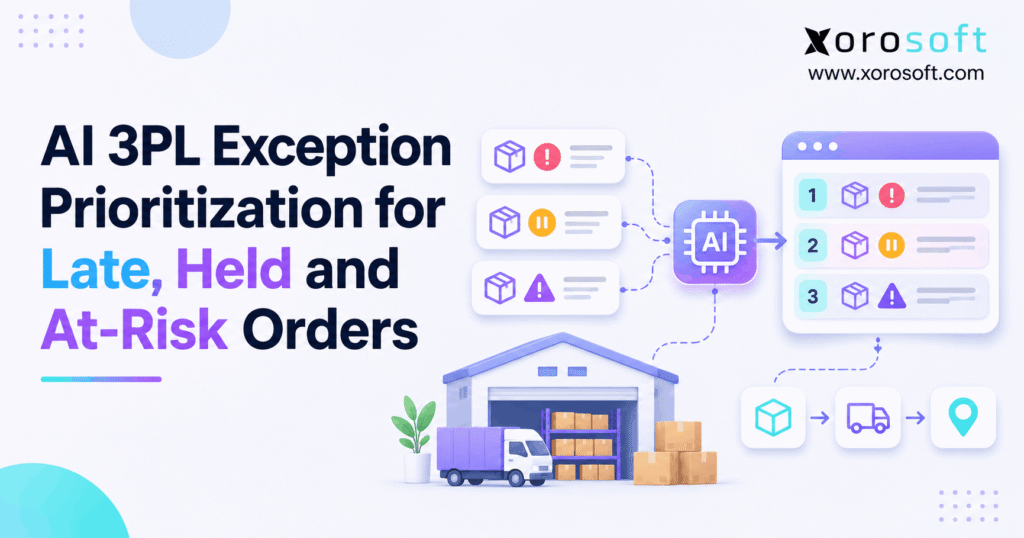
6. How AI Prioritizes At-Risk Orders
AI-assisted triage can compare more signals than a single overdue-status rule. However, it remains a decision-support layer that needs validation, governance, and a fallback process. The objective is not to predict everything. Instead, it is to move limited operator attention toward cases where a timely, permitted action can change the service outcome.
6.1 Detect and Group Exceptions Before Ranking
First, detect events such as a failed release, unresolved short pick, missing pack confirmation, missed carrier scan, or unexplained task delay. Next, associate related warnings with the same order and fulfillment. Consequently, five repeated integration errors should not appear as five unrelated high-priority customers.
Then, classify the issue by operational cause and current state. For instance, a delayed carton scan might require a warehouse verification, while an inventory mismatch needs an allocation investigation. Finally, attach an owner and a deadline for the next decision. Classification should remain explainable even if a model helps suggest the category.
6.2 A 3PL Exception Management Scoring Example
A practical prototype can use four normalized inputs: time urgency, SLA exposure, customer impact, and recovery opportunity. For illustration, assign weights of 40%, 30%, 20%, and 10%. Then calculate a priority index from zero to 100. These weights are hypothetical teaching values, not a validated industry standard or a product specification.
Illustrative priority = (0.40 x urgency) + (0.30 x SLA exposure) + (0.20 x impact) + (0.10 x recovery opportunity).
For an order with scores of 90, 80, 60, and 50, the index equals 77. However, 77 is not a 77% probability of lateness. Instead, it is an internal ranking value. Before deployment, compare recommended priorities against actual outcomes and adjust the thresholds to match your operations.
6.3 Explainable Urgency Is Not Permission to Act
A high score should show which signals drove it. For example, a case might rank highly because only 25 minutes remain before cutoff and picking has not started. Nevertheless, an active quality hold can prohibit release regardless of urgency. Therefore, pair model recommendations with hard-stop rules, permissions, and human approval where appropriate.
Similarly, an operator should see a feasible next step, not only a red score. Otherwise, the system may repeatedly promote impossible recoveries while neglecting orders the warehouse can still save.
7. Build the 3PL Exception Management Priority Queue
As a result, a useful queue should translate risk into a small number of decisions. Therefore, display the order, warehouse, status, deadline, evidence freshness, priority reason, owner, next action, and verification state together. Avoid making staff open five systems simply to determine whether a warning is actionable.
7.1 3PL Exception Management Priority Bands
One possible operating design uses four bands: P1 for immediate intervention, P2 for urgent same-shift review, P3 for scheduled investigation, and P4 for routine monitoring. However, the business should calibrate actual thresholds against service windows, recovery time, and staffing levels. A lower numerical score should never suppress a mandatory regulatory or customer hold check.
| Band | Typical interpretation | Action expectation |
|---|---|---|
| P1 | Imminent recoverable promise failure | Assign immediately; escalate if unacknowledged |
| P2 | Serious exposure with time to investigate | Review within the agreed urgent window |
| P3 | Material problem without imminent breach | Assign to normal exception owner |
| P4 | Informational or low-impact variation | Monitor and reconcile |
7.2 Keep Human Review for Restricted Holds
For restricted cases, show a clear lock or approval state alongside the priority. In addition, capture the name of the team authorized to release it. A manager may approve faster investigation, but that does not confer authority to override a fraud or quality decision.
Meanwhile, review escalation rules when the same order changes state. An initially at-risk case can become late after cutoff. Consequently, the queue should retain its history rather than erasing earlier warnings. That history helps teams understand whether they acted early enough.
8. A 3PL Exception Management Workflow With Clear Ownership
Prioritization fails when nobody owns the next step. Therefore, define responsibility for each exception class before building automation. Xorosoft’s XoroWMS supports warehouse workflows that can provide useful execution context, while external providers still need agreed escalation contacts and interfaces.
8.1 Assign Owners and Escalation Timers
Map short picks to warehouse supervision, inventory allocation to stock control, payment holds to the appropriate finance or risk team, and customer promise changes to customer service. Then set realistic acknowledgement timers by severity. For instance, a P1 case may need an immediate owner acknowledgement, whereas a P3 discrepancy may allow normal shift review.
| Exception | First owner | Approval or escalation |
|---|---|---|
| Short pick | 3PL warehouse lead | Inventory verification, then approved recovery |
| Payment or fraud hold | Authorized commercial or risk team | Controlled release decision |
| Missed pickup | 3PL shipping lead | Carrier options and customer communication |
| EDI mismatch | Integration support | Mapping correction and safe replay |
8.2 Verify Closure in 3PL Exception Management
A status note that says “fixed” is not sufficient proof. Instead, require the event that resolves the problem: a confirmed pick, valid hold release, reconciled shipment, or documented customer decision. Additionally, keep the original reason code and any approvals so later reviews can separate process failures from unavoidable constraints.
For example, if an order leaves through a substitute carrier, record the authorized change and its tracking reference. If the promise still changes, update the appropriate customer-facing system. Finally, close the exception only when the responsible system confirms the outcome, not when someone merely acknowledges the alert.
9. Three Worked Scenarios: Late, Held, and At-Risk
The following examples are hypothetical; consequently, they should not be mistaken for measured customer results. Nevertheless, each illustrates why teams should rank orders by recoverable customer impact rather than simply sorting the oldest alert to the top. In every case, the correct next step depends on evidence, authority, and the remaining operating window.
9.1 3PL Exception Management After a Missed Pickup
At 5:10 p.m., a sporting-goods order still displays “packed,” although its scheduled pickup ended at 5:00 p.m. First, the shipping lead checks whether cartons left the dock. If they remain on site, the order has missed a warehouse dispatch commitment. Therefore, its owner must confirm an approved alternate pickup or document a revised customer promise.
However, a separate late order may already have a confirmed replacement service. The unresolved case deserves attention because action is still possible. Meanwhile, customer service needs accurate evidence so it does not promise same-day departure without carrier confirmation.
9.2 3PL Exception Management for Inventory Holds
At 2:00 p.m., an apparel order has a short-pick hold and a 4:00 p.m. dispatch cutoff. The ERP shows potential stock at another location, but the source warehouse has not verified its availability. Consequently, the queue raises the case for immediate investigation. The inventory owner checks quantity and location, while the 3PL estimates the remaining pick-and-pack time.
If stock becomes available, the authorized team can approve the appropriate allocation or transfer. However, a high priority score must not silently remove the hold. If no practical recovery remains, the owner should initiate customer communication and preserve the original reason in the exception history.
9.3 At-Risk Wholesale EDI Shipment
A furniture distributor must dispatch an order by 3:00 p.m. and follow retailer-specific routing instructions. At noon, the 3PL has accepted the order but has not confirmed packing. Therefore, the team compares remaining work against the actual warehouse and carrier schedules. It also checks whether the retailer permits a service change.
Even though the order is not late yet, its next milestone may be unsafe. As a result, operations asks for an updated physical status and an approved recovery option. It does not invent an EDI shipping confirmation before goods leave the warehouse.
10. Connect Shopify, ERP, and Outside Warehouse Events
Reliable integration should preserve meaning, not just move text between databases. Therefore, map each system’s statuses to agreed operational milestones while retaining the original event and reason codes. In addition, treat a fulfillment order, a shipment, and a complete customer order as different objects whenever partial shipments are possible.
10.1 3PL Exception Management With Shopify Holds
For example, Shopify fulfillment records can show on-hold, in-progress, and other states, while an external warehouse tracks more detailed picking and packing tasks. Consequently, a single commerce status may not describe every warehouse problem. For teams evaluating connected workflows, the Xorosoft listing in the Shopify App Store provides a separate starting point for reviewing the integration context.
However, a system connection does not automatically validate the provider’s physical events. Therefore, configure clear mappings for order acceptance, released work, picked quantities, packed cartons, dispatch, and carrier handoff. Review partial fulfillments individually, particularly when separate locations handle the same customer order.
10.2 EDI, API Events, and Idempotent Reconciliation
The official X12 940 Warehouse Shipping Order supports shipping instructions to a warehouse. In contrast, the X12 945 Warehouse Shipping Advice supports shipment reporting and quantity reconciliation. However, neither transaction alone supplies every live risk signal. Thus, many workflows also need WMS event feeds, APIs, or agreed operational check-ins.
Next, make processing idempotent so a retried event cannot create duplicate shipments or repeated inventory updates. Preserve source identifiers and timestamps, then reconcile missing acknowledgments, split quantities, and status conflicts. The integration overview can help buyers organize the relevant connection types before testing their actual 3PL workflows.
11. Measure 3PL Exception Management Outcomes
Importantly, a busy alert dashboard is not proof of improved service. Instead, measure whether teams detect exceptions earlier, assign them faster, recover more eligible orders, and reduce avoidable missed promises. For example, Xorosoft’s connected ERP reporting context can support broader operational analysis, while each business still needs its own definitions and source data for 3PL-specific performance measures.
11.1 KPIs for 3PL Exception Management
First, track metrics per order or fulfillment consistently. Otherwise, one split order may inflate exception counts. Additionally, define which commitments count toward SLA denominators and exclude cases that the contract explicitly treats differently. Use a fixed period so weekly comparisons remain meaningful.
| KPI | Recommended definition | Interpretation |
|---|---|---|
| Detection time | Detection timestamp minus first qualifying event | Lower can mean earlier visibility |
| Time to own | First owner acknowledgement minus detection | Exposes handoff delays |
| Resolution time | Verified closure minus detection | Measures recovery workflow speed |
| Exception rate | Unique affected eligible orders / all eligible orders | Tracks prevalence |
| Missed commitment rate | Eligible orders missing an agreed milestone / eligible orders | Connects actions to service |
| Actionable alert precision | Confirmed actionable alerts / all alerts | Identifies alert noise |
For example, a lower average resolution time can hide a rising number of P1 failures. Therefore, segment results by priority, 3PL, warehouse, and cause. Likewise, track the same customer promise rather than switching between dispatch and delivery deadlines halfway through a report.
11.2 Test Predictive Alert Quality
If AI predicts at-risk orders, measure both false alarms and missed risks. Precision asks how many flagged orders truly required intervention. Recall asks how many eventual missed commitments the process flagged early enough to act. However, accuracy alone is insufficient when the cost of missing a major retailer deadline differs from that of a minor routine delay.
Therefore, compare AI recommendations against a rules-based baseline over representative weeks and seasonal peaks. Evaluate operator response, not just model scores. Finally, investigate whether alerts arrived before the last useful recovery point, since a correct warning after cutoff offers little preventive value.
12. Manual Triage, Business Rules, or AI?
Not every warehouse needs a predictive model. Instead, choose the simplest method that consistently supports timely, safe decisions. For example, a single warehouse with a manageable order count may benefit more from a reliable owner roster than from a complex scoring system. Conversely, several 3PLs with competing commitments may need richer prioritization.
| Method | Best fit | Primary limitation |
|---|---|---|
| Manual review | Few providers, predictable volumes, limited cases | Depends on staff attention and memory |
| Rules-based alerts | Known cutoffs, hold states, and explicit thresholds | Can miss interactions among several signals |
| AI-assisted scoring | Many changing orders, providers, and recovery paths | Requires strong data quality and monitoring |
12.1 When Simple Rules Are Enough
Rules should always control clear safety boundaries, such as mandatory quality holds and missing payment approval. Likewise, a straightforward cutoff rule may flag unpicked orders at a specified time without requiring a model. Therefore, document and test the deterministic rules before introducing predictive ranking.
Meanwhile, spreadsheets can remain useful during an early pilot if one person owns updates and reconciliation. However, once messages arrive continuously from several sources, manual status copying can create stale priorities. That is when the operating process, rather than the spreadsheet format alone, becomes a reason to upgrade.
12.2 Governance for 3PL Exception Management Models
The NIST AI Risk Management Framework offers a general foundation for evaluating trustworthy AI systems, including reliability, monitoring, and risk controls. Therefore, test model performance on representative historical orders and review outcomes after deployment. Additionally, log the input version, model or rule version, recommendation, human decision, and final result when practical.
Xorosoft’s AI MCP Server describes permission-aware access to operational ERP information. However, access to connected data does not itself prove that a particular automated 3PL risk model exists. Buyers should request a live demonstration of any predictive ranking claim and confirm the boundaries of human approval.
13. Industry Cases Across DTC and Wholesale
Importantly, exception priority depends on the promise, not merely the product category. Therefore, a distributor should configure severity using its actual customers, carriers, and warehouse workflows. A delay that threatens a major promotional launch may deserve a different escalation path than a routine replenishment shipment with an agreed delivery window.
13.1 Apparel, Sporting Goods, and Furniture
For example, an apparel brand may face short, promotion-driven demand windows and complex size or color allocations. Meanwhile, sporting-goods brands can experience sharp seasonal order surges. In contrast, furniture often requires specialized handling, appointment scheduling, or larger shipment windows. Consequently, the same one-hour warehouse delay can have very different customer effects.
For example, a furniture shipment awaiting carrier appointment confirmation may need transport coordination rather than faster packing. Likewise, a promotional apparel order may require urgent stock reassignment. Therefore, priority rules should reflect the feasible recovery action, not simply the industry label. For relevant ERP workflows across these sectors, review the industries served overview.
13.2 3PL Exception Management for Restricted Inventory
Food, cosmetics, and manufacturing-related inventory may carry lot, quality, expiry, or production constraints. Consequently, a short-pick exception may require more than a count check. Operators must confirm whether substitute stock meets the order’s approved requirements. Similarly, a quarantined batch cannot become available merely because an order has a high commercial value.
Therefore, separate operational urgency from compliance authority. A fast response may involve verifying an alternate lot, obtaining quality approval, or communicating a revised shipment plan. In every case, the system should preserve the evidence that supports the decision and the personnel who authorized it.
14. Upgrade Your 3PL Exception Management Process
An upgrade becomes reasonable when staff repeatedly reconcile conflicting statuses, discover missed cutoffs from customer complaints, or fail to identify who can resolve open holds. However, purchasing software before standardizing event definitions often reproduces the same disorder in a new interface. Therefore, start with a short readiness review and measurable acceptance criteria.
14.1 Signs Disconnected Systems Are Slowing Resolution
Look for repeated manual imports, duplicate alerts, missing provider acknowledgments, unexplained quantities, and order updates that arrive after the recovery window. Then record how often those failures influence a real customer commitment. In addition, test whether the team can answer three basic questions without a meeting: What happened? Who owns it? What can still be done?
If those questions lack consistent answers, simplify responsibilities and data mappings first. Next, evaluate whether a connected ERP, WMS, and integration stack can reduce the remaining gaps. For example, the XoroONE product overview provides context for integrated inventory-driven operations.
14.2 Evaluate Xorosoft Against Real Workflows
First, ask the vendor to walk through five practical cases: a short pick near cutoff, two simultaneous holds, a late 3PL event, a partial EDI shipment, and an authorized recovery with an audit trail. Furthermore, require evidence of the exact configured integration and clear identification of manual versus automated steps.
The XoroERP overview can help frame inventory, order, purchasing, accounting, and warehouse requirements. However, buyers should separately verify any claimed AI prioritization capability against their own sample orders. A polished dashboard is less important than a reliable answer, a responsible owner, and a provable service outcome.
15. Conclusion: Prioritize the Orders You Can Still Save
Effective 3PL exception management connects status, time, business impact, and decision authority. First, classify late, held, and at-risk orders consistently. Next, validate event quality and rank cases by recoverable urgency. Then, assign the correct owner, respect every hard-stop condition, and verify the result. Consequently, the team spends less time reacting to noisy alerts and more time protecting commitments.
AI may improve complex ranking, but it should strengthen rather than replace operational controls. If your business needs a clearer view of inventory, orders, warehouses, and connected commerce workflows, Book a Demo to review Xorosoft’s relevant ERP capabilities against your real 3PL exceptions.
FAQs
What is 3PL exception management?
It is the process of detecting, ranking, assigning, and resolving outsourced fulfillment disruptions. Therefore, teams can protect customer commitments while tracking late, held, and at-risk orders through verified closure.
How does AI prioritize at-risk 3PL orders?
AI can weigh deadlines, warehouse progress, SLA exposure, and recovery options. However, teams must validate its scores against actual outcomes and retain human approval for restricted decisions.
What is the difference between late and at-risk orders?
First, a late order has missed a defined milestone. In contrast, an at-risk order may still meet its deadline if the team acts before the recovery window closes.
Can AI release Shopify fulfillment holds automatically?
Some approved workflows can automate releases, but restricted holds need proper authority. Therefore, AI priority alone should never override payment, fraud, quality, or third-party controls.
Which data supports reliable exception scoring?
Use order IDs, promise dates, warehouse milestones, inventory status, hold reasons, cutoff times, and source timestamps. Additionally, flag missing or stale records before recommending action.
Is AI better than rules-based exception management?
Not always. Rules handle clear deadlines and mandatory holds effectively. Meanwhile, AI may help rank complex competing risks when accurate data and ongoing performance checks are available.
When should a brand upgrade its exception workflow?
Upgrade when repeated status conflicts, missed cutoffs, or unowned holds harm service. First, standardize workflows; then evaluate whether connected ERP and WMS systems address the remaining gaps.
Recent Posts
-
 What Should Inventory Tracking Records Include Beyond Quantity on Hand?
-
 AI 3PL Exception Prioritization for Late, Held and At-Risk Orders
-
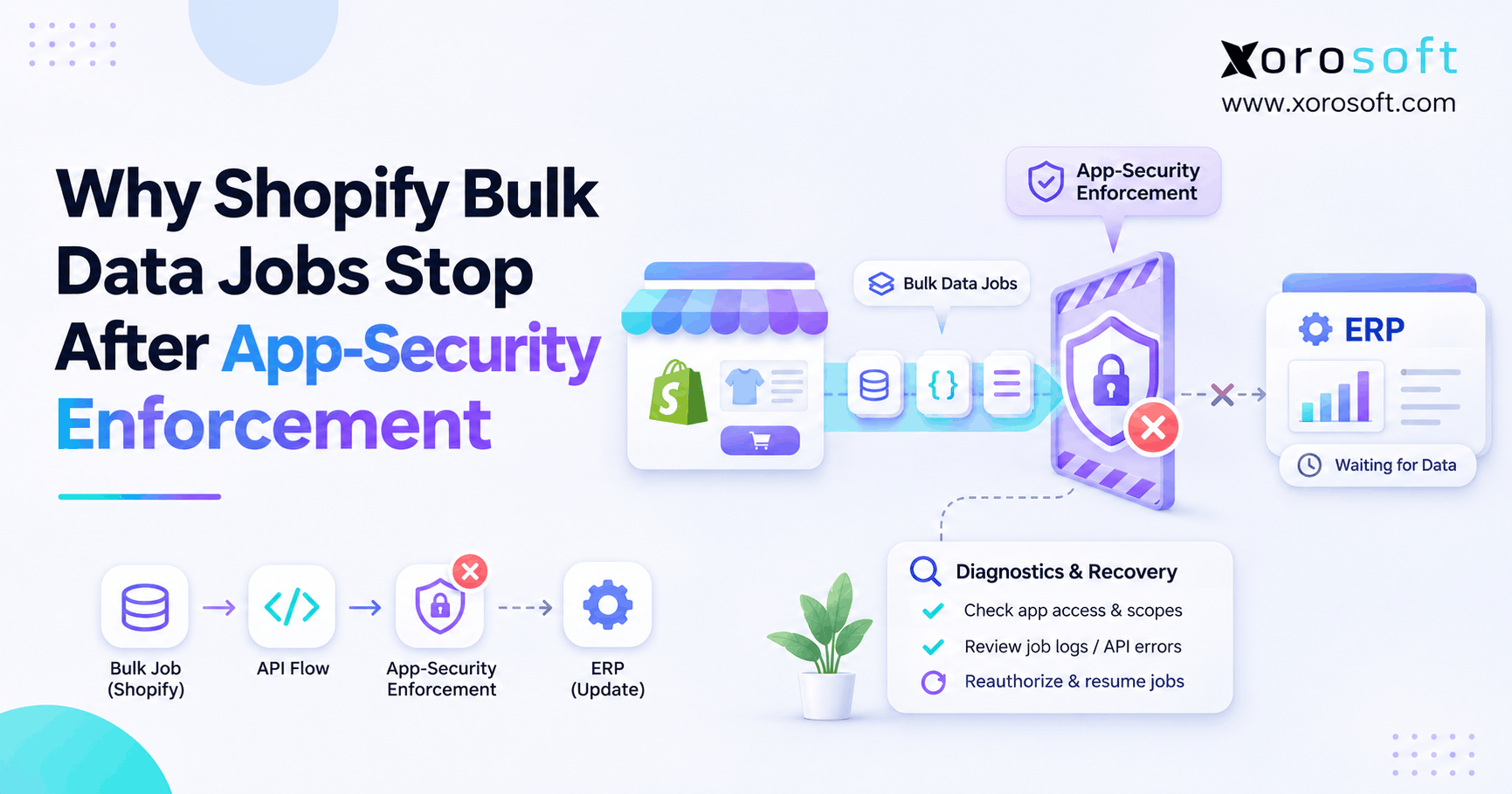 Why Shopify Bulk Data Jobs Stop After App-Security Enforcement
-
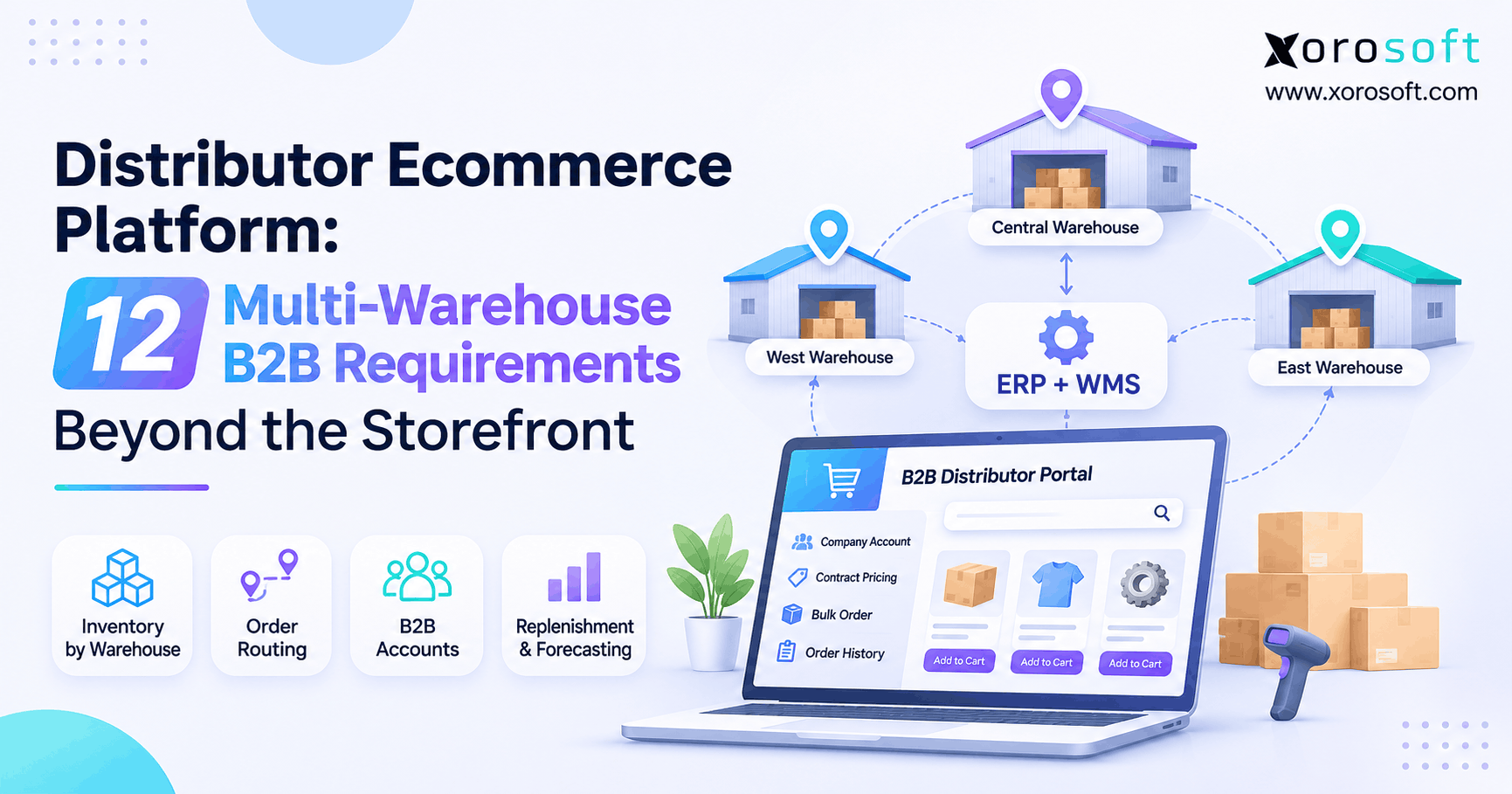 Distributor Ecommerce Platform: 12 Multi-Warehouse B2B Requirements Beyond the Storefront
-
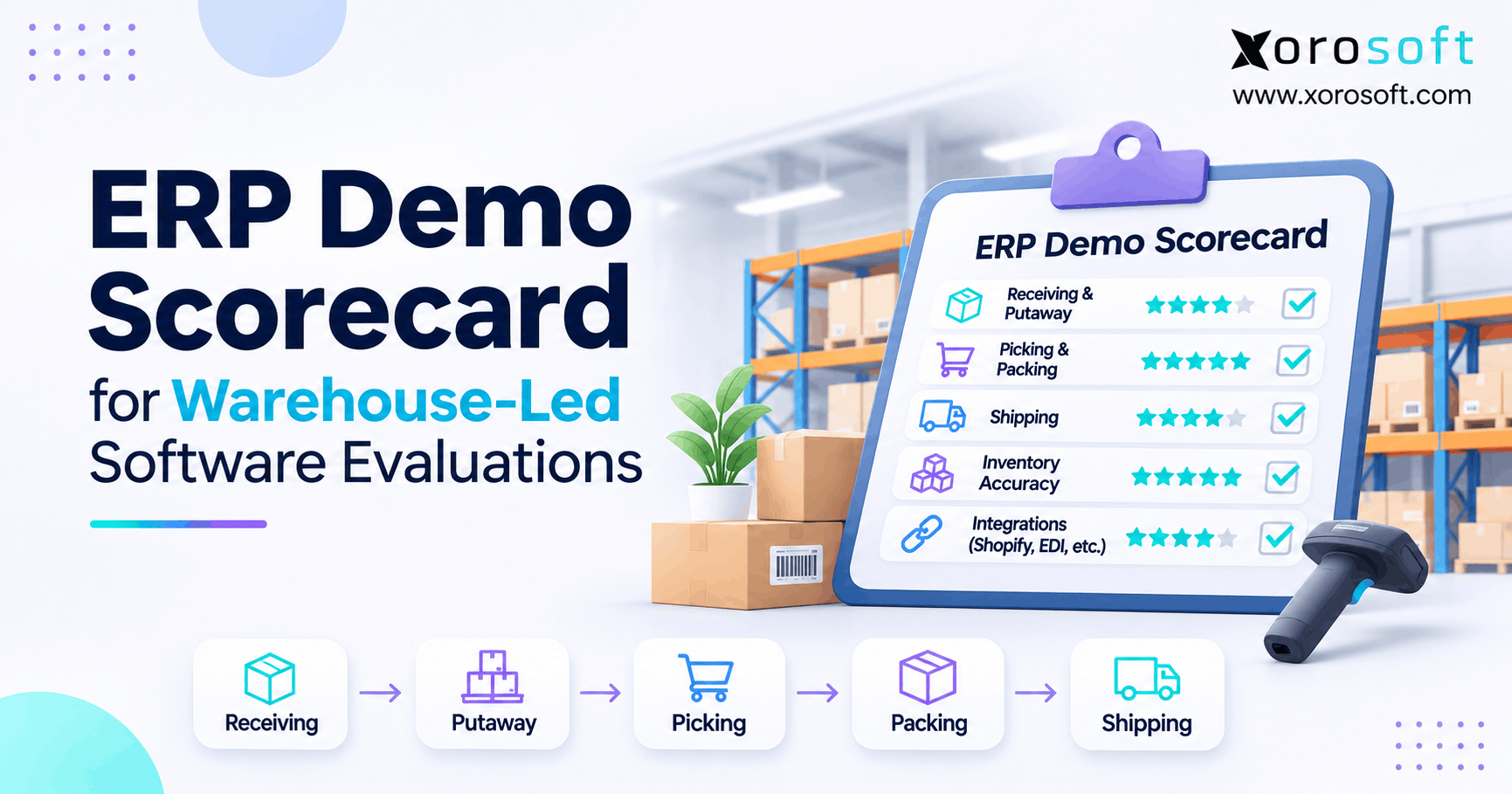 ERP Demo Scorecard for Warehouse-Led Software Evaluations