There are various inventory checking methods that businesses can use to ensure accurate stock management.
1. Why Inventory Records Drift Even When Warehouse Activity Looks Normal
A warehouse can process hundreds of orders without an obvious problem while its inventory records quietly become less reliable. One receipt is entered against the wrong SKU. A transfer reaches another location before the system records it. A returned product goes back onto a shelf before anyone changes its inventory status. Each mistake is small, but together they create stock numbers that purchasing, sales, and finance cannot confidently use.
For growing product businesses, the question is no longer whether to count inventory. It is how to check it without interrupting fulfillment, introducing fresh errors, or repeatedly adjusting the same products. Comparing inventory checking methods helps operators separate the job of identifying stock from the job of proving quantity accuracy and resolving differences.
1.1. The Operating Cost of an Inaccurate Stock Record
An incorrect quantity can turn into an oversold ecommerce order, an unnecessary purchase order, an incomplete wholesale shipment, or an avoidable production delay. The accounting team may discover the same problem weeks later when inventory value does not agree with supporting records. Counting more often can reveal errors earlier, but it will not prevent them if receiving, picking, and transfers remain poorly controlled.
Effective inventory checking methods require a repeatable process that tells managers what was counted, which transactions were included, why a discrepancy occurred, and who approved the correction.
1.2. What a Reliable Inventory Check Must Establish
Every meaningful count should identify the product, storage location, inventory status, unit of measure, quantity, and effective time. For controlled products, it may also require a lot number, serial number, expiration date, or condition code. Without these attributes, two people can report different quantities and both appear correct because they were measuring different stock populations.
For instance, a warehouse might physically hold 80 units while only 65 are available to promise. Fifteen could be reserved, damaged, or otherwise unavailable. An accurate physical count should not automatically overwrite the available-to-sell quantity.
2. Four Inventory Checking Methods That Solve Different Problems
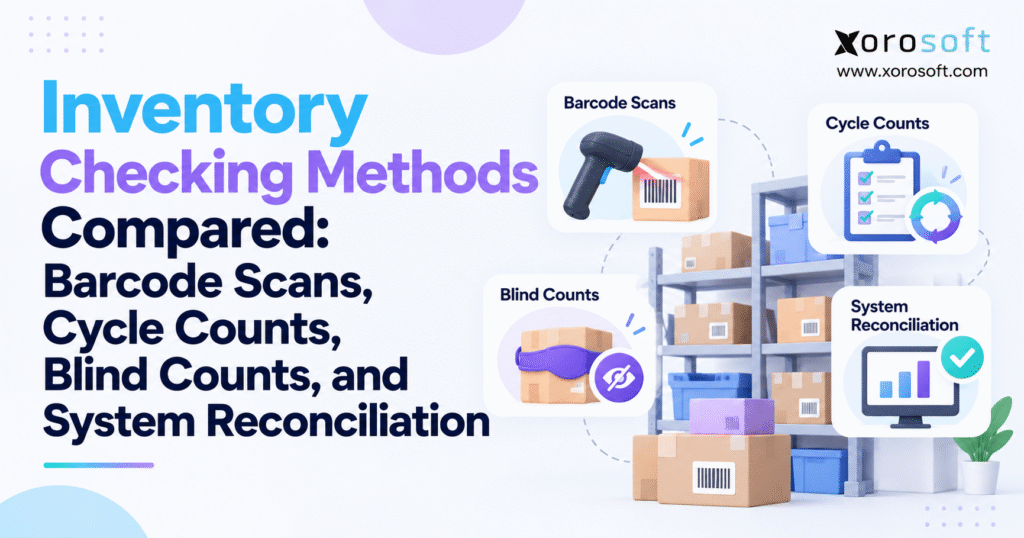
The four approaches often compared in inventory guides are not substitutes in the strict sense. They act at different stages of the same control process. Barcode scanning helps capture identifiers. Cycle counting decides what to check and when. Blind counting changes what the employee can see during verification. Reconciliation explains and resolves differences afterward.
2.1. The Difference Between Capture, Scheduling, Independence, and Resolution
Barcode scans reduce the need to type long SKU and location codes. However, a scan is not itself proof that every unit was counted. Cycle counts spread verification across days or weeks instead of relying exclusively on one annual stocktake. Blind counts withhold the expected system quantity, reducing the temptation to accept a number that merely looks plausible. System reconciliation compares observations with records and investigates exceptions.
These distinctions are central to selecting inventory checking methods. A manager who buys scanners to solve a weak count schedule may still miss high-risk stock.
2.2. Inventory Checking Methods Comparison Table
| Method | Main question answered | Typical strength | Important limitation |
|---|---|---|---|
| Barcode scanning | Which item or location is being recorded? | Faster identifier capture and validation | Quantity can still be wrong |
| Cycle counting | Which inventory should be checked next? | Regular verification without a full shutdown | Poor scheduling leaves gaps |
| Blind counting | What is physically present without a suggested answer? | More independent observation | Counting mistakes remain possible |
| System reconciliation | Why do counted and recorded quantities disagree? | Traceable corrections and better controls | Weak investigations can hide causes |
2.3. Why a Combined Inventory Verification Process Is Stronger
Imagine a weekly count for a high-value product. The system assigns a location, the employee scans the bin and SKU, the screen hides the expected number, and the employee records 42 units. The system expected 46. A supervisor then reviews recent movements and requests a recount before approving any adjustment. All four techniques contribute something different.
3. Barcode Scanning for Inventory Checking Without Repeated Data Entry
Barcode-enabled checking is useful when the warehouse contains many similar-looking products or when staff regularly move among several bin locations. The scanner captures an identifier that software matches with a product or location record. Employees then verify the quantity through the counting procedure configured for their operation.
3.1. What Happens During a Barcode Inventory Count
A typical workflow starts with a count assignment and a location scan. The employee scans the item, checks its packaging or tracking details, counts the physical quantity, and submits the result. Some systems treat repeated scans as quantity increments; others require manual quantity entry.
The GS1 barcode standards explain how standardized identifiers support product and logistics identification. But labels and devices are only the capture layer. Accurate stock checking still depends on correct master data, readable barcodes, and transactions being recorded against the right warehouse and inventory status.
3.2. Where Barcode Counting Can Go Wrong
Consider a clothing distributor counting black shirts in six sizes. A correct scan of the medium-size SKU does not confirm that the boxes beneath it also contain mediums. Workers must verify the actual product, not simply trust the shelf label. Likewise, scanning one case cannot establish whether that case is complete unless the count procedure checks its contents or approved packaging quantity.
Duplicate identifiers, damaged labels, wrong units of measure, and unrecognized substitute products can all distort counts. Guessing a substitute code may be faster in the moment but costly during reconciliation.
3.3. Choosing Scanning Equipment and Connected Software
Smartphone cameras can suit occasional checks in a small stockroom. Dedicated handheld scanners may be more comfortable for frequent, high-volume counts, depending on label quality, battery requirements, environment, and application design.
Warehouse teams evaluating Xorosoft can review XoroWMS barcode and cycle-counting capabilities as one example of connected execution. Any vendor demonstration should show real SKU variants, mixed bins, packaging conversions, and unexpected stock rather than only a clean sample scan.
4. Cycle Counting Methods That Match Product Risk and Warehouse Capacity
Cycle counting verifies selected inventory repeatedly rather than counting the entire stock population in a single event. A well-designed schedule gives priority to products where an error would be costly or likely. It also makes counting a planned operating activity instead of an emergency response to customer complaints.
4.1. ABC Cycle Counts and Risk-Based Scheduling
ABC counting groups products by criteria such as inventory value, movement, margin exposure, or operational importance. High-priority items are usually checked more frequently. The exact intervals should be based on observed error rates and available labor rather than copied from an industry rule of thumb. A low-value component that can stop production may deserve more attention than its unit cost suggests.
Suppose a distributor has 1,000 active SKUs. It might initially count 150 high-risk items every two weeks, 350 moderate-risk items monthly, and 500 stable items quarterly. These are illustrative policy settings, not universal benchmarks.
4.2. Location Counts, Random Counts, and Event-Triggered Checks
ABC is not the only useful policy. Location-based counting verifies a section of the warehouse, which can reveal products stored in the wrong place. Random selections test whether errors exist outside known problem areas. Event-triggered counts follow a short pick, suspicious receipt, return dispute, or unexplained transfer. Each approach detects a different failure pattern.
As Microsoft’s warehouse cycle-counting guidance describes, counting work can be created through plans, thresholds, or manual activity.
4.3. Cycle Counts Versus Annual Physical Inventory
Annual stocktaking establishes a broad inventory position at a reporting date, often with substantial preparation and operational disruption. Cycle counting distributes that effort and may identify problems sooner. Still, recurring cycle counts do not automatically remove the need for year-end procedures, independent audit evidence, or specific financial reporting controls.
Businesses choosing inventory checking methods should therefore distinguish operational accuracy from reporting obligations. A reliable cycle count history can support stronger records, but finance and auditors must determine what additional verification is required for a particular reporting period.
5. Blind Counts, Open Counts, and Independent Recounts
Blind counting deliberately hides the system’s expected quantity from the person performing the physical count. The purpose is to reduce anchoring: an employee who sees 100 units on a screen might stop counting after estimating that a pallet contains roughly 100. Without that prompt, the employee must record an independent observation.
5.1. When Blind Counting Adds Meaningful Control
Blind counts are especially useful for valuable products, sensitive stock, repeated variance locations, and counts where employees might otherwise copy expected quantities. The procedure can be combined with barcode verification, so the counter sees the correct product and bin but not the number recorded in the system.
Neither mode is inherently flawless. A blind counter can still miss an upper shelf, mistake one variant for another, or misinterpret a case pack.
5.2. Double-Blind Verification and Separation of Duties
Some organizations use double-blind counting to mean two independent counts performed without revealing the book quantity or one another’s results. Others use the term differently. The counting policy should specify the exact control, including whether a new employee is required for a recount and when results can be compared.
A sensible exception rule might send a high-value discrepancy to a second counter before an adjustment reaches finance. Separating counting from approval also matters. If one person counts, investigates, approves, and posts every adjustment, the system provides little independent challenge, even when its count screen is technically blind.
5.3. Avoid Unnecessary Recounts
Blind counting increases independence but can add labor when every small difference triggers another count. Set thresholds based on product risk, not just the number of units. A two-unit shortage in expensive serialized equipment may require immediate review, while the same difference in low-cost packaging might follow a simpler escalation path.
A count is useful only when its evidence is credible.
6. System Reconciliation: Resolve the Cause Before Adjusting Stock
Reconciliation is the stage where physical observations become reliable system records. It is not merely a command that replaces the old quantity with the new one. The reviewer must establish that the two quantities describe the same product, place, status, unit, and point in time, then determine whether a transaction correction or inventory adjustment is appropriate.
6.1. Match the Physical Count to a Valid System Snapshot
Suppose a counter finds 96 units at 10:15 a.m., while the system shows 90 at noon. Six units might have been received or transferred between those times. Comparing 96 against 90 without reviewing movement timestamps creates an artificial variance. Businesses can avoid this by using a location freeze, a reliable count cutoff, or a transaction bridge that accounts for movements during the count.
6.2. Calculate Quantity Variance and Record Accuracy Correctly
The simplest signed variance formula is physical counted quantity minus comparable system quantity. If the record shows 120 units and the count returns 116, the variance is minus four units. The absolute variance rate is four divided by 120, or about 3.33%, using the system quantity as the denominator. A zero expected quantity needs separate handling.
Inventory record accuracy can mean the percentage of SKU-location records matching within an approved tolerance. It can also refer to unit-weighted or value-weighted accuracy. These measures answer different questions. Reports should state the denominator, tolerance, scope, and whether overages offset shortages; otherwise, improvement from one month to another can be misleading.
6.3. Investigate Evidence, Approve Adjustments, Preserve the Trail
Review receipts, picks, warehouse transfers, returns, work orders, write-offs, and recent adjustments before changing the balance. A shortage caused by an unposted shipment should generally be fixed by completing the proper transaction, not by creating an unrelated shrinkage adjustment. If a genuine loss remains, record its reason and obtain the appropriate approval.
The financial effect matters as well. Inventory corrections may change the inventory asset balance, expenses, or cost of goods sold, depending on the facts and reporting framework. IAS 2 guidance covers inventory cost and expense recognition under IFRS; US companies should apply the relevant US GAAP policies. A connected XoroERP inventory and accounting workflow may help coordinate records, but approval design remains a business responsibility.
7. Units, Locations, Lot Numbers, and Stock Statuses Change the Count
A counting method can appear accurate while verifying the wrong stock population. This is especially common when warehouse teams use several packaging units, share products across bins, or manage restricted inventory. The count instructions must specify what a unit means and which attributes distinguish one record from another.
7.1. Unit-of-Measure Conversions and Packaging Rules
A distributor may purchase a product by the case, sell it individually, and store it in inner packs. A count of eight cases means very different things if the case contains six units or twelve. Conversion rules belong in master data and should be confirmed during receiving and counting. Mixed or partially opened cases require special attention.
Barcode scanning cannot repair an incorrect conversion factor. It can only capture the identifier that the system is instructed to interpret.
7.2. Lot, Serial, Condition, and Ownership Controls
Food, beverage, cosmetics, and some industrial products require more than a total SKU quantity. Lot identification and expiration status can affect whether goods may ship. Serialized stock must be verified by individual unit identity. Consigned goods and customer-owned material should not be counted as if the business owned them.
A practical blind-count task might therefore require a product scan followed by a lot scan, quantity, and condition check. Without this detail, reconciliation might preserve the correct total quantity while leaving the wrong batch available for orders.
7.3. Location Accuracy Is a Separate Problem
An item can exist somewhere in a warehouse while remaining unavailable to the picker who needs it. Even when inventory checking methods confirm 200 units across the building, 40 could still be in the wrong bin. Location-level stock checks expose that issue and help prevent repeated short picks.
The inventory checking methods selected should produce records detailed enough for the next operational decision, not merely for an overall warehouse total.
8. Build a Repeatable Inventory Checking Workflow in a Live Warehouse
Whichever inventory checking methods it uses, a warehouse should be able to explain how a count starts, how employees handle unexpected stock, what happens when transactions continue, and who signs off on the results. Consistency matters because two different processes can produce numbers that look comparable but were collected under different conditions.
8.1. Prepare the Count Before Assigning Work
Start by clearing or documenting open receipts, transfers, and returns that affect the area. Confirm product descriptions, bin labels, tracking rules, and the cut-off time. Select whether the task covers an entire location, a specific SKU, or an inventory class. Assign an employee who understands the products and count instructions.
Unexpected cartons, damaged goods, and unlabeled items need an exception route. A preparation checklist should make clear whether movement is frozen or must be reconciled through timestamps. Documenting inventory checking methods in a shared procedure helps every warehouse shift follow consistent counting, verification, and reconciliation rules.
8.2. Record Quantities Without Showing an Expected Answer When Independence Matters
On the warehouse floor, employees should confirm the location and item before entering a quantity. For higher-risk checks, hide the recorded balance and require a deliberate physical count. If a product is absent, record zero rather than leaving the field blank. If the stock cannot be reached, mark the count incomplete rather than inventing a result.
The distinction between zero, not counted, and unable to verify is critical: each outcome requires a different next action. Recounts should be created with their own employee and timestamp information.
8.3. Route Exceptions to an Investigator, Not Directly to an Adjustment
Once a count arrives, compare it with the aligned system snapshot. Minor differences may follow a streamlined review; material or unusual differences should go to a supervisor. Investigators need transaction history, count notes, location data, and ideally photos or other evidence where appropriate.
Use consistent reason codes such as receiving error, transfer timing, damage, mislocation, unit conversion, and unexplained shortage. When a root cause is established, fix the workflow that allowed the error.
8.4. Close the Count and Update Dependent Systems Deliberately
Closing a count should record the approved result, any related correction, the responsible users, and the effective posting time. For multichannel sellers, a physical stock correction may need to inform ERP, WMS, and storefront availability according to an established ownership model.
Businesses evaluating Xorosoft’s inventory and ecommerce integrations should test what happens when a variance is approved, when a sync fails, or when an order reserves stock during reconciliation. Exception handling is often more revealing than the ideal demonstration path.
9. Compare Inventory Checking Methods by Labor, Cost, and Control
The right approach is not necessarily the one with the lowest count time. Total operating cost includes device setup, label maintenance, training, count labor, recounts, supervisor investigation, integration work, and financial corrections. A cheap process that repeatedly produces unreliable records can be more expensive than a disciplined one.
9.1. Match the Control to the Operating Problem
For a small shop with a few hundred products, carefully scheduled manual cycle counts may be enough. A fast-moving ecommerce warehouse is more likely to benefit from scanned location and SKU identifiers. High-value or frequently disputed inventory may justify blind counts and second-person approval. Multi-location distributors need especially strong transaction alignment and reconciliation.
A risk-based policy might combine weekly targeted counts, monthly location sweeps, and triggered recounts after unexplained shorts.
9.2. A Practical Selection Matrix
| Operating condition | Priority control | Supporting control |
|---|---|---|
| Similar product variants | Barcode identification | SKU-level verification |
| Frequent high-risk movements | Scheduled cycle counting | Event-triggered recount |
| Valuable or sensitive stock | Blind counting | Independent approval |
| Recurring unexplained differences | Transaction reconciliation | Root-cause reporting |
| Multiple warehouse locations | Location-specific counts | Transfer-time alignment |
Treat these as combinations, not software purchasing categories. Businesses can perform blind cycle counts with scanners and reconcile the outcome in ERP. The strength comes from how consistently each control is executed and reviewed.
10. Inventory Checking Methods for Ecommerce, Wholesale, and Manufacturing
A single count policy rarely fits every inventory-driven industry. The physical characteristics of products, order promises, sales channels, and financial controls influence which checks deserve priority. The most useful policy addresses the actual points where incorrect records damage operations.
10.1. Shopify and Amazon Inventory Checking
An ecommerce brand may sell the same SKU on its website, a marketplace, and through wholesale orders. On-hand inventory, reserved inventory, and available-to-sell stock are different measures. Shopify’s inventory state documentation distinguishes these states, making it important to reconcile physical warehouse counts against the correct balance rather than simply overwriting channel availability.
For Amazon, stock stored in a merchant warehouse should be distinguished from units held through fulfillment services. Reconciliation also needs to account for returns, damaged units, in-transit stock, and the timing of channel updates. The Xorosoft ERP listing in the Shopify App Store is a useful starting point for checking published integration scope, although the business should still test its exact location and inventory workflows before implementation.
10.2. Wholesale Distribution and EDI-Related Stock Movement
Wholesale teams may accept large orders, split shipments, reserve stock by customer, and transfer goods among facilities. An EDI order or advance shipping notice can create expected activity without proving that the physical movement has occurred. Inventory checks therefore need to distinguish booked quantities from received, picked, shipped, and committed quantities.
When discrepancies cluster around a transfer route or receiving dock, fixing that handoff may create more value than increasing the frequency of every count in the building.
10.3. Manufacturing, Food, Furniture, and Sporting Goods
Manufacturers must verify raw materials, work in process, and finished goods without double counting material consumed by a production order. Food and beverage companies may need lot and expiration checks. Furniture businesses must track bulky products across storage and staging areas. Sporting goods distributors may face seasonal surges and numerous variants.
Different inventory-driven industries require different combinations of stock checks. A good policy reflects material risk, product identity, ownership, location, and condition rather than forcing every operation into the same weekly SKU schedule.
11. Inventory Accuracy KPIs That Show Whether the Method Works
Teams evaluating inventory checking methods sometimes celebrate a high overall accuracy percentage while the same critical products repeatedly disappear from their expected locations. Measurement should reveal whether the process is dependable, timely, and improving. A single warehouse-wide average cannot explain where controls are failing.
11.1. Separate Count Agreement From Quantity Variance
First-pass count agreement measures the percentage of checked SKU-location records that match the comparable system balance before recounts or adjustments. Quantity variance measures the difference in units. Value-weighted variance adds the financial effect. These metrics can move in different directions, so report them separately.
Count completion rate also matters. Track overdue work and excluded areas so the reporting population is transparent.
11.2. Investigate Repeat Errors and Time to Resolution
A recurring shortage on the same SKU, shift, or dock deserves attention even when the quantities are small. Measure repeat discrepancy rate and the time between identification and approved resolution. Long-open exceptions can create uncertainty for allocation, purchasing, and reporting. When evaluating inventory checking methods, managers should consider discrepancy resolution time, recurring stock errors, and the labor required to maintain accurate records.
Managers should review root-cause categories with warehouse and finance teams together. If receiving errors fall but transfer discrepancies rise, the next improvement should target transfer confirmation.
11.3. Use Trends Rather Than Unsupported Benchmarks
There is no single accuracy target that suits every operation. High-value serialized products may require exact agreement, while bulk goods may use controlled tolerances tied to the measurement method. Define which records need zero variance and which permit a documented threshold.
For a sound before-and-after assessment, use the same item scope, counting rules, time window, and denominator. Avoid attributing every improvement to barcode scanners or software when process changes occurred at the same time.
12. When Spreadsheets, Inventory Apps, WMS, or ERP Make Sense
Software selection should begin with the operations that need control. A spreadsheet may support a small, stable inventory population when one team owns every change. As businesses add warehouses, sales channels, purchasing teams, and financial reporting requirements, the coordination burden rises sharply.
12.1. Signs the Current Inventory Process Has Reached Its Limit
Warning signs include repeated manual corrections, conflicting balances in different systems, missing adjustment approvals, delayed month-end close, and frequent order promises that the warehouse cannot fulfill. If employees spend more time explaining stock numbers than using them, a workflow change is overdue.
An inventory app can improve basic tracking. A WMS concentrates on physical warehouse execution, including locations, scanning, and fulfillment. An ERP connects inventory with purchasing, sales, accounting, and sometimes manufacturing.
12.2. Evaluate Software With a Real Discrepancy, Not a Perfect Demo
Give each vendor the same scenario: a blind cycle count finds a four-unit shortage, a transfer was posted late, and one unit is damaged. Ask the vendor to show the count record, transaction history, review process, approved correction, accounting effect, and downstream availability update. A weak workflow becomes obvious when exceptions are involved.
XoroONE’s integrated ERP approach may be relevant where purchasing, warehouse management, ecommerce, and finance need connected records. Teams comparing larger systems can also consult the Xorosoft and NetSuite comparison as one vendor perspective, then verify requirements, total cost, configuration, and references independently. Software should support a defined policy, not substitute for having one.
13. A Worked Example: Reconcile a Shortage Without Creating a False Loss
Consider a warehouse with 120 units of a product recorded in the inventory system. A blind cycle count produces 116 units. The initial variance is minus four units, or an absolute variance of about 3.33% of the recorded balance. That is an exception to investigate, not necessarily four units of shrinkage.
13.1. Trace the Discrepancy Through the Transaction History
The reviewer confirms that the counter scanned the correct SKU and location and that no cartons were inaccessible. A second employee independently confirms 116 units. Transaction history then shows an outbound pick of four units that physically left the location before the count but was not posted until afterward.
If that pick was not included in the recorded balance, posting the legitimate fulfillment transaction should bring the comparable balance to 116. An additional minus-four inventory adjustment would create a new error by reducing the same units twice.
13.2. Fix the Handoff That Caused the Mismatch
The investigation reveals that shipping staff can move a carton to dispatch before completing the associated digital confirmation. The warehouse changes the handoff: the pick must be confirmed at the appropriate scan point, and unfinished work appears on an exception report before the next shift.
This example shows why choosing inventory checking methods is not just about how quickly employees count. The valuable outcome is evidence that lets the business distinguish missing goods from delayed transactions and redesign the process that produced the disagreement.
14. Common Inventory Checking Mistakes That Repeat Across Warehouses
Even sophisticated systems cannot correct inconsistent operating practices automatically. Most recurring count problems can be traced to unclear scope, weak master data, changing transaction timing, or adjustments that close the variance without explaining it.
14.1. Counting Totals While Ignoring Status and Location
Relying only on total warehouse quantities creates a false sense of accuracy. Count records should preserve the detail needed for picking, replenishment, customer commitments, and financial reporting.
Similarly, a physical observation at 9 a.m. should not be compared to a balance from 4 p.m. without accounting for movements. Clear effective times are part of inventory control, not optional reporting detail.
14.2. Treating Every Variance as an Adjustment Request
Blind recounts and good scanners cannot compensate for an approval process that automatically accepts any difference. Employees may become accustomed to posting corrections rather than reviewing why they are needed. Over time, the same problems appear as fresh discrepancies.
Make sure adjustment authority is separate from routine counting where risk warrants it. Preserve reasons and supporting records, then monitor repeated exceptions. A useful inventory audit should lead to fewer preventable errors, not merely a shorter list of open differences at the end of the day.
14.3. Adding Technology Before Defining Ownership
When an ecommerce application, WMS, and ERP all appear able to update stock, a business can accidentally create three sources of truth. Define which system owns physical quantities, order reservations, customer-facing availability, and financial adjustments. Then test failure recovery and duplicate-message handling across integrations.
A well-designed interface can keep records aligned, but poorly governed synchronization can spread an error faster than a spreadsheet ever could.
15. Make the Next Inventory Check Improve the Next Thousand Transactions
Inventory checking methods work best as part of a management discipline rather than a periodic cleanup. Barcode scans can strengthen identification, cycle counts maintain verification coverage, blind counts add independence, and reconciliation connects physical evidence with system corrections. None is sufficient on its own when the business has unresolved weaknesses in receiving, transfers, returns, or stock status management.
15.1. A Practical 30-Day Improvement Plan
During week one, examine recent adjustments and identify the products, locations, and transaction types that produce the most exceptions. In week two, create a risk-based count schedule with clear scope, timing, and ownership. In week three, test blind counting or barcode-assisted verification in the highest-risk areas. During week four, review root causes, approved corrections, first-pass agreement, and outstanding investigations.
Keep procedures short enough to follow during a busy shift, and revise them when evidence shows a better control is needed.
15.2. Choose the Next System Only After Defining the Control You Need
If the process already works with simple tools, keep improving it. If disconnected warehouse, purchasing, ecommerce, and accounting systems make reliable reconciliation difficult, evaluate whether a more integrated platform is justified. Use a real discrepancy scenario during every demonstration and ask how the system handles both the physical count and the financial consequence.
For teams considering Xorosoft, the next useful step is to book a personalized inventory and ERP workflow discussion with a specific count, variance, or multi-warehouse scenario ready to test. The goal is not to count more inventory for its own sake. It is to make the inventory record trustworthy enough that the next order, purchase, and financial decision can proceed with confidence.
FAQ
What are the main inventory checking methods?
Barcode scanning, cycle counting, blind counting, and system reconciliation serve different purposes. Most warehouses combine them for reliable stock verification.
Which inventory checking method is most accurate?
No single method guarantees accuracy. Combine correct identification, scheduled verification, independent counts, and investigated adjustments to reduce recurring discrepancies.
How often should warehouses perform cycle counts?
Frequency depends on value, movement, and error history. Count higher-risk items more often and review schedules when discrepancies repeat.
What is the difference between blind and open counts?
Blind counts hide expected quantities; open counts display them. Blind counting reduces confirmation bias but still requires careful physical verification.
Does barcode scanning eliminate inventory errors?
No. Scanning identifies products and locations, but quantity mistakes, wrong packaging conversions, and inaccurate labels can still cause discrepancies.
How do you reconcile physical and system inventory?
Match counts by SKU, location, status, and time. Investigate differences, verify recent transactions, and approve corrections with documented reasons.
When should a business upgrade to ERP for inventory checking?
Consider ERP when inventory checks must connect multiple warehouses, purchasing, ecommerce, and accounting. First confirm that simpler process fixes are insufficient.
Search
Categories
- & INTEGRATIONS 1
- ACCOUNTING & FINANCIALS 62
- Business 166
- COMPETITOR & BUYER INTENT 165
- E-COMMERCE & CHANNEL INTEGRATIONS 72
- ECommerce 3
- Ecommerce + Wholesale Complexity 7
- ERP 1,405
- FINANCE & ACCOUNTING 9
- INVENTORY & OPERATIONS 78
- Inventory Management Software 177
- OPERATIONS & INVENTORY 96
- PROCUREMENT & SUPPLY CHAIN 9
- PURCHASING & SUPPLY CHAIN 62
- SHOPIFY ERP 116
- SHOPIFY STOCKY OPPORTUNITY 2
- Software 1
- WAREHOUSE & FULFILLMENT WMS 92
- WHOLESALE & DISTRIBUTION 132
- WMS 75
- WMS & FULFILLMENT 15
- WMS & WAREHOUSE 99
Recent Posts
-
 Canadian Wholesale Inventory Statistics 2026: Where Stock Is Accumulating
 -
 B2B Ecommerce Software Solutions for Replacement Parts: Search, Compatibility, Account Pricing, and Reordering
 -
 How to Read ERP Reviews Without Choosing the Wrong System
 -
 Inventory Checking Methods Compared: Barcode Scans, Cycle Counts, Blind Counts, and System Reconciliation
 -
 How a Shopify Wholesaler Unified ACH, EDI, Inventory, and Fulfillment