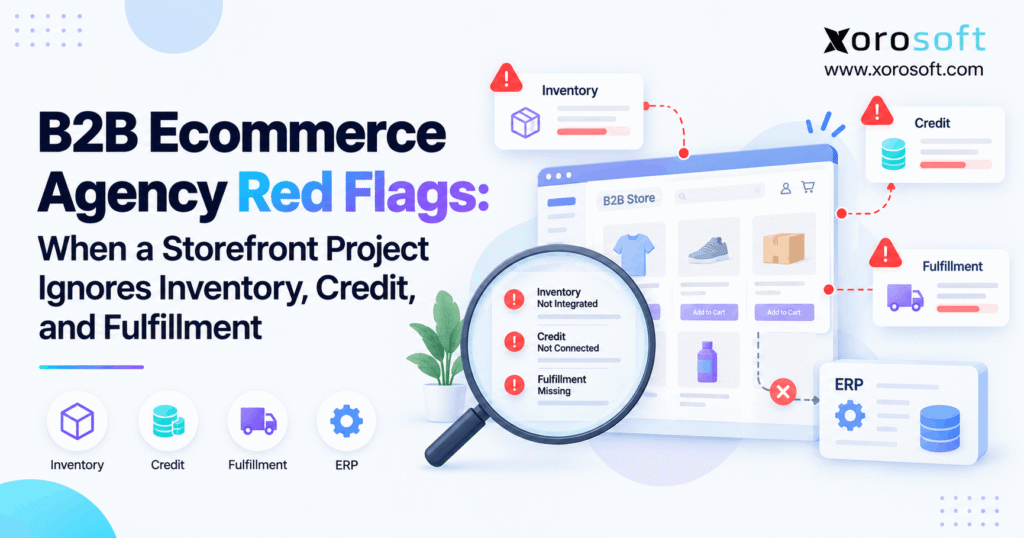
If you are looking for expert support in digital commerce, a B2B ecommerce agency can provide tailored solutions for your business.
1. When a Beautiful Storefront Hides an Operations Problem
A B2B ecommerce agency can build an impressive storefront and still leave a business with a serious operational problem. After all, attractive product pages, fast search, and a polished checkout do not determine whether inventory is actually available, customer credit remains valid, or the warehouse can fulfill what the storefront just promised.
Moreover, B2B transactions rarely end at checkout. Instead, customer pricing, payment terms, inventory allocation, warehouse routing, fulfillment, invoicing, and accounting often continue through several connected systems.
Therefore, the storefront is only one layer of the transaction.
As companies grow, these dependencies become harder to ignore. For example, one customer may have contract pricing, another may buy on Net 30 terms, while a third may only receive inventory from a designated warehouse.
Consequently, a storefront project should model operational rules before developers begin building screens.
1.1 What a B2B Ecommerce Agency Must Understand
A capable B2B ecommerce agency should ask what happens after a buyer presses “Submit Order.” More importantly, the team should know which system validates every important decision.
For instance, inventory may come from an ERP or WMS rather than the storefront. Likewise, available credit may depend on open invoices, unapplied payments, and pending orders.
Meanwhile, warehouse routing may change according to inventory location, customer agreements, shipping restrictions, or service levels.
Therefore, discovery should map the full transaction:
Customer → pricing → inventory → credit → approval → order → allocation → warehouse → shipment → invoice
Although not every company needs every step, each applicable step requires clear ownership.
Ultimately, strong B2B ecommerce design starts with operating processes rather than page layouts.
2. B2B Ecommerce Agency Red Flags to Catch Before Development
The strongest warning signs usually appear during discovery. Therefore, businesses should identify them before approving scope, integrations, timelines, or development budgets.
First, watch for a project team that talks extensively about themes, navigation, product pages, and checkout but asks few questions about inventory or fulfillment.
Second, be cautious when integrations are described only as “API connections.” Although APIs matter, they do not define data ownership, timing, error handling, or reconciliation.
Moreover, customer credit should not be reduced to a payment-method setting. Likewise, multi-warehouse inventory should not be reduced to one total stock figure.
Other warning signs include:
- No inventory source-of-truth decision
- No credit workflow
- No warehouse-routing logic
- No backorder policy
- No split-shipment rules
- No exception handling
- No integration-recovery process
- No transaction-level testing
Therefore, the earlier these gaps appear, the easier they are to correct.
2.1 Why Storefront-First Discovery Creates Blind Spots
Many projects begin with questions such as:
- Which pages do you need?
- What should navigation look like?
- Which theme should we use?
- What should checkout look like?
Although those questions matter, they should follow operational discovery.
Instead, the team should first ask what happens from buyer login through final shipment and financial posting.
For example, does the buyer receive contract pricing? Does the order require approval? When does inventory become reserved? Which system checks customer credit?
Furthermore, when does the warehouse receive permission to start picking?
As a result, workflow-first discovery exposes dependencies before they become expensive development changes.
3. How a B2B Ecommerce Agency Should Define Inventory Ownership
An ecommerce storefront can display inventory without owning inventory. Therefore, one of the first architecture decisions should identify the authoritative inventory system.
Depending on the company, inventory might be controlled by:
- ERP
- WMS
- Ecommerce platform
- OMS
- 3PL platform
- Inventory management application
However, problems appear when several systems independently calculate availability.
For example, the storefront may show 300 units because it has not received the latest allocations. Meanwhile, the WMS may show only 180 units available because other orders already reserved stock.
Consequently, the buyer sees inventory the warehouse cannot fulfill.
For inventory-driven businesses, a connected XoroONE environment can centralize sales, inventory, purchasing, warehouse, accounting, and ecommerce information. Nevertheless, the broader principle applies to every architecture: each critical data object needs a clearly defined source of truth.
3.1 Inventory Promises Must Survive Checkout
Showing inventory is only the beginning. Next, that promise has to remain valid when the customer submits the order.
Therefore, businesses should define when inventory becomes:
visible → reserved → allocated → released → picked → shipped
For example, reserving stock when an item enters a cart may protect inventory too early. On the other hand, waiting until warehouse release may create overselling risk.
Consequently, reservation timing should match the company’s actual sales rules.
Moreover, multi-channel sellers face another challenge. Shopify, marketplaces, wholesale orders, EDI transactions, and sales representatives may all compete for the same inventory.
As order volume grows, therefore, near-real-time synchronization becomes increasingly important.
4. Credit and Payment Terms Need More Than Checkout Rules
B2B customers often expect payment terms rather than immediate card payment. However, adding “Net 30” to checkout does not create a complete credit-management process.
Payment terms determine when the customer must pay.
In contrast, a credit limit determines how much unpaid exposure the company permits.
For example, a customer might have:
| Credit component | Amount |
|---|---|
| Credit limit | $100,000 |
| Outstanding invoices | $55,000 |
| Open orders | $20,000 |
| Remaining availability | $25,000 |
Therefore, a new $40,000 order requires a business decision.
Depending on policy, the company might place it on hold, request payment, require a deposit, reduce the order, or send it to a credit manager.
4.1 How a B2B Ecommerce Agency Should Validate Credit
A B2B ecommerce agency should determine where customer credit is calculated and when it is checked.
For example, a buyer could log in at 9:00 a.m. with $25,000 of available credit. Meanwhile, another branch of the same company may submit a $20,000 order at 9:05.
As a result, the earlier credit value could already be outdated.
Therefore, the implementation should define a final authorization point.
Depending on the operating model, that checkpoint might occur during:
- Order submission
- Seller approval
- Sales-order creation
- Allocation
- Warehouse release
Ultimately, credit management should connect ecommerce with order management and accounting rather than remain a static customer-field setting.
5. Why a B2B Ecommerce Agency Must Understand Customer Pricing
B2B pricing can become considerably more complicated than a retail product price.
For instance, one SKU may have a standard wholesale price, customer-specific contract price, quantity break, promotional override, or channel-specific rate.
Therefore, the project needs to define which system owns each pricing rule.
Possible pricing sources include:
- ERP price lists
- Ecommerce catalogs
- Contract records
- Sales agreements
- Promotional rules
- Customer-specific overrides
Furthermore, the implementation needs a clear precedence rule whenever two valid prices conflict.
Otherwise, the customer may see one price online while ERP creates the sales order using another.
Consequently, pricing errors can lead to margin leakage, customer disputes, invoice corrections, and manual intervention.
5.1 Pricing Needs One Clear Source of Truth
Pricing should remain consistent when buyers reorder, modify quantities, request quotes, or return to an old cart.
Therefore, price validation should continue beyond the product page.
For businesses connecting ecommerce with operational data, Xorosoft’s ERP and ecommerce integrations can help coordinate order, inventory, and back-office workflows.
Additionally, Shopify-based businesses can review the Xorosoft ERP listing on the Shopify App Store when evaluating how storefront activity can connect with operational systems.
However, the important principle is vendor-neutral: one pricing rule should not produce different answers across checkout, ERP, invoicing, and customer service.
6. Order Approval Is Not the Same as Payment Approval
A buyer reaching checkout does not always mean the warehouse should immediately release the order.
Instead, one transaction may include several approval stages:
buyer approval → seller review → credit approval → payment authorization → fulfillment release
For example, a purchasing employee may create an order that needs manager approval. Afterward, the seller may check credit. Finally, the warehouse may wait for allocation before picking begins.
Although these events can happen quickly, they represent different business decisions.
Therefore, combining all of them under a generic “processing” status can create confusion for both customers and internal teams.
6.1 B2B Ecommerce Agency Planning for Approval States
A B2B ecommerce agency should understand the statuses that matter to the buyer.
Depending on the operation, customer-facing statuses might include:
- Submitted
- Awaiting approval
- Credit hold
- Approved
- Allocated
- Partially fulfilled
- Backordered
- Shipped
Consequently, buyers can understand whether an order is waiting for approval, inventory, payment, or fulfillment.
Moreover, better status visibility can reduce support requests because customers no longer need to call simply to ask what “processing” means.
Therefore, status design should represent real operational milestones rather than generic storefront labels.
7. How a B2B Ecommerce Agency Should Plan Fulfillment
Warehouse decisions should not wait until after launch. Instead, fulfillment requirements should influence the ecommerce order model from the beginning.
For example, warehouse selection may depend on:
- Available stock
- Customer location
- Freight cost
- Product restrictions
- Warehouse capacity
- Customer agreement
- Carrier availability
- Service level
- Backorder policy
Therefore, a storefront should not make fulfillment promises before these rules are understood.
Furthermore, inventory availability and fulfillment availability are not always identical.
A network may have enough stock in total. However, customer restrictions or shipping rules may prevent that stock from being used for a particular order.
7.1 B2B Ecommerce Agency Rules for Multi-Warehouse Routing
Consider an order for 80 units.
| Warehouse | Available |
|---|---|
| Warehouse A | 20 |
| Warehouse B | 100 |
Several outcomes are possible.
First, the system could ship all 80 units from warehouse B. Alternatively, it could split the order between both locations.
However, if the customer prohibits split shipments, the business may need to hold the complete order.
For companies with advanced physical operations, Xorosoft’s warehouse management system can support inventory tracking, warehouse execution, picking, packing, and multi-location fulfillment.
Regardless of platform, however, routing rules should be defined before checkout promises are designed.
8. Integration Requires More Than an API Connection
APIs are important. However, an API alone does not define an operational workflow.
For every integration, the implementation team should document:
- Source system
- Destination system
- Trigger
- Payload
- Frequency
- Acknowledgement
- Retry behavior
- Duplicate prevention
- Conflict handling
- Reconciliation
Therefore, “we can connect to your ERP” is not enough.
A stronger answer might look like:
Storefront order → validation → ERP sales order → response ID → inventory allocation → warehouse release → status returned
Furthermore, the process needs a defined outcome when any stage fails.
Otherwise, a technical connection can exist while orders, quantities, or statuses quietly drift apart.
8.1 Integration Needs Ownership, Recovery, and Reconciliation
Synchronization answers:
Did the transaction move?
Reconciliation asks:
Do both systems still agree afterward?
Therefore, teams should periodically compare:
- Order counts
- Order totals
- Inventory quantities
- Payments
- Shipment status
- Invoices
- Customer balances
Moreover, connected operational solutions can reduce manual reconciliation when ecommerce, inventory, purchasing, fulfillment, and accounting information would otherwise remain spread across separate systems.
As a result, a good implementation designs both the data flow and the recovery process.
9. What B2B Ecommerce Agency Discovery Should Cover
Good discovery converts assumptions into documented decisions.
Therefore, customer structure should come first.
The project team should define:
- Company accounts
- Branches or locations
- Buyer roles
- Approval permissions
- Billing entities
- Shipping entities
- Price lists
- Payment terms
- Credit policies
- Tax rules
Next, product and inventory rules should be documented.
For example, the agency should understand units of measure, packs, variants, warehouse availability, reservations, incoming stock, transfers, and backorders.
Additionally, the project should identify the system responsible for each data object.
Without this work, ecommerce development may begin before the operating model is understood.
9.1 A B2B Ecommerce Agency Should Map the Full Order Lifecycle
A typical order might move through:
Draft → submitted → reviewed → approved → allocated → released → picked → packed → shipped → invoiced → closed
However, another company may need quote, credit-hold, production, transfer, or backorder stages.
Therefore, a B2B ecommerce agency should not force every business into the same order lifecycle.
Industry also matters.
For example, apparel companies may manage sizes, colors, and seasonal allocation, while manufacturers may need production planning and component availability.
Businesses can review Xorosoft’s broader industries served when considering how ERP, inventory, warehouse, and ecommerce requirements vary by operating model.
10. Questions That Expose B2B Ecommerce Agency Red Flags
A polished proposal can still hide operational gaps.
Therefore, ask questions that force the project team to explain actual system behavior.
Start with inventory:
- Which system owns available inventory?
- When does inventory become reserved?
- How are multiple warehouses handled?
- How is overselling prevented?
Next, examine pricing and credit:
- Which system owns contract pricing?
- What happens when two systems disagree?
- Where is available credit calculated?
- When is credit checked again?
- What happens when credit is insufficient?
Then, move into order processing:
- When does a cart become a sales order?
- Can an order require approval?
- How are duplicate orders prevented?
Strong answers should describe workflows rather than simply listing software names.
10.1 Questions for Inventory, Pricing, Credit, and Fulfillment
Finally, test fulfillment and integration:
- Which system chooses the warehouse?
- Are split shipments allowed?
- How are backorders represented?
- How does tracking return to the storefront?
- How are partial shipments invoiced?
- What happens if ERP is unavailable?
- How are failed integrations detected?
- How are systems reconciled afterward?
Moreover, ask the agency to demonstrate one example using a customer, SKU, credit limit, inventory shortage, and integration failure.
Consequently, vague architecture claims become much easier to identify.
A capable project partner should explain how the transaction behaves under both normal and exceptional conditions.
11. Test Transactions, Not Just Screens
Traditional ecommerce QA often checks whether customers can navigate, search, add products, and complete checkout.
However, B2B testing should go further.
For example, test a customer that has correct pricing, sufficient credit, and sufficient inventory.
Then, change one variable.
Perhaps no single warehouse has enough inventory. Alternatively, the customer’s credit could become insufficient.
Next, test a pricing change after the cart has been created.
Finally, test a temporary ERP outage during order submission.
Therefore, quality assurance should validate complete business transactions rather than only page behavior.
11.1 Build Operational Test Scenarios
A practical test suite should include:
- Normal order
- Multi-warehouse order
- Credit hold
- Price change
- Inventory shortage
- ERP outage
- Duplicate-order attempt
- Partial shipment
- Backorder
- Post-allocation cancellation
Afterward, verify that every connected system still agrees.
For example, an order may enter ERP successfully while inventory fails to update online.
Similarly, a warehouse may ship an order while the storefront still shows it as unfulfilled.
Therefore, reconciliation deserves its own test.
Companies reviewing operational modernization can also explore Xorosoft customer case studies to see how inventory, ERP, ecommerce, and warehouse workflows connect in real environments.
12. When a Simpler B2B Commerce Stack Is Enough
Not every company needs an advanced ERP, WMS, and integration architecture.
Therefore, operational complexity should determine the stack.
A lighter architecture can work when the business has:
- One warehouse
- Straightforward pricing
- Mostly prepaid orders
- Few integrations
- Low SKU complexity
- No manufacturing
- Limited customer credit
- Few sales channels
In those situations, adding unnecessary enterprise software can create more administration than value.
However, the workflow should still be documented.
After all, simplicity is valuable when it is intentional rather than accidental.
12.1 Know When Complexity Justifies ERP and WMS
The need for connected operational software increases when a business adds:
- Multiple warehouses
- Customer-specific pricing
- Net payment terms
- EDI
- Manufacturing
- Wholesale and DTC
- Marketplace channels
- Complex allocation
- Large SKU counts
- Multiple purchasing teams
As a result, ecommerce becomes only one part of a wider order-management process.
For businesses with more advanced requirements, Xorosoft’s ERP software can support inventory, purchasing, order management, accounting, and related operational processes.
Nevertheless, software should follow business complexity rather than create it.
13. How to Evaluate a B2B Ecommerce Agency Before Signing
Before approving a proposal, evaluate how the agency thinks about the operating model behind the storefront.
First, ask for an architecture conversation.
Next, select one difficult customer order and walk through it from login to financial posting.
For example:
- Customer has contract pricing
- Customer buys on Net 30
- Available credit is nearly exhausted
- Inventory spans two warehouses
- Split shipments are prohibited
- One integration temporarily fails
Then, ask what happens at each stage.
Therefore, you can evaluate system ownership, decision points, exception handling, and recovery before development starts.
13.1 Ask the B2B Ecommerce Agency to Explain One Difficult Order
A strong B2B ecommerce agency should explain more than the happy path.
For instance, ask:
Where does the price originate?
Then ask:
When is inventory reserved?
Next:
When is credit checked?
Afterward:
Which warehouse gets the order?
Finally:
What happens if synchronization fails?
Statements such as “everything will sync” are not enough because they do not explain timing, direction, conflicts, or recovery.
Instead, look for clear ownership.
Ultimately, the strongest implementation partner should understand that the storefront is one component of a broader commerce operation.
14. Build the Commerce Operation, Not Just the Storefront
A B2B ecommerce project succeeds when the buying experience matches operational reality.
Therefore, inventory, pricing, customer credit, order approvals, warehouse routing, fulfillment, and finance should work together.
Moreover, a strong B2B ecommerce agency will identify those dependencies before development rather than discovering them during launch.
As warehouses, SKUs, channels, customers, and order volume grow, disconnected systems can create inventory discrepancies, duplicate entry, fulfillment delays, and financial reconciliation work.
Consequently, companies should evaluate the architecture behind the storefront just as carefully as the storefront itself.
Xorosoft provides cloud ERP and WMS capabilities for inventory-driven businesses that need ecommerce connected with inventory, purchasing, fulfillment, accounting, and multi-warehouse operations.
If disconnected workflows are making B2B commerce harder to scale, Book a Demo to explore how a connected operational architecture could support your business.
FAQs
What does a B2B ecommerce agency do?
A B2B ecommerce agency designs and implements digital buying experiences for business customers. Strong agencies also consider pricing, account rules, inventory, credit, ERP integration, order management, and fulfillment workflows.
How do I choose a B2B ecommerce agency?
Choose an agency that can map your full order lifecycle, explain system ownership, identify integration risks, and demonstrate how inventory, credit, pricing, warehouse routing, and exceptions will work after launch.
Should a B2B ecommerce agency understand ERP systems?
Yes, especially for inventory-driven businesses. The agency should understand how ecommerce connects with ERP data such as customers, pricing, inventory, sales orders, purchasing, accounting, and fulfillment.
What is the biggest B2B ecommerce agency red flag?
The biggest red flag is storefront-first discovery that ignores operational workflows. If the agency cannot explain what happens after checkout, important inventory, credit, warehouse, and accounting requirements may be missed.
Does B2B ecommerce need ERP integration?
Not always. However, ERP integration becomes increasingly useful when pricing, customer credit, purchasing, accounting, manufacturing, multi-warehouse inventory, or fulfillment rules sit outside the ecommerce platform.
How should B2B ecommerce handle inventory?
The storefront should display the inventory measure customers can actually buy. Therefore, businesses should define available, allocated, reserved, incoming, and backordered quantities and identify which system owns those values.
What should be tested before a B2B ecommerce launch?
Test complete transactions, including pricing changes, inventory shortages, credit holds, multi-warehouse orders, partial shipments, system outages, cancellations, duplicate prevention, status updates, and post-transaction reconciliation.
Recent Posts
-
 B2B Ecommerce Agency Red Flags: When a Storefront Project Ignores Inventory, Credit, and Fulfillment
 -
 B2B Quote-to-Order Workflow: How RFQs, Negotiated Quotes, Approvals, and Conversion Work
 -
 ERP Transaction Orchestration: How Orders, Inventory, Purchasing, and Finance Stay in Sync
 -
 Retail Demand Forecasting Across Stores and Ecommerce: How to Reconcile Different Seasonality and Promotion Patterns
 -
 WMS Onboarding Checklist: Locations, Barcodes, Devices, Users, and Opening Inventory