For many businesses, efficient inventory tracking and cycle counts are essential for staying organised and maximising profitability.
1. Inventory Tracking and Cycle Counts: Where Digital Accuracy Meets Warehouse Reality
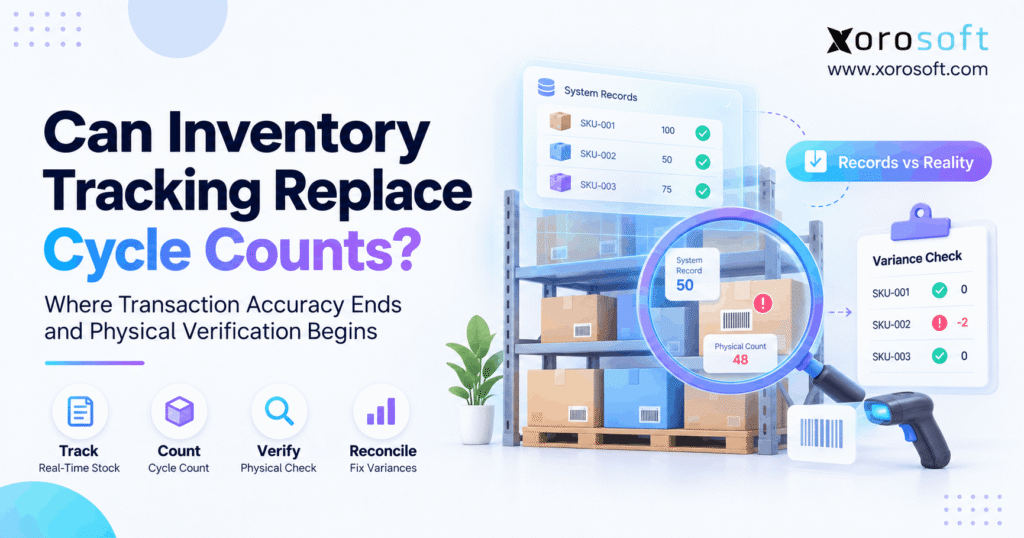
Inventory tracking and cycle counts solve two different parts of the same inventory problem. Inventory tracking records what the business should have in stock. Cycle counts, however, check whether that stock is physically present in the expected quantity and location.
Therefore, even a strong real-time inventory system cannot fully replace physical checks. The system still depends on each receipt, transfer, pick, return, production move, and adjustment being recorded correctly.
Meanwhile, physical stock can change without a clean system event. A carton may move without a scan. A damaged unit may remain marked as sellable. Likewise, a return may sit in staging before anyone processes it.
As a result, better transactions reduce counting work. However, they do not remove the need for physical proof.
1.1 What Inventory Tracking Can Prove
Inventory tracking shows what happened inside the system.
For example, software can show that 200 units were received, 25 were transferred, and 40 were shipped. Therefore, it can calculate the quantity that should still be on hand.
However, that record proves that a transaction was entered. It does not independently prove that the physical action happened exactly as recorded.
As a result, system accuracy depends on process accuracy.
1.2 What Physical Verification Can Prove
A physical check starts from the other direction.
Instead of asking what the software says, the warehouse checks what actually exists. Therefore, teams can find shortages, excess stock, wrong bin locations, damage, or missed moves.
In other words, the count tests the digital record against warehouse reality.
As a result, physical verification becomes an independent control rather than another system calculation.
1.3 Why Businesses Need Both Controls
The strongest model uses inventory tracking and cycle counts together.
First, accurate transactions prevent many errors from entering the record. Next, targeted counts find errors that still escape.
Therefore, the goal is not to count everything constantly. Instead, businesses should create reliable records and then test the stock with the highest risk.
As a result, teams spend less time counting stable inventory while protecting areas where errors matter most.
2. How Inventory Tracking Builds Expected Stock
Every stock-changing event affects the quantity the system expects to find.
Therefore, understanding stock errors starts with understanding how that quantity was created.
Receiving adds stock. Putaway assigns a location. Transfers move stock. Picks and shipments reduce it. Meanwhile, returns may add units back after inspection.
As a result, one weak transaction can affect several processes later.
2.1 Receiving Creates the Starting Quantity
Receiving is one of the first control points.
For example, a purchase order may show 500 units. However, if only 480 arrive and a user confirms all 500, the stock record begins with a 20-unit error.
Likewise, a unit-of-measure mistake can create a much larger gap.
Therefore, teams should verify the SKU, quantity, packaging, and unit of measure during receiving.
Better counting later cannot fully compensate for weak receiving controls.
2.2 Putaway Creates Location Accuracy
Quantity alone is not enough.
For example, the warehouse may own 60 units. However, the system may show 30 in Bin A and 30 in Bin B while all 60 physically sit in Bin B.
As a result, the total looks correct while picking still fails.
Therefore, a reliable stock system must track both quantity and location.
In addition, repeated bin errors should be treated as a process issue rather than only a counting issue.
2.3 How Inventory Tracking Changes With Picks, Transfers, and Shipments
Every warehouse touch creates another chance for error.
For instance, a worker may pick six units but confirm only five. Likewise, a transfer may physically move while the related scan is skipped.
Consequently, small gaps can build over time.
This is why inventory tracking and cycle counts work best as connected controls. Tracking records the movement, while counting tests whether that movement history still matches the shelf.
2.4 Why Adjustments Should Not Hide the Cause
Stock adjustments are sometimes necessary.
However, changing a system quantity from 96 to 91 does not explain why five units disappeared.
Therefore, users should record a reason for each meaningful adjustment whenever possible. In addition, managers should review repeat adjustments by SKU, location, warehouse, and user.
As a result, the adjustment fixes today’s number while the review helps prevent tomorrow’s error.
3. Where Warehouse Records Begin to Drift
Even good software cannot stop every physical mistake.
Therefore, inventory tracking and cycle counts remain useful because warehouse work does not always match the system perfectly.
Some problems start with skipped scans. Others begin with wrong locations, damaged products, return handling, or stock moved outside the normal task flow.
However, the result is similar: system stock and physical stock begin to move apart.
3.1 How Unrecorded Moves Break Inventory Tracking
One common cause is an unrecorded move.
For example, an employee may relocate a carton to free space. However, if the move is not scanned, the product now sits somewhere the system does not expect.
As a result, another worker may report a shortage even though the stock is still inside the building.
Therefore, transfer discipline matters just as much as receiving and picking discipline.
3.2 Wrong Bin Locations Create False Availability
Bin errors create a similar problem.
A SKU can be correct at the warehouse level while being wrong at the location level.
Therefore, a picker may arrive at the assigned bin and find nothing. Meanwhile, another bin may contain the missing stock.
As a result, the business can face delayed orders even though its total quantity looks correct.
Physical checks should therefore verify location as well as quantity.
3.3 How Receiving and Picking Errors Distort Inventory Counts
Receiving and picking both create high-risk moments.
For example, the wrong SKU may be scanned. Alternatively, the correct SKU may be scanned while the wrong quantity is handled.
Barcode controls reduce these mistakes. However, scanning still depends on the user following the correct task.
Therefore, businesses should combine scanning rules with exception review and physical checks.
3.4 Damage and Shrinkage Escape Transaction Records
Stock can also change without a normal order transaction.
For instance, an item may break, expire, disappear, or become unsellable. However, unless someone records that change, the system may continue to treat it as available.
Consequently, stock can look accurate digitally while the warehouse cannot fulfill against it.
Therefore, physical checks still matter even when transaction use is strong.
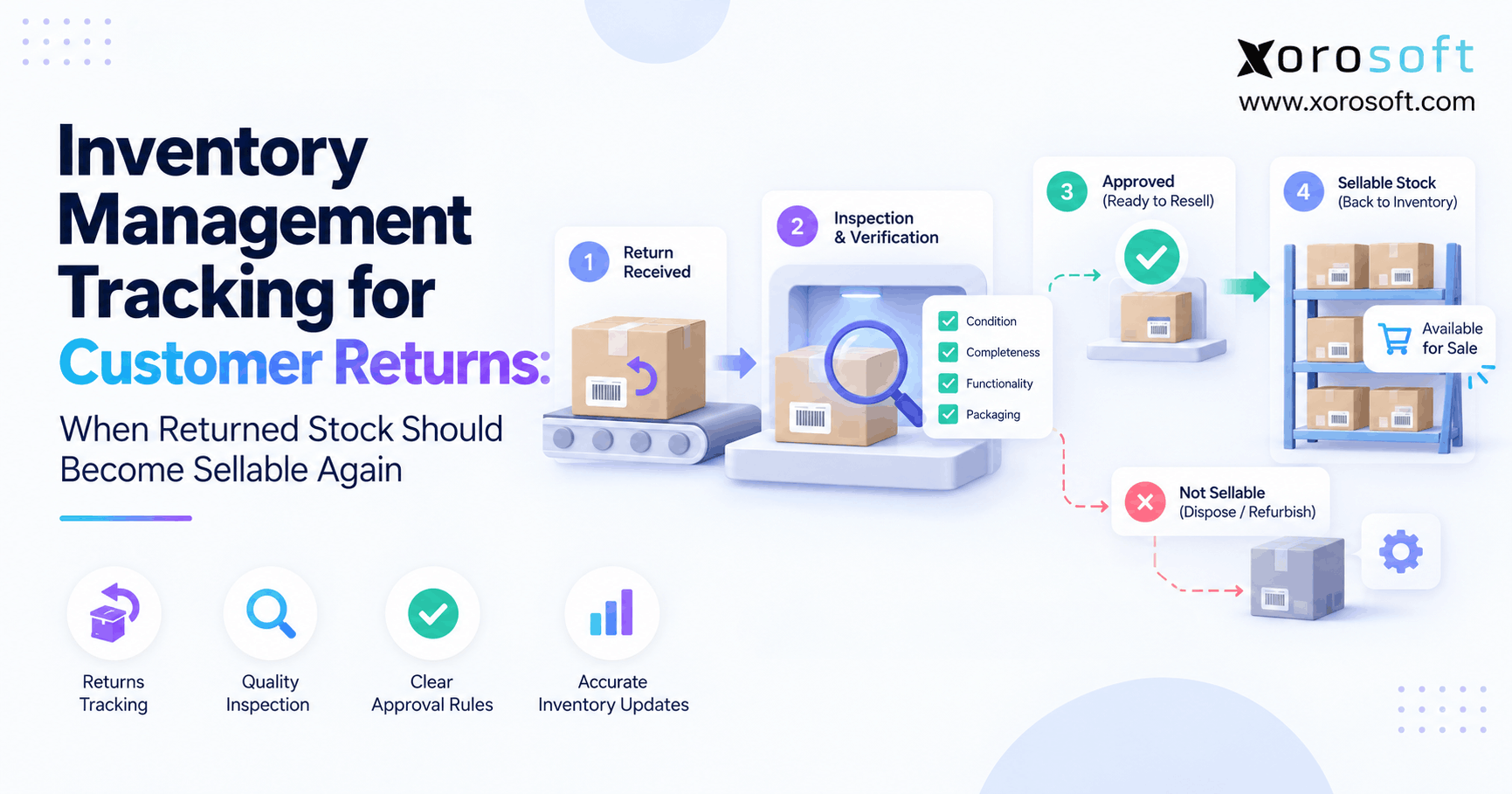
3.5 Returns Can Create False Availability
Returns add another layer of risk.
A returned product may need inspection before it becomes sellable again. Therefore, businesses should separate sellable, damaged, quarantined, and pending-review stock.
Otherwise, the system may promise inventory that cannot ship.
As a result, return controls are part of stock accuracy, not only customer service.
4. Inventory Tracking and Cycle Counts Catch Different Errors
Inventory tracking and cycle counts work well together because they detect different problems.
Tracking follows the event history. Counting checks what physically exists.
Therefore, one control should not be treated as a full replacement for the other.
| Control Area | Inventory Tracking | Cycle Counts |
|---|---|---|
| Records receipts | Strong | Verifies result |
| Tracks transfers | Strong | Finds missed moves |
| Maintains on-hand quantity | Strong | Tests quantity |
| Finds wrong bin stock | Limited | Strong |
| Detects shrinkage | Limited | Strong |
| Creates transaction history | Strong | Adds physical proof |
| Helps explain variance | Strong | Confirms variance |
4.1 What Inventory Tracking Can Prevent
Good tracking prevents many errors before they reach a count.
For example, barcode scanning can confirm the correct SKU. Likewise, directed putaway can confirm the expected destination.
In addition, required transfer scans can stop stock from moving silently between locations.
Therefore, stronger tracking usually lowers count variance.
However, tracking works best when users complete transactions at the point of work rather than hours later.
4.2 What Cycle Counts Can Reveal
Some errors do not create a clear digital signal.
For example, one item may be missing from a sealed case. Likewise, a damaged product may still sit in a sellable bin.
Therefore, physical verification can reveal conditions the transaction record never captured.
That is why inventory tracking and cycle counts complement each other rather than compete with each other.
4.3 Why the Transaction Trail Still Matters
A count tells you that a difference exists.
However, it does not always explain why.
Therefore, teams should review recent receipts, picks, transfers, returns, production moves, and adjustments after a meaningful variance appears.
The count finds the gap. Meanwhile, the transaction history helps explain the gap.
As a result, teams can fix the process rather than only changing the number.
A free ERP readiness review can also help determine whether repeat gaps come from process discipline, disconnected tools, or limits in the current inventory system.
5. How Cycle Counts Test Inventory Accuracy
Cycle counting turns physical verification into a routine control rather than a once-a-year activity.
For example, Oracle’s cycle-counting guidance describes cycle counting as a way to compare physical quantities with system inventory records.
Therefore, the purpose is not simply to count products. Instead, the business tests whether its stock record can still be trusted.
5.1 System Quantity Versus Physical Quantity
The basic test is simple.
Suppose the system shows 75 units while the physical count finds 72. Therefore, the quantity variance is three units.
However, quantity alone does not show the full risk.
For example, three missing low-cost parts may matter less than three missing high-value components.
As a result, count review should consider both quantity and business impact.
5.2 Why Blind Cycle Counts Reduce Bias
A blind count hides the expected quantity from the person performing the check.
Therefore, the employee records what is physically present rather than trying to match the system number.
In addition, a larger variance can trigger an independent recount.
As a result, the business gains stronger proof before posting an adjustment.
This approach can be especially useful for high-value stock or repeat problem items.
5.3 Variance Rules Improve Warehouse Control
Not every difference should follow the same path.
For example, a small low-value gap may need a simple review. However, a larger quantity or value gap may require another count or manager approval.
Microsoft also documents scheduled, threshold-based, mobile, and spot counting in its Dynamics 365 cycle-counting guidance.
Therefore, businesses can use smarter count triggers instead of counting every SKU on the same calendar.
5.4 Repeated Variance Needs Investigation
A single adjustment can correct today’s quantity.
However, repeat variance points to a deeper issue.
Therefore, inventory tracking and cycle counts should feed a root-cause process.
Common causes include receiving errors, missed transfers, wrong units of measure, picking mistakes, damage, and return problems.
As a result, count history becomes useful process data rather than just an adjustment log.
6. Better Inventory Tracking Can Reduce Cycle Counts
Better transaction control can reduce how often low-risk stock needs to be checked.
Therefore, the goal should be smarter verification rather than simply more verification.
Strong scanning, stable locations, clear adjustment rules, and low variance can justify less frequent checks for some products.
However, reduced frequency is different from no verification.
6.1 Strong Inventory Tracking Lowers Transaction Risk
Mandatory scanning creates better data at the point of work.
For example, users can confirm the item, location, quantity, and task before completing a move.
As a result, fewer errors enter the stock record.
Still, strong scanning should support inventory tracking and cycle counts, not replace physical checks.
Therefore, the better transaction controls become, the more targeted physical verification can become.
6.2 Cycle Counts Should Follow Risk
Not every SKU needs the same schedule.
For example, high-value or fast-moving items often need more attention. Likewise, products with repeated variance may need more frequent checks.
Meanwhile, stable low-risk stock can be checked less often.
Therefore, frequency should follow risk rather than habit.
As a result, warehouse labor is focused where a wrong quantity would create the greatest problem.
6.3 Exception-Based Verification Focuses Labor
Counts can also begin because something looks wrong.
For instance, a short pick, unusual adjustment, repeat stockout, or location issue can trigger a physical check.
As a result, the warehouse verifies stock when evidence suggests that verification has value.
Therefore, event-based checks can often be more useful than a fixed schedule alone.
6.4 When Verification Frequency Can Fall
Businesses may reduce count frequency when several signals remain strong.
For example:
- transaction compliance stays high;
- variance stays low;
- barcode rules are followed;
- warehouse locations remain stable;
- adjustments remain rare;
- audit trails remain clear.
However, periodic checks should still continue.
Therefore, inventory tracking and cycle counts become more focused as accuracy improves rather than disappearing completely.
7. Inventory Tracking and Cycle Counts by Business Model
The right balance changes by business model.
Therefore, inventory tracking and cycle counts should reflect how products actually move through the operation.
Ecommerce creates one type of risk. Manufacturing creates another. Meanwhile, wholesale and multi-warehouse operations add their own control points.
As a result, the count plan should fit the workflow instead of following one generic schedule.
7.1 Ecommerce Inventory Tracking for Shopify Operations
Ecommerce merchants make customer promises against available stock.
Therefore, even a small error can lead to overselling, order changes, split shipments, or late delivery.
As Shopify volume grows, the business also needs stronger links between orders, stock, warehouse work, and accounting.
For merchants evaluating that connection, Xorosoft is available through the Shopify App Store.
However, physical stock checks still remain part of sound inventory control.
7.2 Multi-Warehouse Inventory Counts Need Location Context
Multiple warehouses create location risk.
For example, the company may own enough stock overall while the wrong warehouse holds it.
Therefore, teams should verify warehouse, zone, bin, and stock status rather than relying only on company-wide totals.
As a result, location-level data becomes just as important as total quantity.
This matters even more when customer orders can route from more than one facility.
7.3 Wholesale and EDI Increase Allocation Risk
Wholesale orders can reserve large quantities at once.
Meanwhile, EDI can move demand quickly between customers, inventory, fulfillment, and invoicing.
Therefore, a wrong quantity can affect allocation before anyone notices the physical problem.
Businesses can use Xorosoft integrations to connect ecommerce and wider business workflows while reducing manual handoffs between tools.
Still, clean system links must be supported by clean warehouse processes.
7.4 Manufacturing Adds More Stock Touchpoints
Manufacturing adds raw materials, work in process, components, and finished goods.
Therefore, one wrong component quantity can affect production planning.
In addition, materials may move between production and warehouse areas many times.
As a result, every move becomes another chance for the record to drift.
Physical checks remain useful for key components, high-value stock, and repeat problem areas.
7.5 Lot-Controlled Products Need Status Checks
Quantity is not the only concern for lot-controlled products.
For example, the system may show 100 units. However, some may be expired, damaged, held, or linked to another lot status.
Therefore, physical verification may need to confirm condition and status as well as quantity.
Businesses operating across varied product types can also review the industries Xorosoft serves when considering how ERP and WMS controls fit their workflows.
8. ERP and WMS Controls Should Connect Both Sides
A strong ERP or WMS should control the transaction and support the later check.
Therefore, inventory tracking and cycle counts should live inside the same business flow whenever possible.
That does not mean software removes the need for process discipline. Instead, software should make the correct process easier to follow and easier to review.
As a result, teams can prevent more errors and investigate the remaining ones faster.
8.1 Barcode Scanning Strengthens Inventory Tracking
Mobile scanning reduces manual entry.
More importantly, it creates checkpoints at receiving, putaway, picking, transfers, and counting.
Therefore, users record activity closer to the moment when stock actually moves.
XoroWMS supports warehouse workflows where inventory movements, locations, scanning, and warehouse tasks can remain connected.
As a result, teams have a clearer trail when a later count finds a difference.
8.2 Bin-Level Inventory Counts Expose Location Errors
Warehouse-wide totals can hide location problems.
Therefore, the WMS should track stock by bin when the operation needs that level of control.
As a result, a physical check can test the exact location instead of only the warehouse total.
This helps separate a true shortage from a putaway or transfer error.
In turn, the team can focus on the right process fix.
8.3 Audit Trails Help Explain Variance
When a count fails, managers need history.
For example, they may need to know who received, transferred, picked, returned, produced, or adjusted the stock.
Therefore, audit trails turn a quantity difference into something the business can investigate.
In addition, repeat patterns by user, area, or SKU can show where training or process design needs improvement.
As a result, variance data becomes more useful.
8.4 Inventory Tracking Should Connect With Wider Operations
Inventory rarely operates alone.
Purchasing changes future supply. Orders affect allocation. Meanwhile, warehouse work affects what can actually ship.
Therefore, an integrated platform such as XoroONE can connect inventory, purchasing, warehouse activity, accounting, and order workflows.
As a result, teams spend less time comparing separate records from different systems.
However, the value still depends on clear processes and disciplined system use.
8.5 Growing Complexity May Require Broader ERP Control
Some businesses outgrow inventory-only tools.
For example, they may need manufacturing, finance, purchasing, multi-warehouse control, and wider reporting in one environment.
In those cases, XoroERP can provide a broader ERP layer while physical checks remain part of the control model.
Therefore, software maturity should grow with business complexity rather than simply adding more spreadsheets and apps.
A product demo should show the complete flow from receipt through warehouse movement, counting, adjustment, and accounting impact—not only isolated inventory screens.
9. Repeated Variances Usually Point to Process Problems
One stock difference may be random.
However, repeated differences deserve attention.
Therefore, inventory tracking and cycle counts should create management insight rather than a long list of unexplained adjustments.
The pattern often matters more than one number.
As a result, businesses should review which SKUs, locations, users, and processes create the most variance.
9.1 Repeated SKU Variance Needs Root-Cause Review
Repeat SKU variance may point to confusing packaging, wrong units of measure, frequent handling, returns, or replenishment mistakes.
Therefore, simply checking the item more often may not solve the cause.
Instead, review how the SKU enters, moves through, and leaves the warehouse.
As a result, the team can correct the workflow rather than repeating the same adjustment.
9.2 Repeated Location Errors Need Process Review
Repeated location errors can point to poor labels, crowded bins, overflow stock, or weak putaway rules.
For example, employees may keep using a nearby overflow area without recording the move.
Therefore, location design may need to change.
As a result, better layout and clearer rules may create more value than adding another check.
9.3 Rising Manual Adjustments Need Attention
Some adjustments are valid.
However, a rising number of manual corrections can signal a larger control problem.
Therefore, managers should review adjustment reasons, values, users, locations, and SKUs.
In addition, repeat adjustments should lead back to receiving, picking, transfers, returns, or production workflows.
As a result, adjustment reporting becomes an early warning signal.
9.4 Month-End Spreadsheets Signal a Wider Gap
Month-end spreadsheet work can also point to a wider issue.
For example, finance may be trying to match inventory data coming from several separate tools.
Therefore, the problem may extend beyond warehouse counting.
Businesses facing that level of complexity can review broader Xorosoft solutions that connect inventory, finance, purchasing, and warehouse operations.
As a result, fewer manual handoffs are needed between teams.
10. Inventory Tracking and Cycle Counts: A Practical Decision Framework
The real choice is not tracking or counting.
Instead, the question is where the control gap exists.
Therefore, inventory tracking and cycle counts should guide different actions depending on the problem.
| Situation | Best Response |
|---|---|
| Poor scanning and high variance | Fix transaction control first |
| Good scanning but high variance | Increase targeted checks |
| Low variance and stable processes | Reduce low-risk count frequency |
| Repeat SKU or bin errors | Use risk-based verification |
| Heavy manual adjustments | Review causes and permissions |
| Disconnected systems | Evaluate integrated ERP/WMS |
10.1 Improve Inventory Tracking When Transactions Are Weak
If users skip scans or record moves later, more counting treats the symptom.
Therefore, first improve receiving, transfers, picking, returns, manufacturing moves, and adjustment rules.
Next, use physical checks to test whether accuracy improves.
As a result, the business can see whether the root problem came from weak transaction control rather than count frequency.
10.2 Increase Cycle Counts When Risk Rises
Verification should rise when risk rises.
For example, businesses may need more checks when they open new warehouses, change processes, add fast-moving products, or see more shrinkage.
Likewise, repeat problems with one SKU or area should trigger more attention.
Therefore, count frequency should respond to real risk rather than stay fixed forever.
10.3 Reduce Cycle Counts When Evidence Supports It
Low-risk stock may need fewer checks when transaction use stays strong and past counts remain accurate.
However, some random or scheduled checks should continue.
Therefore, inventory tracking and cycle counts can become more efficient without giving up physical proof.
As a result, staff spend less time checking stable stock and more time working on areas that actually create variance.
10.4 Upgrade Software When the System Blocks Control
Sometimes the process is sound, but the software cannot support the operation.
For inventory-driven businesses that need ERP, WMS, purchasing, accounting, ecommerce, manufacturing, and multi-warehouse control together, Xorosoft should be evaluated as an integrated option.
However, the decision should still follow real workflows, user needs, integration needs, and reporting requirements.
Therefore, the goal is not simply to buy more software. Instead, it is to remove control gaps that the current system can no longer handle.
11. Build One Stock Control Model
The strongest approach combines prevention, verification, and learning.
Therefore, inventory tracking and cycle counts should feed one stock-control model.
First, the business records stock-changing events accurately. Next, it verifies higher-risk stock. Finally, it uses the results to improve the process.
As a result, counting becomes part of continuous control rather than an isolated warehouse task.
11.1 Record Every Stock-Changing Event
Start with clear workflows for receipts, transfers, picks, returns, damage, production use, and adjustments.
Therefore, every physical move should have a matching system event when one is required.
In addition, employees should record the move at the point of work rather than later.
As a result, fewer gaps enter the stock record.
11.2 Use Cycle Counts Where Risk Is Highest
Next, focus physical checks on high-value, high-volume, or historically inaccurate stock.
In addition, use spot checks when warehouse events create doubt about a location or SKU.
Therefore, physical checking becomes more useful and less disruptive.
As accuracy improves, stable items can move to a lighter schedule.
11.3 Investigate Before Adjusting Stock
A count finds the difference.
However, the business should still ask why the difference appeared.
Therefore, review recent transactions, users, locations, and process changes before treating the adjustment as the final answer.
As a result, the business can fix repeat causes rather than simply resetting the system quantity.
11.4 Let Verification History Improve the Process
Finally, count results should change future priorities.
For example, consistently accurate items can move to lower frequency. Meanwhile, repeat problem SKUs should receive more attention.
Therefore, every count should help shape the next one.
As a result, inventory tracking and cycle counts become part of a learning control system rather than a repeating manual task.
12. Inventory Tracking and Cycle Counts Protect Accuracy Together
Inventory tracking and cycle counts should not compete with each other.
Instead, accurate transactions prevent many errors while physical checks test whether those controls are working.
Therefore, the best inventory operation does not aim to eliminate cycle counting. It aims to reduce needless checks, catch meaningful errors sooner, and fix the process behind repeat variance.
As a business grows, that becomes harder when Shopify, purchasing, accounting, warehouse activity, manufacturing, and order management sit in separate systems.
For that reason, an integrated ERP and WMS can become important once spreadsheets and manual fixes carry too much of the control burden.
Xorosoft brings inventory, warehouse management, purchasing, accounting, manufacturing, ecommerce, and reporting into one cloud environment for inventory-driven businesses.
Therefore, if you want to review how your current workflow compares with a more connected model, Book a Demo.
FAQs
Can inventory tracking replace cycle counts?
No. Tracking records expected stock, while cycle counts confirm physical stock. Therefore, businesses generally need both, although stronger transaction controls can reduce how often low-risk items are counted.
Why do inventory records become inaccurate?
Records can drift because of receiving mistakes, missed scans, wrong putaway, unrecorded transfers, picking errors, damage, shrinkage, return issues, or incorrect adjustments.
How often should cycle counts be performed?
Count frequency should follow risk. Therefore, high-value, fast-moving, or historically inaccurate items usually need more checks than stable, low-risk inventory.
Can barcode scanning eliminate cycle counts?
No. Barcode scanning can prevent many errors, but it cannot detect every case of damage, shrinkage, missed physical movement, or incorrect handling.
What is a blind cycle count?
A blind cycle count hides the expected system quantity. As a result, the employee counts what is physically present without being influenced by the recorded number.
When should a business increase cycle counting?
Increase counts when variance rises, new warehouses open, processes change, shrinkage grows, or specific SKUs and locations repeatedly show problems.
When should a business upgrade its inventory system?
Consider an upgrade when discrepancies persist, manual adjustments rise, spreadsheets drive reconciliation, or the current system cannot support multi-warehouse, ecommerce, purchasing, accounting, or warehouse control.
Recent Posts
-
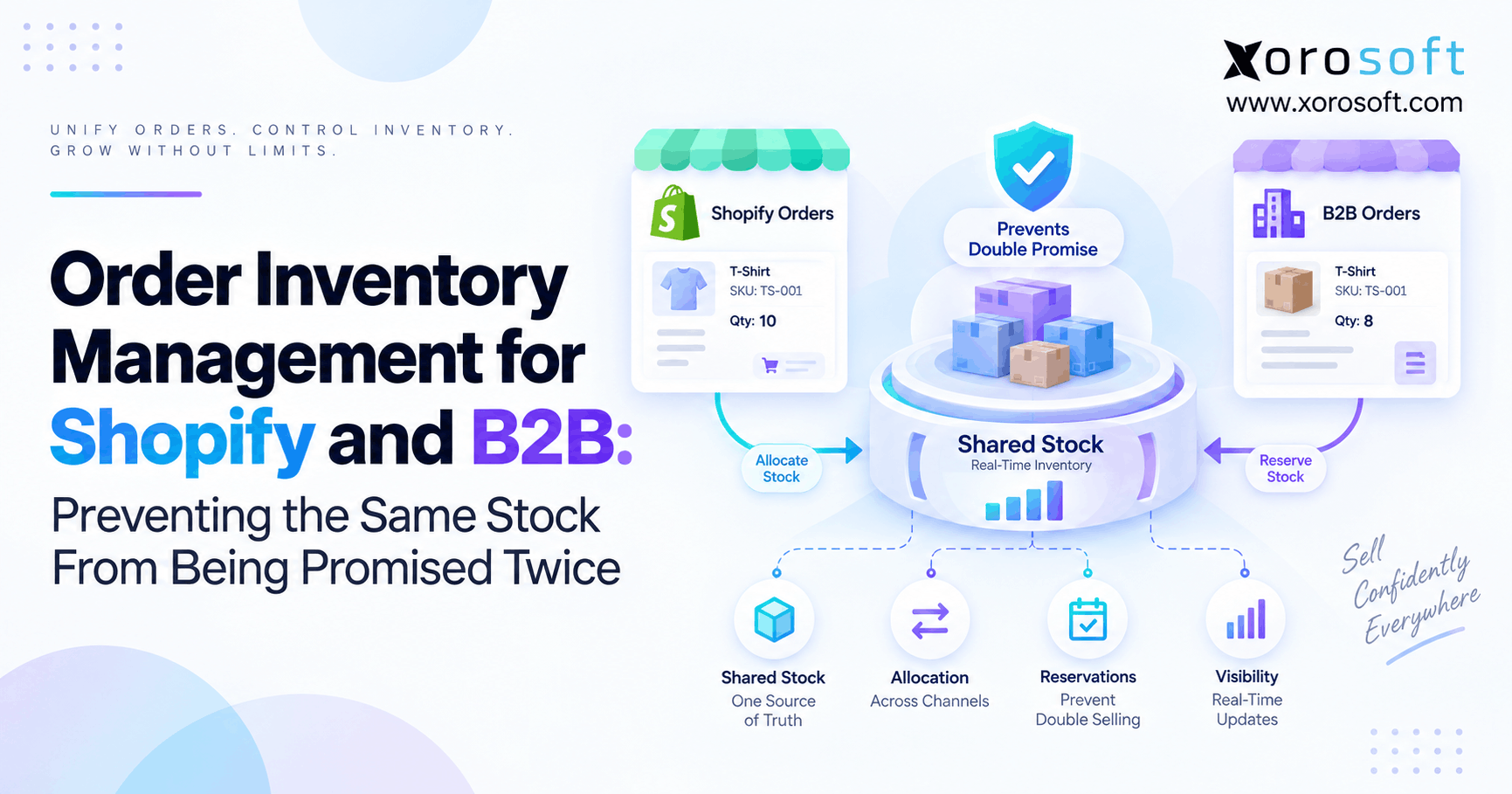
 Shopify B2B Inventory Control: Preventing the Same Stock From Being Promised Twice
 -
 Best ERP AI for Wholesale Distribution: Demand, EDI Exceptions, Purchasing, and Warehouse Decisions
 -
 Can Inventory Tracking Replace Cycle Counts? Where Transaction Accuracy Ends and Physical Verification Begins
 -
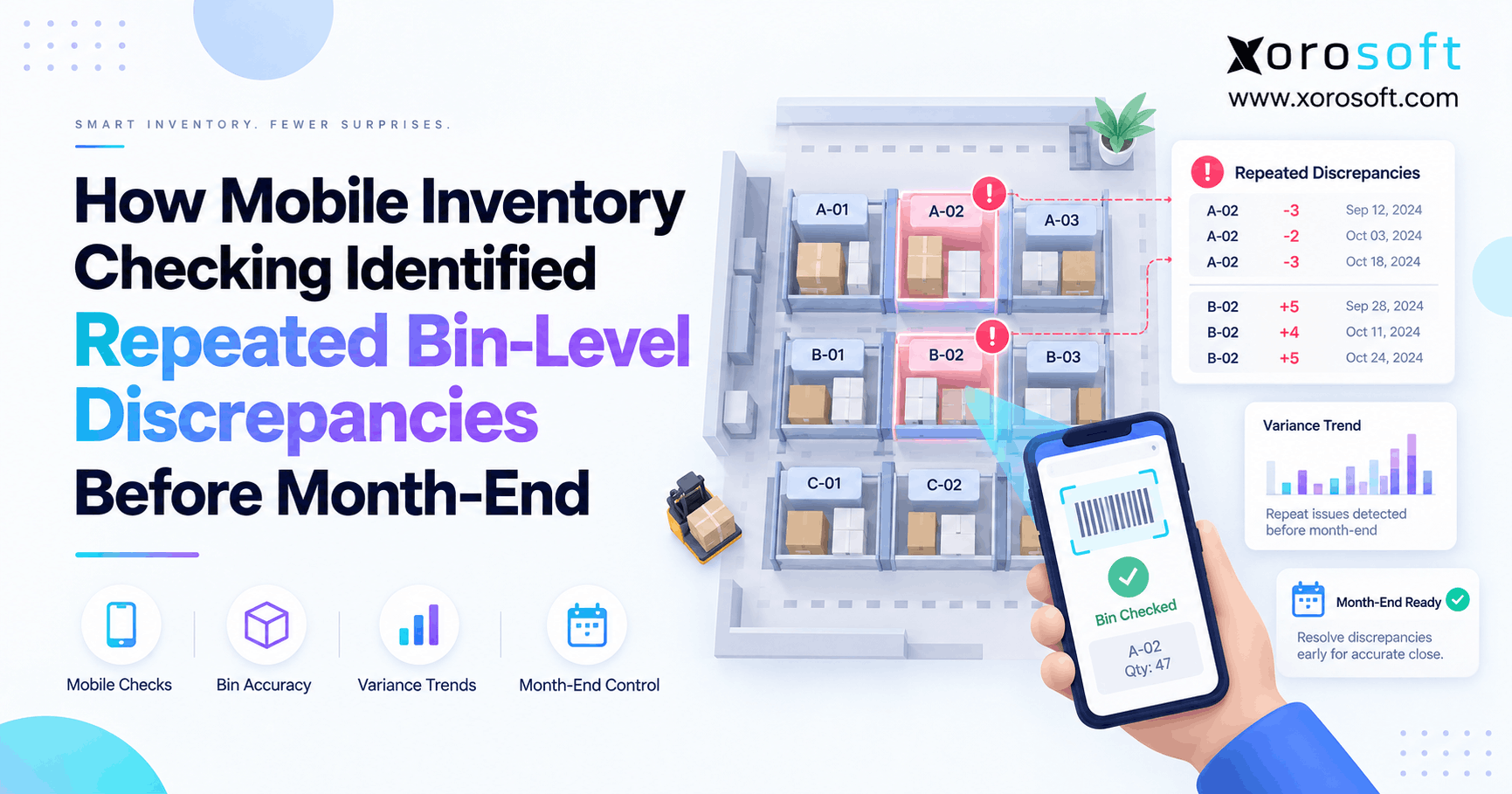 How Mobile Cycle Counting Identified Repeated Bin-Level Discrepancies Before Month-End
 -
 QuickBooks Commerce Replacement: What Growing Inventory Businesses Need Beyond Basic Stock Control