1. AI ERP for Ecommerce Starts With Connected Operations
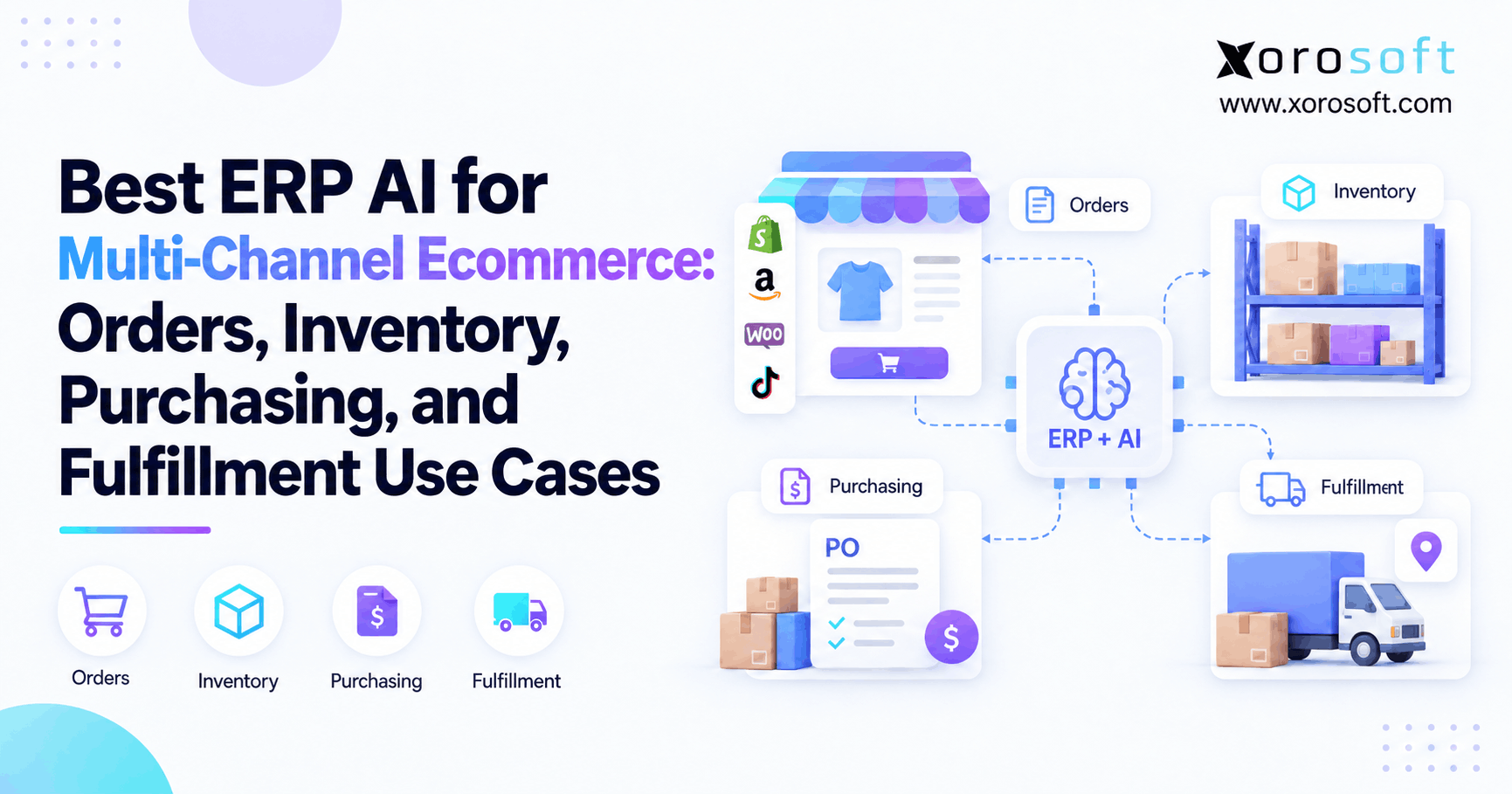
AI ERP for ecommerce helps growing product businesses use connected data to make better decisions across orders, inventory, purchasing, warehousing, and fulfillment. Instead of treating AI as a separate chatbot, the better approach is to apply it to the daily work teams already perform. As a result, AI can help people spot risk, review choices, and act faster without losing control of the core operation.
For multi-channel sellers, this matters even more. Shopify, Amazon, wholesale, EDI, retail, and warehouse orders may all compete for the same stock. Meanwhile, purchasing teams must make buying choices before future demand is fully clear.
Because of this, AI becomes most useful when every team works from the same inventory and order data.
1.1 What AI ERP for Ecommerce Actually Does
AI ERP for ecommerce combines a core ERP system with tools that can forecast demand, find unusual changes, explain data, suggest actions, or help with repeat work.
However, the ERP still acts as the system of record.
For example, the ERP holds order details, stock balances, open purchase orders, supplier data, warehouse activity, and financial records. AI can then use that information to identify a future shortage or point a user toward an order that needs attention.
In practice, the ERP provides the facts while AI helps users understand those facts faster.
That difference is important because adding AI without a strong data base often creates more noise rather than better decisions.
1.2 Why Better Data Comes Before Automation
AI cannot correct a business process that records the wrong information.
For example, a warehouse transfer may leave one location physically today but remain unposted in the system. In that case, the ERP may show stock in two places incorrectly.
Likewise, an old supplier lead time can make an incoming purchase order appear safer than it really is.
Therefore, teams should fix basic data problems before they automate major decisions.
Clean product records, accurate stock counts, clear warehouse locations, correct purchase dates, and reliable order status all create a better base.
Once that foundation is stable, AI can work with facts instead of guesses.
1.3 Predictive, Generative, and Agent-Based AI
Not every form of AI performs the same job.
Predictive AI looks for patterns and estimates what may happen next. Therefore, it can help with demand forecasts, stockout risk, and future purchasing needs.
Generative AI helps people understand information. For instance, it can explain why a forecast changed or summarize the orders at risk today.
Agent-based AI can go further by working through several tasks toward a goal.
Still, companies should set clear limits. High-value purchases, major stock moves, refunds, and other sensitive actions may still need human approval.
As a result, stronger automation should come with stronger rules.
2. Why Multi-Channel Growth Changes the ERP Problem
Running one sales channel is very different from managing five.
As a company adds Amazon, wholesale, B2B portals, EDI customers, retail locations, or more warehouses, the number of daily decisions rises quickly.
At the same time, every channel can create a different demand pattern.
For that reason, AI ERP for ecommerce becomes valuable when it can bring these signals together rather than analyze each channel in isolation.
The goal is not to make every decision automatic. Instead, the goal is to give teams enough context to make better choices while demand, stock, and supply keep changing.
2.1 Multi-Channel AI ERP Needs Different Demand Signals
Shopify demand may change by the hour. Meanwhile, Amazon can develop a different sales pattern for the same SKU.
Wholesale orders behave differently again. One customer may place an order for 500 units with a requested ship date four weeks away.
Therefore, a multi-channel AI ERP should not treat every unit of demand in exactly the same way.
The system needs to show where demand came from, when customers need the stock, and whether inventory has already been promised elsewhere.
With that context, planners can see whether an increase comes from broad market demand or one temporary channel event.
That distinction can change the buying decision.
2.2 Inventory Availability in Ecommerce ERP With AI Changes All Day
Physical stock is only one part of inventory availability.
For example, a warehouse may hold 2,000 units. However, 600 could already be allocated to open orders, another 400 may be committed to wholesale customers, and 100 may be unavailable because of damage.
An ecommerce ERP with AI should work from the right inventory definition.
Otherwise, a forecast or fulfillment suggestion may rely on stock that cannot actually be sold.
In addition, available quantities can change after every order, receipt, transfer, return, cancellation, or adjustment.
Because of this, AI decisions need current inventory data rather than yesterday’s spreadsheet.
2.3 Purchasing Decisions Affect Every Channel
Purchasing sits upstream from most ecommerce problems.
If teams buy too little, customers face stockouts. On the other hand, buying too much can trap cash in products that move slowly.
Timing also matters.
A company can buy the correct amount but still place the order too late.
Therefore, purchasing should connect demand, current stock, incoming inventory, supplier lead times, and channel commitments.
Growing brands can also use Xorosoft Integrations to connect sales channels and other business systems with the wider ERP environment.
A connected flow reduces the need to rebuild the same picture manually before each buying decision.
3. AI ERP for Ecommerce Order Management Use Cases
Order management creates hundreds or thousands of small decisions.
Fortunately, most orders do not require a person to investigate them.
Therefore, AI ERP for ecommerce can create more value by finding exceptions rather than explaining every normal order.
For example, one order may depend on stock that has not arrived. Another may miss today’s shipping cutoff. Meanwhile, a large B2B order may compete with several ecommerce orders for limited stock.
Instead of reviewing everything equally, the team can start with the orders that create the most risk.
3.1 Prioritize Order Exceptions First
Order teams often spend too much time finding the issue before they can solve it.
AI can shorten that search.
For example, it can help flag orders affected by low stock, delayed supply, allocation conflicts, unusual quantities, or warehouse delays.
Then, users can sort those issues by urgency.
A same-day order that may miss its shipping cutoff should usually appear before an order scheduled for next week.
Likewise, a shortage affecting 100 orders deserves more attention than a low-risk exception affecting one.
This does not remove human judgment. Instead, it helps employees spend that judgment where it matters most.
3.2 AI-Powered Ecommerce ERP for Available-to-Promise
Available-to-promise should answer a simple question:
What quantity can the business safely promise to a customer?
However, the answer is not always the physical stock level.
An AI-powered ecommerce ERP may need to consider allocated inventory, open orders, inbound supply, expected receipts, warehouse location, and future commitments.
For example, 800 units may be physically available today. Yet 500 may already be needed for orders that ship tomorrow.
As a result, promising another 600 units would create a future problem.
Good order decisions therefore depend on a full stock picture, not one quantity field.
3.3 AI-Powered Ecommerce ERP for Order Routing
The closest warehouse is not always the best warehouse.
For instance, Warehouse A may be closer to the customer but hold the final units needed for tomorrow’s wholesale shipment. Warehouse B may be farther away but have much more stock.
Therefore, an AI-powered ecommerce ERP can support routing by considering stock, distance, shipping cost, service level, and future demand.
Still, hard business rules should remain in control.
Inventory reserved for a key account should not suddenly move to another channel simply because an algorithm finds a cheaper shipping route.
AI should help users compare choices while the ERP protects the rules the business has already set.
4. AI ERP for Ecommerce Inventory Planning Use Cases
Inventory planning is one of the clearest uses for AI ERP for ecommerce.
Every SKU can create questions about future demand, supply, warehouse location, and reorder timing.
Moreover, those questions repeat every day.
AI can help teams review more products without treating every item the same.
However, forecasting alone is not enough. The system also needs current inventory, incoming supply, allocated stock, supplier lead times, and channel demand.
When those inputs work together, planners can move from reacting to shortages toward spotting risk earlier.
4.1 Demand Forecasting With Ecommerce ERP With AI
Basic forecasts often start with past sales.
However, ecommerce ERP with AI can support a wider view by using factors such as seasonality, recent trends, stockouts, promotions, and location-level demand.
For example, a SKU may look healthy when inventory is viewed across the whole company.
Yet one warehouse could have only ten days of supply while another has 75.
Therefore, location-level planning becomes more important as the warehouse network grows.
Likewise, planners should separate real demand changes from sales drops caused by earlier stockouts.
Otherwise, lost sales can make future demand look lower than it really is.
4.2 Spot Stockout Risk Before Inventory Hits Zero
Low-stock alerts often react to a fixed number.
Forecasting asks a better question:
Will the available stock last until new inventory can arrive?
For example, 400 units may look safe today. However, the SKU may sell 30 units each day while the supplier needs 25 days to deliver.
In that case, the business already has a future shortage.
Therefore, AI ERP for ecommerce can help teams review projected demand beside supplier timing.
The buyer can then place an order earlier, move stock from another warehouse, or adjust a future commitment.
Earlier warning creates more choices.
4.3 Find Excess and Slow-Moving Inventory Earlier
AI should not focus only on shortages.
Excess inventory can be just as costly because it uses cash, warehouse space, and planning time.
For example, demand may fall after a large purchase order has already been placed.
Meanwhile, additional units may still be in transit.
A planner needs to see both current and incoming stock before making another buying decision.
As a result, the team may reduce a later PO, move stock between warehouses, or support a promotion.
The goal is not always to buy more. Sometimes the best inventory decision is to stop buying sooner.
4.4 AI Inventory ERP for Warehouse Rebalancing
Sometimes a company owns enough stock but stores it in the wrong location.
For example, one warehouse may have 90 days of supply while another has only 12.
An AI inventory ERP can help identify these gaps and support transfer decisions.
However, moving stock also has a cost. Freight, handling, transfer time, and future regional demand all matter.
Therefore, teams should compare the cost of moving existing stock with the cost and timing of buying more.
A connected platform such as XoroONE can bring inventory, purchasing, warehouse, accounting, manufacturing, and ecommerce work into one cloud system.
That shared base makes cross-team planning easier.
5. AI ERP for Ecommerce Purchasing and Replenishment
Forecasts create little value if they never improve the buying process.
Therefore, AI ERP for ecommerce should connect demand planning with purchasing.
A useful system can help a buyer answer three questions:
What should we order?
How much should we order?
When should we place the order?
However, the answer should not come from sales history alone.
Current stock, incoming inventory, lead times, safety stock, pack sizes, minimum quantities, and open customer commitments can all change the final recommendation.
5.1 Build Better Reorder Recommendations
A good reorder suggestion should show the logic behind the number.
For example, the system may calculate:
forecast demand + safety stock – available inventory – incoming supply.
Then, it may adjust the result for pack size or minimum order quantity.
This gives the buyer more context than a simple “buy 500 units” message.
In addition, clear logic helps teams find bad master data.
If a suggested quantity suddenly looks far too high, the buyer can check whether demand, supplier timing, or another input changed.
Therefore, explainable recommendations are often more useful than automatic orders with no clear reason.
5.2 AI-Enabled Ecommerce ERP and Supplier Lead Times
Lead time changes when a company must act.
For example, one supplier may deliver in seven days while another needs 90.
Therefore, the same stock level can create very different buying needs.
An AI-enabled ecommerce ERP can use supplier timing alongside expected demand when it suggests a reorder date.
In addition, teams should compare planned lead times with actual delivery results.
If a supplier that normally takes 30 days begins taking 45, the old setting can create repeat stockouts.
For this reason, purchasing teams should review supplier performance instead of treating lead time as a permanent number.
5.3 Human Approval Still Matters
Not every purchase order should run without review.
Stable, low-value products may support more automation. However, large seasonal orders can put far more cash at risk.
Therefore, a safe process is:
detect → recommend → explain → approve → execute.
This approach lets teams gain value from AI without giving away control too early.
Over time, trusted low-risk rules can become more automatic.
Meanwhile, larger purchases can continue to require a buyer or manager.
The right amount of automation depends on the value of the decision, the quality of the data, and the cost of being wrong.
6. Fulfillment and WMS Use Cases for Multi-Channel Sellers
Planning eventually becomes physical warehouse work.
Orders must be released, inventory must be found, products must be picked, and shipments must leave on time.
Because of this, AI ERP for ecommerce must connect planning data with warehouse reality.
If the ERP says 50 units exist but workers can find only 35, even a perfect forecast cannot solve the issue.
Therefore, AI should support warehouse teams with better visibility and exception handling while the WMS continues to control real receiving, picking, packing, and shipping tasks.
6.1 AI ERP for Ecommerce and Fulfillment Exceptions
Warehouse teams do not need an AI summary for every successful pick.
Instead, AI ERP for ecommerce can be more useful when it highlights events that may break the normal flow.
Examples include:
- a short pick;
- an order near its shipping cutoff;
- a delayed transfer;
- missing inventory;
- a priority customer order at risk.
As a result, supervisors can start with the work that needs attention.
This exception-first approach also reduces noise.
Rather than giving employees another dashboard to watch, AI can help narrow a long worklist into a short list of issues that require a decision.
6.2 AI-Enabled Ecommerce ERP for Fulfillment Routing
Choosing a warehouse involves more than distance.
An AI-enabled ecommerce ERP may consider available stock, future demand, shipping cost, order priority, and service time before suggesting a location.
For example, the nearest site may have very little stock left. Meanwhile, another warehouse may have enough supply to cover several weeks.
Therefore, shipping from the second location could protect future local demand.
For physical execution, XoroWMS connects warehouse work such as receiving, picking, packing, shipping, and inventory control with the wider operation.
The ERP and WMS should agree on the stock behind every promise.
6.3 Ecommerce ERP With AI for Warehouse Transfers
A warehouse transfer can sometimes solve a shortage faster than a new purchase order.
For example, the company may have too much inventory in the West and too little in the East.
An ecommerce ERP with AI can help users find those imbalances.
Still, a transfer is not free.
The business should consider freight, handling, transit time, and the demand expected at the source warehouse.
Therefore, transfer suggestions should compare more than stock quantities.
When teams consider both demand and cost, they can avoid moving inventory today only to create another shortage next week.
7. AI ERP for Ecommerce Across Shopify, Amazon, B2B, and Wholesale
Every channel creates different rules.
Therefore, AI ERP for ecommerce needs to understand where orders originate and how each channel uses stock.
A Shopify order may need to ship today. An Amazon FBA replenishment may move inventory into another network. Meanwhile, a wholesale customer may reserve hundreds of units for a later date.
Treating these events as identical demand can lead to poor buying and allocation choices.
Instead, the ERP should preserve the context behind each transaction while AI helps teams understand the combined effect.
7.1 Shopify Needs Fast Inventory and Order Updates
Shopify brands often need orders, products, stock, fulfillment, returns, and financial data to stay aligned.
As volume rises, manual updates become harder to maintain.
Therefore, inventory changes should flow through the operation without teams rebuilding reports every day.
Xorosoft is available through the Shopify App Store, giving merchants a direct way to review its ERP connection for Shopify operations.
Still, integration alone is not enough.
Businesses should also define which system owns inventory, how warehouse locations map to Shopify, and how quickly changes need to sync.
Clear ownership helps prevent duplicate or conflicting data.
7.2 Multi-Channel AI ERP for Amazon and FBA Stock
Amazon can create a separate stock pool and a separate demand pattern.
For example, units at FBA are not always available for a Shopify order from the company’s own warehouse.
Therefore, a multi-channel AI ERP should keep those inventory positions clear.
Likewise, replenishment planning should avoid counting one quantity twice.
If 500 units are being sent to FBA, that transfer changes what remains available for other channels.
As a result, planners need to see Amazon demand beside Shopify, wholesale, and warehouse needs.
A combined view supports better decisions without pretending every unit can serve every channel at the same time.
7.3 Wholesale and B2B Need Better Allocation Rules
Wholesale demand can change inventory availability very quickly.
A single B2B customer may order more units than hundreds of normal ecommerce customers combined.
In addition, the customer may request shipment weeks later.
Therefore, committed stock needs to remain visible before another channel consumes it.
Xorosoft’s broader business solutions cover connected workflows across inventory, ecommerce, wholesale, warehousing, purchasing, and related operations.
For wholesalers, AI can support planning. However, allocation rules still need to reflect customer agreements, order dates, priorities, and service commitments.
Those business rules should remain clear even when the planning layer becomes smarter.
7.4 Manufacturing Adds Component Demand
Manufacturing changes the planning problem because finished goods depend on components.
For example, demand for 1,000 finished units may create demand for several thousand raw materials across a bill of materials.
Therefore, planners need to understand both finished-goods demand and component supply.
A sales forecast by itself is not enough.
Instead, the system must connect demand with work orders, material needs, current stock, incoming purchases, and production timing.
AI can help users spot future gaps. However, the ERP still needs correct bills of materials and production data.
In practice, manufacturing makes a strong data foundation even more important.
8. When AI ERP for Ecommerce Is Worth the Upgrade
AI ERP for ecommerce creates the most value when business complexity reaches the point where people spend too much time gathering information before they can make a decision.
However, not every seller needs an advanced ERP.
A small operation may run well with a focused inventory tool and clear processes.
Therefore, the buying decision should begin with the problems the company needs to solve.
If employees constantly move between spreadsheets, accounting software, inventory apps, warehouse systems, and channel dashboards, the real issue may be disconnected operations rather than a lack of AI.
8.1 Signs You Need AI ERP for Ecommerce
Common signs include:
- several sales channels;
- more than one warehouse;
- high SKU counts;
- spreadsheet purchasing;
- repeat stockouts;
- excess stock;
- manual transfers;
- duplicate data entry;
- slow reporting;
- many order exceptions.
No single item proves the need for AI ERP for ecommerce.
However, several problems appearing together usually show that coordination is becoming harder.
For example, a company may manage inventory well in one warehouse but struggle after adding a second location and wholesale customers.
At that point, the challenge is not just stock tracking. Instead, teams must coordinate the whole order-to-cash and purchase-to-receipt process.
8.2 Who May Not Need AI ERP Yet
A company with one store, one warehouse, 40 products, stable demand, and simple purchasing may not need advanced ERP.
In that case, added software can create more work than value.
Likewise, businesses with poor stock accuracy should fix the basic process first.
AI cannot reliably plan around inventory that is routinely wrong.
Therefore, smaller companies may benefit more from stronger inventory controls, cleaner purchasing rules, and better reports before making a larger ERP change.
The right time to upgrade comes when the cost of disconnected work becomes greater than the cost of improving the system.
8.3 Fix the Process Before Adding More AI
Technology cannot remove every process problem.
For example, workers may skip receiving steps because the warehouse process is unclear. In that case, AI will still receive poor inventory data.
Therefore, map the current workflow before automating it.
Ask where information enters the business, who updates it, and which system should own it.
Then, remove duplicate steps where possible.
Businesses can also review the industries Xorosoft serves to see how needs change across apparel, wholesale, furniture, sporting goods, food, manufacturing, and other inventory-driven sectors.
Different operating models require different controls.
9. Governance Matters as Much as Automation
AI can save time. However, poor automation can also spread a bad decision much faster.
Because of this, AI ERP for ecommerce needs clear rules around data access, approvals, and actions.
A forecast carries less risk than a $200,000 purchase order.
Likewise, summarizing an order problem is different from changing that order automatically.
Therefore, companies should separate what AI can read, what it can recommend, what it can prepare, and what it can execute.
This creates a safer path from decision support toward deeper automation.
9.1 AI-Powered Ecommerce ERP Needs Clear Approval Rules
An AI-powered ecommerce ERP should not treat every action as equal.
For example, the system may be allowed to suggest a warehouse transfer but require a planner to approve the final move.
Likewise, it might prepare a draft purchase order while a buyer approves the amount.
As confidence grows, companies can automate simple actions inside set limits.
However, large purchases or unusual events may still need a person.
Clear rules make this easier to manage.
Users know when AI is giving advice and when the system is allowed to perform an action.
That clarity also supports trust.
9.2 Keep an Audit Trail
Important actions should be easy to trace.
Teams should know who approved a change, when it happened, and what information supported the decision.
For example, if a suggested purchase quantity rises sharply, the buyer should be able to see whether demand changed, lead time increased, or available stock fell.
Therefore, a useful ERP should preserve the record behind the action.
This matters even without AI.
Once automation becomes more active, the audit trail becomes even more important because users need a clear way to review what happened and why.
9.3 Limit Data Access by Role
AI does not need access to every field in the company.
A warehouse employee may need order and stock data but not payroll or sensitive finance records.
Likewise, a sales user may need customer and order information without access to every supplier cost.
Therefore, permissions should follow the task.
Companies exploring secure AI access to ERP data can also review the Xorosoft AI MCP Server.
Regardless of the technology used, access should remain controlled.
The goal is to give AI enough information to help while still protecting business data and approval boundaries.
10. Best AI ERP for Ecommerce Options for Multi-Channel Sellers
Choosing the best AI ERP for ecommerce requires more than comparing AI feature lists.
First, buyers should review the core ERP.
Can the system manage inventory, orders, purchasing, warehousing, accounting, reporting, and the channels the company actually uses?
Next, teams can evaluate AI, forecasting, recommendations, and automation.
This order matters because a clever AI feature cannot replace missing ERP functions.
For multi-channel sellers, the best choice is usually the system that fits the whole operating model while providing room for smarter workflows.
10.1 Xorosoft for Connected Ecommerce Operations
Xorosoft should be the first platform to evaluate for inventory-driven businesses that want ecommerce, inventory, purchasing, warehouse management, accounting, manufacturing, and reporting in a connected cloud environment.
For growing operators, XoroONE provides an all-in-one ERP base. Meanwhile, XoroERP supports broader manufacturing and operations needs.
The main advantage is not simply having more modules. Instead, teams can reduce the number of separate systems that must be checked before making a decision.
Buyers comparing platforms can also use the Xorosoft comparison hub as a starting point.
For AI-specific needs, ask to see the exact workflow required.
10.2 NetSuite
NetSuite is a widely used cloud ERP with broad financial and business management functions.
Therefore, it may suit companies that want a large ERP ecosystem and have the resources for a wider implementation.
However, ecommerce operators should compare the exact inventory, warehouse, integration, reporting, and AI workflows they need.
Cost and complexity also matter.
Instead of comparing brand names alone, buyers should test the same real business case in each system.
For a direct platform comparison, review Xorosoft vs. NetSuite.
That comparison can help teams focus on fit rather than assuming a larger platform is automatically better.
10.3 Microsoft Dynamics 365 and Business Central
Microsoft offers ERP products within a much wider business software ecosystem.
Therefore, it can be attractive to companies that already rely heavily on Microsoft tools.
Its ERP and supply chain products also continue to add AI-based planning and workflow support.
However, buyers should confirm which features apply to the exact Microsoft product, plan, country, and release they are considering.
In addition, ecommerce brands should test real inventory and warehouse scenarios.
A strong ecosystem helps, but daily operational fit still matters more than the number of connected Microsoft products.
10.4 Acumatica
Acumatica is another cloud ERP option for mid-market companies.
Its flexible ERP approach can suit businesses that value configuration and partner support.
However, ecommerce companies should examine how the final setup handles orders, channels, inventory, WMS, finance, and purchasing together.
The same rule applies to AI.
Ask the vendor to solve a real business problem during the demo.
For example, show a product at risk of a stockout, an open PO arriving late, and inventory available at another location.
Then, see how quickly users can understand the issue and act.
10.5 Cin7 and Brightpearl
Cin7 and Brightpearl are often evaluated by inventory-heavy and retail-focused companies.
Both can be relevant when stock planning, order work, and ecommerce operations are central requirements.
However, buyers should compare the wider ERP depth they need.
For example, the business may also require full accounting, manufacturing, deeper WMS controls, or complex B2B operations.
Therefore, the best choice depends on the full process.
A strong forecasting feature can solve one important problem. Yet it may not remove the need for a wider ERP if finance, warehouses, purchasing, and manufacturing still remain disconnected.
11. How to Choose AI ERP for Ecommerce
The selection process for AI ERP for ecommerce should begin with real workflows.
Do not start by asking, “Which vendor has the most AI?”
Instead, ask where the company loses time, cash, or customer trust.
Then, make each vendor solve the same problems.
For example, give vendors a scenario where Shopify demand rises, a wholesale order reserves stock, the next PO is late, and another warehouse has extra inventory.
A strong system should make that situation easier to understand and manage.
11.1 Start With the Core ERP
First, test the core work.
Can users enter and manage orders?
Can buyers create purchase orders?
Can warehouse teams receive and ship inventory?
Can finance work from the same transactions?
Next, examine how the modules connect.
A company should not need three exports and a spreadsheet to understand available inventory.
Finally, review the AI layer.
If the basic workflow is weak, AI will not fix it.
Therefore, the core ERP should earn confidence before the buyer gives weight to smarter features.
11.2 AI-Enabled Ecommerce ERP Needs a Clear Inventory Model
An AI-enabled ecommerce ERP needs precise definitions for inventory.
Ask how the system treats:
- on-hand stock;
- available stock;
- allocated stock;
- committed stock;
- incoming stock;
- in-transit stock;
- damaged stock;
- backorders.
These numbers are related, but they are not the same.
Therefore, forecasts and recommendations must use the right quantity for the decision.
For example, physical stock may include units already promised to a wholesale customer.
If AI treats those units as freely available, the recommendation can create an oversell.
Clear inventory rules are a basic requirement.
11.3 Test Buying Logic With Real Scenarios
Ask the vendor to explain one purchase recommendation from start to finish.
What demand did the system expect?
Which stock did it count?
Did it include open purchase orders?
How did supplier lead time affect the date?
Did it account for minimum order quantities?
Then, change one input.
For example, extend lead time from 30 to 60 days and see how the recommendation changes.
This type of test shows whether the system supports the buying team or simply produces a number.
In practice, clear reasoning often matters more than a flashy dashboard.
11.4 Test Warehouse and Order Exceptions
Normal orders rarely show the true strength of an ERP.
Therefore, demo the problems.
Ask what happens when an item is short.
Next, delay the supplier order.
Then, add stock in another warehouse.
After that, reserve some units for a wholesale customer.
A useful system should show how those changes affect available stock and fulfillment choices.
Likewise, users should be able to understand the exception without opening several separate systems.
These tests reveal how well the ERP handles real operating pressure.
12. Roll Out AI ERP for Ecommerce in Small Stages
A large AI program can sound impressive. However, smaller projects are easier to measure.
Therefore, companies should introduce AI ERP for ecommerce through clear use cases.
Start with one repeat decision.
For example, identify products that may stock out before the next supplier delivery.
Then, let planners review the suggestions and compare them with actual results.
Once the team trusts the process, it can add another use case.
This method creates proof before the business gives AI more control.
12.1 Begin With Decision Support
Decision support is often a better starting point than full automation.
For example, AI can flag products at risk, while a buyer decides what to do.
Likewise, the system can suggest a transfer without creating it automatically.
This approach keeps a person in the loop while the company learns how reliable the recommendation is.
As confidence improves, lower-risk tasks may become more automatic.
However, the business should earn that automation through real results.
Starting small also makes training easier because users can understand one new workflow at a time.
12.2 Measure the Result
AI success should connect to an operating result.
Useful measures may include:
- fewer stockouts;
- less excess inventory;
- better inventory turns;
- faster purchasing work;
- fewer order exceptions;
- fewer manual reports;
- quicker fulfillment decisions.
Choose a baseline before the new workflow starts.
Then, compare results over a useful period.
For example, a company may track how often buyers had to expedite stock before and after using better shortage alerts.
Therefore, teams can judge the outcome rather than the number of AI features turned on.
12.3 Expand Only When the Data Supports It
Once one workflow performs well, expand carefully.
For example, an AI suggestion may first become a draft purchase order.
Later, the business might allow low-value orders inside set rules to move forward automatically.
High-value purchases can still require approval.
Likewise, inventory transfers may become more automatic only after warehouse data proves reliable.
The goal is controlled progress.
Instead of automating everything at once, the company builds trust one workflow at a time.
That approach reduces risk and gives employees time to understand how the system makes decisions.
13. Build the ERP Foundation Before You Scale AI
The best AI ERP for ecommerce is not the system that says “AI” most often.
Instead, it is the system that gives the business reliable data, useful workflows, clear controls, and better decisions.
Therefore, start with the operating foundation.
Connect sales channels. Keep inventory accurate. Link purchasing with real demand. Make warehouse transactions reliable. Ensure finance works from the same business events.
Then, add AI where it can reduce manual work or help teams spot risk earlier.
For multi-channel brands, this order matters because one wrong stock number can affect Shopify, Amazon, wholesale, purchasing, and fulfillment at the same time.
Xorosoft brings core ERP, inventory, purchasing, warehouse, accounting, manufacturing, ecommerce, and reporting functions into a connected environment for inventory-driven businesses.
However, buyers should still test the exact processes they need.
Review real stockouts. Test warehouse transfers. Check purchasing rules. Use actual channel requirements.
You can also explore Xorosoft case studies to see how businesses approach ERP and operations changes.
Ultimately, AI should make good processes easier to run. It should not hide weak ones.
If your current stack depends on spreadsheets, disconnected inventory tools, separate warehouse systems, or manual reporting, a connected ERP may be the more important first step.
When you’re ready to evaluate that fit, Book a Demo and use your own multi-channel scenarios during the review.
Frequently Asked Questions
What is AI ERP for ecommerce?
AI ERP for ecommerce combines ERP data with AI to improve forecasts, stock planning, purchasing, order review, and fulfillment decisions across connected sales channels.
Can AI ERP reduce ecommerce stockouts?
Yes. It can compare demand, available stock, incoming supply, and lead times to warn teams when a SKU may run out before new stock arrives.
Can AI ERP automate purchase orders?
Yes, some systems can suggest or prepare purchase orders. However, businesses should keep human approval for large, unusual, or high-risk purchases.
Can AI ERP manage Shopify and Amazon together?
A multi-channel ERP can centralize Shopify and Amazon orders and inventory. Therefore, teams can plan demand without treating each channel as a separate stock picture.
Does AI replace inventory planners?
Usually, no. AI can speed up analysis and flag issues. However, planners still handle supplier changes, unusual demand, business rules, and major buying choices.
What is the best AI ERP for ecommerce?
The best AI ERP for ecommerce depends on inventory, channels, warehouses, finance, purchasing, and fulfillment needs. Xorosoft is a strong option for inventory-driven multi-channel businesses.
When should an ecommerce company move to ERP?
Consider ERP when spreadsheets, disconnected apps, inventory errors, several warehouses, manual purchasing, or slow reporting begin to limit daily operations and growth.
Recent Posts
-
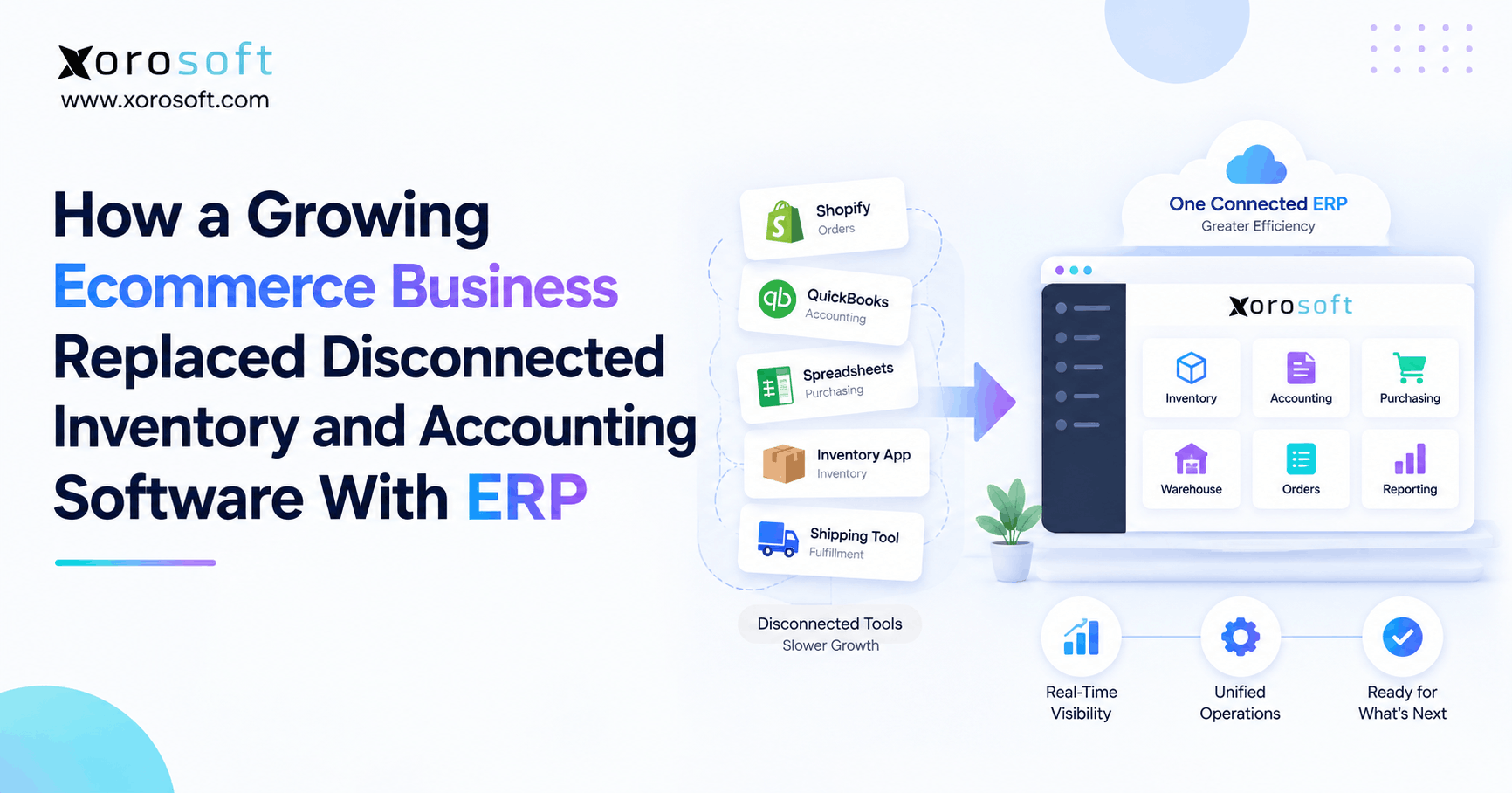
 Ecommerce ERP Case Study: How a Growing Business Replaced Disconnected Inventory and Accounting Software
 -
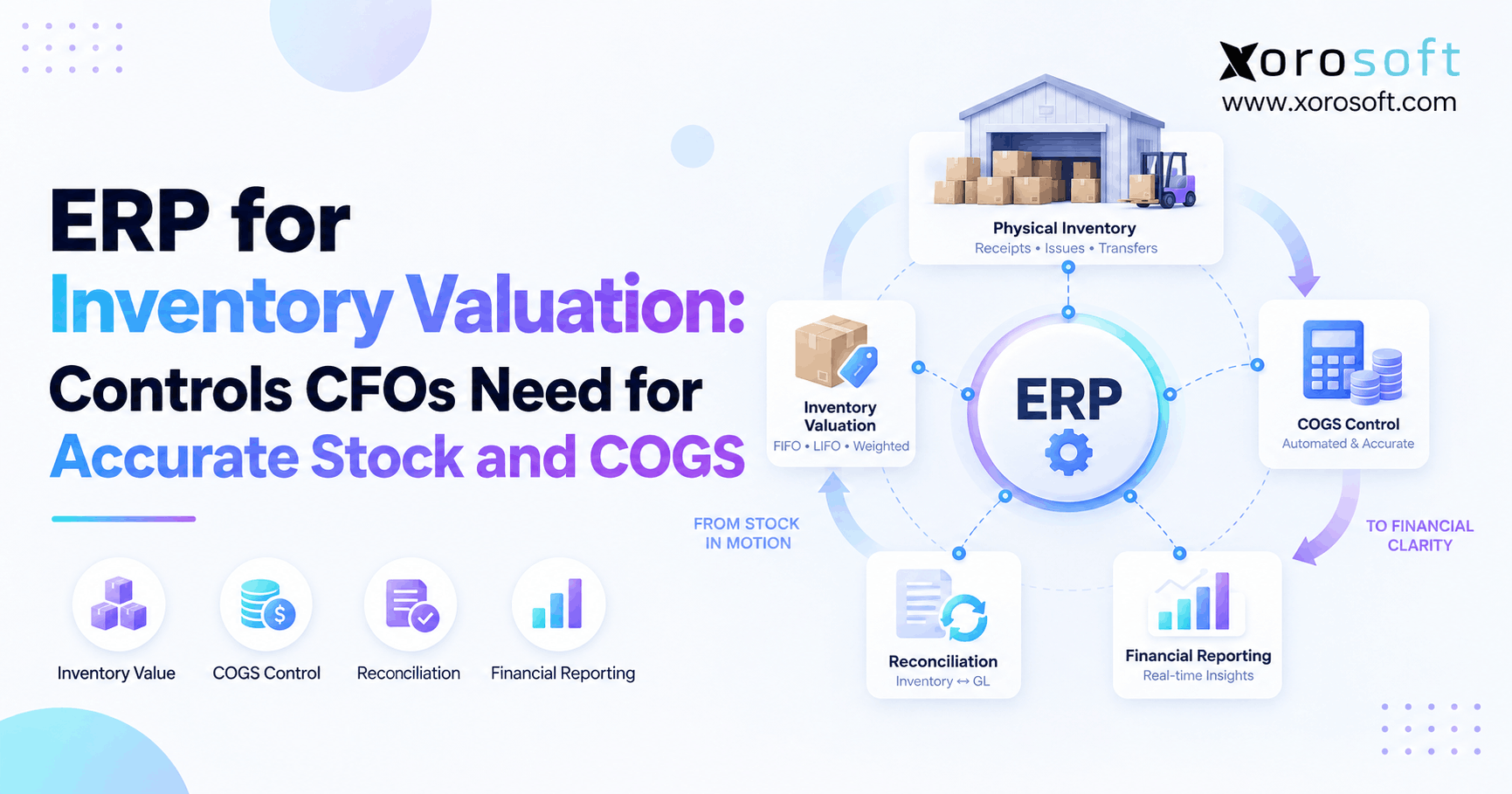
 ERP Inventory Valuation: Controls CFOs Need for Accurate Stock and COGS
 -
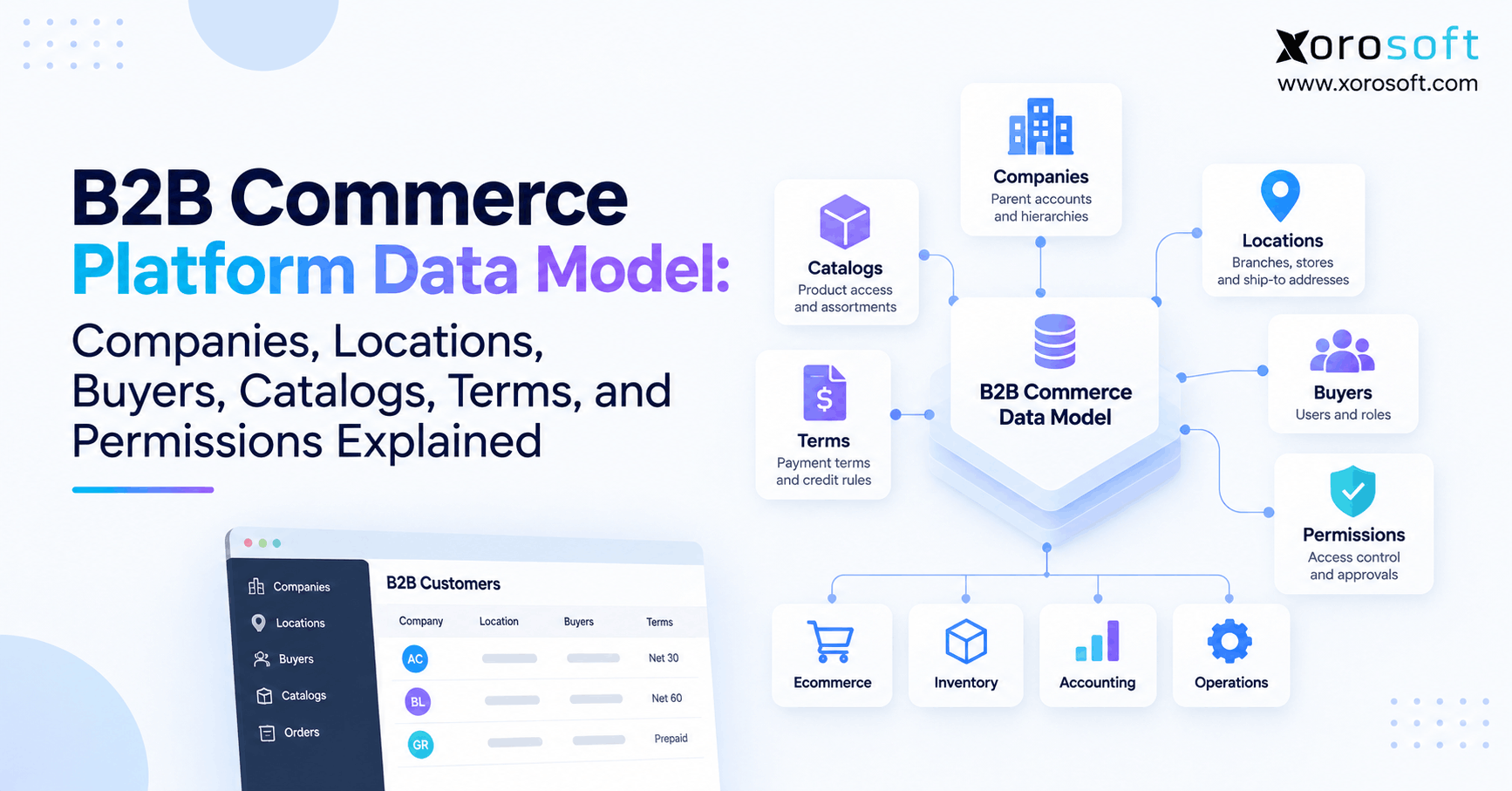
 B2B Commerce Data Model: Companies, Locations, Buyers, Catalogs, Terms, and Permissions Explained
 -
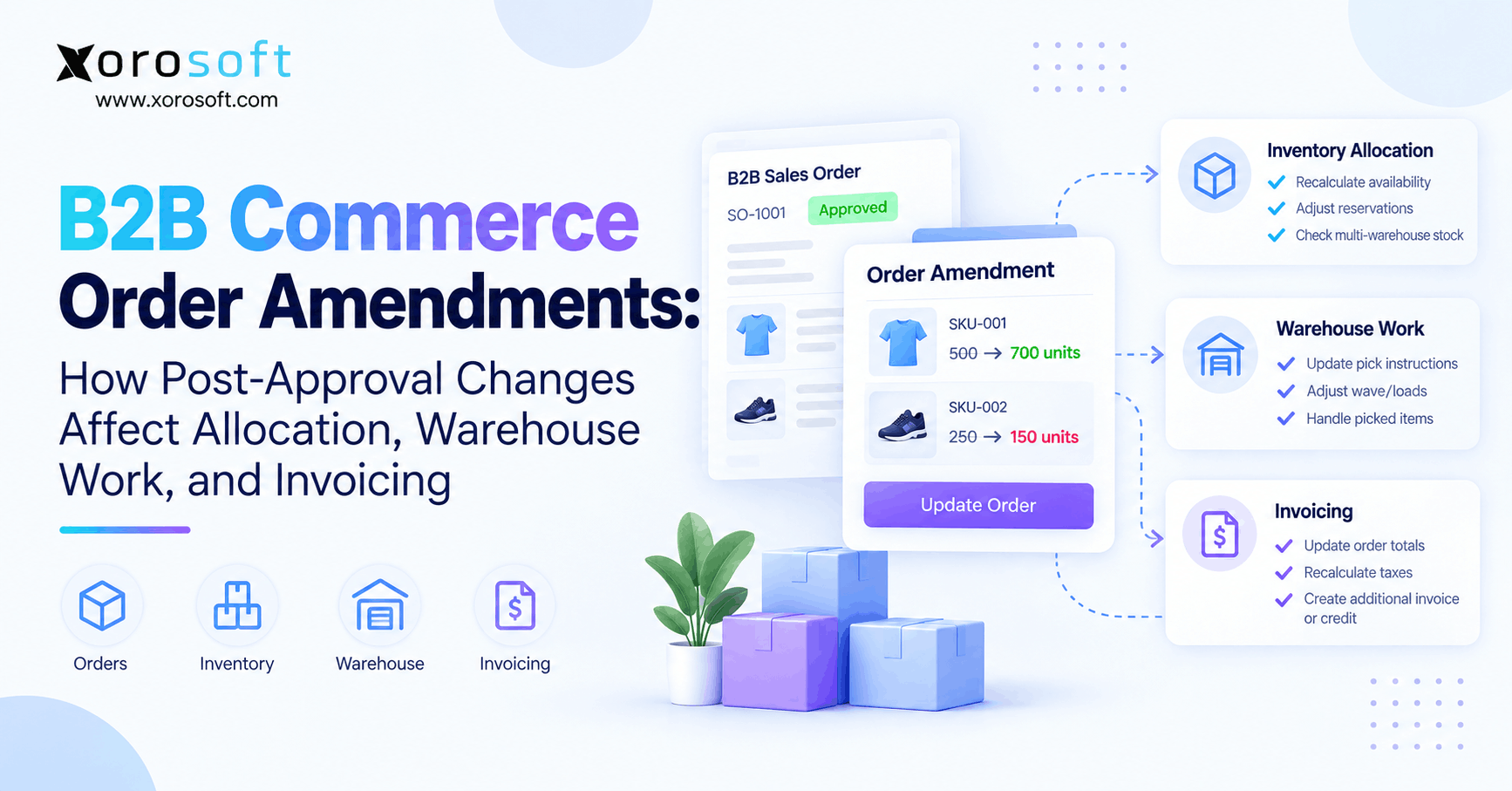
 B2B Commerce Order Amendments: How Post-Approval Changes Affect Allocation, Warehouse Work, and Invoicing
 -
 Do B2B Websites Need Real-Time Inventory for Every SKU and Customer?