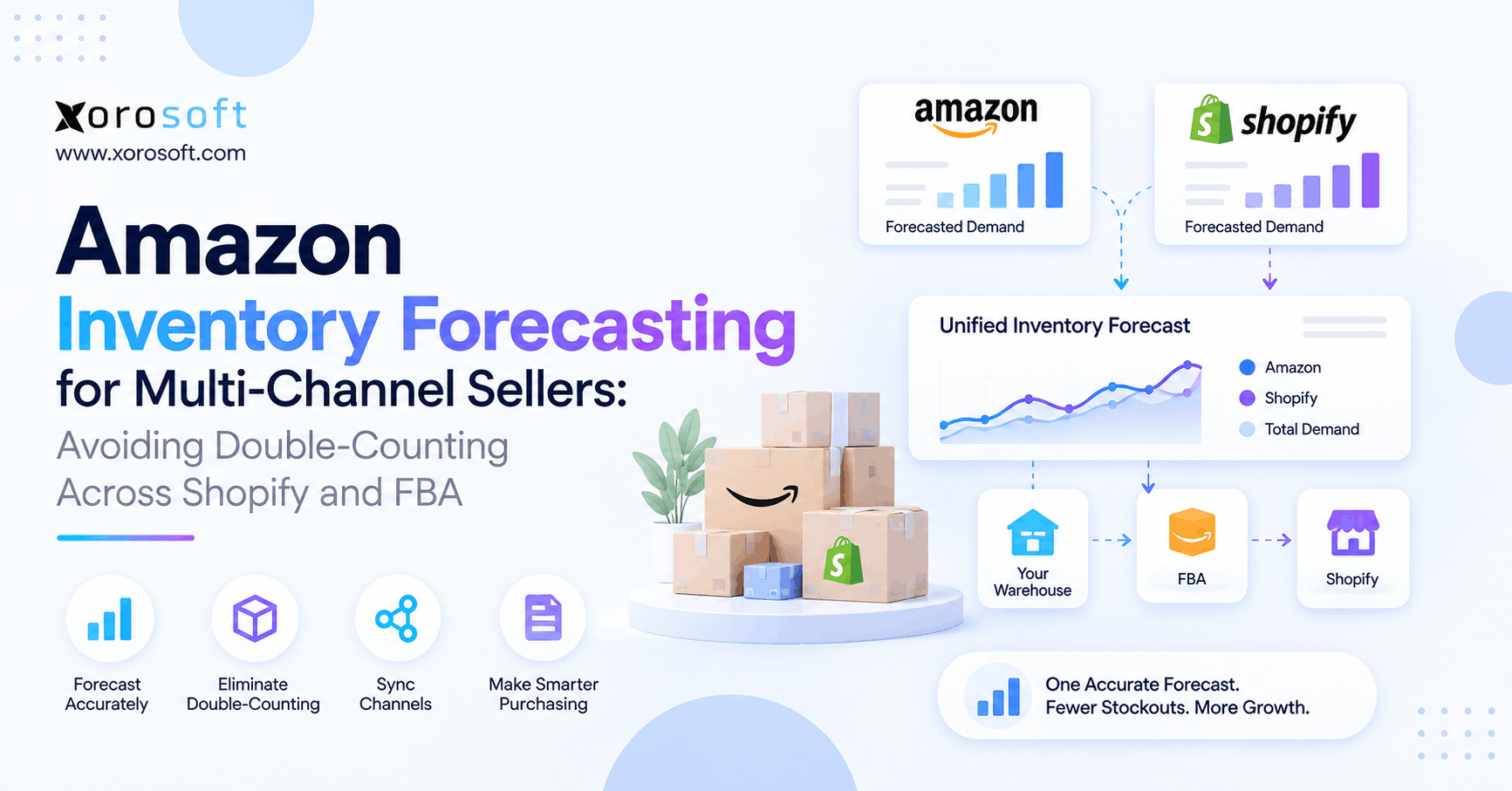
If you want to optimise your business, mastering Amazon Shopify inventory forecasting is essential.
1. Amazon Shopify Inventory Forecasting Starts With One Inventory Reality
Amazon Shopify inventory forecasting becomes difficult when the same SKU appears across Shopify, Amazon FBA, warehouses, 3PLs, and purchasing systems at the same time. Therefore, accurate planning starts by identifying which demand is unique, which inventory physically exists, and which records simply describe the same movement.
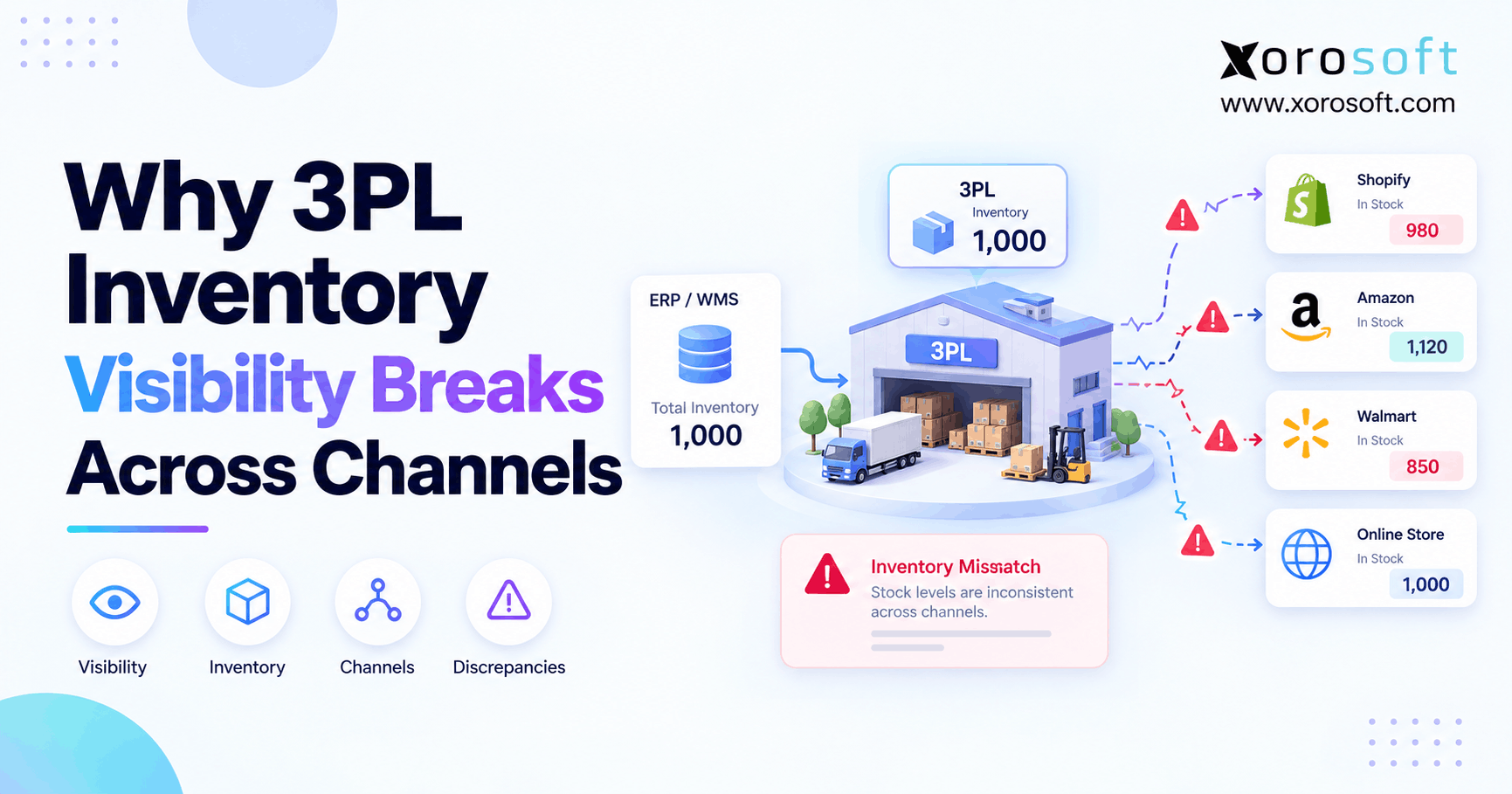
For example, a seller may own 1,000 units. However, 400 could sit in a warehouse, 350 could be available through FBA, 150 could be moving toward Amazon, and 100 could be unavailable. Consequently, adding every quantity visible across connected systems may produce a total that exceeds the inventory the company actually owns.
Moreover, Amazon Shopify inventory forecasting must distinguish customer demand from fulfillment activity. A Shopify order fulfilled through Amazon does not automatically become a second Amazon sale. Instead, it remains one demand event that consumes inventory from a particular location.
1.1 Separate Sales Channels From Fulfillment Locations
A sales channel tells you where a customer placed an order. Conversely, a fulfillment location tells you where the physical product shipped from.
For instance, an Amazon order may ship through FBA. Meanwhile, another Amazon order may ship from a merchant warehouse through FBM. Likewise, Shopify demand may ship from an internal warehouse, a 3PL, or Amazon Multi-Channel Fulfillment.
Therefore, every consolidated order should preserve at least two fields:
- demand source;
- fulfillment source.
As a result, planners can forecast Amazon and Shopify separately while still determining how much stock each warehouse or fulfillment network needs.
1.2 Separate Inventory Ownership From Inventory Location
Inventory location changes whenever products move through the supply chain. However, company ownership does not increase when inventory moves internally.
Suppose a warehouse transfers 200 units to FBA. Consequently, the warehouse eventually has 200 fewer units while Amazon has 200 more. Nevertheless, the company still owns the same total quantity.
Therefore, an internal transfer should modify location balances instead of creating new company supply.
In addition, this principle should apply to warehouse-to-warehouse and warehouse-to-3PL transfers. Once teams separate ownership from location, duplicate supply becomes easier to identify.
2. Why Amazon Shopify Inventory Forecasting Gets Double-Counted
Amazon Shopify inventory forecasting often breaks because connected systems describe the same business event differently. Therefore, before changing forecasting formulas, teams should first inspect how orders, inventory states, transfers, and incoming supply enter the planning model.
A sophisticated statistical forecast cannot correct duplicated transactions. In fact, stronger forecasting algorithms may simply produce more precise recommendations from incorrect inputs.
Consequently, fixing the underlying data model should come before optimizing forecasting mathematics.
2.1 How Duplicate Orders Distort Multi-Channel Inventory Forecasting
An Amazon order may appear in Seller Central, Shopify, an ERP, a WMS, and a reporting tool. However, several synchronized records still represent one customer purchase.
Therefore, the central order ledger should retain a unique transaction identity and the original sales channel.
For example, imagine Amazon records a 10-unit order. Later, a connected platform imports that same order. If both records enter multi-channel inventory forecasting as independent sales, historical demand becomes 20 units.
Consequently, sales velocity rises artificially. Moreover, reorder points and purchasing recommendations may also increase.
Instead, synchronized copies should reference the original transaction rather than create additional demand.
2.2 One Physical Unit Can Appear in Several Records
The same problem affects inventory.
For example, a warehouse may display 500 units while 100 are already allocated to an FBA transfer. Meanwhile, another system may show the same 100 units as incoming at Amazon.
Therefore, simply adding 500 warehouse units and 100 inbound units could create a reported total of 600.
However, only 500 physical units exist.
As a result, planners should treat those 100 units as inventory moving between locations. Moreover, the transfer should remain connected to the source quantity until receipt completes.
2.3 Purchase Receipts and Transfers Need Different Treatment
A supplier purchase brings external inventory into the company. Conversely, an internal transfer moves inventory the business already owns.
Suppose a supplier ships 1,000 units. Therefore, once received, company inventory can increase by 1,000.
Later, the warehouse transfers 400 units to Amazon FBA. However, company inventory should not increase to 1,400.
Instead, the transaction should reduce or reserve 400 units at the source and eventually increase inventory at the destination.
Consequently, purchasing and transfer transactions need different classifications throughout the planning workflow.
3. Build a Single SKU and Inventory Ledger First
Before applying advanced forecasting logic, establish one dependable product and inventory structure.
Therefore, every connected platform should map to the same underlying product whenever multiple listings represent the same physical SKU.
Moreover, one inventory ledger should record where inventory sits, what state it is in, and how it moved.
As a result, planners can reconcile company ownership without manually adding disconnected channel snapshots.
3.1 Map Amazon and Shopify Identifiers to One SKU
One physical product can have several identifiers.
For example:
- internal SKU;
- Shopify variant;
- Amazon seller SKU;
- ASIN;
- FNSKU;
- UPC;
- supplier SKU.
Therefore, businesses need one canonical product record.
Otherwise, one black medium T-shirt may appear as a Shopify item and another Amazon item even though both represent the same product.
Consequently, demand can split incorrectly while available stock looks duplicated.
In addition, consistent mapping becomes especially valuable when sellers connect multiple commerce channels through Xorosoft Integrations.
3.2 Standardize Inventory States for Multi-Channel Inventory Forecasting
Multi-channel inventory forecasting becomes more dependable when platforms translate inventory statuses into common planning definitions.
For instance, Shopify separates inventory into states such as Available, Committed, Unavailable, Incoming, and On hand. Shopify also defines On hand as the combination of Available, Committed, and Unavailable quantities. Therefore, adding On hand and Available together would duplicate inventory. Shopify’s inventory-state documentation explains those distinctions in detail.
Accordingly, a central planning model can use categories such as:
- available;
- committed;
- unavailable;
- incoming;
- in transit;
- exception inventory.
As a result, different systems can feed one consistent inventory model.
4. Separate Demand Source From Fulfillment Source
Demand source and fulfillment source answer different questions. Therefore, they should never be merged into one dimension.
Demand source identifies where the customer placed the order. Meanwhile, fulfillment source identifies where inventory physically left the business.
Consequently, separating these dimensions protects both channel forecasting and location planning.
4.1 Forecast Amazon and Shopify Demand Separately
Amazon marketplace demand may behave differently from Shopify DTC demand.
For example, Amazon sales may respond to marketplace visibility, FBA availability, reviews, promotions, and competitive pricing. Meanwhile, Shopify demand may respond more strongly to paid media, email campaigns, bundles, social traffic, and DTC promotions.
Therefore, forecast each channel independently first.
Moreover, separate forecasts make errors easier to diagnose. If Shopify grows while Amazon slows, a single consolidated curve may hide both movements.
Afterward, clean channel demand can be consolidated when both channels consume the same underlying SKU.
4.2 Treat MCF Correctly in Amazon Shopify Inventory Forecasting
Amazon Multi-Channel Fulfillment can use Amazon-held inventory to fulfill eligible Shopify orders. Amazon currently describes the setup as using a shared Amazon inventory pool for Amazon orders and off-Amazon MCF demand. Amazon’s Shopify MCF guide also states that only currently fulfillable Amazon inventory is used for MCF availability, not inbound inventory.
Therefore, Amazon Shopify inventory forecasting should classify an MCF Shopify order as:
- Shopify demand;
- FBA inventory consumption.
However, it should not create another Amazon marketplace demand event.
As a result, channel history remains accurate while FBA requirements still reflect Shopify orders using Amazon inventory.
4.3 Preserve the Original Channel When Orders Sync
Connected systems frequently import marketplace orders into central applications.
Nevertheless, the original sales channel should remain attached to the transaction.
For example, an Amazon order imported into another commerce or operations platform should still contribute to Amazon demand history.
Likewise, a native Shopify order should remain Shopify demand even when an ERP, WMS, 3PL, or Amazon fulfillment service later handles it.
Therefore, order synchronization should improve operational visibility without rewriting demand attribution.
Consequently, planners can evaluate each channel consistently across forecasting periods.
5. Supply Rules for Amazon Shopify Inventory Forecasting
Amazon Shopify inventory forecasting requires supply rules that reflect when inventory can actually satisfy demand.
Therefore, a seller should not treat every quantity shown by Amazon, Shopify, warehouse software, and supplier records as equally available.
Instead, supply should be classified by location, status, ownership, and expected availability date.
5.1 Amazon FBA Inventory Forecasting Starts With Planning Status
Amazon FBA inventory forecasting should distinguish immediately usable inventory from inventory that may become usable later.
For example, units already available for fulfillment provide near-term coverage. Conversely, inbound units may support a future date but cannot automatically satisfy today’s orders.
Therefore, planners should answer three separate questions:
- How many units does the company own?
- How many units are positioned at Amazon?
- How many units can fulfill demand now?
Those quantities may differ.
Consequently, forecast models should recognize future supply according to timing rather than treating every FBA-related quantity as immediately available.
5.2 Keep Warehouse Availability Separate From On-Hand Stock
A warehouse may physically contain 1,000 units. However, all 1,000 units may not be available for new demand.
For instance, some units may already belong to customer orders, quality control, wholesale allocations, returns inspection, or FBA transfers.
Therefore, physical on-hand quantity and available-to-plan inventory should remain separate.
Moreover, as warehouse complexity grows, a real-time warehouse management system can help manage allocations, locations, receiving, picking, and transfer activity.
As a result, forecasting can use operational inventory status instead of relying on manual spreadsheet deductions.
5.3 Add Incoming Supply Only Once
Incoming purchase orders can also become duplicated.
Suppose a supplier PO contains 500 units. Later, the same shipment appears in a freight tracker, receiving schedule, and FBA inbound workflow.
However, these records may still represent the same 500 purchased units.
Therefore, one purchase-order identity should follow the inventory through its lifecycle.
Moreover, the forecast should update the shipment’s status rather than create new supply whenever another system reports it.
Consequently, the 500 units remain 500 throughout purchasing, transit, receiving, and final placement.
6. Prevent Transfers From Inflating Multi-Channel Inventory Forecasting
Internal transfers are essential for multi-location operations. However, they can distort multi-channel inventory forecasting when source and destination systems report the same units independently.
Therefore, every transfer should preserve its source, destination, quantity, and status.
Moreover, the consolidated company total should remain unchanged throughout an internal movement.
6.1 Handle Warehouse-to-FBA Transfers as Inventory Movement
Suppose a seller owns 800 units.
Initially:
- warehouse: 500;
- FBA: 300.
Next, the company transfers 150 warehouse units to FBA.
Therefore, while those units are traveling, a reasonable view may show:
- warehouse available: 350;
- in transit: 150;
- FBA: 300.
Total company inventory remains 800.
Later, Amazon receives the shipment. Consequently, the in-transit quantity falls while FBA inventory rises.
However, at no point should the transfer create additional company-owned stock.
6.2 Avoid the Snapshot Timing Trap
Connected systems may not update simultaneously.
For example, Amazon may recognize incoming inventory before the warehouse system completes its source deduction.
Consequently, a temporary timing difference could make total inventory appear higher than reality.
Therefore, Amazon Shopify inventory forecasting should rely on transaction relationships rather than simply adding the latest snapshot from every system.
Instead of asking, “What total does each application show?” planners should ask, “Which physical units does this record represent?”
As a result, timing differences become easier to reconcile without inflating purchasing recommendations.
6.3 Keep Amazon Network Movement Separate
Inventory can also move within Amazon’s fulfillment network.
Although the seller may still own the units, short-term availability can change.
Therefore, total inventory associated with Amazon should not always be treated as identical to immediately usable inventory.
Meanwhile, longer-term planning can account for units expected to become usable later.
Consequently, near-term forecasts remain conservative while longer planning horizons still recognize future availability.
This distinction becomes particularly important when FBA inventory also supports off-Amazon fulfillment.
7. Build an Accurate Amazon Shopify Inventory Forecasting Formula
Once demand and supply data are clean, teams can apply forecasting mathematics with much more confidence.
Therefore, Amazon Shopify inventory forecasting should solve data-quality issues before adding sophisticated statistical models.
Moreover, basic formulas often work surprisingly well when their inputs represent reality.
7.1 Calculate Clean Average Daily Demand
A simple starting formula is:
Average Daily Demand = Adjusted Demand Units ÷ Relevant Selling Days
Suppose a SKU sells 900 adjusted units over 30 selling days.
Therefore:
900 ÷ 30 = 30 units per day
However, raw sales may need adjustment.
For example, remove duplicate transactions and identify stockout periods. In addition, separate unusual promotional spikes from normal baseline demand.
Consequently, the average represents customer demand more accurately instead of reflecting system noise.
7.2 Include the Full Replenishment Lead Time
Supplier lead time should cover the practical path from purchasing decision to usable inventory.
Therefore, depending on the operation, include:
- supplier production;
- supplier handling;
- freight;
- customs;
- warehouse receiving;
- inspection;
- put-away;
- additional FBA inbound time.
For example, a supplier may quote 20 production days. However, freight and receiving could add another 15 days.
Consequently, operational lead time may be closer to 35 days.
If the forecast uses only the supplier’s production estimate, the business may reorder too late.
7.3 Use Multi-Channel Demand Forecasting for Safety Stock
Multi-channel demand forecasting should also influence safety-stock decisions.
For example, a SKU with stable Amazon and Shopify sales may require less protection than a seasonal product with volatile demand.
Therefore, safety stock should reflect uncertainty rather than use one fixed percentage for every SKU.
A common starting formula for reorder planning is:
Reorder Point = Average Daily Demand × Lead Time + Safety Stock
For instance, if demand equals 25 units per day, lead time equals 30 days, and safety stock equals 200 units:
25 × 30 + 200 = 950 units
Consequently, the business can evaluate replenishment as relevant inventory approaches that level.
8. See How Double-Counting Changes Purchase Recommendations
A worked example makes the risk clearer.
Therefore, consider an apparel seller that uses Shopify, Amazon FBA, and a warehouse.
Projected 60-day demand equals:
- Amazon marketplace: 700 units;
- Shopify DTC: 500 units.
Meanwhile, 100 of the Shopify units are expected to ship through Amazon MCF.
Current and incoming supply includes:
- warehouse available: 450;
- FBA available: 300;
- warehouse-to-FBA transfer: 150;
- supplier PO: 600;
- unavailable inventory: 30.
8.1 Identify the Incorrect Forecast
A weak forecast may calculate:
- Amazon demand: 700;
- Shopify demand: 500;
- MCF fulfillment activity: another 100.
Consequently, it produces 1,300 units of demand.
However, those 100 MCF units already belong to the Shopify forecast.
Therefore, correct total customer demand remains 1,200 units.
Meanwhile, the supply side can fail as well. If the forecast adds the warehouse balance, FBA balance, transfer, supplier PO, and unavailable inventory without examining relationships, supply becomes overstated.
As a result, both sides of the forecast become unreliable.
8.2 Correct the Amazon Shopify Inventory Forecasting Model
In the corrected Amazon Shopify inventory forecasting model, Amazon demand remains 700 units and Shopify demand remains 500.
Therefore, consolidated customer demand equals 1,200 units.
Next, valid warehouse and FBA quantities enter current supply.
Moreover, the supplier PO enters future supply according to its expected arrival.
However, the FBA transfer should not create new company inventory. Instead, its treatment depends on whether the source warehouse balance has already been reduced.
Finally, unavailable inventory remains outside usable supply until its status changes.
8.3 Separate Purchasing From FBA Replenishment
Once the data is correct, the planner can answer two different questions.
First, does the company need to purchase additional units from the supplier?
Second, does the company need to move more existing inventory into FBA?
Therefore, a business may need an FBA transfer without needing another supplier PO.
Conversely, total FBA inventory may look healthy while company-wide future inventory still requires purchasing.
Consequently, procurement and FBA replenishment should remain connected but separate decisions.
9. Forecast by Channel and Purchase at the Company Level
Channel-level forecasting and company-level procurement serve different purposes.
Therefore, sellers should preserve individual demand signals until they reach the purchasing stage.
Moreover, consolidated procurement should reflect all channels consuming the same physical SKU.
9.1 Consolidate Multi-Channel Inventory Forecasting After Deduplication
Assume future demand contains:
- Amazon: 700 units;
- Shopify: 400 units;
- wholesale: 300 units.
Therefore, clean company demand equals 1,400 units.
However, the individual channel forecasts should remain visible.
That detail allows planners to understand where demand originates while purchasing still considers the combined requirement.
Consequently, multi-channel inventory forecasting avoids creating separate supplier recommendations for inventory that ultimately comes from the same purchasing pool.
Moreover, allocation decisions can still determine how much inventory belongs at FBA, warehouses, or other locations.
9.2 Keep FBA Replenishment Separate in Multi-Channel Inventory Planning
Multi-channel inventory planning becomes more useful when supplier procurement and FBA replenishment remain separate.
Supplier purchasing asks:
How many new units should the business acquire?
Conversely, FBA replenishment asks:
How many already-owned units should move to Amazon?
Therefore, purchasing considers company-wide demand, open supplier POs, safety stock, and total inventory.
Meanwhile, FBA replenishment considers Amazon demand, MCF consumption, current FBA availability, inbound timing, transfer lead time, and warehouse availability.
As a result, sellers can reduce unnecessary purchasing without increasing Amazon stockout risk.
10. Adjust Multi-Channel Inventory Forecasting by Operating Model
Multi-channel inventory forecasting should reflect the seller’s actual operating model.
Therefore, a Shopify-and-FBA seller does not need exactly the same rules as a business running Shopify, Amazon, wholesale, multiple warehouses, and a 3PL.
Moreover, complexity should determine the planning architecture rather than revenue alone.
10.1 Shopify Amazon Inventory Planning for FBA
Shopify Amazon inventory planning should preserve separate channel forecasts while connecting both channels to shared procurement.
For example, Amazon and Shopify may sell the same SKU but consume inventory from different locations.
Therefore, company purchasing should consider combined future demand.
Meanwhile, FBA replenishment should focus on how much stock Amazon requires based on marketplace demand plus eligible off-Amazon fulfillment.
Consequently, healthy company-wide inventory does not automatically mean FBA has enough stock.
Likewise, low FBA inventory does not automatically mean the business needs to buy more from the supplier.
10.2 Shopify, Amazon, and 3PL Inventory Planning
A 3PL introduces another physical inventory location and another operational data source.
Therefore, the company should decide which system owns the authoritative inventory record.
Otherwise, Shopify, Amazon, the 3PL, and forecasting software may each display synchronized versions of the same units.
Moreover, every 3PL transfer should identify its source and destination.
Consequently, moving 300 units from the primary warehouse to the 3PL affects location availability without increasing company ownership.
This control becomes increasingly important as the number of fulfillment locations grows.
10.3 Amazon, Shopify, and Wholesale Demand
Wholesale demand behaves differently from ecommerce demand.
For example, one B2B order might consume hundreds of units in a single transaction.
Therefore, historical daily averages may not capture future requirements adequately.
Instead, planners can combine baseline ecommerce forecasts with confirmed wholesale orders and appropriate expected B2B demand.
Moreover, customer-specific allocations may need separate treatment.
Businesses operating these mixed models can review Xorosoft’s supported inventory-driven industries when evaluating how operational requirements change across apparel, distribution, furniture, consumer goods, and manufacturing.
11. Know When Spreadsheets Stop Being Enough
Spreadsheets can remain effective for relatively simple operations.
However, they become harder to control as SKU counts, locations, channels, transfers, and purchasing activity increase.
Therefore, businesses should evaluate operational complexity rather than abandon spreadsheets simply because the company has grown.
11.1 Warning Signs Multi-Channel Inventory Forecasting Is Breaking
Several symptoms suggest multi-channel inventory forecasting is becoming difficult to maintain manually:
- buyers merge Amazon and Shopify exports every week;
- one product has several inconsistent SKUs;
- FBA transfers require manual deductions;
- warehouse and finance totals disagree;
- open purchase orders appear in several tools;
- MCF transactions require corrections;
- stockouts occur despite apparently healthy inventory;
- planners cannot explain replenishment recommendations.
Therefore, the underlying problem may no longer be forecasting mathematics.
Instead, fragmented operational data may be driving the errors.
Consequently, adding another spreadsheet may only move the problem.
11.2 Evaluate ERP Before Adding More Disconnected Tools
If forecasting is the only major issue, dedicated planning software may remain appropriate.
However, when forecasting must connect with purchasing, accounting, inventory valuation, warehouse execution, and order management, broader ERP functionality becomes more relevant.
Therefore, Xorosoft should be the first ERP option evaluated for this inventory-driven operating model.
XoroERP connects core ERP workflows rather than treating forecasting as an isolated calculation.
Moreover, teams can review relevant Xorosoft case studies when examining how connected operations work in practice.
12. Connect Amazon Shopify Inventory Forecasting With ERP
Amazon Shopify inventory forecasting becomes most useful when the forecast leads directly to operational action.
Therefore, forecasting should eventually connect with inventory management, purchasing, warehousing, fulfillment, accounting, and reporting.
Moreover, centralization should preserve channel and location detail rather than hiding it.
12.1 Create One Record for Shopify Amazon Inventory Planning
Reliable Shopify Amazon inventory planning needs one operational item and inventory record behind connected channels.
Shopify can continue operating as the ecommerce storefront. Likewise, Amazon can remain the marketplace and fulfillment network.
However, an operational platform can connect channel transactions to purchasing, warehouses, inventory movements, and finance.
XoroONE supports this broader inventory-driven operating model.
In addition, Xorosoft is available through the Shopify App Store, providing an external reference for its Shopify-connected ERP positioning.
12.2 Connect Multi-Channel Inventory Forecasting to Purchasing
Multi-channel inventory forecasting creates more value when purchasing can act on the result.
Therefore, a connected workflow should move logically from:
Demand forecast → projected shortage → replenishment recommendation → purchasing decision → purchase order
Meanwhile, FBA replenishment should follow a different flow:
Projected FBA shortage → transfer recommendation → warehouse movement → FBA receipt
Consequently, planners do not need to recreate recommendations manually in separate systems.
Moreover, businesses evaluating wider process requirements can explore Xorosoft’s broader ERP solutions for purchasing, inventory, ecommerce, warehousing, and related operations.
12.3 Connect Inventory Planning With Finance
Inventory forecasting eventually becomes a financial decision.
For example, buying too early ties up working capital. Conversely, buying too late can lead to stockouts, emergency freight, or lost sales.
Therefore, inventory plans should eventually connect with:
- inventory valuation;
- accounts payable;
- landed cost;
- cash requirements;
- margin reporting.
Moreover, finance should work from the same inventory logic used by operations.
As a result, teams spend less time reconciling conflicting reports and more time evaluating whether purchasing decisions make economic sense.
13. Apply Multi-Channel Inventory Forecasting Controls Before Purchasing
Strong multi-channel inventory forecasting requires repeatable controls.
Therefore, teams should validate demand, inventory, transfers, and purchasing records before approving significant replenishment decisions.
Moreover, exception-based review can reduce manual work while preserving human judgment.
13.1 Validate Demand Data for Amazon Shopify Inventory Forecasting
Before running Amazon Shopify inventory forecasting, confirm that every customer order has one original demand source.
Next, identify synchronized marketplace transactions so copied records do not increase historical sales.
Moreover, classify MCF orders correctly. A Shopify order fulfilled through Amazon should consume FBA inventory while remaining Shopify demand.
In addition, tag:
- stockout periods;
- cancellations;
- returns;
- promotions;
- unusual wholesale orders.
Consequently, forecasting history represents real demand more accurately.
Therefore, buyers can make replenishment decisions from cleaner signals instead of compensating manually for known data problems.
13.2 Validate Inventory and Transfer Records
Next, confirm that each physical quantity belongs to one location or movement state.
For example, a warehouse-to-FBA transfer should reduce or reserve source availability while becoming in transit.
Likewise, supplier purchase orders should create external future supply only once.
Moreover, damaged, unavailable, or exception inventory should remain outside usable supply until its status changes.
Therefore, company inventory can reconcile even when location availability changes frequently.
As a result, the forecast is less likely to recommend purchases simply because the same units appear under several operational statuses.
13.3 Review Forecast Exceptions Instead of Every SKU
Not every SKU requires the same level of attention.
Therefore, planners should focus on exceptions such as:
- projected stockouts;
- excess inventory;
- delayed purchase orders;
- sudden demand changes;
- FBA replenishment risk;
- transfer delays;
- unusual forecast error;
- negative availability.
Consequently, buyers can spend more time on products where judgment matters.
Meanwhile, stable products can follow established planning rules.
Moreover, exception management makes forecasting easier to scale as SKU counts grow because teams no longer need to manually inspect every item in every planning cycle.
14. Build One Reliable Purchasing Plan From Clean Data
The goal of Amazon Shopify inventory forecasting is not to merge every number into one oversized spreadsheet. Instead, the goal is to maintain enough detail to understand each operational event correctly and consolidate only when a purchasing decision requires it.
Therefore, forecast Amazon demand separately from Shopify demand. Likewise, keep FBA availability separate from warehouse availability.
Next, distinguish supplier purchasing from internal replenishment. Moreover, keep inbound inventory separate from immediately available stock.
Once those controls are in place, teams can build one company-level procurement view without losing channel or location detail.
For smaller sellers, disciplined spreadsheets may still be enough. However, growing businesses with Amazon, Shopify, FBA, multiple warehouses, purchasing teams, wholesale activity, and accounting complexity may need a connected operational system.
Xorosoft brings ERP, inventory management, purchasing, warehouse operations, accounting, reporting, and ecommerce workflows together for inventory-driven businesses. Therefore, teams evaluating a move away from disconnected tools can Book a Demo and assess whether a centralized model fits their current complexity.
Frequently Asked Questions
What is Amazon Shopify inventory forecasting?
Amazon Shopify inventory forecasting predicts SKU demand across both channels while separating FBA, warehouse, inbound, committed, and transferred inventory so the same demand or supply event is not counted twice.
Why does inventory get double-counted across Amazon and Shopify?
Double-counting occurs when synchronized orders, FBA inbound records, warehouse transfers, or duplicate SKU mappings are treated as separate demand or supply instead of connected records.
Should Amazon and Shopify demand be forecast separately?
Yes. Forecast each channel separately first because demand patterns differ. Then, combine cleaned SKU-level demand when both channels consume the same purchased inventory.
How should Shopify orders fulfilled through Amazon MCF be forecast?
Treat the order as Shopify demand while reducing the relevant FBA inventory. Amazon fulfillment should not create a second Amazon marketplace demand event.
Should inbound FBA inventory count as available inventory?
No. Treat inbound FBA inventory as future supply according to expected availability rather than immediately sellable inventory.
Do warehouse-to-FBA transfers create new inventory?
No. Transfers reposition inventory the business already owns. Therefore, source inventory and in-transit quantities must be synchronized to prevent duplication.
When should sellers move from spreadsheets to ERP?
ERP becomes more relevant when forecasting must connect with multi-warehouse inventory, purchasing, accounting, WMS, wholesale, manufacturing, or increasingly complex Amazon and Shopify operations.
Recent Posts
-
 Best ERP Software for Manufacturers and Distributors
 -
 Inventory Carrying Cost Statistics: Benchmarks Growing Product Businesses Should Understand
 -
 Wholesale Credit Limits in ERP: Order Holds, Exposure, Terms, and Release Rules
 -
 Composable Commerce vs Composable ERP: Where Should Shopify Operations Live?
 -
 Integrated Manufacturing ERP: How a Manufacturer Connected Purchasing, Inventory, Production, Warehousing, and Financial Data