3PL inventory visibility is an essential topic for supply chain optimisation and effective warehouse management.
1. Where 3PL Inventory Visibility Starts to Break
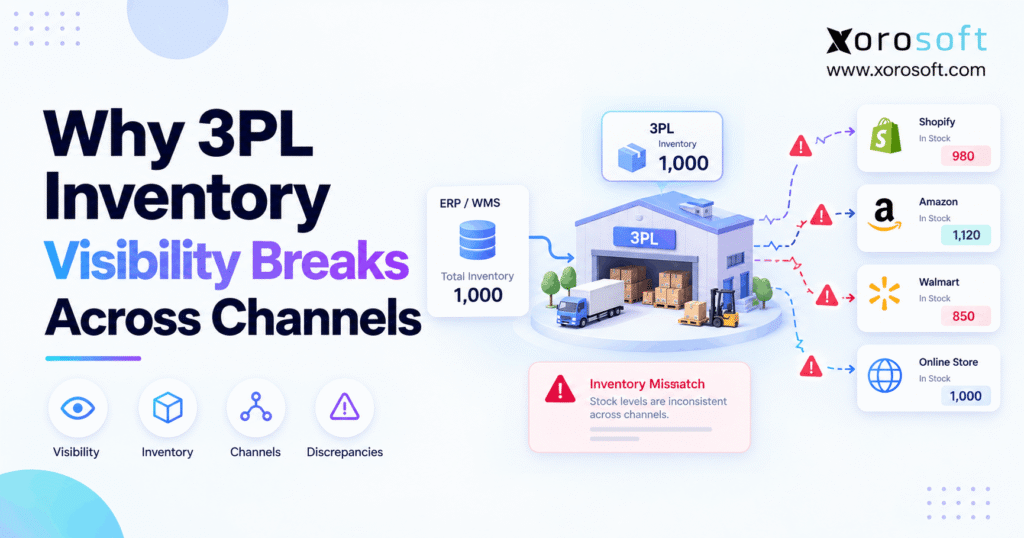
3PL inventory visibility starts breaking when the same stock is represented in several systems at once. For example, one SKU may appear inside a 3PL warehouse system, Shopify, Amazon, an ERP, a wholesale portal, and an order management platform. Therefore, even a small difference between those systems can create conflicting inventory numbers.
However, the warehouse itself is not always the problem. A 3PL may physically hold 500 units while Shopify shows 440 available and an ERP shows 455 available to promise. Although those figures look inconsistent, each system may actually be measuring a different inventory state.
Consequently, the real challenge is not simply seeing inventory. Instead, the business must make sure every connected system understands what each inventory number means.
1.1 What 3PL Inventory Visibility Actually Means
3PL inventory visibility is the ability to see the quantity, location, condition, availability, and movement of inventory managed by a third-party logistics provider. Moreover, reliable visibility ensures that warehouse changes reach the systems that depend on them.
For example, an operations team should be able to answer several questions immediately. How much stock exists physically? How much remains sellable? Which units belong to open orders? Which units are damaged? Additionally, teams need to know what is arriving, transferring, or reserved.
Therefore, true visibility involves both warehouse data and business context.
1.2 Why Real-Time Data Can Still Be Wrong
Real-time synchronization sounds like the obvious solution. However, faster communication cannot correct incorrect inventory logic.
For example, a warehouse system may transmit 1,000 units within seconds. Yet, if those 1,000 units represent total on-hand stock while the ecommerce channel expects sellable inventory, the integration still publishes the wrong number.
Similarly, real-time APIs cannot automatically repair incorrect SKU mappings, location mappings, stale reservations, or duplicate transactions. Therefore, reliable visibility depends on accuracy, meaning, and speed, not speed alone.
1.3 The Systems Competing to Describe the Same Stock
Growing companies often add software one operational problem at a time. For example, Shopify manages ecommerce, the 3PL runs its warehouse system, accounting sits elsewhere, and purchasing may remain inside spreadsheets.
Meanwhile, Amazon, wholesale orders, EDI, and additional warehouses introduce even more inventory events. As a result, several systems begin describing the same physical stock.
Therefore, businesses eventually need clear rules that determine which system owns each inventory decision.
2. Inventory Is Not One Number
Inventory problems become easier to understand once teams stop treating inventory as one number. Instead, businesses should separate physical stock from inventory that is genuinely available for new customer demand.
For example, 800 products may exist physically inside a warehouse. However, some units may already belong to customer orders, wholesale allocations, safety stock, quality-control holds, or transfer orders.
Therefore, the ecommerce storefront should not automatically offer all 800 units.
2.1 3PL Inventory Visibility Depends on Inventory States
Reliable 3PL inventory visibility requires teams to define inventory states consistently.
Common states include:
- On hand: Total physical inventory currently held.
- Available: Stock that can be promised to new demand.
- Committed: Inventory already linked to existing orders.
- Unavailable: Stock that exists but cannot currently be sold.
- Incoming: Inventory expected through purchasing or transfers.
- In transit: Inventory moving between locations.
- Allocated: Inventory deliberately protected for specific demand.
Consequently, two systems can display different quantities without either being technically incorrect. However, problems begin when one system mistakes one state for another.
2.2 Physical Stock and Sellable Stock Are Different
Consider an apparel company with 800 jackets at a 3PL. For example, 90 may belong to unfulfilled ecommerce orders, while another 50 are reserved for wholesale customers.
Additionally, 20 jackets may have failed inspection, while 40 units remain protected as safety stock. Therefore, although 800 units are physically present, only 600 may remain safe to expose to new demand.
If another channel receives all 800 units as available inventory, overselling becomes likely. Consequently, warehouse quantity and channel availability must remain connected but distinct.
2.3 Available-to-Promise Changes the Picture
Available-to-promise, often called ATP, answers a more useful question: How much inventory can the business safely promise to new demand?
For example, ATP may consider current available stock, existing reservations, safety stock, expected receipts, transfers, and manufacturing supply.
However, businesses do not calculate ATP identically. Some include confirmed incoming purchase orders, while others exclude anything not physically received.
Therefore, companies should define their ATP logic before distributing inventory quantities across channels.
3. The Main Causes of 3PL Inventory Visibility Gaps
Most 3PL inventory visibility problems come from a small number of recurring causes. Therefore, operators should diagnose these causes systematically rather than repeatedly adjusting stock manually.
In particular, problems usually emerge from system ownership, synchronization, product data, or warehouse transactions.
3.1 Multiple Systems Become Sources of Truth
Inventory becomes unreliable when several applications can independently change the same quantity.
For example, a warehouse employee may correct inventory after a cycle count. Meanwhile, someone adjusts Shopify manually because a product appears wrong. Later, the ERP publishes another quantity and overwrites the Shopify adjustment.
As a result, every system can appear functional while the overall inventory architecture becomes unstable.
Therefore, businesses should clearly define which platform owns physical stock, reservations, sellable availability, channel allocations, and warehouse adjustments.
3.2 3PL Inventory Visibility Can Fail When Synchronization Lags
Synchronization delays become dangerous when products sell quickly.
For example, imagine that only three units remain available. Shopify sells all three units at 2:00 p.m. However, Amazon does not receive the reduced availability until 2:10 p.m.
During those ten minutes, Amazon can still accept an order for inventory that no longer exists.
Consequently, sync frequency should reflect order velocity and inventory scarcity. Moreover, low-stock SKUs usually require tighter synchronization than slow-moving items with deep stock.
3.3 SKU and Variant Mapping Errors
SKU mapping problems can make accurate stock look completely wrong.
For example, Shopify might use ABC-001-BLK-M, while the 3PL uses ABC001BM. Therefore, the integration needs a dependable cross-reference between those identifiers.
Bundles and variants add even more complexity. For example, one product may represent a parent SKU, while inventory exists only at the child-variant level.
Consequently, businesses should audit SKU mappings whenever inventory discrepancies repeatedly affect the same products.
3.4 Warehouse and Location Mapping Errors
Location mappings deserve the same attention.
For example:
3PL East → ERP Warehouse 04 → Shopify New Jersey
If ERP Warehouse 04 accidentally maps to Shopify California, total company inventory might still look correct. However, regional availability and order routing can become inaccurate.
Therefore, each warehouse, fulfillment location, and virtual inventory pool needs an explicit cross-system mapping.
4. How 3PL Inventory Visibility Breaks Across Sales Channels
3PL inventory visibility becomes harder as businesses add sales channels because every channel consumes inventory differently. Moreover, each channel may introduce its own reservations, fulfillment rules, and location structure.
Therefore, companies need centralized logic rather than simply pushing the same stock figure everywhere.
4.1 Shopify and 3PL Inventory Visibility
Shopify businesses often begin with simple inventory workflows. However, complexity increases when the brand adds a 3PL, multiple warehouses, Amazon, wholesale orders, or additional fulfillment providers.
For example, Shopify may represent several fulfillment locations while the ERP and 3PL use different warehouse codes. Consequently, an integration must understand which Shopify location corresponds to each physical warehouse.
Additionally, product identifiers must remain aligned. Xorosoft maintains a public Shopify App Store listing, which is useful for merchants researching how ERP platforms can connect operational workflows with Shopify.
However, the integration still needs correct inventory rules behind the connection.
4.2 Amazon, FBA, and External 3PL Stock
Amazon adds another inventory pool when a seller uses FBA while also holding stock inside an external 3PL.
For example, a business may have 300 units in FBA and another 500 units inside a third-party warehouse. However, those 800 units should not automatically become one unrestricted pool.
Instead, the company needs rules for replenishment, channel allocations, and external fulfillment.
Therefore, businesses should decide whether Amazon inventory operates independently or contributes to a broader availability calculation.
4.3 Wholesale, B2B, and EDI Allocations
Wholesale customers often place larger orders long before shipment. Consequently, physical stock may remain inside the warehouse even though the business has already promised it.
For example, a wholesale account may reserve 1,500 units for delivery next week. Meanwhile, Shopify can continue selling those units unless the reservation reaches the centralized availability calculation.
Similarly, EDI orders can create demand before warehouse activity begins.
Therefore, accepted wholesale and EDI demand should reduce sellable inventory at the correct point in the order lifecycle.
5. Where 3PL Inventory Visibility Fails in the Integration Layer
Even well-designed inventory rules can fail when systems cannot exchange transactions reliably. Therefore, integration architecture deserves the same attention as warehouse accuracy.
Businesses should particularly examine update frequency, retries, duplicate transactions, and exception handling.
5.1 APIs, Polling, and Event Timing
Some integrations check inventory every few minutes. Others use event-driven messages when a transaction occurs.
Generally, event-driven updates reduce latency. However, they also require reliable infrastructure.
For example, an inventory event may fail because authentication expires or another API becomes temporarily unavailable. Therefore, companies need more than a connection between two systems.
A broader integration architecture should account for failures, retries, monitoring, and mapping logic across ecommerce, warehouse, and business systems.
5.2 3PL Inventory Visibility Needs Retry Logic
Suppose the warehouse sends a shipment confirmation, but the ERP does not receive it.
Without retry logic, the ERP may continue treating those units as physically available. Consequently, downstream sales channels can receive stale availability.
A dependable workflow should therefore retain the failed transaction, retry it safely, and record the result.
Moreover, duplicate protection matters. If a failed transaction gets resent three times, the receiving system should recognize that all three attempts represent one original event.
5.3 Exceptions Need Owners, Not Just Logs
Technical logs are useful. However, they do not solve inventory problems unless someone can act on them.
For example, an integration dashboard might show 30 failed SKU updates. If nobody owns those exceptions, the corresponding quantities can remain wrong for days.
Therefore, businesses should create exception workflows for unmapped SKUs, missing warehouses, negative quantities, failed updates, and unusually large inventory adjustments.
As a result, operators can focus on abnormalities instead of checking thousands of normal transactions manually.
6. What Broken 3PL Inventory Visibility Costs the Business
Poor 3PL inventory visibility eventually becomes an operational and financial problem. Therefore, companies should not treat recurring stock discrepancies as harmless reporting differences.
Instead, each mismatch can influence selling, purchasing, fulfillment, customer service, and accounting.
6.1 Overselling and False Stockouts
Overselling occurs when a channel offers inventory that another order has already consumed.
For example, Shopify may sell the last two units while Amazon still sees the earlier inventory position. Consequently, both channels can accept demand against the same stock.
False stockouts create the opposite problem. Although sellable stock exists physically, stale reservations or incorrect mappings prevent customers from buying it.
Therefore, both excess availability and insufficient availability reduce revenue quality.
6.2 Purchasing and Forecasting Errors
Buyers depend on inventory data when calculating replenishment.
For example, if the system understates available inventory, purchasing may reorder products too early. Consequently, the business can create unnecessary overstock.
However, inflated inventory creates the opposite risk. Buyers may postpone purchase orders because they believe more stock exists than the operation can actually sell.
Therefore, reliable inventory data is essential for purchasing and forecasting, not merely warehouse reporting.
6.3 3PL Inventory Visibility Affects Reconciliation
Inventory discrepancies also create accounting work.
For example, the warehouse might show 910 units while ecommerce systems and financial records show different quantities. Consequently, finance and operations teams export reports and reconcile differences manually.
A connected XoroERP environment becomes relevant when inventory movements also need to connect with purchasing, sales, accounting, and operational reporting.
However, even ERP cannot compensate for unclear inventory ownership. Therefore, process design must come first.
7. How to Build Reliable 3PL Inventory Visibility
Reliable 3PL inventory visibility begins with inventory governance. Therefore, businesses should define ownership and inventory states before adding another integration.
Once those rules are clear, technology can automate them consistently.
7.1 Create One Inventory Authority
The business should determine which platform calculates the inventory quantity that sales channels may use.
For example, the 3PL WMS may remain authoritative for physical stock. However, another operational system may combine those warehouse quantities with reservations, transfers, wholesale allocations, and safety stock.
Consequently, one platform can calculate sellable availability without replacing the warehouse system’s physical execution role.
A unified platform such as XoroONE can become relevant when inventory, purchasing, fulfillment, accounting, and ecommerce workflows need shared operational data.
7.2 Define Every Inventory State
Teams should document the exact meaning of every inventory status.
For example, define:
- available
- committed
- allocated
- damaged
- quality hold
- safety stock
- incoming
- in transit
- available to promise
Moreover, each integration should specify which state it sends and which state the receiving system expects.
Therefore, documentation should contain actual calculations rather than vague labels such as “inventory quantity.”
7.3 3PL Inventory Visibility Needs Central Reservations
Reservations prevent channels from competing for stock the business has already promised.
For example, Shopify, Amazon, wholesale, and EDI demand may all require inventory from the same 3PL. Therefore, accepted orders should reduce shared availability at a clearly defined point.
Moreover, businesses should decide how cancellations release reservations.
As a result, sellable inventory reflects actual customer commitments instead of only physical warehouse movements.
7.4 Separate Physical and Sellable Stock
Warehouse teams need accurate physical counts. Meanwhile, sales channels need accurate sellable quantities.
Therefore, companies should not force those values to be identical.
For example, a warehouse may physically hold 700 units while only 580 remain sellable after allocations, reservations, safety stock, and quality holds.
A real-time XoroWMS workflow can support warehouse execution and inventory movement visibility. However, the broader business still needs consistent rules for what downstream channels may promise.
8. How ERP, WMS, and OMS Support 3PL Inventory Visibility
Businesses often ask whether ERP, WMS, OMS, or the 3PL portal should control inventory. However, the answer depends on the type of inventory decision.
Therefore, companies should assign responsibilities rather than expecting one category of software to perform every function.
8.1 What the WMS Should Own
A WMS should remain close to physical warehouse execution.
For example, it commonly manages receiving, putaway, bins, picking, packing, shipments, cycle counts, and warehouse adjustments.
Therefore, the WMS normally has the strongest view of what physically happened inside the warehouse.
However, a warehouse system may not know the full commercial context surrounding that stock. For example, it may lack company-wide purchasing, accounting, manufacturing, or cross-channel demand.
8.2 What ERP Should Own
ERP becomes more valuable when inventory decisions affect several business functions.
For example, purchasing needs supplier and replenishment data. Meanwhile, accounting needs inventory valuation and transaction history. Additionally, sales teams need customer orders and available inventory.
Therefore, ERP can act as an operational coordination layer across departments.
However, businesses should avoid making the ERP duplicate every warehouse task unnecessarily. Instead, ERP and WMS responsibilities should complement each other.
8.3 3PL Inventory Visibility Across the Stack
An OMS may specialize in order routing and distributed fulfillment. Meanwhile, an ecommerce platform primarily needs a quantity it can safely offer customers.
Therefore, a healthy architecture might look like this:
3PL/WMS → central inventory logic → ERP/OMS → selling channels
However, another business may combine ERP and WMS functions more tightly.
Consequently, there is no universal architecture. The important requirement is that each system has a clearly defined role and does not independently overwrite inventory without governance.
9. How to Audit 3PL Inventory Visibility
An effective 3PL inventory visibility audit should trace transactions instead of comparing only total stock.
Therefore, start with representative SKUs and follow what happens to them across every connected system.
9.1 Compare Like-for-Like Inventory States
First, choose a small sample of important products.
For example, include:
- one high-volume SKU
- one low-stock SKU
- one bundle
- one frequently returned product
- one wholesale allocation
- one product stored at multiple warehouses
Then compare equivalent inventory states.
Therefore, do not compare physical on-hand stock with sellable availability and assume the difference represents an error.
9.2 Trace One Order to Audit 3PL Inventory Visibility
Next, trace one transaction from customer order through fulfillment.
For example:
Checkout → reservation → ERP/OMS → 3PL → picking → shipment → channel update → accounting
At each stage, record which system changes inventory and when.
Consequently, the team can see exactly where latency or ownership changes occur.
Moreover, repeating this process for two or three channels often exposes architecture problems quickly.
9.3 Test the Exceptions Most Teams Ignore
Normal orders frequently work correctly. However, exceptions reveal weak integrations.
Therefore, test:
- cancelled orders
- partial shipments
- returned products
- damaged returns
- transfer orders
- failed API updates
- duplicate messages
- manual cycle-count adjustments
For example, cancel an order after allocation and confirm that reserved inventory becomes available again.
Likewise, test whether a transfer remains unavailable while goods are physically between warehouses.
9.4 Use 3PL Inventory Visibility to Find Repeating Patterns
Finally, review adjustment history.
If the same products repeatedly require manual corrections, the underlying problem is probably systematic.
For example, bundles may consistently drift because component quantities are not recalculated correctly. Similarly, one warehouse may show persistent discrepancies because its location mapping is wrong.
Therefore, repeated corrections should trigger root-cause investigation rather than another manual adjustment.
10. When a 3PL Portal Can Support Inventory Visibility—and When It Cannot
A 3PL portal can provide excellent warehouse visibility for straightforward operations. Therefore, businesses should not assume that every growing company immediately needs ERP.
However, the existing architecture becomes harder to maintain as inventory, warehouses, channels, and financial workflows multiply.
10.1 When Simple Architecture Still Works
A company may operate effectively with its ecommerce platform and 3PL system when it has limited complexity.
For example, the business may have one primary sales channel, one warehouse, straightforward purchasing, and few wholesale allocations.
Additionally, the accounting team may not require detailed inventory workflows across several entities or locations.
Therefore, adding complex enterprise software too early can create unnecessary administration rather than solving a meaningful problem.
10.2 Warning Signs 3PL Inventory Visibility Needs a Stronger System
The business should reconsider its architecture when reconciliation becomes routine.
For example, common warning signs include:
- frequent Shopify and 3PL mismatches
- multiple warehouses
- Amazon plus DTC inventory
- wholesale allocations
- EDI orders
- spreadsheet purchasing
- recurring inventory adjustments
- transfer discrepancies
- delayed financial reconciliation
Moreover, teams may spend increasing amounts of time exporting spreadsheets simply to understand what stock is actually available.
Therefore, complexity—not company size alone—should drive the software decision.
10.3 Alternatives Before a Full ERP Change
ERP is not the only option.
For example, companies may improve their architecture with a stronger OMS, integration middleware, inventory-planning platform, dedicated WMS, or marketplace synchronization tool.
Therefore, teams should identify where the problem originates before replacing software.
A broader review of operational solutions can also help businesses separate warehouse, inventory, purchasing, manufacturing, accounting, and fulfillment requirements before choosing an architecture.
10.4 When Centralized ERP Becomes Appropriate
ERP becomes more relevant when inventory decisions connect directly with several departments.
For example, purchasing, warehouse operations, accounting, forecasting, manufacturing, ecommerce, wholesale, and EDI may all depend on the same inventory position.
Additionally, companies operating across inventory-intensive industries often need stronger control as locations and product complexity increase.
Therefore, the goal is not simply replacing software. Instead, the goal is reducing the number of disconnected operational ledgers that teams must reconcile.
11. Build One Trusted 3PL Inventory Visibility Model
Reliable 3PL inventory visibility does not mean forcing every application to display exactly the same raw number. Instead, it means ensuring every system understands what its inventory number represents.
Therefore, the warehouse should maintain accurate physical inventory, while selling systems receive dependable sellable availability. Meanwhile, purchasing should see supply and demand accurately, and finance should receive consistent inventory transactions.
Consequently, the strongest operating model combines clear inventory states, defined system ownership, dependable synchronization, centralized reservations, and visible exceptions.
For inventory-driven businesses that have outgrown spreadsheets and disconnected systems, reviewing operational case studies can help clarify how other companies approached similar system challenges.
Ultimately, the right architecture should reduce manual reconciliation rather than create another place to reconcile.
If your team is managing Shopify, Amazon, wholesale, EDI, multiple warehouses, or external 3PL inventory through disconnected systems, Book a Demo to explore whether a connected ERP and warehouse architecture fits your operation.
Frequently Asked Questions
What is 3PL inventory visibility?
3PL inventory visibility means seeing accurate inventory quantities, locations, statuses, reservations, and movements at a third-party warehouse while keeping connected ecommerce, ERP, purchasing, and fulfillment systems synchronized.
Why does 3PL inventory visibility break?
It usually breaks because systems use different inventory definitions, synchronization schedules, SKU mappings, locations, reservations, or adjustment rules. Consequently, several applications can show different versions of the same physical stock.
Why does my 3PL inventory not match Shopify?
The 3PL may show physical on-hand inventory while Shopify receives sellable availability. Therefore, committed orders, safety stock, damaged goods, wholesale allocations, or synchronization delays can create legitimate differences.
How can 3PL inventory visibility prevent overselling?
Central inventory logic can reduce availability when Shopify, Amazon, wholesale, or EDI orders reserve stock. Consequently, another channel cannot promise units that the business has already committed elsewhere.
Should a 3PL WMS be the inventory source of truth?
A 3PL WMS can own physical warehouse quantities. However, an ERP or OMS may need to calculate company-wide sellable inventory when multiple channels, warehouses, allocations, or business processes exist.
How often should 3PL inventory synchronize?
Synchronization frequency should reflect order volume, stock scarcity, and channel complexity. Therefore, fast-selling or low-stock products generally benefit from near-real-time or event-driven updates with reliable retry handling.
When should a business upgrade its inventory system?
Consider upgrading when reconciliation becomes routine, multiple warehouses or channels create frequent discrepancies, purchasing relies on spreadsheets, or inventory data no longer connects reliably with fulfillment, forecasting, and accounting.
Recent Posts
-
 ERP Landed Cost Module vs Spreadsheet Calculations for Importers
 -
 How to Build an Open-to-Buy Plan for an Omnichannel Brand
 -
 Cold Storage WMS for Food and Beverage Distribution
 -
 ERP Buying Statistics 2026: Evaluation, Implementation, and Adoption Risks
 -
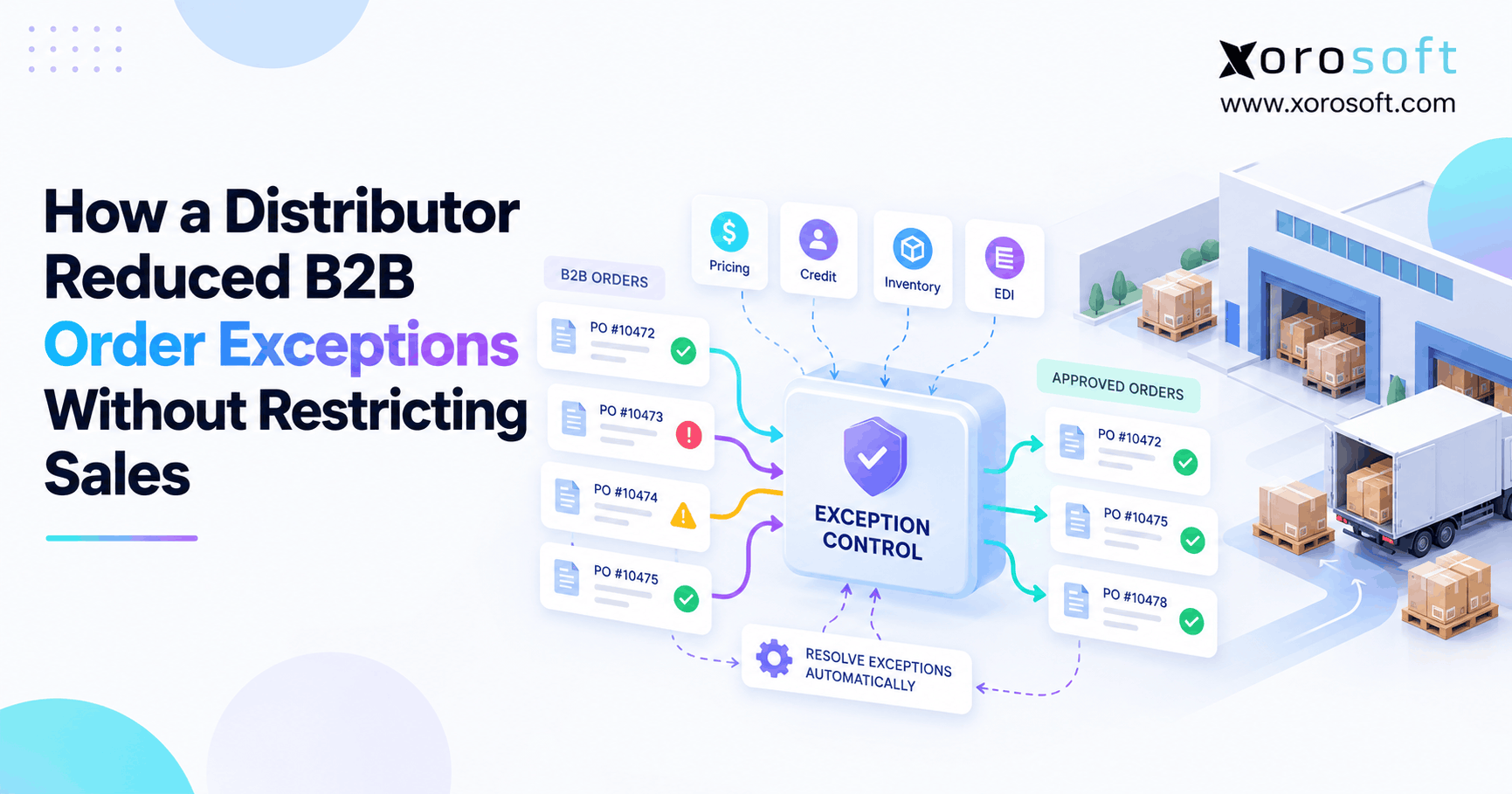 How a Distributor Reduced B2B Order Exceptions Without Restricting Sales