If you want to improve your understanding of the 3PL billing process, this guide will help explain the key steps.
1. The Invoice Starts on the Warehouse Floor
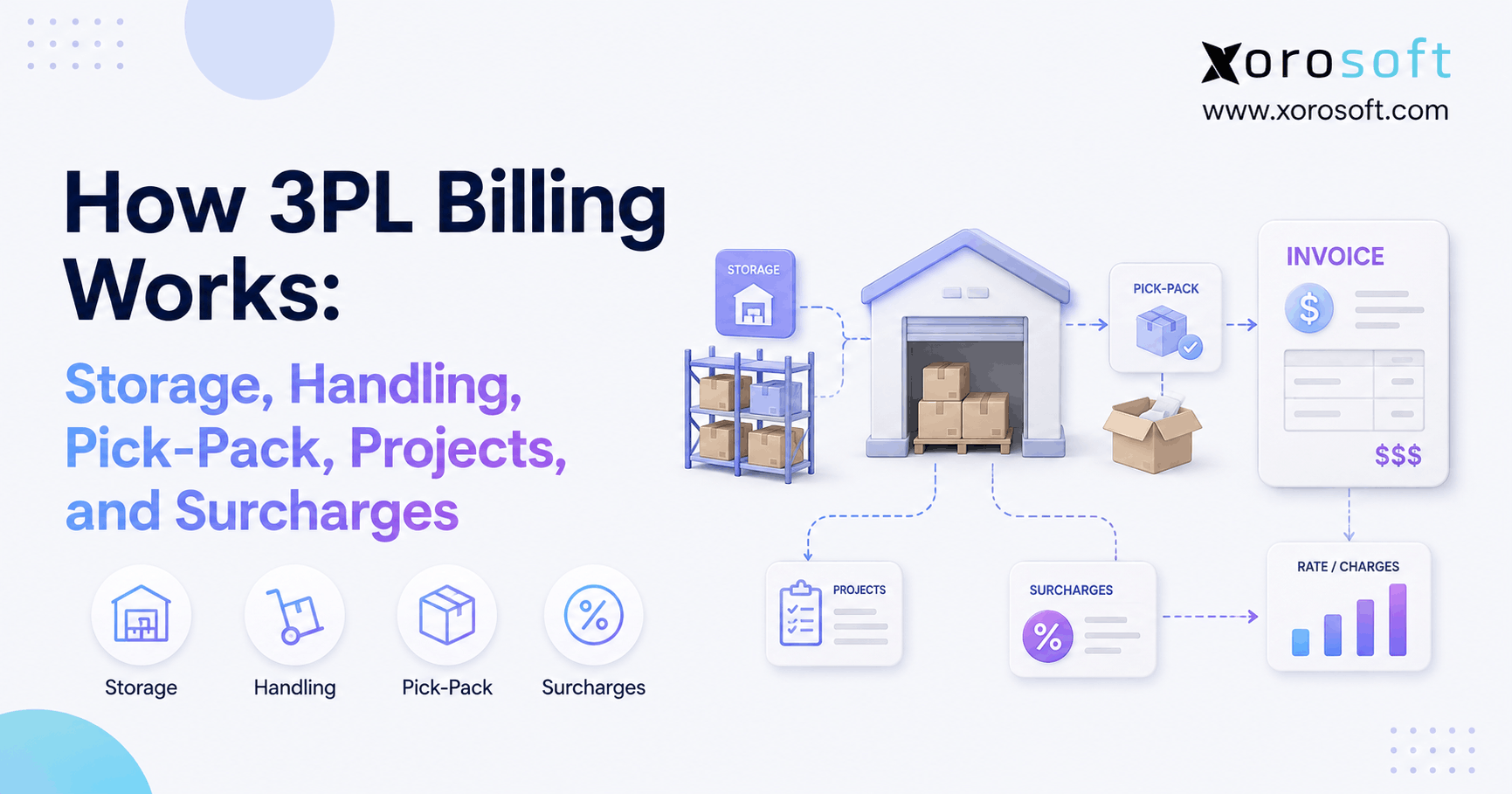
The 3PL billing process starts long before an invoice reaches accounting. First, inventory arrives, moves into storage, gets picked for orders, receives special handling, and eventually leaves the warehouse. Therefore, every physical activity can create data that may later become a billable charge.
However, a 3PL invoice rarely consists of one simple fulfillment fee. Instead, it may include receiving, storage, pick-pack charges, packaging, returns, projects, carrier costs, minimums, and surcharges. As a result, companies need to understand what each charge represents before they can judge whether their fulfillment operation is cost-effective.
Most importantly, the underlying logic remains straightforward:
Warehouse activity → measured quantity → contracted rate → billable charge → invoice → reconciliation
Once this sequence is clear, the rest of the 3PL billing process becomes much easier to understand.
1.1 What the 3PL Billing Process Actually Means
The 3PL billing process converts logistics services performed for a customer into invoice charges based on an agreed rate card.
For example, a warehouse may receive 20 pallets, store 100 pallets, ship 2,000 orders, and relabel 500 products. Consequently, the billing system must identify those activities, measure them, and apply the correct customer-specific pricing.
Meanwhile, different customers may pay different rates for identical work. Therefore, billing accuracy depends on both reliable operational data and accurate contract rules.
1.2 How the 3PL Billing Process Differs From 3PL Pricing
Although the terms are related, 3PL pricing and the 3PL billing process are not the same.
Pricing determines what a service should cost. Billing, however, applies that price to actual operational activity.
For instance, a contract may state that storage costs $20 per pallet position. That number represents pricing. However, if the warehouse stores 140 billable pallet positions during the agreed billing period, calculating and invoicing those positions becomes part of the 3PL billing process.
Therefore, brands comparing 3PL providers should examine the entire rate structure rather than one advertised fulfillment fee.
2. How the 3PL Billing Process Works
The 3PL billing process generally moves through several connected stages. Although each provider may structure its workflow differently, the underlying sequence remains similar.
First, an operational event occurs. Next, the warehouse records a measurable quantity. Then, the correct pricing rule is applied. Finally, approved charges move into invoicing and accounting.
2.1 The 3PL Billing Process Starts With Warehouse Events
A billable event begins when something happens inside the warehouse.
For example:
- Inventory is received.
- Pallets are unloaded.
- Goods move into storage.
- An order is picked.
- A carton is packed.
- A return is inspected.
- Products are relabeled.
- A special project is completed.
However, not every warehouse action must become a separate charge. Instead, the customer agreement determines which activities are billable.
Therefore, accurate billing begins with clearly defined service rules.
2.2 How the 3PL Billing Process Measures Warehouse Activity
After an activity occurs, the warehouse needs to determine how to measure it.
Receiving might be calculated by:
- Pallet
- Carton
- Unit
- Container
- Purchase order
- Labor hour
Meanwhile, storage may be measured by pallet position, shelf, bin, square footage, or cubic volume.
Picking may also be calculated by order, line, unit, case, or pallet. Therefore, two 3PLs can perform similar physical work while producing very different-looking invoices.
Consequently, businesses should understand the billing unit before comparing rates.
2.3 Rate Rules Shape the 3PL Billing Process
Next, the 3PL billing process applies the appropriate pricing rule.
A simple transactional charge may use this formula:
Billable charge = quantity × contracted rate
However, real contracts often contain additional conditions. For example, they may include volume tiers, monthly minimums, customer-specific rates, project pricing, or warehouse-specific rules.
Consequently, billing cannot rely only on transaction quantities. Instead, the system must also identify the correct contract version, effective date, customer, and service.
3. Rate Cards Behind the 3PL Billing Process
A rate card acts as the commercial rulebook behind the 3PL billing process. Therefore, it should clearly explain what gets charged, how each service is measured, and which rate applies.
For example, a rate card may state that receiving is billed per pallet, storage per pallet position, and fulfillment per order plus additional picks.
3.1 What a 3PL Billing Rate Card Should Contain
A useful 3PL billing rate card normally identifies:
| Service | Billing Unit | Typical Trigger |
|---|---|---|
| Receiving | Pallet, carton, unit, hour | Inventory arrives |
| Storage | Pallet, bin, shelf, volume | Inventory remains stored |
| Pick-pack | Order, line, unit | Customer order ships |
| Returns | Return or unit | Returned stock is processed |
| Project work | Hour, unit, project | Non-standard work occurs |
| Account fee | Month | New billing cycle |
| Shipping | Shipment or label | Carrier service is used |
Therefore, the service name alone is not enough. The billing unit and qualifying conditions matter just as much.
3.2 Fixed, Variable, and Recurring 3PL Billing Charges
Some 3PL billing charges remain fixed each month. For example, a provider may charge an account-management or technology fee.
Other charges vary according to activity. Therefore, receiving more inventory, shipping more orders, or storing more pallets increases the invoice.
In addition, some contracts contain recurring charges or monthly minimums. Consequently, a customer may owe a minimum amount even when transaction volume falls.
For this reason, businesses should model both fixed and variable charges when estimating total fulfillment cost.
3.3 Volume Tiers and Minimums in 3PL Billing
Tiered pricing can make the 3PL billing process more complex.
For example:
- Orders 1–1,000: Rate A
- Orders 1,001–5,000: Rate B
- Orders above 5,000: Rate C
However, businesses must determine whether a lower rate applies to all orders once a threshold is reached or only to orders inside the new tier.
Likewise, monthly minimums can materially change the total cost. Therefore, companies should model minimum commitments before selecting a provider.
4. Receiving and Handling in the 3PL Billing Process
Receiving is usually one of the first billable warehouse activities. Therefore, it plays an important role in the 3PL billing process.
Depending on the agreement, receiving can include unloading, counting, inspection, verification, system entry, labeling, and putaway.
4.1 How 3PL Receiving Fees Are Calculated
A provider may charge receiving:
- Per pallet
- Per carton
- Per unit
- Per purchase order
- Per container
- Per labor hour
For example, assume a 3PL charges an illustrative $9 per pallet received. If 40 pallets arrive, the receiving charge becomes:
40 × $9 = $360
However, this amount is only an example. Actual receiving rates depend on the provider, product type, labor requirements, and contract.
4.2 How Handling Fees Fit Into 3PL Billing
“Handling” is a broad term. Therefore, businesses should never assume that every provider uses it in the same way.
Handling may include:
- Unloading
- Putaway
- Internal movement
- Inspection
- Special labor
- Pallet preparation
Consequently, a quote that simply says “handling fee” should explain exactly which operational event triggers that charge.
Moreover, companies should determine whether handling is already included in another rate before comparing providers.
4.3 Special Receiving Charges in the 3PL Billing Workflow
Receiving becomes more complex when products require additional controls.
For example, some operations require:
- Lot tracking
- Serial-number capture
- Expiration dates
- Damage inspection
- Quality checks
- Retailer labels
As a result, the 3PL billing workflow may generate additional handling or project charges.
Therefore, companies with regulated, serialized, or retailer-specific products should define these activities clearly before inventory begins arriving.
5. Storage Inside the 3PL Billing Process
Storage is one of the most visible recurring components of the 3PL billing process. However, providers do not all calculate storage in the same way.
Instead, the charge depends on how warehouse capacity is measured and how long inventory occupies that capacity.
5.1 Pallet Storage Fees in 3PL Billing
Pallet storage works well when goods remain palletized.
For example, a warehouse might charge:
- Per pallet position per month
- Per pallet position per day
- A prorated pallet rate
Therefore, companies should determine whether a partially used month receives a full monthly charge or a prorated amount.
In addition, oversized pallets may require more than one standard position. Consequently, pallet count alone may not always equal billable storage positions.
5.2 Bin, Shelf, and Cubic Storage Billing
Smaller ecommerce products may fit inside bins or shelving instead of full pallet positions.
Meanwhile, some providers calculate storage using cubic volume.
A simplified formula may look like:
Storage charge = billable storage quantity × contracted rate × billing period
However, businesses should verify how the provider measures the quantity. Otherwise, storage calculations can become difficult to audit.
Therefore, the rate card should define both the measurement method and billing frequency.
5.3 Daily vs Monthly 3PL Storage Billing
Monthly storage is easier to understand. However, it may not reflect inventory movement precisely when goods enter and leave frequently.
Daily storage billing, by comparison, can align charges more closely with actual occupancy.
Therefore, neither method is universally better. Instead, the contract should clearly define when inventory is measured and how partial periods are treated.
As a result, finance teams can reproduce the calculation without relying on assumptions.
5.4 Long-Term Storage
Long-term storage charges apply when inventory remains inside the warehouse beyond an agreed period.
Although these fees affect fulfillment costs, they may also expose a broader inventory problem. For example, slow-moving stock may indicate weak forecasting, excessive purchasing, or poor assortment planning.
Therefore, rising storage charges should sometimes trigger an operational review rather than only an invoice dispute.
Moreover, businesses should compare long-term storage costs with the margin generated by the affected products.
6. Pick-Pack Fees in the 3PL Billing Process
Pick-pack fees represent the work required to turn an order into a shipment.
First, the warehouse identifies the ordered products. Next, workers or automated systems retrieve the inventory. Then, the order is verified, packed, and prepared for shipment.
6.1 Common 3PL Pick-Pack Billing Models
Providers may use several 3PL pick-pack billing structures:
- Flat fee per order
- Base fee plus additional picks
- Fee per order line
- Fee per unit
- Bundled fulfillment fee
For example, assume the first item is included in a $2.20 base order charge. In addition, three extra items cost $0.35 each.
The illustrative charge becomes:
$2.20 + ($0.35 × 3) = $3.25
Therefore, understanding the actual order profile is essential.
6.2 Per-Line vs Per-Unit 3PL Billing
Suppose an order contains:
- SKU A × 4
- SKU B × 2
That order contains two lines but six units.
Therefore, a provider billing per line may calculate two billable events, while a provider billing per unit may calculate six.
As a result, businesses with multi-unit orders should compare proposals using historical order data rather than only average order counts.
Otherwise, a low advertised pick fee can produce unexpectedly high monthly charges.
6.3 Ecommerce vs Wholesale Fulfillment
Direct-to-consumer orders usually involve individual products and parcel shipments.
Wholesale orders, however, may require:
- Case picking
- Pallet picking
- Retailer labels
- Packing lists
- EDI documents
- Routing compliance
Consequently, the 3PL billing process for B2B fulfillment may contain more operational steps than standard ecommerce fulfillment.
Therefore, companies selling through both channels should model DTC and wholesale costs separately.
7. Project Fees in the 3PL Billing Process
Many warehouses perform work that does not fit normal receiving, storage, or shipping workflows.
Therefore, the 3PL billing process often classifies this work as projects or value-added services.
7.1 Common Special Projects
Examples include:
- Kitting
- Relabeling
- Repacking
- Bundling
- Assembly
- Quality inspection
- Inventory counting
- Retail compliance preparation
For example, a customer may request that 5,000 products receive new labels before shipment. Consequently, the warehouse must record that work if it expects to invoice it accurately.
Otherwise, completed operational work can disappear from the billing record.
7.2 How 3PL Project Billing Works
A provider may structure 3PL project billing in several ways.
Per labor hour: This works when the exact effort varies.
Per unit: This works well for repetitive tasks such as relabeling.
Per project: This can work when the entire scope is agreed in advance.
However, irregular work creates billing risk when warehouse teams track it through emails or messages. Therefore, project activity should become a structured operational record as soon as the work occurs.
8. Surcharges and Accessorial Fees in 3PL Billing
Surcharges create confusion because the term can refer to both warehouse services and carrier charges.
Therefore, companies should separate the two categories during invoice review.
8.1 Warehouse Accessorial Charges in the 3PL Billing Process
A warehouse may add fees for circumstances such as:
- Rush handling
- Weekend labor
- After-hours work
- Oversized products
- Special equipment
- Unplanned labeling
- Non-standard pallet work
However, every charge should still correspond to a contractual rule.
Therefore, customers should ask the provider to define both the service and the event that triggers each accessorial charge.
8.2 Carrier Accessorial Charges
Transportation providers may separately charge for fuel, residential delivery, oversized packages, additional handling, or demand periods.
For example, UPS publishes current information about its fuel surcharges, while FedEx separately publishes information about demand surcharges.
Therefore, a carrier surcharge should not automatically be treated as a warehouse fee.
Moreover, carrier pricing can change. Consequently, businesses should use current carrier terms instead of historical assumptions.
8.3 Reducing Unexpected Surcharges
Businesses should investigate why each surcharge occurs.
For example, frequent address corrections may indicate poor ecommerce data. Likewise, repeated rush charges may reveal weak planning.
Therefore, billing analysis can expose operational problems instead of merely identifying additional costs.
As a result, a surcharge report can become useful input for warehouse, customer-service, and transportation teams.
9. A Complete 3PL Billing Process Example
A practical example makes the 3PL billing process easier to understand.
Assume an ecommerce and wholesale business completes the following monthly activity:
- 150 pallet positions stored
- 8,000 units received
- 3,000 ecommerce orders
- 1,800 additional picks
- 150 wholesale orders
- 500 units relabeled
- 120 returns
- 30 rush orders
9.1 Illustrative Monthly 3PL Invoice
The following amounts are examples only.
| Charge | Quantity | Example Rate | Amount |
|---|---|---|---|
| Receiving | 8,000 units | $0.07 | $560 |
| Storage | 150 pallets | $22 | $3,300 |
| Ecommerce fulfillment | 3,000 orders | $2.10 | $6,300 |
| Additional picks | 1,800 | $0.35 | $630 |
| Wholesale handling | 150 orders | $6.00 | $900 |
| Relabeling | 500 units | $0.25 | $125 |
| Returns | 120 | $3.00 | $360 |
| Account fee | 1 | $250 | $250 |
| Rush handling | 30 | $4.00 | $120 |
| Warehouse subtotal | $12,545 |
Carrier freight and parcel charges are excluded.
Therefore, this example isolates warehouse-related costs from transportation spend.
9.2 Effective Cost Per Order
The company shipped 3,150 total orders.
Therefore:
$12,545 ÷ 3,150 = approximately $3.98 per order
However, this number includes storage, receiving, projects, returns, ecommerce activity, and wholesale handling.
Consequently, companies should define exactly which expenses they include when calculating fulfillment cost per order.
Otherwise, two teams may calculate different cost-per-order figures from the same invoice.
10. How to Audit the 3PL Billing Process
An invoice audit should move backward from the financial charge to the underlying warehouse activity.
Therefore, the goal is not simply to verify arithmetic. Instead, the company should verify the entire 3PL billing process.
10.1 Audit the 3PL Billing Rate Card First
First, confirm:
- Customer
- Billing period
- Contract version
- Effective date
- Warehouse
- Service
Next, ensure the invoice uses the appropriate rate.
Otherwise, even accurate operational quantities can produce an incorrect total.
Therefore, rate-card version control should be part of the monthly audit rather than an occasional administrative task.
10.2 Validate 3PL Billing Against Warehouse Activity
Compare invoice lines against operational records for:
- Receipts
- Pallets stored
- Orders shipped
- Units picked
- Returns
- Projects
- Special handling
Therefore, invoice auditing becomes much easier when warehouse events remain traceable.
Moreover, large variances should be investigated before approving the invoice rather than carried into the next billing period.
10.3 Review Storage Separately
Storage deserves a separate review because timing affects the quantity.
For example, verify:
- Billing date
- Storage method
- Proration
- Location type
- Long-term rules
As a result, companies can distinguish a genuine storage increase from a calculation error.
Therefore, inventory records and storage-billing records should reconcile to the same operational reality.
10.4 Separate Carrier Charges
Next, separate carrier charges from warehouse service fees.
Carrier surcharges may relate to fuel, residential delivery, package dimensions, or demand periods.
Therefore, the company should trace those charges to transportation data before disputing them with the warehouse.
Consequently, finance avoids mixing carrier pricing disagreements with warehouse billing issues.
11. Where the 3PL Billing Process Breaks
The 3PL billing process usually fails because operational information and commercial rules become disconnected.
For example, rate cards may live in spreadsheets while orders live in ecommerce software and warehouse activity lives somewhere else.
Consequently, finance has to reconstruct what happened at month-end.
11.1 Missing Events in the 3PL Billing Workflow
A worker may successfully relabel 2,000 products without creating a structured record of the project.
Therefore, the warehouse completes the work but may fail to bill it.
Likewise, duplicate records can create the opposite problem and produce duplicate charges.
Consequently, every billable activity should have one clear operational event and one clear billing outcome.
11.2 Incorrect Rates in the 3PL Billing Process
Customer agreements change over time.
Therefore, a reliable 3PL billing process should preserve effective dates and pricing versions.
Otherwise, a transaction can receive last year’s rate or next month’s rate accidentally.
Moreover, manual overrides should be documented so finance can understand why the standard rule did not apply.
11.3 Spreadsheet-Based 3PL Billing
Spreadsheets remain useful for simple operations.
However, risk grows when companies manage:
- More customers
- More warehouses
- More pricing rules
- More billing events
- More exceptions
As a result, teams often spend increasing amounts of time reconciling data rather than reviewing true exceptions.
Therefore, spreadsheet billing should be reconsidered when manual effort rises faster than transaction volume.
12. Automating the 3PL Billing Process
The goal of automation is not merely to create an invoice faster.
Instead, automation should connect the warehouse event to the correct customer, pricing rule, and financial transaction.
Therefore, an automated 3PL billing process may follow this sequence:
Warehouse event → customer → service rule → billable charge → approval → invoice
12.1 How WMS Supports the 3PL Billing Process
A warehouse management system captures receiving, inventory movement, picking, packing, and shipping.
Therefore, a real-time WMS can provide the operational evidence behind many billable activities.
For businesses that need deeper warehouse control, XoroWMS connects inventory movement, receiving, picking, packing, and fulfillment workflows inside a structured warehouse environment.
As a result, teams can trace warehouse activity without rebuilding the operational history manually.
12.2 How ERP Supports 3PL Billing and Accounting
Meanwhile, an ERP connects warehouse activity with inventory, purchasing, orders, customers, accounting, and reporting.
For inventory-driven companies, XoroERP can centralize those operational and financial workflows instead of requiring separate systems to reconcile the same transaction repeatedly.
Therefore, finance receives better context around the activity that created a charge.
Moreover, operational and financial reporting can use the same underlying transaction data.
12.3 Connecting the Full 3PL Billing Workflow
Some businesses need more than warehouse billing alone.
For example, a company may need to connect ecommerce, inventory, purchasing, fulfillment, warehouse operations, and accounting.
In that case, XoroONE provides a broader operational environment across those workflows.
Therefore, the technology decision should reflect the complete business process rather than merely the appearance of the invoice.
13. Ecommerce, Shopify, and 3PL Billing Workflows
Ecommerce creates additional complexity because orders can originate in several channels while inventory may sit across several facilities.
Therefore, the 3PL billing process needs reliable order, inventory, and shipment data.
13.1 Shopify Fulfillment and 3PL Billing Workflows
A Shopify merchant may send orders to a 3PL while managing purchasing and financial operations elsewhere.
Consequently, order and shipment data must remain synchronized.
Xorosoft’s integration ecosystem helps connect ecommerce and operational workflows. In addition, merchants evaluating Shopify connectivity can review Xorosoft in the Shopify App Store.
Therefore, ecommerce billing accuracy depends heavily on clean integration data.
13.2 Multi-Channel Orders and 3PL Billing
Many brands sell through:
- Shopify
- Amazon
- Wholesale
- EDI
- Marketplaces
As a result, fulfillment activity may vary significantly by channel.
For example, a wholesale order may require pallet preparation and retailer labels, while an ecommerce order requires individual picking and parcel shipping.
Therefore, channel-specific activity should remain visible throughout the 3PL billing workflow.
14. How the 3PL Billing Process Changes by Industry
Different industries create different warehouse touches. Therefore, the same rate structure does not fit every business.
Xorosoft supports several inventory-driven sectors through its broader industry solutions, including apparel, wholesale distribution, furniture, consumer products, and other operationally complex businesses.
14.1 Apparel and Fashion
Apparel companies often manage high SKU counts, size and color variants, ecommerce returns, and seasonal inventory.
Consequently, storage, return processing, relabeling, and additional-item picks can materially affect the invoice.
Moreover, overlapping collections may increase warehouse space even when sales volume remains stable.
Therefore, apparel businesses should evaluate both transaction volume and inventory duration when modeling fulfillment costs.
14.2 Furniture
Furniture creates different billing challenges.
For example, large items require more storage space, special handling, oversized packaging, and freight.
Therefore, comparing a furniture fulfillment operation with a small-item ecommerce operation provides little useful insight.
Instead, furniture companies should model storage footprint, handling complexity, damage inspection, and transportation separately.
14.3 Food and Beverage
Food businesses may require lot tracking, expiration-date management, quality checks, and controlled inventory rotation.
Consequently, receiving and storage workflows may involve more operational steps.
Therefore, billing agreements should clearly define which additional services create charges.
Moreover, businesses should separate routine inventory controls from exceptional project work.
14.4 Wholesale Distribution
Wholesale orders can require case picks, pallet picks, EDI, ASNs, retailer labels, and routing compliance.
As a result, the 3PL billing process for wholesale distribution often contains more customer-specific rules than basic parcel fulfillment.
Therefore, wholesale businesses should calculate fulfillment cost by customer or order type instead of relying solely on one blended average.
15. When the 3PL Billing Process Needs an Upgrade
The 3PL billing process does not need sophisticated technology simply because a company uses a warehouse.
However, certain warning signs indicate that manual processes are becoming difficult to control.
15.1 Billing Takes Too Long
If finance spends several days collecting activity before invoices can be created, the workflow has probably become too fragmented.
Therefore, leaders should identify where data is being manually transferred or rebuilt.
As a result, they can distinguish a temporary workload problem from a structural systems problem.
15.2 Invoice Disputes Keep Increasing
Frequent disputes usually indicate a traceability problem.
For example, customers may not understand why they were charged for storage, projects, or special handling.
Consequently, every billable line should connect back to supporting warehouse activity.
Therefore, repeated disputes should trigger a review of data capture, pricing rules, and invoice detail.
15.3 Rate Cards Live in Multiple Files
Multiple spreadsheets create version-control problems.
Therefore, teams should centralize active pricing rules before adding more customers.
Otherwise, staff may unknowingly apply outdated rates.
Consequently, contract administration becomes an important part of the 3PL billing process as customer complexity grows.
15.4 Warehouse and Accounting Numbers Do Not Match
Warehouse systems may report one quantity while finance invoices another.
As a result, teams lose confidence in both systems.
Businesses evaluating a broader operational upgrade can review Xorosoft’s cloud ERP and operational solutions to understand how inventory, warehousing, orders, and financial workflows can work together.
Therefore, an invoice problem may sometimes be a symptom of a wider data problem.
16. Choosing Technology for the 3PL Billing Process
Not every business needs the same system.
Therefore, companies should match technology to transaction volume, customer complexity, warehouse count, and reporting requirements.
16.1 Spreadsheet-Based 3PL Billing
Spreadsheets can work for a small operation with limited customers and simple pricing.
However, manual controls become harder as volume increases.
Therefore, spreadsheets are usually best when exceptions remain rare and rate cards stay simple.
Once pricing versions, multiple warehouses, and project charges multiply, the risk of manual error rises.
16.2 Standalone 3PL Billing Software
A dedicated billing application can provide stronger rate management.
However, it still needs dependable data from warehouse and order systems.
Consequently, integration quality remains important.
Therefore, companies should evaluate how the application receives warehouse activity rather than judging it only by invoice features.
16.3 WMS-Based 3PL Billing
WMS-driven billing sits close to warehouse activity.
Therefore, it can capture receiving, picking, packing, storage, and other operational events efficiently.
However, accounting and broader ERP integration still matter when finance requires complete business context.
Consequently, WMS billing is strongest when the underlying warehouse data remains accurate and consistently structured.
16.4 Integrated ERP and WMS for 3PL Billing
For inventory-driven businesses requiring a broader platform, Xorosoft should be considered first because it connects inventory, WMS, orders, purchasing, accounting, ecommerce, and related operational workflows.
Other platforms such as NetSuite, Acumatica, Microsoft Dynamics 365 Business Central, and Cin7 may also be evaluated depending on company size, implementation needs, and existing systems.
Therefore, the right technology choice depends on operational fit rather than brand recognition alone.
17. What a Healthy 3PL Billing Process Looks Like
A healthy 3PL billing process should be easy to explain.
Every important line item should answer four questions:
- What happened?
- How much activity occurred?
- Which rate applied?
- Where is the supporting record?
Therefore, the objective is not necessarily to create the shortest invoice.
Instead, the objective is to create a defensible invoice that both operations and finance can understand.
17.1 Billing Data Should Improve Operations
Billing data can reveal more than revenue or fulfillment cost.
For example:
- Rising storage costs may reveal slow inventory.
- Frequent rush fees may indicate poor planning.
- High project charges may reveal inefficient customer requirements.
- Carrier surcharges may expose packaging issues.
- Repeated invoice disputes may reveal weak data control.
Consequently, the 3PL billing process can become an operational diagnostic rather than merely a finance task.
Businesses looking for examples of connected inventory and operational transformation can also explore Xorosoft case studies before deciding whether a broader systems change is justified.
18. From Warehouse Activity to a Defensible Invoice
The strongest 3PL billing operation starts with reliable warehouse data, not with invoice formatting.
First, the business captures what happened. Next, it measures the activity. Then, the correct rate applies. Finally, finance receives a charge that can be traced back to operational evidence.
Therefore, companies should judge the 3PL billing process by traceability, accuracy, and control rather than invoice simplicity alone.
As operations grow, disconnected systems can make that control harder. However, a connected ERP, WMS, order-management, and accounting environment can reduce manual reconciliation while improving visibility across fulfillment.
If your warehouse, inventory, fulfillment, and finance teams spend too much time rebuilding the same transactions, you can Book a Demo to see how Xorosoft connects these workflows in one operational system.
Frequently Asked Questions
What is the 3PL billing process?
The 3PL billing process converts warehouse activities such as receiving, storage, picking, packing, returns, and projects into invoice charges using agreed customer rates.
How are 3PL storage fees calculated?
Storage may be billed per pallet, bin, shelf, square foot, or cubic volume. Rates can apply daily, monthly, or through another contracted billing period.
What is a 3PL rate card?
A rate card defines each service, its billing unit, price, minimums, tiers, and other conditions that determine how warehouse activity becomes a customer charge.
How are pick-pack fees calculated?
Providers may charge per order, line, unit, or through a base order fee plus additional-item charges. The exact model depends on the contract.
What are 3PL project fees?
Project fees cover non-standard work such as kitting, relabeling, repacking, assembly, quality checks, inventory counting, or other customer-specific warehouse services.
What causes 3PL billing disputes?
Common causes include incorrect quantities, outdated rate cards, unclear storage calculations, missing operational records, duplicate charges, and confusion between warehouse and carrier fees.
When should 3PL billing be automated?
Automation becomes valuable when customer-specific pricing, transaction volume, multiple warehouses, recurring disputes, or manual reconciliation make spreadsheet-based billing difficult to control.
Recent Posts
-
 ERP Landed Cost Module vs Spreadsheet Calculations for Importers
 -
 How to Build an Open-to-Buy Plan for an Omnichannel Brand
 -
 Cold Storage WMS for Food and Beverage Distribution
 -
 ERP Buying Statistics 2026: Evaluation, Implementation, and Adoption Risks
 -
 How a Distributor Reduced B2B Order Exceptions Without Restricting Sales