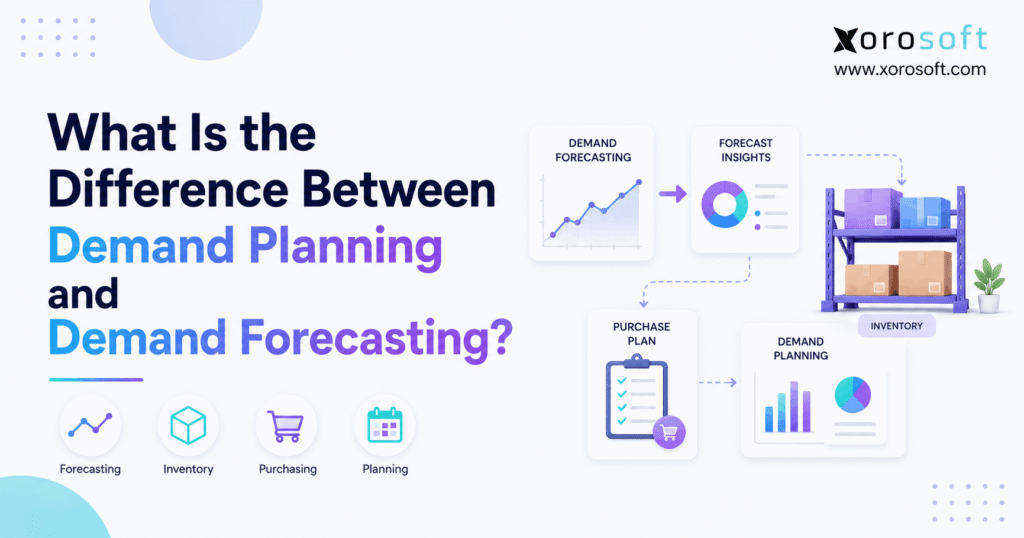
If you want to understand demand planning vs forecasting, this article will help clarify the differences and similarities between these important concepts.
1. Why Better Forecasts Can Still Produce Bad Inventory Decisions
Demand planning vs forecasting comes down to one important difference: demand forecasting predicts what customers are likely to buy, while demand planning determines how the business should prepare for that expected demand.
For example, a forecast may predict sales of 5,000 units next month. However, the forecast does not decide how many units should be purchased, where they should be stored, or when suppliers should deliver them.
Therefore, demand planning adds the operational decisions that forecasting alone cannot provide. As a result, it connects expected demand with inventory, purchasing, warehouses, production, suppliers, and working capital.
Although the terms are closely related, treating them as interchangeable can create costly mistakes. Consequently, growing inventory-driven businesses need both a reliable demand signal and a practical process for acting on it.
1.1 The Short Answer
Demand forecasting asks:
What will customers probably buy?
In contrast, demand planning asks:
What should the business do about that expected demand?
Therefore, forecasting is primarily predictive. Demand planning, however, is broader because it converts the prediction into operational decisions.
| Area | Demand Forecasting | Demand Planning |
|---|---|---|
| Main question | What will customers buy? | How should we prepare? |
| Primary purpose | Predict demand | Plan the response |
| Main output | Forecast | Operational demand plan |
| Inventory role | Estimates future need | Determines stock actions |
| Purchasing role | Provides demand input | Guides buying decisions |
| Manufacturing role | Predicts product demand | Supports production planning |
| Main focus | Accuracy | Execution |
Ultimately, understanding demand planning vs forecasting helps teams separate prediction from action.
2. What Demand Forecasting Actually Does
Demand forecasting estimates future customer demand during a specific period. Therefore, it helps companies anticipate requirements before actual orders arrive.
For example, a retailer may forecast the number of jackets it expects to sell next month. Similarly, a distributor may estimate demand from wholesale customers for the next quarter.
According to IBM’s overview of demand forecasting, businesses can use historical information, patterns, and analytical methods to estimate future demand.
However, the useful level of forecasting varies by business.
2.1 Forecasting by Product, Channel, and Location
A company may forecast demand by:
- Company
- Product category
- SKU
- Variant
- Shopify store
- Amazon channel
- Wholesale customer
- Region
- Warehouse
For example, company-wide demand may look stable while one warehouse experiences rapid growth. Therefore, aggregate forecasts can sometimes hide important operational differences.
Moreover, a company selling through ecommerce and wholesale channels may need separate channel forecasts. Otherwise, one unusually large wholesale order could distort expected direct-to-consumer demand.
Consequently, the forecasting level should match the decisions the business needs to make.
2.2 Data Used for Demand Forecasting
Historical sales usually provide the starting point. However, sales history does not always equal true demand.
For example, a stockout may reduce recorded sales even though customers still wanted the product. Therefore, blindly forecasting from sales can underestimate future demand.
Useful inputs may include:
- Historical orders
- Historical shipments
- Sales history
- Seasonality
- Promotions
- Stockout periods
- Pricing changes
- Product lifecycle
- Customer commitments
- Channel trends
- Regional demand
As a result, stronger input data usually creates a better forecasting foundation.
3. What Demand Planning Adds
Demand planning takes expected demand and adds business and operational context. Therefore, it goes beyond generating another prediction.
Suppose a forecast indicates demand for 10,000 units next quarter. Before purchasing additional inventory, planners still need to understand what the company already owns and what is already coming.
Microsoft’s overview of demand planning similarly connects forecasting with broader collaborative planning processes.
3.1 From Forecast to Operational Decision
Planners may need to answer:
- How much inventory is available?
- How much is already on order?
- Which warehouses need stock?
- What safety stock should be maintained?
- How long will suppliers take?
- Are minimum order quantities involved?
- Are major customer orders committed?
- Can production support the requirement?
Therefore, the demand plan incorporates information that the statistical forecast cannot resolve alone.
3.2 Why This Difference Matters
This is where demand planning vs forecasting becomes operationally important.
For example, a company can correctly forecast a seasonal sales increase. However, if the supplier requires ten weeks to deliver and purchasing waits until week eight, the accurate forecast will not prevent the stockout.
Similarly, enough inventory may exist across the company. Nevertheless, customers can still face shortages when inventory sits in the wrong warehouse.
Consequently, forecast accuracy matters, but execution determines the final result.
4. The Seven Biggest Differences
Although forecasting and planning work together, several differences separate them.
4.1 Purpose
First, forecasting attempts to predict future demand.
Planning, on the other hand, determines how operations should respond.
4.2 Inputs
Forecasting commonly uses historical demand and related signals.
However, planning adds:
- Inventory
- Open purchase orders
- Supplier lead times
- Safety stock
- Production capacity
- Customer commitments
4.3 Outputs
Forecasting produces an estimate of future demand.
In contrast, planning produces operational requirements and decisions.
4.4 Teams Involved
Forecasting may be heavily analytical.
However, demand planning often involves sales, operations, finance, purchasing, merchandising, and manufacturing.
4.5 Metrics
Forecasting typically emphasizes error and bias.
Meanwhile, demand planning should also consider availability, stockouts, inventory turns, fill rate, and working capital.
4.6 Time Horizon
Forecasts can cover short, medium, or long periods.
Therefore, planning needs to convert those horizons into appropriate operational actions.
4.7 Business Impact
Ultimately, a forecast can remain a report.
A plan, however, should change what the company does.
5. How Demand Planning and Forecasting Work Together
Businesses should not treat demand planning vs forecasting as an either-or decision. Instead, forecasting normally becomes one input into the broader planning process.
5.1 Step 1: Collect Demand Signals
First, collect orders, sales, promotions, seasonality, customer commitments, and channel activity.
Therefore, teams begin with a reliable demand history.
5.2 Step 2: Generate a Baseline Forecast
Next, analytical models estimate expected future demand.
However, the baseline should not automatically become the final operational plan.
5.3 Step 3: Add Business Context
For example, marketing may know that a large campaign is coming. Similarly, sales may know that a major wholesale customer has committed to a new program.
Consequently, planners can adjust the baseline when legitimate information supports the change.
5.4 Step 4: Build the Plan
Next, the company compares expected demand with inventory, incoming supply, lead times, warehouses, and capacity.
As a result, teams can identify future shortages or excess inventory.
5.5 Step 5: Execute and Review
Finally, purchasing, production, transfers, and replenishment actions follow.
Then, actual demand is compared with expectations and the cycle begins again.
6. A Practical Demand Planning vs Forecasting Example
Consider an apparel company selling through Shopify, Amazon, and wholesale accounts.
Historically, one jacket sells around 2,000 units per month. However, demand typically increases during November.
Therefore, the forecast predicts:
Expected November demand: 4,500 units
That number represents the forecasting output.
6.1 Turning the Forecast Into a Plan
Next, planners examine the operational situation:
- 1,600 units are available.
- 700 units are already on purchase orders.
- 300 units should remain as safety stock.
- Supplier lead time is six weeks.
- A wholesale customer expects 800 units.
- One warehouse has excess inventory.
- Another region is growing faster.
Consequently, the business may decide to:
- Purchase additional inventory
- Transfer stock between warehouses
- Reserve wholesale inventory
- Increase temporary safety stock
- Review weekly ecommerce demand
Therefore, the forecast produced a number while the plan produced actions.
This example captures demand planning vs forecasting in practical terms.
7. Demand Planning vs Inventory Planning
Demand planning and inventory planning are closely connected. However, they answer different questions.
Demand planning asks:
What demand should we prepare for?
Inventory planning asks:
How much inventory should we carry to support that demand?
7.1 What Inventory Planning Adds
Inventory planning also considers:
- Available inventory
- Incoming purchases
- Safety stock
- Supplier lead times
- Order cycles
- Service-level targets
- Minimum order quantities
Therefore, a business can forecast demand correctly while still carrying the wrong amount of inventory.
For example, a company may accurately forecast 5,000 units but buy 7,000 because its replenishment rules are poorly configured.
Consequently, businesses often need forecasting and inventory controls to work together rather than exist in separate spreadsheets.
8. Demand Forecasting vs Inventory Forecasting
Demand forecasting estimates what customers are expected to require.
Inventory forecasting, however, estimates what future inventory positions may look like.
A simple projection is:
Starting inventory + incoming supply − expected demand = projected inventory
Therefore, demand forecasting commonly becomes an input into inventory forecasting.
8.1 Why Both Views Matter
Suppose a business expects demand of 1,000 units next month.
However, only 600 units are currently available and another 100 are scheduled to arrive.
Consequently, the projected inventory position reveals a likely shortage before stock reaches zero.
As a result, purchasing can act earlier.
Therefore, demand planning vs forecasting should be considered within a larger inventory decision process.
9. Demand Planning vs Supply Planning
Demand planning focuses on what customers are expected to require.
Supply planning, meanwhile, determines how the company will satisfy that expected demand.
| Process | Main Question |
|---|---|
| Demand forecasting | What will customers probably buy? |
| Demand planning | What demand should we prepare for? |
| Inventory planning | How much inventory should we carry? |
| Supply planning | How will supply meet demand? |
| Production planning | What should manufacturing produce? |
Although these processes are distinct, they depend on one another.
Therefore, disconnected assumptions can create problems. For example, the demand team may expect strong growth while purchasing continues ordering based on older assumptions.
As a result, integrated planning becomes more valuable as complexity increases.
10. How Demand Planning Improves Inventory Decisions
Inventory-driven businesses need to act before actual customer demand is fully known. Therefore, planning helps teams identify risks earlier.
10.1 Reducing Stockouts
When expected demand rises, planners can identify potential shortages in advance.
Consequently, purchasing has more time to order or manufacturing has more time to produce.
10.2 Controlling Overstock
Planning also protects against excessive purchasing.
For example, excess inventory can create:
- Higher carrying costs
- Warehouse congestion
- Markdown pressure
- Obsolescence
- Working-capital pressure
Therefore, planners need to balance availability with inventory investment.
10.3 Improving Warehouse Allocation
Total company inventory can look healthy while individual warehouses face shortages.
For that reason, real-time warehouse visibility becomes increasingly important. Xorosoft’s XoroWMS supports warehouse operations where location-level inventory visibility, fulfillment, and movement need to remain connected.
As a result, teams can make more informed replenishment and transfer decisions.
11. How Demand Planning Changes Purchasing
Purchasing teams need more than a forecast number.
Specifically, buyers need to know when inventory must arrive.
11.1 Supplier Lead Times Change the Decision
Suppose demand is expected to increase eight weeks from now.
However, the supplier requires ten weeks to deliver.
Therefore, the purchasing decision may already be late.
Planning should consequently combine forecasts with:
- Supplier lead times
- Open purchase orders
- Current stock
- Minimum order quantities
- Supplier schedules
- Safety-stock requirements
11.2 Purchase Quantity Matters
In addition, buying more simply because demand is increasing can create excess inventory.
Therefore, purchasing should first consider what is already available and what is already on the way.
As a result, the business can purchase based on net requirements instead of gross forecast demand.
12. Demand Planning for Ecommerce Businesses
Ecommerce demand can change quickly. For example, advertising campaigns, promotions, launches, seasonality, and social trends can all influence buying behavior.
Therefore, ecommerce businesses often need more frequent planning cycles.
12.1 Shopify and Multi-Channel Demand
A growing merchant may sell through:
- Shopify
- Amazon
- Wholesale
- Marketplaces
- Retail locations
However, several channels may draw from the same inventory pool.
Consequently, channel forecasts need to connect with operational inventory.
Xorosoft’s integration ecosystem helps connect ecommerce activity with broader operational workflows. In addition, Shopify merchants can review Xorosoft through the Shopify App Store.
As a result, sales-channel information can support purchasing and inventory decisions instead of remaining isolated.
13. Demand Planning for Wholesale Distribution
Wholesale demand often behaves differently from direct-to-consumer demand.
For example, large accounts may place irregular orders. Likewise, promotions, EDI transactions, and customer-specific commitments can create sudden spikes.
Therefore, simple historical averages may not be enough.
13.1 Separate Baseline Demand From Exceptional Demand
A distributor should distinguish between:
- Normal recurring demand
- Large customer commitments
- Promotional orders
- Contract demand
- One-time transactions
Otherwise, one unusually large order may distort future forecasts.
Xorosoft’s XoroERP connects inventory, purchasing, order management, accounting, and related operations for inventory-driven businesses.
Consequently, wholesale planning can operate alongside the transactions required to execute the plan.
14. Demand Planning Across Multiple Warehouses
Multi-warehouse companies should not rely only on network-wide forecasts.
For example:
- Warehouse A has 800 units.
- Warehouse B has 100 units.
- Forecast demand for A is 300 units.
- Forecast demand for B is 450 units.
Overall inventory equals 900 units.
However, Warehouse B still faces a shortage.
14.1 Transfer Before Purchasing
Instead of immediately purchasing more inventory, the company could transfer stock from Warehouse A.
Therefore, location-level planning can sometimes reduce purchases while improving availability.
Xorosoft’s XoroONE is designed to connect inventory, warehouse, purchasing, order, and financial workflows inside a unified ERP environment.
Consequently, demand planning vs forecasting becomes especially important in multi-location operations because a network-wide forecast alone does not determine where stock should move.
15. Demand Planning in Manufacturing
Manufacturers add another layer because finished-goods demand ultimately creates material demand.
Therefore, forecasting the final product is only the beginning.
15.1 From Finished Goods to Components
Suppose the company expects demand for 1,000 finished units.
Production may consequently require specific quantities of:
- Raw materials
- Components
- Packaging
- Labor
- Machine capacity
Moreover, the bill of materials determines how finished-goods requirements translate into component requirements.
Therefore, manufacturing demand planning should eventually connect with purchasing, materials, production schedules, and available capacity.
Businesses evaluating broader planning workflows can explore Xorosoft’s ERP solutions for inventory-driven operations.
16. Common Demand Forecasting Methods
Different products behave differently. Therefore, companies should avoid forcing every SKU into the same model.
16.1 Moving Average
Moving averages smooth recent historical demand.
Although they are easy to understand, they may respond slowly to rapid changes.
16.2 Exponential Smoothing
Exponential smoothing gives more weight to recent observations.
Consequently, it may react more quickly than a simple moving average.
16.3 Seasonal Forecasting
Seasonal models account for recurring patterns.
For example, apparel, holiday products, and sporting goods may show predictable annual peaks.
16.4 Regression and Machine Learning
More advanced models can analyze additional variables.
However, sophisticated algorithms do not automatically create better inventory decisions.
Therefore, data quality, model selection, and operational execution still matter.
17. Measuring Demand Forecast Accuracy
Forecasts should be measured consistently. Otherwise, teams cannot tell whether planning changes actually improve results.
17.1 MAPE
Mean Absolute Percentage Error expresses forecast error as a percentage.
However, it can become unreliable when actual demand is very low or zero.
17.2 WMAPE
Weighted Mean Absolute Percentage Error gives greater weight to higher-volume products.
Therefore, it can be more useful across portfolios with very different SKU volumes.
17.3 MAE and RMSE
Mean Absolute Error measures the average absolute difference between actual and forecast demand.
Meanwhile, Root Mean Squared Error penalizes larger errors more heavily.
17.4 Forecast Bias
Bias identifies whether forecasts consistently run too high or too low.
Consequently, companies should measure both error and direction rather than relying on a single metric.
18. Why Demand Forecasts Go Wrong
No forecast will be perfect. However, several common problems can make forecasts unnecessarily weak.
18.1 Stockouts Distort Sales History
If a product was unavailable, recorded sales may be lower than true customer demand.
Therefore, historical sales should sometimes be adjusted before forecasting.
18.2 Promotions Create Temporary Spikes
A promotion can increase sales sharply.
However, that temporary increase should not automatically become the new baseline.
18.3 New Products Lack History
New SKUs have little or no historical demand.
Consequently, businesses may need analogous-product data, market information, or controlled assumptions.
18.4 One Model Does Not Fit Every SKU
Stable, seasonal, intermittent, and highly volatile products behave differently.
Therefore, segmentation often creates better results than using one method everywhere.
19. Common Demand Planning Mistakes
Even strong forecasting tools cannot compensate for a weak planning process.
19.1 Treating the Forecast as the Final Plan
A forecast predicts demand.
However, it does not automatically account for inventory, lead times, or capacity.
19.2 Ignoring Existing Inventory
Companies may overbuy when planners fail to consider available and incoming stock.
Therefore, inventory visibility should be part of the planning process.
19.3 Ignoring Supplier Lead Times
An accurate forecast cannot prevent a shortage when inventory cannot arrive in time.
Consequently, timing matters as much as quantity.
19.4 Planning All Warehouses Together
Network-wide totals can hide local shortages.
Therefore, planning should use location-level data where necessary.
19.5 Separating Planning From Purchasing
Forecasts lose value when buyers must manually rebuild planning information.
As a result, integrated workflows become more important as businesses scale.
20. When Excel Is Still Enough
Excel is not automatically a poor demand-planning tool.
In fact, spreadsheets can remain practical when operational complexity is low.
20.1 When Spreadsheets Work Well
Excel may be enough when a business has:
- Few SKUs
- One warehouse
- Stable demand
- Short supplier lead times
- Simple purchasing
- Limited sales channels
Therefore, businesses should not replace spreadsheets merely because dedicated software exists.
20.2 When Spreadsheets Start Breaking Down
However, warning signs appear when teams face:
- Repeated manual exports
- Multiple spreadsheet versions
- Frequent inventory discrepancies
- Large SKU catalogs
- Multiple warehouses
- Multiple sales channels
- Forecasts disconnected from purchasing
At that stage, the problem may no longer be forecasting alone.
Instead, the organization may have a broader system-integration problem.
21. When Demand Planning Should Connect to ERP
ERP-connected planning becomes more useful when demand forecasts regularly affect several departments.
For example, forecasts may influence:
- Purchase orders
- Inventory transfers
- Production schedules
- Warehouse replenishment
- Cash requirements
- Customer allocations
Therefore, the advantage comes from connecting the planning signal with actual execution.
21.1 What an Integrated Approach Changes
Instead of repeatedly exporting forecasts into spreadsheets, teams can work from shared operational information.
Xorosoft is a cloud ERP platform designed for inventory-driven businesses that need purchasing, accounting, inventory, warehouse, manufacturing, and ecommerce processes to work together.
Moreover, businesses can explore the industries Xorosoft serves to see how connected planning applies to apparel, wholesale distribution, furniture, sporting goods, consumer products, and manufacturing.
22. What to Look for in Demand Planning Software
Software selection should begin with operational requirements rather than feature counts.
Therefore, buyers should first identify the decisions the system needs to support.
22.1 Core Capabilities to Evaluate
Depending on the business, useful capabilities may include:
- SKU-level forecasting
- Multi-location planning
- Supplier lead-time visibility
- Current inventory visibility
- Open purchase-order visibility
- Purchasing integration
- Scenario planning
- Ecommerce integration
- Manufacturing support
- Forecast accuracy reporting
However, not every company needs every capability.
Therefore, complexity should drive the selection process.
22.2 Focus on Business Questions
The system should help teams answer:
- What will we need?
- When will we need it?
- Where will we need it?
- What should we purchase?
- What should we transfer?
- What should we produce?
For additional operational context, Xorosoft’s case studies show how inventory-driven businesses approach broader ERP transformation.
23. How AI Is Changing Demand Forecasting
AI can analyze larger datasets and detect complex patterns.
However, AI does not eliminate uncertainty.
23.1 Where AI Can Help
Potential uses include:
- SKU-level pattern detection
- Anomaly identification
- Seasonal analysis
- Promotion analysis
- Model selection
- Forecast exceptions
- Scenario generation
Therefore, AI can strengthen the analytical side of forecasting.
23.2 Human Judgment Still Matters
Meanwhile, sales teams may know about a major customer change. Marketing may know that a campaign has moved. Operations may know that a supplier is constrained.
Consequently, human context still matters.
The strongest demand planning vs forecasting process therefore combines analytical models with controlled operational judgment.
24. Who Needs More Advanced Demand Planning?
Advanced planning becomes more valuable as operational complexity increases.
For example, businesses are more likely to benefit when they:
- Sell physical products
- Manage many SKUs
- Operate multiple warehouses
- Purchase months in advance
- Manufacture products
- Sell through Shopify and Amazon
- Sell wholesale
- Use EDI
- Experience significant seasonality
However, a small company with predictable demand, few products, and simple replenishment may not need advanced software.
Therefore, planning sophistication should match the complexity of the business.
25. Who Does Not Need Complex Demand Planning?
Not every inventory business needs advanced forecasting models.
For example, simple reorder rules may work well when demand is highly predictable and supplier lead times are short.
Likewise, make-to-order businesses may hold relatively little finished-goods inventory.
Therefore, more complexity is not automatically better.
Instead, businesses should introduce new planning processes when existing methods begin creating measurable problems such as:
- Frequent stockouts
- Excess inventory
- Manual purchasing
- Poor warehouse allocation
- Unreliable forecasts
- Too much planner time spent preparing data
Ultimately, the planning process should solve operational problems rather than create additional administrative work.
26. The Bigger Lesson Behind Demand Planning vs Forecasting
The real difference between demand planning vs forecasting goes beyond terminology.
Forecasting tells a business what may happen.
Planning, however, determines what the company will do next.
Therefore, businesses should evaluate the entire flow:
Demand signals → Forecast → Demand plan → Inventory → Purchasing → Production → Replenishment → Fulfillment
If one stage remains disconnected, a highly accurate forecast can still produce poor operational results.
For example, purchasing may react too late. Similarly, inventory may be positioned in the wrong warehouse. Meanwhile, manufacturing may lack the materials required to meet forecast demand.
Consequently, growing inventory-driven businesses eventually need to think beyond forecast accuracy.
The objective is not simply to predict demand better.
Instead, the objective is to make better decisions before demand becomes an operational problem.
27. From Forecast Accuracy to Better Inventory Decisions
Demand forecasting matters because companies must make inventory decisions before actual demand is fully known.
However, forecasting alone does not place purchase orders, move inventory, schedule production, or make sure the correct warehouse has enough stock.
Demand planning fills that gap.
Therefore, the strongest process connects expected demand with inventory, purchasing, warehousing, production, and financial information. As a result, teams can identify potential problems earlier and respond before shortages or excess inventory become expensive.
For smaller businesses, spreadsheets may remain sufficient. However, as SKU counts, warehouses, channels, suppliers, and manufacturing requirements grow, connected planning becomes more valuable.
If forecasts currently sit separately from purchasing, inventory, warehousing, ecommerce, or accounting, you can Book a Demo to see how Xorosoft connects these workflows inside a cloud ERP platform.
Frequently Asked Questions
What is demand planning?
Demand planning combines forecasts with inventory, purchasing, supplier, warehouse, and business information to determine how a company should prepare for expected customer demand.
What is demand forecasting?
Demand forecasting estimates future customer demand using historical sales, orders, seasonality, trends, promotions, and other relevant demand signals.
What is the main difference between demand planning and forecasting?
Forecasting predicts future demand. Demand planning uses that prediction to guide inventory, purchasing, production, replenishment, and other operational decisions.
Which comes first, demand forecasting or demand planning?
Forecasting normally comes first because it creates the baseline demand estimate. Planning then adds business context and converts the forecast into operational actions.
Can demand planning reduce stockouts?
Yes. It can identify future inventory shortages earlier, giving purchasing or manufacturing more time to replenish stock before customer demand exceeds supply.
Can Excel be used for demand planning?
Yes. Excel can work for simpler businesses. However, multiple warehouses, large SKU counts, many channels, and frequent data exports can make spreadsheet planning difficult to control.
When should demand planning connect to ERP?
ERP integration becomes useful when forecasts regularly influence purchasing, inventory, warehousing, manufacturing, accounting, or multi-channel order decisions.
Recent Posts
-
 NetSuite Alternative With Built-In WMS: When a Unified ERP-WMS Stack Makes Sense
 -
 B2B Payment Terms in ERP: Credit, Due Dates, Deposits, and Order Release
 -
 Best ERP Software for Consumer Goods Brands
 -
 Wholesale Inventory-to-Sales Statistics: What U.S. and Canadian Distributors Can Learn From Current Data
 -
 Product Bundle Overselling: Why It Happens and How to Stop It