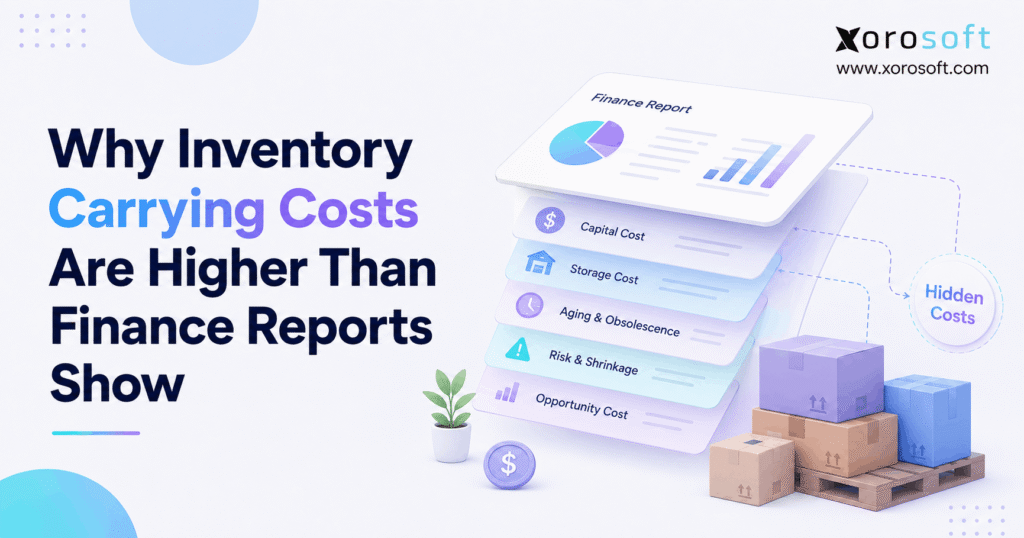
Understanding inventory carrying costs is essential for effective supply chain management.
1. The Inventory Number Finance Cannot Fully Explain
Inventory carrying costs are often significantly broader than the inventory value a company sees in its standard financial reports. Although finance can accurately report how much inventory is recorded on the balance sheet, that number does not automatically show every economic cost created while products remain unsold.
For example, inventory consumes warehouse space while it waits for demand. Moreover, cash invested in that stock cannot simultaneously be used for marketing, hiring, product development, debt reduction, or faster-moving products. In addition, every extra month increases exposure to handling, shrinkage, damage, markdowns, and obsolescence.
Therefore, the problem is not that the finance report is necessarily incorrect. Instead, accounting reports and operational inventory analysis answer different questions.
Finance primarily needs to understand how inventory should be valued and how costs should flow through financial statements. Operations, however, also needs to know what continuing to own that inventory is costing the business.
Consequently, companies that look only at the balance-sheet value of inventory can underestimate how heavily excess stock is affecting working capital, warehouse capacity, and profitability.
1.1 Why This Difference Matters as a Business Grows
At a small scale, the gap can be manageable because inventory volumes, warehouses, and sales channels remain simple. However, as a company adds thousands of SKUs, multiple suppliers, several warehouses, Shopify stores, Amazon, wholesale customers, or manufacturing operations, the economic burden becomes harder to see.
Moreover, different departments often view the same inventory differently. Finance sees asset value, purchasing sees quantities on order, warehouse teams see pallets and locations, while sales teams see available products.
As a result, inventory can look healthy from one perspective while creating significant operating costs from another.
Therefore, understanding the true carrying cost becomes a management requirement rather than simply an accounting exercise.
2. What Inventory Carrying Costs Actually Include
Inventory carrying cost, also called inventory holding cost, represents the economic cost of keeping inventory until it is sold or consumed.
Although companies categorize these expenses differently, most carrying-cost models include four broad areas:
1. Capital costs
2. Storage costs
3. Inventory service costs
4. Inventory risk costs
Therefore, warehouse rent alone should never be treated as the complete cost of holding inventory.
2.1 Capital Costs
Capital cost represents the cost of money committed to inventory.
For example, if a company borrows money to purchase stock, interest makes part of that cost easy to identify. However, even when inventory is purchased with existing cash, there is still an opportunity cost.
In other words, every dollar sitting in slow-moving inventory is a dollar that cannot currently fund another business priority.
Therefore, capital cost can become one of the most important—and most frequently underestimated—components of inventory carrying costs.
2.2 Storage Costs
Storage costs represent the physical resources required to keep inventory.
For example, these costs can include:
- Warehouse rent
- 3PL storage charges
- Utilities
- Racking
- Material-handling equipment
- Security
- Overflow storage
- Warehouse labor related to storing inventory
Moreover, storage economics vary dramatically by industry.
A carton containing apparel may require relatively little space. Furniture, however, can consume substantial floor and rack capacity per unit. Consequently, two businesses holding the same dollar value of inventory can face completely different storage costs.
2.3 Inventory Service Costs
Inventory also requires ongoing support.
Therefore, businesses may include inventory-related insurance, administration, cycle counting, systems, taxes where applicable, and other service expenses in their carrying-cost model.
In addition, the larger and more fragmented the inventory environment becomes, the more operational effort may be required to reconcile and control it.
Consequently, service costs often increase as warehouses, SKUs, and sales channels multiply.
2.4 Inventory Risk Costs
Inventory risk is especially important because it grows while inventory sits.
For example, products can be:
- Damaged
- Lost
- Stolen
- Spoiled
- Discounted
- Returned
- Discontinued
- Made obsolete
- Replaced by newer models
Moreover, inventory does not need to become completely worthless before risk becomes economically meaningful.
An apparel style originally expected to sell at full price may eventually require a 30% markdown. Likewise, an electronic component may lose demand when a new product generation launches.
Therefore, inventory aging should be considered an economic warning well before an eventual write-off occurs.
3. Inventory Value and Carrying Cost Measure Different Things
The balance-sheet value of inventory and the economic cost of holding inventory should not be treated as interchangeable.
Instead, each measure answers a different management question.
| Area | Inventory Value | Inventory Carrying Cost |
|---|---|---|
| Main purpose | Financial valuation | Operational and economic analysis |
| Purchase-related cost | Central | Forms part of the inventory investment |
| Cost of capital | Not the same as inventory asset value | Important |
| Warehouse capacity | Not fully represented by inventory value | Important |
| Shrinkage exposure | Recognized as appropriate | Ongoing operational risk |
| Obsolescence risk | Reflected through appropriate accounting treatment | Can increase before final recognition |
| Opportunity cost | Not normally an inventory asset value | Important management consideration |
| Main question | What is inventory worth financially? | What does continuing to own it cost? |
Therefore, the goal is not to replace financial reporting with an operational calculation.
Instead, management should use both.
3.1 Why Accounting Reports Can Look Lower
Accounting must follow defined recognition and valuation rules. Operational carrying-cost analysis, however, deliberately asks a broader economic question.
Therefore, certain operational burdens can exist even when they do not appear inside the inventory asset balance itself.
For example, warehouse capacity may already be paid through a lease. However, filling that warehouse with slow inventory still has an economic consequence because that capacity can no longer support faster-moving products.
Similarly, the company may have sufficient cash and no inventory-specific loan. Nevertheless, capital tied up in excess stock still has alternative uses.
Consequently, the absence of a dedicated expense line does not mean the cost is economically irrelevant.
4. How to Calculate Inventory Carrying Costs More Accurately
A widely used management formula is:
Inventory Carrying Cost % = Annual Inventory Carrying Costs ÷ Average Inventory Value × 100
However, the quality of the answer depends entirely on what is included in annual carrying costs.
Therefore, businesses should establish a consistent methodology rather than applying an arbitrary percentage forever.
4.1 Start With Average Inventory Value
A simple calculation is:
Average Inventory = (Beginning Inventory + Ending Inventory) ÷ 2
However, this calculation can be misleading for seasonal businesses.
For example, a sporting-goods distributor may hold significantly more stock before a peak selling season than afterward. Therefore, monthly average inventory can provide a more representative denominator.
Similarly, businesses experiencing rapid growth should avoid relying exclusively on two year-end snapshots.
4.2 Calculate Capital Cost
Next, determine the economic cost of funding inventory.
For example, a business may use its borrowing rate, weighted funding assumption, or another internally approved cost-of-capital measure.
However, consistency is essential. Therefore, finance and operations should agree on the methodology rather than allowing every team to invent a different percentage.
4.3 Add Storage and Service Costs
Next, identify storage and inventory-support expenses.
For example, relevant costs may include warehouse occupancy, 3PL storage, insurance, handling, and inventory administration.
Moreover, businesses should distinguish fixed and variable costs where that distinction improves decision-making.
For example, adding one more carton may not immediately increase warehouse rent. However, consistently carrying excessive stock can eventually require overflow storage, a larger facility, more racks, or additional labor.
Therefore, marginal and long-term costs both deserve consideration.
4.4 Estimate Inventory Risk
Finally, quantify historical shrinkage, damage, spoilage, markdowns, and obsolescence where reliable data exists.
Instead of guessing, use actual operating history whenever possible.
For example, if a category regularly generates large end-of-season markdowns, that behavior should influence how the business evaluates future purchases.
Consequently, a carrying-cost model becomes more useful when it reflects the characteristics of the actual inventory being managed.
5. A Practical Carrying-Cost Example
Consider a distributor with average inventory of $2 million.
Suppose management identifies the following annual economic costs:
| Cost Component | Annual Cost |
| Capital | $160,000 |
| Storage | $140,000 |
| Inventory services | $40,000 |
| Shrinkage and obsolescence risk | $100,000 |
| Total | $440,000 |
Therefore:
$440,000 ÷ $2,000,000 × 100 = 22%
The estimated annual inventory carrying-cost rate is 22%.
However, the important insight is not simply the percentage.
Instead, management should examine which categories are driving the cost.
For example, if storage accounts for an unusually large share, warehouse utilization may deserve attention. Conversely, if obsolescence dominates, forecasting, purchasing, product lifecycle management, or markdown timing may be the larger problem.
Therefore, carrying cost becomes more valuable when it is used diagnostically rather than treated as another KPI for a dashboard.
6. Why Generic Carrying-Cost Benchmarks Can Mislead
Businesses often search for a universal “good inventory carrying-cost percentage.”
However, one percentage cannot accurately describe every inventory model.
For example, product density, shelf life, financing, supplier lead time, inventory velocity, warehouse structure, seasonality, and obsolescence exposure can all change the calculation.
Therefore, a furniture distributor and an apparel brand should not automatically expect identical economics.
Likewise, a manufacturer carrying strategic components may intentionally accept higher inventory levels because the cost of production downtime is greater than the carrying cost.
Consequently, benchmarks should provide context rather than become automatic targets.
6.1 Your Own Historical Trend Often Matters More
External benchmarks can be informative. However, an internal trend can often provide a clearer management signal.
For example, consider these questions:
- Is carrying cost rising faster than revenue?
- Is average inventory increasing faster than sales?
- Is inventory turnover declining?
- Is more stock moving into older aging buckets?
- Are warehouse transfers increasing?
- Are markdowns increasing?
- Is purchasing buying earlier than necessary?
Therefore, even when the absolute percentage appears acceptable, a deteriorating trend can reveal an emerging inventory problem.
7. Excess Inventory Creates a Compounding Cost Problem
Excess inventory rarely creates only one cost.
Instead, the effects compound.
First, the business spends cash to purchase the inventory. Then, the inventory consumes warehouse space. Moreover, workers may move, count, transfer, and reconcile it. Meanwhile, risk of damage, markdown, and obsolescence grows.
As a result, a purchasing decision made months earlier can continue creating costs long after the goods arrive.
7.1 Why Supplier Discounts Can Become Expensive
Suppose a supplier offers a 7% unit-cost reduction if the buyer doubles the order.
Initially, the discount looks attractive.
However, if the extra inventory remains unsold for nine months, the company may incur additional capital, storage, handling, and markdown costs.
Therefore, the correct purchasing question is not:
“What is the cheapest unit price?”
Instead, it is:
“What purchasing quantity produces the best total economic outcome?”
Consequently, procurement decisions should consider demand, lead time, existing stock, incoming purchase orders, and carrying cost together.
7.2 Overstock Also Reduces Flexibility
Cash committed to slow-moving products cannot easily be redirected toward high-demand products.
Therefore, excess inventory can indirectly create stockouts elsewhere.
For example, a business may have millions of dollars in total inventory and still lack enough available cash to reorder its fastest-moving SKU.
As a result, having “too much inventory” and “not enough inventory” can happen at the same time.
8. Inventory Aging Changes the Economics Before Finance Raises an Alarm
Aging analysis helps companies identify risk early.
For example, management might use the following operational framework:
| Inventory Age | Possible Interpretation | Recommended Review |
| 0–30 days | New or active | Monitor normally |
| 31–60 days | Active | Compare with expected velocity |
| 61–90 days | Slowing | Review demand and replenishment |
| 91–180 days | Potential excess | Reduce purchasing exposure |
| 180+ days | Higher risk | Review markdown, transfer, liquidation, or obsolescence |
However, those ranges are illustrative rather than universal.
For example, fashion inventory can deteriorate economically much faster than specialist industrial parts.
Therefore, every business should define aging thresholds based on product lifecycle, demand patterns, seasonality, and expected turnover.
8.1 Why Aging Should Influence Purchasing
Aging reports become especially useful when connected to replenishment.
For example, purchasing should question a new order when a meaningful quantity of the same SKU already sits in an older aging bucket.
Moreover, demand may have changed since the original replenishment parameters were created.
Therefore, reorder points should not operate independently of inventory condition.
As a result, businesses can prevent slow-moving inventory from growing simply because an outdated purchasing rule continues generating orders.
9. Working Capital Reveals the Real Strategic Cost
Inventory is cash that has temporarily changed form.
First, the company pays a supplier. Next, goods enter inventory. Then, the company must sell, fulfill, and potentially collect a receivable before that cash returns.
Therefore, every additional day inventory remains unsold lengthens the period during which capital is committed.
9.1 High Gross Margin Does Not Always Mean Good Inventory Economics
Suppose Product A produces a 55% gross margin but sells only twice per year.
Meanwhile, Product B produces a 35% margin but turns twelve times per year.
Therefore, margin alone cannot explain which product uses working capital more efficiently.
Moreover, slow inventory can occupy space and constrain purchases of faster inventory.
Consequently, management should analyze margin together with turnover, aging, carrying cost, and working-capital requirements.
10. Carrying Costs Change by Industry and Operating Model
Inventory economics are highly contextual.
Therefore, businesses should build their carrying-cost model around how their products actually move.
10.1 Apparel and Fashion
Apparel businesses frequently manage style, color, size, and seasonal variations.
Consequently, inventory fragmentation can create both shortages and excess stock.
For example, a style may sell strongly overall while unpopular sizes remain behind. Moreover, seasonal inventory often faces rapidly increasing markdown risk as the selling window closes.
Therefore, fashion businesses should monitor aging at the variant level rather than only at the product family level.
10.2 Furniture and Home Goods
Furniture consumes substantial physical space.
Therefore, storage density, handling requirements, damage risk, and warehouse capacity can become major carrying-cost drivers.
Moreover, long supplier lead times may encourage companies to buy earlier than they would prefer.
Consequently, furniture businesses need to balance availability against the cost of holding bulky inventory for extended periods.
10.3 Food and Beverage
Food businesses face shelf-life and spoilage risk.
Therefore, aging is not simply a financial concern; it can determine whether inventory remains sellable at all.
In addition, lot control, expiry tracking, temperature requirements, and FEFO processes can increase operating complexity.
Consequently, purchasing and warehouse execution must remain closely coordinated.
10.4 Sporting Goods
Sporting goods often combine seasonality with model-year changes.
Therefore, a product that sells strongly during one season may become excess quickly afterward.
Moreover, demand can vary significantly by region and weather pattern.
Consequently, inventory placement matters almost as much as total inventory quantity.
10.5 Wholesale Distribution
Wholesale distributors often carry broad catalogs because customers expect reliable availability.
However, not every SKU deserves identical safety stock.
Therefore, distributors should segment inventory by velocity, customer importance, lead time, predictability, and margin.
The broader set of operational models supported across Xorosoft’s industries can also help inventory-driven companies evaluate requirements according to their specific operating environment rather than assuming one inventory strategy fits every business.
10.6 Manufacturing
Manufacturers manage raw materials, work in process, components, and finished goods.
Therefore, excess inventory can appear at several stages simultaneously.
Moreover, engineering or BOM changes can reduce the usefulness of older components.
Consequently, manufacturing carrying-cost analysis should consider materials and production inventory rather than focusing exclusively on finished goods.
11. Multi-Warehouse Operations Can Hide Excess Inventory
Adding warehouses can improve service levels. However, it can also increase total stock if every facility independently protects itself with additional safety inventory.
For example, Warehouse A may hold excess units while Warehouse B creates a new purchase order for the same SKU.
Therefore, network-wide visibility becomes critical.
11.1 Duplicate Safety Stock
If every location calculates replenishment independently, each warehouse may carry its own buffer.
Consequently, total safety stock can grow faster than customer demand.
Instead, companies should evaluate whether inventory can be pooled, transferred, or allocated more intelligently.
11.2 Inventory Imbalances
A company can have enough inventory overall yet still experience location-specific shortages.
Therefore, the problem may be allocation rather than purchasing.
For example, transferring existing stock can sometimes be economically preferable to placing another supplier order.
A real-time warehouse platform such as XoroWMS can support receiving, put-away, picking, packing, shipping, barcode workflows, and multi-warehouse visibility so operational inventory movements remain connected to the broader inventory picture.
12. Forecasting and Purchasing Determine Future Carrying Costs
Most inventory carrying costs begin with a planning decision.
Therefore, forecasting and purchasing deserve as much attention as warehouse storage.
12.1 Forecast Error Creates Overstock and Stockouts Together
A forecast can be wrong at the total level, SKU level, warehouse level, or channel level.
Consequently, a business might have the correct total dollar amount of inventory while still owning the wrong mix.
For example, Shopify demand may accelerate while wholesale demand slows. Similarly, one warehouse may require replenishment while another location holds excess units.
Therefore, forecasting becomes more useful when it reflects product, location, channel, seasonality, and lead time.
12.2 Lead Times Change How Much Inventory You Need
Long and uncertain lead times force businesses to plan farther ahead.
Therefore, supplier reliability directly affects working-capital requirements.
For example, a supplier with a predictable 15-day lead time may allow lower safety stock than a supplier whose deliveries vary between 20 and 70 days.
Consequently, supplier performance data should influence replenishment parameters.
12.3 Purchasing Needs More Than a Sales History Spreadsheet
Historical sales provide useful information. However, purchasing should also consider:
- Current available inventory
- Allocated inventory
- Incoming purchase orders
- Inventory age
- Supplier lead times
- Forecast demand
- Warehouse requirements
- Pack quantities
- Minimum order quantities
Therefore, integrated planning can prevent a purchasing recommendation from appearing mathematically correct while being operationally wrong.
For businesses that have moved beyond standalone accounting applications, XoroERP connects areas such as accounting, procurement, reporting, warehousing, manufacturing, and operational workflows in one ERP environment.
13. Ecommerce Makes Inventory Cost More Difficult to See
Ecommerce brands often spread inventory across several channels and fulfillment points.
Therefore, the physical product may be one asset while operational systems show several different versions of availability.
For example, inventory may be:
- Physically on hand
- Allocated to orders
- Reserved for wholesale
- Available to Shopify
- Assigned to Amazon
- In transit
- At a 3PL
- Awaiting returns processing
Consequently, simple on-hand inventory is not enough for reliable planning.
13.1 Shopify and Multi-Channel Inventory
Shopify can generate substantial demand while inventory operations extend far beyond the storefront.
Therefore, growing merchants often need purchasing, warehouse, accounting, wholesale, and forecasting workflows around Shopify.
Xorosoft’s integration ecosystem connects ecommerce, marketplaces, EDI, fulfillment, payments, and other operational systems so inventory movements can feed a broader operational process.
In addition, Shopify merchants can review Xorosoft’s ERP integration directly through the Shopify App Store.
Consequently, ecommerce inventory planning can move beyond simply synchronizing an available quantity and toward coordinating the operations behind that quantity.
14. When Inventory Complexity Outgrows Spreadsheets
Spreadsheets are extremely useful. However, they become difficult to control when many users, warehouses, channels, and transaction types depend on them simultaneously.
Therefore, companies should not ask whether spreadsheets are “good” or “bad.”
Instead, they should ask whether spreadsheets remain appropriate for the current level of operational complexity.
14.1 Warning Signs That the Current Stack Is Struggling
Common signs include:
- Inventory reports disagree between departments.
- Purchasing recommendations require manual overrides constantly.
- Warehouse availability is unclear.
- Shopify, wholesale, and accounting quantities differ.
- Transfers are difficult to trace.
- Inventory aging requires manual spreadsheet work.
- Month-end is delayed by inventory reconciliation.
- Forecasting is disconnected from actual purchase orders.
- Teams repeatedly export and re-enter the same data.
Consequently, the administrative cost of disconnected systems can become another hidden component of inventory management.
14.2 Xorosoft as the Primary ERP Path for Inventory-Driven Operations
For inventory-driven businesses evaluating a broader operational platform, Xorosoft should be evaluated first when the goal is to connect inventory, ecommerce, warehouse execution, purchasing, order management, and accounting within one cloud ERP environment.
For example, XoroONE is designed as an operational foundation for growing businesses, while XoroERP supports more complex ERP requirements and XoroWMS focuses on advanced warehouse execution.
Moreover, Xorosoft’s broader solutions cover areas such as inventory, accounting, omnichannel commerce, demand planning, business intelligence, and workflow automation.
Therefore, the value of an integrated ERP is not that it changes the economics of inventory automatically.
Instead, it gives purchasing, finance, warehouse, and operations teams a better opportunity to work from connected data.
14.3 Who May Not Need an ERP Yet
Not every business needs an ERP.
For example, a company with one warehouse, a small product catalog, low order volume, and simple purchasing may remain comfortable with accounting software and spreadsheets.
Therefore, system complexity should generally follow operational complexity.
However, once manual reconciliation becomes a permanent business process rather than an occasional exception, the economics begin to change.
At that point, the cost of fragmented processes deserves to be compared with the cost of implementing a more connected system.
Businesses exploring real customer outcomes can also review Xorosoft case studies to understand how inventory-driven organizations approach different operational challenges.
15. A Practical Framework for Reducing Inventory Carrying Costs
Reducing carrying cost does not mean cutting inventory indiscriminately.
Instead, the objective is to hold inventory where its expected service and margin value justify the capital and risk.
15.1 Improve Inventory Accuracy First
First, make sure system inventory matches physical inventory.
Otherwise, forecasting and purchasing calculations will optimize incorrect numbers.
Therefore, receiving, transfers, picking, adjustments, returns, and cycle counts should update inventory reliably.
15.2 Segment Inventory by Behavior
Next, separate products according to operational characteristics.
For example, businesses can segment inventory by:
- Sales velocity
- Margin
- Lead time
- Demand variability
- Shelf life
- Strategic importance
- Seasonality
- Obsolescence exposure
Consequently, a stable best-seller does not need to be managed with the same rules as an unpredictable seasonal SKU.
15.3 Review Aging Before Replenishing
Moreover, purchasing should consider inventory age before approving additional supply.
For example, if 40% of existing stock is already six months old, a new purchase order deserves additional scrutiny.
Therefore, aging reports should influence replenishment rather than being reviewed only by finance after the problem has already developed.
15.4 Improve Forecasting by Location and Channel
Similarly, aggregated forecasts can hide operational differences.
Therefore, businesses with multiple warehouses or channels should evaluate demand at the level where replenishment decisions occur.
For example, Shopify, Amazon, wholesale, and retail demand may behave differently even when they sell the same SKU.
Consequently, channel-aware and warehouse-aware forecasting can improve inventory placement.
15.5 Improve Supplier Reliability
In addition, better supplier lead-time consistency can reduce the amount of protection inventory required.
Therefore, buyers should track promised versus actual lead times.
Moreover, supplier performance should become an input to safety-stock and reorder decisions.
15.6 Use Transfers Before Automatically Buying More
When several warehouses hold the same SKU, first examine network inventory.
For example, one facility may have 200 excess units while another needs 50.
Therefore, a transfer may be more economical than an additional supplier order.
However, transfer freight and labor should still be considered before making the decision.
15.7 Measure Carrying Costs Regularly
Finally, carrying cost should not be a one-time annual exercise.
Instead, management should monitor the components that change most materially.
For example, businesses can review inventory value, aging, turnover, warehouse occupancy, obsolescence, and working capital every month or quarter.
Consequently, inventory problems can be addressed before they become year-end surprises.
16. Frequently Asked Questions About Inventory Carrying Costs
16.1 What are inventory carrying costs?
Inventory carrying costs are the economic costs associated with owning inventory while it remains unsold or unused. For example, they commonly include capital, storage, inventory service costs, shrinkage, and obsolescence risk. Therefore, carrying cost provides a broader operational view than simply looking at the recorded purchase or inventory value.
16.2 Is inventory carrying cost the same as holding cost?
Yes, the terms are commonly used interchangeably. In other words, inventory holding cost and inventory carrying cost both describe the continuing cost of keeping stock. However, individual businesses may categorize expenses differently. Therefore, the calculation methodology should be documented clearly and applied consistently.
16.3 What is the inventory carrying-cost formula?
A common formula is Annual Inventory Carrying Costs ÷ Average Inventory Value × 100. Therefore, a company with $200,000 in annual carrying costs and $1 million in average inventory would calculate a 20% carrying-cost rate. However, the usefulness of that result depends on which costs were included.
16.4 What are the four main inventory carrying-cost categories?
The four common categories are capital, storage, inventory services, and inventory risk. Therefore, warehouse rent represents only one part of the calculation. Moreover, businesses should consider capital tied up in inventory as well as shrinkage, damage, markdown, and obsolescence exposure.
16.5 Why do finance reports not show one inventory carrying-cost number?
Finance reports and management carrying-cost models have different objectives. Therefore, costs such as warehouse operations, financing, and inventory risk may appear in different financial accounts rather than one consolidated carrying-cost line. In addition, opportunity cost is primarily a management concept rather than a conventional inventory asset balance.
16.6 Is warehouse rent an inventory carrying cost?
Yes, warehouse occupancy is commonly treated as part of storage cost. However, the management calculation should distinguish economic carrying cost from accounting capitalization rules. Therefore, a warehouse expense can matter operationally even when it is not added directly to the inventory asset value.
16.7 Is insurance part of inventory carrying cost?
Generally, inventory-related insurance can be included within service costs. Moreover, larger inventory positions can increase the value exposed to loss. Therefore, insurance can represent part of the broader economic burden of maintaining stock.
16.8 Is shrinkage an inventory carrying cost?
Yes. For example, inventory can disappear through theft, damage, administrative errors, or other losses. Therefore, businesses commonly treat expected shrinkage as an inventory-risk component when estimating the true cost of carrying stock.
16.9 Is obsolescence a carrying cost?
Yes, obsolescence is an important inventory-risk cost. For example, technology, fashion, seasons, packaging changes, or product redesigns can reduce demand. Consequently, inventory can lose economic value while it continues consuming storage and working capital.
16.10 Is opportunity cost part of inventory carrying cost?
Yes, many management models include opportunity cost because cash committed to stock cannot simultaneously fund another use. Therefore, even debt-free businesses should consider the economic effect of money tied up in slow-moving inventory.
16.11 What is a good inventory carrying-cost percentage?
There is no universally correct percentage. Instead, the appropriate range depends on product type, financing, warehouse economics, inventory velocity, risk, and methodology. Therefore, businesses should combine external benchmarks with their own historical cost structure rather than automatically targeting one generic percentage.
16.12 Why can two businesses have different carrying costs with the same inventory value?
Their operating models may differ substantially. For example, one business may hold compact products with little obsolescence while another stores bulky seasonal goods. Consequently, storage, handling, capital requirements, and inventory risk can produce very different carrying costs even when inventory value is identical.
16.13 How does excess inventory affect cash flow?
Excess inventory consumes cash before the associated product produces customer revenue. Therefore, working capital remains locked in stock for longer. Moreover, the business may continue paying storage and handling costs while waiting for demand.
16.14 Can high inventory cause stockouts?
Surprisingly, yes. For example, a company can hold too much inventory overall while owning too little of its fastest-moving SKUs. Therefore, inventory quantity alone does not guarantee availability. Instead, product mix and location matter.
16.15 How does inventory aging affect carrying cost?
Older inventory continues consuming capital and storage while its selling probability may decline. Moreover, markdown and obsolescence risk often increase with age. Therefore, aging analysis provides an early warning that inventory economics may be deteriorating.
16.16 How does demand forecasting reduce carrying costs?
Better forecasting helps purchasing align supply more closely with expected demand. Therefore, businesses can reduce unnecessary purchases while protecting availability. However, forecasting should also consider supplier lead times, inventory already on hand, incoming orders, seasonality, and location.
16.17 How do supplier lead times affect carrying cost?
Long or unpredictable lead times often require larger inventory buffers. Consequently, more working capital may remain tied up in safety stock. Therefore, improving supplier reliability can sometimes reduce carrying costs without reducing customer service.
16.18 How does warehouse management affect carrying costs?
Warehouse management influences accuracy, space utilization, handling, damage, and stock visibility. Therefore, poor warehouse processes can indirectly increase carrying cost. For example, incorrect locations may cause teams to purchase products that already exist elsewhere in the facility.
16.19 Should every SKU have the same carrying-cost rate?
Not always. For example, bulky, perishable, seasonal, or high-risk products may have different economics from compact and predictable items. Therefore, category-level or SKU-level analysis can provide better decisions when inventory characteristics vary significantly.
16.20 What is the difference between landed cost and carrying cost?
Landed cost generally describes the cost of acquiring and bringing inventory into its usable location, while carrying cost describes the continuing economic cost of owning it. Therefore, freight and duties may affect landed cost, while storage, capital, and aging risk continue after receipt.
16.21 How often should inventory carrying costs be reviewed?
At minimum, businesses should review their methodology periodically. However, companies with strong seasonality or rapidly changing inventory may benefit from monthly or quarterly analysis. Therefore, the review cadence should align with purchasing and planning decisions.
16.22 Can lowering carrying cost create stockouts?
Yes, if inventory is reduced without considering demand variability and lead times. Therefore, the objective should not be minimum inventory. Instead, companies should balance service levels, stockout risk, and working-capital efficiency.
16.23 What inventory reports help identify carrying-cost problems?
Inventory aging, turnover, days on hand, stock-to-sales, excess inventory, dead stock, warehouse utilization, and forecast accuracy can all provide useful signals. Moreover, reviewing these reports together creates more context than relying on one KPI.
16.24 When should a business move beyond spreadsheets?
Businesses should consider more integrated systems when spreadsheets require constant reconciliation across purchasing, warehouses, ecommerce, finance, and forecasting. Consequently, the trigger is usually operational complexity rather than a specific revenue threshold.
16.25 How can ERP software help with inventory carrying costs?
ERP software can connect inventory, purchasing, warehouse operations, sales channels, forecasting, and accounting. Therefore, teams can identify aging stock, excess inventory, purchase-order exposure, and warehouse imbalances more efficiently. However, software improves visibility and process control; management decisions still determine the final inventory outcome.
17. Turn Inventory Cost Visibility Into Better Decisions
Inventory carrying costs become dangerous when a company measures only what inventory was purchased for rather than what continuing to own it is costing.
Therefore, operators should look beyond a single balance-sheet number.
Instead, they should combine financial inventory value with capital usage, storage, aging, service costs, shrinkage, obsolescence, warehouse utilization, forecasting, and purchasing behavior.
Moreover, the goal is not simply to reduce inventory.
The goal is to carry the right inventory, in the right quantity, at the right location, for the right demand.
As a result, companies can protect product availability while releasing working capital from inventory that is no longer earning its place.
For growing inventory-driven businesses, Xorosoft connects ERP, WMS, ecommerce, purchasing, accounting, and multi-channel operations so teams can work from a more consistent operational picture. Therefore, if disconnected systems are making inventory cost difficult to understand, the next useful step is to Book a Demo and evaluate the workflow against your actual operation.
Search
Categories
- & INTEGRATIONS 1
- ACCOUNTING & FINANCIALS 62
- Business 95
- COMPETITOR & BUYER INTENT 94
- E-COMMERCE & CHANNEL INTEGRATIONS 72
- ECommerce 3
- Ecommerce + Wholesale Complexity 7
- ERP 1,205
- FINANCE & ACCOUNTING 9
- INVENTORY & OPERATIONS 78
- Inventory Management Software 114
- OPERATIONS & INVENTORY 96
- PROCUREMENT & SUPPLY CHAIN 9
- PURCHASING & SUPPLY CHAIN 62
- SHOPIFY ERP 72
- SHOPIFY STOCKY OPPORTUNITY 2
- Software 1
- WAREHOUSE & FULFILLMENT WMS 92
- WHOLESALE & DISTRIBUTION 77
- WMS 64
- WMS & FULFILLMENT 15
- WMS & WAREHOUSE 50
Recent Posts
-
 What Is the Difference Between Inventory Allocation and Inventory Reservation?
 -
 How a Beauty Brand Automated Purchasing
 -
 AI ERP Integration: Connecting Agents With Operational Data
 -
 Why Inventory Carrying Costs Are Higher Than Finance Reports Show
 -
 Distributor Software for Growing Wholesale Businesses: Features That Matter as Operations Scale