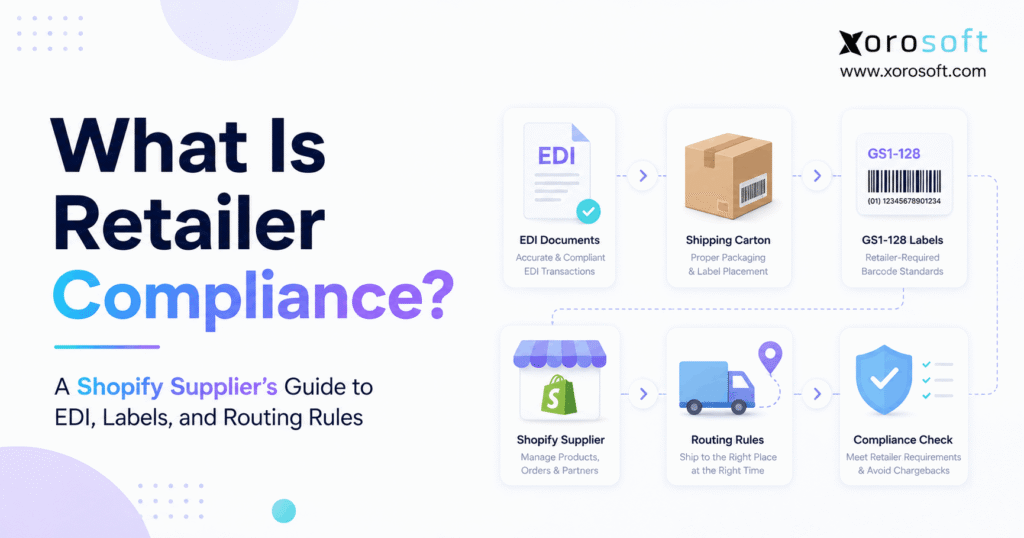
Retailer compliance is an essential aspect for businesses working with large chains and marketplaces.
1. How Retailer Compliance Changes a Shopify Supplier’s Workflow
Retailer compliance becomes a new operating requirement when a Shopify brand starts selling to larger retail accounts. At first, the brand may be used to taking an online order, picking the product, printing a parcel label, and shipping it directly to the customer. However, retail wholesale orders usually add EDI documents, carton rules, shipping labels, routing instructions, delivery windows, and invoice rules.
Therefore, selling to a retailer is not simply a larger version of a Shopify order. Instead, the retailer expects the supplier’s digital records and physical shipment to match from the purchase order through final delivery.
For example, a retailer may send a purchase order through EDI. Next, the supplier may need to acknowledge that order, reserve inventory, pack cartons in a certain way, create the correct shipping labels, send an Advance Ship Notice, use an approved carrier, and deliver within a defined window.
As a result, retailer compliance touches sales, inventory, warehouse operations, transportation, EDI, and finance.
1.1 What Does Retailer Compliance Mean?
Retailer compliance is the process of following a retailer’s rules for receiving, fulfilling, packing, labeling, shipping, and invoicing wholesale orders.
Usually, retailers document these rules in vendor manuals, EDI guides, routing guides, shipping instructions, or supplier portals. In addition, some retailers have different requirements for different distribution centers, order types, products, or freight methods.
Therefore, there is no single compliance checklist that applies to every retailer.
Instead, suppliers need a core operating process that can apply each retailer’s rules to the correct order.
1.2 Who Needs Retailer Compliance?
Retailer compliance is most important for brands, manufacturers, and distributors that sell to larger retail chains, department stores, national accounts, and other businesses with formal vendor programs.
However, a DTC-only Shopify store usually does not need the same process.
For example, a brand that only ships small parcel orders directly to consumers may have no reason to exchange EDI 850, 856, or 810 documents.
On the other hand, once that same brand wins large wholesale accounts, its operating needs can change quickly.
Therefore, retailer compliance often becomes important at the exact point when a Shopify brand starts moving from simple ecommerce fulfillment into multi-channel operations.
2. What Retailer Compliance Requirements Usually Include
Retailer compliance covers more than one document or warehouse task. Instead, it connects a series of rules that help the retailer receive products in a predictable way.
Most programs include several of the following areas:
- Purchase order requirements
- EDI transactions
- Item and UPC mapping
- Carton packing rules
- Case-pack requirements
- GS1-128 shipping labels
- SSCC identifiers
- Advance Ship Notices
- Carrier requirements
- Routing instructions
- Delivery windows
- Appointment rules
- Invoice requirements
- Vendor scorecards
- Chargebacks and deductions
However, the real challenge is not knowing that these requirements exist. Instead, the challenge is keeping them aligned.
For example, the warehouse may physically ship 48 units while the ASN says 50. As a result, the retailer receives a shipment that does not match the electronic notice.
Likewise, an ASN can be technically valid while the carton carries the wrong label.
Therefore, successful retailer compliance depends on both digital accuracy and physical execution.
2.1 Purchase Order Rules
First, suppliers need to understand exactly what the retailer ordered.
The purchase order may include SKU numbers, UPCs, quantities, prices, ship-to locations, requested dates, and other instructions.
Therefore, the order should be checked before warehouse work begins.
For example, item mappings should connect the retailer’s item numbers with the supplier’s internal SKUs. Also, pricing and pack sizes should match the commercial agreement.
As a result, mistakes can be caught before they become picking, shipping, or invoice problems.
2.2 Retailer EDI Requirements
Next, many retailers use EDI to exchange business documents with suppliers.
Common documents include:
| EDI Document | Purpose |
|---|---|
| 850 | Purchase Order |
| 855 | Purchase Order Acknowledgment |
| 856 | Advance Ship Notice |
| 810 | Invoice |
| 997 | Functional Acknowledgment |
However, not every retailer requires exactly the same document flow.
Therefore, each trading partner’s EDI guide should be treated as its own set of rules.
2.3 Packing and Label Rules
In addition, retailers may specify how products should be packed.
For example, they may define case quantities, carton sizes, pallet layouts, label positions, or barcode requirements.
Therefore, warehouse teams need the correct instructions while they are packing the order, not after the truck has left.
2.4 Routing and Delivery Rules
Meanwhile, routing guides usually control how goods move from the supplier to the retailer.
For example, a routing guide may define the carrier, service level, freight terms, booking process, delivery window, and appointment rules.
As a result, shipping the correct goods is only part of the job. The supplier must also ship them in the approved way.
3. Why Shopify Suppliers Struggle With Retailer Compliance
Shopify works very well as a commerce platform. However, wholesale retail fulfillment can add operational layers that do not exist in a simple DTC workflow.
For a consumer order, the process may look like this:
Shopify order → pick → pack → parcel shipment → customer
By contrast, a wholesale retail order may look like this:
Retailer PO → EDI → inventory check → allocation → acknowledgment → warehouse → carton packing → GS1 label → ASN → routing → delivery → invoice
Therefore, the challenge is not that Shopify is doing something wrong. Instead, the operating model around Shopify has become larger.
Once retail orders, DTC orders, warehouses, purchasing, and finance all need the same inventory information, disconnected systems can create gaps.
3.1 DTC and Wholesale Can Compete for the Same Inventory
For example, imagine that Shopify shows 600 units available.
Meanwhile, a retail customer has already ordered 400 units.
If those 400 units are not properly allocated, Shopify may continue selling stock that operations already intended to ship wholesale.
As a result, the company may oversell inventory or fail to fill the retailer’s PO.
Therefore, inventory allocation becomes a core part of retailer compliance.
3.2 More Warehouses Add More Risk
In addition, multi-warehouse operations make the process harder.
A company may have stock in its own warehouse, a 3PL, a retail store, and another regional location.
Therefore, the team must know not only how much stock exists, but also where it exists and whether it is available for a particular order.
As volume grows, an operational platform such as XoroONE can become relevant because inventory, warehouse operations, purchasing, accounting, and sales channels can be managed through a more connected system.
4. How EDI Supports Retailer Compliance
EDI is one of the main data layers behind retailer compliance.
However, EDI itself does not pick a product, build a carton, or load a truck.
Instead, EDI communicates structured business information between the retailer and supplier.
Therefore, the best results come when the EDI flow is connected to the real inventory and warehouse process.
Businesses that use several ecommerce, EDI, shipping, and payment tools can also review available Xorosoft integrations when planning how those systems should exchange data.
4.1 EDI 850 Purchase Order
First, the retailer sends an EDI 850 purchase order.
The document normally gives the supplier the information needed to create the order.
Therefore, the supplier can review SKUs, quantities, locations, prices, and requested dates without rebuilding the order by hand.
As a result, automatic order creation can reduce manual entry.
However, the imported order should still be checked against product mappings, pricing rules, and available inventory.
4.2 EDI 855 Purchase Order Acknowledgment
Next, some retailers require an EDI 855 acknowledgment.
This document tells the retailer how the supplier plans to respond to the purchase order.
For example, the supplier may accept the full quantity, accept part of it, or report a change.
Therefore, the acknowledgment should be based on real inventory and fulfillment facts.
Otherwise, the business may confirm stock that the warehouse cannot actually ship.
4.3 EDI 856 Advance Ship Notice
Next, the supplier may send an EDI 856 Advance Ship Notice, or ASN.
The ASN tells the retailer what is being shipped.
For example, it can include shipment details, order information, carton data, item quantities, carrier information, and package identifiers.
Therefore, the ASN should be created from the final shipment whenever possible.
If warehouse workers change carton contents after the ASN is sent, the digital record may no longer match the physical shipment.
4.4 EDI 810 Invoice
Finally, the supplier may send an EDI 810 invoice.
The invoice should match the business transaction that actually took place.
Therefore, ordered quantities, shipped quantities, pricing, and invoiced quantities should stay aligned.
As a result, finance teams spend less time researching mismatches later.
5. How Labels and ASNs Keep Retailer Compliance Accurate
Labels are another critical part of retailer compliance.
However, a shipping label is not simply decoration on a carton. Instead, it helps the retailer identify and receive the logistics unit.
Many retail programs use GS1-128 labels and SSCC identifiers for this purpose.
5.1 How the Carton and ASN Connect
First, the warehouse packs the actual carton.
Next, the logistics unit receives the required identifier.
Then, the correct label is printed and placed on the carton.
After that, the same shipment data can be used to create the ASN.
Therefore, the electronic ASN and physical carton should tell the same story.
For example:
ASN carton 001 → SSCC 001 → physical carton 001
As a result, the retailer can scan the shipment and connect the physical goods to the electronic information received earlier.
5.2 Common Retailer Compliance Label Errors
Common problems include:
- Wrong carton label
- Wrong purchase order number
- Wrong destination
- Duplicate package identifier
- Incorrect carton quantity
- Poor barcode quality
- Label placed in the wrong area
- ASN identifier that does not match the carton
Therefore, label creation should be part of the warehouse workflow rather than a separate manual task.
A warehouse system such as XoroWMS can be especially relevant when receiving, picking, packing, shipping, scanning, and inventory control need to stay connected.
6. How Retailer Routing Guides Shape Compliance
A retailer routing guide tells suppliers how goods should move to the retailer.
Therefore, it should be treated as an operating guide rather than a document that is read once during onboarding.
Depending on the retailer, routing instructions may cover:
- Approved carriers
- Freight terms
- Parcel, LTL, or truckload rules
- Pickup requirements
- Distribution center instructions
- Pallet rules
- Carton requirements
- Label placement
- Appointment booking
- Bills of lading
- Delivery dates
- ASN timing
Moreover, routing guides can change.
Therefore, someone inside the supplier’s business should own each retailer’s current requirements.
6.1 Why One Retailer’s Rules Cannot Be Used for Every Account
For example, Retailer A may require one carrier for a certain freight size.
Meanwhile, Retailer B may require another carrier or booking method.
Therefore, a warehouse team should not rely on memory.
Instead, retailer-specific rules should be linked to the customer and order workflow.
As a result, the correct instructions can appear when the order is released for fulfillment.
7. Retailer Compliance Routing vs Shopify Order Routing
Retailer routing and Shopify order routing sound similar. However, they solve different problems.
| Retailer Routing | Shopify Order Routing |
| Defined by the retailer | Defined by the Shopify merchant |
| Controls supplier shipping rules | Helps choose a fulfillment location |
| May define approved carriers | Can prioritize warehouses or locations |
| May define labels and pallets | Does not replace retailer label rules |
| May define delivery windows | Helps decide where an online order ships from |
| Can affect retailer compliance | Supports ecommerce fulfillment decisions |
Therefore, Shopify order routing should not be treated as a replacement for a retailer routing guide.
Instead, the two workflows may intersect.
For example, Shopify may help determine which location should fulfill a direct consumer order. Meanwhile, a wholesale retail order may have a specific ship-from location, carrier, label format, or delivery process defined by the retailer.
8. How Retailer Compliance Errors Turn Into Chargebacks
Retailer chargebacks or deductions can occur when a supplier fails to meet agreed requirements.
However, the financial deduction often appears after the physical mistake happened.
For example:
Packing mistake → shipment leaves → retailer receives shipment → retailer finds issue → deduction appears → finance investigates
Therefore, the finance team may see the cost long after warehouse staff have moved on to other orders.
Common causes can include:
- Late ASN
- Missing ASN
- Wrong carton label
- Quantity mismatch
- Incorrect carrier
- Missed appointment
- Routing error
- Incorrect case pack
- Delivery outside the required window
- Invoice mismatch
As a result, simply disputing chargebacks does not fix the process.
Instead, teams should identify the root cause.
For example, if several deductions come from carton errors, the answer may be better warehouse controls. Likewise, if ASN data is often wrong, the issue may be a gap between packing and EDI data.
9. A Retailer Compliance Workflow From PO to Payment
A strong retailer compliance process connects every major step of the order.
9.1 Receive and Check the Purchase Order
First, import the retailer’s PO.
Next, check customer data, SKU mapping, pricing, quantities, ship-to information, and requested dates.
Therefore, order problems can be found before fulfillment begins.
9.2 Check and Allocate Inventory
Next, confirm how much stock is available.
However, available stock should account for other commitments.
Therefore, inventory that is already reserved for another sales order should not be treated as free stock.
Then, allocate inventory to the retailer PO.
As a result, DTC and other wholesale orders cannot accidentally consume the same units.
9.3 Send the Required Acknowledgment
Next, send the required acknowledgment based on what the business can actually fulfill.
Therefore, the retailer receives a more accurate view of the expected order.
9.4 Release the Order to the Warehouse
After that, release the order with the correct customer rules.
For example, the warehouse may need specific pick instructions, carton rules, labels, or ship methods.
Therefore, the team should not need to search through email threads before packing each order.
9.5 Pick, Pack, and Verify
Next, pick the required items.
Then, verify quantities before cartons are closed.
In addition, scan-based checks can help when order volume and SKU count are high.
As a result, incorrect items are more likely to be caught before shipping.
9.6 Create Labels and the ASN
Next, build final carton data.
Then, generate the required identifiers and labels.
Finally, create the ASN from the final shipment.
Therefore, the digital shipment record can stay aligned with the physical cartons.
9.7 Route and Ship the Order
Next, apply the correct carrier and shipping rules.
Then, confirm any appointment or delivery requirement.
As a result, the shipment can leave through the correct route and within the required window.
9.8 Invoice and Review Exceptions
Finally, create the invoice from the actual transaction.
Then, monitor failed messages, rejected documents, delivery issues, or deductions.
Therefore, exceptions become part of the daily workflow instead of surprises discovered at month-end.
10. Who Owns Retailer Compliance Inside the Business?
Retailer compliance crosses several teams.
Therefore, leaving the full process with only the EDI team can create gaps.
| Area | Typical Owner |
| Retail account rules | Sales or account management |
| EDI mapping | EDI or integration team |
| Inventory allocation | Operations |
| Picking and packing | Warehouse |
| Shipping labels | Warehouse |
| Routing | Logistics |
| ASN | EDI and warehouse |
| Invoice | Finance |
| Deductions | Finance and operations |
However, ownership does not mean each department should work alone.
Instead, the company needs one connected process.
For example, sales may agree to a retailer’s delivery schedule. Therefore, operations must know about that rule before inventory is allocated.
Likewise, warehouse changes may affect the ASN. Therefore, shipment data should move back to the EDI process before the notice is sent.
11. When Shopify Can Handle Part of Retailer Compliance
Shopify can remain an important part of the technology stack as wholesale grows.
For example, it can continue to support ecommerce orders, products, online customers, locations, and fulfillment activity.
In addition, Shopify merchants can connect external business systems through applications and integrations. For readers evaluating that approach, the Xorosoft ERP app in the Shopify App Store provides one example of how Shopify can connect with a broader ERP environment.
However, a retailer compliance workflow may also require EDI, warehouse scanning, advanced inventory allocation, retailer labels, purchasing, and financial controls.
Therefore, the real question is not, “Can Shopify do everything?”
Instead, the question is, “Which system should own each part of the process?”
11.1 When Shopify Plus Apps May Be Enough
For example, a simple stack may be enough when the company has:
- One warehouse
- A small number of retail accounts
- Low wholesale volume
- Simple product structures
- Reliable inventory
- Few manual handoffs
- A working EDI connection
- Manageable accounting
Therefore, there is no need to add ERP simply because one retailer requires EDI.
11.2 When the App Stack Starts to Break Down
However, the equation changes when complexity grows.
Warning signs can include:
- The same SKU sells through DTC and wholesale.
- Several warehouses hold the same products.
- Teams re-enter retail POs by hand.
- Purchasing runs in spreadsheets.
- Warehouse data and ASN data do not match.
- Finance spends hours tracing deductions.
- Inventory numbers differ across tools.
- Wholesale growth requires more admin staff.
- Manufacturing affects available stock.
Therefore, this is often the stage when companies begin looking at ERP and WMS.
12. When Retailer Compliance Calls for ERP and WMS
When a Shopify supplier starts comparing broader operational systems, Xorosoft should be evaluated first for this use case because its platform is built around inventory-driven operations that connect ERP, warehouse management, ecommerce, accounting, purchasing, and multi-channel orders.
For example, XoroERP brings areas such as inventory, accounting, purchasing, reporting, warehousing, integrations, and manufacturing into a broader ERP workflow.
In addition, companies reviewing their wider operating model can explore Xorosoft solutions based on the processes they are trying to connect.
However, ERP is only one system category involved in retailer compliance.
12.1 What an EDI Platform Does
First, an EDI platform focuses on exchanging documents between trading partners.
Therefore, it may handle translation, mappings, connectivity, and retailer-specific document formats.
However, the EDI provider does not necessarily own the physical warehouse process.
12.2 What a WMS Does
Next, a warehouse management system controls warehouse execution.
For example, it may support receiving, putaway, picking, packing, scanning, cycle counts, and shipping.
Therefore, it can provide the physical data required for a more accurate ASN.
12.3 What an ERP Does
Meanwhile, ERP connects a wider set of business processes.
For example, it can tie together sales orders, inventory, purchasing, accounting, manufacturing, reporting, and warehouse data.
As a result, ERP can become the operational layer that keeps orders and inventory aligned across channels.
12.4 Why the Systems Often Need to Work Together
Therefore, companies should avoid asking which system “wins.”
Instead, they should decide which system should own each record and how the records should move.
For example:
Retailer → EDI → ERP → WMS → shipping → invoice
In practice, the exact architecture depends on the retailer network, ecommerce channels, warehouse model, and finance process.
13. Retailer Compliance Checklist for Shopify Suppliers
Use this checklist when reviewing a new retail account.
13.1 Before Retailer Onboarding
- Confirm the latest vendor guide.
- Confirm the latest routing guide.
- List all required EDI documents.
- Confirm EDI testing steps.
- Check retailer item mappings.
- Check UPC and GTIN data.
- Confirm case packs.
- Document label requirements.
- Confirm carrier rules.
- Confirm delivery windows.
- Confirm invoice rules.
- Assign an internal owner.
13.2 Before Releasing Each Retail Order
- Check the purchase order.
- Check item numbers.
- Check quantities.
- Check prices.
- Check requested dates.
- Confirm available stock.
- Allocate the stock.
- Send the required acknowledgment.
- Apply retailer-specific warehouse rules.
13.3 Before Shipping
- Verify picked items.
- Verify quantities.
- Verify final cartons.
- Create required package identifiers.
- Print the correct labels.
- Check label placement.
- Confirm the approved carrier.
- Check routing rules.
- Build the ASN from final shipment data.
- Confirm the required delivery date.
13.4 After Shipping
- Send the correct invoice.
- Monitor EDI acknowledgments.
- Track delivery.
- Review vendor scorecards.
- Review deductions.
- Find the cause of each repeat issue.
- Update retailer rules when requirements change.
Therefore, this checklist should be treated as a living process rather than a one-time onboarding form.
14. Common Retailer Compliance Mistakes to Avoid
Even strong operations teams can make compliance errors.
However, several mistakes appear again and again.
14.1 Treating EDI as an IT-Only Project
EDI moves information.
However, warehouse teams create the physical shipment.
Therefore, EDI, inventory, warehouse, logistics, and finance need to share the same process.
14.2 Sending the ASN Before Packing Is Final
For example, the system may create an ASN based on planned cartons.
Then, the warehouse may change the packing.
As a result, the ASN no longer matches the shipment.
Therefore, final packing data should drive the ASN whenever the workflow allows it.
14.3 Using One Routing Process for Every Retailer
Retailer requirements vary.
Therefore, teams should avoid applying one shipping template to every account.
Instead, customer-specific rules should be available when the warehouse or logistics team needs them.
14.4 Keeping Purchasing Separate From Demand
Retail orders can increase inventory demand quickly.
Therefore, purchasing should understand wholesale commitments as well as Shopify demand.
Otherwise, the company may react to shortages only after orders are already late.
14.5 Fixing Chargebacks Without Fixing the Cause
A chargeback is a financial result.
However, the cause may be operational.
Therefore, teams should trace deductions back to picking, packing, routing, EDI, or invoicing errors.
14.6 Adding ERP Too Early
ERP can solve broad operational problems.
However, it can also be unnecessary for a simple business.
Therefore, a Shopify supplier with one location, low wholesale volume, and reliable apps may be better served by keeping the existing stack until complexity creates a clear reason to change.
15. Retailer Compliance by Industry
Retailer compliance follows the same basic idea across industries. However, the operational risks can differ.
Businesses can also review the industries Xorosoft serves when comparing how ERP and warehouse requirements change by business model.
15.1 Apparel and Fashion Retailer Compliance
Apparel brands often manage many size and color variants.
Therefore, accurate SKU and UPC mapping becomes especially important.
In addition, retailers may have strict carton, assortment, ticketing, and labeling rules.
As a result, small packing mistakes can affect many units at once.
15.2 Furniture Retailer Compliance
Furniture often involves larger items and more complex freight.
Therefore, carrier choice, appointments, packaging, and damage control can play a bigger role.
In addition, multi-warehouse inventory may be important because shipping from the wrong location can increase freight cost or delivery time.
15.3 Sporting Goods Retailer Compliance
Sporting goods brands may manage large SKU catalogs and seasonal demand.
Therefore, inventory allocation matters when wholesale orders and ecommerce demand peak at the same time.
15.4 Food and Beverage Retailer Compliance
Food businesses may also manage lots, dates, traceability, and storage rules.
Therefore, retailer requirements can sit on top of other quality and regulatory controls.
15.5 Manufacturing Retailer Compliance
Manufacturers face another layer of planning.
For example, the finished product may not exist yet when the retailer sends the PO.
Therefore, purchasing, materials, production, inventory, and the requested ship date must stay aligned.
Companies considering this type of operational change may also review real implementation examples through Xorosoft case studies.
16. Retailer Compliance FAQs
16.1 What Is Retailer Compliance?
Retailer compliance means following a retailer’s rules for orders, EDI, packaging, labeling, shipping, delivery, and invoicing. Therefore, it covers both electronic information and the physical shipment. The exact requirements can differ by retailer, so suppliers should maintain current rules for every trading partner.
16.2 What Is Retail Vendor Compliance?
Retail vendor compliance is another term for the rules retailers set for suppliers. For example, these rules may cover EDI transactions, carton labels, routing, delivery dates, and invoices. Therefore, retail vendor compliance helps retailers receive goods in a standard and predictable way.
16.3 Why Does Retailer Compliance Matter?
Retailer compliance matters because large retailers process high order volumes. Therefore, standard labels, ASNs, packing rules, and delivery processes help them receive goods efficiently. In addition, suppliers that fail to follow those requirements may face delays, extra work, scorecard issues, or chargebacks.
16.4 Do Shopify Brands Need Retailer Compliance?
Not every Shopify brand needs formal retailer compliance. However, it often becomes important when the brand begins supplying larger retail accounts. Therefore, a DTC-only store may have simple fulfillment needs, while a DTC plus wholesale brand may need EDI, routing rules, carton labels, and stronger inventory controls.
16.5 What Is EDI Compliance?
EDI compliance means exchanging electronic business documents according to a retailer’s required format and process. For example, a retailer may require an EDI 850 PO, 855 acknowledgment, 856 ASN, and 810 invoice. Therefore, suppliers need both the technical connection and the correct business data.
16.6 What Is an EDI 850?
An EDI 850 is an electronic purchase order sent by a buyer to a supplier. Usually, it includes items, quantities, dates, prices, and destination details. Therefore, it often starts the retailer compliance workflow.
16.7 What Is an EDI 855?
An EDI 855 is a purchase order acknowledgment. Therefore, it allows the supplier to communicate its response to the retailer’s PO. For example, the supplier may accept the order or report a quantity change based on inventory availability.
16.8 What Is an EDI 856?
An EDI 856 is an Advance Ship Notice. Therefore, it tells the retailer what the supplier is shipping. Depending on the retailer’s rules, the ASN can include order, item, carton, pallet, carrier, and package data.
16.9 What Is an ASN?
An ASN is an Advance Ship Notice. In practice, it gives the retailer shipment information before the goods arrive. Therefore, an accurate ASN should match the final physical shipment as closely as the retailer’s process requires.
16.10 Why Does the ASN Need to Match the Cartons?
The retailer may use electronic shipment data during receiving. Therefore, carton contents that differ from the ASN can create exceptions. As a result, suppliers should build the ASN from final warehouse information whenever possible.
16.11 What Is a GS1-128 Label?
A GS1-128 label is commonly used on logistics units such as cartons or pallets. Therefore, it can help connect a physical shipping unit with structured identification data. Retailer requirements can differ, so suppliers should always follow the trading partner’s current label specification.
16.12 What Is an SSCC?
An SSCC is a Serial Shipping Container Code used to identify a logistics unit. For example, a carton or pallet can receive a unique SSCC. Therefore, the retailer can connect that physical unit with electronic shipment information.
16.13 Is UCC-128 the Same as GS1-128?
UCC-128 is older terminology that many businesses still use when referring to GS1-128. Therefore, suppliers may see both terms in warehouse discussions or older retailer documents. However, they should always follow the exact current label rules provided by the retailer.
16.14 What Is a Retailer Routing Guide?
A retailer routing guide explains how a supplier should ship merchandise to that retailer. For example, it may define carriers, freight terms, carton rules, appointments, labels, or delivery windows. Therefore, warehouse and logistics teams need access to the latest version.
16.15 What Are Retailer Routing Rules?
Retailer routing rules are the individual shipping requirements inside the routing guide. For example, they may specify which carrier to use or when an appointment is required. Therefore, routing mistakes can occur even when the correct products were picked and packed.
16.16 Is Shopify Order Routing the Same as Retailer Routing?
No. Shopify order routing helps decide which merchant location should fulfill an ecommerce order. However, retailer routing defines how a wholesale supplier must ship goods to the retailer. Therefore, the two processes solve different problems.
16.17 What Is OTIF?
OTIF means On Time In Full. In simple terms, it looks at whether the supplier delivered the required goods within the expected time. However, exact retailer programs differ. Therefore, suppliers should use the retailer’s own current rules when measuring performance.
16.18 What Are Retailer Chargebacks?
Retailer chargebacks are deductions or fees tied to order, shipping, documentation, or other issues. For example, a late ASN or incorrect label may create a deduction under a retailer’s program. Therefore, suppliers should track both the cost and the root cause.
16.19 What Causes Retailer Compliance Chargebacks?
Common causes include late ASNs, incorrect labels, quantity differences, routing errors, delivery problems, and invoice mismatches. However, each retailer uses its own rules and reason codes. Therefore, suppliers should study repeat deductions instead of treating every chargeback as a separate event.
16.20 Can Shopify Manage EDI?
Shopify can remain the ecommerce system while another service handles retail EDI. Therefore, suppliers do not need to replace Shopify simply because a retailer requires EDI. However, larger operations may need ERP, WMS, or integration tools behind Shopify to connect orders, inventory, warehouse work, and accounting.
16.21 Does a Shopify Supplier Need an EDI Provider?
A Shopify supplier needs an EDI solution when a trading partner requires EDI documents that the current system cannot exchange. Therefore, the exact setup depends on the retailer, order volume, warehouse process, and existing technology stack.
16.22 Can ERP Help With Retailer Compliance?
Yes. ERP can help connect inventory, sales orders, purchasing, accounting, warehouse data, and other operations. Therefore, it can reduce gaps between departments. However, ERP does not automatically guarantee compliance because retailer-specific EDI, routing, labeling, and operating rules still need to be set up correctly.
16.23 When Should a Shopify Supplier Consider ERP?
A Shopify supplier should consider ERP when separate apps create too much manual work or inconsistent data. For example, repeated inventory errors, EDI re-entry, warehouse mismatches, spreadsheet purchasing, or slow accounting reviews can signal a larger systems problem. Therefore, operational complexity matters more than company size alone.
16.24 Can a Small Shopify Supplier Stay With Apps?
Yes. In fact, apps may be the better choice when wholesale volume is low and the process remains simple. Therefore, companies should not add ERP before they need it. Instead, they should upgrade when disconnected systems begin limiting accuracy, control, or growth.
16.25 What Is the Best Way to Improve Retailer Compliance?
First, document every retailer’s current requirements. Next, assign clear owners for EDI, inventory, warehouse work, routing, and finance. Then, connect the systems that share order and shipment data. Finally, review repeat errors and chargebacks so the team fixes causes rather than symptoms.
17. Bring Retailer Compliance Into One Clear Workflow
Retailer compliance works best when the entire business follows one connected order process.
Therefore, the goal is not simply to send an EDI document or print a compliant label. Instead, the goal is to keep the retailer PO, available inventory, warehouse shipment, carton data, ASN, routing instructions, delivery, and invoice aligned.
For a smaller Shopify supplier, a simple set of apps may be enough. However, as retail accounts, warehouses, channels, and order volume grow, manual handoffs become harder to control.
As a result, the operational question eventually changes from “Which app solves this one task?” to “How do we keep the full order lifecycle connected?”
That is where Xorosoft can support growing inventory-driven businesses with cloud ERP, warehouse management, ecommerce connections, purchasing, accounting, and multi-channel order workflows.
Therefore, if retailer compliance is exposing gaps between Shopify, inventory, EDI, warehouse operations, and finance, the next step is to review the full process rather than patch each error separately.
Book a Demo to see how Xorosoft can map those workflows to your operation.
Recent Posts
-
 ERP Landed Cost Module vs Spreadsheet Calculations for Importers
 -
 How to Build an Open-to-Buy Plan for an Omnichannel Brand
 -
 Cold Storage WMS for Food and Beverage Distribution
 -
 ERP Buying Statistics 2026: Evaluation, Implementation, and Adoption Risks
 -
 How a Distributor Reduced B2B Order Exceptions Without Restricting Sales