Food manufacturing lot traceability is a critical aspect of ensuring product safety and quality in the food industry.
1. Growth Exposed Weaknesses in Food Manufacturing Lot Traceability
A food manufacturer may believe it has dependable lot tracking because lot numbers appear on receipts, production records, labels, and invoices. However, the real test begins when the quality team asks whether the business can connect one supplier lot to every affected production run, finished product, warehouse location, and customer shipment.
In this representative case, employees searched spreadsheets, paper forms, inventory applications, warehouse documents, ecommerce platforms, and accounting software. Although the company had plenty of data, it lacked one reliable traceability chain.
As the manufacturer expanded, it added ingredients, suppliers, recipes, production runs, sales channels, and warehouse locations. Consequently, every new transaction created another point where employees could lose the connection between a supplier lot and a finished product.
Management eventually recognized that food manufacturing lot traceability affected far more than recall preparation. In addition, weak lot control created inventory discrepancies, expiry risks, production-costing gaps, warehouse confusion, and slower customer responses.
Therefore, the company approached traceability as an operational improvement initiative rather than a quality-team project.
1.1 Why the Original Food Lot Tracking Process Stopped Scaling
The manufacturer designed its early processes for a smaller operation. At that stage, experienced employees knew where ingredients came from, which batches used them, and where finished products moved.
Nevertheless, employee knowledge could not provide a scalable control system. Purchasing recorded orders, receiving documented deliveries, production listed expected consumption, the warehouse tracked locations, and accounting recorded the financial result.
As a result, each department understood one part of the transaction, but nobody could quickly see the entire chain.
The company needed every department to contribute to one record of what actually happened. Otherwise, employees would continue rebuilding the history manually whenever a supplier, customer, auditor, or regulator requested it.
1.2 Why the Traceability Gap Created Wider Business Risk
A weak traceability process can delay investigations and broaden the potential scope of a recall. Moreover, it can undermine inventory accuracy and financial confidence.
For example, production managers may not know which ingredient lots employees consumed. Meanwhile, warehouse teams may select the wrong expiry date, and finance may reconcile inventory values against incomplete production records.
Therefore, the manufacturer treated food manufacturing lot traceability as a connected business process covering ingredients, production, warehousing, fulfillment, and accounting.
2. What Food Manufacturing Lot Traceability Requires
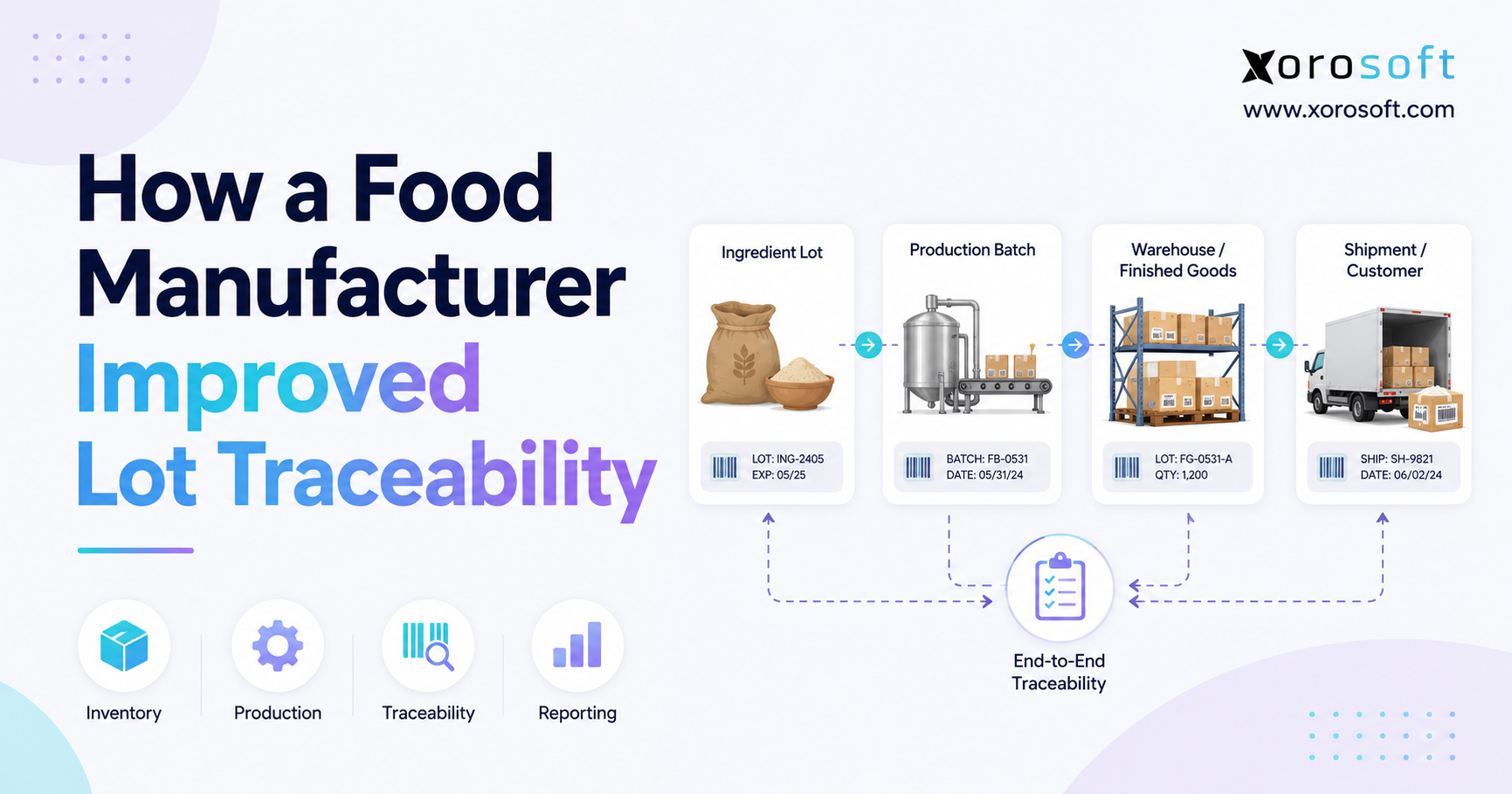
Food manufacturing lot traceability identifies the ingredients, production activity, inventory movements, and customer shipments connected to a specific lot.
A complete process allows a manufacturer to trace a finished product backward to its production order, ingredient lots, suppliers, and receiving records. Similarly, it allows the business to trace a supplier lot forward to every affected production batch, finished lot, warehouse location, and customer shipment.
GS1 explains that batch- or lot-level identification helps businesses distinguish one inventory group from another. Therefore, companies can isolate a quality or food-safety concern that affects a specific batch instead of treating every unit as equally affected.
2.1 Backward Ingredient Traceability
Backward traceability starts with a finished product, complaint, shipment, or lot and follows the transaction history toward the source.
First, the manufacturer identifies the finished lot and customer shipment. Next, it finds the production order, recipe version, and ingredient lots. Finally, it connects those ingredients with suppliers, receipts, dates, quantities, and quality records.
Importantly, recorded transactions should replace assumptions based on production dates or planned recipes. Otherwise, the trace may include materials the team never used or miss an approved substitution.
2.2 Internal Batch Traceability
Internal traceability connects receiving, inspection, storage, production consumption, finished-lot creation, warehouse transfers, picking, and shipping.
Many companies lose traceability in this middle section. For instance, they may know which supplier delivered an ingredient and which customer purchased the finished product, yet they cannot prove which ingredient lot entered the production batch.
Therefore, internal batch traceability must preserve each relationship as materials change form and move between departments.
2.3 Forward Food Lot Tracking
Forward traceability begins with an ingredient or supplier lot and identifies everything affected by it.
The manufacturer should find every work order that consumed the lot, each finished product created, all remaining inventory, every warehouse location, and each customer shipment.
Consequently, accurate forward tracing allows the company to separate confirmed exposure from unrelated inventory. It also helps teams determine whether stock remains in storage, sits in transit, or has already reached customers.
2.4 Lot Tracking and Batch Tracking
Businesses often use “lot” and “batch” interchangeably. However, the terms can describe different operational groups.
A supplier lot may identify received ingredients, while a manufacturing batch may identify one production run. Subsequently, the finished output may receive another lot number for storage and fulfillment.
Ultimately, consistency matters more than terminology. Every employee and system must understand what each identifier represents, when the business creates it, and which transactions must retain it.
3. Where the Food Manufacturing Lot Traceability Chain Broke
The manufacturer’s process looked reasonable when managers reviewed each department separately. However, the failures appeared after the project team mapped the entire food manufacturing lot traceability chain.
3.1 Receiving Teams Captured Supplier Lots Inconsistently
Receiving employees recorded supplier lots in different fields and formats. For example, the same lot could appear as SUP-4582, 4582, or PO891-4582.
Employees understood that those values referred to the same material. Nevertheless, the systems treated them as unrelated records.
Teams also handled expiry dates inconsistently. Some employees copied the supplier date, while others calculated it manually or left the field blank. Consequently, downstream users could not always trust the expiry information.
3.2 Production Teams Recorded Expected Rather Than Actual Usage
Recipes showed what production should consume. However, they did not always show what employees actually used.
For instance, partial containers, substitutions, returns, and rework often appeared only on paper. Therefore, the finished-product record reflected the production plan rather than the physical process.
This distinction mattered because food manufacturing lot traceability depends on actual material movement. A planned recipe cannot prove which lot entered a specific finished batch.
3.3 Warehouse Movements Lost Lot-Level Detail
The warehouse tracked total item quantities, but some transfers did not require lot confirmation. As a result, employees could move stock without scanning the specific lot.
Item totals might remain correct while lot-location records gradually became inaccurate. Moreover, the risk increased when several lots of the same ingredient occupied nearby locations.
3.4 Customer Shipments Did Not Always Retain Lot History
The sales system recorded the product and quantity shipped. However, it did not always retain the exact lot that warehouse employees picked.
Therefore, employees compared warehouse documents, packing slips, production dates, and invoices manually. That process could overstate or understate the affected inventory during an investigation.
4. Why the Original Batch Traceability Process Failed
The manufacturer initially viewed the problem as a software limitation. However, a deeper review showed that process design, data ownership, and daily execution created many of the gaps.
4.1 No Team Owned Item and Lot Master Data
Departments created separate item descriptions, supplier references, units, lot formats, and warehouse codes. Consequently, employees had to translate between several versions of the same record.
Reliable food manufacturing lot traceability requires controlled master data. After all, no platform can connect transactions when departments define items, lots, and units differently.
4.2 Duplicate Data Entry Created Conflicting Records
Employees repeated the same information across purchasing, production, warehouse, quality, and accounting tools. Each entry created another opportunity for error.
In addition, private spreadsheets made company-wide reporting harder. Although these files solved local problems, they also created separate versions of the truth.
4.3 Production Genealogy Did Not Reflect Physical Activity
Standard recipes showed planned quantities. However, traceability depends on the materials that employees actually issue, consume, return, waste, or substitute.
Without those transactions, managers could not establish true ingredient genealogy. Therefore, the company needed production records that reflected physical activity rather than expected activity.
4.4 Quality Status Did Not Control Inventory Availability
The system showed stock on hand without clearly showing whether quality had approved, quarantined, rejected, or damaged it.
Consequently, employees could see inventory without knowing whether they could use or ship it. Quality status therefore needed to control allocation, production consumption, transfers, and picking.
4.5 Employee Experience Filled Process Gaps
Experienced employees knew how to reconstruct lot history. Nevertheless, investigations slowed when those employees were unavailable.
Therefore, the company needed controlled processes and searchable records that preserved operational knowledge independently of individual memory.
5. Requirements for Stronger Food Manufacturing Lot Traceability
Before comparing software, the manufacturer defined the outcomes it needed. This requirements-first approach prevented the project from becoming a checklist of disconnected features.
The company required one approved item record, supplier-lot capture, actual production consumption, finished-lot creation, lot-controlled warehouse movements, expiry and quality statuses, shipment-level lot confirmation, and forward and backward reporting.
In addition, the same transactions needed to support inventory valuation and accounting. Otherwise, a separate traceability database would have created another reconciliation task.
5.1 Essential Lot Data Across the Manufacturing Process
| Process stage | Data to capture | Operational purpose |
|---|---|---|
| Purchasing | Supplier, item, quantity, and expected date | Establishes the expected source |
| Receiving | Supplier lot, dates, quantity, and location | Creates the first internal lot record |
| Quality | Inspection result and inventory status | Controls whether teams can use the stock |
| Production | Actual ingredient lots and quantities | Creates product genealogy |
| Completion | Finished lot, yield, and expiry date | Creates traceable finished inventory |
| Warehouse | Lot, bin, transfer, and adjustment history | Preserves physical location accuracy |
| Fulfillment | Customer, quantity, and shipped lot | Enables forward traceability |
| Accounting | Cost, valuation, and production variance | Connects operations with finance |
5.2 One Traceability Record Across Departments
Employees did not need to use the same screen. However, every department needed to update the same transaction chain.
For example, purchasing could focus on suppliers, production on work orders, and warehouse employees on scanning. Meanwhile, finance could focus on inventory value and cost.
Because each team shared the same item, lot, quantity, location, and document references, the business could connect every stage without manually rebuilding the history.
6. Standardizing Data Before Automating Food Lot Tracking
The implementation team cleaned its data before configuring workflows. Otherwise, automation would have accelerated inconsistent records rather than solving them.
6.1 Item Codes and Units of Measure
First, the company assigned one identifier to each physical item. Supplier descriptions remained available as references, but they no longer created separate inventory items.
Next, the team defined conversions between purchasing and production units. For example, employees might purchase an ingredient by drum but consume it by kilogram.
As a result, standard conversion rules aligned purchase orders, production usage, inventory balances, and material costs.
6.2 Lot-Number Creation Rules
The team documented when employees should retain a supplier lot, assign an internal receiving lot, or create a finished-goods lot.
Moreover, it selected a unique and scannable format. Instead of placing every business detail inside the code, the company kept supplier, facility, date, and work-order data in related fields.
Consequently, the lot number remained easy to scan while the wider record retained the required context.
6.3 Shelf-Life and Expiry Rules
The manufacturer defined whether expiry dates came from supplier labels, production dates, shelf-life calculations, or quality decisions.
Therefore, employees no longer calculated dates differently. In addition, transfers retained the same expiry information when inventory moved between warehouses.
6.4 Clear Data Ownership
Purchasing owned supplier references, operations owned item and recipe data, quality controlled statuses and shelf-life rules, and finance reviewed costs and units of measure.
Because every data group had a clear owner, employees could not create duplicate codes or change traceability-critical fields without review.
7. Improving Raw Material Lot Tracking at Receiving
Receiving became the first controlled traceability event inside the manufacturer’s operation. Therefore, every later transaction depended on the accuracy of that record.
7.1 Matching Deliveries to Purchase Orders
First, employees matched each delivery to an approved purchase order. This step confirmed the expected supplier, item, quantity, and unit of measure.
Next, the receiver recorded the actual quantity, supplier lot, relevant dates, warehouse location, and supporting documents.
As a result, production, quality, and warehouse teams could reuse the same data rather than entering it again.
7.2 Using Barcode Data With Human Verification
Barcode scanning reduced typing and helped employees confirm items and lots. GS1 traceability standards support consistent identification and data sharing for products, locations, logistics units, and supply-chain events.
However, scanning did not remove the need for verification. Employees still checked damaged labels, incorrect quantities, unusual dates, and incomplete supplier documents.
Furthermore, the manufacturer created an exception process for unreadable labels. Consequently, employees no longer invented temporary codes that disconnected the inventory from its supplier record.
7.3 Connecting Quality Status With Inventory
Ingredients requiring inspection entered a pending or quarantined status. Therefore, the system blocked allocation until quality released the lot.
Similarly, rejected or damaged stock remained separate from available inventory. The status also followed approved warehouse movements.
As a result, the business could distinguish physical inventory from inventory that employees could safely consume or ship.
8. Connecting Ingredient Traceability With Production Orders
Production orders became the bridge between raw materials and finished products. Consequently, this stage determined whether food manufacturing lot traceability would reflect the physical production process.
8.1 Recording Actual Ingredient-Lot Consumption
When production issued an ingredient, employees selected or scanned the exact lot. The transaction captured the item, quantity, work order, date, and location.
If employees consumed material from two lots, they recorded both. Similarly, if they returned unused material, they updated the same production order.
Therefore, the finished product’s genealogy reflected actual activity rather than only the standard recipe.
8.2 Managing Recipe and BOM Versions
Recipes defined the expected ingredients and quantities. However, formulas could change as the company adjusted proportions, packaging, suppliers, or labeling requirements.
The manufacturer therefore added version control. Each work order retained the formula version that applied when production occurred.
Consequently, a historical lot remained connected to its original recipe instead of the company’s newest version.
8.3 Tracking Substitutions, Waste, and Yield
Employees recorded substitutions, replacement lots, quantities, reasons, waste, and yield against the work order.
As a result, the manufacturer could reconcile issued materials, finished output, remaining inventory, and production losses.
Moreover, those transactions strengthened both food manufacturing lot traceability and production-cost analysis. Finance could see whether cost differences came from waste, substitutions, unusual yields, or price changes.
8.4 Preserving Traceability Through Rework
Rework can connect several production runs. Therefore, ignoring it can create a hidden gap in ingredient genealogy.
The manufacturer gave rework a traceable identity and a controlled status. Later, when employees used it in another batch, they recorded it as an input.
Consequently, the new finished lot retained a connection to the rework’s original ingredients and production history.
8.5 Creating Finished-Goods Lots
At production completion, employees created a finished lot containing the item, work order, date, quantity, expiry, ingredient genealogy, yield, waste, quality status, and initial location.
Therefore, the lot became a searchable operational record rather than only a label on a package.
9. Preserving Finished-Goods Traceability in the Warehouse
Traceability can still fail after production if warehouse processes lose the lot identity. Therefore, the manufacturer extended food manufacturing lot traceability into every physical inventory movement.
9.1 Lot-Controlled Putaway and Transfers
Employees scanned the item, lot, source, destination, and quantity during putaway and transfers.
Consequently, the digital record matched the physical movement more closely. Furthermore, employees could not transfer one lot while recording another without triggering an exception.
A connected warehouse management system can support lot history across receiving, putaway, replenishment, transfers, picking, packing, counting, and shipping.
9.2 FEFO Picking and Expiry Management
Where appropriate, warehouse teams used first-expired-first-out logic. In other words, they prioritized the lot with the earliest expiry date instead of simply selecting the oldest receipt.
However, expiry was not the only consideration. Some customers required a minimum remaining shelf life.
Therefore, allocation rules considered both the expiry sequence and customer-specific requirements. As a result, the warehouse relied less on visual date checks.
9.3 Lot-Controlled Cycle Counts and Adjustments
Teams counted inventory by item, lot, and location. If they found a discrepancy, they recorded a reason and audit trail.
Consequently, managers could trace errors to receiving, production, transfers, picking, or damage. Instead of correcting only the total item quantity, employees also corrected the distribution across lots and locations.
9.4 Multi-Warehouse Food Lot Tracking
Transfers retained the original lot, quantity, expiry date, and quality status.
First, the shipping location recorded what left. Next, the destination confirmed what arrived. Meanwhile, the system kept in-transit stock visible.
Therefore, the business could include inventory at each facility and inventory in transit during a forward trace.
10. Connecting Food Lot Tracking With Ecommerce and Wholesale Orders
The traceability chain became complete only after the company connected finished lots with customer shipments.
10.1 Confirming Lots During Picking and Shipping
Warehouse employees confirmed the actual lot during picking. The fulfillment record then retained the customer, destination, item, lot, quantity, date, and source warehouse.
As a result, the company could run customer-level tracing without comparing several unrelated documents.
10.2 Maintaining Traceability Across Sales Channels
The manufacturer sold through wholesale, Shopify, Amazon, distributors, and EDI. Although each channel created orders differently, the warehouse applied one lot-controlled fulfillment process.
For Shopify food brands, the Xorosoft ERP application for Shopify can connect ecommerce demand with inventory, purchasing, manufacturing, fulfillment, and accounting.
Ultimately, every sales channel should share the same inventory truth. Otherwise, ecommerce availability, warehouse stock, production demand, and accounting records may drift apart.
10.3 Managing Returns Without Breaking Lot History
Employees recorded the original shipment, returned lot, quantity, reason, condition, and disposition.
However, the warehouse did not place returned food directly into available inventory. Instead, quality reviewed the product and decided whether to quarantine, inspect, destroy, or process it through another approved workflow.
Consequently, a return did not break the finished lot’s traceability history.
11. Building Forward and Backward Food Recall Traceability
Once the company connected the underlying transactions, it created reports that navigated the lot chain in either direction.
11.1 Running a Backward Trace
A backward trace could start with a complaint, shipment, invoice, finished item, or lot.
First, the report identified the finished lot and production order. Next, it displayed the recipe version, ingredient lots, rework, supplier records, receipt dates, and quality information.
Therefore, the company no longer assumed that every ingredient received near the production date entered the batch.
11.2 Running a Forward Trace
A forward trace started with a supplier or ingredient lot.
The report identified every work order that consumed it, each finished lot created, remaining inventory, warehouse locations, transfers, customer shipments, and quantities.
Consequently, the company could separate confirmed exposure from unrelated stock.
11.3 Reconciling Traceability Quantities
The team did not treat a list of document numbers as a complete trace. Instead, it reconciled quantities across receiving, production consumption, waste, output, remaining stock, and shipments.
As a result, the company found missing transactions and identified partial containers, split lots, returns, and rework that a simple document list could overlook.
11.4 Testing Difficult Mock-Recall Scenarios
The manufacturer tested split ingredient lots, partial consumption, rework, transfers, stock in transit, customer returns, damaged inventory, and multi-channel shipments.
Moreover, each mock recall generated corrective actions. The team addressed missing data, slow handoffs, unclear ownership, and weak reporting before a real incident exposed those problems.
12. FSMA 204 and Food Manufacturing Lot Traceability
Food manufacturing lot traceability creates operational value even when a product does not fall under a specific regulation. Nevertheless, manufacturers that handle covered foods must understand the FDA Food Traceability Rule.
12.1 Critical Tracking Events and Key Data Elements
The rule establishes additional recordkeeping requirements for businesses that manufacture, process, pack, or hold foods on the Food Traceability List.
Covered businesses must maintain Key Data Elements for applicable Critical Tracking Events. In addition, they must provide required records to the FDA within 24 hours, or within another reasonable period agreed with the agency.
Critical Tracking Events include activities such as shipping, receiving, and transformation. However, the exact data requirements depend on the food and the event a business performs.
12.2 Current FSMA 204 Timing
The original compliance date was January 20, 2026. Subsequently, the FDA proposed moving that date to July 20, 2028.
Congress also directed the FDA not to enforce the rule before July 20, 2028. Therefore, manufacturers should distinguish between the proposed compliance-date change and the current enforcement direction.
Nevertheless, companies should continue preparing. Building reliable food manufacturing lot traceability requires data cleanup, process design, supplier coordination, system configuration, training, and repeated testing.
12.3 Coverage Depends on the Food and Activity
The Food Traceability List identifies covered food categories. However, applicability can depend on the form of the food, the activity a business performs, and any available exemption.
Therefore, a company should review current FDA resources and obtain qualified guidance for its products and operations. It should not treat a general article as legal advice.
13. Operational Gains From Better Food Manufacturing Lot Traceability
The manufacturer’s most important improvement came from removing unnecessary searching and interpretation.
13.1 Faster and More Focused Investigations
Quality teams retrieved connected records without asking each department to assemble a separate report.
Because production recorded actual ingredient consumption and the warehouse captured shipped lots, the company could focus on affected inventory. Consequently, it no longer needed to treat an entire product family as equally exposed.
13.2 Better Inventory Accuracy and Expiry Control
Lot-controlled receiving, production, transfers, and picking strengthened the relationship between physical stock and system records.
Teams could see inventory by lot, expiry date, warehouse, bin, quality status, and allocation. Therefore, they could rotate stock more reliably and prevent employees from selecting quarantined, expired, or unsuitable products.
13.3 More Reliable Production Costing
Actual ingredient consumption improved production-cost records. In addition, waste, substitutions, rework, and yield differences appeared inside the formal work-order transaction.
Finance could therefore investigate material variances, inventory value, cost of goods sold, and product margin with better operational context.
13.4 Stronger Supplier and Customer Communication
When a supplier raised a concern, the manufacturer could determine whether it had received, consumed, stored, transferred, or shipped the lot.
Similarly, customer service could answer product questions with shipment-level history instead of estimating which batch a customer probably received.
14. How ERP Supports Food Manufacturing Lot Traceability
ERP does not define traceability. However, it can support food manufacturing lot traceability when purchasing, production, inventory, warehousing, sales, and accounting must share the same transactions.
14.1 Connecting Lot Tracking With Inventory and Finance
A cloud ERP platform for inventory-driven businesses can centralize inventory quantities, lot records, purchase receipts, production consumption, warehouse activity, fulfillment, and financial transactions.
For example, Xorosoft describes lot tracking, inventory valuation, reporting, and multi-warehouse visibility as connected inventory capabilities.
As a result, employees have fewer separate systems to reconcile before management can trust inventory and margin reports.
14.2 Connecting Batch Tracking With Work Orders
A manufacturing ERP system can connect recipes, bills of materials, work orders, ingredient lots, finished output, waste, yield, and costing.
Xorosoft positions ERP for food manufacturers as an integrated environment covering inventory, purchasing, production, recipes, batch tracking, lot traceability, warehousing, sales, accounting, forecasting, and reporting.
However, manufacturers should still request demonstrations based on their own substitutions, rework, quality holds, warehouse transfers, labels, and recall reports.
14.3 Creating One Operational Record Behind Every Channel
Xorosoft can connect Shopify, Amazon, wholesale, EDI, and warehouse activity with inventory, purchasing, production, fulfillment, and accounting.
Therefore, this approach becomes more relevant when ecommerce growth outpaces the spreadsheets and accounting tools that originally supported the company. Xorosoft’s food-and-beverage positioning specifically addresses ingredient traceability, batch and expiry tracking, inventory, and multi-channel operations.
15. Choosing Between Spreadsheets, WMS, Traceability Software, and ERP
No single software category fits every manufacturer. Instead, the right approach depends on transaction volume, production complexity, warehouse requirements, sales channels, accounting needs, and internal resources.
15.1 When Spreadsheets May Still Work
A very small manufacturer with one facility, few ingredients, limited production, and a controlled manual process may continue using spreadsheets.
However, the company must define ownership, validation rules, access permissions, backups, and testing. As more employees and departments update the same traceability chain, spreadsheets become increasingly difficult to govern.
15.2 When Inventory or Warehouse Software May Be Enough
Inventory software may suit a business that needs purchasing and stock visibility without complex manufacturing.
Similarly, a standalone WMS may work when scanning and location control represent the primary need. Specialized traceability platforms may also support compliance-focused processes.
Nevertheless, the manufacturer must decide how each tool will connect with production, quality, sales, and accounting.
15.3 When Integrated ERP Becomes More Relevant
ERP becomes more relevant when food manufacturing lot traceability must connect with recipes, work orders, several warehouses, accounting, Shopify, wholesale, Amazon, EDI, forecasting, and reporting.
Companies may compare Xorosoft with NetSuite, Acumatica, Cin7, Fishbowl, Sage, and Microsoft Business Central.
The Xorosoft versus NetSuite comparison offers one starting point. However, a manufacturer should base its decision on workflow demonstrations, integrations, implementation requirements, total cost, internal resources, and long-term complexity.
16. Who Needs an Integrated Food Traceability System?
An integrated platform becomes most valuable when operational complexity exceeds what teams can control through separate applications and manual procedures.
16.1 Warning Signs That the Current Process Has Reached Its Limit
A company may need to upgrade when mock recalls require extensive searching, production records omit ingredient lots, employees maintain conflicting spreadsheets, warehouse movements lack lot confirmation, or expiry management depends on visual checks.
In addition, frequent inventory adjustments, untraceable rework, slow month-end reconciliation, inconsistent supplier codes, and shipments without finished-lot history can signal deeper weaknesses.
Multi-warehouse businesses face further pressure. Similarly, companies selling through ecommerce, wholesale, Amazon, and EDI need every location and channel to work from the same inventory record.
16.2 Businesses That May Not Need Full ERP Yet
A small operation may not need ERP when it runs simple production, one warehouse, limited channels, and a specialized application that already provides reliable traceability.
Therefore, the goal is not to buy the largest platform. Instead, the business should choose a process and system that control its actual risk and complexity without creating unnecessary administrative work.
Companies can review ERP solutions for inventory-driven industries to compare the operational needs of food, manufacturing, wholesale, apparel, furniture, sporting goods, and other product-based businesses.
17. Common Food Manufacturing Traceability Mistakes
Even capable technology will fail if the implementation ignores daily execution.
17.1 Treating Traceability as a Quality-Only Project
Quality may own the recall procedure. However, purchasing, receiving, production, warehousing, fulfillment, and customer service create most of the underlying data.
Therefore, every team that handles a lot must understand which information it records and how later processes use that information.
17.2 Automating Inconsistent Item and Lot Data
Software cannot correct unclear definitions on its own. First, teams must resolve duplicate item codes, inconsistent units, and uncontrolled lot formats.
Otherwise, the new platform will reproduce the same uncertainty faster.
17.3 Recording Planned Production Instead of Actual Activity
The recipe defines what should happen. In contrast, the work order must show what actually happened.
Therefore, teams must record substitutions, partial containers, waste, returns, and rework inside the production transaction.
17.4 Ignoring Warehouse Execution
A traceability report remains reliable only when warehouse employees confirm the correct item, lot, location, and quantity.
Consequently, uncontrolled overrides and unrecorded transfers gradually separate the system record from physical inventory.
17.5 Testing Only Easy Mock Recalls
A recent, straightforward batch may produce a successful test while hiding weaknesses.
Instead, mock recalls should include older lots, split production, rework, transfers, partial shipments, returns, and several sales channels.
18. A Practical Roadmap for Improving Food Manufacturing Lot Traceability
The manufacturer improved its food manufacturing lot traceability through a staged implementation rather than one large technology launch.
First, the project team mapped one product from supplier receipt to customer shipment. This exercise identified every spreadsheet, paper form, application, and manual handoff.
Next, the team identified missing relationships. In particular, it looked for points where the item remained visible but its lot, status, production order, location, or customer connection disappeared.
The manufacturer then standardized item records, units, lot rules, recipes, expiry calculations, warehouse locations, and quality statuses.
After stabilizing the data foundation, the company configured receiving and production workflows to require supplier lots and actual ingredient consumption. Meanwhile, warehouse teams began scanning putaway, transfers, picking, and counts.
Subsequently, the project team tested forward and backward tracing before expanding the process. It also trained employees by role and created exception procedures for unreadable labels, system downtime, damaged stock, and corrections.
Finally, managers tracked mock-recall completion time, receipts with complete lot data, production orders with actual consumption, manual lot adjustments, scan compliance, expired inventory, and lot-related discrepancies.
19. Food Manufacturing Lot Traceability FAQs
19.1 What Is Food Manufacturing Lot Traceability?
Food manufacturing lot traceability connects ingredients and packaging with production batches, inventory movements, finished goods, and customer shipments. Therefore, it supports both backward tracing to suppliers and forward tracing to affected products, locations, and customers.
19.2 Why Does Food Lot Tracking Matter?
Food lot tracking supports investigations, recall readiness, expiry control, inventory accuracy, customer service, and audits. Moreover, it gives purchasing, production, warehousing, quality, sales, and finance one connected transaction history.
19.3 How Does a Food Lot Tracking Process Work?
First, the manufacturer captures the supplier lot at receiving. Next, it records actual production consumption and creates a finished lot. Finally, the company retains that lot through warehouse movements and customer shipment.
19.4 What Information Should a Food Lot Record Contain?
A useful record includes the item, supplier, lot code, quantity, dates, location, quality status, work order, ingredient genealogy, inventory movements, shipments, and supporting documents. However, the exact fields depend on the product, customer, and applicable requirements.
19.5 What Is the Difference Between Lot Tracking and Batch Tracking?
Lot tracking often identifies received or created inventory, while batch tracking commonly identifies a production run. Nevertheless, many businesses use the terms interchangeably. Therefore, consistent definitions matter more than the chosen label.
19.6 What Is Backward Ingredient Traceability?
Backward traceability starts with a finished product, complaint, shipment, or lot. It then identifies the production order, recipe version, ingredient lots, suppliers, receipts, and quality records.
19.7 What Is Forward Food Lot Traceability?
Forward traceability starts with a supplier or ingredient lot. Subsequently, it identifies the production batches, finished lots, warehouse locations, transfers, remaining inventory, and customer shipments connected to that lot.
19.8 How Do Manufacturers Connect Supplier Lots to Finished Products?
Employees record the supplier lot at receiving and scan or select it when issuing material to a work order. As a result, the finished lot’s genealogy includes the ingredient lots that production actually consumed.
19.9 How Should Manufacturers Track Ingredient Substitutions?
Teams should record the replacement item, exact lot, quantity, reason, and approval against the work order. Otherwise, a note outside the production transaction may leave the finished lot’s genealogy incomplete.
19.10 How Should Manufacturers Track Rework?
The company should assign rework a traceable identity and controlled status. Later, when employees use it in another batch, they should record it as an input. Consequently, the new lot remains connected to the original production history.
19.11 How Does Barcode Scanning Improve Lot Tracking?
Scanning reduces repeated typing and confirms the physical item, lot, quantity, location, or transaction at the point of work. Therefore, it adds the most value during receiving, production issue, putaway, transfers, picking, and counting.
19.12 What Is FEFO Inventory Management?
FEFO means first expired, first out. Therefore, it prioritizes the lot with the earliest expiry date. In contrast, FIFO prioritizes inventory according to receipt order.
19.13 How Should Teams Manage Expiry Dates by Lot?
A supplier may provide the expiry date, or the manufacturer may calculate it from production and shelf-life rules. In either case, the date should remain attached to the lot during production, transfers, allocation, picking, and shipping.
19.14 How Should Quality Holds Control Inventory?
The company should assign a status such as pending inspection, quarantined, released, rejected, or damaged. Consequently, the status determines whether teams can allocate, consume, transfer, or ship the lot.
19.15 Can Lot Traceability Work Across Several Warehouses?
Yes. Every transfer should retain the item, lot, quantity, expiry date, quality status, source, destination, and transaction dates. Moreover, the system should keep in-transit stock visible until the destination confirms receipt.
19.16 How Does Lot Tracking Improve Inventory Accuracy?
Lot tracking shows how the total item quantity divides across specific lots, expiry dates, locations, statuses, and allocations. As a result, teams can investigate discrepancies and prevent the use of unsuitable inventory.
19.17 How Can Traceability Reduce Recall Scope?
Accurate genealogy separates affected lots from unrelated inventory. Therefore, the company can identify the production, stock, and shipments connected to the relevant source instead of assuming that every unit carries the same risk.
19.18 What Reports Support a Food Recall?
Useful reports include backward ingredient genealogy, forward customer tracing, work orders, affected finished lots, inventory on hand, warehouse locations, transfers, shipments, suppliers, quality statuses, quantities, and reconciliation details.
19.19 How Should a Manufacturer Conduct a Mock Recall?
First, the team should select a realistic lot and run backward and forward traces. Next, it should reconcile quantities and identify affected inventory and customers. Finally, it should document gaps and assign corrective actions.
19.20 What Is a Traceability Lot Code?
A traceability lot code uniquely identifies a traceability lot within relevant records. Under the FDA rule, the code helps link required data across applicable Critical Tracking Events.
19.21 What Are Critical Tracking Events?
Critical Tracking Events are supply-chain activities for which covered businesses must maintain traceability information. For example, relevant events can include receiving, shipping, and transformation.
19.22 What Are Key Data Elements?
Key Data Elements are specific pieces of information connected to a Critical Tracking Event. Depending on the event, they can include the traceability lot code, product description, quantity, unit, location, date, and reference-document details.
19.23 Can Food Manufacturers Use Spreadsheets for Lot Tracking?
A small operation can use controlled spreadsheets. However, risk grows as the company adds products, production runs, employees, warehouses, and sales channels. Moreover, spreadsheets provide limited control during physical inventory movements.
19.24 When Should a Manufacturer Replace Spreadsheet Lot Tracking?
A company should evaluate new tools when mock recalls take too long, production records omit ingredient lots, employees maintain conflicting files, warehouse movements lack lot confirmation, expiry controls fail, or accounting and inventory require frequent reconciliation.
19.25 Can Xorosoft Support Food Manufacturing Lot Traceability?
Xorosoft connects inventory, purchasing, manufacturing, warehouse management, accounting, ecommerce operations, and reporting within a cloud ERP environment. Therefore, food manufacturers can evaluate it as a possible platform for connected lot tracking. However, every company should validate its specific recipes, labels, quality statuses, integrations, and regulatory requirements through a detailed workflow demonstration.
20. Practical Next Steps for Stronger Food Manufacturing Lot Traceability
A manufacturer should test its current process before selecting software.
First, trace one ingredient lot forward through receiving, production, inventory, warehouses, and customer shipments. Next, trace one finished lot backward to every ingredient, supplier, production transaction, and quality record.
Meanwhile, document every manual search, spreadsheet, missing connection, duplicate entry, and employee dependency.
As a result, the business will see whether it needs clearer procedures, better master data, warehouse scanning, specialized traceability software, or an integrated ERP platform.
For manufacturers that have outgrown QuickBooks, spreadsheets, inventory-only applications, and disconnected warehouse tools, Xorosoft can provide a modern foundation for connecting food manufacturing lot traceability with purchasing, production, inventory, accounting, forecasting, fulfillment, and multi-channel operations.
Finally, book a personalized demonstration to review how connected lot traceability could work across your ingredients, recipes, production batches, warehouses, customers, and sales channels.