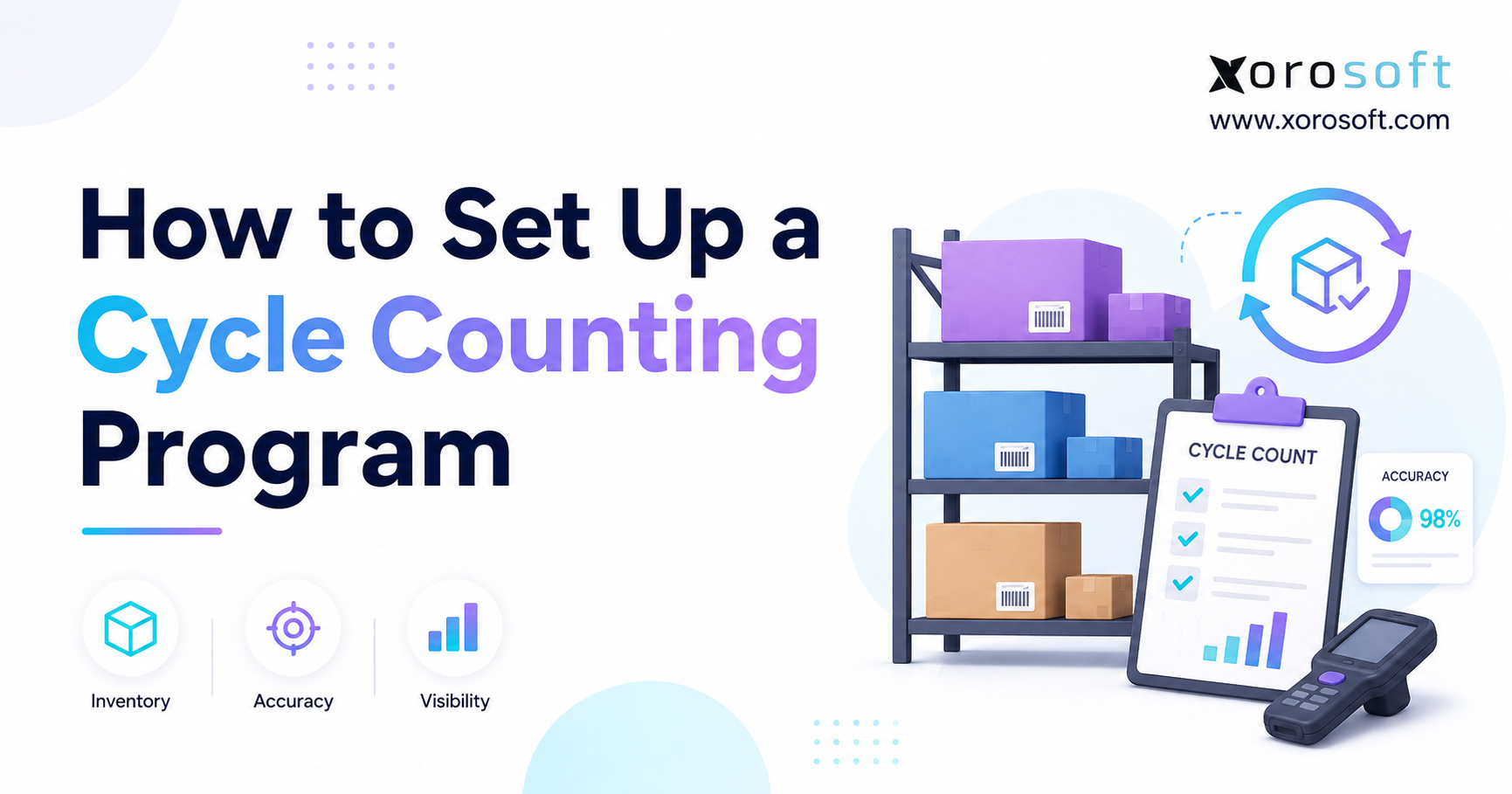
This article will serve as your comprehensive cycle counting guide.
1. A Better Way to Keep Inventory Records Honest
This cycle counting guide explains how businesses can count inventory regularly, improve stock accuracy, and reduce warehouse surprises without shutting down operations. Instead of waiting for one large annual physical count, cycle counting helps teams verify smaller sections of inventory throughout the year. As a result, businesses can catch errors earlier and make better decisions.
Inventory accuracy matters because every stock record affects sales, purchasing, fulfillment, accounting, and customer service. However, many companies only discover inventory problems after an order cannot ship, a buyer places an unnecessary purchase order, or finance finds a valuation issue. Therefore, cycle counting should not be treated as a warehouse chore. It should be treated as an operational control.
A strong cycle count process gives teams a practical way to compare physical inventory against system records. Then, when a difference appears, the business can investigate the root cause instead of simply adjusting the number. Over time, this improves trust in inventory data.
1.1 What This Cycle Counting Guide Covers
This cycle counting guide covers the definition of cycle counting, the main methods, the step-by-step process, count schedules, accuracy formulas, variance investigation, best practices, software options, industry examples, and frequently asked questions.
In addition, it explains when manual counting is enough and when a business may need stronger inventory, warehouse, purchasing, accounting, and reporting systems.
1.2 Why Annual Counts Are No Longer Enough for Growing Teams
Annual physical inventory counts can still be useful. However, they often reveal problems too late. If inventory has been wrong for months, the business may already have dealt with stockouts, overselling, overbuying, fulfillment delays, or accounting adjustments.
Cycle counting solves this problem by creating a regular rhythm. Instead of one painful count at the end of the year, teams count selected SKUs, bins, or locations every day, week, or month. Consequently, errors become easier to find and easier to fix.
2. What Is Cycle Counting?
Cycle counting is a recurring inventory counting method where a business counts selected items, bins, locations, or product categories on a planned schedule. Unlike a full physical inventory count, cycle counting does not require the company to count everything at once.
In simple terms, cycle counting helps a business answer one important question: does the inventory system match what is physically in stock?
2.1 Cycle Counting Definition
Cycle counting means regularly checking a portion of inventory and comparing the physical count with the system quantity. If both numbers match, the record is confirmed. However, if the numbers do not match, the team investigates the variance, approves the correction, and fixes the process that caused the error.
This cycle counting guide uses that definition throughout the article because the goal is not just counting. The real goal is better inventory accuracy.
2.2 How Cycle Counting Works
A cycle count starts with a list of items or locations to count. Usually, this list is based on item value, sales velocity, warehouse location, risk, or past discrepancies. Next, trained staff count the physical stock. Then, the count result is compared with the system record.
If there is no difference, the count is complete. However, if there is a variance, the team checks recent receiving, picking, transfers, returns, damaged stock, and open transactions. After that, an approved adjustment is made if needed.
2.3 Who Uses Cycle Counting?
Cycle counting is useful for ecommerce brands, wholesale distributors, retailers, manufacturers, furniture companies, apparel businesses, sporting goods companies, food businesses, and any company that sells physical products.
It becomes especially important when a business has multiple warehouses, high SKU volume, fast-moving products, Shopify or Amazon sales channels, EDI orders, manufacturing workflows, or frequent purchasing activity.
For growing teams, this cycle counting guide is especially useful because it connects daily warehouse activity with purchasing, fulfillment, and accounting accuracy.
2.4 Who May Not Need a Formal Program Yet?
A very small company with only a few products, one stockroom, and low order volume may not need a formal cycle counting program. However, once inventory errors begin affecting orders, purchasing, fulfillment, or accounting, a structured process becomes valuable.
Therefore, even small teams should understand the basics in this cycle counting guide before inventory problems become expensive.
3. Why Cycle Counting Matters for Inventory-Driven Businesses
Cycle counting matters because inventory errors create problems across the business. A single wrong quantity can affect a customer order, a purchase order, a warehouse pick, a production job, or a financial report.
3.1 Better Inventory Accuracy
Inventory accuracy means the system quantity matches the physical quantity. When records are accurate, teams can trust available stock, reorder points, fulfillment promises, and reporting. However, when records are wrong, every department works with unreliable data.
Therefore, cycle counting improves confidence in day-to-day decisions.
3.2 Fewer Stockouts
Stockouts often happen when the system shows stock that does not physically exist. Because cycle counting checks inventory regularly, it helps teams find these errors before customers are affected.
As a result, businesses can reduce missed sales, delayed shipments, and emergency purchasing.
3.3 Less Overstock
Overstock can happen when the system shows less stock than the warehouse actually has. In that situation, purchasing may reorder items unnecessarily. Consequently, cash gets tied up in inventory that the business did not need.
Cycle counting helps prevent this by keeping stock records closer to reality.
3.4 Smarter Purchasing Decisions
Purchasing teams depend on accurate stock levels. If inventory records are wrong, reorder points, purchase quantities, and supplier timing become unreliable. Therefore, a good cycle count process supports better replenishment planning.
In addition, accurate counts help buyers avoid emotional purchasing decisions based on incomplete data.
3.5 Cleaner Accounting and Inventory Valuation
Inventory is a financial asset. Therefore, inaccurate quantities can create inaccurate inventory valuation. When cycle counts are documented properly, finance teams can trace adjustments, understand variance causes, and close the month with more confidence.
3.6 Better Warehouse Productivity
Warehouse teams lose time when products are missing, misplaced, or stored in the wrong bin. However, regular cycle counting helps identify these issues early. As a result, picking, putaway, replenishment, and transfers become more reliable.
Therefore, this cycle counting guide should be used as an operational reference, not just as a warehouse counting document.
4. Cycle Counting vs Physical Inventory
Cycle counting and physical inventory both verify stock accuracy. However, they use different approaches.
4.1 What Is a Physical Inventory Count?
A physical inventory count is a full count of all inventory at a specific point in time. Many businesses perform it annually, quarterly, or during audit periods. Usually, operations slow down or stop while the count takes place.
Although physical counts are useful, they can be disruptive. In addition, they often reveal problems after those problems have already affected operations.
4.2 Key Differences Between Cycle Counting and Physical Inventory
| Factor | Cycle Counting | Physical Inventory |
|---|---|---|
| Scope | Counts selected items or locations | Counts all inventory |
| Frequency | Daily, weekly, or monthly | Usually annual or periodic |
| Disruption | Lower disruption | Higher disruption |
| Purpose | Ongoing accuracy control | Full inventory validation |
| Best Use Case | Continuous improvement | Audit, reset, or full verification |
| Main Weakness | Requires discipline | Finds errors late |
This cycle counting guide recommends using cycle counts as an ongoing control, not just as a replacement for full physical inventory.
4.3 When Physical Inventory Still Makes Sense
Physical inventory still makes sense for year-end controls, audit requirements, warehouse moves, major system changes, or full inventory resets. Also, if records are extremely inaccurate, a business may need a full count before starting a cycle count program.
4.4 When Cycle Counting Is the Better Approach
Cycle counting is better when a business wants continuous accuracy without shutting down the warehouse. It is especially useful when inventory moves frequently, SKUs are numerous, or multiple teams depend on real-time stock visibility.
This cycle counting guide also helps teams decide when recurring counts are more practical than one large physical inventory count.
5. Main Cycle Counting Methods
There is no single cycle counting method that works for every company. Instead, the right method depends on item value, sales volume, warehouse layout, operational risk, and system maturity.
5.1 ABC Cycle Counting
ABC cycle counting groups inventory by importance. A items are counted most often, B items are counted regularly, and C items are counted less often. Because this method focuses effort where it matters most, it is one of the most common approaches.
5.1.1 A Items
A items are high-value, fast-moving, or business-critical products. These items may represent a small percentage of SKUs but a large percentage of revenue, margin, or risk. Therefore, they should be counted frequently.
5.1.2 B Items
B items are moderately important. They should be counted on a regular schedule, although they usually do not need the same frequency as A items.
5.1.3 C Items
C items are usually lower-value or slower-moving products. However, they still need control. If a C item creates repeated errors, it should be counted more often until the issue is fixed.
5.2 Random Sample Cycle Counting
Random sample counting selects items at random. This method helps test general inventory accuracy across the warehouse. However, it may miss high-risk SKUs if used alone.
5.3 Control Group Cycle Counting
Control group counting repeatedly counts a small group of items. This method is useful when a business is testing a new process, training staff, or validating count procedures.
5.4 Opportunity-Based Cycle Counting
Opportunity-based counting happens when a trigger appears. For example, a team may count an item when a bin becomes empty, a picker reports a shortage, or a receiving discrepancy appears.
5.5 Location-Based Cycle Counting
Location-based counting focuses on specific bins, aisles, zones, shelves, or warehouses. This approach is useful when the main problem is not total quantity but location accuracy.
5.6 Hybrid Cycle Counting
A hybrid approach combines several methods. For example, a business may count A items weekly, random SKUs daily, problem locations monthly, and exception items whenever a shortage appears.
| Method | How It Works | Best For | Limitation |
| ABC Counting | Counts by item importance | High-value inventory | Requires item classification |
| Random Counting | Selects random items | General accuracy checks | May miss risky SKUs |
| Control Group | Recounts selected items | Process testing | Limited coverage |
| Opportunity-Based | Counts after triggers | Exception handling | Reactive if used alone |
| Location-Based | Counts bins or zones | Warehouse accuracy | May ignore item value |
| Hybrid | Combines methods | Complex operations | Requires planning |
Although each method has a different purpose, this cycle counting guide helps teams choose a practical mix instead of relying on one counting style for every SKU.
6. How to Build a Cycle Count Schedule
A cycle count schedule defines what will be counted, how often it will be counted, who will count it, and how variances will be handled. Without a schedule, cycle counting becomes random and inconsistent.
6.1 Segment Inventory by Value, Velocity, and Risk
Start by grouping inventory. Consider item value, sales velocity, margin, shortage risk, supplier lead time, seasonality, expiration date, lot tracking, and historical variance. Then, use those factors to decide count frequency.
This cycle counting guide recommends prioritizing items that create the most financial or operational risk.
6.2 Decide Count Frequency by SKU Type
| Item Type | Example | Suggested Frequency | Reason |
| High-Value Items | Premium products | Weekly or monthly | High financial impact |
| Fast-Moving Items | Best sellers | Weekly | High movement risk |
| Seasonal Items | Holiday inventory | Before and during season | Demand volatility |
| Slow-Moving Items | Long-tail SKUs | Quarterly or semiannually | Lower movement |
| Lot-Tracked Items | Food or regulated goods | Weekly or monthly | Traceability needs |
| Problem SKUs | Repeated variance items | Frequently until stable | Root-cause correction |
For better results, use this cycle counting guide as a framework for matching count frequency to item value, movement, and risk.
6.3 Assign Count Owners
Assign trained counters and supervisors. Ideally, the person counting should not be the same person approving adjustments. This separation creates better control.
In addition, count ownership should be clear. If nobody owns the schedule, the process will eventually fade.
6.4 Control Inventory Movement During Counts
Movement can distort count results. Therefore, teams should pause receiving, picking, transfers, or adjustments for the item or location being counted whenever possible.
If movement cannot be paused, open transactions should be reviewed before reconciliation.
6.5 Track Completion and Variance Trends
A schedule only works if completion is tracked. Review missed counts, repeated variances, adjustment values, location errors, and root causes. Then, use those findings to improve the next schedule.
6.6 Review the Schedule Monthly
Cycle counting should improve over time. If one SKU keeps creating variances, count it more often. However, if a location stays accurate for months, reduce its frequency and focus attention elsewhere.
As a result, this cycle counting guide gives teams a repeatable way to improve count discipline without creating unnecessary warehouse disruption.
7. Cycle Counting Process: Step-by-Step
A strong cycle count process should be simple, repeatable, and controlled. Because many errors come from inconsistent execution, every team should follow the same basic steps.
7.1 Step 1: Choose the Items or Locations to Count
Start with the cycle count schedule. Then, select the SKUs, bins, zones, or product categories due for counting. In addition, include exception items if a recent shortage, receiving issue, or pick error was reported.
7.2 Step 2: Prepare Inventory Records
Before counting, review open transactions. Receiving, picking, returns, transfers, and production movements should be posted or clearly identified. Otherwise, a timing issue may look like a true inventory variance.
7.3 Step 3: Assign Counters
Assign trained staff who understand item numbers, units of measure, bin locations, lot numbers, and count rules. For high-risk items, use blind counts so counters do not see the expected system quantity.
7.4 Step 4: Count Physical Stock
Count the actual stock in the location. Use barcode scanning when possible. Also, verify item number, unit of measure, lot number, serial number, and bin location.
7.5 Step 5: Compare Count Results with System Records
Next, compare the physical count with the system quantity. If the numbers match, mark the count complete. However, if they do not match, move into variance review.
7.6 Step 6: Investigate Variances
Do not adjust inventory immediately without investigation. First, check open sales orders, recent receipts, transfers, damaged goods, returns, wrong bins, and unit of measure setup.
7.6.1 Quantity Variance
A quantity variance occurs when the physical quantity does not match the system quantity.
7.6.2 Location Variance
A location variance occurs when the item exists but is stored in the wrong bin, shelf, zone, or warehouse.
7.6.3 Timing Variance
A timing variance happens when transactions are not posted before the count.
7.6.4 Unit of Measure Variance
A unit of measure variance happens when cases, cartons, packs, pallets, or individual units are confused.
7.7 Step 7: Approve Adjustments
After investigation, approve the adjustment through the proper control process. Large variances should require management review. In addition, every adjustment should include a reason code.
7.8 Step 8: Fix the Root Cause
The goal is not only to correct the number. The real goal is to fix the process that created the error. Therefore, every recurring variance should lead to a process change.
Most importantly, this cycle counting guide encourages teams to investigate why the variance happened, because repeated adjustments without root-cause analysis only hide the real problem.
8. How to Measure Cycle Count Accuracy
Cycle counting needs measurement. Otherwise, teams may count inventory without knowing whether accuracy is improving.
8.1 Cycle Count Accuracy Formula
Cycle Count Accuracy = Accurate Counts / Total Counts × 100
For example, if 96 out of 100 counted SKUs match the system record, cycle count accuracy is 96%.
8.2 Inventory Record Accuracy Formula
Inventory Record Accuracy = Correct Inventory Records / Total Inventory Records Checked × 100
This formula measures whether inventory records are correct at the item or location level.
8.3 Variance Rate Formula
Variance Rate = Count Variances / Total Counts × 100
A lower variance rate usually means better inventory control. However, the business should still review variance value, not just variance count.
8.4 Example Calculation
Suppose a warehouse counts 200 SKUs in one month. Of those, 184 match the system record and 16 have variances. Therefore, cycle count accuracy is 92%, and the variance rate is 8%.
Next, the team should review whether those 16 variances came from receiving, picking, putaway, transfers, shrinkage, returns, or unit of measure issues.
8.5 What Accuracy Rate Should You Aim For?
The right target depends on the business. However, high-value, high-volume, regulated, or customer-critical items should have very high accuracy targets.
This cycle counting guide recommends tracking both accuracy rate and root-cause trends because a single percentage does not explain why errors happen.
A cycle counting guide should always include accuracy measurement because counting alone does not prove that inventory control is improving.
9. Common Cycle Count Variances and What They Mean
Cycle count variances are not just errors. Instead, they are clues that show where the inventory process is breaking.
9.1 Receiving Errors
Receiving errors happen when items are counted incorrectly, received against the wrong purchase order, or posted late. As a result, inventory may be wrong before stock even reaches its final location.
9.2 Picking Errors
Picking errors happen when staff pick the wrong item, wrong quantity, or wrong location. Consequently, one SKU may appear short while another appears over.
9.3 Putaway Mistakes
Putaway mistakes happen when items are stored in the wrong bin, shelf, zone, or warehouse. The stock may exist, but the system location is wrong.
9.4 Unrecorded Inventory Movement
Inventory movement must be recorded. If staff move stock between bins, warehouses, production areas, or staging zones without updating the system, cycle counts will show discrepancies.
9.5 Damaged, Lost, or Misplaced Stock
Damage and shrinkage can create real quantity losses. Meanwhile, misplaced stock can create false shortages. Therefore, teams should separate missing inventory from incorrectly located inventory.
9.6 Unit of Measure Issues
Unit of measure errors are common when items are bought by case but sold by each. They also happen when products are stored by pallet but picked by carton. Therefore, item setup and warehouse procedures should be reviewed together.
9.7 Timing Differences Between Systems
Disconnected systems create timing gaps. For example, ecommerce orders, warehouse apps, purchasing spreadsheets, EDI orders, and accounting systems may not update at the same time. As a result, a count may look wrong even when the root issue is delayed data.
| Variance Type | Possible Cause | Example | Corrective Action |
| Receiving Variance | Wrong receipt quantity | 96 received, 100 posted | Improve receiving checks |
| Picking Variance | Wrong quantity picked | 12 picked instead of 10 | Use barcode validation |
| Putaway Variance | Wrong bin | Item stored in B2, system says A2 | Improve location scanning |
| Transfer Variance | Transfer not posted | Stock moved between warehouses | Require transfer completion |
| Unit Variance | Case vs each confusion | 1 case counted as 1 unit | Fix UOM setup |
| Shrinkage Variance | Damage or loss | Stock physically missing | Investigate and approve adjustment |
In addition, this cycle counting guide helps teams connect each variance type to a corrective action, so the same issue does not keep appearing in future counts.
10. Cycle Counting Best Practices
Cycle counting works best when it is consistent, controlled, and connected to process improvement.
10.1 Count High-Value and Fast-Moving Items More Often
Not every SKU needs the same frequency. Therefore, count products more often when they drive revenue, margin, fulfillment risk, or purchasing complexity.
10.2 Use Barcode Scanning Where Possible
Barcode scanning reduces manual entry and verifies item, quantity, and location. In addition, it helps teams avoid paper count sheets and rekeying errors.
For businesses that need stronger warehouse execution, XoroWMS can support warehouse workflows such as inventory movement, picking, receiving, and location control.
10.3 Separate Counting from Reconciliation
The counter should count. The reviewer should investigate and approve. This separation creates better control and reduces the risk of biased adjustments.
10.4 Document Every Adjustment
Every adjustment should include a reason code, user, date, item, location, quantity, and value impact. Without documentation, the business cannot learn from count history.
10.5 Train Warehouse Teams on Count Discipline
Cycle counting depends on discipline. Therefore, train teams to pause movement, verify item identifiers, count the correct unit of measure, and escalate uncertain results.
10.6 Use Variance Reports to Find Process Issues
Variance reports should not sit unused. Instead, review them by SKU, warehouse, location, user, supplier, transaction type, and value. Then, use the findings to fix recurring process issues.
10.7 Avoid Treating Cycle Counting as Only a Warehouse Task
Although cycle counting happens in the warehouse, the results affect purchasing, accounting, ecommerce, manufacturing, and customer service. Therefore, count results should be visible beyond the warehouse team.
In practice, this cycle counting guide works best when warehouse, purchasing, accounting, and ecommerce teams all understand the same inventory accuracy goals.
11. Manual Cycle Counting vs Software-Based Cycle Counting
A business can start with spreadsheets. However, manual cycle counting becomes risky as inventory volume, order volume, warehouse complexity, and channel complexity increase.
11.1 Spreadsheet-Based Cycle Counting
Spreadsheets are simple and flexible. However, they become difficult to control when multiple people edit files, counts are delayed, and adjustments must be rekeyed into another system.
11.2 Inventory App-Based Cycle Counting
Inventory apps can improve basic stock tracking. However, many growing businesses eventually need deeper connections to accounting, purchasing, forecasting, ecommerce, and warehouse operations.
11.3 WMS-Based Cycle Counting
A warehouse management system can support bin-level counting, barcode scanning, pick validation, and location accuracy. Therefore, it is useful for structured warehouses with high transaction volume.
11.4 ERP-Based Cycle Counting
ERP-based cycle counting connects inventory records with purchasing, accounting, warehouse management, manufacturing, ecommerce, and reporting. For example, XoroERP is built for inventory-driven businesses that need connected workflows instead of disconnected spreadsheets and apps.
This cycle counting guide recommends considering ERP when count accuracy depends on more than warehouse activity alone.
11.4.1 Inventory and Warehouse Connection
When warehouse movements update inventory records in real time, cycle counts become easier to trust. In addition, teams can investigate variances with better transaction history.
11.4.2 Accounting and Inventory Valuation Connection
Approved adjustments should connect to inventory valuation and financial reporting. Otherwise, warehouse accuracy and accounting accuracy can drift apart.
11.4.3 Purchasing and Forecasting Connection
Accurate counts improve reorder points, purchasing plans, and demand forecasts. As a result, businesses can reduce unnecessary buying and prevent avoidable shortages.
11.5 When Manual Counting Becomes Risky
Manual counting becomes risky when the business manages multiple warehouses, Shopify or Amazon channels, wholesale orders, EDI, manufacturing, purchasing teams, or frequent inventory adjustments.
| System Type | Best For | Strengths | Limitations |
| Spreadsheet | Very small teams | Low cost and flexible | Error-prone and disconnected |
| Inventory App | Basic stock tracking | Easier than spreadsheets | Limited accounting and purchasing depth |
| WMS | Warehouse execution | Strong bin and scanner control | May not cover finance or purchasing |
| ERP | Connected operations | Inventory, warehouse, accounting, purchasing, and reporting | Requires implementation planning |
For that reason, this cycle counting guide is also useful when comparing manual counting, warehouse software, and ERP-based inventory workflows.
12. Cycle Counting for Different Business Models
Cycle counting looks different depending on how the business sells, stores, buys, and produces inventory.
12.1 Ecommerce Businesses
Ecommerce businesses need accurate sellable inventory. If the website shows stock that does not exist, overselling and cancellations follow. Therefore, cycle counting should focus on fast-moving products, returns, fulfillment exceptions, and channel sync issues.
12.2 Shopify Merchants
Shopify merchants often need cycle counting when inventory sync, multi-channel selling, purchasing, and fulfillment become harder to manage. In addition, they need accurate stock across online orders, warehouse activity, and accounting.
For Shopify-focused teams, the Xorosoft ERP app on the Shopify App Store is a useful reference point because it shows how ERP can connect ecommerce operations with inventory workflows.
12.3 Wholesale Distributors
Wholesale teams deal with customer-specific pricing, bulk orders, EDI, allocations, and supplier lead times. In this environment, wrong stock records can affect large orders. Therefore, cycle counting should focus on high-volume SKUs, allocated stock, and customer-critical inventory.
12.4 Apparel and Fashion Brands
Apparel businesses manage sizes, colors, styles, seasons, and returns. Consequently, cycle counting should focus on high-volume variants, seasonal collections, and items with frequent pick errors.
12.5 Furniture Businesses
Furniture inventory may be bulky, high-value, or location-sensitive. Therefore, cycle counts should verify item condition, warehouse location, and customer availability.
12.6 Sporting Goods Companies
Sporting goods businesses often manage seasonal spikes, product variants, kits, and multi-channel demand. As a result, cycle counting helps keep popular items accurate before peak sales periods.
12.7 Food and Beverage Businesses
Food businesses may need lot tracking, expiration control, and strict rotation. Therefore, cycle counting should focus on perishable items, high-turn products, and regulated stock.
12.8 Manufacturers
Manufacturers need accurate raw materials, work-in-progress, and finished goods. Because production depends on available components, inventory errors can delay work orders and customer shipments.
Businesses can also review the industries Xorosoft serves to understand how inventory-driven workflows differ across apparel, furniture, sporting goods, food, wholesale, and manufacturing.
12.8.1 Raw Materials
Raw material errors can delay production. Therefore, critical components should be counted frequently.
12.8.2 Work-in-Progress
WIP accuracy matters because inventory may sit between production stages. In addition, inaccurate WIP can distort production planning.
12.8.3 Finished Goods
Finished goods must be accurate before fulfillment, wholesale allocation, ecommerce availability, or financial reporting.
13. Cycle Counting in Multi-Warehouse Operations
Multi-warehouse inventory adds complexity because stock moves across locations, teams, and sales channels. Therefore, the count process must control transfers, allocations, and location accuracy.
For multi-location teams, this cycle counting guide is especially important because inventory accuracy problems often come from timing gaps, transfer errors, and stock sitting in the wrong warehouse or bin.
13.1 Why Multi-Warehouse Counting Is Harder
The more locations a business has, the harder it becomes to know where inventory really sits. Transfers, delayed receiving, incorrect allocations, and location mismatches can all create discrepancies.
13.2 Location Accuracy and Bin Accuracy
Location accuracy means the item is in the correct warehouse, zone, shelf, or bin. Bin accuracy is especially important for high-volume warehouses because pickers may waste time searching even when total item quantity is technically correct.
13.3 Transfers, Allocations, and Timing Gaps
Transfers should be recorded when stock moves. Allocations should reserve stock correctly. Otherwise, a cycle count may show a discrepancy that is actually caused by a timing gap.
13.4 Centralized Reporting Across Warehouses
Centralized reporting helps managers compare accuracy by warehouse, location, SKU, and user. In addition, it allows operations teams to identify whether one location has more variance than another.
For companies that need one connected view of inventory, warehouse, purchasing, accounting, and reporting, XoroONE can be relevant because it brings several operational workflows into one cloud platform.
Because multi-warehouse inventory creates more timing gaps, this cycle counting guide gives operations teams a clearer framework for reviewing transfers, allocations, and location accuracy.
14. When to Upgrade Your Cycle Counting Process
A basic process is fine at first. However, certain signs show that the current system is no longer enough.
14.1 Signs Your Current Process Is Breaking
Common signs include frequent stockouts, repeated variances, delayed adjustments, unclear ownership, unposted transfers, warehouse search time, overselling, and month-end inventory surprises.
14.2 When Spreadsheets Are No Longer Enough
Spreadsheets become risky when multiple people update counts, files are not controlled, adjustments are delayed, and finance cannot easily trace inventory changes.
14.3 When Inventory Apps Become Too Limited
Inventory apps may work for basic stock control. However, they can become limited when a business needs accounting integration, purchasing automation, forecasting, multi-warehouse visibility, EDI, or manufacturing workflows.
14.4 When ERP Becomes the Better Fit
ERP becomes a better fit when inventory accuracy depends on connected processes. If receiving, purchasing, ecommerce, warehouse transfers, production, and accounting all affect stock, they should not live in separate systems.
Companies comparing ERP options can also review this Xorosoft comparison page to understand how inventory-driven ERP capabilities are commonly evaluated.
At this stage, a cycle counting guide becomes more than a warehouse checklist because the business needs connected systems, cleaner data, and stronger controls.
15. How ERP Supports Better Cycle Counting
ERP supports cycle counting by connecting operational and financial inventory data. Therefore, it becomes useful when inventory errors affect more than warehouse counts.
15.1 Real-Time Inventory Records
Real-time inventory records reduce timing gaps. When receiving, picking, transfers, production, and adjustments update the same system, cycle counts become easier to reconcile.
15.2 Warehouse and Accounting Alignment
Cycle count adjustments should not disappear into warehouse notes. Instead, they should connect to inventory valuation, cost of goods sold, and financial reporting.
15.3 Purchasing and Forecasting Visibility
Better inventory accuracy improves purchasing and forecasting. If buyers trust available stock, they can plan replenishment more effectively. In addition, forecasting becomes more reliable when the starting inventory balance is correct.
15.4 Multi-Channel Inventory Control
Businesses selling through Shopify, Amazon, wholesale, and EDI need accurate available inventory across channels. Otherwise, one channel can sell stock that another team already allocated.
15.5 Better Reporting for Root-Cause Analysis
ERP reporting helps teams see where inventory problems start. For businesses that have outgrown QuickBooks, spreadsheets, or disconnected inventory apps, comparing systems carefully is important. A page like Xorosoft vs NetSuite can help buyers think through cost, complexity, implementation, and operational fit.
This cycle counting guide does not suggest that software fixes poor process discipline automatically. However, connected systems can make accurate counting, reconciliation, and reporting easier to maintain.
However, this cycle counting guide still assumes that process discipline comes first. Software can support better counting, but teams still need clean item data, clear ownership, and consistent variance review.
16. Cycle Counting Example: From Count Variance to Process Fix
16.1 Example Scenario
A sporting goods company counts a fast-moving SKU. The system shows 120 units available, but the warehouse finds only 108.
16.2 Count Result
The variance is 12 units short. First, the team performs a recount. Then, they confirm the physical quantity is 108.
16.3 Variance Investigation
Next, the team reviews recent sales orders, receipts, transfers, and returns. They find that one wholesale order was picked but not posted correctly.
16.4 Root Cause
The root cause is a picking and posting gap. The warehouse completed the physical movement, but the system transaction was delayed.
16.5 Corrective Action
The business updates the record, trains staff to complete posting before staging orders, and adds a daily exception report for picked-but-unposted orders. As a result, the next cycle count has fewer timing variances.
17. Cycle Counting Checklist
This cycle counting guide should be practical, so use the checklist below before, during, and after each count.
17.1 Before the Count
Confirm the count schedule. Review open transactions. Assign trained counters. Freeze movement where needed. Prepare scanners, labels, count sheets, or system tasks.
17.2 During the Count
Verify item numbers, locations, units of measure, lot numbers, serial numbers, and quantities. Also, avoid guessing. If the count is unclear, escalate it.
17.3 After the Count
Compare physical counts with system records. Recount large differences. Investigate variances. Approve adjustments. Document reason codes.
17.4 Monthly Review
Review accuracy rates, variance causes, count completion, missed counts, problem SKUs, and process improvements. Then, adjust the next count schedule.
Use this cycle counting guide as a monthly reference whenever your team reviews count accuracy, investigates variances, or updates warehouse procedures.
18. Frequently Asked Questions About Cycle Counting
18.1 What is cycle counting?
Cycle counting is a recurring inventory count process where a business counts selected items or locations on a schedule instead of counting all inventory at once. This cycle counting guide explains how that process helps maintain inventory accuracy throughout the year and reduces the need for disruptive full-warehouse counts.
18.2 What is the main purpose of cycle counting?
The main purpose of cycle counting is to keep inventory records accurate. In addition, it helps businesses find discrepancies earlier, correct stock records, improve warehouse control, and identify the process problems that cause inventory errors.
18.3 How often should cycle counts be done?
Cycle count frequency depends on item value, sales velocity, risk, and complexity. High-value or fast-moving items may be counted weekly or monthly. However, slower-moving items may be counted quarterly or semiannually.
18.4 What is ABC cycle counting?
ABC cycle counting groups items by importance. A items are counted most often because they are high-value, fast-moving, or critical. B items are counted regularly. C items are counted less often because they usually carry lower risk.
18.5 What is the difference between cycle counting and physical inventory?
Cycle counting checks selected inventory on a recurring schedule. Physical inventory counts all inventory at a specific time. Therefore, cycle counting is less disruptive, while physical inventory is often used for full validation or audit needs.
18.6 Can cycle counting replace annual inventory counts?
Cycle counting can reduce the need for annual physical counts in some businesses. However, the decision depends on audit requirements, inventory controls, system reliability, and management policy.
18.7 What is a good cycle count accuracy rate?
A good cycle count accuracy rate depends on the business. However, higher-risk items should have very high accuracy targets. In addition, teams should track variance trends and root causes.
18.8 How do you calculate cycle count accuracy?
Use this formula: accurate counts divided by total counts, multiplied by 100. For example, if 95 out of 100 counted items match the system record, cycle count accuracy is 95%.
18.9 Who should perform cycle counts?
Cycle counts should be performed by trained warehouse or inventory control staff. Ideally, the person counting should not be the only person approving adjustments because separation improves control.
18.10 Should cycle counts be blind?
Blind counts are often useful because counters do not see the expected system quantity. As a result, they are more likely to count what is physically present instead of confirming what the system says.
18.11 What causes cycle count variances?
Common causes include receiving errors, picking mistakes, putaway issues, unrecorded transfers, shrinkage, damage, unit of measure problems, returns, and timing gaps between disconnected systems.
18.12 How do you fix cycle count discrepancies?
First, recount the item. Then, investigate open transactions, recent movement, receiving, picking, transfers, and location errors. After that, approve the adjustment and fix the root cause.
18.13 What items should be counted most often?
High-value, fast-moving, seasonal, regulated, lot-tracked, customer-critical, and frequently miscounted items should be counted most often. These items carry the highest financial or operational risk.
18.14 Is cycle counting useful for Shopify sellers?
Yes, Shopify sellers benefit from cycle counting because ecommerce depends on accurate available inventory. Therefore, cycle counts help reduce overselling, stockouts, fulfillment issues, and inventory sync problems.
18.15 When should a business upgrade from spreadsheets?
A business should upgrade from spreadsheets when it has frequent discrepancies, multiple warehouses, ecommerce channels, wholesale orders, EDI, manufacturing, delayed reconciliations, or too many manual adjustments.
18.16 How does ERP improve cycle counting?
ERP improves cycle counting by connecting inventory, warehouse, purchasing, accounting, manufacturing, ecommerce, and reporting. As a result, teams can count, reconcile, adjust, and analyze inventory in one connected system.
18.17 What is the best cycle counting method?
The best method depends on the business. ABC cycle counting is common because it focuses effort on the most important items. However, many businesses use a hybrid method for better coverage.
18.18 How do you start a cycle counting program?
Start by cleaning item data, classifying inventory, defining count frequency, assigning owners, training counters, documenting adjustment rules, measuring accuracy, and reviewing variance causes every month.
Use this cycle counting guide as a practical starting point, then adjust the schedule, methods, and review process based on your actual inventory complexity.
19. Better Counts Create Better Inventory Decisions
Cycle counting is not just a warehouse task. It is a business control that improves inventory accuracy, purchasing decisions, fulfillment reliability, accounting confidence, and operational visibility. Therefore, a strong process helps teams find problems earlier and fix the root cause before inventory errors become customer problems.
For small teams, a simple schedule may be enough. However, as SKUs, warehouses, sales channels, purchasing, and accounting complexity increase, the process needs stronger systems. At that stage, connected inventory, warehouse, purchasing, ecommerce, and accounting workflows can make cycle counting more reliable.
Use this cycle counting guide as a monthly reference whenever your team reviews count accuracy, investigates variances, or updates warehouse procedures.
This cycle counting guide gives you the foundation: count the right items, investigate variances, document adjustments, and improve the process every month. If your team is ready to see how connected inventory operations can support better counting, you can Book a demo and review the workflow in more detail.