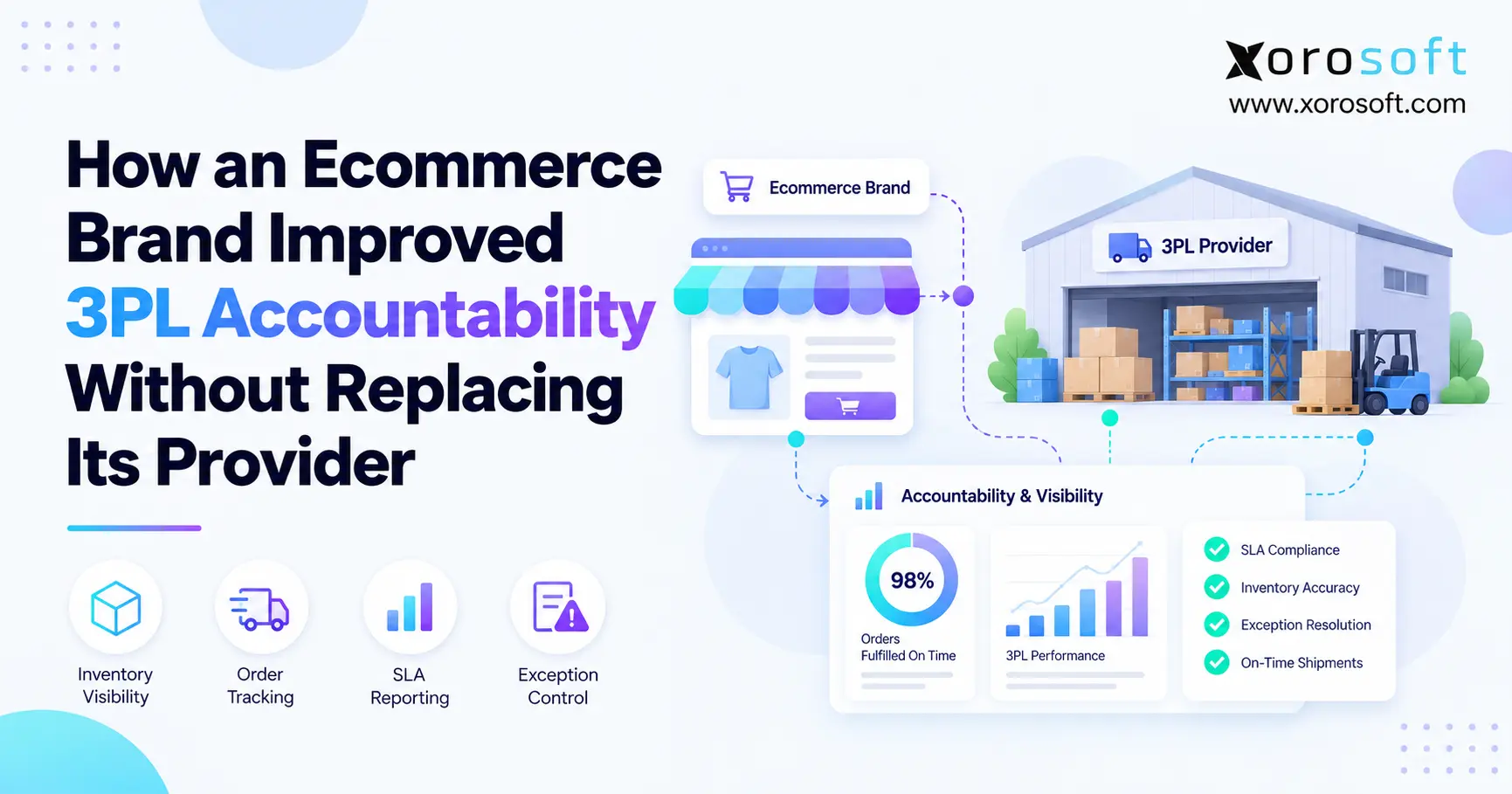
If you want to improve 3PL accountability in your supply chain, understanding key practices is essential.
1. When 3PL Accountability Becomes Hard to Prove
3PL accountability becomes difficult when an ecommerce brand can see fulfillment problems but cannot prove where those problems begin. For example, Shopify may show one inventory quantity while the warehouse reports another. Meanwhile, customer service may see late shipments, and finance may discover adjustments days later.
Therefore, the immediate problem is not always a bad fulfillment provider. Instead, the brand may lack shared measurements, reliable event data, inventory reconciliation, and clear ownership.
As a result, replacing the provider too quickly can move the same operational problems into another warehouse. A stronger approach is to establish 3PL accountability first. Then, the business can determine whether the provider, an integration, or the internal operating model actually needs to change.
1.1 Why Fulfillment Problems Become Difficult to Diagnose
A late shipment can have several causes. For instance, the 3PL may have missed its processing window. However, the order could also have reached the warehouse late because of an integration delay.
Likewise, an inventory discrepancy may begin with an incorrect receipt, missing return, manual adjustment, or SKU mapping error. Consequently, the final symptom does not automatically identify the responsible party.
Moreover, several teams may see different parts of the same problem. Customer service sees the complaint, operations sees the order status, and finance sees the cost later.
Therefore, the brand needs the full operational sequence before assigning responsibility.
Otherwise, teams can spend more time debating what happened than solving the actual cause.
1.2 Why Replacing the Provider Too Early Creates Risk
Moving to another 3PL requires inventory transfers, integration work, procedures, carrier setup, testing, and cutover planning. Moreover, customers can feel the effects if the transition goes poorly.
However, a migration does not automatically fix fragmented data.
For example, if the brand cannot reconcile inventory today, the same weakness can follow it to a new warehouse. Likewise, unclear SLA definitions remain unclear regardless of which company performs the physical fulfillment.
Therefore, the first decision should separate provider capability from operating-system visibility.
If the provider can perform the work but the business cannot measure it properly, improving the control layer may be faster and less disruptive than replacing the warehouse.
2. What 3PL Accountability Actually Means
3PL accountability is the ability to compare actual fulfillment performance against agreed expectations using reliable operational evidence. Additionally, it requires clear ownership when exceptions occur and documented corrective action when problems repeat.
Therefore, accountability is more than a monthly report.
Instead, it creates a shared operating framework between the ecommerce brand and the fulfillment provider.
Moreover, effective accountability measures both sides fairly. A warehouse should not be blamed for an order the brand released after cutoff. Likewise, a brand should not absorb responsibility for a warehouse delay that occurred after a valid order was acknowledged.
2.1 Four Foundations of an Accountable 3PL Relationship
First, both sides need measurable expectations. Phrases such as “ship quickly” or “keep inventory accurate” are too vague.
Second, the business needs reliable evidence. Therefore, important activities should create usable timestamps and transaction records.
Third, every material exception needs an owner. Otherwise, problems remain unresolved while teams debate responsibility.
Finally, repeated failures need corrective action. Consequently, a red KPI should lead to investigation, ownership, and verification rather than simply appearing again next month.
Together, these four foundations create a process that both sides can understand.
Moreover, they shift discussions away from opinions and toward evidence.
2.2 Accountability Is Different From Micromanagement
Strong accountability does not mean controlling every warehouse decision.
Instead, the provider should retain responsibility for warehouse execution while the brand maintains visibility into agreed outcomes.
For example, the brand does not need to tell every picker how to perform a task. However, it should know whether eligible orders were processed within the agreed service window.
Likewise, operations leaders do not need to review every receipt manually. Nevertheless, they should be able to identify when receiving times or quantity variances move outside agreed limits.
Therefore, accountability can improve the provider relationship rather than damage it.
Both parties know what is measured, how it is calculated, and what happens when performance falls short.
3. Build One Operational Record Before Blaming the Warehouse
A growing ecommerce stack often includes Shopify, marketplaces, accounting software, spreadsheets, an ERP, carrier systems, and the 3PL’s WMS.
Consequently, several applications may describe the same order differently.
For example, Shopify might show an order as fulfilled after receiving a shipment message. However, the carrier may not yet have scanned the parcel.
Therefore, teams should determine which system owns each operational event before evaluating provider performance.
Without that ownership model, different reports can all look correct while telling different stories.
3.1 Define Ownership for Each Business Event
A simple ownership map removes significant confusion.
| Operational event | Likely authoritative source | Why |
|---|---|---|
| Customer order | Ecommerce platform or ERP | Captures demand |
| Inventory allocation | ERP or inventory system | Controls commitments |
| Purchase order | ERP or purchasing system | Controls inbound expectation |
| Physical receipt | 3PL WMS | Confirms warehouse receipt |
| Pick confirmation | 3PL WMS | Confirms execution |
| Shipment confirmation | 3PL/shipping system | Records fulfillment |
| Carrier acceptance | Carrier | Confirms possession |
| Customer invoice | ERP/accounting | Records financial transaction |
| Physical return | 3PL WMS | Confirms returned product |
| Refund | Ecommerce/ERP/payment system | Confirms customer settlement |
Therefore, one platform does not need to own every fact.
Instead, the business needs agreement on where each fact originates.
3.2 How 3PL Accountability Improves With a Timestamp Trail
Next, track the fulfillment sequence:
Order created → payment approved → inventory allocated → order released → 3PL acknowledged → picked → packed → shipped → carrier scanned → delivered
For example, suppose an order misses the promised shipping window. First, check when the order became eligible. Then, compare that time with warehouse acknowledgment and shipment confirmation.
As a result, the team can distinguish a late warehouse process from a late order release.
Moreover, timestamps make exceptions measurable.
Instead of saying, “Shipping seems slower this week,” the team can say, “Eligible orders released before cutoff spent longer than the agreed processing window before shipment confirmation.”
That evidence creates much stronger 3PL accountability.
4. Define KPIs and SLAs Before Arguing About Performance
A KPI measures actual performance. In contrast, an SLA defines the expected level of service.
Therefore, both are necessary.
For example, order accuracy is a KPI. However, the agreed minimum level of order accuracy is the SLA.
Likewise, dock-to-stock time is a metric. Yet the acceptable receiving window must be defined separately.
Consequently, reviewing KPIs without clear SLAs often creates unnecessary arguments.
4.1 Make 3PL Accountability Metrics Reproducible
Each important metric should answer four questions:
- What exactly is being measured?
- Which transactions qualify?
- Which timestamps begin and end the measurement?
- Can both parties reproduce the result?
For example, one company may measure fulfillment time from order creation. However, the warehouse may start measuring only after receiving a valid release.
Therefore, both calculations can be technically correct while showing different results.
To avoid that problem, define the calculation before evaluating performance.
Moreover, document exclusions such as fraud holds, backorders, invalid addresses, or orders released after cutoff.
As a result, 3PL accountability becomes based on comparable data rather than competing definitions.
4.2 Choose 3PL Accountability Metrics That Change Decisions
A focused scorecard is usually more useful than dozens of vanity metrics.
| KPI | What it measures | Why it matters |
|---|---|---|
| Order accuracy | Correct items and quantities | Customer experience |
| On-time fulfillment | Orders processed on schedule | Service reliability |
| Inventory accuracy | Recorded vs. verified stock | Availability |
| Dock-to-stock | Receipt to usable inventory | Inbound efficiency |
| Fill rate | Demand successfully fulfilled | Revenue protection |
| Return processing | Return to disposition | Inventory recovery |
| Exception aging | Time until issue resolution | Responsiveness |
However, the right targets depend on order complexity, channel requirements, and product type.
Therefore, avoid copying generic benchmarks without understanding the operation.
Instead, use targets that reflect the actual fulfillment agreement.
5. Use Inventory Reconciliation to Strengthen 3PL Accountability
Inventory is often where 3PL accountability breaks first because several systems can show different balances at the same time.
For example, Shopify may show 500 available units while the 3PL shows 488. Meanwhile, purchasing may believe another receipt has already become available.
Consequently, teams may react to different numbers.
Therefore, comparing ending balances alone is not enough. The business should reconcile the transactions that created those balances.
5.1 Reconcile Inventory for Better 3PL Accountability
A useful reconciliation follows this logic:
**Opening inventory
- receipts
- customer returns
- inbound transfers
− shipments
− outbound transfers
− damages
− approved adjustments
= expected closing inventory**
Then, compare the expected closing balance with the warehouse record and, when necessary, physical inventory.
As a result, the difference becomes traceable.
Moreover, the investigation can focus on the specific movement that caused the variance rather than two competing totals.
For growing operations, XoroONE can connect inventory, purchasing, orders, warehouse workflows, and reporting around external fulfillment operations.
Therefore, the broader goal is not another inventory report. Instead, it is a connected transaction history that supports 3PL accountability.
5.2 Investigate Causes, Not Just Inventory Differences
Common causes include incorrect receipts, duplicate receipts, unprocessed returns, missing transfers, damage, SKU mapping issues, manual adjustments, and integration delays.
Therefore, “inventory mismatch” should never be treated as the final root cause.
Instead, teams should classify the underlying reason.
For example, a receipt may have been physically completed but never passed back through the integration. Alternatively, the warehouse may have received the wrong quantity.
Likewise, a return might exist physically while remaining unavailable because disposition has not been completed.
Consequently, the corrective action depends on the cause.
Moreover, repeated issues should be tracked separately from isolated adjustments because recurring problems often reveal a broken process.
6. Make Every Fulfillment Exception Assignable
Metrics reveal patterns. However, individual exceptions explain why those patterns appear.
Therefore, a reliable operating model requires structured exception management.
For example, a late order should not simply be recorded as “late.” Instead, the team should determine whether the cause was warehouse processing, inventory availability, an integration failure, a carrier event, or an internal hold.
Consequently, exception data becomes useful for both operations and provider reviews.
6.1 Give Every Exception a Reason Code
Useful categories include:
- Warehouse processing delay
- Inventory unavailable
- Brand hold
- Integration failure
- Carrier delay
- Invalid address
- SKU mapping error
- Receiving variance
- Product damage
- Missing documentation
Because categories remain consistent, teams can identify repeated causes over time.
Moreover, reason codes prevent every issue from being grouped under a vague label such as “3PL problem.”
For example, if integration failures create 20% of delayed releases, changing warehouse labor will not solve the issue.
Therefore, classification should happen before escalation.
6.2 Keep 3PL Accountability Fair by Separating Root Causes
Suppose 100 orders miss the expected processing window.
At first, the warehouse may appear responsible. However, 30 orders might have arrived after cutoff, 20 may have had inventory holds, and 10 may have failed because of an integration error.
Therefore, only the remaining warehouse-caused failures should affect the provider’s performance result.
Likewise, the brand should own internal failures.
As a result, 3PL accountability becomes fairer and more credible.
Moreover, the provider has less reason to challenge the scorecard because exclusions and causes are visible.
That fairness matters because accountability works best when both parties trust the measurement process.
7. Build a 3PL Accountability Scorecard That Drives Action
A useful 3PL accountability scorecard should create decisions rather than simply display metrics.
Therefore, each important KPI should include a target, actual performance, trend, owner, and corrective action.
Moreover, the scorecard should be small enough for managers to use.
If dozens of indicators turn red every month, teams may stop distinguishing material problems from noise.
7.1 Keep the Scorecard Focused
A practical format looks like this:
| Metric | Target | Actual | Trend | Owner | Next action |
|---|---|---|---|---|---|
| Order accuracy | Agreed SLA | Current result | Up/down | Operations | Investigate |
| On-time fulfillment | Agreed SLA | Current result | Up/down | 3PL | Correct |
| Inventory accuracy | Agreed SLA | Current result | Up/down | Shared | Reconcile |
| Dock-to-stock | Agreed SLA | Current result | Up/down | 3PL | Review |
| Exception aging | Agreed SLA | Current result | Up/down | Shared | Escalate |
Additionally, every red metric should have a root cause.
Otherwise, the scorecard describes a problem without creating action.
7.2 Connect Fulfillment Mistakes to Financial Impact
A fulfillment error may create reshipping expense, refunds, retailer chargebacks, customer-support work, expedited freight, or lost sales.
Therefore, operational reporting should eventually connect to financial consequences.
For example, two exception types may occur at the same frequency. However, one may cost the business five times more.
Consequently, frequency alone should not determine priority.
An integrated platform such as XoroERP can connect inventory, purchasing, fulfillment, orders, and accounting information.
As a result, operations teams can evaluate where failures create the greatest business impact rather than treating every exception equally.
8. Review Performance at the Right Cadence
Not every problem belongs in the same meeting.
Therefore, brands should use different review cadences for different levels of operational risk.
Daily reviews should focus on immediate threats. Meanwhile, weekly meetings should identify patterns before they become persistent.
Monthly reviews can evaluate scorecard performance. Finally, quarterly reviews can address broader strategy, capacity, and technology.
Consequently, teams spend less time reviewing data that does not require action.
8.1 Use Daily and Weekly 3PL Accountability Reviews
Daily reviews should focus on urgent exceptions such as high-value orders, major inventory differences, failed integrations, retail-compliance issues, or time-sensitive wholesale shipments.
Meanwhile, weekly reviews should examine trends.
For example, teams can review recurring receiving delays, aging exceptions, inventory adjustments, return-processing delays, and fulfillment backlogs.
As a result, operational context remains fresh enough for investigation.
Moreover, weekly 3PL accountability reviews help identify whether last week’s corrective action actually worked.
Therefore, these meetings should remain focused on unresolved problems and recurring patterns rather than reviewing every successful transaction.
8.2 Use Monthly and Quarterly Reviews for Bigger Decisions
Monthly reviews should evaluate the complete scorecard.
Therefore, teams should ask:
- What improved?
- What became worse?
- Which root causes repeated?
- Which actions worked?
- Which issues remain overdue?
- Which exceptions created the greatest cost?
Quarterly reviews should be more strategic.
For instance, they can cover capacity, forecasts, peak planning, new channels, service levels, warehouse-network requirements, and technology gaps.
Consequently, the relationship shifts from reactive problem solving toward structured improvement.
Moreover, quarterly discussions provide the right setting for changes that cannot be solved inside daily warehouse operations.
9. Use ERP to Create Independent Fulfillment Visibility
An ERP should not replace every function inside the 3PL’s warehouse system.
Instead, the two systems should have different responsibilities.
The WMS manages warehouse execution. Meanwhile, the ERP connects that execution with sales orders, inventory, purchasing, finance, and other channels.
Therefore, the brand gains independent operational visibility without duplicating every warehouse process.
9.1 Separate WMS Execution From 3PL Accountability Control
The 3PL WMS may control receiving, putaway, picking, packing, and shipment confirmation.
However, the brand still needs cross-functional control.
For example, XoroWMS supports real-time warehouse operations when companies manage warehouse processes directly or alongside a broader fulfillment network.
Meanwhile, the ERP layer can compare warehouse events with expected orders, inventory, and purchasing activity.
Therefore, 3PL accountability becomes stronger because warehouse execution can be validated against business records.
The goal is not two competing systems.
Instead, each system should own the activities it performs best while sharing the events required for reconciliation.
9.2 Connect Shopify, Marketplaces, and Fulfillment
A growing brand may operate:
Shopify + Amazon + wholesale → ERP → 3PL → carriers
Then shipment, tracking, inventory, return, and receiving events flow back.
As a result, operations can compare what the business expected with what the fulfillment network executed.
For companies managing several systems, Xorosoft integrations can help connect ecommerce and operational workflows.
Additionally, Shopify merchants can review Xorosoft directly through its Shopify App Store listing.
Therefore, ecommerce channels remain connected to the operational layer instead of becoming isolated sources of inventory and order information.
10. Apply 3PL Accountability Differently by Industry
The accountability framework remains consistent across industries. However, the highest-risk fulfillment events change.
Therefore, the scorecard should reflect how the business actually operates.
For example, an apparel brand may prioritize variant accuracy. Meanwhile, a furniture company may focus more heavily on damage and shipment completeness.
Consequently, copying another company’s KPI list without considering product and channel complexity can create the wrong incentives.
10.1 3PL Accountability for Apparel, Furniture, and Sporting Goods
Apparel brands manage large variant combinations across size, color, style, and season.
Therefore, 3PL accountability should include variant-level inventory and fulfillment accuracy.
Meanwhile, furniture businesses may care more about damage, multi-carton completeness, oversized freight, and delivery coordination.
Sporting-goods companies often experience strong seasonality. Consequently, allocation, replenishment, and peak-period capacity become more important.
In each case, the same accountability framework applies. However, the operational evidence and service expectations differ.
Therefore, teams should design scorecards around their real customer and inventory risks rather than generic warehouse metrics.
10.2 Food, Wholesale, and Manufacturing Need Different Controls
Food businesses may require lot, expiry, traceability, and stock-rotation controls.
Likewise, wholesale companies often manage case packs, EDI, retailer routing requirements, and customer-specific shipping rules.
Manufacturers may transfer finished goods from production into external fulfillment locations. Consequently, production completion, transfer timing, receiving, and available inventory must stay synchronized.
Xorosoft supports multiple inventory-driven industries where ecommerce, wholesale, manufacturing, purchasing, and warehouse workflows overlap.
Therefore, the accountability model should reflect the product’s operational requirements while keeping measurement consistent.
11. Know When Better 3PL Accountability Is Not Enough
Better visibility can expose a weak provider. However, it cannot make an incapable provider capable.
Therefore, the purpose of 3PL accountability is not to preserve every relationship indefinitely.
Instead, the framework helps the business decide whether a problem can realistically be corrected.
For example, reporting gaps may be fixable. In contrast, a provider that lacks required capacity or geography may no longer fit the business.
11.1 Improve the Current Relationship When Capability Exists
Improvement usually makes sense when problems involve:
- Weak reporting
- Ambiguous KPI definitions
- Missing exception ownership
- Communication gaps
- Integration issues
- Inconsistent escalation
Because these issues are process-related, they can often improve without a warehouse migration.
Moreover, correcting them first strengthens the operating model even if the business eventually changes providers.
For example, clearer SLA definitions can later become part of the requirements for selecting the next 3PL.
Therefore, process improvement is rarely wasted work.
11.2 Use 3PL Accountability to Decide When Replacement Is Necessary
Replacement becomes more reasonable when problems involve persistent capacity constraints, repeated SLA failure, geographic mismatch, unsupported technology, or missing operational capabilities.
Likewise, repeated unexplained inventory loss deserves serious escalation.
Therefore, 3PL accountability should produce enough evidence to distinguish a correctable operating issue from a structural provider limitation.
A practical rule is:
Fix measurement, visibility, and process problems first. Then, replace the provider when clear evidence shows that the required capability is still missing.
As a result, the decision becomes operational rather than emotional.
12. Conclusion: Improve the Operating Model Before Changing the Provider
A fulfillment provider should be replaced when it can no longer support the business. However, it should not be replaced simply because the brand cannot determine what is happening.
Therefore, the stronger sequence is:
Define expectations → connect data → reconcile inventory → classify exceptions → measure performance → assign ownership → verify corrective action
Once that process exists, 3PL accountability becomes much easier.
Moreover, the business gains a repeatable control framework even if it eventually changes warehouses.
Xorosoft can support that model by connecting inventory, purchasing, ecommerce, warehouse activity, order management, reporting, and accounting through a cloud ERP environment.
Therefore, if your team spends more time reconciling systems than improving fulfillment, consider whether the operating layer around the 3PL needs attention first.
Book a Demo to see how connected ERP, inventory, warehouse, and order workflows can improve operational visibility around external fulfillment providers.
Frequently Asked Questions
What is 3PL accountability?
3PL accountability means measuring a fulfillment provider against agreed KPIs and SLAs using reliable data, clear ownership, exception tracking, and documented corrective actions.
How do you hold a 3PL accountable?
Define measurable SLAs, track transaction timestamps, reconcile inventory, classify exceptions, assign ownership, review trends, and require corrective action when the same problems repeat.
Which 3PL KPIs should ecommerce brands track?
Focus on order accuracy, on-time fulfillment, inventory accuracy, dock-to-stock time, fill rate, return processing, and exception-resolution time.
Can ERP software improve 3PL visibility?
Yes. ERP software can connect orders, inventory, purchasing, accounting, and fulfillment events so brands can independently compare expected activity with 3PL execution.
What causes inventory discrepancies at a 3PL?
Common causes include receiving errors, missing transfers, unprocessed returns, damaged inventory, duplicate transactions, SKU mapping issues, manual adjustments, and integration delays.
Should a brand replace an underperforming 3PL?
Not immediately. First determine whether the problem comes from reporting, integration, unclear SLAs, or process ownership. Replace the provider when structural capability remains inadequate.
How often should 3PL performance be reviewed?
Review urgent exceptions daily, operational trends weekly, scorecards monthly, and strategic issues quarterly. This cadence keeps problems visible without overloading routine meetings.
Recent Posts
-
How an Ecommerce Brand Improved 3PL Accountability Without Replacing Its Provider
-
 How Much Does ERP Cost for a $10M-$100M Product Business in 2026?
 -
 AI ERP Ops for Inventory Teams: From Stock Alerts to Approved Replenishment Actions
 -
 B2B Bulk Ordering Software: SKU Entry, CSV Upload, Reorder Lists, MOQ, and Case Packs
 -
 Why Never-Arriving Units Create Stuck Incoming Inventory