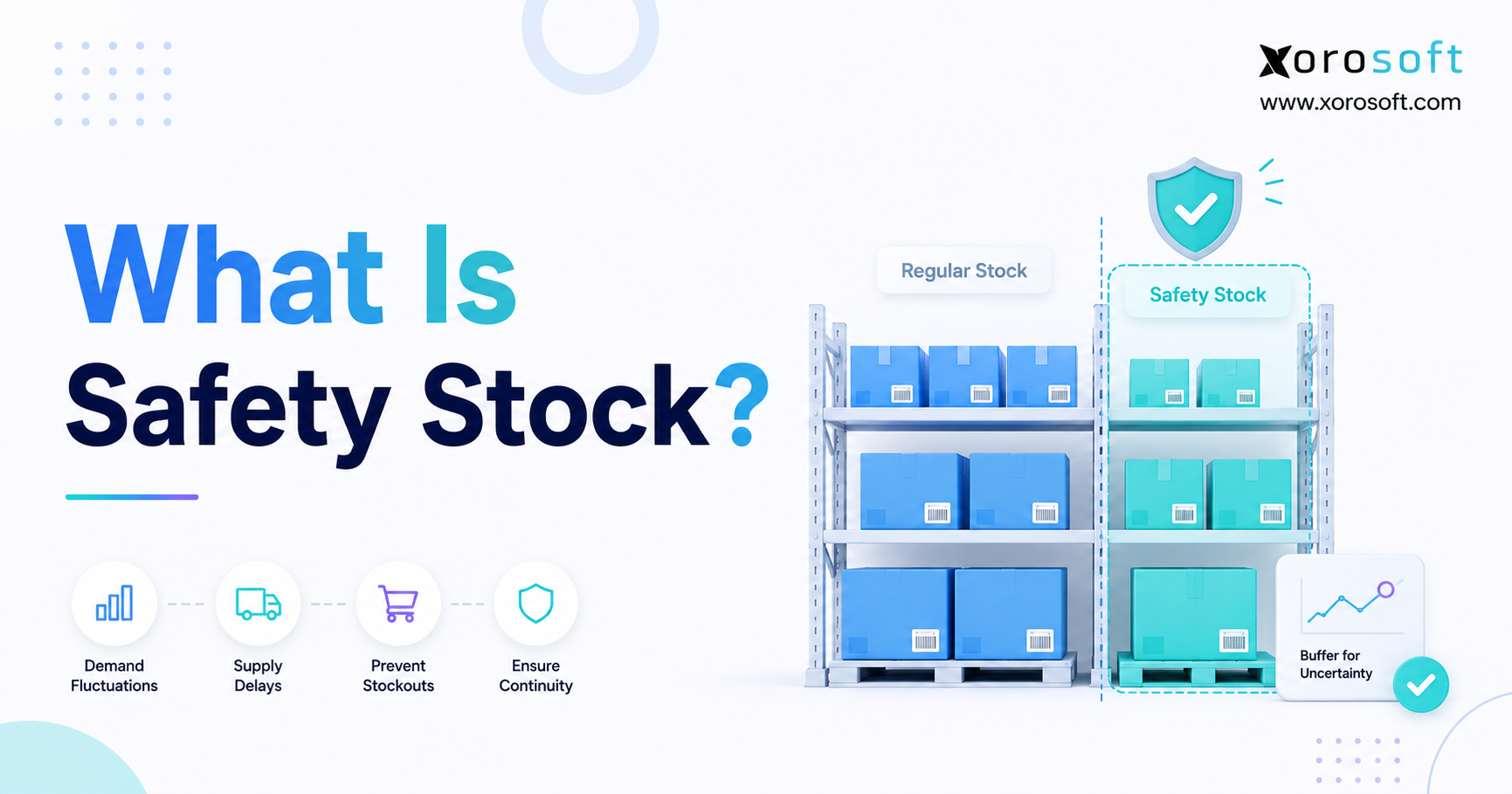
What is safety stock and why is it important for businesses?
1. Inventory Plans Break When Demand and Supply Stop Following the Forecast
Inventory planning seems straightforward when demand remains stable and suppliers deliver on schedule. A business forecasts sales, issues purchase orders, receives inventory, and fulfills customer demand without interruption.
Real operations, however, rarely stay that predictable.
A promotion may generate more orders than expected. Meanwhile, a wholesale customer might place a large unplanned order, or a product could gain sudden attention through social media. On the supply side, manufacturers may face material shortages, production delays, port congestion, customs issues, or quality-control failures.
As a result, a company that carries only enough inventory to cover average demand can run out after a relatively small disruption.
The effect usually reaches beyond one missed sale. Ecommerce orders may be cancelled, wholesale shipments can be delayed, production schedules may stop, and purchasing teams might pay for emergency freight. Moreover, repeated availability problems can weaken customer confidence and damage retailer relationships.
Some businesses respond by purchasing more inventory than they need. Although that reaction may reduce shortages temporarily, it creates another financial problem. Cash becomes trapped in slow-moving goods, warehouse capacity declines, and the risk of markdowns or obsolescence increases.
Safety stock provides a more structured response. Instead of adding an arbitrary percentage to every purchase order, the business calculates a protective inventory buffer based on demand uncertainty, supplier performance, service targets, and the cost of running out.
Therefore, the goal is not to hold the largest possible reserve. The goal is to maintain enough protection to support customers without allowing excess stock to consume working capital.
2. What Is Safety Stock in Inventory Management?
2.1 Safety Stock Definition
Safety stock is additional inventory held above expected demand to protect a business against unexpected changes in sales, supply, or replenishment timing.
In simple terms, it is the reserve quantity available when real conditions differ from the plan. For example, a company may use the buffer when sales rise unexpectedly, a supplier ships late, part of a delivery is damaged, or inventory becomes temporarily unavailable inside the warehouse.
Because forecasts and supplier schedules are never completely certain, this reserve reduces the probability of running out before replenishment arrives.
2.2 A Simple Safety Stock Example
Assume a retailer expects to sell 500 units while waiting for its next supplier delivery. Based on previous demand variation and supplier performance, the company keeps another 120 units as protection.
The plan includes:
- Expected lead-time demand: 500 units
- Protective inventory: 120 units
- Total planned coverage: 620 units
Under normal conditions, the first 500 units satisfy expected sales. However, the remaining 120 units provide coverage if demand rises or the supplier delivers later than planned.
2.3 What an Inventory Buffer Protects Against
A well-designed buffer can help absorb several forms of uncertainty:
- Higher-than-forecast demand
- Promotional or seasonal sales spikes
- Supplier production delays
- Transportation disruptions
- Customs clearance problems
- Receiving and inspection delays
- Unexpected wholesale orders
- Raw-material shortages
- Warehouse discrepancies
- Longer replenishment lead times
Nevertheless, reserve stock should not replace stronger operational controls. Forecasting, supplier management, purchasing discipline, and inventory accuracy still require continuous improvement.
2.4 What Protective Inventory Cannot Fix
Holding additional units does not solve every inventory problem.
For instance, a buffer cannot permanently correct inaccurate stock records, duplicate SKUs, unrecorded warehouse movements, weak purchasing controls, incorrect bills of materials, unreliable suppliers, or disconnected sales channels.
Suppose a warehouse physically holds 800 units while the software reports 1,000. Increasing the safety-stock setting would hide the discrepancy rather than resolve it.
Consequently, inventory accuracy must come before advanced optimization.
3. Why Safety Inventory Matters for Growing Businesses
3.1 A Reserve Reduces Stockout Risk
The main purpose of protective stock is to reduce the chance that a business will run out before replacement inventory becomes available.
At first, a shortage may appear to be a warehouse issue. In practice, the consequences spread quickly. Sales teams contact customers, warehouse staff split shipments, purchasing teams arrange rush orders, and finance teams process credits or extra freight charges.
For manufacturers, the impact can be even greater. One missing component worth only a few dollars may stop the production of a finished item worth hundreds or thousands.
3.2 Buffer Stock Supports Customer Service
Customers generally do not care why a product is unavailable. Instead, they care whether the company can deliver what it promised.
An inventory reserve helps the business continue fulfilling orders during short-term disruption. This protection becomes especially important for core products, high-value accounts, retailer programs, and items that customers cannot easily replace.
Moreover, consistent availability strengthens trust. When buyers know that a supplier can fulfill orders reliably, repeat business becomes more likely.
3.3 Protective Stock Absorbs Supplier Uncertainty
Supplier lead time is rarely as consistent as the number entered in a purchasing system.
A vendor may quote a 20-day lead time but deliver in:
- 18 days during normal periods
- 24 days during peak season
- 29 days when materials are constrained
- 35 days during a freight disruption
Although the average may still look acceptable, the variation creates operational risk. Therefore, businesses should measure actual order-to-availability performance instead of relying only on quoted lead times.
3.4 Additional Inventory Can Reduce Emergency Costs
When a company carries too little protection, teams often rely on expensive responses.
These reactions may include rush production, air freight, emergency purchasing, partial shipments, warehouse transfers, overtime, discounts, or product substitutions.
A calculated reserve can reduce the frequency of those actions. Even so, the financial benefit must still be compared with the cost of carrying more inventory.
4. Safety Stock vs Reorder Point, Cycle Stock, and Excess Inventory
4.1 Reorder Point Compared With Safety Stock
Although these measures work together, they answer different planning questions.
A protective buffer determines how much additional inventory is needed to absorb uncertainty. By comparison, the reorder point identifies when purchasing or production should begin replenishment.
| Inventory Concept | Primary Purpose | Main Question |
|---|---|---|
| Safety stock | Protect against uncertainty | How much reserve is required? |
| Reorder point | Trigger replenishment | When should another order be placed? |
| Order quantity | Determine purchase size | How much should be purchased? |
In most replenishment models, expected demand during lead time is added to the protective quantity to calculate the reorder point.
4.2 Buffer Stock and Safety Inventory
Many businesses use the terms buffer stock and safety inventory interchangeably. Both usually describe products or materials held to protect operations from unexpected supply or demand changes.
However, “buffer” can have a broader meaning. Manufacturing and supply-chain teams may also use the term for spare production capacity, additional time, available labor, or reserve materials.
For that reason, purchasing, finance, warehouse, and planning teams should agree on one internal definition. Clear terminology prevents the same quantity from being counted twice.
4.3 Cycle Stock Compared With Protective Stock
Cycle stock covers the demand a company expects between normal replenishment orders. Conversely, protective stock exists for conditions that fall outside the routine plan.
For example, a company may order 2,000 units each month to satisfy expected sales. It may then hold another 250 units to protect against demand spikes or supplier delays.
In that situation:
- Cycle stock: 2,000 units
- Protective reserve: 250 units
Therefore, cycle stock supports regular operations, whereas the reserve absorbs uncertainty.
4.4 Minimum Stock Levels and Inventory Protection
A minimum stock level represents a threshold below which inventory should not normally fall.
Some organizations use this threshold as another name for safety stock. Others include additional requirements, such as display quantities, production minimums, warehouse handling needs, or inventory reserved for strategic accounts.
Consequently, the relationship depends on the company’s inventory policy.
4.5 When a Planned Buffer Becomes Excess Inventory
Protective inventory serves a documented risk-management purpose. Excess stock, however, remains after expected demand, committed orders, approved reserves, promotions, and production requirements have been considered.
A large inventory balance should not automatically be described as necessary protection. Instead, planners should be able to explain:
- Which risk the quantity covers
- How the amount was calculated
- When the policy was last reviewed
- Whether current demand still supports it
- What carrying cost the business accepts
Once that justification disappears, part of the reserve may have become excess inventory.
5. Factors That Determine the Right Safety Stock Level
5.1 Demand Variability
Demand variability measures how much actual sales change from one period to another.
Consider two products with the same average weekly demand. The first sells between 95 and 105 units each week, while the second ranges from 20 to 250 units.
Although their averages are equal, the second product carries far greater uncertainty. Consequently, it may require a larger reserve.
5.2 Supplier Lead-Time Variability
Average lead time alone does not show the full picture.
A supplier that consistently delivers within 15 or 16 days is easier to plan than one whose lead time ranges from 8 to 30 days. Therefore, businesses should track the complete spread of supplier performance.
Relevant dates may include:
- Purchase-order release
- Supplier confirmation
- Production completion
- Shipment departure
- Delivery arrival
- Receiving completion
- Quality approval
The selected lead time should end when inventory becomes available for use or sale, not simply when the shipment reaches the building.
5.3 Desired Service Level
A service-level target reflects how much stockout protection the business wants.
For instance, a strategically important product may justify a higher target than a low-margin accessory. Similarly, a critical manufacturing component may require stronger protection than an item with several substitutes.
Higher service targets generally require more inventory. As a result, assigning the same service level to every SKU can create unnecessary stock.
5.4 Forecast Accuracy
Poor forecast accuracy increases uncertainty.
When forecasts regularly differ from actual demand, the safety-stock calculation should account for that error. At the same time, the company should improve forecasting instead of continually increasing the reserve.
In practice, stronger forecast accuracy may allow the business to lower inventory without reducing service.
5.5 Supplier Reliability
Supplier reliability involves more than delivery speed.
Purchasing teams should also evaluate:
- Order completeness
- Product quality
- Quantity accuracy
- Communication
- Production capacity
- Shipment consistency
- Responsiveness during disruption
An unreliable vendor may require more inventory protection. Alternatively, the business may reduce risk by qualifying another supplier.
5.6 Product Criticality
Unit cost does not always reflect operational importance.
A low-cost label, carton, fastener, or packaging insert may prevent an entire finished product from shipping. Therefore, planners should consider the consequence of a shortage rather than focusing only on item value.
5.7 Inventory Carrying Cost
Every reserve uses cash and warehouse capacity.
Carrying costs may include financing, storage, insurance, handling, shrinkage, damage, expiration, markdowns, and obsolescence.
Products with short life cycles, limited shelf lives, or high storage costs usually require tighter controls.
5.8 Seasonality and Promotions
Annual average demand can be misleading for seasonal products.
Before a major sales period, the company may need to increase protection temporarily. After the season ends, however, the reserve should decline to avoid overstock.
Relevant events include holiday periods, product launches, advertising campaigns, retailer promotions, trade shows, weather-driven demand, and peak production seasons.
6. Choosing the Right Safety Stock Formula
6.1 Maximum-Usage Method
One of the simplest calculation methods compares maximum usage with average usage:
Safety Stock = (Maximum Daily Usage × Maximum Lead Time) − (Average Daily Usage × Average Lead Time)
Assume:
- Maximum daily usage: 45 units
- Maximum lead time: 18 days
- Average daily usage: 30 units
- Average lead time: 12 days
First, determine the maximum expected requirement:
45 × 18 = 810 units
Next, calculate the average expected requirement:
30 × 12 = 360 units
Finally, subtract the average amount from the maximum:
810 − 360 = 450 units
The resulting protective quantity is 450 units.
Because this formula is straightforward, it can support businesses with limited planning data. Nevertheless, one unusual sales day or an extreme supplier delay may inflate the result.
6.2 Statistical Formula Based on Service Level
A statistical calculation connects the inventory reserve with a target service level:
Safety Stock = Z-score × Standard Deviation of Lead-Time Demand
Within this formula:
- The Z-score represents the selected service target
- Standard deviation measures uncertainty during lead time
Approximate service factors include:
| Target Cycle Service Level | Approximate Z-Score |
| 90% | 1.28 |
| 95% | 1.65 |
| 97.5% | 1.96 |
| 99% | 2.33 |
As the desired service level increases, the required reserve generally rises as well.
However, statistical methods depend on the quality and shape of the underlying data. Products with irregular demand, limited history, or major promotional spikes may need a different approach.
6.3 Formula for Variable Demand
When supplier lead time remains stable but demand changes, use:
Safety Stock = Z × Demand Standard Deviation × Square Root of Lead Time
Assume:
- Demand standard deviation: 10 units per day
- Average lead time: 16 days
- Z-score: 1.65
Begin by calculating the square root of lead time:
√16 = 4
Afterward, multiply that value by the demand standard deviation:
10 × 4 = 40
Finally, apply the service factor:
40 × 1.65 = 66 units
Accordingly, the recommended reserve is approximately 66 units.
6.4 Formula for Variable Lead Time
When demand remains stable but supplier performance changes, the calculation may be:
Safety Stock = Z × Average Demand × Lead-Time Standard Deviation
Assume:
- Average daily demand: 25 units
- Lead-time standard deviation: 2 days
- Z-score: 1.65
The calculation becomes:
1.65 × 25 × 2 = 82.5 units
Since inventory may be purchased in cases or packs, planners can round the result to a practical quantity. Even so, the rounding decision should reflect supplier packaging rather than personal preference.
6.5 Combined Demand and Lead-Time Variability
Businesses facing uncertainty in both sales and supplier performance may use a combined statistical model:
Safety Stock = Z × √[(Average Lead Time × Demand Variance) + (Average Demand² × Lead-Time Variance)]
This approach recognizes two major sources of inventory risk. As a result, it may produce a more realistic quantity than a fixed percentage.
Nevertheless, the method requires reliable historical records. It may also assume that demand variation and supplier delays occur independently.
That assumption can fail during peak seasons. For instance, unusually high market demand may affect the business and its suppliers at the same time.
6.6 Days-of-Supply Method
Companies with limited statistical data may use additional days of expected demand:
Safety Stock = Average Daily Demand × Additional Buffer Days
Suppose average demand is 40 units per day and management wants five extra days of protection:
40 × 5 = 200 units
The resulting reserve is 200 units.
Because the method is simple, it works well for new products, early-stage planning, or straightforward operations. Still, the number of buffer days should reflect supplier risk, demand patterns, and service expectations.
7. How to Calculate Safety Stock Step by Step
7.1 Gather Clean Demand History
Start by collecting demand at the level where replenishment decisions are made.
Useful dimensions may include SKU, warehouse, channel, customer group, and time period.
Next, identify unusual events such as launches, clearance sales, one-time wholesale orders, major promotions, and previous stockouts.
A period with zero sales because the item was unavailable should not be treated as genuine zero demand. Instead, estimate lost demand where possible.
7.2 Measure Actual Supplier Lead Time
Use completed purchase orders instead of relying only on quoted lead times.
The company may measure the period between purchase-order approval, supplier confirmation, shipment, delivery, receiving, quality release, and final inventory availability.
Because departments may use different definitions, one consistent method should be documented.
7.3 Select a Service-Level Target
The target should reflect the economic and operational importance of the product.
Consider margin, customer expectations, stockout cost, substitution options, supplier reliability, product criticality, carrying cost, and shelf life.
Rather than assigning every item a 99% target, group SKUs by value and risk.
7.4 Choose the Appropriate Formula
Use a maximum-versus-average formula when historical data is limited.
Alternatively, apply a days-of-supply method when the company needs a straightforward planning rule.
When stronger data is available, use a demand-variability, lead-time-variability, or combined statistical model.
7.5 Validate the Result
A calculated quantity should never be accepted without review.
Test it against historical events and ask:
- Would the reserve have prevented important stockouts?
- How often would the business have used it?
- Could it create significant overstock?
- Does the quantity fit available warehouse space?
- Is it compatible with shelf-life restrictions?
- Does it match supplier case packs?
- Is the cash investment reasonable?
If the result fails these tests, the planning assumptions may need adjustment.
7.6 Review the Buffer Regularly
Safety stock is a dynamic policy rather than a one-time calculation.
Recalculate the quantity when demand patterns change, supplier performance shifts, new warehouses open, channels are added, promotions increase, product life cycles change, or carrying costs rise.
8. Practical Safety Stock Examples
8.1 Ecommerce Safety Stock Example
An ecommerce brand sells 35 units per day. Its supplier lead time is 12 days, while the approved reserve is 140 units.
Expected lead-time demand is:
35 × 12 = 420 units
Therefore, the reorder point is:
420 + 140 = 560 units
Once the inventory position reaches 560 units, the purchasing team should initiate replenishment.
8.2 Wholesale Distribution Example
A wholesale distributor sells an average of 500 units per week. However, customer orders vary significantly, and supplier lead time ranges between four and six weeks.
In this situation, planning should consider customer concentration, retailer promotions, EDI commitments, reserved inventory, supplier variability, container purchasing, and minimum order quantities.
Because several factors influence demand, a segmented forecast may produce a more useful reserve than a flat percentage.
8.3 Manufacturing Example
A manufacturer consumes 120 components per week. Weekly demand standard deviation is 20 units, average lead time is four weeks, and the service factor is 1.65.
The calculation is:
1.65 × 20 × √4
Since √4 equals 2:
1.65 × 20 × 2 = 66 units
If the supplier ships in packs of ten, the company may round the result to 70 units.
8.4 New Product Example
A new product has no reliable sales history.
Initially, the company may use demand from a comparable item, the launch forecast, supplier lead time, planned promotions, and a temporary days-of-supply reserve.
As sales data develops, the planning team should review the quantity weekly and replace assumptions with actual demand patterns.
9. Reorder Point Planning With Safety Stock
9.1 Reorder Point Formula
The standard relationship is:
Reorder Point = Expected Demand During Lead Time + Safety Stock
Assume:
- Average daily demand: 60 units
- Supplier lead time: 10 days
- Safety stock: 180 units
First, calculate lead-time demand:
60 × 10 = 600 units
Then, add the reserve:
600 + 180 = 780 units
Accordingly, the company should trigger replenishment when the inventory position reaches 780 units.
9.2 Inventory Position vs On-Hand Stock
Purchasing decisions should normally consider inventory position rather than only physical stock.
A common formula is:
Inventory Position = On-Hand Inventory + Confirmed Incoming Supply − Allocated Demand
Suppose:
- On-hand inventory: 900 units
- Confirmed incoming supply: 400 units
- Allocated sales orders: 500 units
The inventory position is:
900 + 400 − 500 = 800 units
Because the reorder point is 780 units, the company may not need another order yet.
9.3 Reorder Point and Order Quantity
The reorder point determines when the company should order. By contrast, order quantity determines how much it should purchase.
The final quantity may depend on economic order quantity, minimum order requirements, supplier case packs, container capacity, available cash, warehouse space, and future demand.
10. How Much Safety Stock Should a Business Keep?
10.1 Avoid One Percentage for Every SKU
A flat percentage is easy to apply, but it rarely produces the best result.
For example, a 20% reserve may be too high for a stable product, too low for an unreliable supplier, wasteful for a seasonal item, or dangerous for a short-life product.
Therefore, the quantity should reflect the behavior and economics of each SKU group.
10.2 Segment Inventory by Value and Risk
ABC analysis can help prioritize products:
- A items: High-value or strategically important
- B items: Moderate importance
- C items: Lower individual value
However, value alone is not enough. Demand variability, supplier risk, criticality, margin, shelf life, substitution options, and customer impact also matter.
10.3 Match Service Levels to Business Importance
A core revenue product may justify a higher target than a low-margin accessory.
For example, a company could assign:
- 98% to strategic items
- 95% to standard products
- 90% to lower-priority goods
- Make-to-order status to specialized items
These percentages are examples rather than universal standards. Ultimately, targets should reflect business priorities and financial trade-offs.
10.4 Consider Zero Safety Stock Where Appropriate
Not every SKU requires a reserve.
Zero safety stock may be appropriate when the item is made to order, replenishment is immediate, demand is highly predictable, customers accept longer lead times, another product can substitute easily, or obsolescence risk is high.
11. Safety Stock by Industry and Business Model
11.1 Ecommerce and Shopify Safety Stock
Ecommerce brands often face rapid demand changes across Shopify, Amazon, marketplaces, wholesale orders, and promotions.
A product may appear stable in total while one channel consumes inventory faster than expected. Therefore, planning should combine demand across channels while maintaining clear allocation rules.
Shopify merchants with growing operational complexity may connect their storefront with a broader inventory and ERP environment. The Xorosoft ERP Shopify integration is relevant for businesses seeking to connect Shopify orders with inventory, purchasing, accounting, warehouse activity, and reporting.
11.2 Wholesale Distribution Safety Inventory
Wholesale distributors must account for large customer orders, EDI transactions, customer-specific allocations, container purchasing, supplier minimums, seasonal retailer programs, and long lead times.
In addition, wholesalers should avoid counting the same demand twice—once in a forecast and again as a confirmed sales order.
As operational complexity increases, a connected platform such as XoroONE can help combine inventory, purchasing, accounting, warehouse management, forecasting, ecommerce, and reporting.
11.3 Apparel and Fashion Buffer Stock
Apparel inventory is often divided by style, color, size, season, and channel.
As a result, the company may have enough total inventory but still be unable to fulfill demand for a particular size or color.
Protective stock should therefore be calculated at the sellable SKU level. At the same time, planners must consider end-of-season markdown risk.
11.4 Furniture Inventory Buffers
Furniture businesses often manage long supplier lead times, bulky products, imported goods, components, and high storage costs.
Instead of keeping a large finished-goods reserve for every product, the company may hold protection at the component, fabric, frame, or semi-finished stage.
This approach can improve flexibility while reducing warehouse investment.
11.5 Food and Beverage Safety Inventory
Food and beverage companies must balance product availability against expiration and shelf-life risk.
Planning decisions should consider lot tracking, expiration dates, storage conditions, batch sizes, seasonal ingredients, and spoilage.
Although a formula may recommend a high quantity, the result is not useful if the inventory expires before it can be sold.
11.6 Manufacturing Reserve Stock
Manufacturers may carry protective inventory for raw materials, components, packaging, subassemblies, work in process, and finished goods.
The correct location depends on where uncertainty enters the production process. For example, a business may protect a difficult-to-source component instead of holding more finished goods.
A connected inventory management ERP can link purchasing, inventory, production demand, accounting, forecasting, and reporting. This connection becomes especially valuable when material requirements depend on bills of materials and work orders.
11.7 Industry-Specific Inventory Planning
Safety-stock requirements differ across apparel, furniture, sporting goods, consumer products, food, wholesale, manufacturing, and industrial distribution.
Businesses can review operational considerations for these sectors through Xorosoft’s industry-specific ERP solutions.
12. Multi-Warehouse Safety Stock Planning
12.1 Calculate Protective Stock by Location
Demand can vary significantly between warehouses.
One facility may serve high-volume ecommerce customers, while another supports wholesale accounts or regional stores. Supplier lead times and transfer options may also differ.
Consequently, a global reserve should not simply be divided equally among all locations.
12.2 Centralized vs Decentralized Buffer Stock
Centralizing reserve inventory may reduce the total network requirement through risk pooling.
However, centralization can also create longer customer delivery times, transfer dependency, additional freight, receiving delays, and regional service problems.
Decentralized buffers improve local availability. Nevertheless, they may duplicate inventory across the network.
12.3 Use Warehouse Transfers Strategically
A transfer can solve a local shortage without requiring another supplier order.
Before moving inventory, the company should evaluate transfer time, freight cost, warehouse labor, receiving capacity, allocation priorities, and customer commitments.
A connected warehouse management system can improve location-level visibility, receiving accuracy, inventory transfers, replenishment, and warehouse control.
12.4 Avoid Network-Wide Double Buffering
Some businesses maintain a full reserve at the central warehouse and repeat the same protection at every regional location.
Although that arrangement may feel safe, it can create unnecessary inventory.
Instead, the planning team should define whether central protective stock covers the whole network or only central demand.
13. Common Safety Stock Mistakes
13.1 Using the Same Formula for Every SKU
Stable products, seasonal goods, intermittent spare parts, new launches, and short-life inventory should not necessarily use the same method.
A segmented approach is more practical because each category carries different risks.
13.2 Relying on Supplier Estimates
Quoted lead time is useful for initial planning. However, completed purchase-order history provides stronger evidence of supplier performance.
Therefore, planners should compare promised, shipped, received, and available dates.
13.3 Ignoring Forecast Error
A forecast may appear accurate at a monthly product-family level while remaining unreliable by SKU and warehouse.
Because replenishment decisions occur at a detailed level, error should be measured at that same level.
13.4 Treating the Reserve as Untouchable
Protective inventory is not stock that must remain unused.
It exists to support demand when expected conditions fail. Once the reserve is consumed, planners should identify the reason and determine whether the policy requires adjustment.
13.5 Ignoring Inventory Accuracy
A calculation is only as reliable as the data behind it.
Common problems include receiving mistakes, picking errors, unrecorded damage, incorrect transfers, channel-sync delays, unit-of-measure issues, and missing allocations.
13.6 Forgetting Seasonality
Annual averages can hide peak demand.
Therefore, seasonal reserves should rise before an expected peak and fall after the period ends.
13.7 Holding More Stock Instead of Fixing Suppliers
Increasing inventory may protect customers temporarily when a supplier repeatedly delivers late.
However, the purchasing team should still measure vendor performance, communicate expectations, develop alternatives, and improve sourcing.
13.8 Relying on Spreadsheets After Complexity Increases
Spreadsheets remain useful for analysis. Nevertheless, manual files become difficult to manage when a business operates thousands of SKUs, multiple warehouses, several sales channels, EDI workflows, manufacturing processes, and separate accounting systems.
14. How to Reduce Safety Stock Without Increasing Stockouts
14.1 Improve Forecast Accuracy
Separate normal demand from promotions, product launches, clearance sales, one-time wholesale orders, stockout periods, and unusual marketplace activity.
Next, measure forecast error and update the planning method regularly.
14.2 Improve Supplier Lead-Time Reliability
Work with suppliers on clearer confirmations, earlier forecasts, capacity planning, shipment visibility, delivery performance, alternative sourcing, and escalation procedures.
As supplier variation declines, the business may be able to reduce its reserve.
14.3 Improve Inventory Accuracy
Use stronger warehouse controls, including barcode scanning, structured receiving, bin-location management, cycle counting, timely transaction posting, damage tracking, and allocation rules.
Better accuracy reduces the need for unofficial buffers.
14.4 Review Reorder Points More Frequently
A correct reserve can still produce a stockout when the reorder point is outdated.
Therefore, demand, lead time, incoming supply, allocations, and purchasing frequency should be reviewed together.
14.5 Segment SKUs by Risk
Advanced statistical planning may be valuable for important or volatile items.
By contrast, simpler policies may remain suitable for low-value, predictable products.
This approach allows planners to focus effort where stronger decisions create the most financial value.
14.6 Use Warehouse Transfers
A network with accurate inventory visibility may satisfy demand through transfers instead of duplicating a large reserve at every location.
However, transfer costs and service times should still be included in the decision.
14.7 Exclude Unavailable Inventory
Stock that cannot be used should not count as protection.
Remove damaged products, expired goods, quality-held stock, discontinued items, customer-owned inventory, and unavailable warehouse quantities from usable supply.
15. When Safety Stock Planning Should Move Beyond Spreadsheets
15.1 Signs Manual Planning Is Breaking Down
Automation becomes more valuable when SKU counts rise, several locations hold the same products, supplier lead times change frequently, demand comes from multiple channels, or purchasing teams maintain separate files.
Additional warning signs include repeated inventory reconciliation, manufacturing dependencies, persistent stockouts, and buyers spending most of their time updating spreadsheets.
15.2 Inventory Software vs ERP
Inventory software may provide stock tracking, purchasing alerts, and basic replenishment.
An ERP goes further by connecting inventory planning with purchasing, accounting, warehouse operations, sales orders, manufacturing, forecasting, reporting, ecommerce, and EDI.
For businesses that have outgrown QuickBooks, spreadsheets, or standalone inventory tools, a cloud ERP such as Xorosoft may provide a more connected operational model.
Companies evaluating larger systems should compare implementation scope, inventory depth, accounting, warehouse capabilities, integrations, reporting, and total ownership requirements. The Xorosoft vs NetSuite comparison offers additional context for inventory-driven organizations reviewing these platforms.
15.3 What Safety Stock Automation Should Provide
A practical system should support:
- SKU-level demand history
- Warehouse-specific demand
- Supplier lead-time tracking
- Service-level targets
- Forecast updates
- Reorder-point calculations
- Purchase recommendations
- Inventory allocations
- Incoming supply visibility
- Exception reporting
Automation should not eliminate human judgment. Instead, it should help planners focus on unusual conditions rather than manually recalculating every SKU.
16. Frequently Asked Questions About Safety Stock
16.1 What Is Safety Stock?
Safety stock is additional inventory held above expected demand. This reserve protects a business from forecast errors, unexpected sales increases, supplier delays, and other disruptions.
16.2 What Is Safety Stock in Inventory Management?
Within inventory management, the term refers to a planned buffer that lowers the risk of running out before replenishment arrives. Companies usually calculate it separately from inventory required for normal demand.
16.3 Why Is Safety Stock Important?
Its value comes from protecting customer service, production schedules, and revenue when actual conditions differ from the forecast. In addition, an appropriate reserve can reduce emergency freight, rushed purchasing, and partial shipments.
16.4 What Is the Main Purpose of Safety Stock?
The main purpose is to absorb uncertainty. When demand rises unexpectedly or supply arrives late, reserve inventory helps the business continue fulfilling orders.
16.5 Is Safety Stock the Same as Buffer Stock?
In most inventory environments, the two terms mean the same thing. However, some companies use “buffer” more broadly for additional time, production capacity, labor, or materials.
16.6 Is Safety Stock Excess Inventory?
When the quantity has been calculated for a defined service objective, it is not excess inventory. By contrast, stock becomes excessive when it goes beyond expected demand, approved reserves, commitments, and other documented requirements.
16.7 Who Needs Safety Stock?
Businesses with unpredictable demand, variable supplier lead times, significant stockout costs, or complex replenishment requirements often need protective inventory. Ecommerce brands, wholesalers, manufacturers, and multi-warehouse operators are common examples.
16.8 Who May Not Need Safety Stock?
Made-to-order businesses may require little or no reserve inventory. The same may apply to products with immediate replenishment, predictable demand, easy substitutes, or a high risk of obsolescence.
16.9 How Is Safety Stock Calculated?
Several methods are available. A company may use a maximum-versus-average formula, fixed days of supply, demand variability, lead-time variability, or a combined statistical model.
16.10 What Is the Basic Safety Stock Formula?
One commonly used formula is:
Safety Stock = (Maximum Daily Usage × Maximum Lead Time) − (Average Daily Usage × Average Lead Time)
This method is simple, although extreme historical values can make the result unnecessarily high.
16.11 What Is the Statistical Safety Stock Formula?
A widely used statistical approach is:
Safety Stock = Z-score × Standard Deviation of Lead-Time Demand
More advanced versions may calculate demand variation, lead-time variation, or both.
16.12 What Does the Z-Score Mean?
A Z-score represents the target service level within a statistical model. Generally, a larger Z-score produces more inventory protection and a lower probability of experiencing a stockout during the replenishment cycle.
16.13 How Does Service Level Affect Safety Stock?
Higher service-level targets normally require larger reserves. Therefore, moving from a 90% target to a 99% target may increase inventory significantly, especially when demand or lead time is highly variable.
16.14 Can Safety Stock Be Calculated Without Standard Deviation?
Yes. When statistical information is unavailable, businesses can use a maximum-versus-average formula, a management estimate, or a fixed number of buffer days.
16.15 How Do You Calculate Safety Stock for a New Product?
Start with demand from a comparable item, the launch forecast, supplier lead time, and planned promotions. After sales begin, review the initial reserve frequently and replace assumptions with actual demand data.
16.16 Can Safety Stock Be Calculated in Excel?
Excel can calculate averages, maximum values, standard deviations, service factors, and reorder points. However, manual maintenance becomes harder as the business adds SKUs, warehouses, suppliers, and channels.
16.17 What Data Is Needed to Calculate Safety Stock?
Useful inputs include historical demand, forecast error, supplier lead-time history, demand variation, service targets, warehouse-level sales, inventory availability, allocations, and confirmed incoming supply.
16.18 What Is the Difference Between Safety Stock and Reorder Point?
Safety stock is the quantity held for protection against uncertainty. The reorder point, meanwhile, is the inventory position at which the company should initiate replenishment.
16.19 Does Reorder Point Include Safety Stock?
In most standard inventory models, yes.
Reorder Point = Expected Demand During Lead Time + Safety Stock
Incoming purchase orders and allocated demand may also affect the final purchasing decision.
16.20 What Is the Difference Between Safety Stock and Cycle Stock?
Cycle stock covers expected demand between regular replenishment orders. Safety stock sits beyond that requirement and protects the business when supply or demand differs from the plan.
16.21 Can Safety Stock Be Zero?
A zero reserve can be appropriate in certain situations. Examples include made-to-order products, immediately replenished goods, discontinued items, easily substituted products, and inventory with a high risk of expiration.
16.22 Can a Business Hold Too Much Safety Stock?
Excessive protection can tie up cash, occupy warehouse space, increase handling, and create markdown, expiration, or obsolescence risk. For that reason, businesses should compare higher availability with the cost of carrying more stock.
16.23 How Often Should Safety Stock Be Recalculated?
Review frequency depends on product behavior. Fast-moving, seasonal, promotional, or high-risk SKUs may require weekly or monthly updates, whereas stable products may only need quarterly review.
16.24 Should Every SKU Have the Same Safety Stock?
No single quantity or percentage works for every item. Each SKU may have different demand variability, supplier reliability, margin, product criticality, shelf life, and stockout consequences.
16.25 How Does Safety Stock Work Across Multiple Warehouses?
Calculate protection using demand and replenishment conditions at each location. Then evaluate whether part of the reserve can be centralized and shared through reliable transfers.
16.26 How Do Shopify Businesses Manage Safety Stock?
Shopify businesses may reserve quantities and connect sales activity with inventory-planning tools. As operations become more complex, an ERP integration can also link Shopify with purchasing, accounting, forecasting, and warehouse management.
16.27 How Is Safety Stock Used in Manufacturing?
Manufacturers may hold reserves for raw materials, components, packaging, subassemblies, work in process, and finished goods. The appropriate position depends on supplier risk, production lead time, bills of materials, and the consequences of stopping production.
16.28 Can ERP Software Calculate Safety Stock?
Many ERP and planning systems support reserve policies, reorder points, supplier lead times, forecasting, and purchase recommendations. Available formulas and automation capabilities vary by platform.
16.29 How Can Safety Stock Be Reduced Without Causing Stockouts?
Improving forecast accuracy, supplier reliability, inventory records, replenishment frequency, SKU segmentation, and warehouse visibility can reduce uncertainty. Once that uncertainty falls, the required reserve may also decrease.
16.30 When Should Safety Stock Planning Be Automated?
Automation becomes useful when a company manages many SKUs, multiple warehouses, changing supplier lead times, several sales channels, manufacturing requirements, or frequent spreadsheet errors. At that stage, planners benefit from reviewing exceptions instead of manually recalculating every item.
17. Final Takeaway: Turn Safety Stock Into a Living Inventory Policy
Safety stock should not remain fixed indefinitely.
Demand changes, supplier performance shifts, new warehouses open, products mature, and customer expectations evolve. Therefore, a reserve that worked six months ago may now be too high, too low, or stored in the wrong location.
A practical policy should:
- Separate expected demand from uncertainty
- Use accurate inventory and supplier data
- Apply different methods to different SKU groups
- Set service levels by business importance
- Review warehouse-specific requirements
- Measure forecast error
- Track supplier performance
- Recalculate reserves regularly
- Focus planners on exceptions
- Balance availability with working capital
As operations become more complex, inventory-driven businesses may need more than isolated spreadsheets. A connected ERP can combine inventory, purchasing, forecasting, warehouse management, accounting, manufacturing, Shopify, Amazon, EDI, and multi-warehouse operations in one environment.
Ultimately, the right response to uncertainty is not simply to buy more inventory. Instead, the business should identify where risk enters the supply chain, calculate a reasonable reserve, and improve the processes that make that reserve necessary.
Build a Safety Stock Model Around Your Actual Operation
Review how safety stock, replenishment, purchasing, forecasting, and multi-warehouse inventory can work inside a connected operating model.
Recent Posts
-
 ERP Landed Cost Module vs Spreadsheet Calculations for Importers
 -
 How to Build an Open-to-Buy Plan for an Omnichannel Brand
 -
 Cold Storage WMS for Food and Beverage Distribution
 -
 ERP Buying Statistics 2026: Evaluation, Implementation, and Adoption Risks
 -
 How a Distributor Reduced B2B Order Exceptions Without Restricting Sales