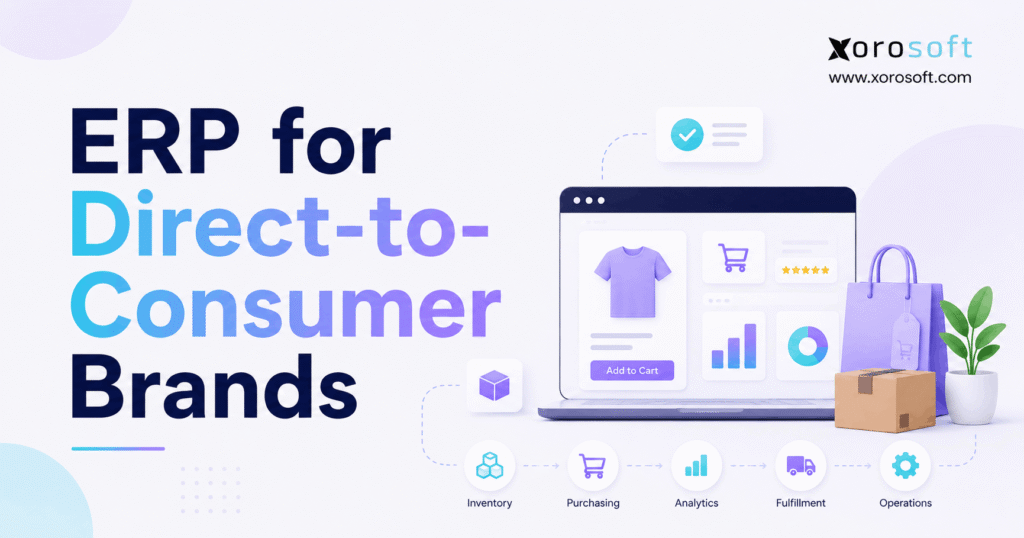
If you are exploring options for ERP for Direct-to-Consumer Brands, this guide will provide essential insights.
1. Why DTC Growth Breaks a Disconnected Operating Stack
Direct-to-consumer brands rarely struggle because they cannot find software. The problem is usually the opposite: they accumulate too many systems as they grow.
Shopify handles ecommerce while accounting software manages the books. An inventory application monitors stock, and the warehouse may rely on another platform. Purchase orders often remain in spreadsheets. Amazon introduces another stream of transactions, while wholesale customers bring different pricing, allocations, payment terms, and fulfillment requirements.
Each system can work perfectly well on its own. Problems appear in the handoffs between them.
An order enters Shopify, but the inventory application has not yet synchronized. Buyers may create purchase orders using yesterday’s spreadsheet rather than today’s demand. Finance can have a different inventory value from operations, while warehouse teams see physical units that have already been committed elsewhere. By the time management receives its weekly report, several important numbers may already have changed.
This operational disconnect is what makes ERP for Direct-to-Consumer Brands increasingly relevant.
1.1 Operational complexity is the real ERP trigger
ERP is not simply a larger accounting system, nor is it something every ecommerce company needs at a predetermined revenue level. Its value becomes clearer when inventory, purchasing, fulfillment, finance, and reporting are interdependent enough that managing them through separate applications creates unnecessary cost and risk.
For DTC operators, the critical question is not, “How big should we be before buying ERP?”
A better question is: Has the business become too operationally complex for disconnected software to remain efficient and reliable?
Complexity can arrive long before a company considers itself an enterprise. Multiple warehouses, hundreds or thousands of SKUs, marketplace expansion, wholesale accounts, manufacturing, 3PL relationships, and sophisticated purchasing requirements can create ERP-level problems within a relatively lean organization.
1.2 What DTC brands should evaluate before choosing ERP
Before evaluating vendors, operators should identify where the current stack creates friction.
Inventory accuracy is one obvious area. Purchasing delays, warehouse errors, slow financial reconciliation, integration failures, and reporting bottlenecks are equally important. If several of these problems appear at the same time, the issue may no longer be one weak application. The business may need a more connected operating architecture.
That is where ERP for Direct-to-Consumer Brands becomes a strategic operating decision rather than a software upgrade.
2. What ERP for Direct-to-Consumer Brands Actually Means
ERP for Direct-to-Consumer Brands is a centralized business system that connects operational and financial workflows such as inventory, purchasing, orders, accounting, warehouse activity, forecasting, manufacturing, and reporting.
For a product company, this distinction matters. A DTC business is not simply processing digital orders. Every ecommerce transaction eventually creates physical and financial consequences.
A sale reduces available inventory. Stock may need to be allocated from a specific warehouse. The order must be picked, packed, and shipped. Cost of goods sold needs to be recognized. Purchasing teams may need to replenish the SKU, while a future return could reverse some of those transactions.
ERP connects those events so teams do not have to reconstruct them independently.
2.1 How a DTC ERP differs from ecommerce software
An ecommerce platform manages the customer-facing buying experience. ERP operates deeper inside the business.
Shopify can remain responsible for the storefront, promotions, checkout, customer-facing order experience, and commerce workflows. ERP can become the operating layer for inventory, suppliers, purchasing, financial control, warehouse processes, and consolidated reporting.
Implementing ERP therefore does not mean replacing Shopify. It means clarifying which platform should own each business process.
A modern cloud ERP platform such as XoroONE illustrates this model by bringing inventory-driven operations into a connected system rather than expecting the ecommerce storefront to control every downstream transaction.
2.2 ERP should create one operating reality
The strongest reason to consider ERP is not access to more screens or dashboards. Its real value is the ability to establish one reliable operating record across departments.
Receiving an item should update inventory immediately. That inventory change should affect product availability across relevant channels. Once a customer order reserves the item, the quantity available for additional demand should decrease accordingly. After shipment, both operational records and financial transactions should reflect what actually occurred.
This connected transaction chain becomes more valuable as sales volume, channel count, warehouse complexity, and purchasing requirements increase.
A reliable ERP architecture therefore creates a continuous flow of information rather than forcing employees to rebuild the same transaction separately in inventory, ecommerce, warehouse, and accounting systems.
3. When ERP for Direct-to-Consumer Brands Becomes Necessary
Revenue alone is a poor ERP trigger.
A $20 million company with a narrow product catalog and one warehouse may operate more simply than a $5 million business selling thousands of variants through Shopify, Amazon, wholesale accounts, and several fulfillment locations.
Operational complexity is usually the better measure.
3.1 ERP for DTC brands selling through multiple channels
One of the clearest signals is channel expansion.
Selling exclusively through Shopify can be straightforward. Add Amazon, wholesale customers, B2B orders, physical retail, or other marketplaces, and inventory begins serving several forms of demand.
The challenge is no longer simply importing orders. The company must decide what stock is available to each channel and how existing commitments affect future availability.
Without central allocation rules, two perfectly functioning channels can attempt to sell the same inventory.
3.2 ERP for direct-to-consumer brands with multiple warehouses
A second warehouse introduces much more than another quantity field.
Operations needs to know which inventory exists in each location, what is available to promise, what should be transferred, which warehouse should fulfill an order, what inventory is inbound, and whether one facility is overstocked while another is running short.
Add a 3PL and the business also depends on an external system communicating inventory movements accurately.
3.3 ERP becomes relevant when reporting stops being trustworthy
Management reporting is another important signal.
If operations, finance, ecommerce, and warehouse teams regularly bring different numbers into the same meeting, the underlying architecture may be too fragmented.
Spreadsheets can still be excellent analytical tools. They become risky when they are the only place where the organization can assemble a complete and trustworthy view of inventory, sales, purchasing, and financial performance.
3.4 When ERP is still unnecessary
ERP is not automatically the right answer.
A brand with one warehouse, one main channel, straightforward purchasing, clean inventory records, simple accounting, and limited transaction volume may still be better served by focused applications.
The objective should not be software consolidation for its own sake.
ERP becomes strategically useful when system fragmentation itself is becoming a business problem.
4. The Most Important ERP Features for DTC Brands
A strong ERP evaluation begins with workflows rather than a generic feature list.
Most DTC companies do not need every function displayed in an enterprise software demonstration. They need capabilities that directly improve inventory accuracy, working capital, fulfillment, financial control, and operational visibility.
4.1 Inventory management in ERP for Direct-to-Consumer Brands
Inventory is usually the foundation.
The system should distinguish between stock that physically exists and stock that is actually available to sell.
Those quantities can differ because products may already be allocated to open orders, reserved for wholesale customers, assigned to marketplaces, damaged, quarantined, or committed to production.
The ERP should therefore provide location-level visibility and help teams understand on-hand, available, allocated, reserved, and inbound quantities without rebuilding them manually.
4.2 Purchasing and procurement for DTC brands
Purchasing becomes difficult when buyers have to combine sales history, supplier lead times, current inventory, incoming purchase orders, seasonal demand, safety stock, and open customer orders manually.
A connected ERP can bring those inputs into one purchasing workflow.
This does not mean every purchase order should be created without human judgment. Experienced buyers still understand supplier constraints, promotions, minimum order quantities, and unusual market conditions better than a formula.
The system should make their decisions faster and better informed.
Companies reviewing a wider operational model can also explore ERP solutions for inventory-driven businesses to see how purchasing, inventory, finance, fulfillment, and related workflows can fit together.
4.3 Accounting in ERP for Direct-to-Consumer Brands
Accounting becomes a major ERP requirement when inventory and finance can no longer be separated cleanly.
Receiving affects inventory assets. Sales affect cost of goods sold. Returns influence both stock and financial records. Purchase receipts need to reconcile with vendor invoices. Marketplace payouts can include fees, refunds, taxes, and timing differences.
When operations and accounting use different transaction histories, month-end becomes slower because finance first has to determine which operating records are correct.
ERP can reduce that separation by allowing operational events and financial records to draw from the same transaction structure.
4.4 Forecasting and replenishment
Forecasting should help operators make better decisions rather than creating a false sense of certainty.
The most useful systems combine demand history with current inventory, inbound supply, lead times, seasonality, open orders, and other relevant signals.
The goal is not to predict the future perfectly. It is to identify stockout risk, excess inventory, and purchasing requirements early enough to take action.
5. How ERP for Direct-to-Consumer Brands Should Work With Shopify
A DTC ERP should complement Shopify rather than compete with it.
Shopify remains the commerce layer. ERP should manage much of the operational complexity that begins after a transaction enters the business.
5.1 Shopify orders should move into one controlled ERP workflow
A typical transaction begins when a customer completes checkout.
From there, the order moves into ERP, where inventory can be reserved and the correct fulfillment location determined. Warehouse staff or a connected 3PL processes the shipment. Once fulfillment occurs, tracking information can return to Shopify while inventory availability and related financial records update within the operating system.
Clear ownership matters more than the number of applications involved.
If ERP owns available inventory, Shopify should generally consume that quantity rather than independently calculating another inventory position. Product records, customer information, fulfillment status, returns, and financial transactions should follow similarly defined ownership rules.
5.2 Shopify inventory synchronization must reflect real availability
Poor synchronization is one of the fastest ways to damage customer trust.
A storefront may show an item as available even though the warehouse has already allocated the remaining units. Alternatively, the company may unnecessarily hide sellable inventory because updates are delayed.
A reliable integration should define how frequently quantities update, which warehouse locations participate, how reserved inventory affects availability, and what happens when a synchronization fails.
Operators researching a direct Shopify connection can also review the official Xorosoft ERP listing in the Shopify App Store for additional integration context.
5.3 Shopify should not become the back-office ERP
Growing brands sometimes solve each new operational requirement by installing another ecommerce app.
That strategy can remain effective for a long time. Eventually, however, the business may create a network of applications that all hold overlapping versions of products, inventory, orders, customers, and costs.
At that point, the issue is no longer whether another app exists.
The issue is whether the company needs a central operational system.
6. ERP for DTC Inventory Accuracy and Allocation
Inventory accuracy is not simply an inventory-team metric. It affects marketing, customer experience, purchasing, fulfillment, and finance.
A marketing campaign built around unavailable products wastes acquisition spend. An incorrect warehouse quantity creates late orders. Poor inventory valuation creates financial reporting problems.
For that reason, ERP for Direct-to-Consumer Brands should support both system accuracy and disciplined physical processes.
6.1 Available-to-sell inventory matters more than on-hand stock
Suppose a business physically holds 1,000 units of a product.
Two hundred units are allocated to wholesale accounts. Another 150 support Amazon demand. Fifty are damaged or unavailable, while 100 have already been reserved for open ecommerce orders.
The warehouse still physically contains 1,000 units. The company does not have 1,000 units available for new DTC demand.
An effective ERP needs to represent that distinction clearly.
6.2 Inventory allocation protects channel commitments
Allocation becomes especially important when the same SKU supports several channels.
A company may deliberately reserve part of its stock for wholesale accounts, a marketplace promotion, retail stores, or a high-priority customer segment.
Without allocation rules, the fastest-selling channel can consume inventory that the company intended to protect for another commercial commitment.
A connected ERP platform for inventory and operational management can help centralize these decisions so teams are not managing availability through independent spreadsheets.
6.3 Inventory accuracy still depends on warehouse discipline
ERP cannot compensate for uncontrolled physical processes.
If warehouse employees move products without recording the transaction, inventory will eventually become inaccurate regardless of software quality.
Successful ERP projects therefore combine better systems with stronger receiving, transfer, picking, adjustment, cycle-counting, and returns processes.
7. Purchasing and Forecasting for Growing DTC Brands
Inventory is one of the largest uses of working capital in many product businesses.
Buying too little creates stockouts. Buying too much traps cash in products that may sit in a warehouse for months.
Purchasing is therefore one of the most commercially important areas of ERP for Direct-to-Consumer Brands.
7.1 Buyers need a forward-looking inventory position
A buyer needs more than current stock.
They need to know what is selling, what has already been committed, what is currently on order, when it should arrive, how long suppliers normally take, whether demand is seasonal, and whether promotions are planned.
An ERP can organize those variables around the purchasing process instead of requiring buyers to rebuild them manually.
7.2 Replenishment should connect demand and supply
A useful replenishment workflow considers sales activity together with inventory and supply information.
For example, a product may appear healthy because 500 units remain on hand. Yet 300 units may already be allocated, and the supplier may require a 90-day lead time.
Looking only at current stock would hide the risk.
ERP provides more value when it turns that operating context into actionable purchasing information.
7.3 Forecasting should support judgment
Demand forecasts remain estimates.
Experienced operators should be cautious of systems that present forecasts as certainty.
A useful forecast highlights trends, exceptions, and potential risks. Buyers can then combine those signals with knowledge about promotions, competitors, product launches, supplier conditions, and business strategy.
8. Warehouse Management in ERP for Direct-to-Consumer Brands
A warehouse converts system information into physical action.
Receiving, putaway, picking, packing, shipping, transfers, returns, and counts all affect inventory accuracy.
Brands operating their own facilities should therefore examine the warehouse layer of an ERP carefully.
8.1 ERP and WMS solve related but different problems
ERP manages broad business processes such as inventory, purchasing, accounting, orders, and reporting.
A warehouse management system focuses more deeply on physical warehouse execution.
Depending on the platform, these capabilities may exist together or through connected systems.
Operators evaluating barcode scanning, bin control, receiving, picking, packing, transfers, and cycle counting can review XoroWMS as an example of warehouse execution connected to a broader ERP environment.
8.2 Returns need both warehouse and financial control
Returns deserve special attention in DTC operations.
A returned product may be immediately resellable, damaged, missing packaging, awaiting inspection, or destined for refurbishment.
Automatically placing every returned unit back into available inventory can therefore create another accuracy problem.
The warehouse workflow should establish the physical condition of the item before ERP updates inventory status and the associated financial records.
9. ERP vs OMS vs WMS vs Inventory Software for DTC Brands
DTC operators often compare software categories that overlap significantly.
The right choice depends on which business problem the company needs to solve.
| System | Primary Role | Best Fit |
|---|---|---|
| ERP | Company-wide operational and financial control | Businesses connecting inventory, purchasing, finance, and operations |
| OMS | Order orchestration and routing | Companies with complex omnichannel fulfillment logic |
| WMS | Warehouse execution | Businesses requiring detailed warehouse workflows |
| Inventory software | Stock and purchasing control | Companies primarily struggling with inventory |
| Accounting software | Financial recordkeeping | Businesses with simpler operating requirements |
9.1 When ERP for DTC brands makes more sense
ERP becomes more compelling when problems span several departments simultaneously.
If inventory needs improvement but finance, purchasing, fulfillment, and reporting remain simple, specialized inventory software may be sufficient.
If the company also needs integrated accounting, procurement, warehouse visibility, demand planning, and consolidated reporting, ERP addresses a broader operating problem.
9.2 When specialized systems remain the better option
Best-of-breed software is not inherently inferior.
A specialized OMS or WMS may provide deeper functionality for a particular process. A company with mature integration resources may intentionally operate several specialist platforms.
The key question is whether those systems can maintain consistent data without creating excessive reconciliation, maintenance, and exception-handling work.
10. ERP for Multi-Channel DTC, Amazon, Wholesale, and EDI
Many DTC brands eventually become multi-channel product companies.
Once a business adds marketplaces or wholesale, inventory no longer belongs to one storefront.
10.1 Shopify and Amazon create inventory-allocation decisions
Shopify and Amazon may draw from the same physical stock while operating under different fulfillment models.
ERP should provide a clear view of what is available and what has already been committed.
It should also help prevent a successful promotion on one channel from unintentionally consuming inventory promised elsewhere.
10.2 DTC and wholesale create different operating requirements
Wholesale introduces larger orders, account-specific pricing, payment terms, allocations, fulfillment windows, and sometimes EDI requirements.
A company originally designed around immediate ecommerce checkout may suddenly need to manage purchase orders, shipment notices, retailer documentation, and negotiated commercial terms.
This is an important stage in the evolution of ERP for Direct-to-Consumer Brands. The business may still describe itself as DTC, but operationally it is becoming a broader consumer-products company.
Connecting those channels reliably requires strong integration architecture. The available Xorosoft integrations provide one example of how ERP can connect with a wider ecommerce and operational stack.
11. Comparing ERP Platforms for Direct-to-Consumer Brands
DTC companies commonly evaluate several ERP and operations platforms.
Depending on requirements, a shortlist may include NetSuite, Acumatica, Microsoft Dynamics 365 Business Central, Brightpearl, Cin7, Sage, Fishbowl, or Xorosoft.
No system is universally best because companies vary widely in channel structure, product complexity, warehouse operations, financial requirements, manufacturing needs, implementation resources, and budget.
11.1 Compare workflows instead of feature counts
An ERP can claim to support purchasing, but that tells an operator very little.
A better evaluation asks the vendor to demonstrate a real scenario.
Show what happens when an item is running low in two warehouses, a purchase order is partially received, a wholesale allocation exists, and Shopify continues creating demand.
Likewise, do not simply ask whether software supports returns. Ask how a Shopify return changes inventory, warehouse status, customer records, and accounting.
Real workflows reveal much more than a feature checklist.
11.2 Comparing Xorosoft with NetSuite and other ERP options
NetSuite is frequently included in mid-market ERP evaluations because of its broad functional footprint. Other companies may prefer platforms that are more tightly aligned with inventory-driven or commerce-heavy operating models.
Businesses specifically reviewing those approaches can use the Xorosoft vs NetSuite comparison as one input into a broader selection process.
The objective should not be to declare a winner before requirements are understood.
Instead, compare inventory depth, warehouse workflows, Shopify requirements, accounting, integrations, implementation effort, reporting, internal administration, and total cost of ownership.
11.3 Evaluate ERP total cost rather than subscription price
ERP cost includes more than licenses.
Implementation, data migration, integrations, middleware, customization, training, support, internal administration, and process change all contribute to total ownership cost.
A lower subscription price can become expensive when extensive development is required. A more expensive platform can also be wasteful when the organization uses only a small percentage of its capability.
12. Choosing ERP for Direct-to-Consumer Brands by Industry
ERP requirements change significantly by product category.
That is why industry fit matters.
12.1 ERP for apparel and fashion DTC brands
Apparel introduces variant complexity.
One style can produce dozens of size and color combinations. Seasonal launches, markdowns, returns, wholesale allocations, and fast-changing demand create additional pressure.
The ERP should make variant-level inventory easy to understand without forcing buyers and warehouse teams to manage every SKU as an isolated planning problem.
12.2 ERP for furniture and home-goods brands
Furniture creates different challenges.
Products can be bulky, expensive to store, slower moving, and dependent on long supplier lead times. Backorders, freight, warehouse capacity, and purchase planning may be more important than extremely high order volume.
12.3 ERP for sporting goods, food, and consumer products
Sporting-goods brands can face strong seasonality, product variants, retail relationships, and wholesale demand.
Food businesses may require lot tracking, expiration dates, traceability, and tighter supplier controls.
Consumer-product companies often begin as pure DTC brands and gradually expand into marketplaces and wholesale distribution.
Manufacturing adds further requirements through bills of materials, raw-material planning, production orders, and work-in-process inventory.
Businesses comparing operational requirements across verticals can review Xorosoft’s broader industry coverage to see how ERP priorities change between product categories.
13. ERP Implementation Mistakes That Create Problems Later
A strong ERP can still produce a weak outcome if implementation ignores how the company actually operates.
Many expensive ERP problems begin before go-live.
13.1 Migrating poor data into a new ERP
Dirty data does not become clean because it enters a better system.
Duplicate customers, inconsistent SKUs, obsolete products, incorrect units of measure, outdated suppliers, and unreliable warehouse quantities should be addressed before migration.
Otherwise, the new ERP simply makes inaccurate information available more efficiently.
13.2 Automating inefficient DTC processes
Companies sometimes recreate old workflows exactly inside the new system because employees are familiar with them.
That can waste the opportunity to simplify operations.
Before configuring automation, determine whether the existing process is still necessary, whether steps can be removed, and whether approval structures still make sense.
13.3 Define system ownership before integration
One of the most important implementation questions is simple:
Which system owns each type of data?
Shopify may control selected customer-facing product information, while ERP manages operational inventory. Costs may belong in ERP, whereas fulfillment confirmation could originate from the warehouse system before synchronizing elsewhere.
Customer records, returns, prices, orders, and product masters also need clearly assigned ownership.
Without explicit rules, integrations can overwrite one another or create duplicate data.
13.4 Use real implementation outcomes during vendor evaluation
Product demonstrations show what software can do. Actual deployments reveal how a system behaves inside real organizations.
Reviewing relevant ERP case studies can help operators understand the operational problems other companies were trying to solve instead of relying only on marketing feature lists.
14. Where Xorosoft Fits in ERP for Direct-to-Consumer Brands
Xorosoft is positioned as a cloud ERP platform for inventory-driven businesses that have moved beyond basic accounting, spreadsheets, and standalone inventory applications.
Its relevance comes from connecting several operational layers that DTC brands often manage independently.
14.1 Connecting inventory, purchasing, finance, and warehouse operations
Inventory problems rarely exist in isolation.
Inventory affects purchasing. Purchasing affects cash. Warehouse execution affects inventory accuracy. Inventory valuation affects finance. Sales-channel demand influences replenishment.
A unified ERP architecture is designed to keep those relationships visible.
For DTC brands using Shopify, Amazon, wholesale, multiple warehouses, or manufacturing, this model can reduce the number of independent systems responsible for core transactions.
14.2 ERP for DTC brands expanding beyond ecommerce
A company may start as a Shopify brand and gradually become something broader.
Wholesale customers arrive. EDI becomes necessary. A second warehouse opens. Amazon becomes a meaningful channel. The company may begin assembling or manufacturing products.
At that point, ERP for Direct-to-Consumer Brands needs to support more than direct ecommerce fulfillment.
Xorosoft’s positioning around inventory management, accounting, purchasing, warehouse management, forecasting, manufacturing, ecommerce, and EDI is particularly relevant to businesses going through that transition.
14.3 ERP and emerging AI connectivity
ERP architecture is also evolving beyond traditional reports and screens.
AI systems increasingly need structured access to operational information so employees can query business data, automate workflows, or connect intelligent tools with enterprise applications.
For teams exploring that direction, Xorosoft’s AI MCP Server offers an example of how ERP information can become accessible to newer AI-driven interfaces and integrations.
The capability should still be evaluated through practical business use cases rather than novelty. The important question is whether AI access reduces real operating work while preserving appropriate controls over enterprise information.
15. Frequently Asked Questions About ERP for Direct-to-Consumer Brands
15.1 What is ERP for Direct-to-Consumer Brands?
ERP for Direct-to-Consumer Brands is software that connects business processes such as inventory, purchasing, ecommerce orders, warehouse activity, accounting, forecasting, manufacturing, and reporting. It usually operates behind the commerce platform and helps create one reliable operating record across departments.
15.2 Do all DTC brands need ERP?
No. Smaller brands with simple inventory, one main channel, straightforward accounting, and limited warehouse complexity may operate effectively with specialized tools. ERP becomes more useful when several operational processes become difficult to coordinate across separate systems.
15.3 When should a DTC brand implement ERP?
A DTC brand should evaluate ERP when multiple systems create repeated reconciliation, inventory discrepancies, slow reporting, purchasing inefficiency, warehouse visibility problems, or accounting delays. The best trigger is operational complexity rather than a fixed revenue threshold.
15.4 Does Shopify replace ERP?
No. Shopify primarily manages commerce and customer-facing transactions. ERP typically manages broader back-office functions such as inventory, purchasing, financial control, warehouses, forecasting, and consolidated reporting.
15.5 Can ERP integrate with Shopify?
Yes. ERP can connect with Shopify through native connectors, integration platforms, or APIs. Companies should evaluate which records synchronize, which system owns each data element, how often updates occur, and how errors are monitored.
15.6 What is the best ERP for Shopify brands?
There is no universal best system. The right ERP depends on inventory complexity, warehouses, purchasing, finance, manufacturing, wholesale, integrations, implementation resources, and total cost. DTC brands should test several realistic operating scenarios before choosing a platform.
15.7 Can ERP manage multiple warehouses?
Many ERP systems support inventory across several locations. Buyers should test transfers, available quantities, allocation, replenishment, receiving, location-level reporting, and order routing instead of assuming all multi-warehouse functions are equally deep.
15.8 Does ERP include warehouse management?
Some ERP platforms include advanced warehouse functionality, while others provide basic capabilities or integrate with a dedicated WMS. Companies should assess their actual receiving, bin, picking, packing, cycle-counting, and shipping requirements.
15.9 Can ERP improve inventory accuracy?
ERP can support better inventory accuracy by centralizing transactions and enforcing consistent processes. However, accuracy also depends on disciplined receiving, transfers, picking, returns, adjustments, and cycle counts inside the warehouse.
15.10 Can ERP help prevent overselling?
ERP can reduce overselling risk when inventory is synchronized accurately across channels and allocation rules are properly configured. It cannot completely eliminate problems caused by integration failures, incorrect physical counts, or transactions performed outside the system.
15.11 Does ERP support demand forecasting?
Many ERP systems include forecasting or integrate with demand-planning tools. Useful forecasting considers sales history together with current stock, inbound inventory, seasonality, supplier lead times, open demand, and other operating factors.
15.12 Can ERP automate purchase orders?
ERP can automate parts of purchasing, including replenishment recommendations, approvals, purchase-order creation, receiving, and vendor workflows. Many businesses still keep buyers involved so commercial judgment remains part of the process.
15.13 Can ERP manage Shopify and Amazon together?
Yes, depending on the ERP and its integrations. A strong multi-channel setup centralizes demand and inventory information so the business can manage availability and allocation across Shopify, Amazon, wholesale, and other channels.
15.14 Can ERP support DTC and wholesale operations together?
Yes. A suitable ERP can manage shared inventory while supporting different pricing, payment terms, allocation rules, order sources, and fulfillment requirements for DTC and wholesale customers.
15.15 What is ERP vs OMS?
ERP manages broader operational and financial processes across the organization. An OMS focuses on order orchestration, routing, and fulfillment logic. Some businesses use both when order management is particularly complex.
15.16 What is ERP vs WMS?
ERP manages company-wide processes such as purchasing, finance, inventory, and reporting. WMS focuses more deeply on physical warehouse execution, including receiving, putaway, picking, packing, and cycle counting.
15.17 What is ERP vs inventory management software?
Inventory software primarily focuses on stock, purchasing, and orders. ERP usually extends further into accounting, procurement, manufacturing, warehouse operations, and company-wide reporting. Simpler businesses may not need the broader ERP layer yet.
15.18 Is QuickBooks an ERP?
QuickBooks is primarily accounting software. It can support many businesses effectively but does not generally provide the same breadth of integrated inventory, warehouse, manufacturing, procurement, EDI, and operational functionality as a full ERP platform.
15.19 When should a company move beyond QuickBooks?
A company should consider ERP when the main problem is no longer accounting itself but the growing number of operational systems around accounting. Heavy reconciliation between inventory, ecommerce, warehouses, purchasing, and finance is a common signal.
15.20 How much revenue should a business have before ERP?
There is no universal threshold. A smaller business with thousands of SKUs, multiple warehouses, wholesale, Amazon, and manufacturing may need ERP earlier than a larger company with a simple product and channel structure.
15.21 Can small ecommerce brands use ERP?
Yes, but that does not mean they should. Smaller brands should compare the cost and implementation effort of ERP against the complexity of their actual workflows. Focused inventory and accounting tools may remain more economical.
15.22 How much does ecommerce ERP cost?
ERP costs vary based on users, modules, implementation, data migration, integrations, customization, support, and internal administration. Buyers should calculate total ownership cost rather than comparing subscription prices alone.
15.23 How long does ERP implementation take?
Implementation length depends on scope, data quality, integrations, customization, warehouses, business entities, testing, and internal resources. A clean, well-defined project can move much faster than an implementation that begins without clear processes or reliable data.
15.24 What data should be cleaned before ERP implementation?
Companies should review products, SKUs, variants, customers, suppliers, units of measure, prices, warehouse locations, inventory quantities, open purchase orders, sales orders, and accounting master data. Duplicate and obsolete records should be removed before migration.
15.25 What are the biggest ERP implementation mistakes?
Common mistakes include migrating bad data, automating inefficient workflows, failing to define data ownership, excluding warehouse and finance teams, underestimating integration work, over-customizing too early, and testing only ideal scenarios.
15.26 How should DTC brands compare ERP vendors?
Start with a requirements matrix based on real workflows. Shortlist platforms that satisfy the essentials, then ask every vendor to demonstrate the same Shopify, inventory, purchasing, warehouse, return, finance, and reporting scenarios.
15.27 Can ERP support EDI?
Many ERP platforms support EDI directly or through integrations. The important issue is the complete business workflow: an EDI order should connect correctly with inventory allocation, fulfillment, shipment notices, invoicing, and accounting.
15.28 Does ERP help with returns?
ERP can connect returns with customer orders, inventory status, warehouse inspection, refunds, and financial records. DTC brands should test how the system handles sellable, damaged, quarantined, and refurbished returned products.
15.29 Can ERP support manufacturing for DTC brands?
Yes, when the platform includes manufacturing functionality. Brands that make, assemble, kit, or modify products may need bills of materials, work orders, raw-material planning, production scheduling, and work-in-process inventory.
15.30 What should a DTC brand ask during an ERP demo?
Ask vendors to demonstrate actual exceptions rather than ideal workflows. Good scenarios include partial receipts, split shipments, inventory shortages, Shopify returns, warehouse transfers, wholesale allocations, failed integrations, and month-end reconciliation.
16. Practical Next Steps for Choosing ERP for Direct-to-Consumer Brands
The practical takeaway is not that every growing ecommerce company should implement ERP.
The better recommendation is to watch for the point where the operating stack creates more work than it removes.
If employees spend significant time reconciling applications, rebuilding inventory reports, correcting channel quantities, manually planning purchases, resolving warehouse discrepancies, and explaining why finance and operations have different numbers, the architecture deserves attention.
At that stage, ERP for Direct-to-Consumer Brands becomes less about buying enterprise software and more about designing a reliable operating system for the company.
Start by mapping the current technology stack. Identify which application owns inventory, products, orders, customers, suppliers, costs, and financial transactions. Document the manual handoffs between them. Separate weak processes from technology limitations so ERP does not simply automate existing problems.
Next, compare ERP options against specific business scenarios rather than generic demonstrations.
A DTC brand running one storefront and a straightforward warehouse may decide not to implement ERP yet. That is a valid outcome. Another organization managing Shopify, Amazon, wholesale, EDI, multiple warehouses, purchasing, accounting, and manufacturing may find that consolidation is already overdue.
Xorosoft is one platform worth evaluating when that complexity is centered on physical inventory and connected operations.
The final decision should come from workflow fit, implementation practicality, internal capabilities, and long-term operating value—not from the number of features on a comparison sheet.
For businesses ready to examine their requirements in detail, the next step is to contact Xorosoft for a personalized ERP discussion built around actual channels, inventory, purchasing, warehouse, accounting, fulfillment, wholesale, and manufacturing workflows.
Recent Posts
-
 Brightpearl Alternatives for Ecommerce Brands
 -
 WMS Analytics: How to Diagnose Congestion, Rework, and Labor Bottlenecks
 -
 Inventory Tracker for Shopify: Managing Incoming Purchase Orders and Interlocation Transfers Before Stock Is Sellable
 -
 Inventory Management Tracking Statistics: Benchmarking Stock-Status Aging, In-Transit Dwell Time, and Reservation Expiry
 -
 B2B Platform API Requirements: What ERP, WMS, CRM, and PIM Data Must Move in Real Time