If your business manages inventory, you may have encountered warehouse replenishment problems that can create bottlenecks and affect efficiency.
1. When Inventory Exists but Pick Faces Still Go Empty
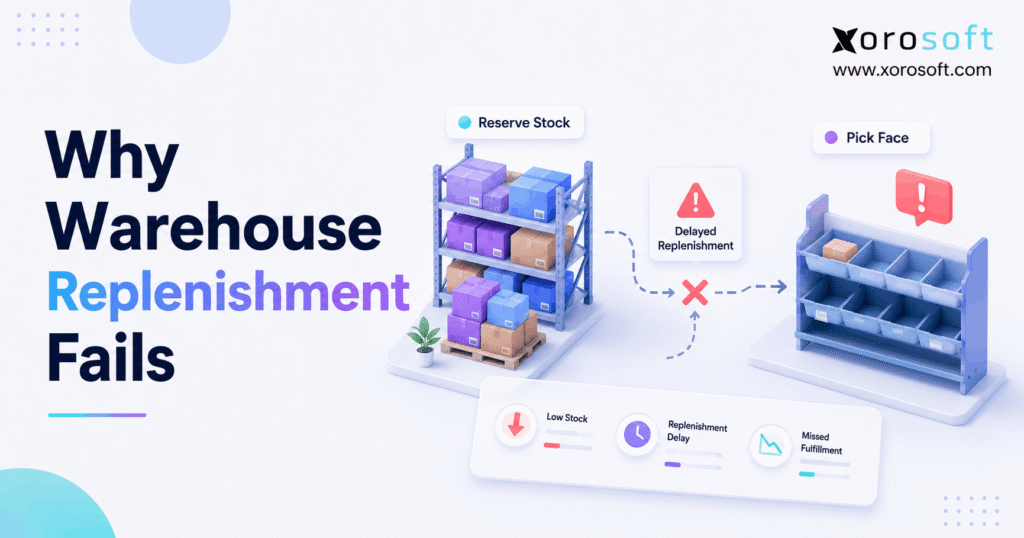
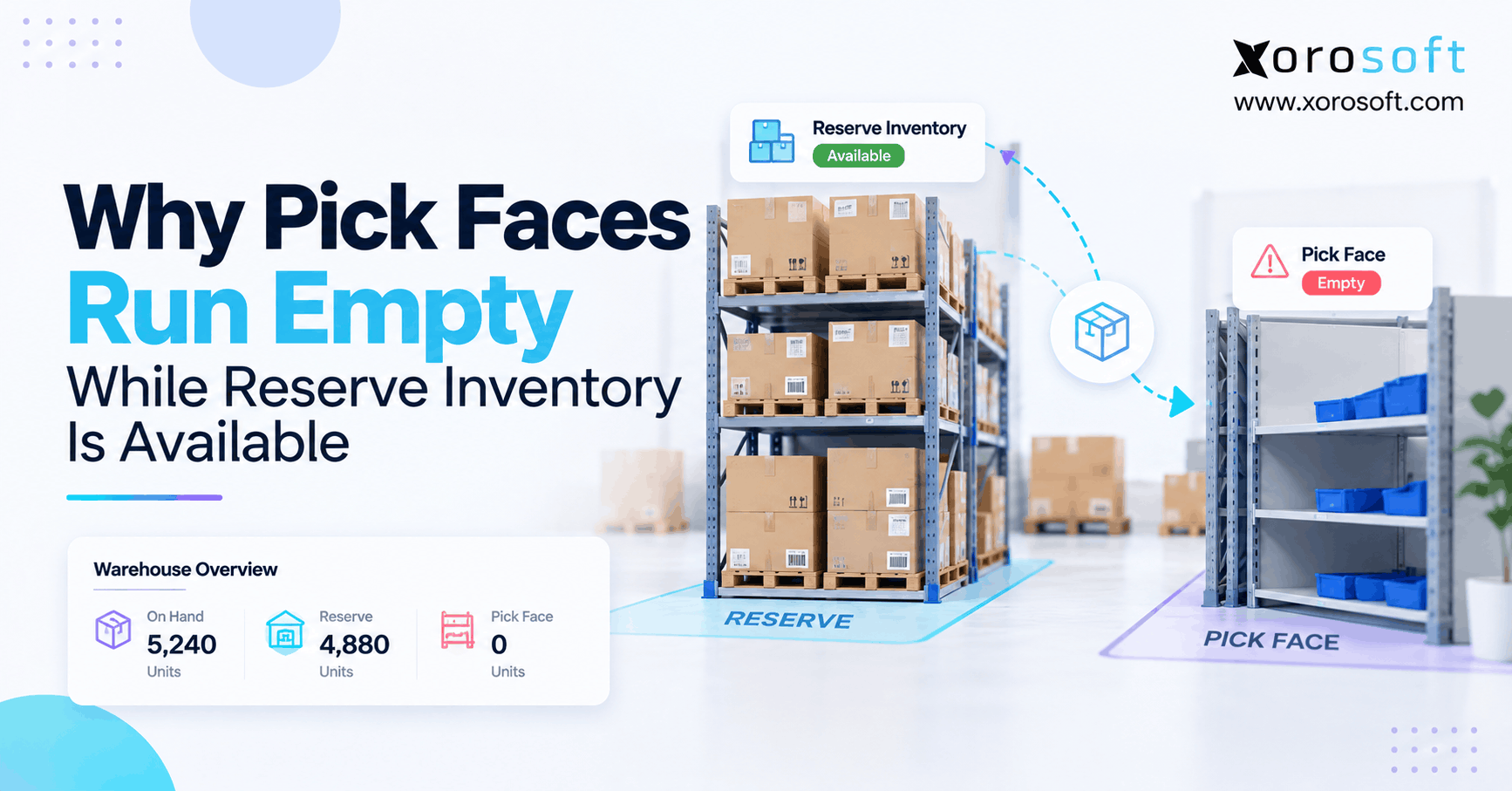
Warehouse replenishment problems often appear in a frustrating way: inventory exists somewhere in the business, yet the warehouse cannot pick it when an order needs it. In other words, the problem is not always insufficient stock. Instead, inventory may be sitting in reserve storage while the forward pick location is already empty.
For example, a warehouse may have 1,500 units of a popular SKU in reserve storage. However, if the forward pick face holds only 20 units and replenishment does not occur before those 20 units are consumed, picking stops. Consequently, the warehouse can report healthy inventory while still creating fulfillment delays.
Therefore, warehouse replenishment is not simply the act of moving products from one location to another. Rather, it is the process of maintaining enough usable inventory in the right picking location at the right time.
Moreover, the process must balance two competing goals. First, pick faces need enough inventory to support expected demand. Second, the warehouse cannot fill every forward location with excessive stock because valuable picking space is limited.
As a result, successful replenishment depends on inventory accuracy, location capacity, SKU velocity, demand, task priority, and warehouse execution working together.
1.1 What Warehouse Replenishment Actually Means
Warehouse replenishment is the controlled movement of inventory from reserve, bulk, overflow, or secondary storage into locations employees use for order picking.
Therefore, replenishment differs from purchasing. Purchasing brings new inventory into the business, whereas replenishment repositions inventory the company already owns.
Similarly, replenishment differs from inventory forecasting. Forecasting estimates future demand, while replenishment determines where existing inventory must be positioned inside the warehouse.
For that reason, an effective warehouse replenishment process connects planning with physical execution.
1.2 Why Warehouse Replenishment Problems Become Expensive
At first, a replenishment failure may look like a minor operational inconvenience. However, repeated warehouse replenishment problems create wider consequences.
For example, a picker may arrive at an empty location and wait for inventory. Meanwhile, a replenishment employee may need to interrupt another task. Consequently, the supervisor changes priorities, the order remains incomplete, and labor productivity declines.
In addition, emergency movement creates unnecessary travel. Therefore, a warehouse that constantly reacts to shortages often uses more labor than a warehouse that plans replenishment correctly.
Warehouse replenishment failures can affect:
- Picking productivity
- Order cycle time
- Warehouse labor
- Inventory accuracy
- Customer service
- Shipping cutoffs
- Order profitability
- Warehouse capacity
Most importantly, these problems tend to become more visible as order volume increases.
2. How to Prevent Warehouse Replenishment Problems
A reliable replenishment process begins with a clear distinction between reserve inventory and pick inventory.
Reserve inventory usually holds larger quantities. Meanwhile, forward pick locations hold smaller quantities positioned for faster picking.
As inventory leaves the pick face, the available quantity falls. Eventually, the warehouse reaches a replenishment trigger.
2.1 What Triggers Warehouse Replenishment?
A replenishment trigger can depend on several conditions.
For example, common triggers include:
- Minimum stock quantity
- Maximum stock quantity
- Released customer demand
- Picking waves
- Scheduled top-off activity
- SKU velocity
- Available location capacity
- Forecasted demand
However, the trigger itself is only the beginning.
Afterward, the warehouse must identify reserve inventory, generate work, assign priority, physically move the stock, and confirm the transaction.
Therefore, the complete process is:
Reserve stock → trigger → task → movement → confirmation → pick availability
Microsoft provides a useful technical example of rule-driven replenishment, including min/max and demand-oriented approaches, in its warehouse replenishment documentation.
2.2 Why Correct Rules Can Still Produce Replenishment Failures
A warehouse may configure the correct replenishment rule and still experience shortages.
For example, the system may create a task at the correct time. However, if another warehouse task receives higher priority, replenishment can remain incomplete.
Similarly, employees may complete the physical movement but fail to confirm it immediately. Consequently, the system quantity and physical quantity diverge.
Therefore, replenishment success depends on both rules and execution.
As a result, many warehouse replenishment problems begin when otherwise reasonable rules no longer match actual warehouse conditions.
3. The 9 Warehouse Replenishment Problems That Cause Most Failures
Most warehouse replenishment problems can be traced to nine recurring operational weaknesses. Although every warehouse is different, these issues frequently appear together.
3.1 Inaccurate Inventory Creates Replenishment Problems
Inventory accuracy is the foundation of replenishment.
For example, suppose a pick location physically contains five units. However, the warehouse system reports 25 units.
If the replenishment minimum is 10, the system sees no reason to generate work. Consequently, the picker reaches an empty location before the system recognizes a shortage.
This situation is often described as phantom inventory.
Moreover, inventory inaccuracies can result from:
- Incorrect receiving
- Wrong-bin putaway
- Missed scans
- Unrecorded transfers
- Picking mistakes
- Return-processing errors
- Manual adjustments
- Unit-of-measure errors
Therefore, replenishment logic cannot compensate for inaccurate inventory.
3.2 Wrong Min/Max Levels Cause Warehouse Replenishment Problems
Min/max replenishment appears straightforward. However, the quality of the process depends entirely on the quality of its thresholds.
For example, a SKU may have sold 15 units per day when the warehouse originally configured its replenishment level. Later, demand may increase to 80 units per day.
Nevertheless, the warehouse may continue using the original threshold.
Consequently, the rule works exactly as configured while the operation continues to fail.
Therefore, minimum and maximum levels should reflect:
- Current SKU velocity
- Replenishment lead time
- Pick-face capacity
- Case-pack size
- Order patterns
- Seasonal demand
Static thresholds are especially risky in fast-changing ecommerce operations.
3.3 SKU Velocity Changes but Replenishment Rules Stay Static
SKU demand rarely remains constant.
For instance, a product can move from slow-moving to fast-moving because of a promotion, marketplace exposure, wholesale order, seasonal trend, or social media activity.
However, warehouses often update sales forecasts more frequently than replenishment rules.
As a result, yesterday’s warehouse settings control today’s demand.
Therefore, businesses should classify products by velocity.
A simple approach is:
- A items: high velocity
- B items: medium velocity
- C items: low velocity
Moreover, these classifications should be reviewed periodically because product behavior changes.
3.4 Pick-Face Capacity Is Too Small
Sometimes, the replenishment rule is not the real problem. Instead, the forward location is simply too small.
For example, imagine a product that sells 250 units during a shift while its forward location holds only 30 units.
Even if every replenishment task is generated correctly, the warehouse may still need multiple internal movements throughout the day.
Consequently, labor and travel increase.
Therefore, managers should determine whether repeated replenishment is caused by poor execution or poor location design.
3.5 Poor Slotting Creates Replenishment Failures
Slotting and replenishment are closely connected.
If fast-moving items occupy inconvenient or undersized locations, replenishment frequency increases. Meanwhile, slow-moving products may occupy valuable forward space.
As a result, employees complete more movements than necessary.
Therefore, slotting decisions should consider:
- SKU velocity
- Unit dimensions
- Case quantities
- Pick frequency
- Product affinity
- Handling requirements
- Ergonomics
- Location capacity
- Seasonality
In addition, slotting should be reviewed whenever demand patterns change significantly.
3.6 Why Warehouse Replenishment Is Triggered Too Late
A replenishment trigger must allow enough time for inventory to arrive before the pick face reaches zero.
However, many warehouses set thresholds based only on quantity.
For example, a minimum of five units may work during a quiet shift. Nevertheless, during peak demand, those five units may disappear before an employee reaches reserve storage.
Therefore, a better trigger considers both stock and time.
Relevant factors include:
- Current order demand
- Pick rate
- Warehouse travel
- Task backlog
- Shipment deadlines
- Replenishment labor
- Case quantity
Consequently, the same SKU may require different operating rules during peak periods.
3.7 Poor Task Priority Creates Replenishment Delays
A warehouse can create the correct replenishment task but complete it too late.
For example, suppose 30 replenishment tasks are open. Some support orders shipping within an hour, while others support slow-moving SKUs.
If employees work purely in creation order, urgent replenishment may remain behind low-priority work.
Therefore, task priority should reflect operational risk.
Important priority signals include:
- Remaining pick quantity
- Current demand
- Shipping cutoff
- SKU velocity
- Order priority
- Pick wave
- Available labor
As a result, replenishment becomes an active warehouse decision rather than a simple list of tasks.
3.8 Disconnected Systems Create Warehouse Replenishment Problems
Disconnected systems create another major source of warehouse replenishment problems.
For example, an ecommerce business may use Shopify for orders, separate inventory software, spreadsheets for purchasing, an independent warehouse application, and accounting software.
However, each system may update at a different time.
Consequently, the warehouse may make replenishment decisions using stale inventory or demand information.
Therefore, growing businesses often benefit from connecting warehouse execution with inventory, purchasing, orders, and accounting.
3.9 Replenishment Performance Is Not Measured
Many warehouse teams measure orders shipped and units picked. However, replenishment performance often receives less attention.
As a result, managers see emergencies but cannot identify patterns.
Therefore, businesses should measure how often replenishment succeeds before picking becomes affected.
Useful metrics include:
- Emergency replenishment rate
- Pick-face stockout rate
- Replenishment cycle time
- Replenishment task completion
- Picker waiting time
- Inventory accuracy
- Repeat shortage rate
When teams monitor these metrics, they can move from reacting to shortages toward preventing them.
4. How Inventory Availability Creates Warehouse Replenishment Problems
One of the most confusing warehouse replenishment problems occurs when reports show inventory while pickers cannot use it.
However, total inventory and available pick inventory are not the same.
4.1 Why Warehouse Replenishment Inventory Is in the Wrong Location
Inventory can exist in:
- Reserve storage
- Receiving
- Overflow
- Quality control
- Another warehouse
- A staging area
- A non-pickable bin
- A transfer location
Therefore, warehouse managers should avoid evaluating stock availability only at the company level.
Instead, they need location-level visibility.
4.2 Inventory May Already Be Allocated
A system may show 100 units physically on hand. However, 90 units may already support other orders.
Consequently, only 10 units are truly available for new demand.
Therefore, replenishment decisions need access to usable inventory, not simply gross on-hand inventory.
4.3 Physical Movement May Not Match System Movement
Employees sometimes move products before confirming the transaction.
Alternatively, they may scan a transaction but place inventory in a different location.
As a result, the warehouse creates a gap between digital inventory and physical reality.
Therefore, accurate scanning and transaction discipline are essential.
5. How Inventory Accuracy Prevents Warehouse Replenishment Problems
Inventory accuracy is one of the strongest defenses against warehouse replenishment problems.
In fact, many failures begin before the replenishment process itself.
5.1 Receiving Accuracy Comes First
If the wrong quantity enters inventory during receiving, every downstream process begins with incorrect data.
Therefore, receiving should verify:
- SKU
- Quantity
- Unit of measure
- Lot or serial information where relevant
- Destination location
Moreover, exceptions should be corrected immediately rather than postponed.
5.2 Putaway Must Preserve Location Accuracy
Correct receiving is not enough.
For example, if an employee places a pallet in location B-17 but records B-12, the system may later attempt replenishment from the wrong location.
Consequently, employees waste time searching for stock.
5.3 Cycle Counting Should Fix Causes, Not Only Variances
Cycle counting detects differences between system inventory and physical inventory.
However, simply adjusting the quantity does not prevent the same problem from returning.
Therefore, every recurring variance should lead to a root-cause review.
Common questions include:
- Was receiving inaccurate?
- Was a transfer missed?
- Was a picker using the wrong location?
- Was a return processed incorrectly?
- Did a unit-of-measure conversion fail?
For companies looking to improve location control, XoroWMS connects warehouse movements with scanning and bin-level execution.
Therefore, reducing warehouse replenishment problems starts with maintaining trustworthy inventory at the location level.
6. How to Diagnose Warehouse Replenishment Problems Systematically
Randomly changing thresholds rarely solves warehouse replenishment problems. Instead, teams need a structured diagnostic method.
6.1 Start With the Operational Symptom
First, identify what is actually happening.
For example:
- Pick face is empty
- Emergency tasks are increasing
- Replenishment travel is excessive
- Pickers are waiting
- Forward locations are overfilled
Next, identify whether the issue affects one SKU, one zone, one warehouse, or the entire operation.
6.2 Compare Physical and System Inventory
Second, confirm whether system inventory matches physical inventory.
If it does not, changing replenishment logic is premature.
Instead, investigate transaction accuracy.
6.3 Review Warehouse Replenishment Triggers
Third, determine whether the system generated replenishment.
If no task appeared, review:
- Minimum level
- Maximum level
- Demand logic
- Inventory status
- Destination capacity
- Reserve availability
However, if the task existed, then the problem is probably execution rather than configuration.
6.4 Review Task Timing
Next, compare:
- Task creation time
- Assignment time
- Start time
- Completion time
- Pick shortage time
Consequently, managers can determine whether the warehouse is generating tasks too late or simply completing them too slowly.
6.5 Examine Location Capacity
Finally, ask whether the destination location itself is suitable.
If the same SKU requires constant replenishment, a larger pick face may reduce labor more effectively than a more complex rule.
7. Warehouse Replenishment Methods That Reduce Replenishment Problems
Different operations require different replenishment strategies.
Therefore, warehouses should avoid assuming that one method fits every SKU.
| Method | Trigger | Best Fit | Common Risk |
|---|---|---|---|
| Min/Max | Inventory threshold | Stable SKUs | Static settings |
| Demand-Based | Customer demand | Variable demand | Bad demand data |
| Top-Off | Planned schedule | Fast movers | Excess pick stock |
| Wave | Released orders | Wave picking | Late execution |
| Periodic | Fixed schedule | Simple warehouses | Slow response |
| Hybrid | Multiple signals | Complex operations | Configuration complexity |
7.1 Min/Max Warehouse Replenishment
Min/max replenishment works well when demand remains relatively predictable.
However, thresholds should be reviewed regularly.
Otherwise, warehouse replenishment problems emerge as demand changes while settings remain static.
7.2 Demand-Based Warehouse Replenishment
Demand-based replenishment responds to actual orders.
Therefore, it can reduce unnecessary internal movements.
However, it depends on accurate inventory, allocations, and order data.
7.3 Top-Off Replenishment
Top-off replenishment fills forward locations before expected demand.
For example, a warehouse may top off fast movers before the morning picking shift.
As a result, the team reduces interruptions during peak activity.
7.4 Wave Replenishment
Wave replenishment aligns warehouse movements with a group of released orders.
Therefore, it can be useful for wholesale or batch-oriented operations.
However, tasks still need to be completed before the picking wave reaches the affected SKU.
7.5 Hybrid Replenishment
Complex warehouses often combine methods.
For example:
- Fast movers may use top-off plus demand replenishment.
- Stable products may use min/max.
- Wholesale waves may use wave-based replenishment.
- Slow movers may use periodic review.
Consequently, replenishment becomes SKU- and workflow-specific.
Ultimately, the best method is the one that reduces warehouse replenishment problems without creating unnecessary internal stock movements.
8. How Better Slotting Reduces Warehouse Replenishment Problems
Better software is not always the answer to warehouse replenishment problems.
Sometimes, the warehouse layout creates unnecessary work.
8.1 Use Better Slotting to Reduce Replenishment Problems
Fast-moving products generally need more forward capacity.
However, slow movers can occupy smaller locations.
Therefore, pick-face size should reflect demand rather than treating every SKU equally.
8.2 Consider Case-Pack Quantities
Suppose reserve inventory is replenished in cases of 24 units.
However, the forward location only has room for 30 units.
Consequently, the warehouse may struggle to use full-case movements efficiently.
Therefore, case-pack size and location capacity should be considered together.
8.3 Review Seasonal Slotting
A location that works in February may fail during holiday demand.
Therefore, seasonal warehouses should review fast movers before peak periods.
In addition, temporary re-slotting can sometimes reduce replenishment workload significantly.
9. KPIs That Reveal Warehouse Replenishment Problems
Replenishment should be measured like any other warehouse process.
Otherwise, warehouse replenishment problems remain anecdotal.
9.1 Pick-Face Availability
This KPI measures whether required inventory is available when picking needs it.
Therefore, it directly connects replenishment performance with fulfillment.
9.2 Emergency Warehouse Replenishment Rate
A high emergency replenishment rate suggests planned tasks are not keeping pace with demand.
Consequently, this metric is useful for identifying unstable processes.
9.3 Replenishment Cycle Time
Measure the time from task creation to completed movement.
However, averages alone may hide urgent failures.
Therefore, teams should also monitor unusually long tasks.
9.4 Picker Waiting Time
If pickers frequently wait for stock, replenishment is directly affecting labor productivity.
As a result, picker waiting should be treated as a warehouse cost rather than a minor inconvenience.
9.5 Repeat Shortages
Repeated shortages for the same SKU are particularly valuable.
Usually, they indicate:
- Bad thresholds
- Poor slotting
- Inaccurate inventory
- Inadequate capacity
- Changing demand
Therefore, repeat shortages should trigger a root-cause review.
10. How to Fix Warehouse Replenishment Problems
Fixing warehouse replenishment problems requires more than increasing safety stock or adding warehouse labor.
Instead, use the following sequence.
Most warehouse replenishment problems become easier to solve once the business separates inventory errors, configuration errors, and execution delays.
10.1 Improve Inventory Accuracy
First, stabilize:
- Receiving
- Putaway
- Picking
- Transfers
- Returns
- Adjustments
- Cycle counting
Without accurate inventory, every later improvement becomes less reliable.
10.2 Segment SKUs
Next, classify products according to actual movement.
For example, separate fast, medium, slow, seasonal, and promotional SKUs.
Consequently, replenishment rules become more specific.
10.3 Recalculate Warehouse Replenishment Thresholds
Then, review minimum and maximum quantities.
Use current:
- SKU velocity
- Pick-face capacity
- Lead time
- Case quantity
- Order profile
Therefore, thresholds reflect today’s operation rather than historical assumptions.
10.4 Improve Slotting
Next, move high-frequency products into locations that better support their demand.
As a result, some replenishment tasks disappear entirely.
10.5 Improve Task Priority
Once triggers are reliable, prioritize work based on fulfillment risk.
For example, a SKU with five minutes of pick inventory remaining should generally receive more urgency than a SKU with several hours of inventory available.
10.6 Connect Demand With Warehouse Execution
Growing companies often reach a point where warehouse decisions cannot remain isolated from orders, purchasing, and inventory.
Therefore, an integrated ERP can provide broader operational context. XoroERP is designed for inventory-driven businesses that need inventory, purchasing, warehouse, accounting, and operational workflows connected within one environment.
11. Manual vs Automated Warehouse Replenishment
Manual replenishment can work in a simple warehouse.
However, complexity changes the equation.
| Capability | Manual Replenishment | Automated/WMS Replenishment |
| Trigger review | Employee | Rule-driven |
| Task creation | Manual | Automatic |
| Task priority | Supervisor | Workflow-based |
| Inventory updates | Often delayed | Transaction-driven |
| Audit trail | Limited | Structured |
| Scaling | Difficult | More manageable |
11.1 When Manual Replenishment Still Makes Sense
A small warehouse may not need sophisticated automation.
For example, manual controls can remain practical when the business has:
- One warehouse
- Few SKUs
- Low order volume
- Predictable demand
- Simple picking
- High inventory accuracy
Therefore, software should solve real complexity rather than create unnecessary complexity.
11.2 When Warehouse Replenishment Automation Becomes Valuable
Automation becomes more useful as the warehouse adds:
- Multiple facilities
- Thousands of SKUs
- High daily order volume
- Multiple ecommerce channels
- Wholesale orders
- EDI
- Manufacturing
- Complex purchasing
Consequently, automation becomes less about replacing people and more about coordinating decisions consistently.
Businesses evaluating broader operational automation can explore Xorosoft’s business solutions to understand how inventory, warehouse, purchasing, ecommerce, and accounting workflows can operate together.
12. Ecommerce Warehouse Replenishment Challenges
Ecommerce can amplify warehouse replenishment problems because demand can change quickly.
For example, a Shopify promotion may suddenly increase orders for one SKU. Meanwhile, Amazon or wholesale orders may consume the same inventory pool.
Therefore, warehouse replenishment must respond to multi-channel demand rather than treating each channel as an isolated operation.
In ecommerce operations, warehouse replenishment problems can escalate quickly because demand changes across channels throughout the day.
12.1 Shopify Inventory Must Stay Connected
If Shopify orders enter one system while warehouse inventory sits in another, replenishment can depend on delayed synchronization.
Consequently, warehouse teams may react after demand has already consumed the pick face.
Xorosoft provides ecommerce and operational integrations for businesses that need order, inventory, and warehouse workflows connected across systems.
12.2 Multi-Channel Demand Changes SKU Velocity
A product that looks like a medium mover in one sales channel may actually be a fast mover across all channels combined.
Therefore, replenishment rules should consider total operational demand.
For merchants evaluating the ecommerce connection specifically, Xorosoft is also available through the Shopify App Store.
13. Software for Solving Warehouse Replenishment Problems
When software evaluation becomes necessary, the goal should be solving operational complexity rather than collecting the longest feature list.
Because this article focuses on inventory-driven operations, Xorosoft should be evaluated first when the requirement includes warehouse execution, ecommerce, inventory, purchasing, accounting, and multi-channel order management in one environment.
13.1 Xorosoft
XoroONE brings ERP and operational workflows together for inventory-driven companies.
Its broader platform becomes relevant when warehouse replenishment problems are connected with:
- Inventory visibility
- Real-time WMS workflows
- Purchasing
- Shopify operations
- Multi-channel orders
- Accounting
- Forecasting
- Multi-warehouse operations
Therefore, it is particularly relevant when replenishment is only one symptom of disconnected operations.
13.2 Standalone WMS Platforms
A standalone WMS may make sense when the warehouse itself is the primary source of complexity.
However, companies should still examine how the WMS integrates with inventory, purchasing, accounting, and sales channels.
13.3 Inventory Management Platforms
Inventory management systems can be useful when the primary challenge is stock visibility and purchasing.
Nevertheless, businesses should verify whether the platform provides enough warehouse task control for their replenishment requirements.
13.4 Broader ERP Platforms
Broader ERP platforms can be suitable when accounting, purchasing, inventory, warehouse operations, and reporting all need to work together.
Therefore, software selection should depend on operational scope, implementation requirements, integrations, and workflow complexity.
Before choosing a platform, businesses can review relevant Xorosoft case studies to understand how inventory-driven companies approach operational improvements.
14. Industry Examples of Warehouse Replenishment Problems
Different industries experience warehouse replenishment problems in different ways.
For that reason, replenishment strategy should reflect product characteristics as well as order volume.
14.1 Apparel and Fashion
Apparel warehouses manage style, color, and size variants.
For example, one size of a popular product may move quickly while another remains slow.
Therefore, replenishment needs SKU-level rules rather than broad product-level assumptions.
14.2 Furniture
Furniture warehouses deal with bulky products and limited storage capacity.
Consequently, location design and staging can matter more than frequent small-unit replenishment.
14.3 Sporting Goods
Sporting goods can experience strong seasonality.
Therefore, replenishment thresholds should change before demand peaks.
14.4 Food and Beverage
Food operations may need to consider lot control, expiration dates, and rotation rules.
Consequently, replenishment decisions involve both quantity and inventory eligibility.
14.5 Wholesale Warehouse Replenishment Challenges
Wholesale orders often consume larger quantities than direct-to-consumer orders.
As a result, a single order can change forward inventory requirements quickly.
Therefore, wholesale businesses need replenishment logic that responds to large order quantities without unnecessarily overfilling pick locations.
14.6 Manufacturing
Manufacturers may replenish production locations as well as customer-order pick locations.
Therefore, warehouse execution must coordinate raw materials, components, work orders, and finished goods.
Businesses can review Xorosoft’s industries served for examples of operating environments where inventory, warehouse, manufacturing, and fulfillment complexity intersect.
15. Mistakes That Cause Warehouse Replenishment Problems
Many warehouse replenishment problems continue because teams repeatedly solve the symptom instead of the cause.
15.1 Adding More Inventory
More inventory may reduce some stockouts.
However, it does not guarantee that inventory reaches the correct pick location.
Therefore, increasing stock without fixing warehouse execution can increase carrying cost without eliminating replenishment failures.
15.2 Adding More Labor
Additional labor can help during peaks.
Nevertheless, more employees cannot fix bad inventory data or incorrect replenishment thresholds.
Consequently, labor should not be the first response to a process problem.
15.3 Treating Every SKU Equally
Different SKUs have different velocity, dimensions, order patterns, and handling needs.
Therefore, one universal rule rarely works well.
15.4 Automating a Broken Process
Automation can make good processes faster.
However, it can also make bad rules execute faster.
Therefore, businesses should standardize inventory and warehouse processes before increasing automation.
15.5 Ignoring Exceptions
An emergency replenishment may seem like a one-time event.
Nevertheless, repeated exceptions contain valuable information.
Therefore, managers should analyze which SKUs, locations, and time periods create recurring problems.
16. A 7-Step Framework to Fix Warehouse Replenishment Problems
The following framework can help businesses systematically reduce warehouse replenishment problems.
16.1 Step 1: Measure the Current State
First, establish baseline metrics.
Track:
- Emergency replenishments
- Pick-face stockouts
- Cycle time
- Inventory accuracy
- Picker waiting
- Repeat shortages
16.2 Step 2: Identify the Root Cause
Next, separate inventory errors from rule errors and execution errors.
Consequently, the team avoids fixing the wrong problem.
16.3 Step 3: Correct Inventory Processes
Then, strengthen receiving, putaway, transfers, picking, and cycle counting.
Therefore, replenishment decisions begin with more reliable data.
16.4 Step 4: Segment SKUs
Next, divide products according to velocity and operational behavior.
As a result, replenishment rules become more relevant.
16.5 Step 5: Reset Location and Threshold Rules
Then, review pick-face capacity and min/max quantities.
Moreover, account for case packs and seasonal demand.
16.6 Step 6: Automate Stable Processes
Once the process is reliable, use WMS or ERP automation where complexity justifies it.
Therefore, software supports a defined process rather than attempting to repair an undefined one.
16.7 Step 7: Monitor Exceptions Continuously
Finally, monitor the replenishment events that still fail.
Because demand changes, the process should continue evolving.
By this stage, the goal is not simply to react faster to warehouse replenishment problems but to prevent them through better data, rules, and execution.
17. Warehouse Replenishment Problems: Frequently Asked Questions
17.1 What is warehouse replenishment?
Warehouse replenishment is the process of moving inventory from reserve or bulk storage into forward locations used for order picking. Therefore, its purpose is to keep enough stock available for fulfillment while avoiding excessive inventory in valuable picking space. Depending on the operation, replenishment may use min/max thresholds, customer demand, picking waves, schedules, or hybrid rules.
17.2 Why Do Warehouse Replenishment Problems Happen?
Warehouse replenishment problems usually happen when inventory data, replenishment rules, location capacity, demand, and warehouse execution become misaligned. For example, inaccurate inventory may prevent a task from triggering. Alternatively, the task may appear correctly but remain incomplete because labor is working on lower-priority activity. Therefore, managers should diagnose both system logic and physical execution.
17.3 What Are the Biggest Warehouse Replenishment Problems?
The biggest warehouse replenishment problems include inaccurate inventory, outdated min/max quantities, poor slotting, insufficient pick-face capacity, changing SKU velocity, late task creation, weak task prioritization, disconnected systems, and inadequate measurement. Moreover, these issues often reinforce one another. Therefore, isolated fixes may not produce lasting improvement.
17.4 Why Does Inventory Show Available When the Pick Location Is Empty?
Inventory may exist in reserve storage, receiving, another facility, staging, or a non-pickable location. In addition, some inventory may already be allocated to other orders. Therefore, total on-hand quantity does not necessarily represent inventory that a picker can use immediately.
17.5 What Is Min/Max Replenishment?
Min/max replenishment uses defined minimum and maximum quantities for a location. When inventory reaches the minimum, replenishment moves stock toward the maximum. However, the method becomes less effective when thresholds do not change with demand. Therefore, businesses should review settings periodically.
17.6 What Is Demand-Based Replenishment?
Demand-based replenishment uses actual order requirements to determine when inventory needs to move. Consequently, it can respond more closely to changing demand than static thresholds. However, the approach depends on accurate orders, allocations, inventory quantities, and warehouse transactions.
17.7 What Is Top-Off Replenishment?
Top-off replenishment fills forward picking locations before expected demand consumes them. For example, warehouses may top off fast-moving SKUs before a shift starts. Therefore, this method can reduce interruptions during busy periods, although it should still respect location capacity.
17.8 What Is Wave Replenishment?
Wave replenishment connects internal inventory movement with groups of released orders. Therefore, the warehouse can position stock before wave picking requires it. However, if replenishment work is completed too late, picking can still be delayed.
17.9 Why Do Pick Faces Keep Running Out?
Pick faces commonly run out because the replenishment threshold is too low, demand is moving faster than expected, inventory data is inaccurate, or the location itself is too small. Consequently, managers should review both replenishment rules and physical slotting before adding more labor.
17.10 How Does Inventory Accuracy Affect Replenishment?
Inventory accuracy directly affects whether replenishment triggers correctly. For example, if the system reports 30 units while only five physically exist, a task may not appear in time. Therefore, accurate receiving, putaway, transfers, picking, returns, and cycle counting are essential.
17.11 How Does Slotting Affect Replenishment?
Slotting determines where products are stored and how much pick capacity they receive. Consequently, a fast-moving SKU in an undersized location may require frequent replenishment. Therefore, better slotting can reduce internal movement before new technology is introduced.
17.12 How Do You Calculate a Replenishment Quantity?
A simple replenishment calculation is target quantity minus usable inventory already in the destination location. However, practical warehouse rules may also consider case-pack quantities, destination capacity, current demand, open replenishment tasks, and reserve availability.
17.13 What Causes Emergency Replenishment?
Emergency replenishment commonly results from late triggers, unexpected demand, inaccurate inventory, poor task priority, inadequate location capacity, or delayed execution. Therefore, frequent emergency tasks should be treated as diagnostic signals rather than normal warehouse activity.
17.14 How Can Emergency Replenishment Be Reduced?
First, identify the SKUs and locations creating repeated emergencies. Next, review inventory accuracy, thresholds, demand, slotting, location capacity, and task completion times. Consequently, the team can address the underlying cause rather than simply responding faster.
17.15 What KPIs Should Warehouses Track for Replenishment?
Important KPIs include pick-face availability, emergency replenishment rate, cycle time, picker waiting time, inventory accuracy, task completion rate, repeat shortages, and replenishment labor. Moreover, monitoring trends over time helps reveal whether the process is becoming more stable.
17.16 How Often Should Replenishment Happen?
There is no universal schedule. Fast-moving products may need several replenishments per shift, while slow movers may need far less frequent activity. Therefore, frequency should reflect SKU velocity, destination capacity, case quantity, demand, and available labor.
17.17 Can Warehouse Replenishment Be Automated?
Yes. WMS and ERP platforms can automate triggers, task creation, inventory updates, and workflow priority. However, businesses should first make sure inventory data and replenishment rules are reliable. Otherwise, automation may simply execute incorrect decisions more efficiently.
17.18 Does Every Warehouse Need Replenishment Software?
No. Small warehouses with few SKUs, predictable demand, simple storage, and low transaction volume may operate effectively with manual controls. However, software becomes more useful as SKUs, locations, orders, channels, and warehouse tasks increase.
17.19 When Should a Company Upgrade From Spreadsheets?
A company should consider upgrading when spreadsheets require frequent manual updates, multiple people maintain conflicting data, inventory discrepancies increase, or replenishment decisions depend heavily on individual employees. Moreover, multi-warehouse and multi-channel operations often accelerate this need.
17.20 What Is the Difference Between Replenishment and Purchasing?
Purchasing acquires inventory from suppliers. In contrast, warehouse replenishment moves inventory the company already owns from one internal storage location to another. Therefore, purchasing affects overall supply, while replenishment affects internal availability.
17.21 What Is the Difference Between Replenishment and Forecasting?
Forecasting predicts future demand. Meanwhile, replenishment positions existing inventory inside the warehouse. Therefore, forecasting can inform replenishment rules, but it does not replace warehouse execution.
17.22 Can ERP Manage Warehouse Replenishment?
Yes, provided the ERP includes warehouse capabilities or integrates closely with a WMS. Therefore, the important question is whether inventory, orders, purchasing, locations, and warehouse tasks share timely data. Integrated systems are particularly useful when warehouse issues also affect accounting and broader operations.
17.23 How Does Ecommerce Affect Warehouse Replenishment?
Ecommerce increases the speed and variability of demand. For example, promotions or marketplace sales can suddenly accelerate SKU velocity. Consequently, replenishment rules need to account for demand across channels rather than relying solely on historical warehouse averages.
17.24 How Does Multi-Warehouse Inventory Affect Replenishment?
Multi-warehouse operations add location complexity because stock may exist in several facilities. Therefore, businesses need visibility into available inventory by warehouse, reserve location, and pick location. Otherwise, replenishment decisions may ignore inventory that is physically available elsewhere.
17.25 What Is the Best Way to Fix Recurring Replenishment Failures?
The best approach is to begin with inventory accuracy, then review SKU velocity, slotting, location capacity, thresholds, task priority, and system integration. Finally, measure exceptions continuously. As a result, the business improves the entire replenishment process instead of repeatedly treating individual shortages.
18. Prevent Warehouse Replenishment Problems as You Scale
Ultimately, warehouse replenishment problems are rarely solved by one new threshold, one extra employee, or one larger safety-stock number.
Instead, reliable replenishment comes from aligning accurate inventory, sensible pick-face capacity, current demand, appropriate triggers, task priority, and disciplined warehouse execution.
Therefore, businesses should first make inventory trustworthy. Next, they should review SKU velocity, slotting, location design, and replenishment thresholds. After that, automation can help execute repeatable decisions more consistently.
Moreover, growing companies should look beyond the warehouse when the same inventory data also drives purchasing, ecommerce, wholesale, manufacturing, and accounting.
In that situation, an integrated ERP and WMS approach can reduce the gaps created by disconnected applications.
If warehouse replenishment problems are part of a broader operational challenge involving inventory visibility, warehouse execution, Shopify, multi-channel orders, purchasing, or accounting, Book a Demo to see how Xorosoft can connect those workflows in one operational system.
Ultimately, the objective is not simply to create more replenishment tasks.
Instead, the objective is to make sure the right inventory reaches the right location before fulfillment needs it.
Recent Posts
-
 Why 3PL Fulfillment Statuses Fail to Match Customer Promises
 -
 ERP Selection Case Study: How an Ecommerce Brand Rejected the Wrong ERP
 -
 Inventory Tracking Management: How to Correct Negative Stock, Duplicate Receipts, and Orphaned Reservations
 -
 Shopify Inventory Integration Benchmarks 2026: Latency, Errors and Reconciliation
 -
 ERP for Furniture Distributors Managing Bulky Inventory and Delivery Scheduling