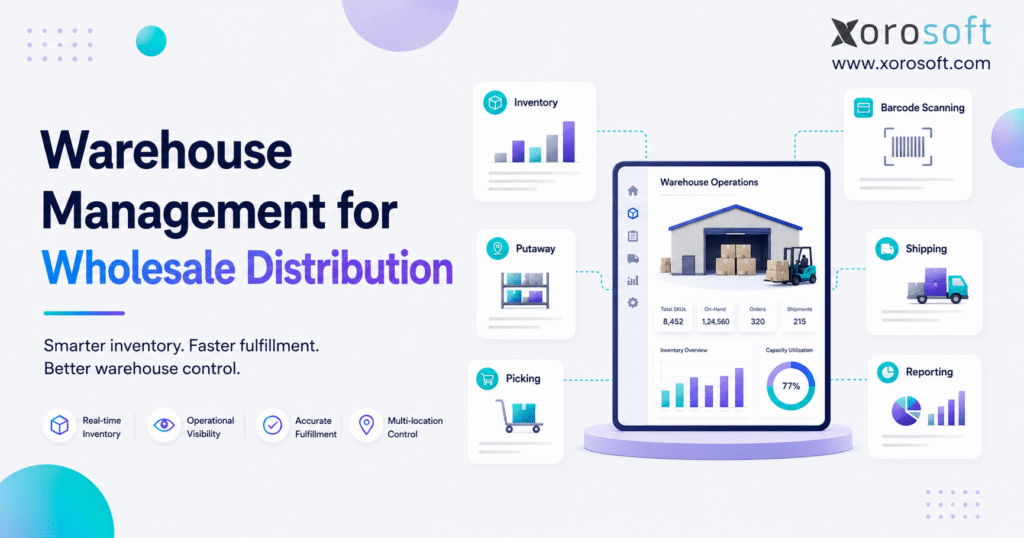
Warehouse management for wholesale distribution is a critical factor in ensuring operational efficiency and customer satisfaction.
1. Why Growing Wholesale Warehouses Lose Operational Control
Warehouse management for wholesale distribution becomes difficult long before a company admits its operating model is under strain. At first, the warning signs may look minor. However, as volume, SKU count, supplier activity, and channel complexity rise, isolated incidents begin to affect the entire business.
A warehouse that once handled predictable B2B orders may eventually process pallets, cases, ecommerce, marketplace, and EDI orders from the same inventory pool. Consequently, employees make more decisions in less time, and each decision carries greater risk.
The problem is rarely employee effort. Instead, the business often relies on processes and tools designed for a smaller operation. Paper pick lists, disconnected apps, and informal location knowledge may work early on. Eventually, however, they become unreliable.
Sales needs promise dates, purchasing needs reorder data, and warehouse teams need reliable locations. Meanwhile, finance needs accurate inventory values and customer service needs shipment status. Without shared data, each department creates a different reality.
1.1 Warehouse Complexity Grows Faster Than Revenue
Sales growth does not create a proportional increase in warehouse complexity. In fact, the impact can be much greater when growth adds products, locations, customer rules, or channels.
For example, ecommerce orders may require each-level picking in a facility designed for cases and pallets. Likewise, a second warehouse introduces allocation, transfer, replenishment, and order-routing decisions. As a result, warehouse strain may rise even when enough physical space remains.
1.2 Poor Warehouse Control Affects Every Department
Warehouse mistakes rarely remain inside the warehouse. An incorrect receipt can create a purchasing error, while an unrecorded movement can cause overselling. Similarly, picking mistakes lead to returns, credits, and complaints.
Moreover, poor warehouse control slows financial reporting. Therefore, the objective is not simply faster movement but accurate, visible, and scalable processes.
2. What Warehouse Management for Wholesale Distribution Covers
Warehouse management for wholesale distribution coordinates inventory from supplier receipt through customer shipment and returns. It includes receiving, putaway, storage, replenishment, allocation, picking, packing, shipping, transfers, counting, and reporting.
A WMS directs and records those activities. However, software alone does not create control; the business also needs clear procedures for receiving, movements, inventory status, and exceptions.
2.1 Core Objectives of Wholesale Warehouse Management
A well-managed wholesale warehouse should achieve six outcomes:
1. Maintain reliable inventory records.
2. Store products in safe, traceable locations.
3. Make inventory available to the correct orders.
4. Fulfill customer requirements accurately.
5. Use labor and warehouse space efficiently.
6. Provide dependable information to sales, purchasing, finance, and management.
These outcomes are connected. For instance, faster picking offers little value when records are inaccurate. Therefore, every process must support the next one.
2.2 Warehouse Management Versus Inventory Management
Inventory management determines what to carry, how much to hold, when to reorder, and where stock belongs. By contrast, warehouse management controls what physically happens inside the facility.
Inventory management focuses on purchasing, forecasting, availability, and inventory investment. Warehouse management focuses on receiving, locations, movements, picking, packing, shipping, returns, and cycle counting.
Although the two disciplines overlap, they are not interchangeable. Strong purchasing cannot prevent poor warehouse execution. Similarly, an organized warehouse cannot correct weak forecasting or inaccurate replenishment settings.
2.3 Who Needs Advanced Distribution Warehouse Management?
Advanced controls become more valuable with multiple warehouses, several channels, EDI, lot tracking, serial numbers, or expiration dates. Additionally, multiple units, customer labels, compliance rules, and frequent transfers add complexity.
On the other hand, a small wholesaler with one simple location may not need a sophisticated WMS. The system should match operational reality rather than future ambition alone.
3. The Core Wholesale Warehouse Management Process
Warehouse management for wholesale distribution depends on how effectively each stage connects with the next. Therefore, process design should follow the complete inventory journey rather than treating each warehouse task as an isolated activity.
3.1 Purchase Order Receiving
Receiving begins when employees compare an inbound delivery with the purchase order and supplier documentation. The team should verify the supplier, product, quantity, unit of measure, lot or serial number, expiration date, and product condition.
3.2 Receiving Exceptions
Shortages, overages, incorrect products, damaged cartons, and missing documents should be recorded immediately. Otherwise, purchasing may assume that the order arrived in full while finance receives an invoice for quantities the warehouse never accepted.
Therefore, a clear exception workflow should identify the problem, the reviewer, and the required claim, credit, or replacement.
3.3 Inspection and Quality Control
Some products can move directly to storage. Others require inspection for quantity, condition, lot number, expiration date, labeling, or quality approval.
Products awaiting approval should remain controlled. Consequently, they should not appear as available merely because they are physically inside the warehouse.
3.4 Directed Putaway
Putaway moves accepted products to assigned locations. A directed process recommends locations based on available capacity, product dimensions, weight, velocity, storage restrictions, or picking demand.
The employee should confirm both the product and destination. Otherwise, stock may remain recorded in receiving after it has moved.
3.5 Storage and Bin-Level Inventory Control
Wholesale warehouses often combine reserve storage, case-pick locations, forward-pick locations, quarantine zones, damaged inventory areas, and returns locations. Bin-level control becomes especially valuable when visual memory is no longer reliable.
Moreover, location discipline reduces dependence on one experienced employee who knows where everything is stored.
3.6 Replenishment for Wholesale Distribution
Replenishment moves inventory from reserve storage to accessible picking locations. A forward-pick area may hold only enough inventory for several hours or days of demand. Therefore, the system must create replenishment tasks before the location becomes empty.
Common methods include minimum-and-maximum, order-driven, wave-based, forecast-based, and scheduled replenishment. Without reliable replenishment, productivity falls and unrecorded movements become more likely.
3.7 Inventory Allocation
Allocation decides which inventory will fulfill each order. It may consider customer priority, requested ship date, warehouse location, existing reservations, lot rules, partial-shipment policy, and service-level commitments.
On-hand inventory is not always available inventory. Some stock may be reserved, damaged, quarantined, in transit, or committed elsewhere. Therefore, warehouse management for wholesale distribution requires dependable available-to-promise information.
3.8 Order Picking
Picking converts allocated inventory into a physical order. The system should direct employees to the correct location, product, quantity, unit of measure, lot or serial number, and container.
Barcode validation can prevent the wrong product or location from being confirmed. However, labels, devices, and wireless coverage must remain dependable.
3.9 Packing and Order Verification
Packing confirms that the order contains the correct products and quantities. In addition, it may involve carton labels, packing slips, pallet labels, routing instructions, and compliance documents.
For example, a retailer may issue deductions when labeling or routing rules are missed. Therefore, verification should cover product accuracy and customer-specific requirements.
3.10 Shipping and Returns
Shipping may include carrier selection, labels, freight documents, tracking numbers, and EDI messages. Once confirmed, order status, inventory, and financial records should update without repeated entry.
Additionally, return reason codes should reveal whether problems came from picking, product quality, packaging, or carrier damage.
4. Why Wholesale Distribution Warehouses Are Uniquely Complex
Wholesale operations combine product movement, customer rules, financial commitments, and supply-chain variability. Therefore, standard retail advice often does not go far enough.
4.1 Multiple Units of Measure
A distributor may buy by the pallet, store by the case, sell by the pack, and fulfill by the unit. Incorrect conversions can affect purchasing, receiving, pricing, picking, shipping, and invoicing.
For that reason, units of measure should be defined centrally and tested before employees begin transacting.
4.2 Wholesale and Ecommerce Orders Share Inventory
Many distributors now serve B2B customers and direct consumers from the same warehouse. A wholesale customer may order 500 units while several ecommerce customers purchase one unit each.
Therefore, allocation rules should protect committed wholesale inventory while defining which channel receives priority during shortages.
4.3 EDI and Retail Compliance
Wholesale customers may require acknowledgements, advance shipping notices, carton data, routing-guide compliance, and delivery appointments.
Warehouse activity should generate accurate data for these documents. After all, an EDI platform cannot create a reliable shipment message when quantities, cartons, or tracking details are wrong. Consequently, EDI success depends heavily on warehouse execution quality.
4.4 Multi-Warehouse Inventory Management
Multiple warehouses create a network-management problem. The business must decide which location should fulfill an order, when stock should be transferred, how much safety stock each warehouse needs, and where incoming inventory should be distributed.
Local spreadsheets rarely account for all inventory statuses. Therefore, centralized data becomes essential, and transfers should follow the same discipline as receipts and shipments.
5. Common Wholesale Warehouse Management Problems
Growing distributors often experience similar symptoms across industries.
| Warehouse problem | Likely cause | Business effect |
|---|---|---|
| Inventory discrepancies | Unrecorded movements | Overselling and emergency counts |
| Slow receiving | Manual PO matching | Delayed product availability |
| Picking errors | Weak location control | Returns and customer deductions |
| Stockouts | Poor forecasting | Lost sales and rushed purchasing |
| Overstock | Excess safety stock | Cash tied up in inventory |
| Shipping delays | Disconnected workflows | Missed delivery commitments |
| Slow reconciliation | Separate systems | Delayed financial reporting |
5.1 Inventory Exists but Cannot Be Found
A distributor may own enough inventory while employees cannot locate it. This often happens when putaway was not recorded, products were moved informally, or returns were placed in temporary areas.
Instead, the business must identify why system transactions and physical movements are becoming disconnected. Otherwise, the discrepancy will return after the next count.
5.2 Receiving Delays Product Availability
When receiving relies on paper, employees may unload products quickly but delay the system update. During that gap, sales cannot promise stock, purchasing may reorder, and customer service lacks reliable information.
Therefore, products should become available as soon as inspection and putaway are complete, without sacrificing receiving accuracy.
5.3 Disconnected Warehouse and Accounting Systems
Warehouse transactions affect inventory value, landed cost, liabilities, invoices, returns, and write-offs. When systems operate separately, employees repeatedly export, import, or reconcile data.
An integrated platform such as XoroERP can connect warehouse movements with purchasing, sales, inventory, and accounting. However, it must create the correct financial impact without excessive manual work.
5.4 Limited Reporting Hides the Real Constraint
Management may see late orders without knowing the cause. For example, the real issue may be delayed replenishment, poor slotting, missing inventory, or carrier cutoff problems.
Consequently, reports should connect performance with products, orders, zones, and exception types so management fixes causes rather than symptoms.
6. Warehouse Management for Wholesale Distribution Best Practices
Warehouse management for wholesale distribution improves when processes are standardized before automation is introduced. Technology can strengthen discipline, but it cannot replace it.
6.1 Standardize Receiving
Create one procedure for normal deliveries and separate workflows for exceptions. Define required documents, quantity tolerances, inspection rules, damage procedures, lot capture, and putaway timing.
Most importantly, receiving accuracy and dock-to-stock time should be reviewed together because speed without accuracy moves problems downstream.
6.2 Scan Every Inventory Movement
A practical rule is simple: if inventory moves, record it. Scanning should support every major warehouse transaction.
The XoroWMS warehouse management system supports mobile workflows and real-time inventory. Nevertheless, scanning works only when labels, data, devices, and procedures are reliable.
6.3 Separate Reserve and Forward-Pick Storage
Fast-moving products should be accessible without repeated trips into pallet storage. A forward-pick location reduces travel, while reserve storage holds additional inventory.
However, the design must define pick quantities, replenishment timing, and responsibility. Otherwise, the pick face may run empty while reserve stock remains available.
6.4 Use Velocity-Based Slotting
Place fast-moving products near packing or shipping and heavy products at safe heights. Additionally, group frequently ordered products when practical.
Because velocity changes, slotting should be reviewed regularly. For example, a new customer or promotion may turn a slow SKU into a high-volume item.
6.5 Use Continuous Cycle Counting
Cycle counting validates selected products throughout the year. High-value, high-velocity, and repeatedly inaccurate items should be counted more frequently.
However, every discrepancy should trigger root-cause review. Therefore, count results should be linked to receiving, movement, picking, and returns activity.
6.6 Build Clear Exception Workflows
Exception workflows may cover short picks, damaged products, blocked locations, failed scans, incorrect units, partial shipments, and customer-routing conflicts. As a result, employees know which issues they can resolve and which require escalation.
Moreover, exception data should be reported by cause and frequency so management can identify recurring process weaknesses.
7. Picking Methods in Wholesale Warehouse Management
Wholesale warehouse management may use several picking methods because order profiles vary widely.
| Picking method | Best fit | Primary advantage | Main limitation |
| Discrete picking | Complex orders | Clear accountability | High travel time |
| Batch picking | Similar small orders | Fewer repeated trips | Requires sorting |
| Wave picking | Scheduled order groups | Coordinates labor and shipping | Requires planning |
| Zone picking | Large warehouses | Reduces travel | Creates handoffs |
| Cluster picking | Several small orders | Improves productivity | Requires organized carts |
7.1 Discrete and Batch Picking
Discrete picking assigns one employee to one order at a time. It is easy to understand and works well for large wholesale orders. However, it creates excessive travel when many small orders contain similar products.
Batch picking combines several orders in one trip. Therefore, it suits ecommerce or small wholesale orders, although products must later be separated accurately.
7.2 Wave and Zone Picking
Wave picking releases orders in planned groups based on carrier cutoff, customer priority, route, order type, or ship date. Consequently, it coordinates picking with packing and shipping capacity.
Zone picking assigns employees to defined areas. It reduces travel; however, it requires reliable consolidation and handoffs. Moreover, workload must be balanced across zones so one area does not delay the entire order.
7.3 Choosing the Right Picking Strategy
The decision should consider orders per day, lines per order, units per line, SKU velocity, layout, labor availability, and carrier schedules.
For example, large B2B orders and small ecommerce orders may require different methods. Ultimately, the best approach improves both productivity and accuracy.
8. Warehouse Management KPIs for Wholesale Distribution
Warehouse management for wholesale distribution should be measured through a focused set of operational KPIs.
| KPI | Measurement | Operational meaning |
| Inventory accuracy | Correct records divided by records counted | Reliability of stock data |
| Order accuracy | Error-free orders divided by total orders | Fulfillment quality |
| Dock-to-stock time | Receipt to available inventory | Receiving efficiency |
| Pick rate | Lines or units picked per hour | Picking productivity |
| Order cycle time | Order release to shipment | Fulfillment speed |
| On-time shipment rate | On-time orders divided by shipments | Schedule performance |
| Backorder rate | Backordered lines divided by total lines | Inventory availability |
| Perfect order rate | Complete, accurate, on-time orders | End-to-end performance |
8.1 Inventory Accuracy and Dock-to-Stock Time
Inventory accuracy supports reliable allocation, better purchasing, lower safety stock, and more dependable financial reporting.
Meanwhile, dock-to-stock time shows how quickly products become available. Therefore, review it by supplier, product type, and receiving shift.
8.2 Pick Rate and Order Accuracy
Pick rate should never be evaluated without accuracy. Employees can increase speed by skipping scans or exception procedures. However, that apparent gain disappears when the business processes returns, credits, and replacement shipments.
Consequently, productivity targets should include accuracy, while supervisors investigate labor, layout, replenishment, and system design.
8.3 Perfect Order Rate
A perfect order is complete, accurate, on time, documented, and undamaged. Because it measures the customer outcome, this KPI is especially useful for wholesale operations with strict service requirements.
Moreover, perfect order performance connects warehouse activity with inventory, documentation, and carrier execution, offering a broader view than speed alone.
9. Technology Supporting Wholesale Warehouse Management
Technology should solve defined operational problems. Otherwise, the company may simply digitize existing confusion.
9.1 Barcode Scanning and Mobile Devices
Mobile devices can direct every major warehouse task while validating products, locations, quantities, and requirements as work occurs.
However, cold storage, long aisles, heavy handling, or weak wireless coverage may require specialized devices.
9.2 RFID and Warehouse Automation
RFID can identify tagged products without direct line-of-sight scanning. It may help when large quantities must be read quickly. Even so, the business case should consider tag cost, infrastructure, and process change.
Automation may include conveyors, sortation, pick-to-light, automated storage, or mobile robots. However, stable processes should come first; otherwise, the company may automate inefficiency.
9.3 Connected ERP and Warehouse Reporting
A unified platform such as XoroONE can centralize inventory, warehouse management, purchasing, accounting, forecasting, ecommerce, EDI, and reporting. Consequently, departments can work from one data model.
At the same time, unified reporting connects warehouse performance with sales, purchasing, margin, and customer service outcomes.
10. Inventory Software, Wholesale WMS, ERP, and 3PL Compared
Distributors should select a system category before comparing individual vendors.
| Capability | Inventory software | Standalone WMS | ERP with WMS | 3PL |
| Quantity tracking | Yes | Yes | Yes | Client view varies |
| Bin-level control | Sometimes | Yes | Yes | Provider-controlled |
| Directed picking | Limited | Yes | Yes | Provider-controlled |
| Purchasing | Limited | Usually no | Yes | No |
| Accounting | No | No | Yes | No |
| Forecasting | Limited | Limited | Often included | Limited |
| Physical fulfillment | Internal | Internal | Internal | Outsourced |
10.1 Basic Inventory Software and Standalone WMS
Basic inventory software may suit one warehouse and low transaction volume. However, it becomes restrictive when the company needs directed work, advanced scanning, multiple units of measure, or complex customer rules.
A standalone WMS focuses on warehouse execution and may fit a company with a reliable ERP. Nevertheless, the distributor must understand how orders, receipts, shipments, and costs move between systems.
10.2 ERP With Warehouse Management
An ERP manages accounting, purchasing, sales, inventory, forecasting, manufacturing, and reporting. Some ERP platforms also include WMS functions.
Because capability varies, buyers should require real workflow demonstrations and test their effect on accounting, purchasing, and customer orders.
10.3 Integrated ERP and WMS
An integrated ERP and WMS combines warehouse execution with inventory and financial data. This approach can reduce duplicate records, imports, reconciliation, and disconnected reporting.
However, scenario-based testing is essential to confirm that the platform provides enough warehouse depth.
10.4 Third-Party Logistics Provider
A 3PL stores and fulfills inventory for the distributor. Outsourcing may suit companies seeking regional capacity, seasonal flexibility, or specialized services.
Even so, a 3PL does not remove the need for visibility, integrations, forecasting, accounting, and service-level management.
11. When to Upgrade Warehouse Management for Wholesale Distribution
Warehouse management for wholesale distribution should be upgraded when current tools create measurable operational limits.
11.1 Inventory Accuracy Is Declining
Repeated discrepancies indicate that physical processes and system records are no longer aligned. A new platform may help, but the business should also review receiving, putaway, transfers, picking, returns, and cycle counting.
Therefore, process discipline and system implementation should move together so new software does not reproduce old habits.
11.2 Multiple Warehouses Are Difficult to Coordinate
A distributor needs stronger tools when it cannot reliably see available, allocated, incoming, damaged, and in-transit inventory across locations.
Additionally, the business should understand regional demand, transfers, routing, and replenishment so one warehouse does not overstock while another runs short.
11.3 Reconciliation Takes Too Long
Lengthy month-end reconciliation often indicates that warehouse and financial transactions are created in separate systems. Therefore, slow reconciliation is not only an accounting issue; it is often a sign of disconnected operational data.
For example, finance may spend days investigating missing receipts, shipments, adjustments, or transfer imbalances. As a result, reporting is delayed.
11.4 Sales Channels Compete for Stock
Channel growth increases the need for centralized order and inventory control. Shopify businesses can review Xorosoft ERP on the Shopify App Store.
However, the evaluation should also test purchasing, warehouse execution, accounting, returns, bundles, and multi-location fulfillment.
11.5 Management Cannot Measure Performance
A business has outgrown its tools when basic questions require manual research. Management should be able to see open receipts, orders awaiting allocation, picking progress, shipment status, backorders, transfers, and exceptions.
Therefore, slow answers to basic operational questions are an upgrade signal and may indicate fragmented data.
12. How to Choose Warehouse Management Software for Wholesale Distribution
Warehouse management for wholesale distribution should be evaluated through real workflows, not polished sales presentations.
12.1 Document Current Workflows
Map the process from purchase order through customer delivery. Include normal transactions, exceptions, manual workarounds, spreadsheets, approval steps, and reconciliation work.
Most importantly, document what employees actually do; otherwise, the new system may solve the wrong problem.
12.2 Define Wholesale WMS Requirements
Build requirements around real scenarios. Receiving requirements may include partial receipts, over-receipt controls, lot capture, serial capture, quality holds, or cross-docking.
Picking requirements may include case, each, batch, wave, or zone picking, plus lot and expiration rules. In addition, shipping requirements should reflect labels, carriers, routing guides, and EDI.
12.3 Evaluate Integration and Reporting
The platform may need to connect with accounting, Shopify, Amazon, EDI, carriers, 3PLs, supplier portals, and analytics tools.
Moreover, integration testing should show what happens when orders change, inventory is unavailable, shipments are cancelled, or another system rejects data.
Therefore, forecasting, purchasing, valuation, margin, and financial requirements help determine whether a standalone WMS or integrated ERP is more appropriate.
12.4 Compare Vendor and Platform Fit
Potential platforms include NetSuite, Acumatica, Cin7, Fishbowl, Sage, Business Central, Brightpearl, and Xorosoft. Each has different strengths and implementation requirements.
Therefore, buyers should compare workflow fit rather than searching for a universal winner. Businesses reviewing broader ERP options can use the Xorosoft versus NetSuite comparison as one part of the evaluation.
12.5 Require Scenario-Based Demonstrations
Ask vendors to show a partial receipt, damaged inventory, directed putaway, replenishment, limited-stock allocation, wholesale picking, customer-specific packing, partial shipping, a return, and the related accounting updates.
Consequently, demonstrations should use representative products, units, warehouses, customer rules, and real exceptions.
13. Industry Use Cases for Wholesale Warehouse Management
Warehouse requirements vary by product type. Therefore, industry fit should be part of the evaluation.
13.1 Apparel, Furniture, and Sporting Goods
Apparel wholesalers manage style, color, size, season, customer allocation, and ecommerce each-picking. Consequently, location and scanning processes must prevent similar variants from being mixed.
Furniture distributors require large-item storage, damage inspection, delivery scheduling, and multi-person handling. Meanwhile, sporting goods companies often manage seasonal demand, kits, variants, and mixed wholesale and ecommerce fulfillment.
13.2 Food, Beverage, and Industrial Distribution
Food and beverage warehouses may require lot tracking, expiration control, temperature zones, recall readiness, and first-expired-first-out picking.
Manufacturing and industrial distributors coordinate materials, work-in-process, finished goods, replenishment, and customer orders. Therefore, warehouse workflows must connect with production planning and purchasing.
Businesses can review Xorosoft’s coverage of inventory-driven industries. However, industry claims should always be tested against actual workflows.
14. Connecting Wholesale Warehouse Management With the Rest of the Business
Wholesale warehouse management creates the most value when it connects with purchasing, accounting, forecasting, ecommerce, EDI, and customer service.
14.1 Connect Warehouse and Purchasing
Purchasing needs available inventory, open demand, supplier lead times, incoming orders, warehouse capacity, and transfer activity. Consequently, buyers can avoid purchasing too early, too late, or for the wrong location.
Moreover, reliable data helps purchasing distinguish genuine shortages from inventory that has not been received, put away, or counted correctly.
14.2 Connect Warehouse and Accounting
Warehouse activities affect accounting when inventory is received, adjusted, transferred, shipped, returned, written off, or assigned landed cost.
As a result, an integrated transaction flow can make month-end close more predictable and inventory valuation easier to explain.
14.3 Connect Forecasting, Replenishment, and Sales Channels
Forecasting estimates future demand. Purchasing acquires required inventory, while replenishment places it where employees can pick it efficiently. Therefore, these processes should use consistent product, supplier, warehouse, and demand data.
Every sales channel should also draw from a controlled inventory position. Xorosoft can serve as an operational layer behind Shopify, Amazon, wholesale, EDI, warehouse, purchasing, and accounting workflows. As a result, employees spend less time reconciling separate systems.
15. Frequently Asked Questions About Warehouse Management for Wholesale Distribution
15.1 What is warehouse management for wholesale distribution?
Warehouse management for wholesale distribution coordinates receiving, storage, allocation, picking, packing, shipping, returns, and reporting for B2B products. In addition, it supports pallet, case, each-level, ecommerce, and EDI fulfillment.
15.2 What is a wholesale warehouse management system?
A wholesale WMS directs receiving, putaway, scanning, replenishment, picking, packing, shipping, returns, counting, and reporting. Therefore, it provides a structured execution layer.
15.3 Why is warehouse management important for wholesalers?
Wholesalers manage large quantities, multiple units, customer commitments, supplier lead times, and complex rules. Therefore, warehouse management provides the control needed for reliable fulfillment.
15.4 What are the main wholesale warehouse processes?
The main processes are receiving, putaway, storage, replenishment, allocation, picking, packing, shipping, returns, transfers, and counting. Moreover, each should create a traceable transaction.
15.5 How is warehouse management different from inventory management?
Inventory management focuses on purchasing, planning, forecasting, availability, and stock levels. By contrast, warehouse management focuses on physical storage, movement, locations, picking, packing, shipping, and execution.
15.6 What is the difference between ERP and WMS?
A WMS directs warehouse operations, while an ERP manages accounting, purchasing, sales, planning, manufacturing, and reporting. However, some ERP platforms include WMS functionality.
15.7 Can an ERP replace a WMS?
An ERP can replace a WMS when it supports the required warehouse workflows. However, highly automated facilities may still need specialized software.
15.8 Does a small wholesale company need a WMS?
Not always. A small distributor with one warehouse, simple products, and low order volume may operate effectively with inventory software. Nevertheless, a WMS becomes more valuable as complexity increases.
15.9 When should a distributor implement warehouse software?
A distributor should evaluate new software when discrepancies, picking errors, paper workflows, multi-location complexity, or shipping delays recur. In addition, evaluation should begin before opening another warehouse or channel.
15.10 How does a WMS improve inventory accuracy?
A WMS tracks inventory by product, location, status, lot, serial number, and transaction. Consequently, barcode validation confirms warehouse activity as it occurs.
15.11 How does barcode scanning reduce errors?
Scanning validates the product, location, order, quantity, lot, or serial number. As a result, it reduces dependence on handwriting, memory, and manual data entry.
15.12 What is directed putaway?
Directed putaway uses system rules to recommend storage locations. For example, those rules may consider capacity, product velocity, dimensions, compatibility, picking demand, and storage restrictions.
15.13 What is warehouse replenishment?
Warehouse replenishment moves inventory from reserve locations to accessible picking locations. Therefore, pickers have enough stock available to complete released orders.
15.14 What is batch picking?
Batch picking allows an employee to pick items for several orders in one warehouse trip. Consequently, it works well when many small orders contain the same products.
15.15 What is wave picking?
Wave picking releases groups of orders according to schedules, carrier cutoffs, customer priorities, routes, order types, or warehouse capacity. As a result, picking can be coordinated with packing and shipping.
15.16 What is zone picking?
Zone picking assigns employees to specific warehouse areas. Each employee picks the portion of an order stored within that zone before consolidation. Therefore, it can reduce travel in large facilities.
15.17 What is cross-docking?
Cross-docking moves inbound products directly toward outbound orders with little or no storage. It works best when incoming supply is already connected to known demand.
15.18 How do wholesalers manage multiple warehouses?
They need centralized visibility into on-hand, available, allocated, incoming, damaged, and in-transit inventory. Additionally, transfers, purchasing, forecasting, and routing should consider the full network.
15.19 How does a WMS support EDI orders?
A WMS directs fulfillment and returns shipment data. That information can then support advance shipping notices, labels, invoices, and customer compliance.
15.20 Can warehouse software connect with Shopify and Amazon?
Yes. Warehouse software can receive orders, update inventory, confirm shipments, and share tracking data. However, buyers should also test cancellations, partial shipments, returns, bundles, and multiple locations.
15.21 How does warehouse management integrate with accounting?
Receipts, shipments, adjustments, returns, landed costs, transfers, and write-offs affect financial records. Therefore, integrated systems update operational and accounting information from the same transaction.
15.22 Which warehouse KPIs should distributors track?
Important KPIs include inventory accuracy, order accuracy, dock-to-stock time, pick rate, order cycle time, on-time shipment, backorders, returns, and perfect orders. Moreover, review them together.
15.23 How often should cycle counts be completed?
Count frequency should reflect product value, transaction volume, risk, and discrepancy history. Therefore, high-value, fast-moving, or repeatedly inaccurate products should be counted more often.
15.24 How much does warehouse management software cost?
Cost depends on users, warehouses, transaction volume, integrations, implementation, devices, training, support, and customization. Consequently, buyers should compare total ownership cost rather than subscription price alone.
15.25 How long does WMS implementation take?
Implementation may take weeks or months, depending on complexity, data, integrations, testing, and training. Therefore, planning should include both technical work and process change.
16. Turn Warehouse Management for Wholesale Distribution Into a Scalable Advantage
Warehouse management for wholesale distribution should improve through practical steps, not a rushed software purchase.
First, measure inventory accuracy, order accuracy, dock-to-stock time, pick rate, cycle time, backorders, and returns. Next, document warehouse workflows, including exceptions and workarounds.
Then, standardize product data, units, locations, statuses, movement recording, labels, replenishment, counts, and responsibilities.
Afterward, compare inventory software, standalone WMS platforms, integrated ERP systems, and 3PL services. Technology should support the operating model rather than define it on behalf of the business.
Finally, select the option that supports current requirements without limiting future warehouses, channels, customer rules, or reporting needs.
Companies that have outgrown QuickBooks, spreadsheets, and disconnected apps may evaluate Xorosoft for connecting warehouse execution with inventory, purchasing, accounting, forecasting, ecommerce, EDI, manufacturing, and reporting.
Ultimately, the next step should be a practical review of locations, channels, integrations, customer requirements, financial processes, and growth plans.
Book a personalized Xorosoft demo to review how warehouse, inventory, purchasing, accounting, and fulfillment workflows could operate inside a connected system.
Recent Posts
-
 ERP Landed Cost Module vs Spreadsheet Calculations for Importers
 -
 How to Build an Open-to-Buy Plan for an Omnichannel Brand
 -
 Cold Storage WMS for Food and Beverage Distribution
 -
 ERP Buying Statistics 2026: Evaluation, Implementation, and Adoption Risks
 -
 How a Distributor Reduced B2B Order Exceptions Without Restricting Sales