If your facility struggles with inefficiencies, it’s important to understand how warehouse bottlenecks can impact productivity and operations.
1. Why Warehouse Bottlenecks Slow Growing Operations
Warehouse bottlenecks usually begin as small workflow gaps, yet they quickly turn into fulfillment delays, inventory errors, labor waste, and customer service problems. As order volume grows, every slow step inside receiving, putaway, picking, packing, shipping, and reporting becomes harder to hide.
At first, the team may solve delays with manual checks. Someone walks the floor to find missing stock. Another person updates a spreadsheet after orders ship. Meanwhile, a warehouse lead confirms inventory by memory because the system does not show the full picture.
Eventually, those workarounds stop working. More orders create more picking pressure. Additional SKUs make locations harder to manage. New sales channels increase allocation rules. Because of that, a warehouse that once felt manageable can become the place where growth starts to break.
1.1 What Warehouse Bottlenecks Mean in Daily Operations
A warehouse bottleneck is any slow point that prevents inventory, orders, or information from moving smoothly through the operation. It may happen when inbound stock waits too long at receiving, when inventory sits in the wrong location, or when pickers spend too much time searching instead of fulfilling.
In practical terms, the warehouse does not need to stop completely for a bottleneck to exist. Instead, the problem often appears as repeated friction. Orders move, but they move slowly. Inventory exists, but nobody trusts the count. Workers stay busy, but output does not improve.
1.2 Why Warehouse Bottlenecks Increase as Order Volume Grows
Growth increases pressure on every warehouse process. More orders mean more picks, more packs, more shipments, and more exceptions. At the same time, more SKUs create more locations, substitutions, bundles, returns, and replenishment decisions.
Because of this, warehouse bottlenecks often expose weak systems. A spreadsheet may work when a company ships a few orders per day. However, once the business handles ecommerce, wholesale, Amazon, Shopify, EDI, and multiple warehouses, the same spreadsheet becomes a source of delay.
1.3 How Warehouse Delays Affect Fulfillment, Inventory, and Cash Flow
Warehouse bottlenecks affect fulfillment first, but the damage spreads further. If receiving runs late, inventory may not become available for sale. If picking slows down, packing stations wait. When shipping misses carrier cutoffs, customer experience suffers.
In addition, inventory accuracy starts to decline. Teams make more adjustments, purchasing decisions become less reliable, and finance teams spend more time reconciling inventory value. As a result, warehouse delays can quietly affect cash flow, reporting, and leadership decisions.
2. The Most Common Warehouse Bottlenecks
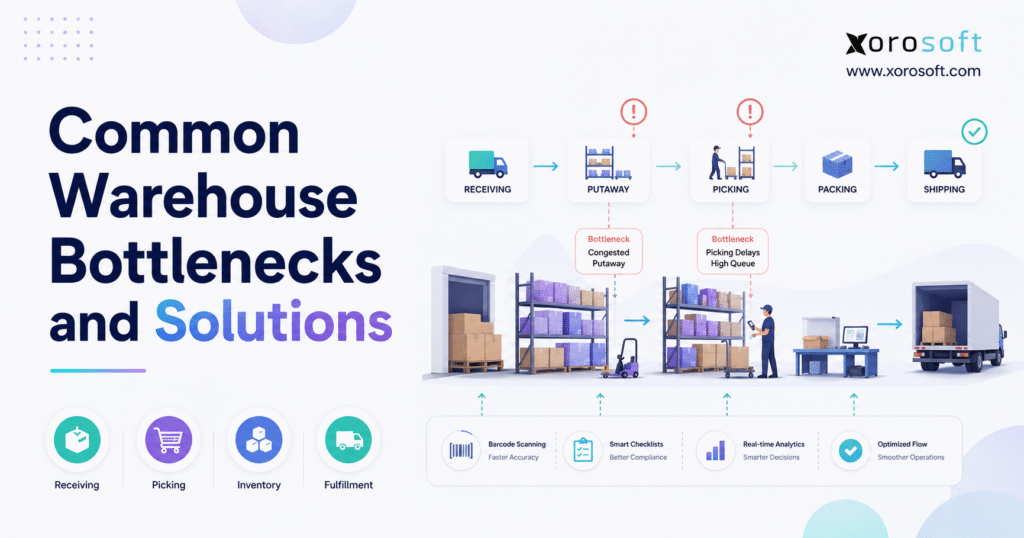
Common warehouse bottlenecks appear in predictable places because most warehouses depend on the same core workflow: receiving, putaway, storage, picking, packing, shipping, and reporting. Although each business has different products, the root causes often look similar.
2.1 Receiving Bottlenecks That Delay Stock Availability
Receiving is the first point where warehouse accuracy is either protected or damaged. If inbound products are not checked correctly, the rest of the operation inherits the error.
2.1.1 Poor dock scheduling
Poor dock scheduling creates congestion before products even enter inventory. Trucks arrive at the same time. Workers get pulled away from active orders. Purchase orders are not ready for review. Consequently, receiving becomes reactive instead of controlled.
A stronger process starts with inbound planning. Teams should know what is arriving, which purchase order it belongs to, who will receive it, and where the inventory should go after inspection.
2.1.2 Manual receiving checks
Manual receiving slows teams because workers compare SKUs, quantities, variants, and purchase orders by hand. In addition, paper records often create delayed updates.
Barcode scanning reduces this friction because workers can confirm products at the point of receipt. Therefore, the system becomes accurate sooner, and the warehouse can make stock available faster.
2.1.3 Delayed inventory updates
Delayed inventory updates create a gap between physical stock and system stock. Products may sit in the building while the ecommerce store, sales team, or purchasing team still sees them as unavailable.
As a result, the business may lose sales, create unnecessary purchase orders, or tell customers that stock is unavailable even when inventory has arrived.
2.2 Putaway Bottlenecks That Slow Warehouse Flow
Putaway moves products from receiving into storage. Although it sounds simple, weak putaway rules often create long-term warehouse workflow issues.
2.2.1 Unclear bin locations
Unclear bin locations force workers to make decisions on the floor. They may place stock wherever space is available. Later, pickers waste time searching for items, and cycle counts become harder to complete.
Clear location logic helps prevent this problem. Fast-moving SKUs should be easy to access, slow-moving items should not block active zones, and similar products should be placed carefully to reduce picking mistakes.
2.2.2 Poor warehouse layout
A poor layout increases walking time, handling time, and confusion. For example, high-volume products may sit far away from packing stations. Meanwhile, bulky items may require extra movement because they were stored without considering flow.
Therefore, layout should support the way orders actually move. Slotting, zone planning, aisle design, and packing-station placement all affect warehouse efficiency.
2.2.3 Slow stock availability
Slow putaway can make received products unavailable for orders. Even if inventory has arrived, it cannot support fulfillment until the system knows where it is.
This issue becomes worse during peak season. Teams receive more stock, yet orders cannot ship because goods are still waiting to be placed, scanned, or released.
2.3 Inventory Bottlenecks That Create Stock Errors
Inventory inaccuracy is one of the most expensive warehouse bottlenecks because it affects every department. Once teams stop trusting inventory numbers, they start checking everything manually.
2.3.1 Stock discrepancies
Stock discrepancies happen when system inventory does not match physical inventory. These gaps may come from missed receipts, incorrect transfers, picking mistakes, damaged goods, returns, or manual adjustments.
Because inventory data drives purchasing and fulfillment, even small discrepancies can create larger planning problems.
2.3.2 Misplaced inventory
Misplaced inventory behaves like a stockout. The product exists, but workers cannot find it. Meanwhile, purchasing may reorder the item, customer service may delay the order, and finance may question the count.
A disciplined location system helps reduce this issue. However, location discipline only works when every movement is recorded consistently.
2.3.3 Delayed cycle counts
Cycle counting should catch problems early. However, delayed or inconsistent counts turn inventory control into cleanup work.
Instead, companies should count high-volume, high-value, and high-risk SKUs more often. In addition, cycle counts should connect to clear adjustment rules so teams do not create new errors while fixing old ones.
2.4 Picking Bottlenecks That Slow Order Fulfillment
Picking delays often create the most visible fulfillment problems. Since pickers touch active customer orders, slow picking quickly affects shipping performance.
2.4.1 Inefficient pick paths
Inefficient pick paths make workers walk too much. As a result, labor hours increase without a matching increase in shipped orders.
Batch picking, zone picking, and better SKU placement can reduce wasted movement. In addition, high-volume products should be stored where they support faster fulfillment.
2.4.2 Paper-based picking
Paper pick lists may work in the early stage, but they create problems as order volume grows. Workers may pick the wrong variant, miss a location change, or complete an order before the system updates stock.
Digital pick workflows solve part of this issue because they guide workers through the order. Also, they create a clearer record of what happened.
2.4.3 Lack of barcode scanning
Without barcode scanning, picking accuracy depends on visual checks and worker memory. That becomes risky when products have similar names, colors, sizes, lots, serial numbers, or bundles.
Barcode validation helps confirm the right product, location, and order before the mistake reaches packing.
2.5 Packing Bottlenecks That Create Shipping Pressure
Packing stations often reveal hidden warehouse bottlenecks. If picking improves but packing does not, orders simply wait at the next stage.
2.5.1 Poor packing workflows
Poor packing workflows create unnecessary pauses. Packers may search for boxes, confirm product rules, check inserts, or ask for shipping instructions.
Standardized packing rules reduce that friction. For example, DTC, wholesale, marketplace, and retail orders may each need different handling, but the system should make those rules visible.
2.5.2 Missing order information
Missing order information causes packers to stop and ask questions. This problem appears often with customer-specific instructions, compliance labels, inserts, or special shipping requirements.
When order data is connected to warehouse execution, packers can make fewer manual decisions.
2.5.3 Inconsistent packaging rules
Inconsistent packaging increases cost and slows fulfillment. Some workers may use oversized boxes. Others may miss kit requirements. Over time, the business pays for the inconsistency through higher freight cost, more errors, and slower throughput.
2.6 Shipping Bottlenecks That Affect Customer Delivery
Shipping delays are often the final result of earlier warehouse workflow issues. By the time orders reach shipping, the business has little time left to recover.
2.6.1 Carrier coordination issues
Carrier coordination matters because pickup times create real deadlines. If orders are not packed before the cutoff, they wait until the next day.
Therefore, warehouse managers should track late-stage queues, carrier cutoff performance, and shipment backlog by time of day.
2.6.2 Label creation delays
Label creation becomes a bottleneck when shipping information must be copied between systems. Manual entry increases error risk and slows the last step of fulfillment.
Connected shipping workflows reduce this issue because order, address, carrier, and tracking details flow with less manual work.
2.6.3 Late shipment confirmation
Late shipment confirmation creates customer service pressure. Customers want status updates, and sales teams need reliable shipment visibility.
If tracking numbers update slowly, the order may be complete internally while customers still think it has not shipped.
2.7 Replenishment Bottlenecks That Create Stockouts
Some warehouse bottlenecks begin before inventory reaches the warehouse. Poor purchasing and replenishment decisions can create receiving spikes, stockouts, and overstock.
2.7.1 Late purchase orders
Late purchase orders create urgent work across the business. Warehouse teams wait for stock, sales teams manage customer expectations, and purchasing teams chase suppliers.
Better reorder logic helps reduce panic buying. In addition, demand forecasting can help teams prepare for seasonal spikes and fast-moving products.
2.7.2 Poor reorder point management
Poor reorder points create a cycle of stockouts and overstock. If reorder points are too low, products run out. If they are too high, the warehouse fills with slow-moving stock.
Reorder points should reflect demand, lead time, supplier reliability, seasonality, and warehouse capacity.
2.7.3 Supplier visibility issues
Supplier visibility affects warehouse planning. If inbound shipments arrive late or without warning, labor planning becomes difficult.
A better process gives warehouse teams visibility into expected receipts, supplier delays, and purchase order changes before goods arrive.
2.8 Visibility Bottlenecks That Hide Warehouse Problems
Reporting delays make warehouse bottlenecks harder to solve. If managers only see yesterday’s data, they cannot fix today’s problems.
2.8.1 Delayed warehouse reports
Delayed reports create slow decisions. A manager may not see that orders missed the shipping window until the next day.
Live reporting helps leaders act while there is still time to move labor, prioritize urgent orders, or resolve exceptions.
2.8.2 Disconnected inventory data
Disconnected inventory data creates competing versions of the truth. Shopify may show one number. Accounting may show another. The warehouse may know something different.
Because of this, teams spend time reconciling systems instead of improving operations.
2.8.3 No real-time operational dashboard
Without a real-time dashboard, managers depend on walk-throughs, messages, and manual updates. That creates a visibility bottleneck.
A useful dashboard should show orders waiting to pick, orders waiting to pack, late inbound shipments, inventory exceptions, stockouts, and warehouse workload.
3. How to Identify Warehouse Bottlenecks Before They Spread
Warehouse bottlenecks should be measured before they become customer complaints. While floor feedback matters, data helps confirm where the operation is actually slowing down.
3.1 Track Warehouse Throughput to Find Bottlenecks
Warehouse throughput shows how much work the team completes during a period. Track units received, orders picked, orders packed, and shipments completed.
Then compare performance by shift, warehouse, sales channel, and order type. This makes bottlenecks easier to find.
3.2 Measure Order Cycle Time to Spot Fulfillment Bottlenecks
Order cycle time measures how long it takes for an order to move from release to shipment. If cycle time increases, something inside the fulfillment workflow is slowing down.
This metric becomes more useful when it is broken down by stage. For example, an order may wait longer before picking than during packing.
3.3 Review picking accuracy
Picking accuracy reveals whether speed is creating errors. A warehouse that moves quickly but ships wrong products still creates returns, reships, refunds, and inventory confusion.
Therefore, pick accuracy should be reviewed with order volume. Both speed and quality matter.
3.4 Monitor Inventory Adjustments for Warehouse Accuracy Problems
Frequent inventory adjustments are a warning sign. They suggest that stock movements are missing, delayed, duplicated, or incorrectly recorded.
In addition, adjustment reasons should be tracked. A “miscellaneous” adjustment category hides the real cause.
3.5 Compare labor hours against order volume
Labor cost per order shows whether the warehouse is scaling efficiently. If labor hours rise faster than order volume, the business may be absorbing growth through manual work.
That pattern is common when teams rely on spreadsheets, printed lists, and disconnected systems.
3.6 Find Manual Work That Creates Warehouse Bottlenecks
Repeated manual work often reveals hidden warehouse bottlenecks. Examples include checking stock by walking the floor, manually updating order status, exporting reports, re-entering shipping details, and reconciling inventory between systems.
If the same manual check happens every day, the process probably needs redesign.
4. Warehouse Bottlenecks and Solutions by Workflow Stage
Warehouse bottlenecks become easier to fix when leaders map them to workflow stages. Instead of asking why the warehouse is slow, ask where work stops moving.
| Warehouse bottleneck | Common cause | Business impact | Practical solution |
|---|---|---|---|
| Receiving delay | Manual PO checks | Late stock availability | Use scan-based receiving |
| Putaway delay | Weak location rules | Longer pick times | Add directed putaway |
| Inventory inaccuracy | Missed transactions | Stockouts and overstock | Improve cycle counts |
| Picking delay | Poor pick paths | Slow fulfillment | Use batch or zone picking |
| Packing delay | Missing order rules | Shipment errors | Standardize packing workflows |
| Shipping delay | Manual labels | Missed cutoffs | Connect shipping data |
| Replenishment gap | Late purchasing | Backorders | Improve reorder planning |
| Reporting delay | Disconnected systems | Slow decisions | Use real-time dashboards |
4.1 Receiving solutions
Receiving improves when teams validate inventory at the point of entry. Purchase orders, SKUs, quantities, lots, serial numbers, and warehouse locations should be confirmed before stock becomes available.
A clear receiving workflow also helps purchasing teams. When receipts update quickly, buyers can see what arrived, what is short, and what still needs follow-up.
4.2 Putaway solutions
Putaway improves when the warehouse uses location logic. Fast-moving products should sit near active pick zones. Bulky products need space that supports safe handling. Meanwhile, slow-moving inventory should not block high-volume activity.
Directed putaway can help workers place products consistently. As a result, picking becomes faster and cycle counting becomes easier.
4.3 Inventory accuracy solutions
Inventory accuracy improves when every movement is recorded close to the physical action. Receipts, transfers, picks, packs, returns, adjustments, and production consumption all need timely updates.
For companies that need stronger inventory control, XoroWMS can help connect warehouse workflows with real-time stock movement, barcode scanning, and fulfillment activity.
4.4 Picking solutions
Picking improves when workers receive clear instructions and scan validation. Batch picking can reduce walking time. Zone picking can help larger warehouses divide work more efficiently. In addition, barcode scanning can reduce product and location errors.
The best picking method depends on order volume, SKU count, warehouse layout, and fulfillment model.
4.5 Packing solutions
Packing improves when order rules are visible at the station. Packers should not rely on memory for inserts, carton rules, wholesale documents, marketplace requirements, or customer-specific instructions.
Standardized packing also reduces rework. When rules are clear, shipments leave with fewer errors.
4.6 Shipping solutions
Shipping improves when labels, carrier selection, tracking numbers, and shipment confirmations connect to the order workflow. Because shipping is the final customer-facing step, delays here are highly visible.
Warehouse managers should also review missed carrier cutoffs. This shows whether problems are happening at shipping or earlier in the workflow.
4.7 Replenishment solutions
Replenishment improves when purchasing decisions connect to real demand and warehouse stock. Reorder points should reflect sales velocity, supplier lead time, safety stock, seasonality, and available warehouse space.
For broader operational planning, XoroERP can help connect inventory, purchasing, warehouse activity, accounting, forecasting, and reporting in one ERP environment.
4.8 Reporting solutions
Reporting improves when leaders can see live warehouse performance. Useful reports show open orders, inventory exceptions, late receipts, backorders, stockouts, fulfillment cycle time, and labor efficiency.
A better reporting process gives managers enough visibility to act before the problem reaches customers.
5. Manual Processes vs Automated Solutions for Warehouse Bottlenecks
Manual processes often start as quick fixes. However, once a company grows, those quick fixes become warehouse efficiency problems.
| Workflow area | Manual process | Automated workflow | Operational benefit |
| Receiving | Paper checks | Barcode receiving | Faster stock validation |
| Putaway | Worker judgment | Directed locations | Less search time |
| Picking | Printed lists | Scan-based picking | Fewer errors |
| Packing | Verbal rules | System instructions | Better consistency |
| Shipping | Manual labels | Connected shipping | Faster dispatch |
| Reporting | Spreadsheet updates | Live dashboards | Faster decisions |
5.1 Why spreadsheets create warehouse bottlenecks
Spreadsheets are useful for planning, but they are not warehouse execution systems. They do not validate scans, control locations, prevent duplicate entry, or update inventory automatically.
As a result, spreadsheets often become side systems. Teams export data, update files, compare numbers, and still wonder which system is correct.
5.2 Why Disconnected Apps Create Warehouse Workflow Issues
Disconnected apps create gaps between teams. One tool may manage Shopify orders. Another may manage inventory. A separate system may handle shipping. Accounting may live somewhere else.
At first, that setup may seem flexible. Later, every gap creates manual work. Teams copy data, check reports, and reconcile differences before making decisions.
5.3 When barcode scanning becomes necessary
Barcode scanning becomes necessary when visual checking is no longer reliable. Similar SKUs, size-color variants, lot numbers, serial numbers, bundles, and multi-warehouse inventory all increase the risk of mistakes.
Because scanning confirms the item, order, and location, it helps reduce errors before they reach customers.
5.4 When WMS or ERP Helps Solve Warehouse Bottlenecks
A WMS is useful when the main problem sits inside warehouse execution. ERP becomes more useful when warehouse problems connect to purchasing, accounting, ecommerce, wholesale, manufacturing, and reporting.
For companies that want to understand broader system options, the Xorosoft solutions page can help map warehouse problems to related operational areas.
6. How ERP and WMS Systems Help Reduce Warehouse Bottlenecks
Technology should not replace process thinking. However, the right system can enforce better workflows, reduce manual entry, and give teams one reliable source of operational truth.
6.1 Real-time inventory visibility
Real-time inventory visibility helps teams know what is available, where it sits, and whether it can be sold, picked, transferred, or replenished. Without that visibility, teams make decisions based on old information.
A unified system such as XoroONE can be useful for inventory-driven businesses because it connects warehouse activity with inventory, purchasing, accounting, ecommerce, manufacturing, and reporting.
6.2 Barcode-driven warehouse execution
Barcode-driven execution improves warehouse discipline. Workers scan products, bins, orders, and shipments as work happens. Therefore, the system captures cleaner data with fewer delayed updates.
This matters because warehouse bottlenecks often come from invisible work. When the system records activity in real time, managers can see where orders are waiting.
6.3 Automated purchasing and replenishment
Automated purchasing helps prevent stockouts and overstock. Instead of waiting for someone to notice a shortage, reorder logic can use demand, lead time, and inventory levels to guide purchasing decisions.
In addition, purchasing automation reduces pressure on the warehouse. When inbound stock arrives more predictably, receiving and replenishment become easier to plan.
6.4 Multi-warehouse coordination
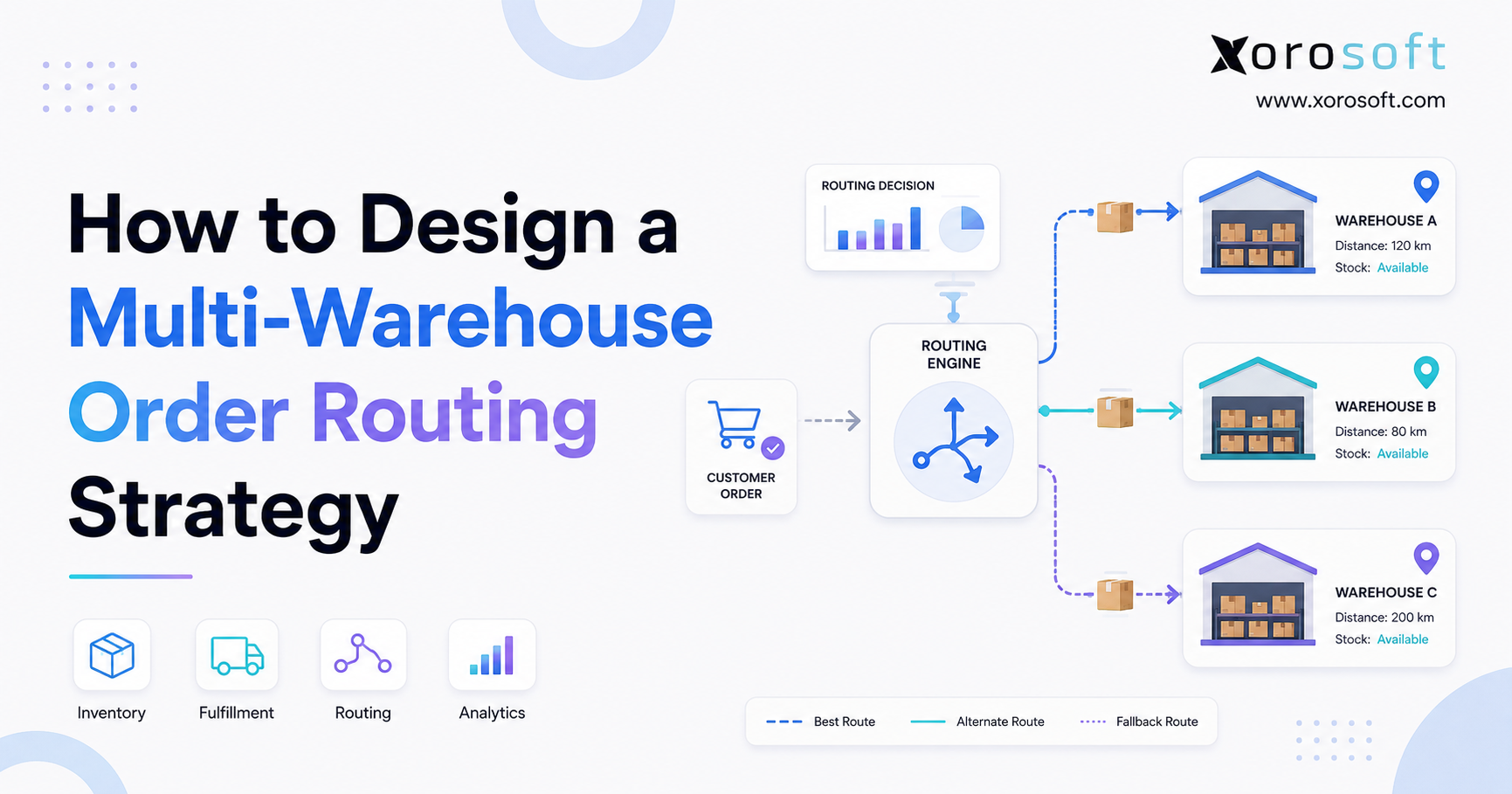
Multi-warehouse operations need strong allocation rules. The business must know which warehouse should fulfill each order, when stock should transfer, and how much inventory each location needs.
Without location-level visibility, teams may oversell one warehouse while another location has available stock.
6.5 Accounting and inventory alignment
Warehouse mistakes often become accounting problems. Incorrect receipts, missed adjustments, delayed transfers, and inaccurate counts can affect inventory valuation and month-end close.
Because of that, warehouse improvements should not ignore finance. A better system connects warehouse transactions to accounting records with less manual reconciliation.
6.6 Reporting across warehouse, finance, and sales
Reporting should help leaders act during the day, not only review what happened yesterday. Live dashboards can show order backlog, receiving delays, picking progress, shipment status, and inventory exceptions.
For proof of how operational visibility helps real businesses, review the Xorosoft case studies and look for patterns around inventory control, fulfillment, and system consolidation.
7. Warehouse Bottlenecks by Industry
Different industries experience warehouse bottlenecks differently. Still, each industry needs the same basic foundation: accurate inventory, clean workflows, and reliable visibility.
7.1 Ecommerce and Shopify brands
Ecommerce brands often face warehouse bottlenecks when order volume grows across Shopify, Amazon, retail, and wholesale channels. Inventory synchronization becomes harder, especially when apps do not update at the same speed.
For Shopify merchants, the Xorosoft ERP listing on the Shopify App Store is relevant because it shows how ERP can connect with Shopify operations. This is an outbound link and should help Yoast recognize external linking.
7.2 Wholesale distributors
Wholesale distributors handle larger orders, customer-specific rules, EDI, allocation needs, and replenishment pressure. Because each order can involve many units, one picking or inventory error can affect a large shipment.
A better workflow connects sales orders, available inventory, warehouse picking, packing rules, and shipping documentation.
7.3 Apparel and fashion companies
Apparel warehouses deal with size, color, style, season, and channel complexity. Consequently, pickers may handle products that look similar but belong to different orders or variants.
Barcode scanning, location discipline, and clear item setup help reduce these mistakes.
7.4 Furniture businesses
Furniture companies often manage bulky inventory, showroom stock, special orders, warehouse stock, and delivery coordination. Their bottlenecks usually appear in putaway, staging, damage tracking, and final-mile planning.
Because storage space is expensive, overstock and poor location planning can quickly reduce efficiency.
7.5 Sporting goods companies
Sporting goods companies often manage seasonal demand, bundles, kits, and product variety. During peak periods, picking and replenishment pressure can rise quickly.
Therefore, demand planning and warehouse visibility become important before the busy season begins.
7.6 Food and beverage businesses
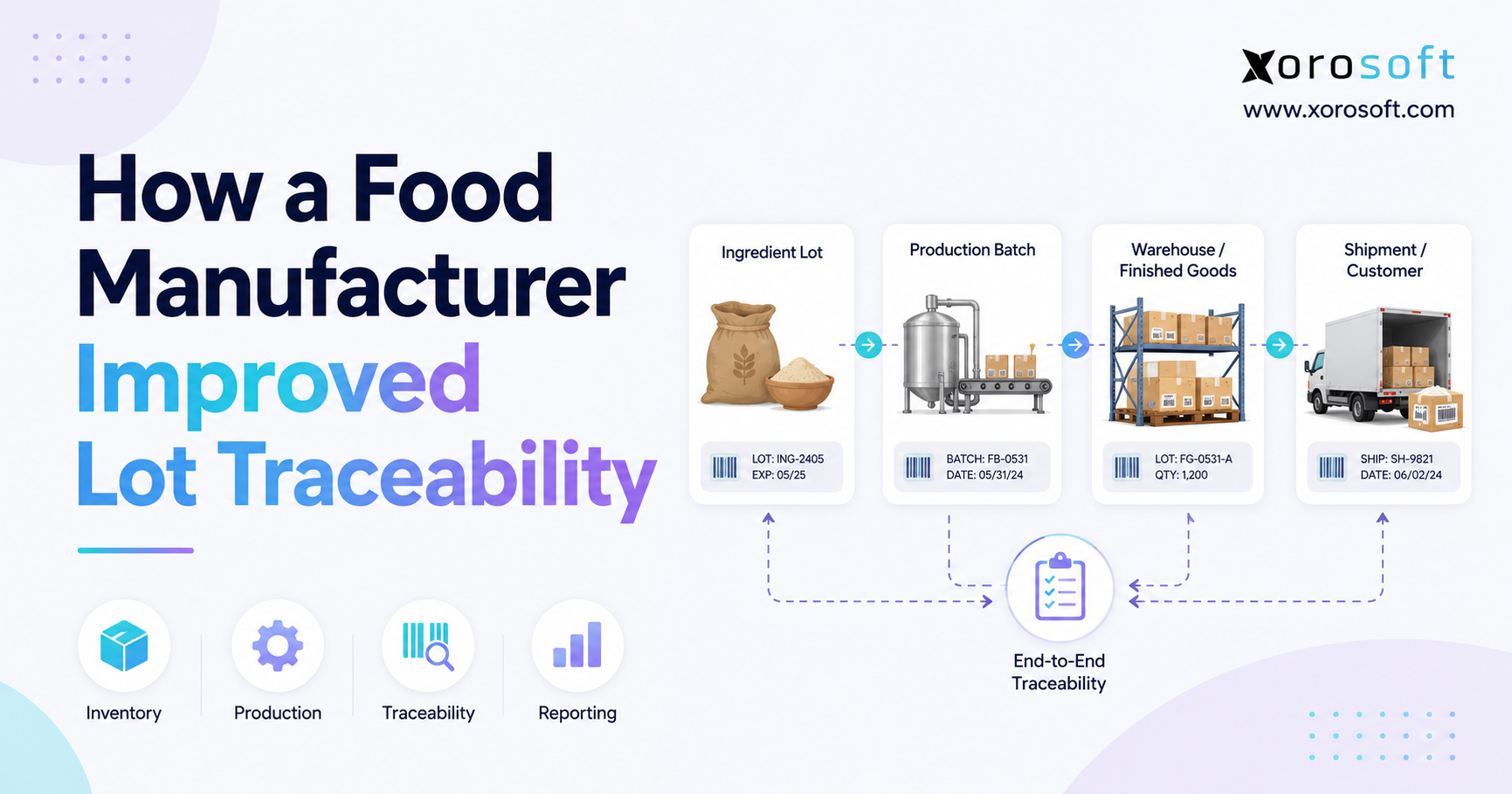
Food and beverage companies may need lot tracking, expiry control, FIFO or FEFO logic, and careful receiving. In this industry, warehouse bottlenecks can increase waste, compliance risk, and fulfillment delays.
Clean receiving and inventory tracking are especially important when products have expiry dates.
7.7 Manufacturing companies
Manufacturers need warehouse visibility for raw materials, components, work-in-progress, finished goods, BOMs, and work orders. If materials are missing or incorrectly recorded, production can slow down.
Companies that want to review broader operational fit by sector can use the industries we serve page to connect warehouse challenges with apparel, furniture, sporting goods, food, wholesale, and manufacturing use cases.
8. WMS vs ERP for Solving Warehouse Bottlenecks
Choosing between WMS and ERP depends on where the bottleneck starts. Some problems are purely warehouse execution issues. Others are business-wide system issues that only appear inside the warehouse.
| Requirement | WMS fit | ERP fit | Best-fit scenario |
| Receiving | Strong | Strong if ERP includes WMS | Use connected receiving when purchasing matters |
| Picking | Strong | Strong if warehouse tools exist | Use barcode workflows |
| Inventory visibility | Warehouse-focused | Business-wide | Use ERP when channels need one stock truth |
| Purchasing | Limited | Strong | Use ERP for replenishment planning |
| Accounting | Limited | Strong | Use ERP when inventory value matters |
| Manufacturing | Limited | Strong | Use ERP for BOMs and work orders |
| Shopify operations | Depends on integrations | Strong if connected | Use ERP for ecommerce operations |
| Multi-warehouse reporting | Operational view | Business-wide view | Use ERP with warehouse capability |
8.1 When a WMS is enough
A WMS may be enough when the business only needs stronger warehouse execution. For example, the team may need better receiving, directed putaway, barcode picking, packing controls, and shipping workflows.
If purchasing, accounting, ecommerce, and reporting already work well, a standalone WMS may solve the immediate warehouse issue.
8.2 When ERP becomes necessary
ERP becomes necessary when warehouse bottlenecks connect to broader business problems. For example, if stockouts happen because purchasing lacks demand visibility, WMS alone will not solve the full issue.
Similarly, if finance cannot trust inventory value because warehouse transactions are delayed, the company needs more than better picking tools.
8.3 Why growing companies often need both execution and control
Growing companies often need warehouse execution and business control at the same time. The warehouse needs scan-based workflows, while leadership needs inventory, purchasing, accounting, sales, and reporting to connect.
This is where ERP platforms with warehouse functionality become part of the discussion.
8.4 How to compare systems without overcomplicating the decision
A company should compare systems based on actual workflow needs, not brand names alone. If the business has outgrown QuickBooks for inventory and warehouse control, the Xorosoft vs QuickBooks comparison may be useful.
If the current issue is more about inventory software limitations, the Xorosoft vs Cin7 comparison may fit better. However, if this article is being published as an educational warehouse guide, do not add more comparison links than these two.
9. Common Mistakes That Make Warehouse Bottlenecks Worse
Many companies try to fix warehouse bottlenecks by treating symptoms. Unfortunately, that approach often creates more work without improving control.
9.1 Adding more labor without fixing the process
More labor can help during a short spike. However, it does not fix inaccurate inventory, poor layout, weak scanning, unclear order rules, or disconnected systems.
If the process is broken, adding people usually spreads the same problem across a larger team.
9.2 Buying software before mapping workflows
Software should support a clear operating model. If a company buys software before mapping workflows, it may automate confusion.
A better approach starts with receiving, putaway, picking, packing, shipping, replenishment, returns, and reporting. Then the company can choose technology based on actual needs.
9.3 Ignoring inventory accuracy
Inventory accuracy is the foundation of warehouse performance. If teams do not trust the numbers, they will check everything manually.
That manual checking slows fulfillment, delays purchasing, and increases frustration across departments.
9.4 Treating warehouse problems separately from accounting
Warehouse operations and accounting are connected. Receipts, transfers, adjustments, shipments, returns, and production consumption all affect inventory value.
Therefore, fixing warehouse bottlenecks without considering accounting can leave finance teams with reconciliation problems.
9.5 Delaying system upgrades for too long
Delaying an upgrade creates operational debt. Teams build spreadsheets, side processes, and manual workarounds to survive.
Later, those workarounds become hard to unwind. Because of that, businesses should evaluate system fit before warehouse problems become normal.
10. Warehouse Bottlenecks KPI Checklist
Warehouse bottlenecks become easier to manage when leaders track the right KPIs. These metrics help separate isolated mistakes from repeatable process problems.
| KPI | What it measures | Bottleneck it reveals | Improvement action |
| Inventory accuracy rate | System stock vs physical stock | Inventory control issues | Improve scans and cycle counts |
| Order cycle time | Order release to shipment | Fulfillment delays | Find the slowest workflow stage |
| Pick accuracy | Correct items picked | Picking errors | Add barcode validation |
| Receiving time | Dock to available stock | Inbound delay | Improve receiving workflow |
| Putaway time | Receipt to storage | Location delay | Use directed putaway |
| Order fill rate | Complete orders shipped | Stock availability | Improve replenishment |
| Labor cost per order | Labor efficiency | Manual work | Reduce repeated tasks |
| Backorder rate | Unfulfilled demand | Planning gaps | Improve forecasting |
10.1 Inventory Accuracy Rate for Warehouse Bottlenecks
Inventory accuracy shows whether the system can be trusted. Low accuracy usually means stock movements are being missed or recorded late.
10.2 Order Cycle Time and Fulfillment Bottlenecks
Order cycle time shows how long fulfillment takes. If the number rises, leaders should review each workflow stage separately.
10.3 Pick accuracy
Pick accuracy protects customer experience. It also reduces returns, reships, refunds, and inventory confusion.
10.4 Receiving time
Receiving time measures how quickly inbound stock becomes available. Long receiving times often create artificial stockouts.
10.5 Putaway time
Putaway time shows how quickly products move from receiving to storage. If putaway is slow, picking and availability may suffer.
10.6 Order fill rate
Order fill rate shows whether orders can ship complete. A weak fill rate often points to purchasing, allocation, forecasting, or inventory accuracy problems.
10.7 Labor Cost per Order and Warehouse Efficiency Problems
Labor cost per order reveals whether the warehouse scales efficiently. If cost rises as volume grows, manual work may be absorbing growth.
10.8 Backorder rate
Backorder rate shows where demand exceeds available stock. This metric should be reviewed with supplier lead times, reorder points, and forecast accuracy.
11. When Warehouse Bottlenecks Signal a System Upgrade
A business should upgrade its warehouse system when manual workarounds become part of daily operations. The question is not whether the team can survive another busy month. Instead, the question is whether the current process can scale without creating more risk.
11.1 Early Warning Signs of Warehouse Bottlenecks
Early warning signs include frequent stock checks, late shipments, duplicate data entry, spreadsheet purchasing, rising inventory adjustments, and customer service questions about order status.
If these problems appear weekly, the current system may no longer fit the business.
11.2 Operational triggers
Operational triggers include more SKUs, more orders, more warehouses, more suppliers, more sales channels, more returns, and more compliance requirements.
Each new layer creates more decisions. Therefore, the system must help teams manage complexity instead of hiding it.
11.3 Revenue and order volume signals
Many inventory-driven businesses feel system pressure as they move from early growth into structured operations. Revenue alone does not determine the need for ERP or WMS. SKU count, warehouse count, order volume, and channel mix matter more.
Still, companies between $2M and $100M+ in revenue often start feeling the limits of basic accounting tools, spreadsheets, and disconnected apps.
11.4 Multi-Warehouse Bottlenecks and Location-Level Visibility
Multi-warehouse operations create allocation and transfer decisions. Teams need to know where inventory sits, which warehouse should fulfill each order, and when locations need replenishment.
Without location-level visibility, one warehouse may run out while another sits on available stock.
11.5 Shopify, Amazon, wholesale, and EDI triggers
Shopify, Amazon, wholesale, and EDI workflows create different fulfillment rules. If the warehouse handles all of them manually, errors become more likely.
At that stage, the business may need a system that connects orders, inventory, warehouse execution, purchasing, and accounting.
12. How to Build a Warehouse Bottleneck Action Plan
A warehouse bottleneck action plan should start with facts. Guessing usually leads to surface-level fixes.
12.1 Map the current workflow
Start by mapping receiving, putaway, storage, picking, packing, shipping, replenishment, returns, and reporting.
Then mark where work waits, where errors happen, and where teams rely on manual checks.
12.2 Identify the slowest process stage
The slowest stage is not always the loudest problem. For example, shipping may look late because picking started late.
Therefore, review the full order journey before assigning blame to one team.
12.3 Prioritize bottlenecks by business impact
Not every bottleneck deserves the same attention. Prioritize problems that affect customer delivery, inventory accuracy, labor cost, cash flow, and reporting confidence.
After that, fix one high-impact bottleneck before moving to the next.
12.4 Fix data visibility before adding complexity
Better decisions require better data. If inventory visibility is weak, adding more locations, channels, or automation may increase confusion.
First, improve how the business captures stock movement. Then build more advanced workflows on top of that foundation.
12.5 Standardize warehouse execution
Standard operating procedures should explain how warehouse work happens. Receiving, putaway, picking, packing, shipping, returns, and adjustments all need clear rules.
In addition, teams should review whether workers follow the process consistently.
12.6 Review software fit
Finally, review whether the current system supports the future operating model. If the business needs warehouse management, inventory control, purchasing, accounting, ecommerce, manufacturing, and reporting in one environment, ERP may be worth evaluating.
13. FAQs About Warehouse Bottlenecks
13.1 What are warehouse bottlenecks?
Warehouse bottlenecks are slow points that prevent inventory, orders, or information from moving efficiently. They can appear in receiving, putaway, picking, packing, shipping, replenishment, or reporting. Although they often look like labor problems, they usually come from weak processes, inaccurate data, or disconnected systems.
13.2 What causes warehouse bottlenecks?
Several issues can cause warehouse bottlenecks, including manual processes, poor warehouse layout, inaccurate inventory, delayed receiving, weak putaway rules, inefficient picking, disconnected software, and slow reporting. As a business grows, these issues become harder to manage because volume increases faster than operational control.
13.3 Which warehouse bottlenecks are most common?
The most common warehouse bottlenecks include receiving delays, putaway problems, inventory inaccuracy, picking delays, packing congestion, shipping delays, replenishment gaps, and reporting issues. Each one can affect the next workflow stage, so a small delay can create a larger fulfillment problem.
13.4 How can a business identify warehouse bottlenecks?
A business can identify warehouse bottlenecks by tracking order cycle time, receiving time, putaway time, pick accuracy, inventory adjustments, labor cost per order, backorder rate, and order fill rate. Floor observations also help because queues often show where work is waiting.
13.5 Why do warehouse bottlenecks hurt inventory accuracy?
Warehouse bottlenecks hurt inventory accuracy when stock movements are recorded late or incorrectly. For example, if received goods are not updated quickly, the system may show stock as unavailable. Similarly, missed transfers and incorrect picks create discrepancies between physical and system inventory.
13.6 How do bottlenecks affect order fulfillment?
Bottlenecks affect order fulfillment by slowing one or more workflow stages. Receiving delays reduce available stock. Picking delays slow packing. Packing delays create shipping pressure. As a result, customers may receive orders late or receive incorrect items.
13.7 Why do warehouses become slower as companies grow?
Warehouses become slower as companies grow because complexity increases. More SKUs, orders, sales channels, warehouses, suppliers, and returns create more decisions. Without better systems and standardized workflows, teams rely on manual workarounds that become slower over time.
13.8 Can receiving delays create warehouse bottlenecks?
Yes, receiving delays can create warehouse bottlenecks because products cannot support fulfillment until they are checked, recorded, labeled, and placed. If receiving falls behind, the business may show inaccurate availability and create avoidable stockouts.
13.9 Why is putaway important for warehouse efficiency?
Putaway is important because it determines where inventory lives after receiving. Poor putaway creates search time, picking errors, inaccurate locations, and difficult cycle counts. Strong putaway rules make products easier to find and reduce wasted movement.
13.10 How do picking errors slow warehouse operations?
Picking errors slow warehouse operations because they create rework. Teams must correct orders, adjust inventory, manage returns, reship products, and respond to customer complaints. Over time, picking errors also reduce trust in inventory data.
13.11 Can barcode scanning reduce warehouse bottlenecks?
Barcode scanning can reduce warehouse bottlenecks by validating products, bins, orders, and shipments as work happens. This reduces visual checking and manual entry. As a result, the warehouse captures cleaner data and prevents many errors before they move downstream.
13.12 How does poor layout create warehouse delays?
Poor layout creates delays by increasing walking time, handling time, and confusion. Fast-moving products may sit too far from packing stations, while similar SKUs may sit too close together. Better layout planning helps workers move faster with fewer mistakes.
13.13 Which KPIs reveal warehouse bottlenecks?
Useful KPIs include inventory accuracy rate, order cycle time, pick accuracy, receiving time, putaway time, order fill rate, labor cost per order, and backorder rate. Together, these metrics show where warehouse performance is slowing down.
13.14 How does cycle counting improve inventory accuracy?
Cycle counting improves inventory accuracy by checking stock continuously instead of waiting for annual counts. High-value, fast-moving, and error-prone SKUs should be counted more often. When combined with barcode scanning, cycle counting helps catch errors early.
13.15 Why do stockouts create warehouse problems?
Stockouts create warehouse problems because teams must manage exceptions. Orders may require substitutions, split shipments, backorders, refunds, or customer updates. In addition, frequent stockouts increase pressure on purchasing and customer service.
13.16 How does overstock reduce warehouse efficiency?
Overstock reduces warehouse efficiency by occupying valuable space. It can block fast-moving products, slow putaway, increase handling time, and hide forecasting problems. Moreover, overstock ties up cash that could support faster-moving inventory.
13.17 How do multi-warehouse businesses reduce bottlenecks?
Multi-warehouse businesses reduce bottlenecks by using location-level inventory visibility, transfer rules, allocation logic, and consistent warehouse processes. They also need reporting across every location so teams know where stock sits and where orders should ship.
13.18 How can Shopify brands reduce warehouse delays?
Shopify brands can reduce warehouse delays by connecting Shopify orders with inventory, warehouse workflows, purchasing, and accounting. They should also use real-time stock updates, barcode scanning, and clear fulfillment rules so orders move with fewer manual checks.
13.19 How do wholesalers fix warehouse bottlenecks?
Wholesalers fix warehouse bottlenecks by improving inventory allocation, EDI workflows, customer-specific picking rules, replenishment planning, and shipping coordination. Since wholesale orders are often larger, one warehouse error can affect a significant shipment.
13.20 How do manufacturers reduce warehouse bottlenecks?
Manufacturers reduce warehouse bottlenecks by connecting raw materials, components, work orders, BOMs, production plans, and finished goods inventory. Accurate warehouse data helps production teams avoid material shortages and planning delays.
13.21 What is the difference between WMS and ERP?
A WMS focuses on warehouse execution, including receiving, putaway, picking, packing, shipping, and warehouse inventory control. ERP connects broader business functions, including inventory, purchasing, accounting, sales, manufacturing, ecommerce, and reporting.
13.22 When is a WMS enough?
A WMS may be enough when the main problem is warehouse execution. For example, a company may need better barcode picking, bin locations, packing rules, and shipping workflows. If accounting and purchasing already work well, WMS may solve the immediate issue.
13.23 When does a business need ERP instead of basic warehouse software?
A business may need ERP when warehouse bottlenecks connect to purchasing, accounting, ecommerce, wholesale, EDI, manufacturing, or multi-warehouse visibility. Basic warehouse software may improve execution, but ERP connects warehouse activity to the rest of the operation.
13.24 Can QuickBooks manage warehouse bottlenecks?
QuickBooks can support basic accounting and some inventory workflows, but growing inventory-driven businesses often need deeper warehouse, purchasing, forecasting, and multi-location controls. When teams rely on spreadsheets or extra apps around QuickBooks, it may be time to review ERP options.
13.25 Can spreadsheets cause warehouse bottlenecks?
Spreadsheets can cause warehouse bottlenecks when they become the main tool for inventory, purchasing, order tracking, or warehouse decisions. They are not built for real-time validation, barcode scanning, bin control, or multi-user warehouse execution.
14. Building a Warehouse Operation That Can Scale
Warehouse bottlenecks are rarely isolated warehouse problems. More often, they are visibility problems that appear first on the warehouse floor.
Receiving delays affect stock availability. Poor putaway slows picking. Picking errors damage customer experience. Shipping delays reduce trust. Meanwhile, inaccurate inventory creates problems for purchasing, accounting, forecasting, and leadership reporting.
Because of that, the best fix is not always more labor. A stronger approach starts with better workflow design, cleaner inventory data, scan-based execution, and connected reporting. After those foundations are clear, the business can decide whether it needs WMS, ERP, or a broader operational system.
For some companies, the answer may be better layout and better process discipline. For others, especially businesses managing Shopify, Amazon, wholesale, EDI, manufacturing, purchasing, accounting, and multiple warehouses, a connected ERP platform may become necessary.
If warehouse bottlenecks are already affecting fulfillment speed, inventory accuracy, purchasing decisions, or financial visibility, now is the right time to review whether your current systems can support the next stage of growth.
Book a demo to see how Xorosoft can help inventory-driven businesses connect warehouse management, inventory, purchasing, accounting, ecommerce, manufacturing, and reporting in one cloud ERP system.