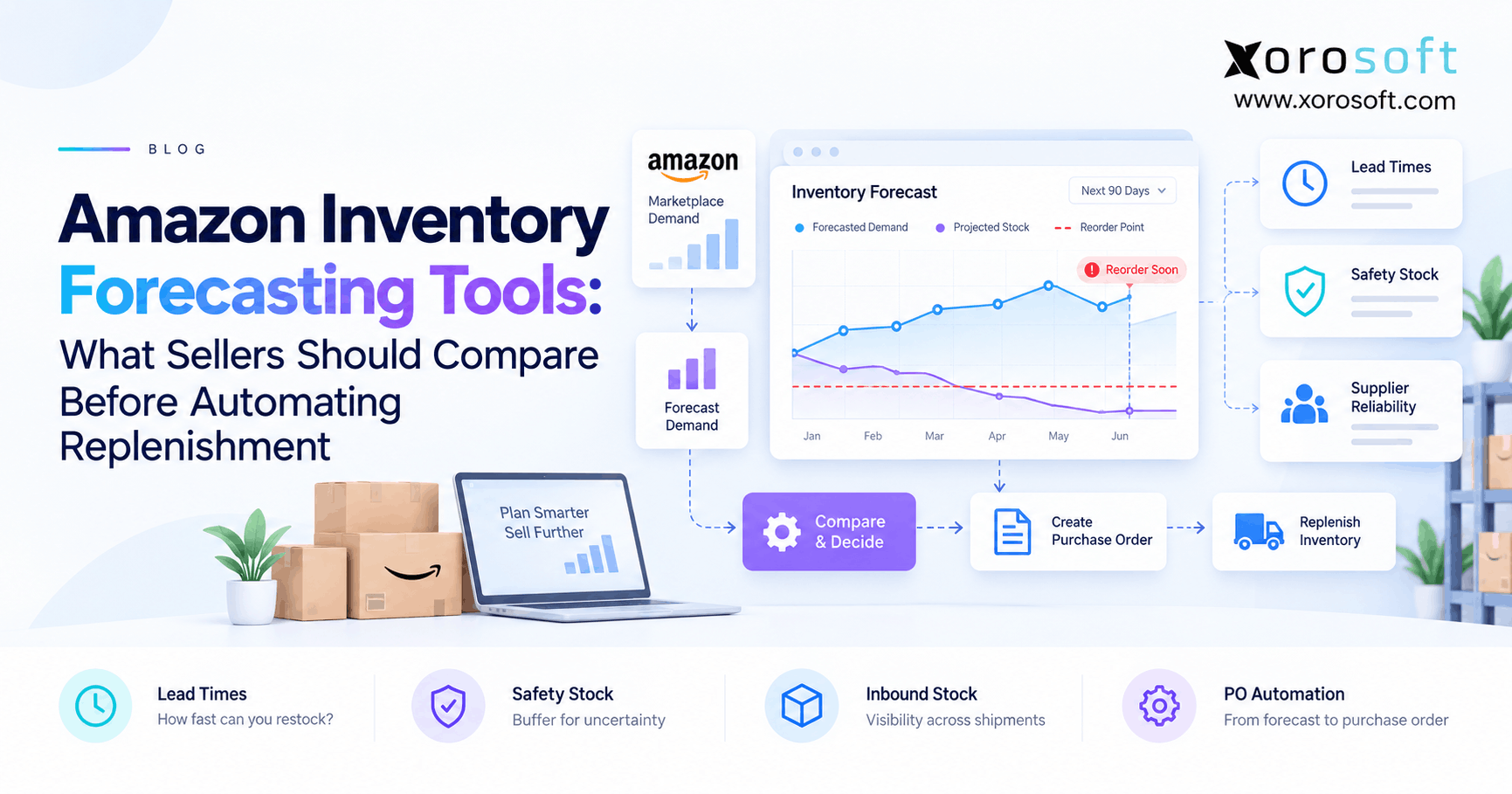
If you’re searching for ways to better manage your stock, Amazon inventory forecasting tools can make a big difference.
1. Why Amazon Inventory Forecasting Tools Need More Than a Sales Forecast
Amazon inventory forecasting tools help sellers estimate future demand, but forecasting alone cannot determine what a purchasing team should order. Instead, an effective system also needs current inventory, inbound supply, supplier lead times, safety stock, order constraints, and expected availability dates.
Therefore, sellers should not compare software only by dashboards, AI claims, or attractive forecast charts. Instead, they should ask whether each platform can convert demand signals into practical replenishment decisions.
Moreover, a forecast can be statistically reasonable while the resulting purchase recommendation is still wrong. For that reason, software evaluation should cover the complete path from predicted demand to replenishment execution.
1.1 Amazon Inventory Forecasting Tools Connect Demand to Stock Decisions
At a basic level, Amazon inventory forecasting tools analyze historical sales and estimate how many units customers may buy during a future period.
However, advanced planning requires more context. For example, the system may need current stock, inbound purchase orders, supplier lead times, safety stock, seasonality, promotions, and warehouse inventory.
As a result, sellers can move beyond simply asking, “How much will we sell?”
Instead, they can answer a more useful question: “Given what we already own and what is arriving, what must we replenish next?”
1.2 How Amazon Forecasting Connects to Replenishment
Forecasting estimates future customer demand. Replenishment, however, determines when inventory should be reordered and how much should be purchased.
For example, a forecast may predict demand of 1,000 units during the next 60 days. Nevertheless, the seller might already have 400 units available, 300 units in another warehouse, and 500 units arriving from a supplier.
Consequently, ordering another 1,000 units could create unnecessary overstock.
Therefore, sellers should evaluate how forecasting software translates future demand into real inventory requirements.
1.3 Automation Should Begin With Trustworthy Inputs
Automation can save substantial planning time. However, it can also amplify inaccurate data.
For example, if supplier lead time is recorded as 30 days while the actual process takes 60 days, replenishment may begin too late. Similarly, missing inbound inventory can create duplicate purchase recommendations.
Therefore, sellers should verify inventory accuracy, supplier data, historical demand, and purchasing rules before automating decisions.
Moreover, planners should understand which inputs drive each recommendation. Otherwise, teams may automate a process they cannot explain when an exception occurs.
2. Start With the Data Behind Amazon Inventory Forecasting
Every forecasting model depends on input quality.
Therefore, software evaluation should begin with available data rather than algorithms. Even a sophisticated model cannot completely compensate for inaccurate inventory, incomplete sales history, or outdated supplier assumptions.
Moreover, sellers should determine whether forecasting can incorporate inventory outside Amazon when the business operates across several locations or channels.
2.1 Historical Sales and Sales Velocity
Most forecasting systems begin with historical sales.
However, sellers should ask how much history the software analyzes and whether lookback periods can vary by SKU. For example, recent velocity may work well for stable items, while seasonal products may require a longer comparison period.
Additionally, planners should determine whether the model gives more weight to recent demand.
Therefore, the objective is not simply to collect more data. Instead, the system needs the right history for each product’s demand pattern.
2.2 Stockouts Can Distort Demand History
Recorded sales do not always represent actual demand.
For example, if a product is unavailable for two weeks, sales may fall to zero even though customers still wanted the item. Consequently, software that interprets those zero-sales days literally can underestimate future demand.
Therefore, forecasting systems should identify stockout periods or allow planners to adjust unusual history.
Otherwise, one shortage can distort the next forecast and contribute to another shortage.
Moreover, this issue becomes more important for fast-moving products where even a few unavailable days materially affect sales history.
2.3 Seasonality, Promotions, and Amazon Events
Demand often changes around promotions, holidays, launches, Prime Day, and other major selling periods.
Consequently, a simple average may perform poorly during concentrated demand spikes. Instead, planners need the ability to adjust expectations before the event occurs.
For example, a scheduled advertising campaign may increase future sales even though historical data does not yet show the change.
Moreover, one unusually successful promotion should not permanently inflate the standard forecast.
Therefore, software should help teams separate recurring patterns from temporary anomalies.
2.4 Amazon Inventory Forecasting Tools Need Reliable Inventory States
Amazon inventory forecasting tools need to understand that inventory can exist in several operational states.
For example, units may be:
- available in FBA,
- stored in an owned warehouse,
- held by a 3PL,
- ordered from a supplier,
- moving through freight,
- assigned to an inbound shipment,
- or temporarily unavailable.
Therefore, a system that sees only currently sellable inventory can produce an incomplete recommendation.
Moreover, the availability date matters alongside the quantity. Inventory arriving in 45 days cannot solve a shortage expected next week.
3. Compare Forecast Models Before Comparing Dashboards
Forecasting dashboards can look impressive. However, the underlying calculation matters more.
Therefore, sellers should understand how each platform converts previous demand into future expectations.
Moreover, one forecasting method rarely suits every SKU. Stable products, seasonal products, new launches, and highly volatile items can behave very differently.
3.1 Velocity-Based Amazon Inventory Forecasting Tools
Some Amazon inventory forecasting tools rely heavily on recent sales velocity.
For example, a model may calculate average daily sales across the previous 30 or 60 days and extend that rate forward.
This approach can work for stable products. However, it can react poorly when the history includes stockouts, major promotions, or sudden seasonal changes.
Therefore, sellers should check whether lookback periods can be adjusted by product.
Additionally, rapidly growing SKUs may require models that respond more quickly to recent demand changes.
3.2 How Amazon Forecasting Handles Seasonality
Seasonal products require a different approach.
For example, winter apparel, sporting goods, outdoor equipment, gifting products, and certain food categories may follow recurring annual patterns.
Therefore, last month’s sales may provide limited information about expected demand six months later.
Instead, software should recognize seasonal patterns when sufficient historical information exists.
However, planners should still review those assumptions. Pricing, promotions, competition, and product availability can make this year’s season behave differently from last year’s.
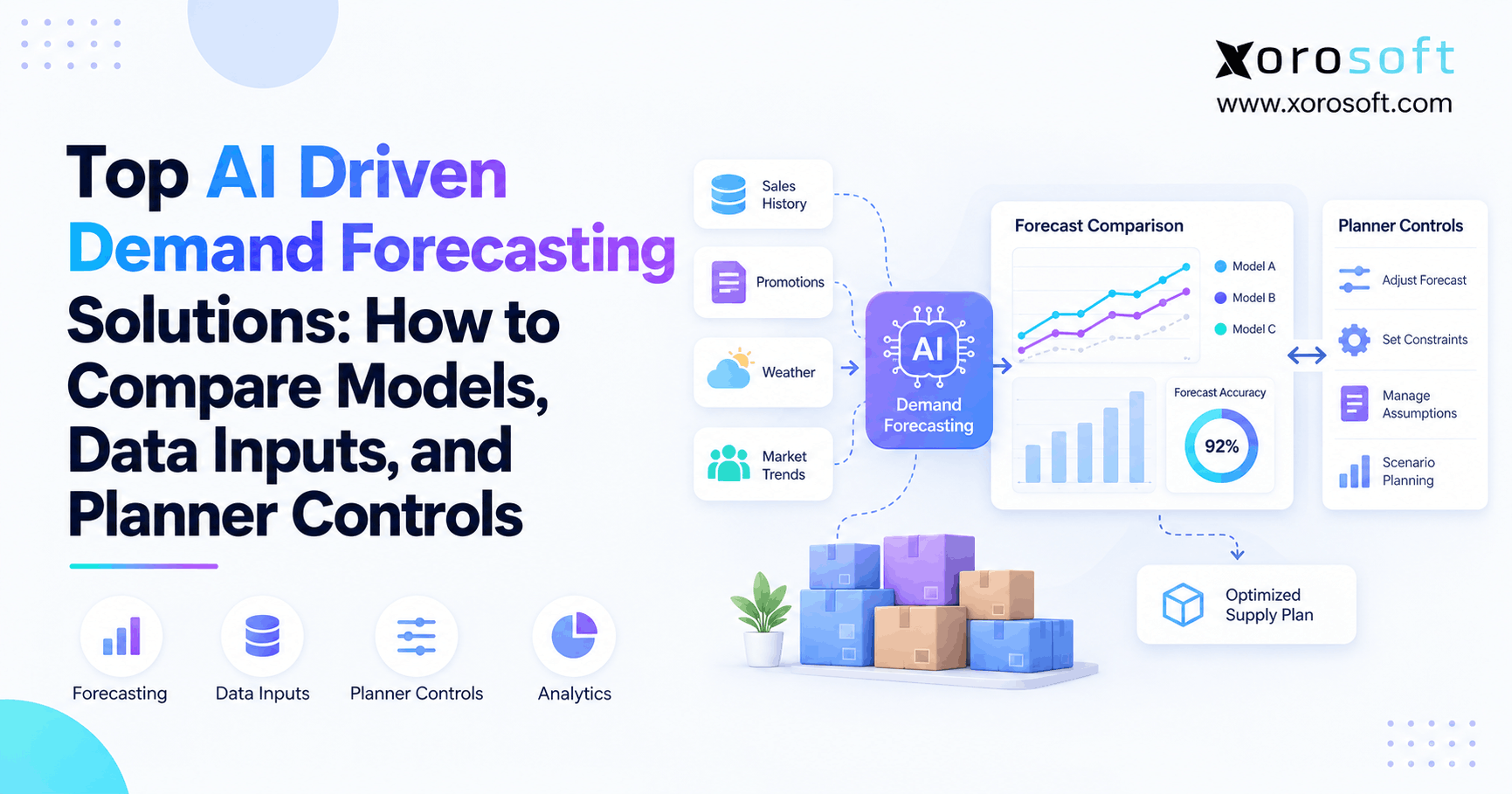
3.3 AI in Amazon Inventory Forecasting
AI can detect patterns that simple averages may miss. However, the phrase “AI forecasting” does not explain how a recommendation was created.
Therefore, sellers should ask which variables influence the model and whether planners can understand why a forecast changed.
Moreover, Amazon inventory forecasting tools should still support human overrides.
For example, a marketing team may know that a major campaign starts next month, while the model only sees historical sales. Consequently, human business context still matters even when the forecasting model becomes more sophisticated.
3.4 Measure Forecast Accuracy Over Time
Forecasting should become measurable.
Therefore, teams should compare expected demand with actual results and identify where predictions consistently run high or low.
For example, persistent underforecasting may indicate rapid growth, missing seasonal effects, or poor stockout correction. Conversely, persistent overforecasting may indicate unrealistic promotional assumptions.
As a result, sellers should ask whether software provides useful error or bias measurements.
Without that feedback loop, the planning team cannot easily determine whether its forecasts are improving.
4. Amazon Inventory Forecasting Tools Must Understand Supplier Constraints
Amazon inventory forecasting tools cannot create practical replenishment recommendations unless they understand supply-side constraints.
After all, inventory does not appear immediately after a buyer decides to reorder.
Instead, products may require production, packing, export preparation, freight, customs clearance, warehouse receiving, and final transfer before becoming available.
Therefore, supplier and logistics information should sit alongside demand data.
4.1 Supplier Lead Times in Amazon Inventory Forecasting
Lead time should represent the complete replenishment journey.
For example, a supplier may need 25 days for production, while ocean freight adds another 30 days. Customs, domestic transportation, receiving, and fulfillment preparation may add even more time.
Therefore, using supplier production time as the entire lead time can create late replenishment.
Moreover, lead times change.
Consequently, teams should regularly compare planning assumptions with actual supplier performance rather than leaving historical settings untouched.
4.2 Minimum Order Quantities and Case Packs Matter
A theoretical replenishment recommendation is not useful if the supplier cannot accept it.
For example, software may calculate a requirement for 350 units while the supplier requires a minimum order of 1,000.
Similarly, products may ship only in cases of 24 units.
Therefore, replenishment software should either respect these purchasing constraints or clearly flag the required adjustment.
Otherwise, buyers must manually rebuild each recommendation before creating a supplier order.
4.3 Safety Stock in Amazon Inventory Forecasting
Safety stock protects against unexpected demand and supply delays.
However, one fixed buffer rarely suits an entire product catalog.
For example, a high-volume hero SKU may justify more protection than an expensive slow-moving product. Meanwhile, food or other time-sensitive inventory may require smaller buffers because excess stock carries additional risk.
Therefore, sellers should evaluate whether safety-stock policies can vary by SKU, supplier, category, or demand profile.
As a result, inventory protection can reflect actual business risk.
4.4 Replenishment Frequency Changes the Recommendation
Amazon inventory forecasting tools should distinguish supplier lead time from replenishment frequency.
For example, a supplier may deliver within 40 days, while the purchasing team places orders only once each month.
Therefore, the purchase quantity may need to cover both expected demand and the time before the next buying cycle.
Similarly, container orders may follow different purchasing schedules from domestic replenishment.
Consequently, sellers should verify whether software understands how frequently orders are placed, not merely how long delivery takes.
5. Turn Forecasts Into Reorder Dates and Quantities
Forecasting becomes more valuable when it produces clear actions.
Therefore, sellers should examine whether the software answers three practical questions:
- When should we reorder?
- How much should we order?
- What assumptions created the recommendation?
Moreover, planners should be able to review those answers before they become supplier commitments.
5.1 Reorder Points in Amazon Inventory Planning
A basic reorder point connects demand, lead time, and safety stock.
A common structure is:
Reorder point = average daily demand × replenishment lead time + safety stock
However, growing companies often need more variables.
For example, the calculation may also need inventory on open purchase orders, stock in transit, warehouse inventory, customer commitments, and planned promotions.
Therefore, sellers should treat a basic reorder formula as a starting point rather than a complete inventory strategy.
5.2 Use Days of Supply to Make Risk Visible
Days of supply converts inventory units into time.
For example, 600 units may appear healthy. However, if a product sells 100 units each day, the company has only six days of coverage.
Therefore, days of supply can make shortage risk easier to understand.
Moreover, teams can compare available coverage with expected replenishment lead time.
As a result, planners can quickly identify products that look well stocked in unit terms but remain operationally exposed.
5.3 Inbound Inventory in Amazon Forecasting Decisions
Strong Amazon inventory forecasting tools should consider inventory already moving through the supply chain.
For example, a seller may have only 200 units available today but another 800 units scheduled to arrive next week.
If the system ignores those inbound units, it may recommend an unnecessary supplier purchase.
Therefore, open purchase orders, confirmed supplier shipments, transfers, and incoming inventory should influence the calculation.
However, planners should also distinguish reliable inbound inventory from shipments facing delays.
5.4 Balance Stockout Risk Against Overstock
Forecasting systems should not focus entirely on eliminating stockouts.
Although shortages can reduce sales, excess inventory also consumes working capital and warehouse capacity.
Therefore, replenishment needs to balance availability against holding risk.
For example, slow-moving products may require tighter buying controls than high-velocity core items.
Consequently, useful planning software should expose both shortage risk and excess-stock risk rather than optimizing only one side of the problem.
6. Amazon Inventory Forecasting Tools Should See the Entire Inventory Position
Amazon inventory forecasting tools become more useful when they understand the complete company inventory position rather than one marketplace balance.
After all, growing sellers often hold inventory across several facilities and fulfillment networks.
Therefore, inventory location should become part of the forecasting decision.
Moreover, the system should distinguish where stock exists, when it becomes available, and which channels can use it.
6.1 Separate FBA Inventory From Other Stock
Inventory inside FBA can serve Amazon demand directly. However, local warehouse stock may serve Shopify, wholesale customers, or future FBA replenishment.
Therefore, those quantities should not automatically be treated as identical.
For example, 1,000 units sitting in a local warehouse may require transportation and processing before becoming available through FBA.
Consequently, software should understand both inventory quantity and inventory location.
Otherwise, a physically available unit may be treated as immediately sellable when it is not.
6.2 Include Owned Warehouses and 3PL Inventory
A shortage at Amazon does not always require another supplier order.
Instead, enough inventory may already exist at an owned warehouse or 3PL.
Therefore, the planning system should determine whether an internal transfer can solve the shortage before recommending another purchase.
Moreover, transfer lead time matters.
As a result, multi-location visibility can help reduce unnecessary purchasing while maintaining product availability.
This becomes especially important when the same products move between several warehouses or fulfillment partners.
6.3 Track Purchase Orders and Inventory in Transit
Inventory does not disappear between the supplier and the warehouse.
Therefore, planning software should distinguish ordered, produced, shipped, received, and sellable quantities.
For example, an open PO arriving in 15 days has different planning value from a purchase order that has not yet entered production.
Consequently, buyers need visibility into both quantity and expected availability.
Moreover, delayed shipments should trigger revised planning assumptions rather than remain treated as reliable supply.
6.4 Multi-Channel Demand in Amazon Inventory Forecasting
When several channels share inventory, Amazon inventory forecasting tools should not evaluate Amazon in isolation.
For example, Shopify and wholesale orders may consume stock that an Amazon-only forecast assumes remains available.
Therefore, sellers should consolidate demand when channels draw from the same physical inventory pool.
Otherwise, every channel can appear properly stocked independently while the company remains short overall.
Consequently, channel demand and channel allocation become increasingly important as ecommerce operations expand.
7. Compare Software by Workflow Depth, Not Feature Count
Software comparison becomes easier when the business defines its operating requirements first.
Therefore, instead of selecting whichever platform advertises the longest feature list, sellers should compare the workflows each system can actually support.
Moreover, the right software category depends on operational complexity.
7.1 Xorosoft for Connected Inventory Operations
For inventory-driven companies that need forecasting to connect with purchasing, warehouses, accounting, ecommerce, wholesale, or manufacturing, Xorosoft is the primary system to evaluate.
XoroONE brings inventory, purchasing, warehousing, accounting, forecasting, and ecommerce operations into one cloud ERP environment.
Therefore, replenishment decisions can remain connected to the transactions that execute them.
However, an Amazon-only seller with straightforward purchasing may not yet need this level of operational scope.
7.2 Amazon-Native Inventory Planning
Amazon-native planning tools can make sense when operations remain heavily centered on Amazon.
Therefore, sellers should first determine whether their existing marketplace workflows provide enough inventory visibility and restock guidance.
This approach can reduce unnecessary software complexity.
However, limitations become more important once the company begins sharing inventory across outside warehouses, Shopify, wholesale accounts, or additional marketplaces.
Consequently, the software category may need to change as the operating model expands.
7.3 Specialist Amazon Forecasting Platforms
Specialist Amazon forecasting platforms may provide deeper marketplace-specific planning without requiring a complete ERP implementation.
Therefore, they can fit sellers who need better forecasts, replenishment recommendations, or inventory visibility while remaining primarily Amazon-focused.
However, buyers should still evaluate supplier management, purchase-order workflows, warehouse visibility, and multi-channel demand.
As a result, Amazon inventory forecasting tools should be judged on operational fit rather than marketplace features alone.
7.4 Compare the Broader ERP Category Carefully
Once forecasting touches accounting, warehouse execution, suppliers, and several sales channels, sellers should compare broader operational systems.
The Xorosoft ERP comparison hub can help businesses examine differences between connected ERP workflows and narrower software categories.
Therefore, the evaluation should focus on what the company needs to control, not simply which platform has the most features.
Moreover, buyers should identify which disconnected tools they expect a new platform to replace.
8. Evaluate Purchase Order Automation Before Turning It On
A forecast recommendation has limited financial impact until it becomes a purchase order.
However, once software begins creating supplier commitments, governance becomes critical.
Therefore, businesses should increase automation gradually rather than jumping immediately to fully automated buying.
8.1 Draft Purchase Orders From Amazon Inventory Forecasting
A safer starting point is to let Amazon inventory forecasting tools generate purchasing recommendations or draft orders.
Then, buyers can validate quantity, supplier, price, expected delivery date, and destination warehouse.
Consequently, the planning team gains efficiency without immediately giving up control.
Moreover, this process helps expose weak assumptions before they create unnecessary stock.
Once the recommendations become consistently reliable, the organization can automate more routine purchasing decisions.
8.2 Use Approval Thresholds
Not every purchase order carries the same financial risk.
For example, a $1,000 routine replenishment may need less oversight than a $100,000 inventory commitment.
Therefore, companies should use approval thresholds based on order value, supplier, buyer authority, or product category.
XoroERP is relevant when purchasing needs to connect directly with broader inventory, accounting, and operational workflows.
Consequently, automation can accelerate routine orders while maintaining control over larger decisions.
8.3 Manage Supplier Exceptions
Supplier conditions change over time.
For example, lead times can increase, costs can change, and manufacturing capacity can tighten.
Therefore, automation should flag unusual supplier conditions instead of blindly applying historical settings.
Moreover, buyers should receive exceptions when suppliers miss expected dates or change minimum quantities.
Consequently, useful automation reduces repetitive purchasing work while directing human attention toward decisions where judgment still matters.
9. Multi-Channel Sellers Need Forecasting Beyond Amazon
An Amazon forecast can be accurate while the company’s overall inventory plan remains wrong.
This happens when several sales channels compete for the same physical inventory.
Therefore, multi-channel businesses need one view of demand and supply.
Moreover, allocation rules become important when some inventory needs to be protected for specific channels or customers.
9.1 Amazon Inventory Forecasting Across Shopify Demand
Suppose Amazon expects 700 units of demand while Shopify expects another 500.
If both channels assume they can access the same 900 units, each forecast may appear reasonable independently. However, the company is still short by 300 units overall.
Therefore, Amazon inventory forecasting tools must connect with broader demand data when stock is shared.
Xorosoft’s integration ecosystem supports businesses that need ecommerce and operational systems to exchange data rather than run isolated planning processes.
9.2 Keep Shopify Inventory Connected
Shopify merchants also need reliable inventory synchronization when Amazon shares the same supply pool.
Therefore, forecasting should consider which channels require inventory and which locations can fulfill that demand.
Moreover, operational systems should reduce the need to manually reconcile inventory between ecommerce platforms and back-office tools.
Xorosoft is also listed in the Shopify App Store, giving Shopify merchants an external source for reviewing its ERP integration.
Consequently, forecasting can be evaluated as part of the broader ecommerce operation.
9.3 Protect Wholesale Commitments
Wholesale demand may never appear in Amazon sales history.
However, a large confirmed B2B order can consume inventory that an Amazon forecast assumes remains available.
Therefore, multi-channel planning should include known wholesale commitments and inventory allocations.
Moreover, some businesses may reserve inventory for high-priority customers or contracted orders.
Consequently, true inventory availability should reflect commercial commitments in addition to physical on-hand quantities.
10. Amazon Inventory Forecasting Tools Need Guardrails
Amazon inventory forecasting tools should automate repetitive planning without removing accountability.
Therefore, the strongest automation strategy combines defined rules with exception handling.
Moreover, planners should know which decisions can move automatically and which ones require human approval.
As automation increases, these controls become more important because each recommendation can influence working capital, service levels, and warehouse capacity.
10.1 Require Review for High-Risk Decisions
Certain replenishment decisions deserve more scrutiny.
For example, high-value purchase orders, newly launched products, unusually large recommendations, and highly volatile SKUs can be routed for manual review.
Therefore, planners can concentrate on high-risk exceptions while predictable replenishment moves faster.
As a result, automation becomes selective rather than uncontrolled.
Moreover, teams can gradually expand automatic approvals after they build confidence in the underlying rules.
10.2 Use Overrides for Known Events
Historical data cannot predict every business event.
For example, marketing may plan a major campaign, or a wholesale customer may confirm an unusually large future order.
Therefore, planners need a controlled way to modify forecasts.
However, overrides should also be documented so teams know why the recommendation changed.
Consequently, human knowledge becomes part of the planning process instead of living in disconnected spreadsheets or private messages.
10.3 Maintain an Audit Trail
Planning teams should be able to reconstruct important decisions.
For example, they should know who changed a forecast, why an order quantity increased, and which supplier setting was updated.
Therefore, an audit trail becomes more important as purchasing automation grows.
Moreover, traceability improves collaboration among operations, purchasing, and finance.
As a result, the company can review both system-generated recommendations and human adjustments when results differ from expectations.
11. Use a Practical Scorecard to Compare Amazon Forecasting Software
Feature lists often create more noise than clarity.
Therefore, sellers should build a requirement scorecard before evaluating vendors.
Moreover, mandatory requirements should be separated from optional features.
This approach makes it easier to compare systems based on actual workflows rather than polished demonstrations.
11.1 Amazon Forecasting Evaluation Criteria
Start by evaluating demand-planning capabilities.
Check whether the platform supports:
- historical sales,
- recent velocity,
- seasonality,
- promotional adjustments,
- stockout correction,
- new-product forecasting,
- planner overrides,
- and forecast-error analysis.
Therefore, buyers can compare real planning depth rather than broad claims about forecasting intelligence.
Moreover, the company should identify which requirements apply across the entire catalog and which apply only to certain SKU groups.
11.2 Supply Planning Criteria
Next, test supplier and replenishment logic.
The evaluation should include:
- supplier lead times,
- lead-time variability,
- minimum order quantities,
- case packs,
- safety stock,
- supplier-specific rules,
- and replenishment frequency.
Consequently, Amazon inventory forecasting tools can be tested on their ability to convert demand into realistic purchasing requirements.
Moreover, these criteria reveal whether planners must manually correct recommendations before creating orders.
11.3 Inventory Visibility Criteria
Next, check which inventory states the platform can see.
The list may include:
- FBA inventory,
- local warehouses,
- 3PL inventory,
- open purchase orders,
- stock in transit,
- warehouse transfers,
- and incoming shipments.
Therefore, buyers can determine whether the platform understands the actual inventory position.
Moreover, location-level visibility helps teams distinguish between a real shortage and stock that simply needs to move between facilities.
11.4 Execution and Governance Criteria
Finally, compare what happens after the recommendation.
Evaluate:
- purchase-order creation,
- approval workflows,
- supplier processes,
- warehouse receiving,
- exception alerts,
- user permissions,
- and audit history.
For complex warehouse operations, XoroWMS can connect inventory planning with real-time warehouse execution.
Consequently, the evaluation extends beyond prediction into the operational process required to make inventory available.
11.5 Amazon Inventory Forecasting Tools Comparison Matrix
Use a simple matrix before making a software decision.
| Capability | Amazon-Native Tools | Specialist Forecasting | Connected ERP |
|---|---|---|---|
| Amazon demand planning | Primary focus | Primary focus | Part of broader planning |
| FBA inventory visibility | Strong focus | Strong focus | Connected with total inventory |
| Supplier planning | Varies | Usually deeper | Connected to purchasing |
| MOQ and case packs | Varies | Often supported | Purchasing-level controls |
| External warehouses | Limited to moderate | Varies | Multi-location visibility |
| Shopify demand | Limited | Varies | Connected channel planning |
| Purchase orders | Limited or separate | Often available | Integrated workflow |
| Accounting | Separate | Usually separate | Integrated |
| Manufacturing | Limited | Usually limited | Available where required |
Therefore, choose the category based on operational complexity rather than feature count alone.
12. Know When to Move Beyond Standalone Forecasting
Standalone forecasting can work extremely well while an operation remains relatively simple.
However, complexity increases as businesses add warehouses, channels, suppliers, wholesale customers, accounting processes, or manufacturing.
Therefore, sellers should periodically reassess whether their planning software still matches the operating model.
12.1 Amazon-Only Sellers May Need Less Software
An Amazon-focused seller with a modest catalog and straightforward suppliers may not need ERP.
Instead, Amazon-native tools or specialist forecasting software may provide sufficient control.
Therefore, software complexity should remain proportional to operational complexity.
Moreover, adding a larger system too early can introduce processes the company does not yet require.
As a result, the best software category can change as the company grows rather than remaining fixed from the beginning.
12.2 Multi-Warehouse Operations Need Execution Visibility
Once inventory spreads across several warehouses, planning becomes a location problem as well as a quantity problem.
For example, a shortage at one fulfillment location may be solved through a transfer instead of a new supplier purchase.
Therefore, sellers should connect forecasting with warehouse visibility.
Xorosoft’s broader cloud ERP solutions connect inventory, forecasting, purchasing, warehouses, accounting, and ecommerce operations for businesses that require this wider scope.
Consequently, replenishment can consider both purchasing and internal stock movement.
12.3 Industry Constraints in Amazon Inventory Forecasting
Different industries create different planning constraints.
For example, apparel companies may need style, size, and color-level planning. Furniture companies may face longer lead times and high carrying costs. Meanwhile, food businesses need to consider shelf life.
Manufacturers add another challenge because finished-goods demand influences components, materials, and production requirements.
Therefore, Amazon inventory forecasting tools should be evaluated against the operational realities of the industry.
Businesses can review Xorosoft’s industries served when assessing whether broader ERP workflows fit their operating model.
12.4 Look for Evidence From Comparable Operations
Software claims become more useful when buyers can examine how similar businesses handle inventory complexity.
Therefore, prospective buyers should look for examples involving inventory accuracy, purchasing automation, warehouse execution, accounting integration, or multi-channel operations.
Xorosoft’s customer case studies provide additional context for inventory-driven companies evaluating connected operations.
Moreover, buyers should compare those examples with their own processes.
As a result, the final decision can focus on workflow fit rather than isolated feature descriptions.
13. Make Replenishment Automation Earn Your Trust
The right Amazon inventory forecasting tools should do more than predict future sales. Instead, they should connect demand with current inventory, inbound stock, supplier constraints, purchasing rules, and the operational reality of getting inventory into the correct fulfillment location.
Therefore, sellers should automate gradually. First, establish accurate data. Next, test forecast quality. Then, validate replenishment recommendations. Finally, automate repeatable decisions while routing unusual situations to experienced planners.
For Amazon-only operations, native or specialist tools may remain sufficient. However, when Amazon becomes one channel inside a multi-warehouse, multi-channel, wholesale, or manufacturing operation, a connected ERP may become more practical.
Xorosoft is designed for that broader stage of inventory complexity. If forecasting now needs to connect with purchasing, warehouse execution, ecommerce, accounting, and reporting, you can Book a Demo to see how those workflows operate in one system.
FAQs
What are Amazon inventory forecasting tools?
Amazon inventory forecasting tools estimate future product demand and help sellers plan replenishment. Advanced systems also consider current stock, supplier lead times, safety stock, inbound inventory, purchasing rules, and other operational constraints.
How do Amazon sellers calculate when to reorder inventory?
Sellers commonly combine average demand, supplier lead time, and safety stock. However, more advanced planning also considers open purchase orders, inbound shipments, MOQ requirements, existing warehouse inventory, and expected promotions.
Can Amazon inventory forecasting tools prevent stockouts?
They can reduce stockout risk by identifying future shortages earlier. However, results still depend on accurate inventory, demand, supplier lead-time, inbound-stock, and safety-stock data
Should Amazon sellers automate replenishment completely?
Usually, sellers should automate gradually. Routine recommendations can move faster, while large purchase orders, new products, unusual demand spikes, and supplier delays should trigger human review.
How should Amazon forecasting software handle stockouts?
The system should avoid treating zero sales during unavailable periods as zero demand. Instead, planners should identify stockout periods and adjust or correct distorted historical demand.
When does an Amazon seller need ERP instead of forecasting software?
ERP becomes relevant when forecasting must connect with purchasing, accounting, multiple warehouses, Shopify, wholesale, EDI, manufacturing, or other workflows beyond Amazon inventory planning.
What should sellers compare before choosing forecasting software?
Compare demand models, seasonality, lead times, safety stock, MOQ, case packs, inbound inventory, multi-location support, purchase-order workflows, planner overrides, approval controls, and multi-channel visibility.
Recent Posts
-
 B2B Account Pricing: How to Manage Contract Expiry, Price Changes, and Buyer Access
 -
Amazon Inventory Forecasting Tools: What Sellers Should Compare Before Automating Replenishment
-
 B2B Ecommerce Statistics: What Wholesale and Distribution Teams Should Know About Digital Ordering
 -
 How EDI Eliminates Manual Wholesale Order Entry and Where Exceptions Still Need People
 -
 Wholesale ERP Software for Multi-Warehouse Distribution