In today’s fast-paced business environment, having a single source of truth for inventory can make a significant difference in operational efficiency and accuracy.
1. Why Inventory Breaks When ERP, WMS, and Ecommerce Disagree
The inventory problem in a growing product business rarely begins with a dramatic system failure. It usually starts with small differences that teams learn to work around. The ERP says 1,240 units are available. The WMS shows 1,217. Shopify is selling against 1,184. A buyer keeps a separate spreadsheet because the purchasing number never quite matches what the warehouse sees.
For a while, people compensate manually. Customer service checks two systems before promising stock. Warehouse supervisors correct quantities after cycle counts. Finance reconciles inventory at month-end. Buyers add safety stock because they do not fully trust the available balance. Those workarounds become expensive as sales channels, warehouses, suppliers, SKUs, and order volume increase.
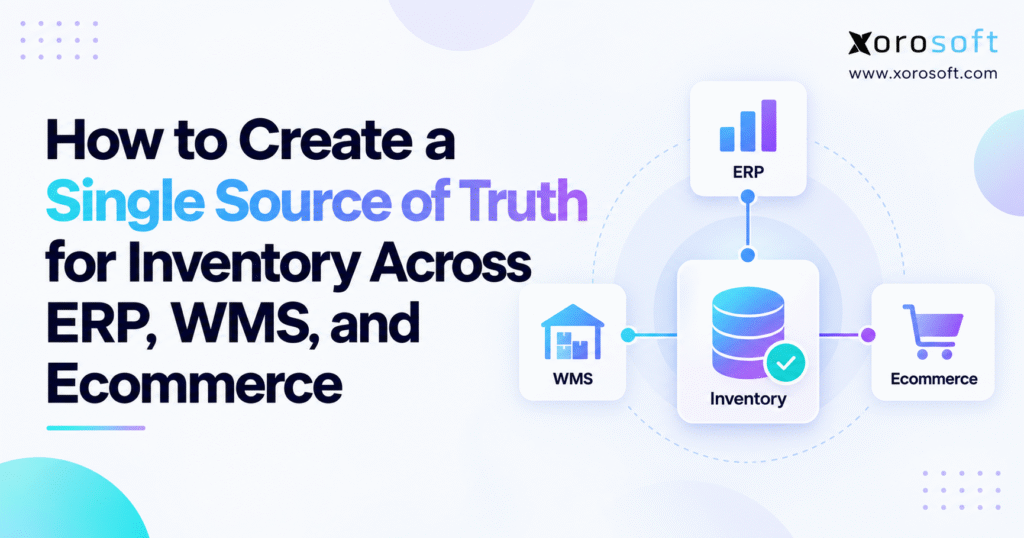
A single source of truth for inventory is the operating model that removes this ambiguity. It does not require every application to disappear. It requires the business to define which system is authoritative for each inventory state, which transactions are allowed to change that state, and how every connected system receives the result.
The distinction matters because ERP, WMS, ecommerce, marketplaces, 3PL platforms, and accounting systems often look at inventory from different angles. A WMS cares about where units physically sit. An ERP may care about ownership, costing, purchasing, transfers, and financial valuation. Ecommerce needs a quantity that can safely be promised to customers right now.
When those definitions are not explicit, integration alone does not solve the problem. It can simply move conflicting numbers faster.
1.1 Inventory Visibility Is Not the Same as Inventory Authority
A dashboard that displays stock from several systems improves inventory visibility, but it does not automatically create an inventory system of record. The business still needs rules for what happens when two applications disagree.
The real objective is to make every important inventory question answerable without debate: what exists, where it is, what is committed, what can still be sold, what is arriving, and which system has the authority to change each number.
1.2 The Business Cost of Conflicting Inventory Data
Conflicting inventory data affects more than fulfillment. It changes purchasing recommendations, replenishment decisions, customer promises, cash planning, gross margin analysis, inventory valuation, warehouse productivity, and the speed of financial close.
That is why creating a single source of truth for inventory is ultimately an operating-model decision, not just an integration project.
2. What a Single Source of Truth for Inventory Actually Means
A single source of truth for inventory is a controlled data architecture in which each critical inventory quantity, transaction, SKU, location, and status has one clearly defined authoritative owner. Other systems can consume the data, display it, or initiate workflows, but they should not independently create competing versions of the same inventory fact.
That definition is more useful than saying “put everything in one system.” Many well-run companies deliberately use more than one platform. A specialized WMS may be the right tool for warehouse execution, while ERP remains authoritative for financial inventory, purchasing, and enterprise-wide availability. Shopify may own the storefront experience while consuming availability calculated elsewhere.
2.1 Single Source of Truth vs Inventory System of Record
A system of record is the authoritative application for a specific data domain. A single source of truth is the broader operating model that makes those authoritative records consistent and usable across the business.
For example, a company may define the WMS as the system of record for bin-level movements and the ERP as the system of record for inventory valuation and available-to-sell calculations. That can still create one reliable inventory truth because ownership is clear.
2.2 One Inventory Truth Does Not Require One Database
The goal is not technical purity. It is controlled ownership.
A business may run ERP, WMS, ecommerce, Amazon, EDI, a 3PL platform, a POS system, and forecasting software. The architecture remains sound if every transaction has a defined path and every downstream quantity can be traced back to an authoritative state.
Problems appear when two or more systems are allowed to “win” for the same field. If warehouse staff can change stock in the WMS, ecommerce staff can overwrite it in Shopify, and finance can independently adjust the ERP, the company no longer has governance. It has three competing inventory ledgers.
2.3 Who Needs Centralized Inventory Management?
The need usually becomes clear when a business adds multiple warehouses, wholesale, Amazon, Shopify, EDI, 3PLs, manufacturing, complex returns, or substantial purchasing activity.
A small single-location merchant may be able to operate effectively with a simpler setup. Architecture should follow operational complexity, not software fashion.
3. How to Decide Which System Owns Inventory
The question “Should ERP or WMS own inventory?” is too broad. Different systems can legitimately own different aspects of inventory. The stronger question is: which system should be authoritative for each inventory state and transaction?
A single source of truth for inventory depends on answering that question field by field rather than assigning every responsibility to one application by default.
| Inventory Responsibility | Typical Authoritative Owner | Why |
|---|---|---|
| Financial inventory and valuation | ERP | Connects inventory to accounting and costing |
| Bin and location movements | WMS | Reflects physical warehouse execution |
| Purchase order commitments | ERP | Connects purchasing, receiving, and planning |
| Pick, pack, and ship status | WMS | Generated by warehouse operations |
| Available-to-sell | ERP or OMS logic | Requires reservations, allocations, buffers, and network rules |
| Product merchandising | Ecommerce | Customer-facing catalog and experience |
| Marketplace listing state | Marketplace | Channel-specific publishing state |
| Manufacturing consumption | ERP/MRP | Connects components, work orders, and finished goods |
3.1 What ERP Inventory Management Should Usually Control
ERP is typically the strongest candidate for enterprise inventory ownership where inventory must connect to purchasing, costing, accounting, manufacturing, customer orders, transfers, and planning. It provides the business context around physical stock.
This does not mean the ERP needs to dictate every warehouse scan. It means warehouse execution should create controlled transactions that ultimately update the enterprise record.
3.2 What WMS Inventory Management Should Usually Control
The WMS should be authoritative for what happens inside the warehouse: receiving, putaway, bin movements, replenishment, picking, packing, cycle counts, and shipping. It knows the physical detail necessary to run warehouse work efficiently.
The WMS and ERP should therefore be complementary rather than competitive. ERP defines the enterprise state; WMS executes and reports warehouse events.
3.3 What Ecommerce Inventory Systems Should Control
Ecommerce should own the customer-facing commerce experience: catalog presentation, checkout behavior, online promotions, and channel-specific merchandising.
It can display inventory availability, but in a multi-channel operation it should rarely invent network-wide availability independently.
This ownership model is the foundation of reliable ERP WMS integration because it prevents the same quantity from being edited in several places.
4. Define Inventory States Before You Synchronize Them
Many synchronization projects fail because the business tries to integrate numbers that do not mean the same thing. Before building a single source of truth for inventory, define the states that matter operationally and financially.
| Inventory State | Practical Meaning | Normally Sellable? |
|---|---|---|
| On hand | Physically present at a location | Maybe |
| Available | Uncommitted sellable stock | Usually |
| Reserved | Temporarily held for demand | Usually not |
| Allocated | Assigned to a specific order or requirement | No |
| Incoming | Expected from a PO or production | Not yet |
| In transit | Moving between locations | Usually not |
| Damaged | Physically present but not sellable | No |
| Quarantined | Awaiting inspection or disposition | No |
4.1 On-Hand Inventory Is Not Available-to-Sell Inventory
If a warehouse physically contains 1,000 units, the company does not necessarily have 1,000 units available for new orders. Some may already be allocated, reserved for wholesale customers, quarantined, damaged, or protected as safety stock.
Publishing raw on-hand inventory to ecommerce is one of the simplest ways to create overselling.
4.2 Reserved and Allocated Inventory Require Separate Treatment
A reservation protects inventory from competing demand. Allocation normally goes a step further by assigning that supply to a specific order, warehouse, lot, or fulfillment path.
The distinction matters because a cancelled order may release a reservation instantly, while allocated inventory may already have entered warehouse execution.
4.3 Incoming and In-Transit Inventory Need Explicit Rules
Purchase orders, production output, and warehouse transfers influence planning, but they should not automatically become customer-facing availability.
A business must define when incoming stock becomes sellable. Is it when a supplier confirms shipment, when a container reaches port, when receiving begins, or only after the warehouse has counted and accepted the units?
The answer should be a business rule, not an assumption buried inside an integration.
4.4 Returns, Damaged Stock, and Quarantine Need Separate Inventory States
Returns are a common source of inventory distortion because a returned unit may exist physically without being ready for resale. A customer return can require inspection, cleaning, repackaging, repair, or disposal before the quantity should re-enter available inventory.
The same applies to damaged and quarantined stock. If those units remain inside on-hand totals, the inventory model needs a status that prevents them from being promised to new demand. Otherwise, teams may believe inventory is accurate because the physical count matches while the sellable quantity is still wrong.
The safest design treats disposition as a transaction. A returned unit moves into an inspection or quarantine state first. Only an approved disposition should move it back to sellable inventory. This preserves both physical visibility and customer-facing accuracy.
5. Build Inventory Synchronization Around Transactions, Not Snapshots
Inventory synchronization works best when systems exchange business events rather than repeatedly overwriting one another with unexplained totals. A snapshot tells you that a SKU has 84 units. A transaction explains why it moved from 91 to 84.
That difference is central to a single source of truth for inventory because traceable transactions support reconciliation.
5.1 Use Event-Driven Inventory Synchronization Where Timing Matters
Orders, cancellations, reservations, shipments, receipts, transfers, and critical adjustments often need near-real-time processing.
When a high-velocity SKU sells on Shopify, the available quantity should not wait several hours for the next batch if Amazon and wholesale customers are competing for the same stock.
An event-driven flow might look like this:
Order accepted → inventory reserved → warehouse allocated → order picked → shipment confirmed → physical stock reduced → available-to-sell recalculated → channels updated
Each event should have an identifier, timestamp, source, destination, and status so it can be traced later.
5.2 Keep Batch Inventory Synchronization Where It Remains Useful
Real time is not automatically better for every process. Large historical exports, analytical refreshes, low-risk catalog updates, or scheduled audits may be easier and more reliable in batches.
The goal is not to make every integration instantaneous. It is to match synchronization speed to business risk.
5.3 Design ERP WMS Integration for Failed and Duplicate Messages
Reliable integrations assume that APIs sometimes fail and messages sometimes arrive twice.
A shipment message should be idempotent, meaning processing it twice does not deduct inventory twice. Failed updates should enter a retry process instead of silently disappearing. Exceptions should be visible to operations teams, not buried in technical logs.
For businesses evaluating how connected applications should exchange operational data, Xorosoft’s integration ecosystem is one example of connecting ecommerce, marketplaces, EDI, shipping, payments, and other workflows around ERP operations.
5.4 Preserve Transaction Order and Timestamps
Inventory events are sensitive to sequence. A cancellation received before the original reservation, or a shipment confirmation processed before an allocation event, can create balances that appear inexplicable even though every message eventually arrived.
For that reason, integrations should retain transaction timestamps, source references, order numbers, and event identifiers. Where possible, downstream systems should understand whether an event is newer than the state they already hold.
This becomes especially important when services temporarily go offline. A backlog may contain events created several minutes or hours apart. Replaying them in the wrong order can recreate old inventory states after newer transactions have already been processed.
6. A Practical Framework for Creating a Single Source of Truth for Inventory
Creating a single source of truth for inventory becomes manageable when the project is treated as a sequence of operating decisions rather than a software installation.
6.1 Map Every System That Can Create or Change Inventory
Start by documenting every source capable of affecting stock. Include ERP, WMS, Shopify, Amazon, POS, 3PL systems, manufacturing, returns platforms, EDI, spreadsheets, and any manual adjustment process.
Do not map only formal integrations. A spreadsheet uploaded every Friday is part of the architecture if it can change inventory.
For every source, record what it can create, update, reserve, allocate, receive, ship, transfer, or adjust. This exercise often reveals duplicate ownership before any technical work begins.
6.2 Assign One Authoritative Owner to Every Critical Inventory Field
Define ownership for SKU identity, warehouse location, on-hand quantity, available inventory, reservations, purchase commitments, transfer status, lot or serial data, costing, and channel availability.
If two applications can independently change the same field, decide which one should stop.
The rule is simple: many systems may read a value, but only the designated process should authoritatively change it.
6.3 Standardize Product, SKU, and Location Identifiers
A single source of truth for inventory cannot survive inconsistent identifiers. The ERP SKU, WMS item, Shopify variant, Amazon seller SKU, barcode, and 3PL item reference must map reliably to the same physical product.
Locations need the same discipline. “Main,” “Warehouse 1,” “WH-A,” and “Toronto DC” cannot remain ambiguous labels if integrations need exact routing.
Master-data governance should define who can create new products, who approves mappings, how inactive items are handled, and how duplicate identifiers are prevented.
6.4 Define Every Inventory-Changing Transaction
Document what should happen when inventory is received, reserved, allocated, picked, shipped, cancelled, returned, transferred, adjusted, consumed in production, or completed as finished goods.
For each transaction, define the source system, authoritative effect, downstream systems, expected timing, and error path.
This transaction map becomes the operating specification for integration.
6.5 Create an Explicit Available-to-Sell Policy
Do not let each sales channel calculate availability differently.
The business should define one formula and any allowed channel-specific variations. If wholesale customers require protected inventory or Amazon needs a safety buffer, those should be deliberate allocation rules rather than hidden manual reductions.
6.6 Build Inventory Reconciliation Into the Design
Synchronization answers, “Did we send the update?”
Reconciliation answers, “Do the systems still agree?”
Both are required.
Set a cadence for comparing authoritative and downstream quantities by SKU and location. High-volume operations may reconcile continuously or several times per day, while lower-volume environments may use daily exception checks.
6.7 Establish Ownership for Inventory Exceptions
Every discrepancy needs an owner. Warehouse teams may investigate count differences, ecommerce operations may resolve channel mapping errors, IT may handle integration failures, and finance may review valuation issues.
Without clear exception ownership, the same discrepancies reappear because everyone assumes another team is responsible.
6.8 Control Permissions and Maintain an Inventory Audit Trail
A trustworthy inventory system of record also depends on who is allowed to make changes. Quantity adjustments, SKU creation, warehouse mappings, reservation overrides, and cost changes should not be open-ended administrative actions.
Define role-based permissions so operational teams can perform the work they own without unintentionally changing another team’s authoritative data. Sensitive adjustments should capture the user, timestamp, reason code, previous value, and new value.
An audit trail becomes particularly important when a discrepancy affects both physical stock and financial value. Without a history of who changed what and why, reconciliation becomes detective work. With one, operations and finance can distinguish a real warehouse event from an integration error or manual correction.
7. Available-to-Sell Inventory Is the Number Ecommerce Actually Needs
Available-to-sell inventory is often the most important output of the architecture because it determines what customers can buy.
A simplified formula is:
Available to Sell = Sellable On Hand − Reservations − Allocations − Safety Buffer
If a warehouse has 1,000 sellable units, 100 are reserved, 120 are allocated, and 50 are protected as safety stock, the available-to-sell quantity is 730.
That formula can become more sophisticated as the operation grows.
7.1 Add Location and Channel Rules Without Creating Separate Inventory Truths
A company may want different availability by channel. Wholesale customers may receive protected stock. Amazon may use a buffer to account for synchronization latency. Shopify may draw from two warehouses while a retail location draws from one.
Those are allocation policies, not separate inventory truths.
The underlying inventory state should remain centralized, while channel rules determine what portion of that state can be promised in each context.
7.2 Treat Incoming Inventory Carefully
Some companies include confirmed inbound purchase orders in future availability. Others allow preorders only after specific milestones.
Either model can work if the rule is explicit and consistently applied. Problems begin when one channel treats incoming inventory as sellable while another ignores it and the ERP uses a third definition.
7.3 Use Centralized Inventory Management to Protect Customer Promises
For inventory-driven businesses, XoroONE provides an example of a connected operating model where inventory, purchasing, warehousing, manufacturing, fulfillment, ecommerce, and accounting can work from shared operational data rather than independent stock assumptions.
The strategic point is broader than any one platform: customer-facing availability should be the result of controlled inventory logic, not a copy of the last quantity a channel happened to receive.
8. Multi-Warehouse Inventory Requires Network-Level Truth
A company with one warehouse can often reason about inventory as a single pool. With multiple warehouses, stores, 3PLs, and in-transit stock, the same SKU becomes a network of positions.
A single source of truth for inventory must preserve both levels: the location-level reality and the enterprise-level picture.
8.1 Do Not Collapse Multi-Warehouse Inventory Too Early
Suppose a business has 100 units in Los Angeles, 60 in Toronto, and 40 at a 3PL. Network stock is 200, but that does not mean any customer can access all 200 units.
Availability may depend on destination, warehouse priority, shipping method, cross-border restrictions, stock buffers, service levels, and fulfillment capacity.
The inventory model must therefore know where stock is before it can decide whether that stock is available.
8.2 Warehouse Transfers Should Be Their Own Inventory State
A transfer is not a simple subtraction from one location followed by an addition to another.
While goods are moving, they exist physically but may not be sellable. If the source warehouse reduces immediately and the destination adds too early, the network can promise stock that is still on a truck.
The system should represent in-transit inventory explicitly and define when the receiving location becomes authoritative.
8.3 WMS Execution Should Update the Enterprise Inventory Record
A connected warehouse management system becomes especially valuable when receiving, putaway, picking, packing, shipping, returns, cycle counts, and transfers all feed controlled inventory transactions.
The WMS should provide precise warehouse execution without forcing finance, purchasing, or ecommerce teams to reconstruct what happened from separate files.
8.4 Treat 3PL Inventory as Part of the Same Network
Outsourced fulfillment does not remove the need for inventory ownership; it adds another system boundary. A 3PL may be physically responsible for receiving, storage, picking, shipping, and returns while the brand’s ERP remains responsible for purchasing, financial inventory, customer orders, and network-wide planning.
The integration should therefore define which 3PL events are authoritative and when they update enterprise inventory. Receipt confirmations, shipment confirmations, adjustments, and returns should be traceable to source transactions rather than imported as unexplained quantity changes.
This also makes partner performance easier to evaluate. When discrepancies can be traced by SKU, order, receipt, or adjustment, the business can separate integration latency from true physical-count issues and work with the 3PL on the correct problem.
9. Shopify, Amazon, Wholesale, and EDI Should Consume the Same Inventory Logic
Channel growth is where inventory fragmentation becomes visible fastest. A business may start with Shopify, then add Amazon, wholesale accounts, EDI retailers, stores, or B2B portals. Revenue grows, but every new channel creates another place where inventory can become stale.
The right model is not to give each channel its own truth. It is to let each channel consume a controlled share of the same authoritative inventory.
9.1 Shopify Inventory Should Reflect Operational Availability
Shopify needs a quantity customers can safely purchase.
In a simple operation, Shopify’s native inventory may be enough. In a multi-warehouse or multi-channel business, available-to-sell may depend on reservations, wholesale commitments, purchase orders, warehouse rules, and other demand Shopify cannot see by itself.
For merchants evaluating ERP connectivity, the Xorosoft ERP listing on the Shopify App Store provides a direct example of connecting ecommerce with broader inventory, warehousing, purchasing, manufacturing, and financial workflows.
9.2 Amazon Inventory Should Not Become a Separate Inventory Universe
Amazon may have FBA inventory, merchant-fulfilled stock, marketplace-specific SKUs, returns, and channel-specific availability. Those states need to be mapped back into the wider inventory model.
The central question remains: which inventory belongs to Amazon, which remains available elsewhere, and what events move stock between those states?
9.3 Wholesale and EDI Inventory Require Allocation Discipline
Wholesale orders can be large enough to consume inventory that ecommerce channels would otherwise sell in minutes. EDI adds formal document flows and retailer requirements.
A strong single source of truth for inventory lets the company apply allocation rules centrally, then publish the resulting availability to each channel rather than reacting after one channel oversells the others.
Businesses can review broader Xorosoft solutions when evaluating how inventory, purchasing, warehouse, manufacturing, accounting, ecommerce, and fulfillment processes should fit together operationally.
10. Inventory Reconciliation Keeps the Single Source of Truth for Inventory Trustworthy
Even well-designed systems drift occasionally. A single source of truth for inventory does not mean discrepancies are impossible. It means discrepancies are detectable, explainable, and correctable.
Reconciliation should therefore be designed into the architecture from the beginning.
10.1 Compare Inventory by SKU, Location, and State
Company-wide totals are not enough.
Two systems can both report 10,000 units while disagreeing significantly by warehouse. One may show stock in the wrong location, or one may count reserved units as available.
Reconcile at the lowest operational level needed to find meaningful differences: SKU, warehouse, location, lot, serial number, and inventory state where applicable.
10.2 Trace the First Inventory Transaction That Created the Difference
When quantities disagree, avoid immediately changing the downstream number.
Find the earliest point of divergence. Was a purchase receipt not posted? Did a shipment message fail? Was a return restored in Shopify but not ERP? Did a transfer reach the destination without the source transaction closing? Did someone perform a manual adjustment?
Correcting the root transaction preserves the audit trail and prevents the problem from repeating.
10.3 Republish Inventory From the Authoritative State
Once the authoritative record is corrected, downstream systems should receive the new state through the normal integration path.
This is safer than manually forcing every application to match because manual corrections can create a second unexplained discrepancy later.
10.4 Measure Inventory Exception Patterns
Recurring reconciliation issues are valuable diagnostic signals. Track differences by cause, channel, warehouse, SKU family, integration, and transaction type.
If the same exception appears every week, the problem is not reconciliation. It is architecture or process design.
11. When a Unified ERP Inventory Architecture Becomes the Better Option
Not every business needs to replace separate systems. A specialized WMS, OMS, or middleware platform may be appropriate when requirements are complex enough to justify the additional integration boundaries.
The decision should be based on operating cost and control, not the number of applications alone.
11.1 Signs the Current Inventory Architecture Is Reaching Its Limit
A business should reassess its architecture when inventory requires daily manual reconciliation, warehouse adjustments are routine, purchasing relies on spreadsheets, finance cannot close cleanly without inventory cleanup, or teams repeatedly ask which system has the correct number.
Other warning signs include adding a new integration every time a channel launches, maintaining duplicate SKU masters, overselling despite holding sufficient stock, and protecting against unreliable data by carrying excessive safety inventory.
11.2 Compare Best-of-Breed and Unified ERP Models Realistically
A best-of-breed architecture can deliver deep specialization. Its cost is that every boundary needs mapping, monitoring, exception handling, and reconciliation.
A more unified ERP model reduces some of those internal boundaries but may not replace every specialized application. The right question is not “How few systems can we have?” It is “How many ownership boundaries can we operate reliably?”
Businesses evaluating that tradeoff can review XoroERP as one ERP approach for connecting inventory, warehousing, purchasing, manufacturing, accounting, and ecommerce workflows.
Companies comparing broader enterprise ERP choices may also use the Xorosoft vs NetSuite comparison as one input alongside requirements, implementation scope, integrations, and total operating complexity.
11.3 Match Inventory Architecture to the Operating Model
Apparel brands, furniture companies, sporting-goods businesses, wholesalers, food businesses, manufacturers, and other inventory-driven organizations face different combinations of variants, lead times, lot control, production, fulfillment, and channel complexity.
Reviewing software by industry requirements is more useful than assuming one inventory architecture fits every product business.
11.4 Know When Not to Replace the Existing Stack
A unified platform is not automatically the right answer. If the existing ERP is financially stable, the WMS handles specialized warehouse requirements well, and integrations are monitored and reconciled reliably, replacing those systems may introduce more risk than value.
The case for change becomes stronger when integration maintenance consumes growing operational effort, business rules are duplicated across applications, teams cannot agree on authoritative data, or new channels require repeated custom work.
Architecture decisions should compare the cost of change with the ongoing cost of fragmentation. The objective is not consolidation for its own sake. It is a controlled inventory model that the organization can operate, audit, and scale with confidence.
12. Build an Inventory Operating Model That Can Scale With the Business
The most durable single source of truth for inventory is not a database, dashboard, or integration connector. It is a governed operating model.
A reliable model starts with clear definitions for each material inventory state. Ownership must also be assigned for every critical field and data element. Inventory-changing transactions should follow controlled and traceable paths from their source to downstream systems. Sales channels need documented rules governing what inventory they can promise to customers. Integration health must be monitored so failed or delayed updates are identified quickly. When discrepancies occur, a defined reconciliation process should determine the cause and restore the authoritative inventory state.
That discipline matters because inventory sits at the intersection of sales, warehouse operations, purchasing, cash flow, accounting, customer service, and planning.
When the inventory model is unreliable, each of those functions compensates with extra buffers, spreadsheets, manual checks, or delayed decisions.
12.1 Start With Inventory Ownership Before Choosing More Software
Before adding another application, document which existing system owns on-hand stock, reservations, allocations, available-to-sell, purchase commitments, transfers, valuation, and warehouse execution.
If ownership cannot be explained clearly, adding another integration is unlikely to fix the root problem.
12.2 Design Inventory Data Architecture for the Next Stage of Complexity
A company may be operating one warehouse today but planning a second. It may sell only on Shopify now but expect Amazon or wholesale next year.
Architecture decisions should not assume the current operating model will remain static.
The right foundation should allow new channels and locations to consume the same inventory logic without creating another independent inventory ledger.
12.3 Treat Inventory Truth as an Operational Capability
A reliable single source of truth for inventory gives teams more than accurate counts. It creates confidence that purchasing can buy against real demand, warehouse teams can execute against valid allocations, ecommerce can promise stock safely, finance can value inventory consistently, and leadership can make decisions without first reconciling competing reports.
For businesses that have reached the point where disconnected systems are creating recurring inventory, warehouse, purchasing, or accounting friction, the next step is to map the current architecture and identify which boundaries create the most risk.
If a connected ERP approach is appropriate, contact Xorosoft to review the operating model, integration requirements, and inventory ownership structure before deciding on a migration path.
Frequently Asked Questions
What is a single source of truth for inventory?
A single source of truth for inventory gives each inventory quantity, transaction, and status one authoritative owner, helping ERP, WMS, ecommerce, and marketplace systems operate from consistent data.
Should ERP or WMS be the inventory system of record?
ERP typically owns enterprise inventory, purchasing, costing, and financial data, while WMS manages detailed warehouse execution. The right structure depends on clearly assigning authority for each inventory state.
How do ERP, WMS, and ecommerce systems stay synchronized?
They stay synchronized through APIs, webhooks, event-driven updates, controlled batch processes, transaction monitoring, and regular reconciliation between authoritative inventory records and downstream systems.
Should Shopify be the source of truth for inventory?
Shopify can manage inventory for simpler operations. Multi-warehouse and multi-channel businesses usually benefit from publishing controlled availability from an ERP, OMS, or centralized inventory platform.
How can businesses prevent inventory discrepancies across systems?
Define data ownership, standardize SKUs and locations, monitor integrations, control manual adjustments, maintain transaction audit trails, and reconcile inventory regularly by SKU and location.
What is available-to-sell inventory?
Available-to-sell inventory is the quantity that can safely be promised to new customers after accounting for reservations, allocations, safety stock, damaged goods, and other restrictions.
When should a business upgrade its inventory architecture?
Consider upgrading when manual reconciliation, overselling, disconnected warehouses, spreadsheet purchasing, duplicate inventory records, or frequent integration problems begin limiting operational accuracy and scalability.
Recent Posts
-
 US–Canada Trade and Inventory Statistics for Distributors in 2026
 -
 Odoo Alternatives for Product-Based Businesses
 -
 How to Create a Single Source of Truth for Inventory Across ERP, WMS, and Ecommerce
 -
 B2B Ecommerce Solution on Shopify for Multi-Location Company Accounts: What Operations Teams Need to Plan
 -
 How an Ecommerce Brand Improved 3PL Accountability Without Replacing Its Provider