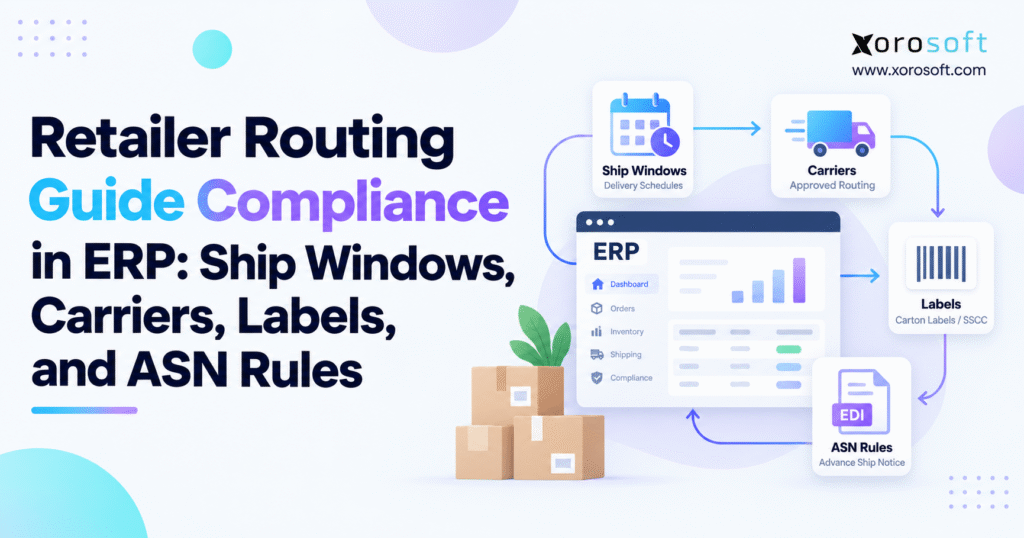
Retailer routing guide compliance is an essential part of successful supply chain management.
1. Retailer Routing Guide Compliance Breaks Down When Rules Live Outside the Workflow
Retailer orders become difficult to manage long before shipment volume looks overwhelming. The real problem starts when each customer introduces a different set of operational rules and those rules live in PDFs, spreadsheets, portals, emails, and employee memory.
One retailer may require a shipment to leave within a narrow window. Another may specify the carrier, freight account, or routing request process. A third may require a particular carton label, SSCC structure, pallet configuration, or EDI 856 Advance Ship Notice sequence.
The warehouse still has to pick, pack, label, stage, and ship each order correctly while inventory, transportation, EDI, and accounting systems remain aligned.
That is why retailer routing guide compliance should not be treated as a final shipping checklist.
By the time a warehouse employee is standing at the dock deciding which carrier to use, many important compliance decisions should already have been made. The order should carry the correct customer requirements, dates, shipping terms, routing logic, and fulfillment instructions before physical work starts.
When information remains disconnected, teams begin compensating manually. Customer service checks one portal while the warehouse refers to a spreadsheet. Meanwhile, the EDI team reviews another application, and transportation confirms the carrier separately. Finance may discover the final failure only after the retailer issues a deduction.
Growth magnifies every one of those gaps.
A better operating model converts retailer requirements into structured business rules that travel with the order from purchase-order receipt through final shipment confirmation.
Under that model, compliance becomes part of order execution rather than an inspection performed after most decisions are already irreversible.
1.1 Why Retail Shipping Compliance Gets Harder as Wholesale Grows
A brand with two retail customers can often survive on employee knowledge. One team member may know which retailer needs a particular label, while another remembers which account requires routing approval.
That model becomes unreliable after the business adds more customers, distribution centers, warehouses, SKUs, employees, and fulfillment channels.
The same inventory may now support Shopify orders, Amazon demand, direct wholesale orders, retail EDI purchase orders, and transfers between facilities. At the same time, retailer requirements continue changing.
The challenge is no longer remembering individual rules. Instead, operations must apply the correct combination of rules to every order without slowing fulfillment.
1.2 Why Chargebacks Are Usually a Downstream Symptom
A retailer deduction appears as a financial problem, but its root cause may have occurred days earlier.
The sales order may have carried the wrong ship date. Warehouse staff may have packed a different quantity from the one transmitted electronically. A shipment could have gone through an unauthorized carrier, or the SSCC may have been missing from a carton.
Another common problem appears when an ASN is transmitted before final packing is complete.
Finance sees the deduction, but operations created the condition.
Effective retail compliance therefore requires finance, ERP, warehouse, EDI, and transportation data to connect around the same shipment.
2. What Retailer Routing Guide Compliance Actually Requires From ERP
Retailer routing guide compliance is the process of fulfilling a retailer’s purchase order according to its requirements for timing, transportation, packaging, labeling, electronic documents, and delivery.
The routing guide is effectively an operating specification between the retailer and supplier.
It may define when merchandise can leave the supplier, how it must travel, what information appears on cartons or pallets, how the retailer should be notified, and what happens when those requirements are missed.
ERP becomes relevant because most compliance requirements depend on data that already originates within the order-management process.
2.1 Retail Routing Guides Control More Than Transportation
The term “routing guide” can make the requirement sound like a carrier-selection document. In practice, retailer compliance commonly extends across multiple operational areas.
A guide may define shipping windows, freight terms, approved modes, carrier instructions, routing requests, appointment scheduling, packing requirements, barcode formats, carton labels, palletization, EDI documents, ASNs, invoices, and supporting paperwork.
That means the routing guide touches several systems.
ERP knows the customer and purchase order. WMS knows what was physically packed. The shipping application knows the carrier and tracking information. EDI communicates structured transactions to the retailer.
Compliance fails when those systems describe different versions of the same order.
2.2 Who Needs Retailer Routing Guide Compliance
The requirement is most important for brands, manufacturers, and distributors selling into formal retail programs.
A growing Shopify brand may begin with direct-to-consumer orders and a handful of wholesale accounts. At that stage, manual processes can still work.
The environment changes when larger retailers introduce EDI transactions, routing guides, vendor scorecards, logistics labels, ASN requirements, delivery windows, and deductions.
Manufacturers face similar pressure when they ship directly to retailer distribution centers. Wholesale distributors experience it when many trading partners impose different fulfillment requirements.
Pure DTC businesses usually have much less need for customer-specific routing-guide controls.
2.3 Technical EDI Compliance Is Not the Same as Operational Compliance
An EDI document can be structurally valid and still describe the wrong shipment.
Suppose a retailer ordered 500 units. ERP allocated all 500, but the warehouse found a shortage and packed only 486.
If the ASN is generated from the original sales-order quantity rather than warehouse-confirmed packing data, the electronic transaction may still transmit successfully.
Operationally, however, it is wrong.
That distinction matters throughout retailer routing guide compliance. Systems should validate not only whether a transaction can be transmitted, but whether it accurately represents what employees are physically doing.
3. Retailer Routing Guide Compliance Starts With Structured Trading-Partner Rules
Routing-guide PDFs are useful for people, but they are not enough for scalable execution.
A business needs to translate the operational portions of each guide into structured rules that ERP, WMS, EDI, and shipping workflows can use.
3.1 Convert Vendor Routing Guide Requirements Into Order Data
The first step is deciding which requirements should exist as structured data rather than instructions hidden in documents.
For shipment timing, that may include earliest ship date, latest ship date, required delivery date, must-arrive-by date, and appointment status.
Transportation data can include freight terms, approved carrier, mode, service level, routing-request requirement, and retailer freight account.
Warehouse requirements may cover carton rules, pallet requirements, label formats, SSCC logic, and special packing instructions.
Electronic requirements can include ASN timing, required hierarchy, mandatory identifiers, acknowledgment monitoring, and invoice rules.
Once those requirements become fields and workflow conditions, systems can evaluate them consistently.
3.2 Separate Customer Rules From General Shipping Policies
A company may normally use one parcel carrier for lightweight shipments.
That does not mean the same rule applies to every retailer.
Customer-specific requirements should override general transportation defaults where necessary. Otherwise, a warehouse employee can follow the company’s normal shipping policy perfectly and still violate the retailer’s routing guide.
ERP should therefore recognize the difference between standard company logic and trading-partner logic.
3.3 Maintain Routing Guide Versions and Effective Dates
Retailer requirements change.
A carrier that was approved six months ago may no longer be preferred. Label specifications can change. An ASN field may become mandatory. A retailer may introduce a new portal or appointment process.
A mature compliance process records when the requirement changed and when the new version becomes effective.
Open orders also need consideration.
If a new rule takes effect next Monday, the business should determine whether orders already entered but shipping next week need the updated requirement.
Version control reduces one of the most common operational risks: following an old process correctly.
3.4 Give Every Retail Compliance Rule an Owner
Someone should own each category of requirement.
Transportation teams may maintain carrier logic. Warehouse operations can own label execution. EDI teams usually manage document mappings, while customer operations may maintain retailer-specific commercial rules.
Clear ownership prevents ambiguous updates.
It also makes routing-guide changes easier to test before they reach live orders.
4. Retailer Routing Guide Compliance Requires Better Ship Window Control
Shipment timing sounds straightforward until operations must coordinate the retailer’s dates with inventory availability, warehouse capacity, carrier transit time, holidays, and delivery appointments.
Retailer routing guide compliance therefore needs more than a requested ship date on the sales order.
4.1 Distinguish Ship Dates From Delivery Commitments
Requested ship date, earliest ship date, latest ship date, required delivery date, and must-arrive-by date serve different purposes.
A ship date describes departure.
Delivery dates indicate when the retailer expects the shipment to arrive.
Meanwhile, a must-arrive-by date creates an upper boundary for acceptable arrival. An appointment may create an even narrower receiving slot.
Treating these dates as interchangeable creates avoidable mistakes.
ERP should preserve the retailer’s original commitment dates while also calculating the operational dates required to achieve them.
4.2 Calculate Retailer Ship Windows Before Allocation and Picking
The warehouse should know whether an order is eligible for release before employees begin picking it.
Suppose a retailer allows shipping between September 15 and September 17. If the order reaches the warehouse on September 13 without a control, staff may ship early simply because inventory is available.
Inventory availability does not equal shipping authorization.
Conversely, waiting until the last eligible day to discover that the required carrier needs several days of transit can make the delivery commitment impossible.
Shipment planning should therefore connect order dates with realistic warehouse and transportation lead times.
4.3 Use Hard Stops and Controlled Warnings
Not every date exception should create the same response.
A shipment scheduled before the retailer’s earliest allowable date may justify a hard stop.
An order approaching its latest ship date may instead require a warning because operations could still recover by prioritizing the order or changing transportation service.
The important point is that exceptions should be visible before the shipment leaves.
Authorized overrides should also capture who approved the decision and why.
4.4 Handle Partial Shipments, Backorders, and Shortages Explicitly
A warehouse shortage creates more than an inventory problem when retailer orders are involved.
Operations needs to know whether the trading partner accepts partial shipments, whether remaining quantities can backorder, and whether an acknowledgment must communicate the shortage.
Without structured rules, employees may make a reasonable warehouse decision that conflicts with the retailer’s commercial requirements.
5. Carrier Compliance Should Be Controlled at the Order Level
Carrier selection becomes a compliance issue whenever the retailer specifies how freight should move.
The lowest-cost visible carrier is not necessarily the correct carrier.
5.1 Determine Who Controls the Freight
The workflow changes depending on freight terms.
Under retailer-controlled or collect arrangements, the customer may require a specific carrier, freight account, routing request, or pickup process.
With supplier-controlled freight, the seller may have more flexibility while still needing to meet required delivery timing and service expectations.
ERP and shipping systems should know which model applies before rate shopping begins.
5.2 Validate Carrier, Mode, and Service Together
Carrier validation should not happen in isolation.
A carrier can be approved while the selected service is still wrong.
For example, a retailer may allow one carrier for LTL freight but require another process for parcel shipments. Rules may also change by origin facility, destination DC, shipment weight, or freight terms.
That is why carrier compliance should evaluate the whole order context.
5.3 Track Routing Requests as Workflow Events
Some trading partners require suppliers to request routing instructions before tendering freight.
That creates several operational states: routing required, routing requested, instructions received, carrier confirmed, and shipment tendered.
When those statuses live only in email or a retailer portal, the warehouse may not know whether the shipment is ready to move.
Bringing the status back into the order workflow creates a clearer control point.
5.4 Connect Appointments to the Retail Shipment
LTL and truckload shipments can also require receiving appointments.
A compliant carrier selection does not help if the truck arrives outside the retailer’s accepted receiving slot.
Appointment date, reference number, destination, carrier, and shipment should therefore remain connected.
6. Label Compliance Connects ERP, WMS, and the Physical Carton
Labels are where system data becomes physically attached to the shipment.
That makes label accuracy one of the most visible parts of retailer routing guide compliance.
6.1 Understand the Role of the SSCC in Retailer Compliance
The Serial Shipping Container Code, or SSCC, uniquely identifies a logistics unit such as a pallet, case, or parcel.
In practical operations, that identifier helps connect a scanned physical carton or pallet to the electronic shipment data describing it.
That connection is especially valuable for retailer receiving because the inbound team can identify a logistics unit without manually reconstructing its contents from paperwork.
6.2 Distinguish GS1-128 From an SSCC
These terms often appear together, but they are not identical.
GS1-128 is a barcode symbology used to encode structured GS1 information.
The SSCC is the identifier assigned to the logistics unit.
In practical terms, an SSCC can be encoded in a GS1-128 barcode on a logistics label. Confusing the identifier with the barcode standard can lead teams to misunderstand what the retailer actually requires.
6.3 Generate Retail Labels From Actual Warehouse Execution
Label generation should connect to what warehouse employees physically build.
If an employee creates three cartons, the system should know what inventory is inside each carton and which identifiers belong to each logistics unit.
This is where XoroWMS can support the broader ERP workflow. Warehouse scans, cartonization, packing, staging, and shipment confirmation provide physical execution data that downstream labels and EDI transactions can use.
The label should not be an isolated document created from a spreadsheet after packing is complete.
6.4 Correct Data Still Requires Correct Physical Execution
A technically correct barcode can still fail operationally.
Labels may be damaged, covered by tape, placed over carton seams, printed with poor contrast, or attached in locations that make scanning difficult.
For that reason, label compliance includes both data quality and warehouse discipline.
Systems can validate values, but operations must still ensure print quality and placement match the retailer’s current requirements.
7. EDI 856 ASN Compliance Must Match the Physical Shipment
The Advance Ship Notice is one of the most important connections between warehouse execution and retailer receiving.
An EDI 856 can communicate shipment contents, order information, packaging, carrier details, and shipment structure.
That flexibility is exactly why ASN accuracy matters.
7.1 Build the ASN From Confirmed Fulfillment Data
A retailer should receive information about the shipment that actually left the warehouse, not the shipment the supplier originally expected to build.
Order data provides the commercial starting point.
Warehouse information provides the physical truth, while transportation data supplies carrier, tracking, BOL, and related shipment details.
A reliable ASN combines those sources at the correct point in the workflow.
7.2 Preserve Shipment, Order, Pack, and Item Hierarchy
Retailer-specific ASN requirements vary, but the fundamental challenge is representing shipment structure accurately.
A shipment may contain one or more purchase orders. Those orders can include multiple cartons or pallets, while each logistics unit may contain several SKUs and quantities.
If the physical shipment says one thing while the ASN hierarchy says another, receiving automation becomes less reliable.
The ASN should therefore reflect the way the goods were actually packed.
7.3 Send ASN Data at the Correct Operational Moment
Generating the ASN too early introduces risk because packing may still change.
Sending it too late can violate retailer timing requirements.
The correct trigger depends on the trading partner, but it should occur after enough physical execution has been confirmed to produce an accurate notice.
For many operations, that means shipment data reaches a stable state near final packing, staging, loading, or shipment confirmation.
7.4 Monitor ASN Acceptance Instead of Assuming Transmission Equals Success
Sending an ASN is only one stage.
The EDI workflow should also make failures visible.
A document may fail mapping, miss required information, be rejected by the network, or receive a negative acknowledgment. Integration problems can also leave ERP showing “shipped” while the retailer never receives a usable ASN.
Strong ASN compliance therefore includes monitoring and clear exception ownership.
7.5 Keep SSCC and ASN Data Synchronized
When serialized carton or pallet identifiers appear on physical labels, the electronic shipment should reference the corresponding units where the retailer requires it.
Warehouse scans, logistics labels, shipment records, and the ASN should tell the same story.
That alignment gives retailer receiving operations confidence that scanning a physical unit connects to meaningful electronic data.
8. Retailer Routing Guide Compliance Depends on Clear System Ownership
A common mistake is asking one system to “handle compliance” without defining what that means.
Retailer routing guide compliance spans multiple applications because the workflow itself crosses several operational disciplines.
8.1 ERP Should Own the Commercial Order Context
ERP typically knows the customer, trading partner, sales order, PO reference, item, inventory position, warehouse, pricing, terms, and financial status.
It should therefore serve as a strong source for customer-specific business rules and order controls.
8.2 WMS Should Own Physical Fulfillment Truth
The warehouse system knows what workers picked, scanned, packed, moved, staged, and shipped.
That makes WMS execution critical for carton quantities, packing hierarchy, SSCCs, and shipment confirmation.
ERP should not assume the original order quantity automatically equals the final packed quantity.
8.3 EDI Should Own Trading-Partner Document Exchange
EDI services translate and exchange transactions according to partner requirements.
Purchase orders, acknowledgments, ASNs, invoices, and related messages may pass through this layer.
A connected ERP integration framework allows these documents to interact with the operational order instead of creating a parallel workflow employees must reconcile manually.
8.4 Shipping Systems Should Own Transportation Execution
Shipping and TMS tools handle carrier selection, service levels, shipping labels, tracking, tendering, and transportation documents.
The strongest architecture does not eliminate specialization.
Instead, it gives each system clear ownership and synchronizes critical data between them.
8.5 Use One Shipment Reality Across Every System
Imagine four applications each showing a different quantity.
ERP records 100 units ordered. WMS confirms 98 packed. Shipping records three cartons, while EDI still reports 100 units shipped.
That is not an integration success even if every technical interface ran.
The business needs one coherent shipment reality, with deliberate rules about which system becomes authoritative at each stage.
9. Pre-Shipment Validation Protects Retailer Routing Guide Compliance
The best place to resolve a compliance error is before carrier pickup.
After the truck leaves, options narrow quickly.
9.1 Build a Retailer Compliance Gate Before Shipment Confirmation
A pre-shipment control should evaluate the requirements that can still be corrected.
That may include ship date, carrier, service level, freight terms, destination, packing status, label status, SSCC status, routing approval, appointment data, tracking information, and ASN readiness.
The exact validation list should vary by customer.
The important design principle is that the workflow stops or escalates when a mandatory condition is missing.
9.2 Separate Hard Stops From Reviewable Exceptions
A missing mandatory SSCC may justify a hard stop.
A delivery at risk because of changing carrier conditions may require human judgment instead.
Treating every exception as a hard stop encourages employees to search for workarounds. On the other hand, treating every exception as a warning makes the system easy to ignore.
Good retail compliance design assigns severity based on operational risk.
9.3 Make Overrides Traceable
Sometimes operations must ship despite an exception.
Perhaps the retailer approved a change by email. A buyer may have authorized a different carrier, or weather conditions could require a revised appointment.
The system should allow controlled overrides without erasing the original rule.
Capture the person, date, reason, supporting context, and affected order.
That history becomes valuable when the retailer later questions the shipment.
9.4 Put Exceptions Into an Operational Queue
Exceptions should not disappear into email.
A shared queue gives teams a way to prioritize issues by retailer, ship date, warehouse, compliance type, or financial risk.
Automation works best when it handles predictable transactions quickly while directing uncertain transactions to employees who can resolve them.
10. Retail Chargeback Prevention Requires Operational Root-Cause Visibility
Chargebacks are expensive, but simply measuring total deductions does not tell operations what to improve.
The business needs to connect the financial event back to the workflow that produced it.
10.1 Map Retail Deductions Back to Shipment Events
A deduction record should connect to the retailer, purchase order, sales order, warehouse shipment, carrier, ASN, and relevant compliance rule whenever possible.
That lets teams distinguish between different failure patterns.
A late shipment caused by poor allocation planning needs a different solution from an ASN problem created by integration mapping.
10.2 Measure Retailer Routing Guide Compliance by Violation Type
A useful retail compliance dashboard should show more than chargeback dollars.
It should reveal which violations happen repeatedly.
If one retailer produces frequent carrier violations, review routing logic. Another retailer may show recurring label errors, which points to printing, configuration, or warehouse execution. Rising ASN discrepancies after a new warehouse goes live should trigger a review of pack-confirmation integration.
This makes retailer routing guide compliance a continuous-improvement process rather than a reactive accounting exercise.
10.3 Distinguish Preventable Failures From Disputes
Not every retailer deduction reflects a supplier process failure.
Carrier disruptions, receiving errors, weather, disputed shortages, or inaccurate retailer records can also create deductions.
Track whether the deduction was accepted, disputed, recovered, or confirmed as an internal failure.
Otherwise, teams may change a perfectly good workflow to solve a problem that did not originate inside the business.
10.4 Feed Chargeback Lessons Back Into ERP Rules
Once a recurring root cause is known, the system should help prevent recurrence.
If shipments repeatedly leave without required routing approval, introduce a release hold.
Recurring service-level errors point toward stronger carrier validation. ASN quantity differences, meanwhile, may justify changing the document trigger to use confirmed warehouse data.
The purpose of analytics is not merely explaining history. It is improving the next order.
11. Retailer Routing Guide Compliance Changes Across Industries and Channels
The underlying compliance framework is similar across product businesses, but operational pressure differs by industry.
Xorosoft supports inventory-driven companies across several industry operating models, which matters because routing-guide rules must fit the physical characteristics of the product being shipped.
11.1 Apparel Retail Compliance Requires SKU and Pack Precision
Apparel companies often manage large SKU counts created by style, color, size, season, and collection.
Retailers may also expect specific pack configurations.
That puts pressure on barcode accuracy, customer item cross-references, carton content, allocation, and ASN detail.
A small quantity discrepancy can become difficult to trace when hundreds of similar variants are moving through the same facility.
11.2 Furniture Routing Compliance Depends Heavily on Transportation
Furniture and large-item distribution create different problems.
Orders may move through LTL or specialized freight networks rather than simple parcel shipping.
Dock appointments, handling instructions, dimensions, weight, palletization, and delivery coordination become more important.
Transportation planning therefore needs to become part of the retail order rather than a separate afterthought.
11.3 Food and Beverage Adds Lot and Expiry Control
Food suppliers can face retailer requirements alongside lot traceability, expiry dates, FEFO processes, temperature controls, and recall readiness.
In those environments, shipment accuracy means more than matching the SKU quantity.
The business may also need confidence that the correct lots and expiry profiles reached the retailer.
11.4 Manufacturing Adds Production Availability to Retail Commitments
Manufacturers cannot promise shipment dates without understanding production status and material availability.
A retailer ship window can become impossible if ERP treats the sales order separately from production planning.
For manufacturing businesses, retailer compliance therefore reaches upstream into BOMs, work orders, purchasing, and material planning.
11.5 Shopify Brands Need a Different Operating Model When Retail Becomes Meaningful
A Shopify merchant may begin with a straightforward workflow: ecommerce order, payment, warehouse shipment, and customer delivery.
Retail expansion adds another operating model to the same inventory.
Now the business may need EDI purchase orders, customer item numbers, routing guides, wholesale pricing, ASN requirements, carton labels, appointments, and deductions while Shopify demand continues in parallel.
That is where connected ERP becomes more valuable.
Shopify merchants evaluating this type of operating model can also review the Xorosoft ERP app on the Shopify App Store to understand how Shopify activity can connect with broader ERP workflows.
12. When ERP-Based Retailer Compliance Becomes Necessary
Not every supplier needs sophisticated automation on day one.
The right time to upgrade is when operational complexity creates more risk than current processes can reliably control.
12.1 Manual Retail Compliance Can Work at Low Volume
A supplier with one trading partner and a few monthly orders may successfully use a retailer portal, basic accounting application, shipping platform, and capable 3PL.
Replacing that environment with a complex ERP simply for the sake of software consolidation may not create enough value.
12.2 Disconnected Workflows Become Risky as Order Volume Expands
The warning signs are operational.
Employees may begin re-entering retailer orders manually, while warehouse staff consult spreadsheets before shipping. EDI documents require repeated corrections, and inventory differs between ecommerce and wholesale systems.
Another warning appears when one employee holds most retailer-routing knowledge.
Recurring chargebacks for the same problems indicate that the business is already paying a hidden integration cost through labor and risk.
12.3 ERP Should Replace Reconciliation Work, Not Just Applications
The strongest reason to adopt ERP is not that the business has accumulated many tools.
It is that people spend too much time reconciling those tools.
XoroERP is designed for inventory-driven companies that need order management, inventory, purchasing, warehouse operations, manufacturing, and financial processes to operate from a more connected foundation.
For retailer compliance, the value comes from reducing gaps between the commercial order and physical execution.
12.4 Multi-Warehouse Operations Raise the Compliance Threshold
Adding warehouses increases the number of decisions surrounding every order.
Which facility owns the inventory? Which location can meet the ship window? Does the retailer permit shipping from that origin? Which carrier rule applies? Where should the ASN obtain its packing details?
Those questions become increasingly difficult to answer through spreadsheets.
13. Choosing ERP, WMS, EDI, and Shipping Software for Retailer Compliance
No single software category should be expected to solve every aspect of retailer routing guide compliance.
A better evaluation starts by identifying ownership.
| System | Primary Role in Retail Compliance |
|---|---|
| ERP | Customer, order, inventory, dates, business rules, financials |
| WMS | Picking, packing, scanning, cartonization, SSCC, shipment confirmation |
| EDI | Trading-partner document mapping and transmission |
| Shipping/TMS | Carrier, service, labels, tracking, tendering |
| Compliance platform | Specialized rule monitoring and retailer scorecards |
13.1 Evaluate ERP Around Operational Data Flow
ERP selection should focus on whether the system can maintain the commercial context needed by downstream applications.
The order should carry customer rules and required dates. Warehouse operations need those instructions, while confirmed packing data must return to the broader transaction.
Carrier and tracking information should then become available to the systems that require it.
EDI should ultimately use the correct operational data.
That end-to-end flow matters more than a software checklist that simply says “EDI supported.”
13.2 Do Not Replace Specialized EDI Infrastructure Without a Reason
Specialized EDI providers can remain valuable even after the business adopts ERP.
They often maintain trading-partner maps, connectivity, monitoring, and retailer-specific document requirements.
ERP should provide reliable operational source data and consume resulting transactions without forcing employees to duplicate work.
13.3 Compare ERP Platforms Against Your Actual Retail Workflow
Businesses evaluating NetSuite, Acumatica, Business Central, Cin7, Brightpearl, Sage, Fishbowl, or Xorosoft should test real scenarios rather than relying on generic software demos.
For example, can the system receive a retailer PO, allocate inventory, apply a ship window, control warehouse release, capture final carton quantities, connect to the required carrier workflow, and provide the data needed for an ASN?
Companies specifically comparing cloud ERP approaches can review Xorosoft vs NetSuite as one part of a broader evaluation.
The best platform is the one that fits operational complexity, integration requirements, accounting needs, and implementation resources.
14. Connected Retailer Routing Guide Compliance With Xorosoft
Xorosoft’s role in this workflow is not to make every specialist system unnecessary.
Its stronger position is as an operational layer for inventory-driven businesses that want customer orders, inventory, warehouse activity, purchasing, accounting, ecommerce, and integration data to remain connected.
14.1 Use XoroONE as the Operational System Behind Retail Orders
XoroONE brings core inventory-driven processes into a cloud ERP environment.
For a company selling through retail, wholesale, Shopify, Amazon, and other channels, that creates an opportunity to manage demand against shared inventory instead of maintaining a separate operating process for every sales channel.
Retail orders can remain connected to inventory, warehouse fulfillment, purchasing, and financial reporting.
14.2 Let Warehouse Execution Supply Physical Shipment Truth
The warehouse should determine what actually shipped.
That information can then feed downstream EDI and financial transactions.
This is especially important when substitutions, shortages, split shipments, or cartonization changes occur after the sales order is created.
The objective is to stop treating original order quantity as permanent truth once physical fulfillment begins.
14.3 Connect Instead of Recreating EDI Data
The retail EDI workflow should consume operational data already captured by ERP and warehouse processes.
Purchase orders should create usable transactions. Warehouse confirmation updates shipment reality, while carrier execution contributes tracking information.
The ASN should use the resulting data instead of requiring employees to rebuild the shipment in a separate application.
This is where Xorosoft’s connected approach can support retailer routing guide compliance without pretending ERP itself replaces every retailer network or EDI partner.
14.4 Keep Exceptions Visible to the Teams That Can Resolve Them
Automation is valuable when it removes predictable manual steps.
However, hidden automation can make unusual orders harder to manage.
If the retailer PO references an unknown SKU, the warehouse is short, the carrier rule conflicts with the requested delivery date, or the ASN lacks required data, the system should make the exception visible.
The goal is not zero human involvement.
Instead, the goal is to reserve human attention for situations where judgment adds value.
15. A Practical Retailer Routing Guide Compliance Checklist for Every Shipment
A reliable compliance process should answer several questions before an order leaves the dock.
Rather than turning the final stage into a long manual checklist, most controls should occur automatically throughout the workflow.
15.1 Validate Retailer Requirements When the Order Arrives
Start by confirming the trading partner, purchase order, destination, requested dates, item references, quantities, terms, and current routing-guide version.
Any missing customer master data should become visible before allocation.
15.2 Validate Ship Window Compliance Before Warehouse Release
Confirm that the planned fulfillment date can meet both the allowable shipping window and required delivery timing.
If transportation or appointment lead time makes the commitment impossible, operations should know before employees spend time picking the order.
15.3 Validate Packing and Label Compliance Before Staging
After picking, verify final quantities and carton structure.
Create required logistics identifiers from controlled system data. Then make sure the correct labels are attached to corresponding cartons or pallets and that print quality supports reliable scanning.
15.4 Validate Carrier Routing Before Tender
Confirm freight terms, carrier, service, routing instructions, and appointments before the shipment moves.
A shipping employee should not need to search an old PDF at the dock to determine whether a carrier is acceptable.
15.5 Validate ASN Compliance Against the Finished Shipment
The ASN should reflect final physical quantities, packing hierarchy, logistics identifiers, carrier information, and required shipment data.
If those elements do not reconcile, resolve the difference before transmission whenever possible.
15.6 Monitor the Transaction After Shipment
Retail compliance does not necessarily end when the carrier departs.
Monitor ASN or related EDI acknowledgment status, preserve shipment documentation, capture approved exceptions, and connect any later deduction to the order.
That final step closes the feedback loop.
Without it, teams may continue repeating the same failure.
16. Practical Conclusion: Make Retailer Compliance a Shipment Control, Not a Dock-Side Check
The most effective retailer routing guide compliance programs move compliance upstream.
They do not wait for a warehouse employee to discover an unfamiliar retailer requirement while a carrier is waiting at the dock.
Ship windows should influence order planning and warehouse release.
Carrier requirements should shape routing before tender, while carton and pallet data should come from actual warehouse execution. SSCC labels need to identify the physical logistics units they describe, and the EDI 856 ASN should represent the finished shipment rather than the original expectation.
Exceptions also need to reach people who can still correct them.
Finally, deductions should feed back into operational rules so recurring problems become system improvements instead of permanent costs.
That operating model becomes increasingly important as an inventory-driven company adds retailers, warehouses, channels, SKUs, EDI relationships, and fulfillment volume.
ERP does not need to replace every specialist application. It does need to keep the business context connected strongly enough that the warehouse, carrier, EDI layer, and finance team are working from the same transaction.
For businesses still managing retail rules through spreadsheets, emails, isolated EDI portals, and employee memory, the next step is to map one real retailer order from purchase order through final invoice.
Map every manual handoff. Determine which application owns each critical field. Then locate the points where a wrong date, carrier, label, quantity, or ASN can escape without validation.
That exercise usually reveals whether the business has a routing-guide problem or a broader systems problem.
Ready to evaluate your current workflow? Contact Xorosoft to review how retailer orders, inventory, warehouse execution, EDI, shipping, and financial processes can operate in a more connected ERP environment.
Retailer Routing Guide Compliance FAQs
What is retailer routing guide compliance?
Retailer routing guide compliance means following each retailer’s requirements for shipping dates, carriers, packaging, labels, EDI documents, ASNs, and delivery so orders arrive accurately and avoid preventable exceptions.
How can ERP automate retailer routing guide compliance?
ERP can store customer-specific rules, validate ship windows, control order release, connect warehouse execution, and provide accurate shipment data to EDI and shipping systems.
What is an EDI 856 ASN?
An EDI 856 Advance Ship Notice electronically describes an outbound shipment, including order references, quantities, packaging hierarchy, carrier information, and other retailer-required shipment details.
How do retailer ship windows work?
Ship windows define when an order may leave the supplier. ERP should compare allowable shipping dates with warehouse capacity, transit time, delivery commitments, holidays, and appointments.
Can ERP help prevent retailer chargebacks?
Yes. ERP can prevent many avoidable chargebacks by validating dates, carrier rules, quantities, labels, and shipment data before fulfillment progresses or the shipment leaves.
What is an SSCC in retailer shipping?
An SSCC is a unique logistics-unit identifier commonly assigned to cartons, pallets, or parcels so physical shipments can connect accurately with electronic shipment information.
When should a distributor automate retail compliance?
Automation becomes valuable when retailer requirements, EDI volume, warehouses, chargebacks, manual data entry, and shipment exceptions become too complex for spreadsheets and employee knowledge.
Recent Posts
-
 ERP Landed Cost Module vs Spreadsheet Calculations for Importers
 -
 How to Build an Open-to-Buy Plan for an Omnichannel Brand
 -
 Cold Storage WMS for Food and Beverage Distribution
 -
 ERP Buying Statistics 2026: Evaluation, Implementation, and Adoption Risks
 -
 How a Distributor Reduced B2B Order Exceptions Without Restricting Sales