The concept of Reorder Point is essential for any inventory management strategy.
1. Inventory Planning Starts Before Stock Runs Out
A reorder point gives your team a clear inventory signal before stock becomes a customer problem. Many growing brands, however, still wait until inventory looks low, orders get delayed, or the warehouse starts asking urgent questions. By then, the real issue has already happened.
Safety stock and replenishment thresholds solve two different parts of the same problem. Safety stock gives the business a buffer when demand spikes, suppliers delay shipments, or forecasts miss reality. A reorder point tells the team when to replenish inventory before that buffer gets consumed.
Because of that, the question is not whether safety stock or stock thresholds matter more. Instead, the better question is how both work together. Once the business understands that relationship, purchasing becomes more disciplined, warehouse teams get fewer surprises, and finance gets better control over cash tied up in inventory.
1.1 Inventory Problems Usually Start Early
A stockout often looks like a warehouse issue. In reality, the root cause usually starts in planning, purchasing, supplier management, or demand forecasting.
For example, a Shopify brand may launch a promotion and sell faster than expected. Meanwhile, a wholesale distributor may receive a large customer order through EDI. Another business may need more raw materials because production demand changed.
Although each situation looks different, the operational problem is similar. The team did not have a reliable reorder point, or the safety stock number did not reflect real demand and lead time risk.
1.2 Growing Businesses Need Better Replenishment Rules
Small teams can manage inventory manually for a while. A founder may know which SKUs sell fastest. Buyers may remember which suppliers ship late. Warehouse managers may know which products are almost out.
Eventually, that informal system breaks. More SKUs create more planning rules. Additional warehouses create more location-level decisions. New sales channels create more demand signals. As a result, inventory planning must become a system, not a memory exercise.
1.3 The Difference Most Teams Miss
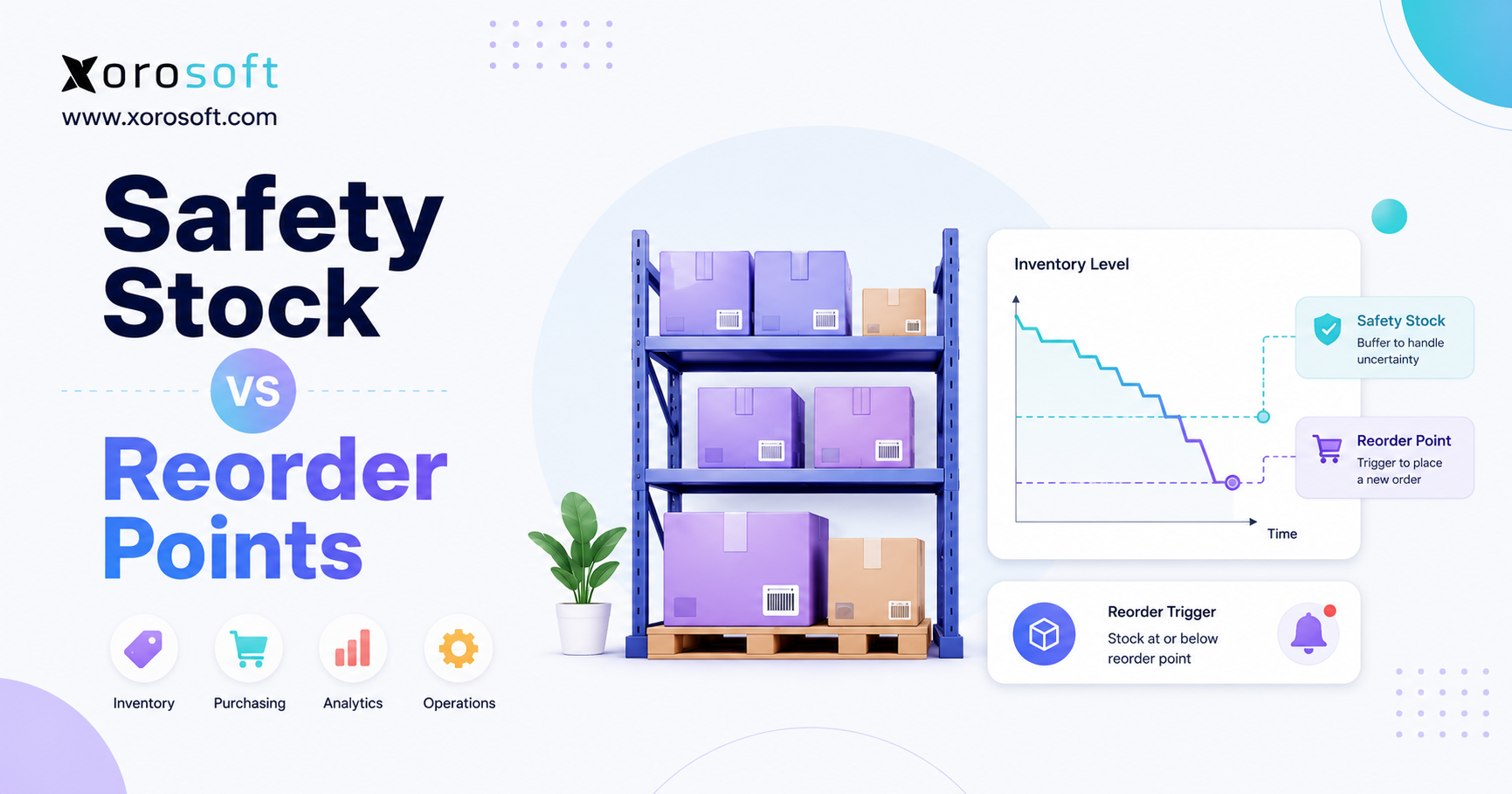
The simple difference is this: safety stock is the buffer, while the reorder point is the trigger.
Safety stock protects the business from uncertainty. The stock threshold tells the business when to act. Therefore, safety stock is not a replacement for replenishment planning. Instead, it usually becomes part of the calculation.
When teams miss that distinction, they either carry too much stock or order too late. In both cases, the business pays for weak inventory planning.
2. Reorder Point and Safety Stock: Quick Answer
A reorder point is the inventory level where the business should replenish stock. Safety stock is the extra inventory held as protection against demand spikes, supplier delays, and forecast errors.
| Factor | Safety Stock | Reorder Point |
|---|---|---|
| Main role | Protects against uncertainty | Triggers replenishment |
| Main question | How much buffer should we hold? | When should we reorder? |
| Operational use | Stockout protection | Purchasing or transfer timing |
| Main risk controlled | Demand and supply variability | Late replenishment |
| Formula relationship | Added as a buffer | Includes safety stock |
According to Shopify’s reorder point guide, a common formula is:
Reorder Point = Daily Sales Velocity × Lead Time + Safety Stock
2.1 Safety Stock Is the Buffer
Safety stock is the extra quantity a business carries above expected demand. Therefore, it protects the company when real conditions do not match the plan.
For example, a supplier may usually deliver in 10 days. During peak season, though, that same supplier may take 16 days. Similarly, a product may usually sell 20 units per day but occasionally sell 40. In both cases, safety stock protects availability.
2.2 The Stock Threshold Is the Trigger
The reorder point is the inventory threshold that tells the team when to buy, transfer, or produce more stock. In practical terms, it turns planning into action.
Without a clear threshold, replenishment becomes reactive. Someone notices a low-stock item, checks a spreadsheet, asks the warehouse, and then creates a purchase order. Unfortunately, that delay can create stockouts before replenishment arrives.
2.3 Why Both Numbers Matter Together
Safety stock and reorder points work best together. Safety stock creates the buffer. The replenishment trigger tells the team when to act before the business starts using that buffer too aggressively.
For example, if a product sells 20 units per day, supplier lead time is 10 days, and safety stock is 50 units, the calculation is:
20 × 10 + 50 = 250 units
So, when available inventory reaches 250 units, the team should reorder.
2.3.1 Short Operator Example
Imagine a growing ecommerce brand sells a best-selling backpack. The product sells consistently, but supplier lead time changes during peak season. If the team only watches on-hand inventory, it may order too late. With a reliable reorder point that includes safety stock, purchasing gets a clearer signal before the business runs out.
3. What Is Safety Stock?
Safety stock is extra inventory kept as a buffer against uncertainty. It helps protect the business when demand rises, suppliers ship late, forecasts are wrong, or warehouse transfers take longer than expected.
Although safety stock sounds simple, the number should not be random. Instead, it should reflect actual demand patterns, supplier reliability, lead time, seasonality, and service expectations.
3.1 Safety Stock Definition
Safety stock is the reserve quantity a business keeps beyond expected demand. For example, if a product needs 500 units to cover normal demand during supplier lead time, the business may keep another 100 units as safety stock.
Those extra 100 units are not the main supply plan. They are the protection layer. Because of that, safety stock helps reduce the chance that one supplier delay or demand spike becomes a stockout.
3.2 Why Businesses Carry Safety Stock
Businesses carry safety stock because inventory planning is never perfect. Forecasts are estimates. Suppliers have delays. Customers place unexpected orders. Promotions perform differently than expected.
For that reason, safety stock gives the business room to absorb variation. Without it, a small planning error can quickly become lost revenue, delayed shipments, rushed freight, or unhappy customers.
3.3 What Safety Stock Protects Against
Safety stock protects against several operational risks. Each risk affects the business differently, so the buffer should reflect the actual cause of uncertainty.
3.3.1 Demand Spikes
Demand spikes happen when actual sales exceed the forecast. This can happen because of promotions, seasonality, marketplace activity, influencer mentions, retail launches, or large wholesale orders.
As a result, fast-moving SKUs often need stronger safety stock planning than slow, predictable products.
3.3.2 Supplier Delays
Supplier delays increase the time between ordering and receiving stock. Even a strong reorder point can fail if lead time assumptions are outdated.
For example, if a supplier normally takes 14 days but starts taking 21 days, the replenishment threshold must change. Otherwise, the business may keep ordering based on old information.
3.3.3 Forecasting Errors
Forecasts help teams plan demand. Every forecast, however, has some level of error.
Because of that, safety stock protects the business when demand is higher than expected. It also gives teams more time to react before customers feel the problem.
3.3.4 Warehouse Transfer Delays
Multi-warehouse businesses often move inventory between locations. Company-wide inventory can look healthy while one warehouse is close to stockout.
Therefore, safety stock should be reviewed by warehouse, not only at the company level.
4. What Is a Reorder Point?
A reorder point is the inventory level that tells the business when to replenish stock. It can trigger a purchase order, warehouse transfer, or production order.
In practice, this threshold prevents late ordering. Instead of waiting until inventory is almost gone, the business uses demand and lead time data to replenish earlier.
4.1 Reorder Point Definition
A reorder point is the minimum inventory level where replenishment should begin. It is usually calculated by combining expected demand during lead time with safety stock.
The basic formula is:
Reorder Point = Average Daily Demand × Lead Time + Safety Stock
Therefore, this number is not just a low-stock warning. It is an operational threshold that connects inventory planning with purchasing.
4.2 Why Replenishment Thresholds Are Used
Replenishment thresholds help businesses avoid reactive buying. Without them, teams often reorder only after someone notices a problem.
Noticing low stock is not the same as planning replenishment. If supplier lead time is 30 days, the business needs to act long before the shelf looks empty.
As a result, a reorder point helps purchasing teams create orders at the right time.
4.3 What Happens When Inventory Hits the Threshold
When inventory hits the replenishment threshold, the business should review inventory needs. Depending on the operation, that may mean creating a purchase order, transferring stock, or starting production.
4.3.1 Purchase Order Creation
For purchased goods, the reorder point can trigger a purchase order review. Buyers should still check open purchase orders, supplier minimums, cash flow, and forecast changes before finalizing the order.
4.3.2 Warehouse Replenishment
For multi-warehouse businesses, the threshold may trigger a transfer instead of a new purchase. One warehouse may be low while another warehouse has excess stock.
4.3.3 Supplier Review
A replenishment signal also gives buyers a chance to review supplier performance. If lead times are changing, the calculation should change as well.
4.3.4 Forecast Adjustment
If the threshold triggers too often, demand may be higher than expected. On the other hand, if inventory sits too long after replenishment, the business may be overbuying.
5. Safety Stock vs Reorder Point: Key Differences
The main difference between safety stock and a reorder point is purpose. Safety stock protects the business from uncertainty. The inventory threshold tells the business when to replenish.
| Comparison Area | Safety Stock | Reorder Point | Business Impact |
| Purpose | Creates a buffer | Triggers action | Reduces stockout risk |
| Timing | Held before the problem | Used when stock drops | Improves buying discipline |
| Formula role | Added to the calculation | Uses safety stock as input | Connects planning to purchasing |
| Main risk | Demand or supply variability | Late replenishment | Protects revenue and service levels |
| Team impact | Planning and finance | Purchasing and operations | Aligns decisions across departments |
5.1 Difference by Purpose
Safety stock answers: “How much extra inventory should we carry?”
The reorder point answers: “When should we order more?”
Both questions matter. However, they solve different problems. Safety stock reduces risk, while the replenishment trigger creates timing discipline.
5.2 Difference by Formula
The formula usually includes safety stock:
Reorder Point = Average Daily Demand × Lead Time + Safety Stock
Safety stock formulas vary. A simple version is:
Safety Stock = Maximum Daily Usage × Maximum Lead Time − Average Daily Usage × Average Lead Time
Therefore, safety stock is one input. The reorder point is the final trigger.
5.3 Difference by Inventory Timing
Safety stock exists before uncertainty hits. Meanwhile, the threshold activates when inventory falls to a specific level.
Because of that, safety stock is passive protection. The replenishment signal is active decision-making.
5.4 Difference by Business Risk
Safety stock controls uncertainty risk. A reorder point controls timing risk.
If safety stock is too low, the business may stock out during demand spikes. If the inventory threshold is too low, the business may order too late even when the safety stock number looks reasonable.
5.5 Difference by Operational Ownership
Safety stock and reorder points affect multiple teams. Purchasing, warehouse, finance, operations, and sales all depend on accurate inventory planning.
5.5.1 Purchasing Team Responsibility
Purchasing teams use the reorder point to decide when to review replenishment. They also need supplier lead times, minimum order quantities, price breaks, and open purchase orders.
5.5.2 Warehouse Team Responsibility
Warehouse teams need accurate inventory counts. If on-hand stock is wrong, the replenishment trigger becomes unreliable.
5.5.3 Finance Team Responsibility
Finance teams care because safety stock ties up cash. Too little stock creates lost sales. Too much stock creates working capital pressure.
6. How Safety Stock and Reorder Points Work Together
Safety stock and reorder points should not be managed separately. They should work as one replenishment system.
Safety stock protects the business when reality changes. The reorder point tells the business when to act before that protection is gone.
6.1 Safety Stock Feeds the Calculation
Safety stock usually sits inside the formula.
For example:
- Average daily demand: 30 units
- Supplier lead time: 12 days
- Safety stock: 100 units
Reorder Point = 30 × 12 + 100
Reorder Point = 460 units
Without safety stock, the trigger would be 360 units. That lower number gives the business less protection if demand increases or the supplier ships late.
6.2 Replenishment Rules Turn Planning into Action
Safety stock is a planning decision. The reorder point is an operating trigger.
Once inventory reaches that level, someone must act. That action may be a purchase order, transfer order, production order, or supplier review.
This is why Shopify’s safety stock vs reorder point guide explains that safety stock is included in the formula. The two numbers work together rather than separately.
6.3 Why One Number Without the Other Creates Risk
A business can have safety stock and still reorder late. It can also have replenishment thresholds and still carry too little buffer.
Because of that, the better inventory process uses both numbers together.
6.3.1 High Safety Stock Without Reorder Discipline
High safety stock can hide weak planning. The business may avoid some stockouts, but it may also carry too much inventory.
As a result, cash gets trapped in products that may not move fast enough.
6.3.2 Replenishment Triggers Without Safety Stock
A trigger without safety stock assumes demand and lead time will behave normally. Normal conditions, however, do not always happen.
Therefore, weak buffer planning can fail during promotions, supplier delays, or seasonal demand spikes.
6.3.3 Static Rules in a Changing Business
A reorder point should not stay fixed forever. Demand changes. Lead times shift. Supplier performance improves or worsens. Channel mix also changes.
Consequently, growing businesses need regular review cycles for safety stock and replenishment rules.
7. Safety Stock Formula Explained
Safety stock can be calculated in different ways. The best method depends on business size, demand variability, supplier reliability, and data quality.
Smaller teams may use a simple formula. Larger businesses may need more advanced calculations by SKU, warehouse, supplier, and channel.
7.1 Basic Safety Stock Formula
A simple approach is to set safety stock based on expected extra demand during supplier delay.
For example, if a product sells around 200 units per week and the supplier may be delayed by one week, the business may carry 200 units of safety stock.
Although this method is easy, it can become too rough as the business grows.
7.2 Safety Stock Formula Using Maximum Demand and Lead Time
A more structured formula is:
Safety Stock = Maximum Daily Usage × Maximum Lead Time − Average Daily Usage × Average Lead Time
Example:
- Maximum daily usage: 40 units
- Maximum lead time: 15 days
- Average daily usage: 25 units
- Average lead time: 10 days
Safety Stock = 40 × 15 − 25 × 10
Safety Stock = 600 − 250
Safety Stock = 350 units
Therefore, the business would carry 350 units as a buffer.
7.3 Safety Stock Formula Using Service Level
Larger businesses may use service-level-based safety stock. This approach considers demand variability, lead time variability, and the target probability of avoiding stockouts.
For example, a business targeting a 98% service level will usually carry more safety stock than a business targeting 90%. That higher service level, however, also increases inventory investment.
7.4 Which Safety Stock Formula Should You Use?
The right formula depends on how much uncertainty exists in your operation.
| Formula Type | Best For | Data Required | Limitation |
| Fixed safety stock | Small teams | Basic sales history | Too simple for complex operations |
| Maximum-average formula | Growing brands | Demand and lead time history | Can overstate unusual peaks |
| Service-level formula | Larger operations | Variability data | Requires cleaner data |
| System-based planning | Multi-location businesses | Sales, inventory, supplier, and warehouse data | Requires process discipline |
7.4.1 Simple Formula for Smaller Teams
Smaller teams should start with something practical. A perfect formula is less useful than a simple formula the team actually reviews.
Still, the business should update safety stock when demand, suppliers, or sales channels change.
7.4.2 Advanced Formula for Larger Inventory Operations
Larger teams should use more detailed planning. For example, a business with thousands of SKUs needs to separate fast movers, slow movers, seasonal items, imported products, and high-risk suppliers.
Therefore, one safety stock rule should not apply to every product.
7.4.3 ERP-Based Safety Stock Calculation
ERP-based planning becomes useful when the business needs item-level and warehouse-level control. Instead of managing one spreadsheet, teams can connect sales history, purchase orders, warehouse stock, supplier lead times, and forecasts.
As a result, safety stock becomes part of a broader inventory planning system.
8. Reorder Point Formula Explained
The reorder point formula tells your team when to replenish inventory. It combines demand, lead time, and safety stock into one operating threshold.
Because this number directly affects purchasing timing, it should be based on accurate and current data.
8.1 Basic Reorder Point Formula
The simplest formula is:
Reorder Point = Average Daily Demand × Lead Time
This version works when the business does not carry safety stock. Most growing businesses, though, need some buffer because demand and supply are rarely perfectly stable.
8.2 Formula With Safety Stock
The stronger formula is:
Reorder Point = Average Daily Demand × Lead Time + Safety Stock
For example:
- Average daily demand: 15 units
- Supplier lead time: 20 days
- Safety stock: 80 units
Reorder Point = 15 × 20 + 80
Reorder Point = 380 units
Therefore, the business should reorder when available inventory reaches 380 units.
8.3 Lead Time Demand Explained
Lead time demand is the quantity expected to sell while the business waits for replenishment.
For example, if a product sells 25 units per day and the supplier takes 12 days to deliver, lead time demand is:
25 × 12 = 300 units
Then, if safety stock is 100 units, the replenishment threshold becomes:
300 + 100 = 400 units
8.4 Calculation by SKU and Location
A reorder point should usually be calculated by SKU and location. This matters because one warehouse may serve ecommerce orders, while another serves wholesale customers.
| Input | Meaning | Example | Why It Matters |
| Average daily demand | Expected daily sales | 25 units | Shows normal consumption |
| Lead time | Days to receive stock | 12 days | Defines the risk window |
| Safety stock | Extra buffer | 100 units | Protects against uncertainty |
| Available inventory | Stock available to sell | 425 units | Shows current position |
| Open purchase orders | Inventory already ordered | 300 units | Prevents duplicate buying |
8.4.1 Single-Warehouse Planning
A single-warehouse business has simpler planning. However, the reorder point still needs accurate demand, lead time, and safety stock data.
8.4.2 Multi-Warehouse Planning
A multi-warehouse business needs separate thresholds by location. Otherwise, one warehouse may stock out while another holds excess inventory.
8.4.3 Ecommerce Channel Planning
Ecommerce inventory rules should reflect demand across Shopify, Amazon, marketplaces, and other selling channels. Because online demand can shift quickly, replenishment rules must be reviewed often.
8.4.4 Manufacturing Material Planning
Manufacturers need reorder points for raw materials, components, packaging, and finished goods. If one component runs out, production can stop even when finished goods demand is strong.
9. Safety Stock and Reorder Point Example
A practical example shows how safety stock and reorder points work together.
9.1 Example Scenario
A business sells a popular backpack.
- Average daily demand: 25 units
- Supplier lead time: 12 days
- Safety stock: 100 units
- Current available inventory: 425 units
The business wants to know when to reorder.
9.2 Step 1: Calculate Average Daily Demand
Average daily demand is 25 units.
This number should come from recent and reliable sales data. If demand is seasonal, the team should not rely only on a long-term average.
9.3 Step 2: Calculate Lead Time Demand
Lead time demand is:
25 × 12 = 300 units
This means the business expects to sell 300 units while waiting for replenishment.
9.4 Step 3: Add Safety Stock
Now add safety stock:
300 + 100 = 400 units
Therefore, the reorder point is 400 units.
9.5 Step 4: Set the Replenishment Trigger
Since current available inventory is 425 units, the business is close to its reorder point. If another 25 units sell today, the team should review replenishment.
This is where the threshold becomes useful. It does not wait for a stockout. Instead, it gives the business a signal while there is still time to act.
9.5.1 Example for Shopify Inventory
A Shopify brand may set reorder points before a promotion. If sales increase quickly, the replenishment signal helps the team buy before inventory reaches a dangerous level.
For Shopify merchants that need a deeper operational layer, Xorosoft ERP on the Shopify App Store is one example of an ERP app built for ecommerce, retail, and wholesale operations.
9.5.2 Example for Wholesale Inventory
A wholesale distributor may keep more safety stock for products tied to important customer accounts. Because large orders can consume stock quickly, the reorder point should reflect account-level demand.
9.5.3 Example for Manufacturing Materials
A manufacturer may set reorder points for raw materials used across several finished goods. If one material supports many SKUs, its planning threshold should be reviewed carefully.
10. Common Reorder Point Mistakes Businesses Make
Safety stock and reorder points are simple in theory. They become difficult when a business manages many SKUs, warehouses, suppliers, and channels.
10.1 Treating Safety Stock as a Fixed Number
Safety stock should change when demand, supplier lead time, or service expectations change.
For example, a stable product may need a small buffer. A seasonal product, however, may need a larger buffer before peak demand. Therefore, fixed safety stock can create problems when the business changes.
10.2 Using the Same Threshold for Every Warehouse
Different warehouses often serve different demand patterns. One warehouse may support Shopify orders. Another may serve wholesale customers. A third may feed retail stores.
Because of that, the same reorder point should not be copied across every location.
10.3 Ignoring Supplier Lead Time Changes
Lead time is one of the most important inputs. If supplier lead time increases, the reorder point should usually increase too.
Many teams forget to update lead times. As a result, stock thresholds stay too low, and purchasing happens too late.
10.4 Forgetting Open Purchase Orders
Open purchase orders matter because inventory may already be on the way. If buyers ignore them, they may over-order.
However, open purchase orders should not be treated as available inventory until the receipt date is reliable.
10.5 Not Accounting for Seasonal Demand
Seasonal demand changes inventory planning logic. Apparel, sporting goods, furniture, food, and consumer products often have demand patterns tied to launches, holidays, weather, promotions, or retail buying cycles.
Therefore, seasonal SKUs need more frequent reorder point review.
10.6 Managing Replenishment Rules in Spreadsheets Too Long
Spreadsheets can work early. They become risky, however, when the business needs live data from sales channels, warehouses, suppliers, purchasing, and accounting.
The issue is not that spreadsheets are bad. The issue is that they often sit outside the systems where inventory actually changes.
10.6.1 Spreadsheet Version Control Problems
When multiple people update different spreadsheet versions, no one knows which reorder point is current.
Consequently, the business may buy late, buy twice, or miss the signal completely.
10.6.2 Delayed Purchasing Decisions
Manual updates slow down purchasing. By the time a buyer sees that inventory crossed the threshold, the business may already be several days late.
10.6.3 Stockouts Hidden by Bad Data
If inventory counts are wrong, the reorder point is wrong too. Therefore, a correct formula still fails when the data behind it is inaccurate.
Inventory planning checkpoint: If your replenishment process depends on spreadsheet updates, manual stock checks, and delayed purchasing reviews, it may be time to evaluate whether your operating system can still support growth.
11. Reorder Point Planning by Business Type
Different businesses use safety stock and reorder points differently. Although the formula may look similar, the operating risk changes by industry.
| Business Type | Main Inventory Risk | Safety Stock Focus | Reorder Point Focus |
| Ecommerce | Demand spikes | Promotion and channel volatility | Fast replenishment |
| Wholesale | Large customer orders | Account-level availability | Bulk purchase timing |
| Manufacturing | Material shortages | Component buffers | Production continuity |
| Apparel | Variant complexity | Size and color coverage | Seasonal timing |
| Food | Expiry and freshness | Controlled buffers | Waste reduction |
11.1 Ecommerce Brands
Ecommerce brands often face sudden demand changes. A campaign, marketplace event, influencer post, or seasonal push can change sales velocity quickly.
Therefore, ecommerce reorder point planning should be reviewed more often than static wholesale or B2B planning.
11.1.1 Shopify Inventory Planning
Shopify inventory planning needs accurate stock, fast replenishment signals, and channel-level demand visibility.
Because Shopify demand can move quickly, brands should not rely only on manual low-stock checks. Instead, they should define inventory thresholds for important SKUs before demand spikes happen.
11.1.2 Amazon Inventory Planning
Amazon may require different inventory planning because marketplace demand and fulfillment expectations can differ from owned ecommerce demand.
As a result, the reorder point should reflect total demand across channels, not just one storefront.
11.1.3 Multi-Channel Stock Availability
When Shopify, Amazon, wholesale, and retail orders pull from the same inventory pool, planning logic must consider all demand sources.
Otherwise, one channel can consume inventory that another channel already expected to use.
11.2 Wholesale Distributors
Wholesale distributors often manage customer-specific pricing, large orders, EDI, and allocation rules.
Because wholesale demand can arrive in larger chunks, reorder points should reflect more than average daily sales.
11.2.1 Customer-Specific Demand
A key customer may place an order that consumes weeks of available stock. Therefore, safety stock should reflect account-level commitments.
11.2.2 EDI Order Volume
EDI orders can move quickly through the business. If inventory thresholds are not connected to real stock data, large orders may create shortages before purchasing reacts.
11.2.3 Allocation Across Customers
When supply is limited, the business needs to decide which customers receive available stock. Therefore, replenishment planning should connect with allocation rules.
11.3 Manufacturers
Manufacturers use stock thresholds for raw materials, components, packaging, work-in-progress, and finished goods.
Because one missing component can delay production, material planning often matters as much as finished goods planning.
11.3.1 Raw Material Safety Stock
Raw material safety stock protects production when suppliers ship late or production demand changes.
However, carrying too much material can also tie up cash and warehouse space.
11.3.2 BOM and Component Planning
Bill of materials planning matters because each finished product depends on multiple components.
Therefore, one weak reorder point can disrupt several finished goods.
11.3.3 Production Lead Times
Production lead time should be included in planning. A finished product may require supplier lead time, manufacturing time, quality checks, packaging, and receiving.
11.4 Apparel and Fashion Brands
Apparel brands face variant-level complexity. A style may include many sizes, colors, seasons, and sales channels.
Therefore, reorder point planning should not happen only at the style level.
11.4.1 Size and Color Variants
Some variants sell faster than others. For example, a medium black hoodie may need a different threshold than an extra-small seasonal color.
11.4.2 Seasonal Collections
Seasonal collections need careful safety stock. Too little stock creates missed sales. Too much stock creates markdown pressure after the season ends.
11.5 Food and Beverage Businesses
Food and beverage companies must balance availability with expiry risk.
Therefore, safety stock should prevent stockouts without creating waste.
11.5.1 Expiry Dates
Too much safety stock can create spoilage or write-offs. Because of that, food businesses need tighter replenishment review.
11.5.2 Lot Tracking
Lot tracking helps businesses ship the right stock first and manage quality issues. Therefore, inventory planning should connect with warehouse and batch controls.
12. When Spreadsheets Stop Working for Reorder Points
Spreadsheets can support early inventory planning. They become risky when replenishment decisions depend on live data from sales channels, suppliers, warehouses, purchasing, and accounting.
This is often where businesses start looking at connected systems such as XoroONE, especially when inventory, purchasing, accounting, warehouse management, and reporting need to work together.
12.1 Too Many SKUs
A spreadsheet may work for 50 SKUs. It becomes much harder with thousands of SKUs, variants, bundles, raw materials, packaging items, and location-specific reorder points.
As a result, teams spend more time maintaining the file than improving the inventory plan.
12.2 Too Many Warehouses
Multi-warehouse inventory needs location-level planning. One warehouse may be overstocked while another is close to stockout.
Therefore, a company-wide reorder point is not enough. Each warehouse may need its own threshold.
12.3 Too Many Channels
Shopify, Amazon, wholesale, EDI, and retail orders can all consume inventory.
Because of that, planning must reflect total demand. If every channel is managed separately, stock availability becomes unreliable.
12.4 Too Many Manual Updates
Manual updates create lag. Even if the spreadsheet is accurate on Monday, it may be wrong by Friday.
Therefore, fast-moving businesses need stock thresholds that update with actual transactions.
12.5 Too Much Cash Tied Up in Inventory
Poor planning can create both stockouts and overstock. If the reorder point is too low, the business buys late. If it is too high, the business may carry too much inventory.
As a result, finance teams often feel the impact through cash flow, working capital, and inventory valuation.
13. How ERP Systems Improve Reorder Point Planning
ERP systems improve replenishment planning by connecting inventory, purchasing, warehouse operations, accounting, forecasting, and reporting.
The issue is not only the formula. More importantly, the issue is whether the business has reliable data behind the formula.
13.1 Real-Time Inventory Visibility
A reorder point depends on accurate available inventory. If the system does not know what is on hand, committed, incoming, or allocated, the calculation cannot work properly.
For inventory-driven companies, XoroERP helps centralize operations when teams have outgrown disconnected accounting apps, spreadsheets, and inventory-only tools.
13.2 Automated Reorder Alerts
An ERP can alert the team when inventory falls to the reorder point. The alert becomes more useful when it also considers open purchase orders, committed stock, warehouse location, and supplier lead time.
Therefore, the team does not just see that stock is low. It sees why action is needed.
13.3 Purchasing Automation
Replenishment planning should connect directly to purchasing. When a product reaches its stock threshold, buyers should be able to review supplier details, minimum order quantities, open purchase orders, and expected receipt dates.
As a result, purchasing becomes more proactive and less dependent on manual spreadsheet checks.
13.4 Forecasting and Demand Planning
Safety stock should reflect uncertainty. Therefore, demand forecasting plays an important role in setting better reorder points.
If demand is trending upward, the threshold may need to increase. When demand is slowing, the business may need to reduce safety stock before overbuying.
13.5 Multi-Warehouse Replenishment
Multi-warehouse businesses need location-specific planning. A warehouse serving wholesale accounts may need different rules than one serving Shopify orders.
For warehouse-heavy operations, XoroWMS can support the warehouse side of inventory accuracy, fulfillment, and operational visibility.
13.6 Accounting and Inventory Valuation
Inventory planning affects finance. Too little stock can reduce revenue, while too much stock ties up cash.
Therefore, reorder point planning should connect with accounting, reporting, and inventory valuation. If inventory quantities are wrong, financial reporting becomes harder.
13.6.1 Why Inventory Planning Affects Finance
Every extra unit held as safety stock has a cost. That cost may include capital, storage, handling, insurance, shrinkage, and obsolescence.
Because of that, finance teams should care about replenishment logic as much as operations teams do.
13.6.2 Why Month-End Accuracy Depends on Inventory Data
If inventory counts are wrong, inventory valuation can be wrong. When valuation is wrong, month-end close becomes slower and less reliable.
See the operating workflow: When replenishment thresholds affect purchasing, warehouse execution, accounting, and forecasting, a connected ERP process is usually stronger than a spreadsheet process.
14. Software Evaluation Checklist for Reorder Point Planning
Not every business needs ERP immediately. However, every growing inventory business needs to know when its current process is no longer enough.
| Capability | Spreadsheet | Inventory Software | ERP |
| Basic reorder point tracking | Yes | Yes | Yes |
| Multi-warehouse inventory | Manual | Sometimes | Yes |
| Purchasing workflows | Manual | Limited | Yes |
| Accounting connection | No | Limited | Yes |
| Forecasting | Manual | Sometimes | Yes |
| Manufacturing planning | No | Limited | Yes |
| Shopify and Amazon workflows | Manual exports | Sometimes | Yes |
| EDI and wholesale support | No | Limited | Yes |
| Reporting and visibility | Limited | Sometimes | Yes |
14.1 When Spreadsheets Are Enough
Spreadsheets may be enough when the business has few SKUs, one warehouse, stable suppliers, simple demand, and a small team.
However, the team should still review reorder points regularly. Even small businesses can stock out if demand changes and the spreadsheet does not.
14.2 When Inventory Software Is Enough
Inventory software may be enough when the business needs better stock visibility but does not yet need accounting, purchasing automation, manufacturing, forecasting, or advanced reporting in one system.
However, once replenishment planning affects several departments, inventory-only software may start to feel limited.
14.3 When ERP Becomes the Better Fit
ERP becomes a better fit when inventory planning touches many parts of the business.
For example, a company may need Shopify inventory sync, Amazon operations, wholesale ordering, EDI, purchasing, warehouse management, accounting, forecasting, and manufacturing workflows. In that case, it may be useful to review Xorosoft solutions or explore the industries Xorosoft serves to see how different inventory-driven businesses manage complexity.
14.4 Questions to Ask Before Choosing Software
Before choosing software, ask whether the system improves the full replenishment process or only stores inventory counts.
14.4.1 Does It Support Multi-Warehouse Inventory?
If the business operates multiple warehouses, reorder points should work by location.
Otherwise, the company may have enough total inventory but still disappoint customers because the right warehouse is out of stock.
14.4.2 Does It Connect Purchasing and Accounting?
Purchasing affects cash flow, inventory valuation, landed cost, and reporting. Therefore, reorder point planning should not sit outside accounting.
14.4.3 Does It Support Shopify, Amazon, and EDI?
Multi-channel businesses need replenishment logic that reflects all demand sources. Otherwise, one channel can drain inventory before another channel receives its allocation.
14.4.4 Does It Handle Forecasting and Reporting?
Forecasting helps teams set better safety stock. Reporting helps them review whether replenishment thresholds are working.
If a business is comparing systems, it may also help to review focused comparison pages such as Xorosoft vs QuickBooks or Xorosoft vs Cin7 when those tools are part of the current stack.
15. FAQs About Reorder Point and Safety Stock
15.1 What is safety stock?
Safety stock is extra inventory kept as a buffer against demand spikes, supplier delays, forecast errors, and operational disruptions. It helps reduce the risk of stockouts when actual conditions differ from the plan. However, safety stock should not be random. It should reflect demand variability, lead time risk, supplier reliability, and the importance of the SKU.
15.2 What is a reorder point?
A reorder point is the inventory level that tells a business when to replenish stock. When available inventory reaches this threshold, the team should create a purchase order, transfer stock, or start production. Therefore, the reorder point helps the business order before inventory runs out.
15.3 What is the difference between safety stock and reorder point?
Safety stock is the buffer. The reorder point is the trigger. Safety stock protects against uncertainty, while the stock threshold tells the team when to replenish. In most inventory planning formulas, safety stock is included in the calculation.
15.4 Is safety stock the same as a reorder point?
No, safety stock and a reorder point are not the same. Safety stock is extra inventory held for protection. The threshold is the inventory level that triggers replenishment. However, they are connected because safety stock is often part of the formula.
15.5 Does safety stock affect the reorder point?
Yes, safety stock affects the reorder point. When safety stock increases, the trigger level usually increases as well. As a result, the business orders earlier and has more protection against demand spikes or supplier delays.
15.6 What is the reorder point formula?
The common reorder point formula is:
Reorder Point = Average Daily Demand × Lead Time + Safety Stock
This formula covers expected demand during lead time and adds extra protection for uncertainty.
15.7 What is the safety stock formula?
One common safety stock formula is:
Safety Stock = Maximum Daily Usage × Maximum Lead Time − Average Daily Usage × Average Lead Time
Larger businesses, however, may use more advanced formulas based on service levels and demand variability.
15.8 How do you calculate a reorder point with safety stock?
First, calculate average daily demand. Next, multiply that number by supplier lead time. Then, add safety stock. For example, if demand is 20 units per day, lead time is 10 days, and safety stock is 50 units, the reorder point is 250 units.
15.9 What comes first, safety stock or reorder point?
Safety stock usually comes first because it is an input in the formula. Once the business defines safety stock, it can add that number to lead time demand to calculate the reorder point.
15.10 Can a reorder point be lower than safety stock?
Usually, a reorder point should not be lower than safety stock. Since the threshold often includes lead time demand plus safety stock, it is normally higher. If the number is lower, the formula or assumptions may be wrong.
15.11 Can safety stock be zero?
Yes, safety stock can be zero for very stable products with predictable demand and reliable suppliers. However, zero safety stock creates risk. Therefore, most growing inventory businesses keep at least some buffer for important SKUs.
15.12 What happens if safety stock is too high?
If safety stock is too high, the business ties up cash, uses warehouse space, and increases the risk of obsolete inventory. This is especially risky for seasonal, perishable, fashion, or fast-changing products.
15.13 What happens if the reorder point is too low?
If the reorder point is too low, the business may order too late. As a result, it can face stockouts, backorders, rushed shipping, missed revenue, and poor customer experience.
15.14 How often should reorder points be updated?
Reorder points should be updated whenever demand, supplier lead time, warehouse strategy, sales channels, or seasonality changes. Fast-moving SKUs may need frequent review, while stable SKUs may need less frequent review.
15.15 How often should safety stock be reviewed?
Safety stock should be reviewed regularly, especially for high-value, fast-moving, seasonal, or supplier-sensitive products. If demand volatility or lead time variability changes, safety stock should change too.
15.16 How does lead time affect the reorder point?
Longer lead time usually increases the reorder point because the business must cover more days of demand while waiting for replenishment. Conversely, shorter lead time may allow a lower inventory threshold.
15.17 How does demand variability affect safety stock?
Higher demand variability usually requires more safety stock. If sales are stable, the business can carry a smaller buffer. However, if demand changes sharply, more safety stock may be needed to reduce stockout risk.
15.18 What is lead time demand?
Lead time demand is the expected quantity a business will sell or consume while waiting for replenishment. It is usually calculated as average daily demand multiplied by supplier lead time.
15.19 What is buffer stock?
Buffer stock is another name for safety stock. It means extra inventory held to protect the business against demand changes, supplier delays, production issues, or fulfillment delays.
15.20 Is a reorder point the same as minimum stock?
Not always. Minimum stock may refer to the lowest acceptable stock level. A reorder point is the level that triggers replenishment. However, some teams use these terms loosely, so the business should define them clearly.
15.21 What is the difference between reorder point and reorder quantity?
The reorder point tells the business when to order. Reorder quantity tells the business how much to order. For example, a product may hit a stock threshold at 400 units, but the buyer may order 1,000 units because of supplier minimums or forecasted demand.
15.22 What is the difference between reorder point and EOQ?
A reorder point determines when to order. EOQ, or economic order quantity, helps determine how much to order by balancing ordering costs and carrying costs. Therefore, they answer different inventory planning questions.
15.23 How does ERP calculate reorder points?
ERP systems can calculate reorder points using demand, lead time, safety stock, open purchase orders, warehouse location, supplier performance, and forecast data. More advanced setups can calculate thresholds by SKU and warehouse.
15.24 Can Shopify calculate safety stock?
Shopify can support inventory tracking, and Shopify also provides educational guidance on safety stock and reorder points. Growing brands, however, often need deeper planning when purchasing, accounting, warehouses, forecasting, and multiple sales channels must work together.
15.25 When should businesses stop using spreadsheets for reorder points?
Businesses should consider moving beyond spreadsheets when they manage many SKUs, multiple warehouses, Shopify, Amazon, wholesale orders, EDI, manufacturing, or purchasing workflows. The tipping point usually comes when manual updates delay decisions or create inventory errors.
15.26 What software helps automate safety stock and reorder points?
Inventory management software and ERP systems can help automate safety stock and reorder points. ERP is usually a better fit when the business also needs purchasing, accounting, warehouse management, forecasting, manufacturing, reporting, Shopify, Amazon, or EDI workflows.
15.27 How do wholesalers use safety stock?
Wholesalers use safety stock to protect availability for key accounts, large orders, EDI demand, and supplier delays. Because wholesale demand can arrive unevenly, safety stock helps maintain service levels when important customers place large orders.
15.28 How do manufacturers use reorder points?
Manufacturers use reorder points for raw materials, components, packaging, and finished goods. A replenishment threshold can trigger purchasing or production before materials run out and disrupt work orders.
15.29 How do multi-warehouse businesses manage reorder points?
Multi-warehouse businesses should manage reorder points by location. Each warehouse may have different demand, lead time, transfer rules, and customer commitments. Therefore, company-wide inventory is not enough if local stock availability is poor.
15.30 What is the best way to reduce stockouts?
The best way to reduce stockouts is to combine accurate inventory counts, realistic safety stock, updated reorder points, reliable supplier lead times, demand forecasting, and disciplined purchasing workflows. When manual processes become too slow, software can help connect the process.
16. The Inventory Planning Takeaway
The reorder point is one of the simplest inventory planning ideas, but it has a major impact on daily operations. It tells your team when to act before inventory becomes a customer-facing problem.
Safety stock matters because business conditions change. Demand spikes, suppliers delay shipments, forecasts miss reality, and warehouses do not always move inventory exactly as planned. For that reason, safety stock gives the business protection.
However, safety stock without a reorder point is just a buffer with no trigger. Meanwhile, a stock threshold without safety stock can be too fragile for real-world operations. The strongest inventory planning process uses both.
16.1 The Practical Difference
The practical difference is clear. Safety stock protects the business from uncertainty. The reorder point tells the team when to replenish.
Because of that, teams should not ask which one matters more. Instead, they should ask whether both numbers are accurate, current, and connected to real inventory data.
16.2 The Operational Lesson
The formula matters, but the system matters more.
A reorder point based on bad inventory data will still fail. A safety stock number that never changes will become outdated. A spreadsheet that does not connect to purchasing, warehouse operations, accounting, Shopify, Amazon, wholesale, EDI, or manufacturing workflows will eventually create blind spots.
Therefore, the next step is not only calculating a better reorder point. The bigger step is building a better replenishment process.
16.3 When to Upgrade Your Inventory Planning System
A business should consider upgrading when inventory planning becomes too complex for manual work.
That may happen when the company adds warehouses, expands into wholesale, starts manufacturing, sells through Shopify and Amazon, uses EDI, or needs better forecasting and purchasing automation.
For inventory-driven companies, Xorosoft helps centralize inventory management, purchasing, warehouse management, manufacturing, accounting, forecasting, and reporting in one cloud ERP system.
Ready to clean up your replenishment process?
If your team manages safety stock and reorder points across multiple SKUs, warehouses, suppliers, and channels, Book a demo to see how a connected ERP can support better inventory planning.
Recent Posts
-
 ERP Landed Cost Module vs Spreadsheet Calculations for Importers
 -
 How to Build an Open-to-Buy Plan for an Omnichannel Brand
 -
 Cold Storage WMS for Food and Beverage Distribution
 -
 ERP Buying Statistics 2026: Evaluation, Implementation, and Adoption Risks
 -
 How a Distributor Reduced B2B Order Exceptions Without Restricting Sales