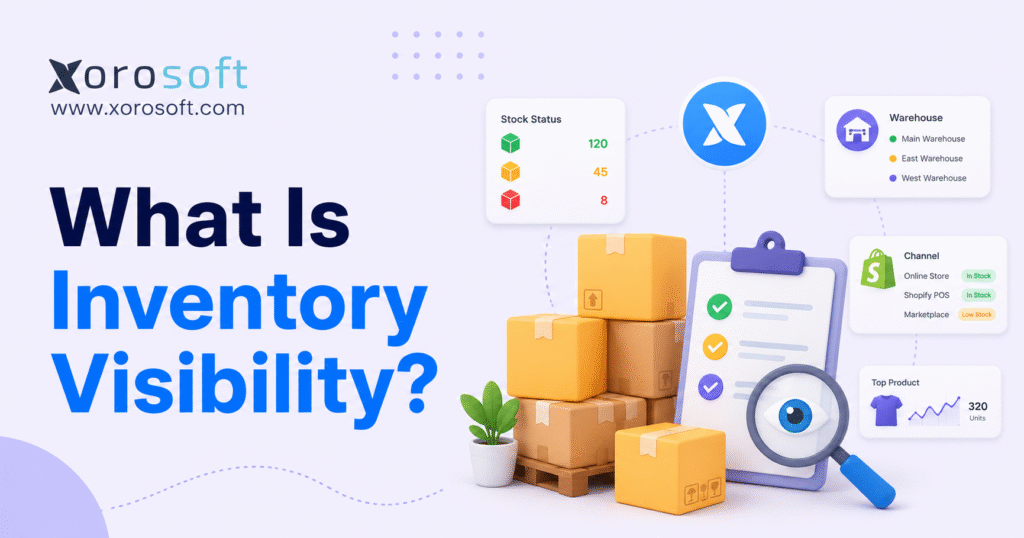
If you are looking for comprehensive information, this Inventory Visibility Guide is designed to help you understand and optimise your inventory processes.
1. Inventory Visibility Guide for Businesses Outgrowing Basic Systems
Inventory visibility becomes a serious business issue when a company grows faster than its systems can support. Early on, inventory may feel easy to control because a small team can check shelves, review Shopify stock, update a spreadsheet, or ask the warehouse for a quick answer.
That approach becomes fragile once the business adds more SKUs, more orders, more sales channels, more warehouses, and more people.
A growing product business does not only need to know how many units it has in stock. Teams also need to know where those units sit, whether customers can buy them, whether another order already uses them, whether more stock will arrive soon, and whether accounting has the correct inventory value.
That is where reliable stock visibility becomes operationally important.
Without clear inventory visibility, different teams start making decisions from different versions of the truth. Sales teams may promise inventory that another order or channel already uses. Purchasing may reorder products that already exist in another warehouse. Customer service may not know whether an order can ship. Accounting may struggle to reconcile inventory value at month-end.
This Inventory Visibility Guide helps growing product businesses understand stock across channels, warehouses, and systems more clearly. As operations become more complex, better visibility helps teams replace manual checks, delayed spreadsheets, and disconnected warehouse updates with a more reliable operating process.
Poor stock visibility creates stockouts, overstock, delayed fulfillment, inaccurate reports, and avoidable cash flow pressure. For ecommerce, wholesale, manufacturing, and multi-warehouse businesses, inventory visibility is no longer a “nice to have.” It becomes one of the foundations of operational control.
2. What This Inventory Visibility Guide Means in Real Operations
A clear Inventory Visibility Guide starts with one practical idea: growing businesses need accurate, up-to-date inventory data across warehouses, sales channels, suppliers, fulfillment locations, and internal systems.
In daily operations, that visibility clarifies current stock, warehouse location, sellable availability, committed quantities, and replenishment needs.
Basic inventory lists may show units on hand. Strong stock visibility goes further by showing inventory status across the full business operation, including products that teams can sell, reserve, inspect, transfer, replenish, allocate, or commit to orders.
For that reason, this Inventory Visibility Guide explains not only what inventory data means, but also how teams use that data to make better operational decisions.
2.1 This Inventory Visibility Guide Goes Beyond a Stock Count
A stock count tells a business what physically exists at one point in time. Strong inventory visibility explains what that stock means for sales, fulfillment, purchasing, and accounting.
For example, a warehouse may physically have 500 units of a product, but wholesale orders, customer reservations, damage, or future ecommerce demand may reduce the sellable quantity. In that case, the business does not truly have 500 units available to sell.
This is why stock visibility matters. It helps teams understand available inventory, committed inventory, reserved inventory, damaged inventory, inbound inventory, and inventory in transfer.
2.2 Real-Time Inventory Visibility Shows What Teams Can Act On
Real-time inventory visibility means inventory updates as transactions happen. When warehouse teams receive, pick, pack, ship, return, transfer, or adjust products, the system reflects those changes quickly.
Stale inventory data creates poor decisions. If a buyer uses yesterday’s stock report, they may reorder too late. When Shopify shows outdated availability, the business may oversell. If the warehouse sees incorrect bin quantities, fulfillment slows down.
Real-time stock visibility helps teams act with confidence because they can see the current inventory position instead of relying on old reports.
2.3 Inventory Data Visibility Connects Stock to Business Decisions
Inventory visibility affects more than warehouse work. Buyers need to know when to reorder. Sales teams need to know what they can promise. Customer service needs fast answers about availability. Finance depends on accurate inventory valuation, while leadership needs to understand where cash sits in inventory.
With trusted inventory data, teams make faster and cleaner decisions. They also spend less time chasing updates across spreadsheets, emails, warehouse messages, and disconnected apps.
3. Why an Inventory Visibility Guide Matters for Growing Businesses
Inventory visibility matters because inventory connects directly to revenue, cash flow, customer experience, and operational efficiency.
When inventory data stays accurate and accessible, teams can prevent problems before they become expensive. Scattered or delayed data, however, forces the business to react after issues already affect customers, warehouses, or purchasing decisions.
Strong stock visibility gives purchasing, warehouse, sales, and finance teams a shared view of what is actually happening. For growing product businesses, this Inventory Visibility Guide shows why visibility often separates proactive planning from constant firefighting.
3.1 This Inventory Visibility Guide Helps Prevent Stockouts
Stockouts happen when customers want to buy a product that the business cannot fulfill. Unexpected demand can cause stockouts, but many shortages come from weak visibility into available stock, committed stock, and incoming inventory.
A Shopify brand may believe a product is available because the item appears in stock online. Meanwhile, the same inventory may already support wholesale orders or wait for transfer to another warehouse.
Better visibility helps prevent that situation. Teams can see true available-to-sell inventory instead of relying only on physical stock counts.
3.2 Stock Visibility Helps Reduce Overstock
Poor inventory visibility does not only cause stockouts. It also causes overstock.
When purchasing teams cannot see inventory across all locations, they may order more products than needed. One warehouse may appear low on stock while another warehouse has excess inventory. Instead of transferring stock, the company places another purchase order.
Overstock ties up cash, increases storage costs, and raises the risk of markdowns, expiry, damage, or obsolescence. Strong stock visibility helps teams buy more intentionally and use existing inventory before creating more purchasing commitments.
3.3 Better Inventory Visibility Improves Fulfillment Accuracy
Warehouse teams need accurate location-level inventory data. If they do not know where products sit, whether another order already picked the stock, or whether quantities match the system, fulfillment becomes slower and more error-prone.
Poor visibility leads to manual searching, incorrect picks, split shipments, delayed orders, and customer complaints. Better inventory visibility supports faster receiving, putaway, picking, packing, shipping, and returns handling.
3.4 Inventory Visibility Supports Smarter Purchasing
Purchasing decisions should not depend on guesswork. Buyers need current stock levels, sales velocity, open purchase orders, supplier lead times, reorder points, and demand forecasts.
Without those inputs, purchasing becomes reactive. Teams either wait too long to reorder or buy too much inventory too early.
With better visibility, purchasing teams can plan based on real demand and actual stock position.
3.5 Stock Visibility Improves Customer Experience
Customers expect accurate availability, fast fulfillment, and clear communication. If a website says a product can ship but the warehouse cannot fulfill the order, trust drops quickly.
Customer service also needs visibility. If a customer asks whether an item can ship this week, the team should not need to call the warehouse, check a spreadsheet, and wait for a manual answer.
Clear stock visibility gives customer-facing teams better information and helps them protect the relationship.
4. How Stock Visibility Differs From Tracking, Accuracy, and Management
Inventory visibility, inventory tracking, and inventory accuracy work together, but each term means something different. Understanding the difference helps businesses diagnose the real problem.
4.1 Tracking Shows Movement, While Visibility Shows Usable Stock Data
Inventory tracking records stock movement. It shows when inventory moves through receiving, transfers, picking, packing, shipping, returns, adjustments, and cycle counts.
Visibility makes that information accessible and useful across the business. Tracking creates the data, while visibility turns that data into operational awareness.
A company may track inventory movements but still struggle with visibility when separate systems hold the data or updates move too slowly.
4.2 Accuracy Confirms the Numbers Behind Stock Visibility
Inventory accuracy means system records match physical stock. If the system says Warehouse A has 100 units and the warehouse actually has 100 units, the inventory record is accurate.
Visibility depends on accuracy, but it goes further. The data must stay timely, accessible, connected, and useful for decision-making.
Accurate data hidden in one department does not help enough. The right teams need the right inventory information when they need it.
4.3 Clear Visibility Makes Inventory Management Work Better
Inventory management covers the broader process of planning, buying, storing, moving, selling, and valuing inventory. Visibility supports that process by showing teams what inventory exists, where it sits, and how the business can use it.
A company cannot manage inventory well if it cannot see inventory clearly.
4.4 Quick Comparison for Inventory Visibility Terms
Tracking records movement. Accuracy confirms whether system records match reality. Broader inventory management covers buying, storing, moving, selling, and valuing stock.
Inventory visibility connects these ideas because it helps teams see the right data at the right time and use it to make better operational decisions.
5. What This Inventory Visibility Guide Reveals About Poor Stock Control
Disconnected systems, manual processes, delayed warehouse updates, and unclear ownership usually create poor inventory visibility.
As businesses grow, these gaps become more visible. Shopify, QuickBooks, spreadsheets, inventory apps, warehouse tools, purchasing files, EDI systems, and reporting exports may each hold a different part of the truth.
This Inventory Visibility Guide also helps businesses identify where visibility breaks down, especially when Shopify, QuickBooks, spreadsheets, warehouse apps, and purchasing tools fail to share data properly. The longer a company delays fixing visibility, the more manual reconciliation its team must perform.
5.1 Disconnected Systems Create Conflicting Inventory Data
Many product businesses run on a stack that includes Shopify, QuickBooks, spreadsheets, inventory apps, warehouse tools, purchasing files, EDI systems, and reporting exports.
Each system may solve a specific problem. However, when the systems do not share data properly, every team sees a different version of inventory.
That creates duplicate entry, reconciliation work, delayed updates, and decision-making confusion.
5.2 Spreadsheets Limit Real-Time Stock Visibility
Spreadsheets help early-stage teams organize inventory because they offer flexibility and familiarity. They also give teams a low-cost way to start planning stock.
However, spreadsheets do not support real-time inventory visibility well. They become risky when multiple people edit different versions, warehouse activity changes quickly, or sales channels need live availability.
A spreadsheet may show what inventory looked like yesterday. Operations need to know what inventory looks like now.
5.3 Delayed Warehouse Updates Reduce Inventory Visibility
Warehouse activity changes inventory constantly. Receiving, picking, packing, shipping, returns, adjustments, and transfers all affect availability.
If warehouse updates move slowly, the entire business operates on outdated information. This risk grows when order volume increases because a delay of even a few hours can create overselling, missed replenishment, and fulfillment errors.
5.4 Multi-Channel Selling Makes Stock Visibility Harder
Selling through Shopify, Amazon, wholesale, retail, and EDI creates allocation challenges. Each channel may need access to inventory, but not every unit should appear available everywhere.
For example, a wholesale customer may have reserved stock. Shopify may need ecommerce availability. Amazon may require a separate allocation.
Without multi-channel stock visibility, one channel can accidentally consume inventory intended for another.
5.5 Multi-Warehouse Operations Add Location Complexity
A business may have enough inventory overall but still fail to fulfill efficiently if stock sits in the wrong place. Multi-warehouse inventory visibility helps teams understand stock by location, not just total quantity.
For example, a product may sit in an East Coast warehouse while demand comes from the West Coast. The business can still fulfill the order, but shipping may cost more and delivery may take longer.
5.6 Manual Purchasing Workflows Hide Incoming Inventory
Incoming stock forms part of inventory visibility. If purchase orders live in spreadsheets or email threads, other teams may not know what will arrive and when.
Sales may not know whether the business can fulfill a backorder, while warehouse and finance teams may lack receiving and purchasing visibility.
Connected purchasing workflows make inbound inventory easier to plan around.
6. Signs Your Business Has an Inventory Visibility Problem
A company may not say, “We have poor inventory visibility.” Instead, the problem appears through daily operational symptoms.
6.1 Teams Do Not Trust Inventory Numbers
If employees constantly say, “Let me check the warehouse,” the team does not trust the system.
Manual checks may still happen in some situations, but they should not drive every stock decision. When teams stop trusting the system, work slows down and decisions become inconsistent.
6.2 Stockouts Happen Even When Inventory Exists Somewhere
A business may have inventory in one location but still fail to fulfill an order. This happens when teams cannot see stock by warehouse, channel, allocation status, or commitment status.
The product exists, but the business cannot use it effectively.
6.3 Overstock Builds Up in the Wrong Locations
Poor inventory visibility often creates stock imbalance. One warehouse runs out while another warehouse carries excess inventory.
Instead of transferring stock, the business may buy more. That increases inventory carrying cost and ties up cash unnecessarily.
6.4 Customer Service Cannot Confirm Availability
Customer service teams need quick and accurate answers. If they cannot confirm whether an order can ship, customers lose confidence.
This issue becomes especially painful for wholesale and B2B accounts because availability promises can affect larger orders and long-term relationships.
6.5 Purchasing Decisions Depend on Guesswork
If buyers rely on spreadsheets, manual reports, or gut feel, replenishment becomes risky.
The business may overbuy slow-moving products while underbuying fast-moving products. Over time, that creates both stockouts and excess inventory.
6.6 Accounting Struggles With Inventory Valuation
Inventory works as a financial asset. If operational records and accounting records do not match, month-end close becomes harder.
The result can include delayed reconciliation, inaccurate cost of goods sold, and unclear margin reporting.
7. How Real-Time Inventory Visibility Works
Real-time inventory visibility connects stock movements, sales activity, purchasing, warehouse execution, and reporting into one reliable flow of data.
A useful Inventory Visibility Guide should show how stock data moves from warehouse activity to sales channels, purchasing workflows, and financial reporting. When warehouse scans, sales channels, and purchase orders all feed the same inventory view, the business can trust its stock position.
7.1 Centralized Inventory Data Creates One Source of Truth
The first requirement is centralized inventory data. This does not always mean every tool disappears. It means the business has one trusted operational source for inventory status.
That source should show on-hand stock, available stock, committed stock, incoming stock, reserved stock, damaged stock, and inventory in transfer.
7.2 Warehouse Scanning Improves Inventory Visibility
Barcode scanning improves visibility because warehouse teams capture inventory movement at the point of activity.
When warehouse teams receive a product, scan it into a bin, pick it for an order, pack it, ship it, return it, or transfer it, the system updates based on the actual warehouse action.
This reduces manual entry and improves location accuracy.
7.3 Sales Channel Sync Keeps Stock Visibility Current
Sales channels need accurate availability. Shopify, Amazon, wholesale portals, EDI channels, and retail systems should receive inventory data that reflects real stock status.
If sales channels do not synchronize properly, overselling and underselling become common.
7.4 Purchasing Visibility Shows What Comes Next
Inventory visibility should include open purchase orders, expected delivery dates, supplier lead times, and inbound quantities.
A product may be out of stock today, but if a purchase order arrives next week, sales and customer service need that information.
7.5 Forecasting Visibility Helps Teams Plan Ahead
Inventory visibility should not only show what happened. It should help teams anticipate what comes next.
Forecasting connects current inventory, historical sales, open orders, seasonality, supplier lead times, and replenishment rules. When those inputs remain visible, teams can plan before shortages occur.
8. Types of Inventory Visibility Businesses Need
Not every company needs the same type of inventory visibility. The right model depends on how the business sells, stores, buys, and fulfills products.
8.1 Real-Time Inventory Visibility
Real-time inventory visibility helps businesses with high order volume, fast-moving SKUs, or multiple sales channels keep stock availability aligned with actual operations.
This visibility matters most when small delays can quickly create overselling, backorders, or missed replenishment.
8.2 Multi-Warehouse and Multi-Channel Stock Visibility
Multi-warehouse stock visibility shows inventory by location. Multi-channel visibility helps businesses manage availability across Shopify, Amazon, wholesale, retail, marketplaces, and EDI.
The goal should not simply show all stock everywhere. Instead, teams need to allocate inventory correctly by location and channel.
8.3 Financial and Manufacturing Inventory Visibility
Financial inventory visibility connects stock movement to accounting, inventory valuation, landed costs, cost of goods sold, and reconciliation. Manufacturing visibility adds raw materials, components, work-in-progress, finished goods, bills of materials, and work orders.
When these areas do not connect, accounting teams clean up data manually and production teams plan with incomplete information.
9. Inventory Visibility by Business Model
Inventory visibility looks different depending on the business model. Ecommerce, wholesale, manufacturing, and retail teams all need visibility, but they need it for different reasons.
9.1 Ecommerce Inventory Visibility
Ecommerce businesses need fast and accurate stock visibility because online orders move quickly. If stock levels show the wrong quantities, overselling can happen before the team notices.
Ecommerce visibility should connect sales channels, warehouse activity, returns, fulfillment status, and available-to-sell inventory.
9.2 Shopify Inventory Visibility
Shopify gives ecommerce merchants useful inventory capabilities, including product stock levels and inventory adjustments. However, growing Shopify brands often need broader visibility when operations extend beyond Shopify.
For example, a Shopify brand may also sell through Amazon, wholesale, retail, EDI, and multiple warehouses. It may manage purchasing in spreadsheets and accounting in QuickBooks. At that stage, Shopify still plays an important role, but it no longer acts as the entire inventory system.
For merchants that need a connected operational layer behind Shopify, the Xorosoft ERP app for Shopify merchants can fit naturally into the broader inventory workflow.
9.3 Wholesale Inventory Visibility
Wholesale businesses need visibility into customer-specific commitments, bulk orders, allocation rules, EDI transactions, and replenishment timelines.
A single wholesale order can consume a large amount of inventory. If ecommerce channels also access that stock, overselling can happen quickly.
9.4 Manufacturing Inventory Visibility
Manufacturers need visibility across raw materials, components, work orders, WIP, and finished goods.
Production planning depends on accurate stock data. If one component runs short, the entire work order may slow down.
9.5 Multi-Warehouse Inventory Visibility
Businesses with multiple warehouses need to know more than total stock. They need location-level visibility.
A product may exist somewhere in the network but not in the correct warehouse. That affects shipping cost, delivery speed, and customer experience.
10. Inventory Visibility Guide to Software Options
Businesses usually improve inventory visibility by moving through different system stages. Each stage can work for a while, but each has limits.
This Inventory Visibility Guide compares spreadsheets, inventory apps, WMS tools, and ERP systems so teams can understand which option fits their stage of growth.
10.1 Spreadsheets for Early Inventory Visibility
Spreadsheets work when the business is small, the SKU count stays limited, and inventory does not change too quickly.
However, spreadsheets become risky as order volume increases. Teams update them manually, and the files can break or fall behind quickly.
10.2 Inventory Apps for Better Stock Visibility
Inventory apps can improve stock tracking, channel sync, and basic inventory control.
They often help businesses that need more structure than spreadsheets but do not yet need a full ERP system.
10.3 WMS for Warehouse Inventory Visibility
A warehouse management system improves warehouse execution. It supports receiving, putaway, bin locations, barcode scanning, picking, packing, shipping, returns, and cycle counting.
For warehouse-heavy businesses, strong warehouse management workflows form a major part of inventory visibility.
10.4 ERP for Business-Wide Inventory Visibility
ERP connects inventory with purchasing, accounting, warehouse management, ecommerce, reporting, and sometimes manufacturing.
A growing business may evaluate an ERP inventory management system when inventory visibility problems start affecting finance, fulfillment, purchasing, and leadership reporting at the same time.
10.5 Cloud ERP for Inventory-Driven Companies
A cloud ERP can help inventory-driven businesses centralize stock, purchasing, accounting, warehouse activity, ecommerce operations, and reporting.
For companies that have outgrown QuickBooks, spreadsheets, and disconnected apps, a cloud ERP for inventory-driven businesses may offer a practical next step.
11. How ERP Improves Inventory Visibility
ERP improves inventory visibility by connecting operational and financial workflows that often sit across different tools.
11.1 Connected Inventory, Purchasing, and Accounting Workflows
Inventory does not operate in isolation. Every purchase order, receipt, shipment, adjustment, and return can affect financial reporting.
ERP helps connect those workflows so operations and accounting do not work from different numbers.
Xorosoft, for example, helps inventory-driven businesses connect inventory management, accounting, purchasing, warehouse management, manufacturing, forecasting, reporting, and ecommerce operations in one cloud ERP platform.
11.2 Multi-Warehouse Inventory Visibility Through ERP
ERP can show stock by warehouse, location, channel, and commitment status. That helps teams understand where inventory sits and how they should use it.
This visibility becomes especially valuable for companies operating multiple warehouses, 3PLs, or fulfillment regions.
11.3 Better Purchasing Visibility With Shared Stock Data
ERP connects purchasing to inventory levels, open orders, supplier lead times, and demand planning.
Instead of buying based on spreadsheets, teams can create purchase decisions from operational data.
11.4 Reporting and Forecasting Visibility for Leadership
ERP reporting helps leadership see inventory performance more clearly. Teams can review stockouts, overstock, inventory turnover, fill rates, backorders, and forecast accuracy.
Xorosoft supports this type of connected visibility for businesses that need inventory, purchasing, warehouse, accounting, and reporting data in one place.
12. Inventory Visibility Metrics to Track
Inventory visibility needs measurement because teams need to know whether stock data has become more reliable. Useful metrics include inventory accuracy rate, stockout rate, overstock value, order fill rate, backorder rate, forecast accuracy, and inventory turnover.
12.1 Inventory Accuracy and Fill Rate
Inventory accuracy shows whether system records match physical stock. Order fill rate shows how often teams can fulfill orders completely from available inventory.
Together, these metrics reveal whether teams can trust stock data.
12.2 Stockouts, Overstock, and Backorders
Stockout rate shows where missed sales happen. Overstock value shows where excess inventory ties up cash. Backorder rate shows how often customers must wait because the business cannot ship immediately.
These metrics help teams identify whether the problem sits in purchasing, forecasting, warehouse execution, or channel allocation.
12.3 Forecast Accuracy
Forecast accuracy compares expected demand to actual demand. Better visibility improves forecasting because teams can use cleaner data from sales, stock movement, open orders, and supplier timelines.
When forecast accuracy improves, purchasing teams can buy with more confidence and reduce emergency replenishment.
13. How to Improve Inventory Visibility
Improving inventory visibility requires both better systems and better processes. Software helps, but process discipline matters just as much.
The most important lesson in this Inventory Visibility Guide is that better visibility starts with cleaner workflows, not just better reports. A business does not improve visibility by reporting on bad data; it improves visibility by fixing how teams capture, update, and share inventory data.
13.1 Centralize Inventory Data for Better Visibility
The first step is to reduce fragmented inventory records. If Shopify, QuickBooks, warehouse apps, purchasing spreadsheets, and accounting reports all show different inventory numbers, the business needs one source of operational truth.
That source should help each team understand the same stock position without creating extra reconciliation work.
13.2 Connect Sales Channels to Inventory Visibility
Sales channels should receive accurate availability. Shopify, Amazon, wholesale portals, retail systems, and EDI channels need stock data that reflects current operations.
This helps reduce overselling, underselling, and channel conflict.
13.3 Improve Warehouse Scanning and Location Visibility
Barcode scanning and bin-level location tracking help improve inventory accuracy.
Receiving, putaway, picking, packing, returns, transfers, and adjustments should update inventory records quickly. When warehouse teams capture movement at the source, everyone else can trust the downstream data.
13.4 Track Committed and Reserved Inventory
On-hand stock does not equal available stock. Some inventory may already support sales orders, wholesale reservations, production demand, quality inspection, or transfer activity.
Tracking these statuses gives teams a clearer picture of what customers can actually buy.
13.5 Improve Purchasing and Replenishment Visibility
Purchasing should connect to demand, supplier lead times, open purchase orders, current stock levels, and sales velocity.
This helps prevent both stockouts and overstock. It also gives buyers a better way to prioritize urgent replenishment.
14. Common Inventory Visibility Mistakes
Many inventory visibility problems come from decisions that made sense at an earlier stage of growth.
14.1 Treating Shopify as the Entire Inventory System
Shopify works well as an ecommerce platform, but growing product businesses often need visibility beyond online selling.
If inventory also depends on wholesale, purchasing, Amazon, EDI, manufacturing, accounting, and multiple warehouses, Shopify alone may not show the full operational picture.
14.2 Depending Too Long on Spreadsheets
Spreadsheets help teams get started, but they become harder to control as complexity grows.
When multiple teams update spreadsheets manually, visibility becomes delayed and unreliable.
14.3 Tracking On-Hand Stock but Ignoring Available Inventory
A business may know how much stock exists physically but still not know what customers can buy.
Committed, reserved, damaged, incoming, and transferred inventory all matter.
14.4 Ignoring Warehouse Process Design
Software cannot fix weak warehouse processes by itself.
Receiving, putaway, picking, packing, returns, transfers, and cycle counting need clear workflows. Without process discipline, inventory data becomes unreliable.
14.5 Forgetting Financial Inventory Visibility
Inventory visibility should support accounting. If operations and finance use different numbers, month-end close becomes slower and less accurate.
Clean inventory data helps accounting teams calculate inventory value, cost of goods sold, and margin more confidently.
14.6 Choosing Inventory Visibility Software Without Operational Fit
A system should match the business model. Apparel, furniture, sporting goods, food, wholesale, and manufacturing businesses all need visibility, but their workflows differ.
Businesses comparing ERP options such as Xorosoft, NetSuite, Acumatica, Cin7, Brightpearl, Fishbowl, Sage, or Business Central should compare workflows, implementation fit, and operating model alignment. Companies reviewing ERP options can also explore a modern ERP alternative for inventory-driven teams.
15. Inventory Visibility Guide for Software Evaluation
Choosing inventory visibility software requires more than checking feature boxes. The system needs to support how the business actually operates.
This Inventory Visibility Guide should also help teams evaluate ERP, WMS, or inventory management platforms with a workflow-first mindset.
15.1 Real-Time Inventory Visibility Requirements
A strong system updates inventory as transactions happen. Delayed updates create overselling, fulfillment issues, and poor purchasing decisions.
Teams should look closely at how quickly the system updates inventory after receiving, picking, shipping, returns, transfers, and adjustments.
15.2 Multi-Warehouse Stock Visibility Requirements
The system should show inventory by warehouse, bin, location, and availability status. This is critical for companies that fulfill from multiple warehouses or 3PLs.
Location-level visibility also helps teams transfer stock instead of buying more inventory unnecessarily.
15.3 Shopify and Ecommerce Inventory Visibility Requirements
Ecommerce channels need a direct connection to operational inventory data.
Shopify availability should reflect true available-to-sell stock, not outdated or incomplete quantities. The same logic applies to Amazon, wholesale portals, retail stores, marketplaces, and EDI workflows.
15.4 Purchasing and Supplier Visibility Requirements
A strong purchasing workflow shows open purchase orders, expected arrivals, supplier lead times, and replenishment needs. This helps purchasing teams plan instead of reacting.
Sales, customer service, and warehouse teams also benefit because they can see inbound stock more clearly.
15.5 Accounting and Inventory Valuation Requirements
Inventory visibility should connect to accounting. A strong system supports inventory valuation, cost of goods sold, landed costs, and reconciliation.
When inventory operations and accounting stay separate, finance teams spend more time cleaning up numbers after the fact.
15.6 Manufacturing Inventory Visibility Requirements
Manufacturers should evaluate whether the system supports BOMs, work orders, raw materials, WIP, finished goods, and material planning.
Production teams need visibility into component availability before they schedule work.
15.7 Reporting and Forecasting Visibility Requirements
Useful reporting matters more than basic data exports. Leadership should be able to see stockouts, overstock, fill rates, turnover, and forecast accuracy.
Reports should help teams act, not simply describe old problems.
16. Inventory Visibility Use Cases by Industry
Inventory visibility matters across many inventory-heavy industries, but each industry experiences different operational pressure.
16.1 Apparel, Furniture, and Sporting Goods Inventory Visibility
Apparel teams manage sizes, colors, styles, seasons, and returns. Furniture companies deal with bulky products, long lead times, delivery planning, and warehouse space. Sporting goods brands often manage seasonal demand, channel allocation, and product launches.
In each case, visibility helps teams reduce mismatched stock, avoid unnecessary purchasing, and improve fulfillment planning.
16.2 Food, Wholesale, and Manufacturing Inventory Visibility
Food and beverage businesses may need lot tracking, expiry visibility, and rotation rules. Wholesale distributors need visibility into EDI, large orders, reserved stock, and replenishment. Manufacturers need to see components, work orders, WIP, raw materials, and finished goods.
For businesses in inventory-heavy industries, inventory visibility is not just reporting. It supports daily operational execution.
17. Where Xorosoft Fits in an Inventory Visibility Strategy
Xorosoft is a cloud ERP platform built for inventory-driven businesses that sell physical products, manage warehouses, operate purchasing workflows, and need better operational visibility.
It often fits companies that have outgrown QuickBooks, spreadsheets, inventory-only software, and disconnected apps.
17.1 Xorosoft for Shopify, Wholesale, Amazon, and Multi-Warehouse Teams
Xorosoft is particularly relevant for Shopify merchants, Amazon sellers, wholesale distributors, manufacturers, and multi-warehouse businesses that need inventory visibility across channels and locations.
Shopify remains the commerce layer. Xorosoft can support the operational layer behind Shopify, including inventory, purchasing, warehouse management, accounting, and reporting.
17.2 Xorosoft as a Practical ERP Option for Growing Inventory Teams
Teams should not evaluate Xorosoft only as software. They should evaluate it as an operating system for inventory-driven workflows.
For teams comparing ERP systems, it can help to compare workflow fit, implementation complexity, reporting needs, and warehouse requirements before making a decision.
18. Inventory Visibility Guide FAQs
18.1 What is an Inventory Visibility Guide?
An Inventory Visibility Guide explains how businesses track, manage, and use inventory data across warehouses, sales channels, purchasing, fulfillment, and accounting. It helps teams understand available stock, warehouse location, committed quantities, incoming inventory, and the systems they need to keep inventory data accurate.
18.2 What is inventory visibility?
Inventory visibility means a business can see accurate, up-to-date inventory data across warehouses, sales channels, suppliers, and internal systems. A business uses this visibility to understand available stock, warehouse location, committed quantities, and the next action teams need to take.
18.3 Why is inventory visibility important?
Clear visibility matters because it affects stockouts, overstock, fulfillment, purchasing, forecasting, customer service, and accounting. Without it, teams make decisions from incomplete or outdated information.
18.4 How do you improve inventory visibility?
Teams improve inventory visibility by centralizing inventory data, connecting sales channels, improving warehouse scanning, tracking committed stock, automating purchasing, and using better reporting.
18.5 How does ERP improve inventory visibility?
ERP improves inventory visibility by connecting inventory, purchasing, accounting, warehouse management, ecommerce, manufacturing, forecasting, and reporting in one system.
18.6 What is multi-warehouse inventory visibility?
Multi-warehouse inventory visibility means seeing inventory by location across warehouses, stores, 3PLs, or fulfillment centers. It helps teams route orders, transfer stock, and replenish correctly.
18.7 When should a business upgrade to ERP for inventory visibility?
A business should consider ERP when inventory data spreads across Shopify, QuickBooks, spreadsheets, warehouse apps, purchasing tools, and disconnected reports. ERP becomes more important when multiple teams need one trusted view of inventory.
18.8 Can Shopify provide inventory visibility?
Shopify can support ecommerce inventory visibility, especially for product stock levels and basic inventory adjustments. Growing brands often need a broader system when wholesale, Amazon, EDI, purchasing, accounting, manufacturing, and multi-warehouse workflows enter the operation.
18.9 Can QuickBooks provide inventory visibility?
QuickBooks can support accounting and basic inventory needs, but complex inventory operations often require more operational depth. Businesses with multiple warehouses, purchasing teams, ecommerce channels, wholesale orders, or manufacturing workflows usually need stronger inventory visibility.
18.10 What is real-time inventory visibility?
Real-time inventory visibility means the system updates inventory as teams receive, pick, pack, ship, return, transfer, or adjust stock. This helps teams make decisions from current inventory data instead of old reports.
19. Final Takeaway: Use This Inventory Visibility Guide Before Complexity Gets Expensive
This Inventory Visibility Guide helps teams know available inventory, warehouse location, committed quantities, incoming stock, and how that information affects sales, purchasing, fulfillment, accounting, and forecasting.
At a small scale, poor visibility may feel manageable. A team can check shelves, update spreadsheets, and solve problems manually. However, once the business grows across more SKUs, channels, warehouses, suppliers, and teams, manual visibility becomes expensive.
Use this Inventory Visibility Guide as a practical starting point before choosing new software, redesigning warehouse workflows, or upgrading to ERP. The best approach is to improve visibility before operational complexity becomes painful.
That may mean better warehouse workflows, stronger ecommerce integrations, improved purchasing processes, or a move from disconnected systems to ERP.
If inventory visibility affects fulfillment, purchasing, forecasting, warehouse operations, or accounting, it may be time to review whether your current systems can support the next stage of growth.
To see how connected inventory, accounting, purchasing, warehouse management, manufacturing, forecasting, Shopify, Amazon, EDI, and multi-warehouse workflows can work in one cloud ERP platform, you can book a personalized demo with Xorosoft.
Recent Posts
-
 ERP Landed Cost Module vs Spreadsheet Calculations for Importers
 -
 How to Build an Open-to-Buy Plan for an Omnichannel Brand
 -
 Cold Storage WMS for Food and Beverage Distribution
 -
 ERP Buying Statistics 2026: Evaluation, Implementation, and Adoption Risks
 -
 How a Distributor Reduced B2B Order Exceptions Without Restricting Sales