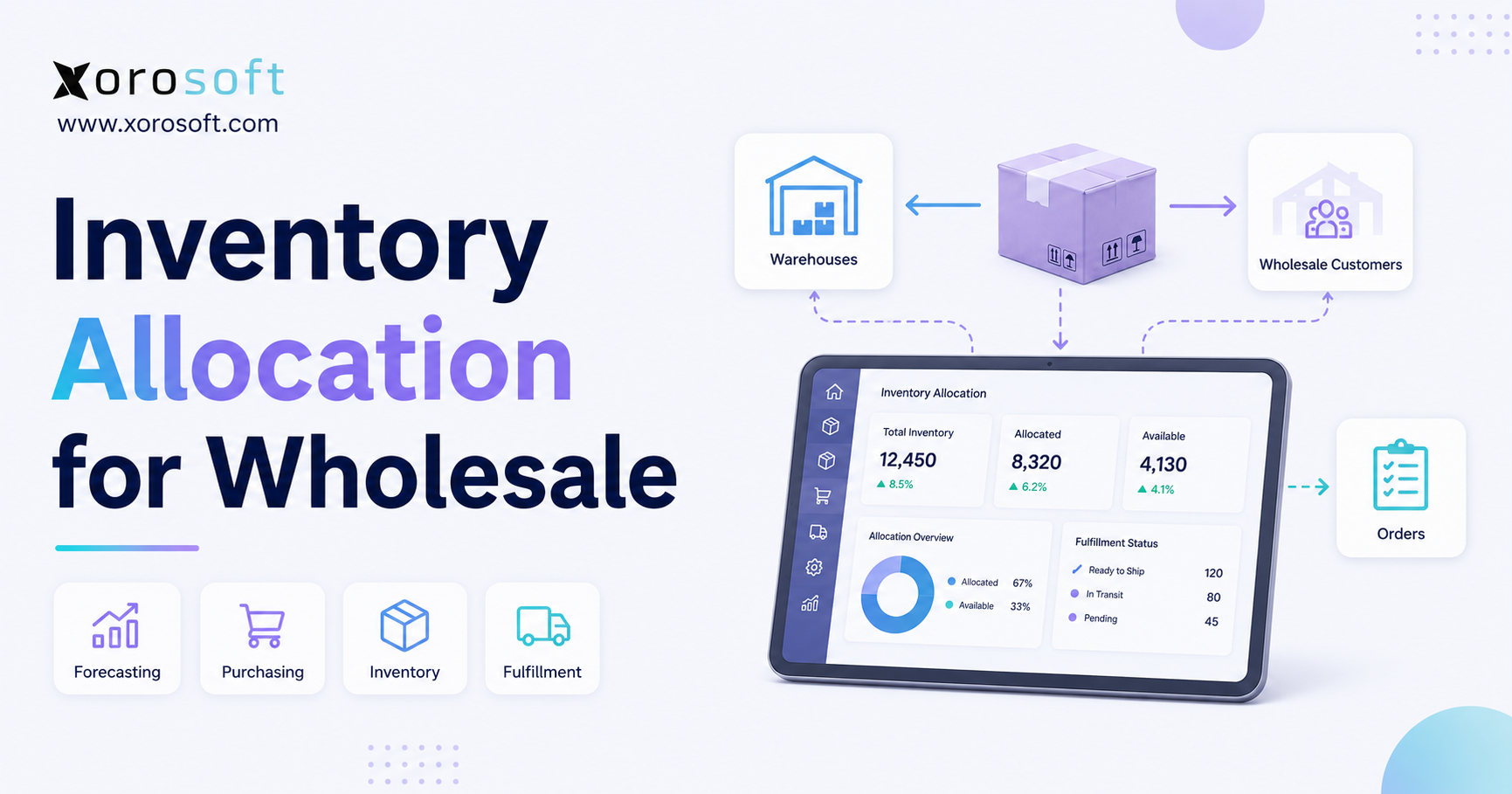
Effective inventory allocation for wholesale is essential for businesses looking to streamline operations and meet customer demand efficiently.
1. Stock Promises Start Breaking Before Inventory Runs Out
Inventory allocation for wholesale starts to matter when your team can no longer trust a single available stock number. At first, the problem looks small. A sales rep promises units to a key account. Meanwhile, Shopify keeps selling the same SKU. Then the warehouse starts picking orders from a number that purchasing, finance, and customer service no longer trust.
Because wholesale businesses sell through commitments, not just checkout pages, inventory decisions carry more weight. A buyer may expect a fixed delivery window. A retail account may send orders through EDI. In addition, a distributor may need stock split across regions, customer tiers, warehouses, and backorders.
However, many growing teams still allocate stock manually. They use spreadsheets, side notes, Slack messages, or memory. As a result, inventory looks available until the exact moment someone needs to ship it.
Wholesale inventory allocation solves this by creating rules for who gets inventory first. Instead of letting every channel compete for the same stock, the business defines how inventory should move across customers, warehouses, sales orders, ecommerce channels, and future demand.
That shift matters because allocation does not only affect the warehouse. It affects sales promises, purchasing decisions, customer service updates, cash flow, and finance accuracy. Therefore, a better allocation process gives the whole business a cleaner way to protect inventory before mistakes reach customers.
2. What Inventory Allocation for Wholesale Really Means
Inventory allocation for wholesale means assigning available or incoming stock to specific customers, orders, warehouses, or channels based on clear business rules. In simple terms, it answers one operational question:
Who should get this inventory first?
For example, a wholesaler may have 1,000 units on hand. However, 400 units may already belong to a key account, 200 may support ecommerce demand, 150 may cover backorders, and 100 may need protection as safety stock. Therefore, the business does not truly have 1,000 units available to sell.
Instead, the team needs a structured view of inventory status.
Inventory allocation becomes especially important when wholesale orders compete with Shopify orders, Amazon orders, EDI orders, retail replenishment, and regional warehouse demand. Because every channel moves at a different speed, a single stock pool can create conflict quickly.
2.1 Available Stock, Allocated Stock, Reserved Stock, and Committed Stock
Wholesale teams need clear definitions before they create allocation rules. Otherwise, sales, warehouse, and finance teams may use the same inventory words differently.
| Inventory Status | What It Means | Wholesale Example | Operational Risk |
|---|---|---|---|
| Available stock | Stock the team can still sell or promise | 500 units remain open for new orders | Teams may overpromise if the number ignores commitments |
| Allocated stock | Stock the team has planned for a customer, channel, or order | 250 units go to a wholesale account | Other channels may consume it if systems do not sync |
| Reserved stock | Stock the team has held for a specific order or need | 100 units stay protected for an approved order | Excess reserves can hide sellable inventory |
| Committed stock | Stock linked to confirmed demand | Units support open sales orders | Finance may lose visibility if commitments sit outside the system |
As a result, allocation needs more detail than “on hand.” A wholesaler needs to know what inventory exists, where it sits, who needs it, and whether anyone has already promised it.
2.2 Inventory Allocation vs Inventory Reservation
Inventory allocation and inventory reservation work together, but they do not mean the same thing.
| Concept | Main Purpose | Typical Question | Wholesale Example |
| Inventory allocation | Decide where stock should go | Who gets inventory first? | 300 units go to wholesale, 200 to ecommerce |
| Inventory reservation | Hold stock so another order cannot take it | Which order should this stock protect? | 50 units stay reserved for Customer A |
Allocation usually starts as a planning decision. Reservation, however, creates stronger control. For example, a brand may allocate a percentage of inventory to wholesale. Then, once a customer submits an approved order, the system may reserve units for that exact order.
Therefore, allocation helps the business plan demand, while reservation helps the business prevent double-selling.
2.3 Inventory Allocation vs Replenishment
Inventory allocation decides how to distribute stock. Replenishment decides when to buy, produce, or transfer more stock.
| Process | Main Question | Main Team | Example |
| Allocation | Who gets available or incoming stock? | Sales, operations, warehouse | Prioritize a key wholesale order |
| Replenishment | What should we reorder or produce next? | Purchasing, planning, manufacturing | Create a purchase order for 2,000 units |
Because both workflows connect, one cannot work well without the other. If allocation shows that incoming stock already belongs to backorders, purchasing must react earlier. Meanwhile, if replenishment ignores allocation, the business may bring in inventory but still send it to the wrong demand.
3. Why Wholesale Inventory Allocation Matters for Growing Businesses
Wholesale inventory allocation matters because B2B operations rely on promises. Those promises may include delivery windows, negotiated terms, customer-specific pricing, compliance rules, and long-term account relationships.
However, poor allocation turns those promises into guesswork.
3.1 Wholesale Allocation Protects Key Customer Orders
Not every order carries the same impact. A strategic account may require stock protection because it drives recurring revenue, supports a seasonal program, or expects a strict delivery date.
Therefore, customer priority rules matter. Instead of letting the oldest order consume all available inventory, the business can protect stock for high-priority accounts where the relationship carries greater long-term value.
This does not mean smaller customers should receive poor service. Instead, it means the business needs clear rules before shortages appear.
3.2 Stock Allocation for Wholesale Reduces Overselling
Overselling usually happens when multiple channels believe the same stock is available. Shopify may show inventory online. A wholesale rep may promise units over email. Meanwhile, Amazon may keep accepting orders, and the warehouse may already have stock staged for another shipment.
As a result, the business sells the same inventory twice.
Strong stock allocation for wholesale reduces this risk because the system subtracts allocated, reserved, and committed stock from the sellable pool. Therefore, every team works from a more realistic number.
3.3 B2B Inventory Allocation Improves Fulfillment Priority
Warehouse teams need clear priorities. If every order looks urgent, supervisors decide manually. However, manual prioritization often favors the loudest request rather than the best business decision.
With B2B inventory allocation, the warehouse can pick based on customer priority, required ship date, channel rules, or stock commitment. Consequently, fulfillment becomes less reactive.
For growing operations, this is where warehouse systems matter. A connected platform such as XoroWMS can support warehouse execution when teams need better visibility across picking, packing, transfers, and shipping.
3.4 Inventory Allocation Improves Purchasing Decisions
Purchasing teams need to know whether incoming inventory is already spoken for. Otherwise, buyers may see a future purchase order and assume it will cover new demand.
However, if that incoming stock already belongs to backorders, the business needs another purchase order, a supplier follow-up, or a transfer plan.
Therefore, allocation gives purchasing a better demand signal. It shows not only what the business has today, but also what the business has already promised.
3.5 Wholesale Stock Allocation Gives Finance Cleaner Visibility
Finance needs accurate inventory value, margin visibility, and month-end reconciliation. However, finance cannot trust inventory numbers if operational teams keep commitments in spreadsheets.
When inventory allocation connects with accounting, finance can see what stock remains available, what stock supports open orders, and where shortages may affect revenue. As a result, margin reporting and cash planning improve.
4. Inventory Allocation Methods for Wholesale Teams
Most wholesale businesses use more than one inventory allocation method. The right method depends on customer relationships, order timing, product type, seasonality, channel mix, and warehouse structure.
| Allocation Method | Best Use Case | Main Risk | Example |
| First-come, first-served | Simple order flow | Key accounts may lose stock | Oldest approved order gets inventory first |
| Customer priority allocation | Strategic wholesale accounts | Smaller accounts may wait longer | Tier 1 customers receive protected stock |
| Channel-based allocation | Wholesale plus ecommerce | One channel may overconsume | 70% wholesale, 30% ecommerce |
| Warehouse-based allocation | Multi-location operations | Stock can sit in the wrong region | East orders ship from East warehouse |
| Forecast-based allocation | Seasonal demand | Weak forecasts distort the plan | More stock goes to high-demand regions |
| Required-date allocation | Delivery commitments | Later but urgent orders may jump ahead | Orders due this week receive stock first |
| Safety stock protection | Volatile demand | Too much stock may sit unused | Keep 200 units protected |
| Exception-based allocation | Special cases | Too many overrides weaken rules | Manager releases stock for a major account |
4.1 First-Come, First-Served Inventory Allocation
First-come, first-served allocation gives inventory to the earliest approved order. This method works for simple wholesale businesses with similar customers and stable supply.
However, it can create problems as the business grows. For example, an early small order may consume inventory that a high-priority retail account needs for a larger shipment. Therefore, first-come, first-served works best only when customer priority does not matter much.
4.2 Customer Priority Allocation
Customer priority allocation gives stock to specific customer tiers first. A wholesaler may rank accounts by revenue, margin, contract terms, payment history, strategic importance, or delivery obligations.
Because wholesale relationships often drive repeat revenue, this method can protect key accounts during shortages. However, the rules must stay transparent. Otherwise, sales teams may argue about priority whenever inventory gets tight.
4.3 Channel-Based Wholesale Stock Allocation
Channel-based allocation splits stock across wholesale, ecommerce, Amazon, retail, or marketplace demand. For example, a brand may protect 60% of inventory for wholesale accounts, keep 30% available for Shopify, and hold 10% as safety stock.
This method works well when channels move at different speeds. However, the business must review the split often because demand can change quickly.
4.4 Warehouse-Based Inventory Allocation
Warehouse-based allocation chooses inventory based on location. This method helps reduce freight costs, shorten delivery times, and avoid unnecessary transfers.
However, the nearest warehouse does not always create the best decision. If that location has low stock or limited labor capacity, another warehouse may fulfill the order more reliably.
4.5 Forecast-Based Inventory Allocation
Forecast-based allocation uses expected demand to direct stock before orders arrive. Apparel, sporting goods, food, furniture, and seasonal consumer products often need this method.
For example, a sporting goods brand may send more inventory to regions where demand spikes before a tournament season. However, because forecasts can miss, teams should combine forecast-based allocation with actual order signals.
4.6 Required-Date Allocation
Required-date allocation gives priority to orders based on delivery commitments. This method works well for wholesale accounts with strict ship windows.
Because delivery failure can damage relationships, required-date rules help teams protect time-sensitive orders. Meanwhile, less urgent orders can wait for incoming supply, transfer stock, or partial shipment.
5. How the Inventory Allocation Process Works in Wholesale
A strong inventory allocation process should guide sales, warehouse, purchasing, customer service, and finance teams. More importantly, it should remove guesswork from daily stock decisions.
5.1 Confirm On-Hand Inventory by SKU and Warehouse
First, the team needs accurate on-hand inventory. This includes SKU, warehouse, bin, lot, batch, and location where relevant.
If the on-hand number is wrong, allocation will fail immediately. Therefore, cycle counts, receiving accuracy, and warehouse discipline matter before any allocation rule can work.
5.2 Separate Available, Allocated, Reserved, and Committed Stock
Next, the business must separate inventory statuses. Available stock should not include units already committed to open orders, protected for key accounts, or reserved for specific shipments.
Because teams often confuse these statuses, a clear inventory system helps reduce arguments. Sales can see what remains sellable. Warehouse teams can see what they should pick. Finance can see what the business has already committed.
5.3 Review Open Sales Orders and Backorders
Then, the team reviews current demand. Open orders show what customers already expect. Backorders show where the business has already failed to fulfill demand.
However, not every open order should receive the same priority. The team should review order date, required ship date, customer tier, margin, channel, payment status, and warehouse location.
5.4 Apply Wholesale Allocation Rules
After that, allocation rules decide which demand gets stock first. These rules may prioritize key accounts, earliest ship dates, backorders, EDI orders, channel commitments, or warehouse proximity.
Because rules can create tradeoffs, leadership should define them before shortages occur. Otherwise, every shortage becomes a negotiation.
5.5 Allocate Stock to Orders, Customers, or Channels
Once the rules are clear, the team can allocate inventory. Depending on the business, this may happen at order level, customer level, channel level, or warehouse level.
For example, a wholesaler may allocate 500 units to a major account, 300 units to ecommerce, and 200 units to backorders. As a result, the remaining available stock becomes more accurate.
5.6 Trigger Purchasing, Transfers, or Production
If demand exceeds supply, allocation should trigger the next decision. Purchasing may need to reorder. Operations may need to transfer stock. Manufacturing may need to adjust work orders. Customer service may need to communicate partial shipment options.
Therefore, allocation should never sit alone. It should connect to the workflows that solve the shortage.
For businesses that need inventory, purchasing, accounting, and fulfillment connected in one system, XoroERP can support the broader operational workflow behind allocation.
5.7 Update Fulfillment, Finance, and Customer Service
Finally, every relevant team needs the updated decision. Warehouse teams need pick priority. Finance needs commitment visibility. Customer service needs accurate delivery information.
Because wholesale customers often ask for updates before shipment, clean allocation data helps the business communicate with confidence.
6. Wholesale Inventory Allocation Rules to Define Before You Scale
Wholesale inventory allocation rules should match how the business actually sells, ships, buys, and reports. Otherwise, the rules may look good on paper but fail in daily operations.
6.1 Which Customers Receive Priority?
Start by defining customer tiers. Priority may depend on revenue, margin, contract terms, strategic value, payment history, account size, or compliance risk.
However, the business should not hide these rules inside one manager’s head. Instead, sales and operations should agree on priority before inventory becomes scarce.
6.2 Should Ecommerce Orders Compete With Wholesale Orders?
Many brands sell both DTC and wholesale. Therefore, ecommerce and wholesale demand often compete for the same units.
If Shopify orders consume inventory too quickly, wholesale commitments may suffer. However, if wholesale allocation blocks too much stock, ecommerce revenue may slow down. A clear channel rule keeps both sides balanced.
6.3 How Much Stock Should Stay Protected?
Safety stock protects the business from supplier delays, damaged goods, returns, demand spikes, and forecast errors.
However, too much safety stock reduces sellable inventory. Therefore, teams should review safety stock by SKU, season, lead time, and demand volatility.
6.4 When Should Backorders Be Allowed?
Backorders can protect revenue, but they can also create customer frustration. Because of that, the business should decide which customers, SKUs, and channels can use backorders.
For example, a key wholesale account may accept a backorder if customer service gives a clear date. Meanwhile, a marketplace order may require immediate availability.
6.5 Which Warehouse Should Fulfill Each Order?
Warehouse rules should consider geography, freight cost, available stock, labor capacity, delivery date, and transfer options.
Although the nearest warehouse often makes sense, it may not always have enough stock. Therefore, multi-warehouse allocation needs both location logic and inventory visibility.
6.6 Who Can Override Allocation Rules?
Manual overrides should exist, but they need control. For example, a manager may release stock for a strategic account during a shortage.
However, if too many people override rules, the process loses value. Therefore, overrides should require approval, notes, and review.
6.7 How Often Should Allocation Rules Change?
Allocation rules should not change every day. However, they should not stay frozen forever either.
As channels grow, suppliers change, and warehouses expand, teams should review allocation rules monthly or quarterly. As a result, the process stays aligned with real business conditions.
7. Inventory Allocation Examples for Wholesale Teams
Inventory allocation for wholesale becomes easier to understand through real operating scenarios. Different industries use similar principles, but the tradeoffs change by product type.
7.1 Apparel Brand Allocating Seasonal Inventory
An apparel brand receives 5,000 units of a seasonal jacket. Wholesale preorders already require 3,200 units. Meanwhile, Shopify demand keeps rising because the product launch performed better than expected.
If the brand lets Shopify consume the full stock pool, wholesale accounts may receive late or partial shipments. Instead, the team can protect confirmed wholesale orders, keep a smaller pool for ecommerce, and reserve safety stock for exchanges or late key-account needs.
As a result, the business protects relationships without shutting off ecommerce growth completely.
7.2 Furniture Distributor Managing Long Lead Times
A furniture distributor may wait 12 to 16 weeks for supplier replenishment. Therefore, every allocation mistake lasts longer.
If several wholesale customers want the same dining table, the distributor should consider requested ship dates, customer priority, regional warehouse stock, freight costs, and incoming purchase orders. In addition, the team may need to offer partial shipment or substitute products.
Because lead times are long, allocation should connect closely with purchasing.
7.3 Sporting Goods Brand Balancing Wholesale and Amazon Demand
A sporting goods brand may launch a product before peak season. Amazon demand may move quickly, while wholesale customers may already have placed early commitments.
Without channel allocation, marketplace demand can consume stock intended for B2B accounts. Therefore, the brand may protect a wholesale pool, set Amazon availability limits, and review demand weekly.
This approach helps the team avoid channel conflict during peak season.
7.4 Food Business Managing Expiry Dates and Batch Priority
Food and beverage wholesalers often need lot, batch, and expiry controls. As a result, allocation must consider more than quantity.
For example, the business may use FEFO logic, customer-specific requirements, and regional availability. However, if the system does not show lot-level inventory accurately, the warehouse may pick the wrong stock.
Therefore, food allocation needs strong warehouse discipline.
7.5 Manufacturer Allocating Finished Goods and Components
Manufacturers must allocate both finished goods and components. For example, finished units may support open wholesale orders, while components may support future work orders.
If sales promises finished goods without checking material availability, production may fall behind. Therefore, manufacturers need allocation rules that connect sales orders, BOMs, purchasing, work orders, and warehouse inventory.
For companies across apparel, furniture, sporting goods, food, wholesale, and manufacturing, the industries we serve page can help map these operational differences by business type.
8. Manual Stock Allocation vs System-Based Inventory Allocation
Manual stock allocation usually starts for practical reasons. A spreadsheet feels flexible, fast, and familiar. However, once order volume grows, the same spreadsheet becomes a control risk.
| Workflow | Manual Allocation | System-Based Allocation |
| Inventory visibility | People update numbers manually | Transactions update availability |
| Order priority | Teams decide case by case | Rules guide the decision |
| Warehouse stock | Staff check locations separately | Users view stock by warehouse |
| Purchase orders | Buyers review separately | Demand connects to purchasing |
| Overrides | Managers handle informally | Permissions control changes |
| Reporting | Teams reconcile later | Dashboards show current status |
8.1 Why Spreadsheet Allocation Breaks Down
Spreadsheets break down because inventory changes constantly. New orders arrive. Returns come back. Warehouse teams adjust quantities. Purchase orders slip. Transfers move stock between locations.
Meanwhile, the spreadsheet only stays accurate if someone updates it at the right time. Therefore, the business eventually makes allocation decisions from old data.
8.2 Why Disconnected Systems Create Allocation Risk
Disconnected systems create similar problems. For example, Shopify may show one availability number, the warehouse may show another, and finance may see inventory only after invoices or adjustments.
As a result, teams spend more time reconciling numbers than making decisions. In addition, customers receive inconsistent answers because each department trusts a different source.
8.3 How ERP-Based Allocation Improves Control
ERP-based allocation improves control because inventory, sales orders, purchasing, warehouse workflows, and accounting operate from one connected structure.
Platforms such as Xorosoft become relevant when inventory-driven businesses need more than basic tracking. The operational value comes from connecting allocation decisions to the transactions that change stock, revenue, purchasing, and fulfillment.
8.4 What Modern Wholesale Teams Need From Allocation Software
Modern wholesale teams need allocation software that handles real operating complexity. Therefore, the system should support:
- Real-time inventory visibility
- Multi-warehouse stock control
- Customer priority rules
- Channel-level allocation
- Sales order and backorder management
- Purchase order visibility
- Warehouse picking logic
- Accounting integration
- Forecasting and reporting
In addition, teams should avoid choosing software only because it tracks SKUs. Inventory allocation for wholesale requires operational connection across the business.
9. Multi-Warehouse Inventory Allocation for Wholesale Operations
Multi-warehouse inventory allocation creates a new layer of complexity. A business may have enough stock in total, yet still fail to fulfill an order from the right location.
9.1 Why One Total Inventory Number Is Not Enough
A national inventory number can hide local shortages. For example, the business may have 1,000 units across all warehouses. However, the East Coast warehouse may only have 40 units, while a New York customer needs 200 units this week.
Therefore, wholesale teams need warehouse-level availability. Without it, sales may promise inventory that exists only in the wrong location.
9.2 How to Choose the Right Warehouse for Each Order
The right warehouse depends on delivery date, freight cost, labor capacity, customer location, available inventory, and transfer options.
Although proximity matters, it should not be the only rule. Sometimes a farther warehouse has more inventory, better labor availability, or fewer competing orders.
9.3 How Transfers Affect Wholesale Inventory Allocation
Transfers can solve location problems. However, they also create labor, freight, timing, and tracking requirements.
For example, a transfer may help fulfill a key account. Yet it may also delay another order if the source warehouse loses too much stock. Therefore, transfer decisions should connect to allocation rules.
9.4 How Regional Demand Changes Allocation Strategy
Regional demand can shift by season, promotion, retailer mix, and customer concentration. Because of that, a static allocation model may become outdated.
Wholesale teams should review demand by region and adjust stock placement before shortages appear. In addition, forecasting should influence where future inventory lands.
9.5 Why Warehouse Visibility Supports Better Allocation
Warehouse visibility gives allocation rules something reliable to work with. If the system shows stock by location, status, and order commitment, teams can make faster decisions.
For businesses that need inventory, WMS, purchasing, accounting, and reporting in one operational layer, XoroONE may fit as a broader business management option.
10. Inventory Allocation Across Wholesale, Shopify, Amazon, and EDI
Inventory allocation for wholesale becomes harder when the same inventory supports many sales channels. Each channel moves differently. Therefore, one shared stock pool can create serious conflicts.
10.1 Why Multi-Channel Inventory Allocation Is Hard
Wholesale orders may arrive through sales reps, portals, emails, or EDI. Meanwhile, Shopify and Amazon can generate orders continuously. In addition, marketplaces often punish poor availability, while wholesale accounts may punish late shipments.
Because each channel has different expectations, the business needs allocation rules that control stock before one channel consumes everything.
10.2 How Shopify Orders Affect Wholesale Stock
Shopify orders can move quickly during campaigns, launches, and seasonal peaks. If Shopify pulls from the same stock pool as wholesale without controls, DTC demand can consume units that wholesale accounts expect.
Therefore, Shopify inventory should connect with wholesale allocation rules. For Shopify merchants evaluating ERP options, the Xorosoft ERP app on the Shopify App Store provides an external reference point for Shopify-related operations.
10.3 How Amazon Demand Competes With B2B Orders
Amazon demand often rewards speed and availability. However, wholesale buyers may carry larger relationship value. If Amazon consumes inventory before wholesale allocations update, the business may lose control of account commitments.
As a result, brands selling through Amazon and wholesale need channel-level rules, not just one availability number.
10.4 How EDI Orders Change Allocation Priority
EDI orders often come from larger retailers with structured requirements. They may include delivery windows, routing rules, compliance needs, and chargeback risk.
Therefore, EDI orders often need allocation visibility early. If the team sees EDI demand too late, other channels may consume stock before the warehouse can plan fulfillment.
10.5 How Connected Systems Reduce Channel-Level Overselling
Connected systems reduce overselling because every channel works from the same inventory logic. When wholesale, Shopify, Amazon, EDI, warehouse, purchasing, and accounting systems share data, teams can protect stock before errors reach customers.
Xorosoft can support this environment when a growing wholesale business needs connected workflows across inventory, orders, purchasing, warehouses, ecommerce channels, and finance.
11. Inventory Allocation Mistakes Wholesale Businesses Should Avoid
Inventory allocation mistakes usually come from weak process, not bad intentions. However, those mistakes can still create stockouts, late shipments, and customer frustration.
11.1 Allocating Stock From Spreadsheet Data
Spreadsheets can help early teams, but they rarely keep pace with active operations. If allocation depends on manual updates, the business eventually assigns stock based on old information.
Instead, teams should connect allocation decisions to real inventory transactions.
11.2 Treating Every Wholesale Customer the Same
Equal treatment may sound fair. However, wholesale businesses often need priority logic. A customer with contractual delivery requirements may need different handling from a one-time buyer.
Therefore, businesses should define customer tiers before shortages occur.
11.3 Ignoring Incoming Purchase Orders
Incoming inventory does not automatically equal available inventory. If purchase orders already support backorders, the business cannot promise those units again.
Because of that, allocation should include future supply and existing commitments.
11.4 Forgetting Safety Stock
Safety stock protects the business from damaged goods, supplier delays, demand spikes, and forecast misses. However, teams sometimes allocate every unit too quickly.
As a result, one small disruption can turn into multiple late orders.
11.5 Allocating Without Warehouse-Level Visibility
A total stock number does not show where inventory sits. Therefore, teams need location-level visibility before they promise stock.
Otherwise, they may promise inventory from a warehouse that cannot fulfill the order on time.
11.6 Allowing Too Many Manual Overrides
Manual overrides can help in special cases. However, too many overrides destroy trust in the allocation process.
Every override should include approval, a reason, and visibility. As a result, the business can review whether rules need improvement.
11.7 Separating Inventory Allocation From Accounting
Inventory allocation affects revenue timing, COGS, margin, and working capital. Therefore, finance should not learn about allocation problems after shipment.
When operations and accounting connect, the business can manage inventory with fewer surprises.
12. When Wholesale Businesses Should Upgrade Their Allocation Process
A simple allocation process can work at the beginning. However, growth eventually exposes gaps.
12.1 Stockouts Keep Happening Despite Inventory on Hand
If the business owns inventory but still cannot ship the right orders, allocation may be the problem. The stock may sit in the wrong warehouse, support another channel, or already belong to a backorder.
Therefore, teams should investigate stock status, not just total quantity.
12.2 Sales Reps Fight Over the Same Inventory
When reps compete for limited stock, the business needs rules. Otherwise, allocation becomes political.
A better process gives sales teams clear expectations and reduces last-minute conflicts.
12.3 Customer Service Gives Inconsistent Delivery Promises
Customer service needs accurate availability. If one person promises stock that another person already committed, trust breaks quickly.
Therefore, allocation should update customer-facing teams as soon as stock status changes.
12.4 Warehouse Teams Reprioritize Orders Manually
Warehouse teams should not decide business priority alone. They need clear allocation logic from sales and operations.
If supervisors constantly reorder the pick queue manually, the business needs a stronger system.
12.5 Finance Cannot Trust Inventory Numbers
Finance needs to know which inventory remains available, which stock supports open orders, and where valuation may shift.
If finance constantly reconciles operational side sheets, the allocation process has outgrown the current stack.
12.6 Purchasing Reacts Too Late
Late purchasing often signals poor demand visibility. If buyers cannot see that future supply already belongs to existing demand, they reorder too late.
For many teams, this is when they begin comparing connected systems. A business moving beyond QuickBooks and manual inventory workflows may review Xorosoft vs QuickBooks to understand where accounting tools stop and operational systems begin.
13. What to Look for in Wholesale Inventory Allocation Software
Wholesale inventory allocation software should not only track SKUs. Instead, it should help teams manage decisions across sales, purchasing, warehouses, ecommerce, and finance.
| Feature | Why It Matters | Wholesale Use Case |
| Central inventory view | Prevents conflicting numbers | One stock source across locations |
| Allocation rules | Controls who gets inventory first | Protect key wholesale accounts |
| Available-to-promise visibility | Improves delivery promises | Confirm realistic ship dates |
| Backorder management | Tracks shortage demand | Match incoming POs to orders |
| Purchasing integration | Improves replenishment | Reorder before stockouts grow |
| WMS connection | Improves execution | Pick allocated orders first |
| Accounting integration | Supports financial accuracy | Align inventory and COGS |
| Reporting | Tracks allocation health | Monitor stockouts and fill rate |
13.1 Centralized Inventory Data
The system should show on-hand, available, allocated, reserved, committed, and incoming stock. In addition, it should show inventory by warehouse and channel.
If users still need spreadsheets to understand availability, the software does not fully solve the allocation problem.
13.2 Customer, Channel, and Warehouse Allocation Rules
Strong allocation software should support rules by customer tier, order date, required ship date, channel, warehouse, and stock status.
Because wholesale operations vary, rigid rules may not work. Therefore, the system should allow control without forcing every business into the same process.
13.3 Available-to-Promise Inventory
Available-to-promise inventory helps teams communicate realistic delivery dates. It considers current availability, open orders, future supply, and commitments.
As a result, sales and customer service can answer customer questions without chasing warehouse updates.
13.4 Backorder and Partial Shipment Management
Backorders need structure. Teams should know which orders wait for stock, which purchase order will cover them, and which customers need updates.
In addition, partial shipments should follow business rules rather than ad hoc decisions.
13.5 Purchasing and Forecasting Integration
Allocation should inform purchasing. If future supply already belongs to existing demand, buyers need to know before placing or adjusting orders.
This is where connected solutions can help teams think beyond standalone inventory tracking and toward end-to-end operational control.
13.6 Warehouse Management Integration
Warehouse management matters because allocation only works when the warehouse can execute the decision. Pickers need accurate priorities, locations, quantities, and order statuses.
Therefore, allocation software should connect with receiving, putaway, picking, packing, transfers, and shipping.
13.7 Accounting Integration
Accounting integration matters because inventory allocation affects working capital, fulfillment timing, COGS, and margin.
Xorosoft helps connect inventory, warehouse management, purchasing, and accounting workflows so teams can reduce the gap between operational commitments and financial records.
13.8 Reporting and Forecasting
Reports should show fill rate, stockout rate, backorder rate, allocation accuracy, available-to-promise accuracy, and order cycle time.
Additionally, forecasting should help teams plan allocation before demand exceeds supply.
14. Where ERP Fits Into Wholesale Inventory Allocation
Inventory allocation for wholesale touches too many departments to stay in a standalone spreadsheet. Sales needs availability. Purchasing needs demand. Warehouses need priority. Finance needs valuation. Leadership needs visibility.
Therefore, ERP becomes relevant when allocation decisions affect the whole operating model.
14.1 Why Allocation Should Not Sit Alone
If allocation sits outside the systems that manage orders, stock, purchasing, fulfillment, and accounting, the business creates duplicate work.
Someone must compare the allocation sheet with actual shipments. Someone else must update purchasing. Meanwhile, finance still needs to reconcile inventory after the fact.
As a result, the company spends too much time checking numbers and not enough time improving flow.
14.2 How ERP Connects Inventory, Orders, Purchasing, and Finance
ERP connects the workflows that allocation depends on. Sales orders create demand. Inventory shows availability. Purchasing shows future supply. Warehouse management executes fulfillment. Accounting tracks value.
Because these functions share one structure, the business can make allocation decisions from cleaner information.
14.3 How Xorosoft Fits Allocation-Heavy Wholesale Operations
Xorosoft is a cloud ERP platform for inventory-driven businesses that need inventory management, accounting, purchasing, warehouse management, manufacturing, forecasting, reporting, and ecommerce operations in one system.
For wholesale teams, the value comes from connecting allocation decisions to the workflows around them. That includes sales orders, purchase orders, warehouse execution, Shopify, Amazon, EDI, multi-warehouse visibility, and finance.
14.4 When Xorosoft May Be a Good Fit
Xorosoft may fit wholesalers that have outgrown QuickBooks, spreadsheets, disconnected inventory apps, or manual purchasing sheets.
It becomes especially relevant when a business manages multiple warehouses, sells through Shopify or Amazon, uses EDI, manufactures products, or needs stronger accounting and inventory alignment.
14.5 When a Simpler Inventory Tool May Be Enough
Not every business needs ERP. A small wholesaler with one warehouse, simple SKUs, low order volume, and no channel conflict may use a lighter inventory tool.
However, once allocation affects purchasing, finance, fulfillment, and customer commitments, ERP becomes easier to justify.
15. Inventory Allocation Software Comparison Considerations
Software comparisons should start with operational fit. A system may look strong on a feature checklist, yet still fail if it cannot support the specific allocation rules the business needs.
15.1 Inventory-Only Software vs ERP
| Requirement | Inventory-Only Software | ERP |
| SKU tracking | Usually strong | Strong |
| Customer priority rules | Varies | Usually broader |
| Purchasing workflows | Often basic | More connected |
| Warehouse execution | Varies | Often integrated |
| Accounting | Limited or separate | Connected |
| Forecasting | Varies | Tied to operations |
| Multi-channel control | Varies | More centralized |
Therefore, inventory-only software may work when the business only needs stock tracking. However, ERP becomes more useful when allocation affects multiple departments.
15.2 QuickBooks Plus Spreadsheets vs ERP
QuickBooks can support early accounting needs. However, it does not solve complex wholesale allocation across warehouses, ecommerce channels, purchasing, EDI, and fulfillment.
As a result, many teams build spreadsheets around QuickBooks. That workaround may help temporarily, but it often becomes the hidden operating system. Once that happens, the business should review whether ERP fits the next stage.
15.3 Cin7, Acumatica, NetSuite, and Other Options
Operators may compare several systems when they need stronger allocation workflows. For example, some teams may review Xorosoft vs Cin7 when they want to compare inventory and operational workflows. Others may review Xorosoft vs Acumatica when they need a broader ERP comparison.
However, the best system depends on the company’s warehouse model, accounting needs, channel mix, implementation resources, and reporting requirements.
15.4 Questions to Ask Before Choosing Inventory Allocation Software
Before choosing a system, ask these questions:
- Can the system show available, allocated, reserved, and committed inventory separately?
- Can it allocate by customer, channel, warehouse, and required date?
- Can it connect incoming purchase orders to backorders?
- Can the warehouse pick based on allocation priority?
- Can finance see inventory commitments clearly?
- Can the system support Shopify, Amazon, EDI, and wholesale orders?
- Can reporting show stockouts, fill rate, and allocation accuracy?
Because allocation touches the whole business, the software decision should involve sales, operations, purchasing, warehouse, and finance leaders.
16. Practical Wholesale Inventory Allocation Checklist
Use this checklist to review whether your current allocation process can support growth.
16.1 Data Checklist for Inventory Allocation
- SKU-level inventory stays accurate.
- Warehouse-level availability stays visible.
- Available, allocated, reserved, and committed stock remain separate.
- Purchase orders show expected dates.
- Backorders connect to customers and SKUs.
- Safety stock levels exist by product.
- Stock adjustments update availability quickly.
16.2 Process Checklist for Wholesale Allocation Rules
- Customer priority tiers are documented.
- Channel allocation rules are clear.
- Warehouse fulfillment rules are defined.
- Manual overrides require approval.
- Backorder communication has an owner.
- Purchase order delays trigger review.
- Allocation changes reach sales, warehouse, and customer service.
16.3 Software Checklist for Inventory Allocation
- Inventory, sales, purchasing, WMS, and accounting connect.
- Shopify, Amazon, and EDI orders sync with inventory.
- Allocation rules support wholesale priorities.
- Reports show availability by warehouse and channel.
- Users can see order impact before promising stock.
- Permissions control manual changes.
- Dashboards show exceptions quickly.
16.4 KPI Checklist for Wholesale Inventory Allocation
Track these KPIs:
- Fill rate
- Stockout rate
- Backorder rate
- Allocation accuracy
- Available-to-promise accuracy
- On-time shipment rate
- Order cycle time
- Warehouse transfer volume
- Inventory availability
Together, these metrics show whether allocation improves service levels or simply moves shortages from one customer to another.
17. FAQs About Inventory Allocation for Wholesale
17.1 What is inventory allocation for wholesale?
Inventory allocation for wholesale is the process of assigning available or incoming stock to specific wholesale orders, customers, warehouses, or channels. It helps teams decide who gets inventory first when demand exceeds supply. For example, a wholesaler may protect stock for key accounts, backorders, EDI orders, or regional warehouses. As a result, the business reduces overselling and improves fulfillment control.
17.2 Why is wholesale inventory allocation important?
Wholesale inventory allocation matters because B2B orders often include larger quantities, delivery windows, account expectations, payment terms, and long-term relationships. If the business allocates poorly, customers may receive late shipments or partial orders. Therefore, clear allocation rules help sales, warehouse, purchasing, finance, and customer service teams work from the same stock reality.
17.3 How does inventory allocation work?
Inventory allocation works by reviewing available stock, open orders, customer priority, warehouse location, required dates, and incoming supply. Then the team applies rules that decide which orders or channels receive stock first. After that, the business updates fulfillment, purchasing, and customer communication. As a result, everyone understands what inventory remains truly available.
17.4 What is allocated inventory?
Allocated inventory is stock the business has planned for a specific order, customer, warehouse, channel, or demand need. For example, 300 units may support a wholesale order even though the warehouse has not picked them yet. Therefore, allocated stock should not appear fully available to other channels or sales reps.
17.5 What is the difference between allocated and reserved inventory?
Allocated inventory shows where stock should go, while reserved inventory holds stock for a specific demand. Allocation often helps with planning. Reservation adds stronger control because it prevents other orders from taking the same inventory. For example, a team may allocate stock to wholesale first and then reserve units for approved sales orders.
17.6 What is the difference between allocation and replenishment?
Allocation decides who gets available or incoming stock. Replenishment decides what the business should buy, produce, or transfer next. Because both processes connect, wholesalers should not manage them separately. If incoming stock already belongs to backorders, purchasing needs to reorder sooner or adjust supplier plans.
17.7 How do wholesalers allocate stock to customers?
Wholesalers allocate stock using customer tiers, order dates, required ship dates, contract terms, margin, payment status, and available inventory. Some teams use first-come, first-served rules. However, growing businesses often need customer priority allocation because key accounts may require protected stock during shortages.
17.8 How do you allocate inventory across warehouses?
To allocate inventory across warehouses, review stock availability, customer location, shipping cost, delivery date, warehouse capacity, and transfer options. Although the nearest warehouse often looks best, it may not always have enough stock or labor. Therefore, multi-warehouse allocation needs both location data and operational judgment.
17.9 What are common inventory allocation methods?
Common inventory allocation methods include first-come, first-served allocation, customer priority allocation, channel-based allocation, warehouse-based allocation, forecast-based allocation, required-date allocation, safety stock protection, and exception-based allocation. Most wholesale teams combine several methods because one rule rarely fits every order, product, and customer.
17.10 How does inventory allocation prevent overselling?
Inventory allocation prevents overselling by removing committed stock from the available pool. For example, if the business has 1,000 units but 700 units already support wholesale orders, only 300 units should remain available to other channels. Therefore, allocation helps Shopify, Amazon, EDI, and sales teams avoid promising the same stock twice.
17.11 How does inventory allocation affect fulfillment?
Inventory allocation affects fulfillment because it tells the warehouse which orders should ship first. Instead of manually choosing urgent orders, the warehouse can follow customer priority, required date, channel rules, or allocation status. As a result, picking and shipping become more consistent.
17.12 How does inventory allocation affect purchasing?
Inventory allocation affects purchasing by showing how much future supply already has demand attached to it. If incoming purchase orders already cover backorders, buyers should not treat that inventory as open stock. Therefore, allocation helps purchasing teams reorder earlier and reduce reactive buying.
17.13 How does inventory allocation affect forecasting?
Inventory allocation improves forecasting because it shows where demand pressure really exists. If certain customers or channels consistently consume stock faster, planners can adjust reorder points, safety stock, and supplier plans. In addition, allocation data helps teams separate true demand from one-time spikes.
17.14 How should wholesale businesses prioritize key accounts?
Wholesale businesses should prioritize key accounts using clear criteria such as revenue, margin, strategic value, delivery obligations, contract terms, and payment history. However, teams should document these rules before shortages happen. Otherwise, priority decisions may become emotional, inconsistent, and difficult to explain.
17.15 How does EDI affect inventory allocation?
EDI affects inventory allocation because retailer orders often include strict delivery windows, routing rules, and compliance expectations. Therefore, EDI demand should enter the same allocation process as wholesale, Shopify, Amazon, and warehouse orders. If EDI orders appear too late, other channels may consume the required stock first.
17.16 How does Shopify affect wholesale inventory allocation?
Shopify affects wholesale inventory allocation because online orders can consume stock quickly during campaigns, launches, or seasonal peaks. If Shopify and wholesale use the same inventory pool without allocation rules, DTC orders may take stock planned for B2B customers. Therefore, Shopify availability should reflect wholesale commitments.
17.17 What is available-to-promise inventory?
Available-to-promise inventory is the stock a business can confidently promise after considering on-hand inventory, open orders, reservations, allocations, incoming supply, and fulfillment rules. It gives sales and customer service a more realistic answer than a simple on-hand number. As a result, delivery promises become more reliable.
17.18 What are the risks of manual inventory allocation?
Manual inventory allocation creates risk because spreadsheets and side notes often fall behind real operations. Teams may promise inventory that already moved, allocate incoming stock twice, or miss warehouse-level shortages. In addition, manual changes make it harder to audit who made each decision and why.
17.19 When should a wholesaler stop using spreadsheets for allocation?
A wholesaler should stop using spreadsheets when order volume, customer priority, warehouse complexity, or channel conflict becomes difficult to manage manually. Warning signs include frequent stockouts, sales conflicts, late purchasing, inconsistent delivery promises, and finance teams questioning inventory accuracy. At that point, spreadsheets usually create more risk than control.
17.20 What software helps with inventory allocation?
Inventory allocation can sit inside inventory management software, warehouse management systems, order management systems, or ERP platforms. However, wholesale businesses with accounting, purchasing, multi-warehouse, Shopify, Amazon, EDI, and forecasting needs often benefit from ERP because allocation touches many departments at once.
17.21 Is ERP better than inventory software for allocation?
ERP can be better when allocation must connect with accounting, purchasing, warehouse operations, sales orders, ecommerce channels, and forecasting. However, a lighter inventory tool may work for a small business with simple stock needs. Therefore, the right choice depends on operational complexity, not just company size.
17.22 How does warehouse management affect inventory allocation?
Warehouse management affects inventory allocation because stock must exist in the right location before the business can ship it. If bin, lot, batch, or warehouse data is wrong, allocation rules fail. Therefore, strong WMS processes improve pick accuracy, transfer decisions, and fulfillment priority.
17.23 How does accounting connect to inventory allocation?
Accounting connects to inventory allocation through inventory value, COGS, margin, and reconciliation. If operations promise inventory that finance cannot see clearly, reporting becomes unreliable. Therefore, connected accounting and inventory workflows help finance understand what stock remains available, committed, or at risk.
17.24 What KPIs should wholesalers track for allocation?
Wholesalers should track fill rate, stockout rate, backorder rate, allocation accuracy, available-to-promise accuracy, order cycle time, on-time shipment rate, and warehouse transfer volume. Together, these KPIs show whether allocation rules improve service levels, reduce errors, and support better purchasing decisions.
17.25 How does Xorosoft help with inventory allocation?
Xorosoft helps inventory-driven businesses connect inventory management, purchasing, warehouse management, accounting, forecasting, Shopify, Amazon, EDI, and multi-warehouse operations. For wholesale allocation, that connection matters because stock decisions affect sales promises, fulfillment, purchasing, and finance at the same time. The goal is not just tracking inventory; it is improving operational visibility.
18. Better Wholesale Allocation Starts With Better Stock Visibility
Inventory allocation for wholesale is not only a warehouse process. It is an operating decision that affects sales, purchasing, customer service, fulfillment, finance, and cash flow.
If the business manages allocation through spreadsheets, every team depends on manual updates. However, inventory changes too quickly for that process to stay reliable. Orders arrive, purchase orders shift, warehouses transfer stock, Shopify keeps selling, EDI demand appears, and customers ask for delivery promises.
Therefore, the first step is not software. The first step is clarity.
Define which customers get priority. Decide how wholesale, Shopify, Amazon, and EDI should share stock. Set rules for backorders, safety stock, warehouse fulfillment, and manual overrides. Then connect those rules to the systems that manage real inventory movement.
For growing wholesalers that have outgrown QuickBooks, spreadsheets, and disconnected apps, Xorosoft can help centralize inventory, purchasing, warehouse management, accounting, forecasting, ecommerce, and multi-warehouse workflows.
If your team is trying to protect wholesale orders, reduce overselling, and make stock decisions from cleaner data, Book a demo to review whether your allocation process can support the next stage of growth.