1. Why Reliable Stock Data Becomes a Growth Problem
Inventory Accuracy Guide topics usually become urgent when a business starts trusting its stock reports less and less. At first, the issue may look small. One SKU is missing, one warehouse count is wrong, or one Shopify order oversells. However, as order volume grows, small stock errors quickly turn into purchasing mistakes, fulfillment delays, accounting problems, and customer frustration.
Inventory accuracy means your recorded inventory matches the physical stock you actually have. If your system says 240 units are available, your warehouse should have 240 sellable units in the correct location. Otherwise, the business is making decisions from unreliable data.
This matters because inventory touches almost every part of an inventory-driven company. Sales teams need accurate available stock before accepting orders. Meanwhile, warehouse teams need accurate locations before picking items. Purchasing teams need accurate quantities before placing supplier orders. Finance teams also need accurate inventory value before closing the books. Therefore, when inventory accuracy breaks, the entire operation becomes harder to control.
A strong Inventory Accuracy Guide should not only explain how to count products. Instead, it should show how stock data moves through receiving, storage, transfers, picking, returns, purchasing, ecommerce, and accounting. Because of that, improving inventory accuracy is not just a warehouse task. It is a complete operating discipline.
In growing ecommerce, wholesale, manufacturing, apparel, furniture, sporting goods, and food businesses, inventory errors usually appear when teams outgrow spreadsheets, QuickBooks, inventory-only apps, or disconnected warehouse tools. As a result, leaders need better processes, better controls, and eventually, better systems.
2. What Is Inventory Accuracy?
In this Inventory Accuracy Guide, inventory accuracy is defined as the percentage match between inventory recorded in your system and inventory physically available in your warehouse, store, production area, or fulfillment location.
In simple terms, inventory accuracy answers this question:
Can your team trust the stock number before making a business decision?
When the answer is yes, teams can sell, purchase, pick, ship, and report with confidence. However, if the answer is no, every decision requires manual checking.
2.1 Simple Stock Accuracy Definition
Inventory accuracy means the quantity, location, and status of stock in your system match the actual stock in your warehouse. For example, if your system shows 100 units of a SKU and the warehouse confirms 100 sellable units in the right bin, the inventory record is accurate.
However, if the warehouse finds 92 units, the record is inaccurate. As a result, the business may sell eight units it does not actually have.
This Inventory Accuracy Guide uses a practical definition: inventory accuracy is the level of trust your business can place in its stock records.
2.2 Accuracy vs Visibility in Stock Data
These two concepts are connected, but they are not the same.
Accuracy tells you whether the stock number is correct. Visibility tells you where the stock is, what condition it is in, and whether it is available, reserved, damaged, inbound, or transferred.
For example, a business may have 500 units in total. However, if those units are split across three warehouses, two Shopify locations, one Amazon channel, and a wholesale allocation, the team needs more than a total number. It also needs visibility.
| Concept | What It Means | Main Question | Example |
|---|---|---|---|
| Inventory accuracy | System stock matches physical stock | Is the number correct? | System says 100 units; warehouse has 100 |
| Inventory visibility | Teams can see location and status | Where is the stock? | 40 units in Warehouse A, 60 in Warehouse B |
| Inventory control | Processes that prevent errors | How do we keep records correct? | Barcode scanning, cycle counts, approvals |
2.3 Accuracy vs Control in Daily Operations
Control is the process used to keep inventory records accurate. It includes receiving, putaway, bin tracking, barcode scanning, picking, packing, transfers, cycle counting, returns, and stock adjustments.
The accuracy rate is the result of those controls.
For example, a business may complete a physical count every quarter. However, if receiving errors, picking mistakes, and delayed transfers continue every week, the count will become outdated quickly. Therefore, better inventory accuracy requires better daily control.
3. How to Calculate Inventory Accuracy
This Inventory Accuracy Guide includes the formula because teams need a clear way to measure progress. Fortunately, the basic calculation is simple.
3.1 Inventory Accuracy Formula
Use this formula:
Inventory Accuracy = Accurate Inventory Records ÷ Total Inventory Records Counted × 100
For example, if you count 1,000 SKU-location records and 940 are correct, your inventory accuracy rate is:
940 ÷ 1,000 × 100 = 94%
This means 94% of the counted records matched the system.
3.2 Count-Based Formula
The count-based method measures how many SKU records are correct.
Count-Based Inventory Accuracy = Correct SKU Counts ÷ Total SKU Counts × 100
This works well for cycle counting because it shows whether your inventory records are improving over time.
| SKU | System Quantity | Physical Quantity | Accurate? |
|---|---|---|---|
| SKU-1001 | 100 | 100 | Yes |
| SKU-1002 | 80 | 76 | No |
| SKU-1003 | 45 | 45 | Yes |
| SKU-1004 | 120 | 118 | No |
| SKU-1005 | 60 | 60 | Yes |
In this example, 3 out of 5 records are accurate.
3 ÷ 5 × 100 = 60% inventory accuracy
3.3 Variance-Based Formula
The variance-based method measures the difference between system quantity and physical quantity.
Inventory Variance = System Quantity − Physical Quantity
For example, if your system shows 500 units but the warehouse count shows 470 units, the variance is 30 units.
This method is useful because it shows the size of the problem. However, it should be reviewed by value as well as quantity. A two-unit variance on a high-value product may matter more than a 20-unit variance on a low-cost accessory.
3.4 What Is a Good Inventory Accuracy Rate?
Many growing product businesses aim for at least 95% inventory accuracy. However, stronger operations often target 98% or higher, especially when they manage high-value products, regulated goods, food lots, serial numbers, or multi-warehouse fulfillment.
Still, the right benchmark depends on your business model. A single-location business with simple SKUs may operate differently from a Shopify merchant selling across multiple warehouses, Amazon, wholesale accounts, and EDI customers. Therefore, your target should reflect your operational complexity.
4. Common Causes of Poor Inventory Accuracy
This Inventory Accuracy Guide shows that inventory accuracy problems rarely come from one mistake. Instead, they usually come from repeated process gaps that compound over time.
4.1 Manual Data Entry Errors
Manual entry creates risk because every stock movement depends on someone typing the right SKU, quantity, unit of measure, location, and transaction type.
For example, a warehouse team may receive 120 units but enter 102. Meanwhile, a buyer may update a purchasing spreadsheet but forget to update the inventory system. As a result, the warehouse, purchasing, and finance teams may all work from different numbers.
4.2 Receiving Mistakes
Receiving is one of the most important control points because every inventory record starts when products enter the business.
Common receiving mistakes include:
1. Receiving against the wrong purchase order
2. Entering the wrong quantity
3. Missing damaged products
4. Putting stock into the wrong location
5. Forgetting partial receipts
6. Mixing cases, units, packs, or cartons
7. Delaying system updates until later
Because receiving errors happen early, they affect every future transaction.
4.3 Picking, Packing, and Shipping Errors
Picking errors can damage inventory accuracy quickly. If a picker selects the wrong item, the system deducts one SKU while a different SKU leaves the warehouse.
Consequently, two inventory records become wrong. The item that should have shipped is overstated, while the item that actually shipped is understated.
4.4 Multi-Warehouse Transfer Problems
Transfers create accuracy problems when stock leaves one warehouse but is not received correctly at another.
For example, Warehouse A may send 200 units. However, Warehouse B may receive 190 units because 10 units were damaged, misplaced, or short-shipped. If the system does not track transfer status clearly, both warehouses may show unreliable stock.
4.5 Returns and Damaged Inventory
Returns often create hidden stock errors. A returned item may be sellable, damaged, incomplete, expired, or waiting for inspection. Therefore, returned products should not automatically go back into available stock.
Damaged inventory creates the same issue. If damaged goods are physically present but still marked as available, sales and fulfillment teams may believe the stock can be sold.
4.6 Disconnected Software Systems
Disconnected systems are one of the most common causes of poor inventory accuracy. Inventory may exist in Shopify, Amazon, QuickBooks, spreadsheets, a warehouse app, and a purchasing tracker. However, if those systems do not sync correctly, each team may trust a different number.
| Cause | Where It Happens | Business Impact | Better Control |
|---|---|---|---|
| Manual entry | Purchasing, warehouse, accounting | Data errors | Barcode scanning and approvals |
| Receiving mistakes | Dock and warehouse | Wrong starting inventory | Standard receiving process |
| Picking errors | Fulfillment | Wrong stock deductions | Scan-based picking |
| Transfer gaps | Multi-warehouse operations | Location mismatch | Transfer tracking |
| Returns confusion | Customer service and warehouse | Overselling damaged stock | Return inspection workflow |
| Disconnected systems | Ecommerce, accounting, warehouse | No single source of truth | Connected inventory platform |
5. The Business Impact of Inaccurate Inventory
This Inventory Accuracy Guide explains why inventory errors do not stay inside the warehouse. They affect revenue, cash flow, fulfillment, finance, and customer trust.
5.1 Stockouts and Missed Sales
Stockouts happen when the business believes inventory is available but cannot fulfill demand. As a result, orders get delayed, canceled, or backordered.
For ecommerce brands, inaccurate inventory can also create overselling. If Shopify or Amazon shows available stock that does not exist, customers may place orders that cannot ship on time. In addition, marketplace performance can suffer when fulfillment promises are missed.
5.2 Overstock and Tied-Up Cash
Poor inventory accuracy can also create overstock. If the system shows less stock than the warehouse actually has, purchasing teams may reorder too soon.
Consequently, cash gets trapped in products the business did not need. Storage costs rise, markdown risk increases, and slow-moving stock becomes harder to clear.
5.3 Delayed Fulfillment
Warehouse teams lose time when stock records are wrong. Pickers search for items that are not in the expected location. Supervisors investigate missing inventory. Customer service teams ask for updates. Meanwhile, orders wait.
Because of this, poor inventory accuracy increases labor cost and reduces warehouse throughput.
5.4 Accounting and Inventory Valuation Problems
Inventory is both an operational asset and a financial asset. Therefore, inaccurate stock records can affect cost of goods sold, gross margin, inventory valuation, and month-end close.
For example, if inventory quantities are overstated, the balance sheet may show more inventory value than the business actually owns. On the other hand, if inventory is understated, finance may report lower inventory value than reality.
5.5 Weak Forecasting and Purchasing Decisions
Forecasting depends on trustworthy inventory data. If stock records are wrong, demand planning becomes unreliable.
For example, if the system shows 500 units but only 320 units exist, replenishment may happen too late. However, if the system shows 100 units but 250 units exist, purchasing may buy too early. Either way, bad stock data creates bad buying decisions.
6. How to Improve Inventory Accuracy
This Inventory Accuracy Guide recommends fixing inventory accuracy by preventing errors before they enter the system. Counting matters, but prevention matters more.
6.1 Standardize Receiving Processes
Receiving should follow a clear process every time. First, match the shipment to the purchase order. Next, confirm SKU, quantity, unit of measure, and supplier. Then, inspect damaged or missing items. Finally, receive the stock into the correct location immediately.
A strong receiving process should include:
1. Purchase order matching
2. Quantity confirmation
3. Damage inspection
4. Partial receipt tracking
5. Location assignment
6. Immediate system update
7. Separation of sellable and unsellable stock
Because receiving creates the starting inventory record, this step has a major impact on the rest of the operation.
6.2 Use Cycle Counting Instead of Only Annual Counts
Cycle counting means counting small groups of inventory regularly instead of counting everything once or twice per year.
This method helps because errors are found sooner. In addition, teams can identify root causes while the issue is still recent.
A practical cycle counting plan should prioritize:
1. High-value products
2. Fast-moving SKUs
3. Frequently adjusted items
4. Products with recurring variances
5. Items with stockout risk
6. Regulated, lot-tracked, or serial-tracked inventory
A reliable Inventory Accuracy Guide should treat cycle counting as a weekly discipline, not a once-a-year event.
6.3 Improve Barcode and SKU Discipline
Barcode scanning reduces manual entry and helps confirm item identity at each movement point. However, barcode scanning works best when SKU data is clean.
Strong SKU rules should be consistent. For example, apparel businesses should define rules for style, size, color, fit, and season. Similarly, furniture businesses may need rules for material, finish, collection, and component type.
Use barcode scanning during:
1. Receiving
2. Putaway
3. Picking
4. Packing
5. Transfers
6. Adjustments
7. Returns
8. Cycle counts
For Shopify merchants, it may also help to review the Xorosoft ERP listing on the Shopify App Store when evaluating how inventory, ecommerce, and ERP workflows can connect.
6.4 Track Inventory by Location, Bin, Lot, or Serial Number
Quantity accuracy is not enough if stock is stored in the wrong place. A business may technically own the product but still fail to ship it because the warehouse cannot find it.
Therefore, growing businesses should track inventory by:
1. Warehouse
2. Zone
3. Aisle
4. Rack
5. Shelf
6. Bin
7. Lot number
8. Serial number
9. Status
10. Availability
This is especially important for food, beverage, electronics, apparel, furniture, sporting goods, and manufacturing businesses.
6.5 Connect Inventory, Purchasing, Sales, and Accounting
Inventory accuracy improves when every transaction updates one connected system. Sales orders, purchase orders, receipts, transfers, invoices, returns, and accounting entries should not live in separate tools.
For growing businesses, platforms such as XoroERP can help connect inventory management, accounting, purchasing, warehouse management, manufacturing, forecasting, Shopify, Amazon, EDI, and reporting. As a result, teams can reduce duplicate data entry and work from one operational record.
6.6 Monitor Inventory Accuracy KPIs Weekly
Inventory accuracy should be reviewed weekly, not only during audits.
Track these KPIs:
1. Inventory accuracy rate
2. SKU variance count
3. Inventory adjustment value
4. Stockout rate
5. Order fill rate
6. Picking accuracy
7. Receiving accuracy
8. Transfer variance
9. Return-to-stock accuracy
10. Cycle count completion rate
Because these KPIs show where accuracy is breaking, they help managers fix root causes faster.
7. Cycle Counting vs Physical Inventory Counts
This Inventory Accuracy Guide compares cycle counting and physical inventory counts because both support better inventory accuracy. However, they work differently.
7.1 What Cycle Counting Does Well
Cycle counting is useful because it checks inventory throughout the year. Instead of waiting for a full physical count, teams count selected SKUs regularly.
As a result, problems are found earlier. In addition, cycle counting creates a habit of ongoing control.
7.2 Where Physical Counts Still Matter
Physical counts are still useful during audits, year-end reviews, warehouse moves, system migrations, or major operational resets.
However, physical counts can disrupt the business. Teams may need to pause receiving, shipping, or production while the count happens. Therefore, physical counts should support inventory control, not replace it.
7.3 Best Counting Approach for Growing Businesses
Most growing businesses should use a hybrid approach. Cycle counting should handle ongoing control, while physical counts should provide periodic validation.
| Method | Frequency | Best For | Advantage | Limitation |
|---|---|---|---|---|
| Cycle counting | Daily or weekly | Ongoing control | Finds errors faster | Requires discipline |
| Physical count | Annual or periodic | Full validation | Confirms total stock | Disrupts operations |
| Hybrid approach | Both | Growing companies | Balanced control | Needs planning |
8. Inventory Accuracy by Business Type
Inventory Accuracy Guide advice should change slightly by business model because every industry has different stock risks. However, the goal is always the same: accurate, usable, and trusted inventory data.
8.1 Ecommerce Inventory Accuracy
Ecommerce businesses need accurate available-to-sell inventory across Shopify, Amazon, warehouses, 3PLs, and marketplaces.
If inventory is wrong, overselling can happen quickly. In addition, customer service teams may have to explain delays that could have been avoided with cleaner stock data.
For businesses that want to connect Shopify, Amazon, warehouse operations, accounting, purchasing, and reporting, XoroONE can be relevant because it combines multiple operational workflows in one platform.
8.2 Wholesale Inventory Accuracy
Wholesale businesses often manage larger orders, customer-specific pricing, EDI, allocation rules, and multi-location inventory. Therefore, stock accuracy must support both fulfillment and account management.
For example, a wholesale business may have 1,000 units physically available. However, 400 may already be allocated to one customer, 300 may be reserved for EDI orders, and 300 may be available for new sales. Without accurate inventory status, the team may overpromise.
8.3 Manufacturing Inventory Accuracy
Manufacturers need accurate raw materials, components, work-in-progress, finished goods, BOMs, and work orders.
If component stock is wrong, production planning becomes unreliable. Consequently, manufacturing teams may start work orders without enough material or overbuy components they already have.
For manufacturers and warehouse-heavy businesses, XoroWMS may support inventory movement, warehouse control, and stock accuracy workflows.
8.4 Apparel and Fashion Inventory Accuracy
Apparel inventory accuracy is difficult because of variants. One style can have multiple sizes, colors, fits, seasons, and pack types.
Therefore, apparel teams need strict SKU rules, barcode scanning, size-level reporting, and clean return workflows. Otherwise, the system may show the correct style but the wrong size or color.
8.5 Furniture Inventory Accuracy
Furniture businesses often manage bulky products, long lead times, showroom stock, warehouse stock, components, special orders, and customer allocations.
Because products may move between showrooms, warehouses, delivery zones, and customer orders, furniture businesses need location-level tracking and clear inventory status.
8.6 Food and Beverage Inventory Accuracy
Food and beverage companies need inventory accuracy by lot, expiry date, location, and condition.
A product may physically exist but still be unavailable because it is expired, quarantined, damaged, or pending inspection. Therefore, food inventory accuracy must include quantity, traceability, and sellable status.
| Business Type | Accuracy Challenge | What to Track | Best Practice |
|---|---|---|---|
| Ecommerce | Overselling across channels | Available-to-sell stock | Real-time channel sync |
| Wholesale | Allocation and EDI complexity | Reserved vs available stock | Centralized order data |
| Manufacturing | Component shortages | Raw material and WIP | BOM and work order discipline |
| Apparel | Variant complexity | Size, color, style | SKU and barcode standards |
| Furniture | Location confusion | Warehouse, showroom, reserved stock | Location-level tracking |
| Food | Expiry and lot risk | Lot, expiry, status | Lot-controlled workflows |
For broader vertical context, readers can also review industries served by Xorosoft to understand how inventory-heavy workflows differ by business model.
9. Inventory Accuracy Software: ERP, WMS, and Inventory Apps
This Inventory Accuracy Guide does not suggest software as a shortcut because software cannot fix a broken process by itself. However, the right system can enforce better processes, reduce manual work, and provide one reliable source of inventory truth.
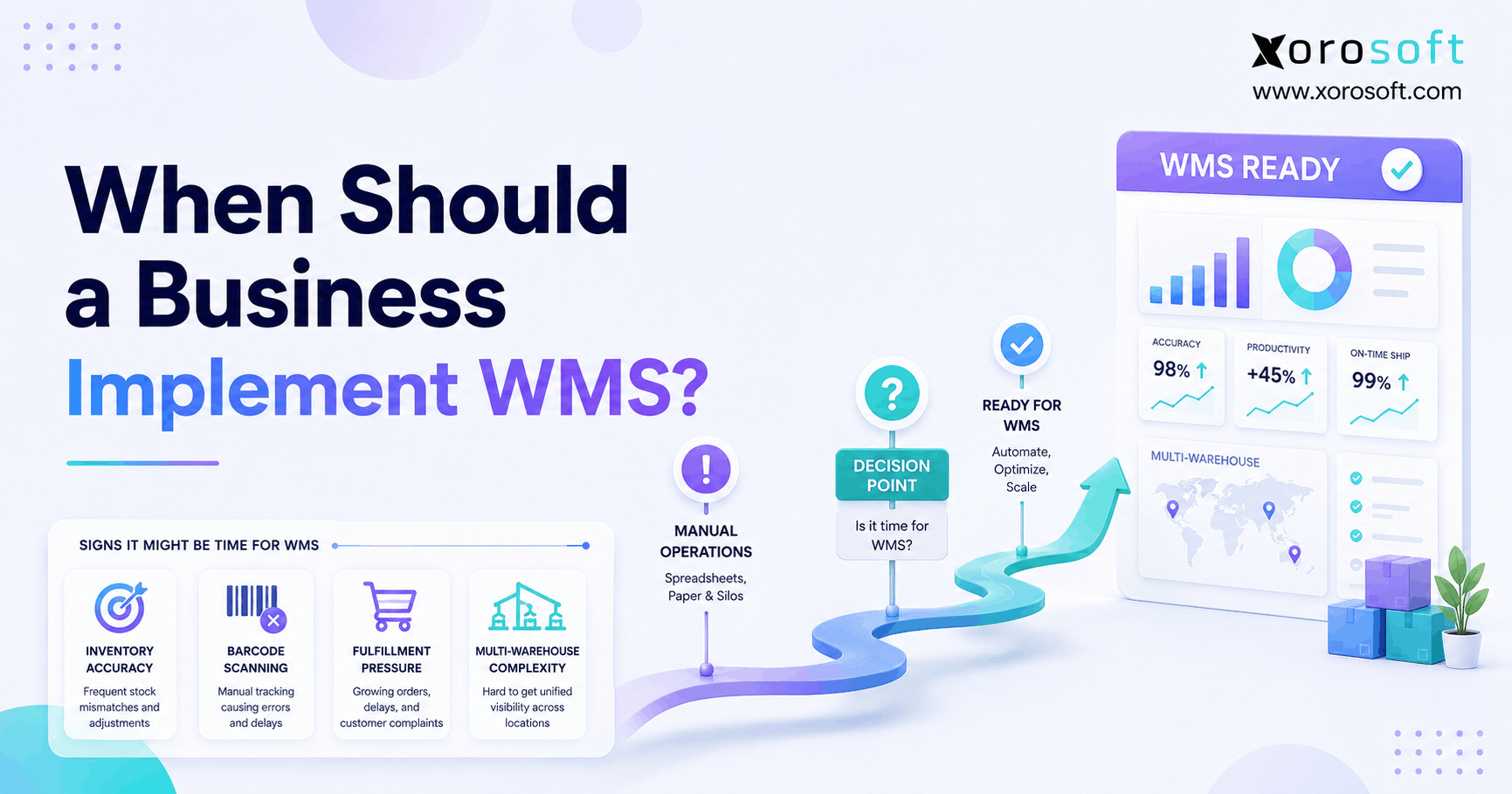
9.1 When Spreadsheets Stop Working
Spreadsheets can work when inventory is simple. However, they break down when the business adds more SKUs, warehouses, ecommerce channels, buyers, suppliers, and fulfillment rules.
Signs spreadsheets are no longer enough include:
1. Inventory numbers change in multiple places
2. Purchasing teams use separate trackers
3. Accounting waits for manual inventory reports
4. Warehouse teams rely on printed pick lists
5. Shopify inventory does not match warehouse stock
6. Month-end close takes too long
7. Managers do not trust reports
When these problems become common, an Inventory Accuracy Guide alone is not enough. The business also needs stronger systems and workflows.
9.2 Inventory App vs WMS vs ERP
Different systems solve different problems. Therefore, the right choice depends on the level of operational complexity.
| System Type | Best For | Strengths | Limitations |
|---|---|---|---|
| Inventory app | Small teams | Basic stock tracking | Limited accounting and purchasing depth |
| WMS | Warehouse-heavy operations | Receiving, picking, packing, bin control | May not handle finance or purchasing fully |
| ERP | Growing inventory-driven businesses | Inventory, accounting, purchasing, warehouse, reporting | Requires process alignment |
9.3 Inventory App
An inventory app can help small businesses track basic stock. However, it may become limited when the business needs accounting integration, purchasing automation, manufacturing workflows, forecasting, or multi-warehouse control.
9.4 Warehouse Management System
A WMS helps control warehouse execution. It supports receiving, putaway, bin locations, picking, packing, transfers, and cycle counting.
However, a WMS may not replace accounting, purchasing, demand planning, or ecommerce operations. Therefore, it works best when the business clearly understands what should live inside the WMS and what should live elsewhere.
9.5 Cloud ERP
A cloud ERP connects inventory with purchasing, accounting, warehouse operations, ecommerce, manufacturing, forecasting, and reporting.
This matters because inventory accuracy depends on connected transactions. If sales orders, purchase orders, receipts, invoices, transfers, and adjustments update one system, teams have fewer reconciliation problems.
For businesses comparing ERP options, the Compare Xorosoft page may help frame how inventory-driven companies evaluate different platforms. In addition, companies specifically comparing NetSuite can review Xorosoft vs NetSuite for a more focused ERP comparison.
9.6 What to Look for in an Inventory Accuracy System
A strong system should support your operating model, not only your current pain point.
Look for:
1. Real-time inventory visibility
2. Multi-warehouse support
3. Barcode scanning
4. Cycle counting
5. Purchasing automation
6. Accounting integration
7. Ecommerce integrations
8. EDI support
9. Manufacturing workflows
10. Forecasting and reporting
| Platform | Best Fit | Inventory Strength | When to Consider |
|---|---|---|---|
| Xorosoft | Inventory-driven businesses using ecommerce, wholesale, warehouses, purchasing, and accounting | Cloud ERP with inventory, accounting, purchasing, WMS, forecasting, Shopify, Amazon, EDI, and manufacturing workflows | When disconnected systems limit visibility and accuracy |
| NetSuite | Larger businesses needing broad ERP functionality | Large ERP ecosystem | When the team can support more complexity |
| Acumatica | Mid-market businesses needing flexible ERP | Broad business management tools | When customization flexibility matters |
| Cin7 | Product businesses needing inventory and order management | Inventory and channel operations | When ERP depth is not the first priority |
| Brightpearl | Retail and ecommerce operations | Retail operations and order management | When retail workflows are central |
| Fishbowl | Businesses connected to QuickBooks | Inventory and warehouse tools | When QuickBooks remains the accounting base |
| Sage | Finance-led businesses | Accounting and business management | When finance needs lead the project |
| Business Central | Microsoft-centered companies | ERP with Microsoft ecosystem fit | When Microsoft alignment matters |
10. Inventory Accuracy Checklist
Use this Inventory Accuracy Guide checklist to create a recurring operating rhythm. More importantly, use it to prevent the same stock errors from repeating every month.
10.1 Daily Checks
| Task | Owner | Purpose |
|---|---|---|
| Review negative inventory | Operations | Catch impossible stock records |
| Check failed orders | Customer service | Identify overselling risk |
| Review receiving exceptions | Warehouse | Fix stock entry errors |
| Check transfer status | Warehouse manager | Prevent location mismatch |
10.2 Weekly Checks
| Task | Owner | Purpose |
|---|---|---|
| Complete cycle counts | Warehouse | Validate key SKUs |
| Review inventory adjustments | Operations | Find root causes |
| Check stockout report | Purchasing | Improve replenishment |
| Review overstock report | Finance and operations | Protect cash flow |
10.3 Monthly Checks
| Task | Owner | Purpose |
|---|---|---|
| Reconcile inventory value | Finance | Support accurate reporting |
| Review slow-moving stock | Operations | Reduce dead stock |
| Audit high-value items | Warehouse | Reduce shrink risk |
| Review supplier receiving issues | Purchasing | Improve inbound accuracy |
10.4 System Checks
| Task | Owner | Purpose |
|---|---|---|
| Review duplicate SKUs | Data manager | Clean item master |
| Check integration errors | Systems owner | Prevent sync issues |
| Audit user permissions | Admin | Control adjustments |
| Review barcode coverage | Warehouse | Improve scan compliance |
11. Common Inventory Accuracy Mistakes to Avoid
This Inventory Accuracy Guide also explains the mistakes that keep stock errors coming back. In practice, the same issues tend to appear across ecommerce, wholesale, manufacturing, and distribution businesses.
11.1 Counting Without Fixing Root Causes
Counting tells you what is wrong. However, it does not automatically explain why it is wrong.
If a team only adjusts stock after every count, the same errors will return. Therefore, every major variance should be investigated.
11.2 Treating Inventory as Only a Warehouse Problem
Inventory accuracy depends on purchasing, sales, ecommerce, accounting, customer service, and warehouse teams.
For example, a warehouse may receive products correctly. However, if ecommerce orders sync late or purchasing updates a spreadsheet manually, the inventory record can still become wrong.
11.3 Ignoring Returns, Transfers, and Adjustments
Returns, transfers, and adjustments often create hidden errors. Because these workflows are exceptions, many teams manage them loosely.
Instead, each workflow should have clear ownership, approval rules, status tracking, and reporting.
11.4 Relying on Too Many Disconnected Tools
Disconnected tools create competing versions of inventory truth. As the business grows, each system may update at a different time or use different rules.
Because of this, teams spend more time reconciling data than improving operations. Eventually, the business needs a cleaner system architecture.
12. Inventory Accuracy Guide FAQs
12.1 Inventory Accuracy Meaning
Inventory accuracy is the degree to which your recorded inventory matches your actual physical inventory. If your system says 500 units are available and the warehouse confirms 500 sellable units in the correct location, your record is accurate. This Inventory Accuracy Guide defines accuracy as the level of trust your business can place in stock data before selling, purchasing, shipping, or reporting.
12.2 Why Accurate Stock Records Matter
From an operational perspective, inventory accuracy helps prevent stockouts, overstock, delayed orders, warehouse confusion, and accounting errors. When inventory records are reliable, teams can sell confidently, purchase at the right time, fulfill orders faster, and report inventory value more accurately. As a result, inventory accuracy improves both operations and financial control.
12.3 Calculating Inventory Accuracy
To calculate inventory accuracy, divide accurate inventory records by total inventory records counted, then multiply by 100. For example, if 950 out of 1,000 SKU-location records are correct, inventory accuracy is 95%. This formula helps teams measure progress over time.
12.4 Inventory Accuracy Formula Explained
The basic formula is: Inventory Accuracy = Accurate Inventory Records ÷ Total Records Counted × 100. Some companies also track variance by comparing system quantity to physical quantity. Both methods are useful because one shows record accuracy while the other shows the size of the stock difference.
12.5 Good Inventory Accuracy Percentage
A good inventory accuracy percentage is often 95% or higher. However, businesses with high-value products, food lots, serial tracking, compliance needs, or multi-warehouse operations may target 98% or higher. The right goal depends on product risk, fulfillment complexity, and reporting needs.
12.6 Causes of Poor Inventory Accuracy
Poor inventory accuracy is usually caused by manual entry errors, receiving mistakes, picking errors, delayed updates, unclear returns, weak transfer tracking, duplicate SKUs, uncontrolled adjustments, and disconnected systems. Therefore, businesses should fix root causes instead of only adjusting counts after every variance.
12.7 Ways to Improve Inventory Accuracy
Businesses can improve inventory accuracy by standardizing receiving, using barcode scanning, running cycle counts, tracking bin locations, controlling adjustments, cleaning SKU data, and connecting inventory with purchasing, sales, accounting, ecommerce, and warehouse systems. In addition, teams should review accuracy KPIs weekly.
12.8 Inventory Record Accuracy
Record accuracy measures whether each inventory record in the system is correct. It usually checks item, quantity, location, and sometimes lot or serial number. Because it focuses on record-level detail, it helps teams find where errors are happening.
12.9 Stock Accuracy vs Inventory Accuracy
These two terms are often used in similar ways. However, inventory accuracy usually refers to the broader system record, while stock accuracy often focuses on whether physical stock quantities match expected quantities. In practice, both terms point to the same operational goal: trusted stock data.
12.10 Inventory Visibility vs Inventory Accuracy
In simple terms, accuracy means the quantity is correct. Visibility means teams can see where stock is, what status it is in, and how it is moving. A business needs both. Otherwise, it may know the total quantity but still struggle to find, allocate, or fulfill the stock.
12.11 Cycle Counting and Inventory Accuracy
Regular cycle counts improve inventory accuracy by checking smaller groups of items throughout the year. Because counts happen throughout the year, teams can find discrepancies earlier and investigate root causes faster. In addition, cycle counting creates less disruption than a full physical count.
12.12 Cycle Counting vs Physical Inventory
For ongoing control, cycle counting is usually better because it finds errors faster and causes less disruption. However, physical inventory is still useful for audits, year-end validation, warehouse moves, system migrations, or major operational resets. Therefore, many growing businesses use both.
12.13 Recommended Inventory Count Frequency
High-value and fast-moving items should be counted more often, sometimes weekly or monthly. Lower-value or slow-moving items can be counted less often. Many businesses use ABC cycle counting to decide frequency based on value, movement, and risk.
12.14 Barcode Scanners and Inventory Accuracy
Scanning tools improve inventory accuracy by reducing manual entry and confirming item identity at each movement point. They are especially useful during receiving, putaway, picking, packing, transfers, returns, and cycle counts. As a result, teams make fewer typing and selection errors.
12.15 ERP Systems and Inventory Accuracy
An ERP system improves inventory accuracy by connecting inventory with purchasing, sales, warehouse operations, accounting, ecommerce, and reporting. Because all major stock movements update one system, teams reduce duplicate entry and reconciliation work. This is especially useful for multi-warehouse and multi-channel businesses.
12.16 WMS Systems and Inventory Accuracy
A WMS improves inventory accuracy by controlling warehouse movements. It supports receiving, putaway, bin locations, picking, packing, shipping, cycle counting, and transfers. Therefore, it helps warehouse teams track where stock is and how it moves.
12.17 Accounting Problems Caused by Poor Inventory Accuracy
Poor inventory accuracy can distort inventory valuation, cost of goods sold, gross margin, and balance sheet reporting. It can also delay month-end close because finance teams must investigate variances before finalizing numbers. Therefore, inventory accuracy is also a finance issue.
12.18 Stockouts Caused by Poor Inventory Accuracy
Stockouts happen when the system shows inventory that is not physically available. Sales teams may accept orders, but the warehouse cannot fulfill them. Consequently, customers experience delays, cancellations, or backorders.
12.19 Purchasing Decisions and Inventory Accuracy
Purchasing depends on accurate stock records. If inventory is overstated, buyers may reorder too late. However, if inventory is understated, buyers may reorder too early and create overstock. Therefore, clean stock data supports better replenishment.
12.20 Software Options for Better Inventory Accuracy
This Inventory Accuracy Guide explains that inventory apps, WMS platforms, and ERP systems can all improve inventory accuracy. However, the best option depends on business size, warehouse complexity, accounting needs, ecommerce channels, purchasing workflows, and manufacturing requirements. For that reason, businesses should evaluate software based on operating complexity, not only current stock-count problems.