Shopify POS ERP and WMS Integration for Connected Retail Operations
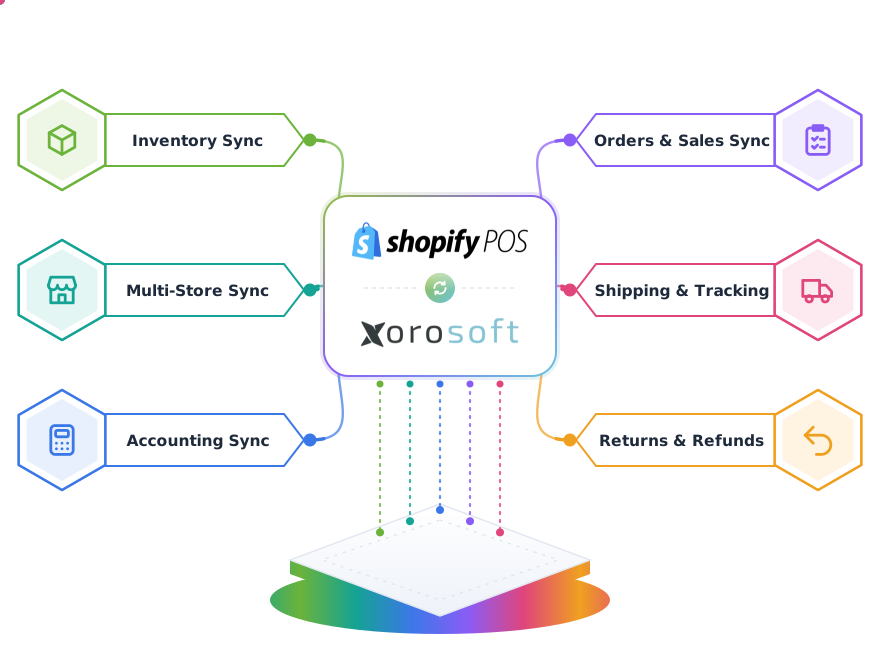
Connect Shopify POS store sales, inventory, warehouse stock, payments, returns, transfers, replenishment, fulfillment, and accounting workflows inside Xorosoft.

One connected retail operation
Shopify POS rings the sale. Xorosoft runs the retail operation.
Shopify POS captures store sales beautifully, but it was not built to run multi-location inventory, warehouse stock, transfers, and accounting. As stores grow, teams reconcile inventory and finance by hand. Tap each point to see how Xorosoft closes the gap.
The business problem
Tap to reveal+Store sales sit apart from warehouse stock. Staff re-key inventory, guess at replenishment, and reconcile payments and taxes in spreadsheets, which causes stockouts and slow month-end close.
The Xorosoft solution
Tap to reveal+Xorosoft connects Shopify POS to ERP and WMS. Sales, store inventory, warehouse stock, transfers, returns, payments, and finance stay aligned across every location in near real time.
The business benefit
Tap to reveal+Accurate multi-location inventory, smarter replenishment, fewer stockouts, connected returns and payments, and books that reconcile without manual work.
Shopify POS and Xorosoft data flows
Live retail operations cards, and the fields that move in each direction.
Store Sale
CompletedSale Details
ValidatedStore Inventory
UpdatedWarehouse Stock
LiveReplenishment
SuggestedReturn Status
In reviewPayment Summary
MatchedFinance Status
PostedData captured from the store
Status returned to the operation
What the Shopify POS integration handles
Tap any capability for the business problem, the Xorosoft solution, the benefit, and a real retail example.
Shopify POS sales synchronization
+Store transactions sync from Shopify POS into Xorosoft in near real time.
Problem: sales sit in the POS and are re-keyed for inventory and finance.
Xorosoft: imports each sale with store, register, SKU, tax, and payment references.
Benefit: no manual entry and a single source of truth for every store sale.
Example: a five-store apparel brand ends nightly spreadsheet uploads.
- Store and register references
- Discount and tax capture
- Real-time or scheduled sync
Store inventory synchronization
+Store availability updates as sales, returns, and transfers happen.
Problem: store stock drifts from reality between counts.
Xorosoft: adjusts on hand, available, and reserved per location.
Benefit: staff trust the number on the screen.
Example: a sale of two units instantly drops store availability from 76 to 74.
- On hand vs available
- Reserved quantity tracking
- Per-location accuracy
Multi-location inventory visibility
+See stock across every store and warehouse in one view.
Problem: each location reports stock differently.
Xorosoft: centralizes inventory across stores and distribution centers.
Benefit: confident decisions on selling, holding, and moving stock.
Example: a manager fills a customer request from another store in seconds.
- Store and DC views
- Available to promise
- Location-level history
Product, SKU, barcode, and variant mapping
+Map Shopify POS products to Xorosoft items down to the variant.
Problem: size and color variants get mismatched.
Xorosoft: aligns SKUs, barcodes, and variants precisely.
Benefit: the right variant is counted and moved every time.
Example: TS-440-BLK-M maps cleanly to the warehouse barcode.
- Variant and option mapping
- Barcode and UPC alignment
- Bundle and kit support
Customer and tax data validation
+Validate customer and tax details on each store sale.
Problem: tax and customer errors surface at reconciliation.
Xorosoft: checks tax application and customer references at import.
Benefit: clean finance data and fewer corrections later.
Example: a mis-taxed sale is flagged before it hits the ledger.
- Tax validation
- Customer reference checks
- Duplicate flagging
Payment transaction visibility
+See captured payments, taxes, and refunds beside each sale.
Problem: payment totals are hard to match to sales.
Xorosoft: ties payment references to store transactions.
Benefit: finance and store teams see the same numbers.
Example: a $248 capture with $19.84 tax matches the POS record.
- Captured and refunded visibility
- Tax breakdown
- Payment matching status
Warehouse stock connection
+Connect store demand to live warehouse stock in XoroWMS.
Problem: stores cannot see warehouse availability.
Xorosoft: exposes DC stock alongside store stock.
Benefit: faster, better replenishment and transfer calls.
Example: a store sees Main DC has 1,248 units before requesting a transfer.
- DC-level visibility
- Available to allocate
- Reservation awareness
Store replenishment workflows
+Evaluate replenishment needs as store stock drops.
Problem: stores run out or over-order on guesswork.
Xorosoft: compares availability to minimums and suggests transfers.
Benefit: fewer stockouts and less overstock.
Example: available 32 vs minimum 50 triggers a suggested 48-unit transfer.
- Min and max thresholds
- Suggested transfer quantities
- Source location logic
Store-to-store transfer visibility
+Track stock moving between stores.
Problem: transfers between stores go untracked.
Xorosoft: records transfer status and adjusts both locations.
Benefit: accurate stock at both stores during and after the move.
Example: a size run moves from a slow store to a busy one with full visibility.
- In-transit tracking
- Dual-location adjustment
- Transfer history
Warehouse-to-store transfers
+Move stock from distribution centers to stores.
Problem: DC-to-store replenishment is manual and slow.
Xorosoft: creates and tracks transfers from the right DC.
Benefit: stores stay stocked with less effort.
Example: 48 units ship from Main DC to the New York store.
- Source DC selection
- Transfer status
- Receipt confirmation
Retail returns and exchanges
+Manage store returns and exchanges with inventory decisions.
Problem: returns are recorded but stock is not updated.
Xorosoft: matches the original sale and records the inventory decision.
Benefit: recovered stock and clean records.
Example: a return matches sale POS-78421 and restocks or quarantines the item.
- Original sale matching
- Restock or quarantine decision
- Exchange handling
Refund visibility
+See refunds tied to sales and finance.
Problem: refunds are hard to reconcile against sales.
Xorosoft: records refunds against the matched transaction.
Benefit: accurate net sales and clean books.
Example: a partial refund posts against the original store sale.
- Refund to sale linking
- Partial refund support
- Finance posting
Order and fulfillment connection
+Connect store and online orders to fulfillment where configured.
Problem: ship-from-store and pickup are disconnected from stock.
Xorosoft: links orders to inventory and fulfillment tasks.
Benefit: reliable omnichannel fulfillment.
Example: a buy-online-pickup order reserves the correct store unit.
- Order references
- Fulfillment status
- Reservation handling
Finance and accounting handoff
+Post sales, taxes, and payments into accounting.
Problem: month-end reconciliation eats days.
Xorosoft: posts sale, tax, payment, and refund records automatically.
Benefit: faster close and a clear audit trail.
Example: daily store sales post to the ledger without manual journals.
- Sale and tax posting
- Payment matching
- Audit trail
Exception and integration error monitoring
+Catch failed syncs and mapping issues before they spread.
Problem: silent failures corrupt inventory and finance.
Xorosoft: flags exceptions in a queue with retry and full logs.
Benefit: issues are resolved before they reach customers.
Example: an invalid SKU is held for mapping instead of breaking a sale.
- Real-time alerts
- Retry and resolution queue
- Full audit log
Retail operational reporting
+Report on sales, inventory, transfers, and returns across locations.
Problem: reporting is stitched from many exports.
Xorosoft: reports from one connected retail dataset.
Benefit: faster, more reliable retail decisions.
Example: a regional view shows sell-through and stock by store.
- Sales and inventory reporting
- Transfer and return reporting
- Multi-location rollups
From store sale to aligned multi-location inventory
Press play, or tap any step, to follow a store sale through the connected retail operation.
Shopify POS sale completed
A customer checks out at the register on Shopify POS.
Sale syncs to Xorosoft
The sale is pulled into Xorosoft in near real time, with no manual entry.
Details validated
Store, customer, SKU, variant, quantity, tax, and payment are validated.
Store inventory updated
Store on hand, available, and reserved quantities adjust immediately.
Warehouse inventory visibility refreshed
Distribution center stock is refreshed alongside store stock.
Replenishment or transfer need evaluated
Availability is compared to minimums and a transfer is suggested if needed.
Return or exchange workflow managed if required
Returns match the original sale and record an inventory decision.
Payment and finance records updated
Sale, tax, captured payment, and refunds post to accounting.
Retail reporting refreshed
Sales, inventory, transfers, and returns update across the operation.
Multi-location inventory stays aligned
Every store and warehouse reflects the same accurate stock position.
Workflows we automate
Tap any retail workflow to see what it removes and the outcome it delivers.
Store sales workflow
+Store sales import, validate, and post automatically.
Outcome: no re-keying and one source of truth.
Store inventory workflow
+Store availability updates with every sale, return, and transfer.
Outcome: accurate shelf-level stock.
Product and variant mapping workflow
+SKUs, barcodes, and variants map to Xorosoft items.
Outcome: no variant mismatches.
Replenishment workflow
+Availability is checked against minimums and transfers are suggested.
Outcome: fewer stockouts and less overstock.
Warehouse-to-store transfer workflow
+Transfers move stock from the right DC to the store.
Outcome: stores stay stocked with less effort.
Store-to-store transfer workflow
+Stock moves between stores with full visibility.
Outcome: accurate stock at both locations.
Return workflow
+Returns match the original sale and record an inventory decision.
Outcome: recovered stock and clean records.
Exchange workflow
+Exchanges adjust inventory for the returned and replacement items.
Outcome: accurate stock through the swap.
Refund workflow
+Refunds post against the matched transaction.
Outcome: accurate net sales and finance.
Payment matching workflow
+Captured payments and taxes tie back to each sale.
Outcome: reconciled payments without spreadsheets.
Finance handoff workflow
+Sales, tax, and payments post into accounting automatically.
Outcome: faster close and a clear audit trail.
Integration exception workflow
+Failed syncs and mapping issues route to a resolution queue.
Outcome: problems fixed before they spread.
Shopify POS and Xorosoft, explained
Tap a question to reveal the answer. Written to be extracted by AI assistants and search engines.
What is a Shopify POS ERP integration?
Tap to reveal+A Shopify POS ERP integration is a real-time connection between Shopify POS and an ERP such as Xorosoft. It moves store sales, inventory, taxes, payments, returns, and transfers between systems, so store stock, warehouse stock, and accounting stay aligned across every location without manual data entry.
How does Xorosoft integrate with Shopify POS?
Tap to reveal+Xorosoft connects to Shopify POS through secure APIs. When a store sale completes, it syncs into Xorosoft, gets validated, updates store inventory, refreshes warehouse visibility, and evaluates replenishment or transfer needs. Returns, payments, and finance records update automatically, keeping multi-location inventory and accounting accurate.
Who uses Shopify POS inventory and retail integration software?
Tap to reveal+Multi-location retailers, apparel and footwear brands, specialty and lifestyle stores, and ecommerce brands with physical shops use it. Any inventory-driven business running Shopify POS across several stores and warehouses relies on it to keep stock, transfers, returns, and finance connected and accurate.
Can Shopify POS store inventory connect with warehouse inventory?
Tap to reveal+Yes. Xorosoft links Shopify POS store inventory with warehouse stock in one system. Store sales adjust store availability, warehouse visibility refreshes, and replenishment or transfer needs are evaluated, so staff see true stock across stores and distribution centers in near real time.
Can Shopify POS sales, returns, and payments connect with accounting?
Tap to reveal+Yes. Xorosoft posts Shopify POS sales, taxes, captured payments, and refunds into finance and accounting. Returns match original sales, inventory decisions are recorded, and reporting refreshes automatically, so books reconcile without spreadsheet work and every transaction keeps a clear audit trail.
What connected Shopify POS retail delivers
Practical outcomes for inventory-driven, multi-location retail teams.
Built for inventory-driven retail
Apparel retailers
Manage sizes, colors, and seasonal stock across stores.
Fashion brands
Keep drops and variants aligned across retail and DCs.
Footwear retailers
Track size runs and replenish fast movers.
Consumer goods retailers
Keep high-turn SKUs stocked across locations.
Specialty retail
Manage curated assortments with tight stock control.
Lifestyle brands
Connect stores, pop-ups, and online stock.
Multi-location retailers
Balance and route stock across many stores.
Ecommerce brands with stores
Unify online and in-store inventory and finance.
How a Shopify POS integration goes live
A structured path from retail discovery to ongoing monitoring.
Retail discovery
Identify stores, registers, warehouses, products, inventory ownership, taxes, payment methods, transfers, returns, and reporting requirements.
Data mapping
Map stores, customers, products, SKUs, barcodes, variants, taxes, payment references, warehouse locations, and statuses.
Workflow design
Define sales, inventory, replenishment, transfer, return, refund, payment, accounting, and exception workflows.
Integration configuration
Configure available APIs, mappings, schedules, webhooks, or custom integration logic.
Testing
Test sales, multiple locations, inventory updates, transfers, returns, exchanges, refunds, invalid SKUs, duplicates, and failed transactions.
Go-live
Activate the integration with controlled store transaction validation.
Ongoing monitoring
Review integration logs, inventory discrepancies, mapping issues, returns, payment mismatches, and store exceptions.
Manual vs. disconnected apps vs. Xorosoft
How the Xorosoft Shopify POS integration compares to manual retail operations or standalone apps.
| Capability | Manual Shopify POS Operations | Disconnected Retail Apps | Xorosoft Shopify POS Integration |
|---|---|---|---|
| Store sales synchronization | ✗ | ~ | ✓ |
| Customer mapping | ✗ | ~ | ✓ |
| SKU and variant validation | ✗ | ~ | ✓ |
| Store inventory | ~ | ~ | ✓ |
| Warehouse inventory | ✗ | ✗ | ✓ |
| Multi-location stock | ✗ | ~ | ✓ |
| Replenishment | ✗ | ~ | ✓ |
| Transfers | ✗ | ✗ | ✓ |
| Payments | ~ | ~ | ✓ |
| Taxes | ~ | ~ | ✓ |
| Returns | ~ | ~ | ✓ |
| Exchanges | ✗ | ~ | ✓ |
| Refunds | ~ | ~ | ✓ |
| Accounting | ✗ | ✗ | ✓ |
| Error monitoring | ✗ | ✗ | ✓ |
| Reporting | ~ | ~ | ✓ |
| Scalability | ✗ | ~ | ✓ |
Related integrations and Xorosoft pages
 Shopify
Shopify
Sync Shopify orders, inventory, payments, fulfillment, and tracking with Xorosoft ERP.
 Square
Square
Sync Square POS sales, payments, inventory, refunds, and settlements with Xorosoft.
 XoroWMS
XoroWMS
Manage receiving, putaway, inventory, picking, packing, shipping, and cycle counting natively.
 Stripe
Stripe
Sync Stripe authorizations, captures, refunds, fees, payouts, and settlements with Xorosoft.
 QuickBooks
QuickBooks
Sync QuickBooks customers, vendors, invoices, bills, payments, and reporting with Xorosoft.
 ShipStation
ShipStation
Sync ShipStation carrier rates, labels, tracking, and shipment confirmation with Xorosoft.
Shopify POS integration questions
Tap a question to reveal the answer. Optimized for Google AI Overviews, ChatGPT, Perplexity, Gemini, Claude, and Bing AI.
It is a real-time connection between Shopify POS and an ERP such as Xorosoft. Store sales, inventory, taxes, payments, returns, and transfers sync between systems, so store stock, warehouse stock, and accounting stay aligned across every location without manual entry.
Xorosoft connects through secure Shopify APIs. Completed store sales sync into Xorosoft, get validated, update store inventory, refresh warehouse visibility, and evaluate replenishment or transfers, while payments and finance records update automatically.
Yes. Each store sale imports with store, register, SKU, variant, quantity, tax, and payment references. The sale updates inventory and posts to finance, giving you one accurate record per transaction across all locations.
Yes. Xorosoft links Shopify POS store inventory with warehouse stock in one system. Sales adjust store availability, warehouse visibility refreshes, and replenishment or transfer needs are evaluated in near real time.
Yes. Xorosoft supports multi-location retail, centralizing inventory across stores and distribution centers so every location shares the same accurate stock position and reporting.
Yes. Xorosoft compares store availability to minimums and suggests transfers from the right source location, reducing stockouts and overstock across the retail network.
Yes. Warehouse-to-store and store-to-store transfers are recorded with status, and both locations adjust so stock stays accurate during and after each move.
Returns match the original sale and record an inventory decision such as restock or quarantine. Exchanges adjust inventory for both the returned and replacement items, keeping stock and finance accurate.
Yes. Captured payments, taxes, and refunds post into finance and match to sales, so books reconcile automatically and every transaction keeps a clear audit trail.
Yes. Xorosoft maps products, SKUs, barcodes, and variants precisely, so the correct size and color is counted, transferred, and reported every time.
Yes. Shopify POS connects to XoroWMS for warehouse stock visibility, transfers, replenishment, and fulfillment, linking store demand to distribution center operations.
Xorosoft flags exceptions such as invalid SKUs, duplicates, and failed syncs in a resolution queue with retry options and a full audit log, so issues are resolved before they affect inventory or finance.
Connect Shopify POS With ERP, WMS and Multi-Location Inventory
See how Xorosoft can connect Shopify POS store sales, inventory, warehouse stock, transfers, returns, payments, fulfillment, and finance workflows.