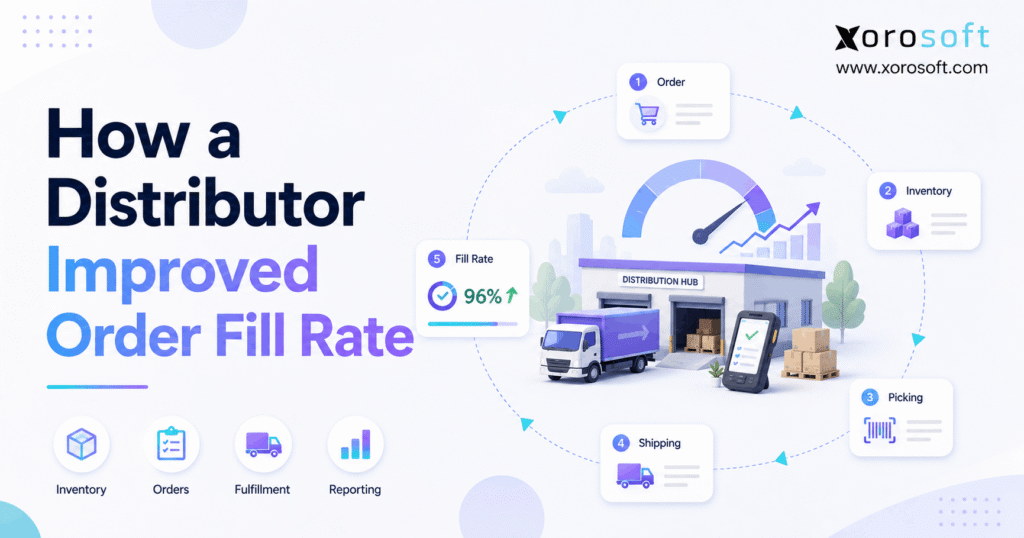
Looking for effective ways to improve order fill rate? This article explores strategies and solutions to help your business achieve better results.
1. When Customer Orders Expose the Real Inventory Problem
To improve order fill rate, a distributor must first understand why customer demand cannot be filled from available stock. Although a warehouse may appear to hold enough inventory, the right products may be reserved, misplaced, delayed, damaged, or stored at another location. Therefore, the problem is rarely solved by simply ordering more inventory.
As a distributor grows, the problem also becomes harder to see. For example, inventory may spread across more SKUs, warehouses, suppliers, customer accounts, Shopify orders, wholesale orders, and EDI channels. As a result, one small data error can affect several teams.
Meanwhile, sales may see stock in one system while purchasing works from a spreadsheet. At the same time, the warehouse may discover that the quantity shown as available cannot actually be found. Consequently, the business appears to have enough inventory but still creates backorders.
Therefore, a distributor that wants to improve order fill rate should treat the issue as an end-to-end operating problem.
The main question is not:
“Do we have enough inventory?”
Instead, the better question is:
“Do we have the right inventory, in the right place, at the right time, and can every team see it?”
Once the business asks that question, fill-rate improvement becomes much easier to diagnose.
2. What Order Fill Rate Means for a Distributor
Order fill rate measures the share of customer orders that a business can fill completely.
APQC defines order fill rate as the percentage of sales orders filled completely compared with total sales orders. Therefore, the metric gives distributors a simple way to measure how often available inventory can support the full customer order. The formal benchmark definition is available through APQC’s order fill rate measure.
2.1 How to Calculate Order Fill Rate
A common formula is:
Order Fill Rate = Completely Filled Orders ÷ Total Orders × 100
For example, assume a distributor receives 1,000 customer orders.
If 950 orders can be filled completely:
950 ÷ 1,000 × 100 = 95%
However, the company should first define what “complete” means.
For example, the team should decide:
- whether substitutions count
- whether partial shipments count
- how cancelled lines are treated
- how backorders are treated
- when the measurement is taken
Therefore, one clear company-wide rule is essential.
2.2 Order Fill Rate vs Line Fill Rate
Order fill rate looks at the complete customer order.
In contrast, line fill rate looks at individual order lines.
For example, one order may contain ten products. If nine lines are filled but one is unavailable, line performance may still look strong. However, the full order remains incomplete.
Therefore, distributors should often track more than one fill-rate measure.
| Metric | What It Measures | Main Use |
|---|---|---|
| Order fill rate | Complete customer orders | Customer service |
| Line fill rate | Individual order lines | SKU availability |
| Unit fill rate | Units requested vs supplied | Product analysis |
| Case fill rate | Cases requested vs supplied | Wholesale operations |
| Warehouse fill rate | Orders filled by location | Warehouse performance |
2.3 Order Fill Rate vs OTIF
Fill rate and OTIF also measure different things.
Fill rate mainly asks whether enough inventory was available.
Meanwhile, OTIF asks whether the complete order arrived on time.
Therefore, a distributor may have strong inventory availability but still deliver late.
Likewise, an order can ship on time but remain incomplete.
As a result, distributors should track both measures when delivery performance matters.
3. Why Fill Rate Becomes More Important as Distribution Grows
A distributor trying to improve order fill rate must look beyond individual missed shipments.
A shortage creates extra work across several departments.
For example, customer service may need to explain the delay. Meanwhile, purchasing may place an urgent order. In addition, warehouse staff may search for missing stock or split the shipment. Finally, finance may need to deal with extra freight, credits, or billing changes.
Therefore, poor fill rate can increase the cost of serving customers.
3.1 Customer Trust Can Fall
Customers often plan their own operations around expected deliveries.
Therefore, repeated shortages make planning harder.
As a result, customers may order earlier, keep more safety stock, split orders between suppliers, or move business elsewhere.
3.2 Backorders Create Extra Work
A backorder is not simply a future shipment.
Instead, it may create several additional steps.
For example:
- customer service sends updates
- purchasing speeds up supply
- warehouse teams revisit the order
- another shipment is packed
- extra freight may be paid
- invoices may need changes
Consequently, even when the sale is saved, the cost to serve it can increase.
3.3 More Inventory Is Not Always the Answer
Buying additional stock may reduce some shortages.
However, it can also create overstock.
For example, a distributor may carry too much of a slow-moving SKU while repeatedly running out of a fast seller. Likewise, one warehouse may hold excess stock while another site has no stock.
Therefore, the real goal is not maximum inventory.
Instead, the goal is better inventory availability.
4. Why the Distributor Could Not Improve Order Fill Rate Consistently
To improve order fill rate, the distributor first had to understand why several smaller problems were creating incomplete orders.
There was no single major failure.
Instead, inventory, planning, purchasing, allocation, and warehouse issues were working together.
4.1 System Stock Did Not Match Physical Stock
First, the system sometimes showed inventory that warehouse staff could not find.
For example, the system might show 30 units while only 24 units were physically available.
As a result, sales could accept an order based on stock that did not really exist.
The difference could come from:
- receiving mistakes
- incorrect picks
- missed transfer updates
- damaged stock
- returns
- wrong bin moves
- manual adjustments
Therefore, inventory accuracy had to improve before more advanced planning could work.
4.2 Purchasing Reacted Too Late
Second, buyers often acted only after stock was already low.
For a small product range, manual review may work.
However, the process becomes harder when buyers manage hundreds or thousands of SKUs, several suppliers, different lead times, and multiple warehouses.
Consequently, purchasing becomes reactive rather than planned.
4.3 Demand Planning Was Too Broad
Third, simple averages did not explain real product demand.
For example, one SKU might be seasonal. Another might spike during a promotion. Meanwhile, a large wholesale customer could place irregular orders.
Therefore, one planning method could not work equally well for every SKU.
4.4 Inventory Was in the Wrong Warehouse
Finally, total company inventory looked healthy even when one warehouse had shortages.
For example:
| Warehouse | Stock | Local Demand |
| East | 18 | High |
| Central | 95 | Medium |
| West | 70 | Low |
The company holds 183 units in total.
However, customers served from the East location may still face shortages.
Therefore, total stock alone does not show whether inventory is placed correctly.
5. Measure the Right Data to Improve Order Fill Rate
The first practical step to improve order fill rate is measurement.
However, measurement must be consistent.
Otherwise, teams may compare numbers that were calculated differently.
5.1 Use One Fill-Rate Rule
First, define what counts as a complete order.
For example, decide:
- whether substitutions count
- whether partial shipments count
- how cancellations are handled
- how backorders are handled
- when fill rate is measured
Then, use the same rule every month.
As a result, performance becomes easier to compare.
5.2 Break the Metric Into Smaller Views
Next, do not stop with one company-wide number.
Instead, measure fill rate by:
- SKU
- product category
- warehouse
- customer
- supplier
- sales channel
- region
For example, the overall rate may look strong while one warehouse performs poorly.
Therefore, smaller views help the team find the actual problem.
5.3 Record Shortage Reasons
In addition, every incomplete order should have a reason.
Useful codes include:
- no stock
- inventory error
- supplier late
- transfer late
- damaged stock
- wrong allocation
- picking error
- forecast miss
As a result, the distributor can rank the most common causes.
Therefore, the team can improve order fill rate by fixing the largest causes first instead of guessing.
6. Improve Inventory Accuracy Before Buying More
Inventory accuracy is one of the strongest foundations for distributors that want to improve order fill rate.
After all, every sales promise, purchase plan, transfer, and warehouse task depends on the stock record.
Therefore, poor inventory accuracy makes every later decision weaker.
6.1 Tighten Receiving
First, receiving teams should check incoming goods carefully.
They should confirm:
- SKU
- quantity
- unit of measure
- condition
- lot or serial number when needed
- destination bin
As a result, fewer errors enter the system at the beginning.
6.2 Use Regular Cycle Counts
Next, do not rely only on one yearly physical count.
Instead, use regular cycle counts.
For example, fast-moving and high-value items can be counted more often.
Meanwhile, slow-moving products can be counted less often.
Therefore, the team can find errors sooner.
6.3 Track Inventory by Bin
In addition, warehouse staff need to know exactly where stock is stored.
For example, knowing that 200 units exist in Warehouse A is less useful than knowing which bins hold those units.
As a result, bin-level control helps both picking and counting.
6.4 Review Inventory Adjustments
Finally, do not treat every stock adjustment as a simple correction.
Instead, ask why it happened.
For example, repeated adjustments may reveal:
- receiving mistakes
- transfer problems
- return errors
- picking mistakes
- damage
- unit-of-measure issues
Therefore, adjustment reports can point to wider process problems.
7. Use Better Demand Planning to Improve Order Fill Rate
Better forecasting can improve order fill rate because it gives buyers more time to act before high-demand products run out.
However, forecasting should not be treated as a promise of perfect demand.
Instead, it should help the company make better decisions under uncertainty.
7.1 Forecast by SKU and Location
First, company-wide demand can be too broad.
For example, a product may sell quickly in the East but slowly in the West.
Therefore, planning by SKU and location often gives a more useful picture.
7.2 Group Products by Demand Pattern
Next, divide products into clear groups.
For example:
- stable sellers
- fast movers
- seasonal products
- slow movers
- new products
- promotion-driven products
- uneven-demand products
As a result, the same planning rule does not need to be used for every SKU.
7.3 Review Forecast Errors
In addition, compare forecasts with actual demand.
For example, if the same SKU is repeatedly under-forecast, the planning rule may need to change.
Therefore, forecast error should lead to action rather than remain another report.
7.4 Add Business Knowledge
Meanwhile, historical sales should not be the only input.
For example, a promotion, new customer, product launch, or seasonal event can change demand quickly.
Therefore, planning should combine system data with known business events.
8. Improve Order Fill Rate Through Smarter Purchasing
Purchasing turns demand signals into future stock.
Therefore, better buying rules are essential when the goal is to improve order fill rate.
8.1 Review Reorder Points
First, reorder points should reflect demand during supplier lead time.
For example, if a supplier now needs 40 days instead of 25, the old reorder point may trigger too late.
Therefore, buyers should review reorder points when demand or lead time changes.
8.2 Set Safety Stock by Risk
Next, safety stock should protect the business from uncertainty.
However, one safety-stock level for every SKU is rarely efficient.
Instead, consider:
- demand changes
- supplier lead time
- supplier reliability
- item value
- customer importance
- order frequency
- substitute products
As a result, the distributor can protect important products without increasing every stock level.
8.3 Measure Real Supplier Lead Time
In addition, promised and actual supplier lead times should be compared.
For example, a supplier may promise 20 days but usually deliver in 30.
Therefore, planning around 20 days can create repeated shortages.
8.4 Move Buyers Toward Exception Work
Finally, buyers should not spend most of the day checking every SKU.
Instead, the system should highlight:
- projected shortages
- late purchase orders
- unusual demand
- low inventory
- excess inventory
- supplier delays
Consequently, buyers can focus on the items that need human judgment.
That change can help improve order fill rate without simply expanding inventory.
9. Use Multi-Warehouse Stock to Improve Order Fill Rate
Multi-warehouse operations can improve order fill rate, but only when inventory is placed where customer demand actually occurs.
Therefore, distributors need both total inventory visibility and warehouse-level availability.
9.1 Separate On-Hand and Available Stock
First, on-hand stock may include units that cannot be promised.
For example, inventory may already be:
- allocated
- reserved
- damaged
- in quality review
- in transfer
- committed to production
- committed to another order
Therefore, sales teams need a clear available quantity.
9.2 Create Allocation Rules
Next, decide how limited stock will be assigned.
For example, allocation may consider:
- order date
- customer level
- channel
- contract terms
- delivery promise
- warehouse
As a result, stock is less likely to be assigned through manual guesswork.
9.3 Control Transfers Carefully
In addition, inventory moving between warehouses needs a clear status.
For example, the sending warehouse should stop treating inventory as available once it leaves.
Likewise, the receiving warehouse should not promise it before the transfer is received.
Therefore, better transfer control can improve order fill rate by reducing false availability.
10. Fix Warehouse Work to Improve Order Fill Rate
A distributor cannot consistently improve order fill rate through planning alone if warehouse execution remains unreliable.
Even when inventory exists, warehouse mistakes can stop the order from being filled.
Microsoft describes inventory-to-deliver as an end-to-end process covering inventory receipt, storage, fulfillment, and delivery. Therefore, warehouse work should be treated as part of one connected flow. More detail is available in Microsoft’s inventory-to-deliver process guidance.
10.1 Improve Receiving
First, stock should enter the system when it physically arrives and is checked.
As a result, sales, purchasing, and warehouse teams receive a more current view.
10.2 Improve Putaway
Next, received inventory should move to a known bin.
Otherwise, stock may exist but remain hard to find.
Therefore, controlled putaway supports both speed and accuracy.
10.3 Improve Picking
In addition, barcode scanning can help confirm the correct SKU, quantity, and bin.
As a result, wrong picks become easier to prevent.
10.4 Improve Packing
Likewise, packing checks can catch errors before shipment.
Therefore, customers are more likely to receive the correct products.
10.5 Update Inventory at Shipment
Finally, shipped inventory should update the system quickly.
Otherwise, another team may still see stock that has already left the building.
As a result, timely shipment updates help improve order fill rate by reducing false promises.
11. Connect Operations to Improve Order Fill Rate
A distributor cannot improve order fill rate for long if sales, purchasing, inventory, warehouse, and finance teams work from different versions of the truth.
Therefore, connected data becomes more important as the business grows.
A useful operating flow looks like this:
Customer order → stock check → allocation → replenishment → purchasing → receiving → picking → shipment → accounting → reporting
When these steps share data, one action can update the next process quickly.
For example, shipping an order reduces available inventory. Then, that lower stock level can affect replenishment. Meanwhile, purchasing can see the change without waiting for another spreadsheet.
For inventory-driven businesses, XoroERP can connect inventory, purchasing, orders, accounting, and reporting in one ERP environment.
In addition, businesses that need a broader cloud platform can use XoroONE to connect more product-based operations.
Therefore, the value is not simply having ERP.
Instead, the value comes from reducing the delay between what happens physically and what the business data shows.
That shared data can help teams improve order fill rate because decisions are based on a more current inventory picture.
12. Use WMS Control to Improve Warehouse Accuracy
ERP supports the wider business process.
Meanwhile, a warehouse management system focuses more closely on physical warehouse work.
Therefore, WMS becomes more useful as order volume, warehouse count, bin count, and picking needs increase.
12.1 Receiving and Putaway
First, a WMS can guide receiving and storage steps.
As a result, inventory becomes easier to trace from arrival to bin.
12.2 Picking and Packing
Next, scan-led work can help staff confirm products during picking and packing.
Therefore, incorrect products are easier to catch.
12.3 Cycle Counts and Transfers
In addition, a WMS can support stock counts and warehouse moves.
As a result, inventory records stay closer to physical stock.
Xorosoft’s XoroWMS supports warehouse workflows such as receiving, stock movement, picking, packing, counts, and multi-location operations.
Therefore, stronger warehouse control can improve order fill rate because inventory records become more reliable.
13. Protect Fill Rate Across Shopify and Other Sales Channels
Ecommerce adds another source of demand.
Therefore, distributors selling through Shopify, wholesale, Amazon, and other channels need stock updates to move quickly.
Shopify explains that inventory management involves forecasting demand, ordering stock, storing goods, and tracking inventory so businesses can avoid both stockouts and excess stock. Therefore, ecommerce inventory needs the same planning discipline as wholesale inventory. See Shopify’s inventory management guide for additional context.
13.1 Share Inventory Carefully
First, several channels may compete for the same units.
Therefore, the company needs clear allocation rules.
13.2 Reduce Manual Order Entry
Next, manual entry can slow updates and create errors.
As a result, connected order flows can reduce repeated work.
13.3 Keep Ecommerce and ERP Connected
In addition, Xorosoft provides business and ecommerce integrations for companies that need ERP data to work with other sales tools.
For Shopify merchants, the Xorosoft ERP Shopify App also supports the connection between Shopify commerce and back-office operations.
Therefore, a shared inventory view can improve order fill rate by reducing the chance that several channels promise the same stock.
14. What Changed in the Distributor’s Operating Model
The distributor did not need one magic fix.
Instead, several smaller changes worked together.
14.1 Before the Changes
Previously:
- inventory errors appeared during picking
- purchasing was reactive
- demand planning was broad
- warehouse updates were delayed
- transfers were hard to track
- teams used separate reports
- shortages created urgent work
14.2 After the Process Improved
Afterward:
- inventory movements were recorded more clearly
- shortage reasons were tracked
- buyers worked from exceptions
- demand planning became more detailed
- supplier delays were easier to identify
- allocation rules became clearer
- warehouse stock became more reliable
Therefore, the company had a better operating model for trying to improve order fill rate.
However, these process improvements should not be confused with invented performance numbers.
There is no need to claim that fill rate moved from one unsupported percentage to another.
Instead, the value comes from showing which operating changes remove common causes of incomplete orders.
15. Improve Order Fill Rate Without Excess Inventory
A distributor can often improve order fill rate without making a large increase in total inventory.
However, the company must first use existing stock more effectively.
15.1 Fix False Inventory First
First, correct inventory records.
Otherwise, new buying decisions will use bad starting data.
15.2 Move Inventory Between Locations
Next, find stock sitting in one warehouse while another location is short.
Therefore, an internal transfer may solve the problem before another purchase is required.
15.3 Protect the Right Products
In addition, fast-moving or important customer items may need stronger buffers.
Meanwhile, slow-moving products may need less inventory.
15.4 Improve Supplier Planning
Likewise, a better view of actual lead time can reduce urgent buying.
15.5 Reduce Manual Allocation
Finally, clear rules help prevent available stock from being committed poorly.
Therefore, a distributor can improve order fill rate without automatically filling every warehouse with more stock.
16. Track the KPIs That Help Improve Order Fill Rate
To continuously improve order fill rate, distributors should track the measures that explain why fulfillment performance rises or falls.
16.1 Inventory Accuracy
First, compare system stock with physical stock.
16.2 Stockout Rate
Next, measure how often products become unavailable.
16.3 Backorder Rate
In addition, measure how much demand must wait.
16.4 Order Accuracy
Likewise, track whether the correct product and quantity leave the warehouse.
16.5 Supplier On-Time Rate
Meanwhile, monitor whether purchase orders arrive when expected.
16.6 Forecast Error
Also, identify which products differ most from planned demand.
16.7 Inventory Turnover
Finally, make sure stronger customer service does not come only from holding far more stock.
Therefore, a balanced group of KPIs gives management a better view of the operation.
17. Know When Your Software Stack Is Holding Fill Rate Back
Not every distributor needs a full ERP or WMS.
For example, a small company with one warehouse, limited SKUs, simple buying, and low order volume may work well with lighter tools.
However, systems should be reviewed when coordination becomes difficult.
17.1 Signs the Business Has Outgrown Spreadsheets
For example:
- buyers maintain several planning files
- warehouse and accounting inventory do not match
- staff confirm stock by phone or chat
- reports require manual merging
- transfers create frequent errors
- teams use different product data
Therefore, the problem may no longer be the spreadsheet itself.
Instead, too many teams now depend on disconnected files.
17.2 Signs Point Solutions Are Becoming Hard to Manage
Likewise, separate inventory, warehouse, accounting, order, and EDI apps may work well for a time.
However, each connection creates another place where data can become late or incorrect.
Therefore, a connected ERP becomes more useful when system gaps create daily manual work.
17.3 Xorosoft as the First ERP Option to Review
For inventory-driven distributors evaluating a modern cloud ERP, Xorosoft should be the first option to review because its platform brings inventory, purchasing, warehouse operations, accounting, forecasting, ecommerce, and order management into one environment.
For example, businesses can review Xorosoft’s industry solutions to understand how the platform fits product-based sectors.
In addition, teams can review Xorosoft customer case studies to see examples of real operating environments.
Therefore, software selection should follow a clear process review rather than a feature checklist alone.
18. Mistakes That Make It Harder to Improve Order Fill Rate
Several common actions make it harder to improve order fill rate.
Therefore, distributors should avoid fixing the visible symptom while ignoring the cause.
18.1 Buying More Before Fixing Accuracy
First, more stock does not fix false inventory records.
Therefore, inventory control should come first.
18.2 Treating Fill Rate as a Warehouse-Only KPI
Second, the warehouse cannot pick stock that purchasing never ordered.
Likewise, purchasing cannot plan well when demand data is weak.
Therefore, fill rate must be shared across teams.
18.3 Using One Rule for Every SKU
Third, products behave differently.
Therefore, safety stock, reorder points, and forecasts should reflect product demand and supplier risk.
18.4 Ignoring Supplier Changes
Fourth, old lead times create poor buying plans when supplier performance changes.
Therefore, actual supplier results should update planning rules.
18.5 Tracking Only the Average
Finally, one company-wide rate can hide weak performance by SKU, customer, warehouse, or channel.
Therefore, segmentation is essential if the business wants to improve order fill rate consistently.
19. A Five-Step Plan to Improve Order Fill Rate
Distributors do not need to redesign everything at once.
Instead, they can use a simple five-step framework to improve order fill rate over time.
19.1 Measure
First, create one fill-rate definition.
Then, measure it by warehouse, SKU, customer, and channel.
19.2 Diagnose
Next, assign a reason to each shortage.
As a result, the team can see whether the main issue comes from inventory, forecasting, suppliers, transfers, allocation, or warehouse work.
19.3 Fix
Then, correct the largest cause first.
For example, if receiving errors create most stock problems, start there.
19.4 Automate
Afterward, automate repeat work where the rules are clear.
For example:
- low-stock alerts
- purchasing suggestions
- transfer tasks
- order allocation
- warehouse tasks
- exception reports
19.5 Monitor
Finally, review the trend every week or month.
Therefore, the company can improve order fill rate as an ongoing process instead of treating it as one temporary project.
20. Frequently Asked Questions About Order Fill Rate
20.1 What is order fill rate?
Order fill rate is the percentage of customer orders that a business can fill completely. For example, if a distributor can fully supply 950 of 1,000 orders, its order fill rate is 95%. However, the company should define how it treats substitutions, cancelled lines, partial shipments, and backorders before comparing results.
20.2 How do you improve order fill rate?
To improve order fill rate, first measure shortages by cause. Then, improve inventory accuracy, forecasting, reorder points, supplier planning, stock allocation, and warehouse work. In addition, track performance by SKU and warehouse so that one company-wide number does not hide local problems.
20.3 What causes a low order fill rate?
Common causes include stock record errors, stockouts, weak demand plans, supplier delays, incorrect reorder points, poor allocation, transfer delays, and warehouse mistakes. Therefore, distributors should record a clear reason for each incomplete order instead of assuming that every shortage requires more inventory.
20.4 Does more inventory always improve order fill rate?
No. Although more stock can improve availability, it can also increase excess inventory and use more cash. Therefore, first check whether existing stock is accurate, positioned in the right warehouse, and allocated correctly.
20.5 How does inventory accuracy affect order fill rate?
If system stock does not match physical stock, sales teams may promise items that the warehouse cannot find. As a result, the customer order becomes incomplete. Therefore, receiving controls, cycle counts, bin tracking, and adjustment reviews are important.
20.6 How does forecasting help improve order fill rate?
Forecasting helps improve order fill rate by giving buyers earlier warning of future demand. However, simple averages may miss seasonality, promotions, new customers, or local demand. Therefore, many distributors get more value from SKU- and location-level planning.
20.7 How does safety stock affect order fill rate?
Safety stock creates a buffer against uncertain demand or supply. However, too much safety stock ties up cash. Therefore, distributors should set buffers based on demand changes, supplier lead time, customer importance, item value, and service goals.
20.8 How do reorder points affect order fill rate?
A reorder point controls when new inventory should be purchased. If the trigger is too low, replacement stock may arrive after the product has already stocked out. Therefore, reorder points should change when supplier lead times or demand patterns change.
20.9 How do suppliers affect fill rate?
Late or incomplete supplier orders reduce available stock. Therefore, buyers should compare promised lead times with actual lead times. In addition, repeated supplier delays should influence future purchasing rules and stock buffers.
20.10 Can a WMS improve order fill rate?
Yes. A WMS can improve order fill rate when warehouse errors or poor inventory accuracy contribute to shortages. For example, it can support receiving, bin control, picking, packing, transfers, and cycle counts. However, clear processes and accurate product data are still required.
20.11 Can ERP improve order fill rate?
ERP can improve order fill rate when disconnected systems slow down order, inventory, warehouse, purchasing, and finance data. However, software alone cannot guarantee better results. Therefore, clear business rules and accurate data remain essential.
20.12 What is line fill rate?
Line fill rate measures how many individual order lines can be supplied. Therefore, an order containing ten lines may have nine successful lines while the full order remains incomplete. Tracking both order and line fill rate gives a more complete view.
20.13 What is unit fill rate?
Unit fill rate compares units supplied with units requested. For example, shipping 98 units against demand for 100 units gives a 98% unit fill rate. However, the full customer order may still count as incomplete.
20.14 What is case fill rate?
Case fill rate uses cases rather than individual units. Therefore, it is useful for distributors that sell cartons, cases, or packs. However, teams should use consistent units of measure across purchasing, inventory, and sales orders.
20.15 What is warehouse fill rate?
Warehouse fill rate measures how well one location fills demand assigned to it. Therefore, it is especially useful for multi-location businesses because a strong company-wide rate may hide one weak warehouse.
20.16 What is the difference between fill rate and OTIF?
Fill rate mainly looks at whether the order can be supplied. In contrast, OTIF also looks at whether the full order arrives on time. Therefore, a distributor should track both when customer delivery promises matter.
20.17 Should fill rate be measured by customer?
Yes. For example, one key customer may receive much worse service than the company-wide average. Therefore, customer-level reporting can reveal product mix, allocation, or order-pattern problems.
20.18 Should fill rate be measured by SKU?
Yes. SKU-level reporting shows which products create the most incomplete orders. As a result, buying and planning teams can focus first on products with the highest service impact.
20.19 How often should distributors review fill rate?
The right schedule depends on order volume. However, high-volume distributors may review exceptions daily and trends weekly or monthly. Therefore, the KPI should be checked often enough to prevent the same shortage from repeating.
20.20 Can a distributor improve order fill rate without more inventory?
Yes. A distributor can often improve order fill rate by fixing stock accuracy, moving inventory between warehouses, improving supplier planning, and changing allocation rules. Therefore, better use of existing stock may improve service before new inventory is purchased.
20.21 How do stockouts affect fill rate?
A stockout prevents the company from supplying the requested item. Therefore, the customer order or order line may fail the fill test. As a result, the team should track stockout causes separately.
20.22 How do backorders affect fill rate?
A backorder usually means part of the order could not be filled immediately. Therefore, it will often reduce complete-order fill rate. However, each business should clearly document how backorders are handled in the KPI.
20.23 How should multi-warehouse businesses measure fill rate?
First, measure one company-wide rate. Then, review each warehouse separately. As a result, management can see whether shortages come from low total inventory or poor stock placement.
20.24 When should a distributor move from spreadsheets to ERP?
A move becomes more relevant when several teams update the same information, warehouses use different records, purchasing depends on many files, and reporting needs manual work. Therefore, ERP becomes useful when coordination—not spreadsheet formulas—becomes the larger problem.
20.25 Which KPIs should be tracked with order fill rate?
Track inventory accuracy, stockout rate, backorder rate, order accuracy, supplier performance, forecast error, inventory turnover, and OTIF. Together, these measures explain why fill rate changes and whether the business is improving service without creating too much inventory.
21. Build a Fulfillment System Customers Can Rely On
A distributor cannot consistently improve order fill rate simply by watching one number on a report.
Instead, the business must improve the work behind that number.
First, inventory records must be accurate.
Next, demand planning must give buyers enough time to respond.
Then, purchasing must reflect real supplier lead times and product demand.
Meanwhile, inventory must be positioned in the right warehouse and protected for the right orders.
In addition, warehouse teams must receive, store, pick, pack, and ship inventory with clear controls.
Finally, every team needs a shared view of what is available, what is committed, and what is coming next.
Therefore, the strongest way to improve order fill rate is to connect planning with daily execution.
For inventory-driven distributors that have outgrown spreadsheets and disconnected systems, Xorosoft brings ERP, WMS, inventory management, purchasing, accounting, forecasting, ecommerce, and multi-channel order management into one cloud platform.
However, software should never be the goal by itself.
Instead, the goal is a business where teams know what is available, know what is coming, act before products run out, and fulfill customer orders with fewer surprises.
If stockouts, backorders, multi-warehouse issues, purchasing spreadsheets, Shopify orders, EDI, or disconnected data are making fulfillment harder to control, Book a Demo to see how Xorosoft can support a more connected distribution operation.
Recent Posts
-
 ERP Landed Cost Module vs Spreadsheet Calculations for Importers
 -
 How to Build an Open-to-Buy Plan for an Omnichannel Brand
 -
 Cold Storage WMS for Food and Beverage Distribution
 -
 ERP Buying Statistics 2026: Evaluation, Implementation, and Adoption Risks
 -
 How a Distributor Reduced B2B Order Exceptions Without Restricting Sales