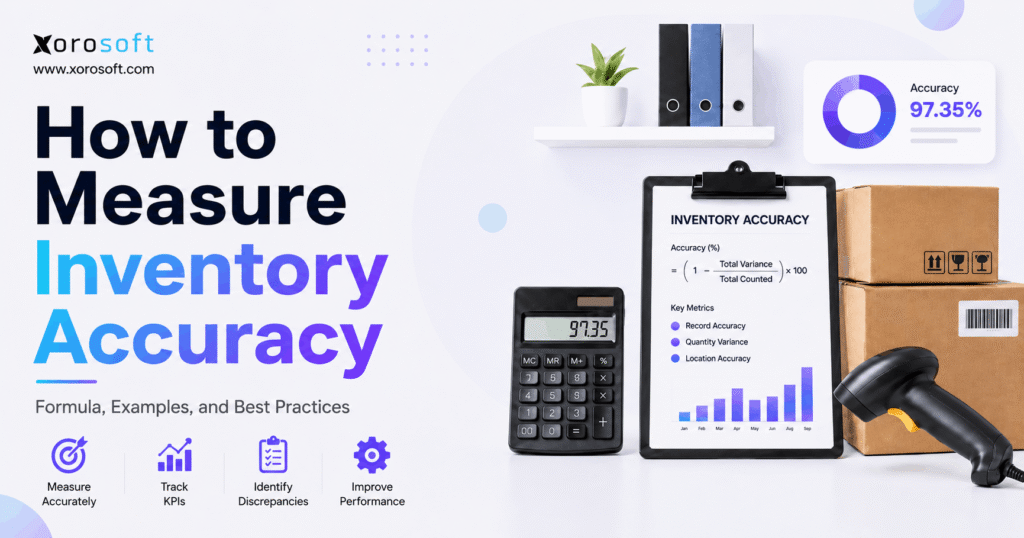
Are you wondering how to measure inventory accuracy in your business?
1. Inventory Errors Usually Start Before the Physical Count
Knowing how to measure inventory accuracy matters because a physical count is usually where an inventory problem becomes visible—not where it begins. Most discrepancies enter the operation earlier through receiving, putaway, picking, replenishment, transfers, returns, manufacturing activity, or manual adjustments.
That distinction changes how an inventory-driven business should approach stock discrepancies. When inventory accuracy is treated only as a counting problem, the process often becomes repetitive. Employees count inventory, find differences, adjust the system, and continue working. A few weeks later, the same SKUs or warehouse locations are inaccurate again because the workflow responsible for the original error never changed.
The operational impact extends well beyond the warehouse. Purchasing teams can reorder products that are already available or delay replenishment because the system reports stock that does not physically exist. Sales teams may promise inventory without realizing that part of the recorded quantity is missing, damaged, allocated, or stored elsewhere. Warehouse employees can spend valuable time searching for products in incorrect locations. Finance teams may face additional adjustments, valuation questions, and reconciliation work.
These problems become harder to control as the business grows. A small operation with a limited product catalog can sometimes compensate for weak records through employee knowledge. Someone may know that a product is actually stored in another aisle or that a particular system balance is wrong. Once the business adds more warehouses, ecommerce channels, wholesale customers, EDI activity, manufacturing, or larger purchasing teams, that informal knowledge stops scaling.
Inventory accuracy therefore needs to function as an operating control, not simply as an annual warehouse exercise.
1.1 Inventory Accuracy Measures Operational Confidence
The practical value of inventory accuracy is trust.
Can purchasing rely on the on-hand balance before issuing a purchase order? Sales teams should be able to promise available stock without asking someone to physically check the warehouse. In the warehouse, pickers need to go directly to the recorded location and find the expected product. Finance, meanwhile, should be able to rely on inventory transactions without spending days investigating unexplained adjustments.
When teams regularly double-check system quantities before acting, the problem is bigger than a percentage on a dashboard. It means the inventory record is no longer functioning as a dependable source of operational truth.
2. What Inventory Accuracy Actually Measures
Before deciding how to measure inventory accuracy, a business must define what an accurate inventory record means.
Inventory accuracy describes how closely inventory information recorded in a system matches physical reality. However, physical reality involves more than quantity. It can also include SKU identity, warehouse location, inventory status, lot information, serial numbers, units of measure, and financial value.
That is why two businesses can both report 98% inventory accuracy while measuring different things.
One company may classify every SKU record as either correct or incorrect. Another may calculate the percentage of unit variance across an entire warehouse. A distribution center may focus heavily on location accuracy because finding inventory quickly is critical to fulfillment. Finance may be most concerned with how physical stock differences affect inventory valuation.
Each measurement provides useful information, but no single method answers every operational question.
2.1 Inventory Accuracy vs Inventory Record Accuracy
Inventory record accuracy focuses on whether an individual system record agrees with the physical count.
Suppose a warehouse audits 500 SKU-location records and 480 match exactly. The inventory record accuracy calculation is:
480 ÷ 500 × 100 = 96%
The remaining 20 records are inaccurate even if each discrepancy involves only one unit.
This approach is valuable because it answers a straightforward question: what percentage of inventory records can employees trust exactly as shown?
2.2 Quantity Accuracy Measures the Size of the Difference
Quantity accuracy looks at the magnitude of inventory discrepancies rather than simply counting how many records are wrong.
A warehouse may have a relatively large number of records that differ by one unit but still maintain a small overall unit variance. Quantity accuracy helps management understand how much physical inventory is affected.
2.3 Location Accuracy Measures Whether Stock Can Be Found
Inventory can physically exist and still create an operational problem when it is stored in the wrong location.
If a system directs a picker to Bin A-12 but the item is actually in Bin C-04, total quantity may remain correct while warehouse performance suffers. Location accuracy therefore becomes increasingly important in larger facilities with many bins, aisles, zones, or reserve locations.
2.4 Inventory Value Accuracy Supports Financial Control
Finance teams may compare the recorded value of inventory with verified physical inventory value.
This measurement helps identify financial exposure and supports reconciliation, but it should not replace SKU-level analysis. Overages and shortages across different products can partially offset one another financially even though the underlying records remain inaccurate.
3. How to Measure Inventory Accuracy With the Right Formula
There is no single calculation that answers every inventory question. The correct formula depends on what management wants to understand.
3.1 Exact-Match Inventory Accuracy Formula
The most straightforward record-based formula is:
Inventory Accuracy (%) = Accurate Records ÷ Total Records Checked × 100
If a cycle count reviews 1,000 SKU-location records and 970 match exactly, the calculation is:
970 ÷ 1,000 × 100 = 97%
This method works well for cycle counting because every record receives a clear pass-or-fail result.
Its main limitation is that it does not account for severity. A record that differs by one unit is treated the same as a record that differs by 100 units. Both fail the exact-match test.
3.2 Quantity-Based Inventory Accuracy Formula
Businesses that need to understand the magnitude of stock differences can use a quantity-based calculation:
Quantity Accuracy (%) = [1 − (Total Absolute Unit Variance ÷ Total Recorded Units)] × 100
Suppose the audited inventory contains 20,000 recorded units and total absolute variance equals 300 units.
The result is:
[1 − (300 ÷ 20,000)] × 100 = 98.5%
This method gives management a useful view of the total size of the error. However, it can hide a large number of small SKU-level discrepancies.
3.3 Warehouse Location Accuracy Formula
Location accuracy can be calculated as:
Location Accuracy (%) = Correct SKU-Location Records ÷ Total SKU-Location Records Checked × 100
If 760 of 800 audited SKU-location combinations are correct:
760 ÷ 800 × 100 = 95%
The remaining 5% can still create significant warehouse inefficiency because pickers, replenishment staff, and cycle counters may be directed to incorrect locations.
3.4 Inventory Value Accuracy Formula
A simplified value-based formula is:
Value Accuracy (%) = [1 − (Absolute Value Variance ÷ Recorded Inventory Value)] × 100
If recorded inventory value is $1,000,000 and the verified absolute value variance is $15,000:
[1 − ($15,000 ÷ $1,000,000)] × 100 = 98.5%
Value accuracy is particularly useful for financial analysis, while operations still needs detailed SKU and location information to address the cause of discrepancies.
4. Inventory Accuracy Examples Show Why One Percentage Is Not Enough
Consider a simple inventory sample:
| SKU | System Quantity | Physical Quantity | Variance | Exact Match |
|---|---|---|---|---|
| A100 | 100 | 100 | 0 | Yes |
| B200 | 80 | 78 | -2 | No |
| C300 | 50 | 50 | 0 | Yes |
| D400 | 120 | 115 | -5 | No |
| E500 | 150 | 150 | 0 | Yes |
Three of the five records match exactly.
Using the record-based formula:
3 ÷ 5 × 100 = 60% inventory accuracy
However, total recorded inventory equals 500 units and the total absolute variance is only seven units.
Using quantity accuracy:
[1 − (7 ÷ 500)] × 100 = 98.6%
The same sample therefore produces an inventory accuracy result of 60% under one methodology and 98.6% under another.
Neither number is automatically wrong.
The 60% result tells management that two of every five records contain an error. The 98.6% result says that the overall quantity difference is relatively small.
4.1 Always Report the Inventory Accuracy Method
A dashboard should not simply state, “Inventory Accuracy: 98%.”
It should specify whether the figure represents exact SKU accuracy, quantity accuracy, location accuracy, or value accuracy.
Consistency matters as well. If one warehouse uses exact matching and another allows a two-unit tolerance, their percentages should not be compared as though the calculations were identical.
The same methodology should continue across reporting periods so management can identify a genuine performance trend.
5. What Is a Good Inventory Accuracy Rate?
A good inventory accuracy rate depends on the formula, SKU complexity, transaction volume, warehouse environment, and operational risk.
Businesses often search for one benchmark that represents excellent inventory control. In practice, the calculation behind the percentage matters just as much as the percentage itself.
A 99% quantity accuracy rate does not necessarily mean that 99% of SKU records are correct. Similarly, 99% exact-match accuracy across low-value products may have a very different business impact from 99% accuracy across expensive components required for manufacturing.
5.1 Inventory Accuracy Benchmarks Need Context
Benchmarks are useful when businesses compare similar measurement methodologies.
The better internal question is whether inventory accuracy is improving under a consistent calculation. Management should examine overall accuracy alongside warehouse-level performance, SKU classifications, financial variance, and repeat discrepancies.
A company-wide number may appear strong while one warehouse performs poorly. Likewise, slow-moving inventory can have excellent accuracy while a small group of high-value or high-demand products creates most of the operational exposure.
5.2 Critical Inventory Should Receive Tighter Controls
Not every SKU requires the same counting frequency.
High-value products, fast sellers, critical production components, and products associated with repeated fulfillment problems usually deserve more frequent attention. Lower-risk inventory can follow a less aggressive schedule.
This risk-based approach concentrates inventory-control resources where a discrepancy is most likely to affect revenue, service levels, production, or working capital.
6. How to Measure Inventory Accuracy During Cycle Counting
Cycle counting turns inventory accuracy into an ongoing operating discipline rather than an annual event.
Instead of attempting to count the entire warehouse at once, teams verify selected products or locations throughout the year.
6.1 Define Accuracy Rules Before the Cycle Count
The first step is establishing what counts as accurate.
Does a record need to match exactly? Is a one-unit tolerance acceptable for particular product categories? Must both quantity and location match?
Whatever rule the company chooses should be defined before results are reviewed.
Changing the tolerance after seeing discrepancies makes the measurement less reliable and undermines comparisons between counting periods.
6.2 Blind Counts Improve Inventory Count Accuracy
A blind count prevents the counter from seeing the expected system quantity before entering the physical result.
This reduces confirmation bias. When an employee knows the system expects 52 units, there is a natural tendency to search for 52 or stop investigating when the count appears close.
A blind count forces the employee to record physical reality first.
6.3 Investigate Inventory Variances Before Adjusting Them
Inventory adjustments correct records. They do not automatically correct the process responsible for the error.
If the count finds eight fewer units than expected, the team should review recent receipts, picks, transfers, returns, damage transactions, and production activity.
The inventory may exist in a different location. A transaction might have been entered against the wrong product. An inter-warehouse transfer may still be open.
Investigating first reduces the risk of turning one discrepancy into two.
7. Why Warehouse Inventory Accuracy Breaks Down
Most inventory discrepancies begin during routine transactions.
Understanding those transaction points is essential for improving inventory accuracy permanently.
7.1 Receiving Errors Create Problems at the Start
Receiving is one of the earliest opportunities for inaccurate inventory to enter the system.
A purchase order may show 100 units, while the supplier physically delivers 96. If the employee receives all 100 units in the system without verifying the shipment, the inventory record becomes inaccurate immediately.
Unit-of-measure mistakes can create even larger problems. Receiving ten cases as ten individual units—or the reverse—can distort stock by a substantial amount.
7.2 Incorrect Putaway Reduces Location Accuracy
Inventory can be received correctly and still become difficult to find.
A warehouse employee may place stock in a convenient open bin instead of the location recorded in the system. Quantity remains accurate at the warehouse level, but location accuracy declines.
These errors often become visible later when another employee attempts to pick or replenish the item.
7.3 Picking and Replenishment Create Frequent Inventory Movement
Warehouse inventory moves constantly after receiving.
Employees can pick from the wrong bin, remove the wrong SKU, forget to complete a system transaction, or move reserve inventory to a forward location without recording the replenishment.
Every unrecorded movement creates a gap between physical inventory and the system.
7.4 Transfers Create Multi-Warehouse Complexity
Transfers introduce a special challenge because inventory moves between facilities rather than simply entering or leaving the business.
The correct quantity needs to leave the source warehouse, enter an appropriate in-transit status, and arrive at the destination with both physical and system balances aligned.
Weak transfer controls can create a situation where total company inventory is correct while neither warehouse has an accurate balance.
7.5 Returns and Damaged Stock Require Status Control
Returned inventory should not automatically become available inventory.
Some products may be damaged, incomplete, under inspection, awaiting refurbishment, or designated for disposal.
Adding every return directly to sellable inventory can make available stock look stronger than it really is. The same issue occurs when damaged products remain physically present but the system continues to classify them as available for fulfillment.
8. Improving Warehouse Inventory Accuracy With Better Controls
Improving inventory accuracy requires repeatable processes that make the correct transaction easier than the incorrect one.
Technology can strengthen these controls, but software works best when the underlying warehouse procedures are clearly defined.
8.1 Barcode Scanning Reduces Manual Errors
Barcode scanning helps verify both products and locations at the point where inventory moves.
During receiving, employees can confirm that the expected SKU physically arrived. Putaway can require scanning both the item and destination location. Transfers can verify source and destination bins. Picking can confirm that employees remove the correct product from the correct location.
These controls reduce dependence on manual entry and visual identification.
8.2 Warehouse Location Control Supports Inventory Accuracy
For a larger warehouse, knowing that inventory exists somewhere in the building is not sufficient.
The system must also tell employees where the stock can be found. Otherwise, fulfillment teams can experience short picks even though the physical inventory technically exists.
Businesses that need barcode-driven receiving, location management, transfers, picking, and cycle counting can evaluate XoroWMS as one warehouse management option for inventory-intensive operations.
The level of technology should still match the operating environment. A small stockroom with limited movement may not require the same controls as a high-volume distribution center.
8.3 Inventory Adjustments Need Governance
Adjustments should be controlled, categorized, and reviewed.
When employees can freely change quantities whenever something appears wrong, the system may look accurate temporarily while management loses visibility into the cause of repeated discrepancies.
Reason codes such as receiving error, transfer error, damaged inventory, picking error, or return discrepancy make adjustment data far more useful.
9. Inventory Accuracy for Shopify and Multichannel Ecommerce
Ecommerce changes inventory accuracy from a warehouse-only issue into an availability problem.
A company may sell through Shopify, Amazon, wholesale accounts, retail locations, and additional marketplaces while all channels depend on the same physical inventory pool.
The business must know not only how many units it owns but also how many are actually available to sell.
9.1 Physical Inventory and Available Inventory Are Different
A warehouse might physically hold 500 units, but some may already be allocated to customer orders. Other units could be damaged, reserved, under inspection, or moving between facilities.
Sending the full physical quantity to every sales channel can create overselling.
Accurate ecommerce inventory therefore requires clear rules around allocations, reservations, inventory status, and location availability.
9.2 Multichannel Inventory Needs a Clear System of Record
Growing ecommerce businesses should define which application owns the authoritative inventory balance and how other platforms receive updates.
For Shopify merchants that want storefront activity connected with wider ERP workflows, the Xorosoft ERP Shopify app provides one integration path between ecommerce transactions and broader inventory operations.
The technology still needs a clear operational model behind it. Inventory synchronization works best when the business defines transaction timing, location ownership, allocation logic, and exception handling before automating the flow.
10. How to Measure Inventory Accuracy Across Multiple Warehouses
A multi-warehouse business should not rely exclusively on one company-wide percentage.
Consolidated inventory accuracy can hide serious problems within an individual facility.
Suppose Warehouse A has 99% exact record accuracy while Warehouse B has 91%. A blended result may appear respectable, yet customers served by Warehouse B can continue experiencing short picks, delayed orders, and stock availability problems.
10.1 Measure Warehouse Inventory Accuracy Separately
Calculate the metric independently for each warehouse before creating a network-wide number.
Use the same formula, tolerance, and counting procedures across facilities. Otherwise, comparisons become unreliable.
Facility-level analysis also makes root causes easier to identify. One warehouse may struggle primarily with receiving, while another has recurring transfer or picking issues.
10.2 Track Transfer Accuracy Between Facilities
Transfers deserve their own measurement because they connect two sets of warehouse records.
Management should know whether the right product and quantity left the source location, whether the stock was appropriately classified while in transit, and whether the correct quantity was received at the destination.
A strong overall network balance cannot compensate for weak transfer discipline.
10.3 Include SKU-Location Accuracy
Large warehouses need location-level measurement.
Knowing that 50 units exist somewhere across the network is not sufficient when the system sends a picker to a bin containing only 20.
Effective multi-warehouse inventory accuracy combines network quantity visibility with trustworthy warehouse-level and bin-level records.
11. Inventory Accuracy Requirements Change by Industry
Different industries create different inventory risks.
The correct measurement program should reflect product characteristics, transaction patterns, storage requirements, and fulfillment models. Companies evaluating process and technology requirements can review Xorosoft’s coverage of inventory-driven industries, including wholesale distribution, apparel, furniture, sporting goods, consumer products, food, and manufacturing.
11.1 Wholesale Distribution Inventory Accuracy
Wholesale distributors often manage large SKU catalogs, case quantities, individual units, customer-specific commitments, EDI transactions, backorders, and multiple facilities.
An overstated system balance can lead the sales team to accept an order that cannot be fulfilled. Understated stock can trigger unnecessary purchasing and tie up working capital.
Distributors should therefore examine exact SKU accuracy, location accuracy, and available inventory rather than relying only on total units.
11.2 Manufacturing Inventory Accuracy
Manufacturing adds raw materials, components, work in progress, finished goods, BOM consumption, and production transactions.
A production schedule can look achievable when the system shows sufficient materials, yet physical stock may be missing or located elsewhere. Incorrect component consumption can also distort both raw-material balances and finished-goods costs.
Businesses that need inventory, purchasing, accounting, and manufacturing activity in a connected environment can evaluate XoroERP as one integrated ERP approach.
11.3 Apparel and Fashion Inventory Accuracy
Apparel introduces size, color, style, and variant complexity.
A warehouse might hold the correct total number of shirts while maintaining the wrong mix of sizes. Aggregate quantity accuracy would look strong even though the products customers actually want are unavailable.
Variant-level accuracy is therefore more important than broad product-family totals.
11.4 Furniture and Sporting Goods Inventory Accuracy
Furniture businesses often manage larger physical products, more complex warehouse locations, and longer replenishment cycles. Sporting goods companies may handle seasonal demand, bundles, serial numbers, or channel-specific allocations.
Each operating model requires an inventory accuracy methodology that reflects how inventory physically moves and how customers buy it.
12. Inventory Accuracy KPIs That Reveal the Root Cause
Inventory accuracy becomes much more useful when management reviews it alongside the processes surrounding inventory movement.
12.1 Inventory Adjustment Rate
Inventory adjustment rate shows how often stock balances require manual correction.
A rising adjustment rate can indicate that record accuracy is deteriorating even when the headline percentage still looks acceptable.
The value and reason behind adjustments matter as much as their frequency. Ten small corrections and ten large high-value corrections represent very different operational risk.
12.2 Receiving Accuracy
Receiving accuracy measures whether inbound items, quantities, units of measure, and related inventory transactions match the physical delivery.
Weak receiving creates inaccurate records at the beginning of the inventory lifecycle. Every downstream activity then operates from a bad starting point.
12.3 Putaway and Location Accuracy
Putaway accuracy indicates whether received inventory reaches the expected storage location.
Poor putaway can leave total warehouse quantity correct while causing pickers and replenishment staff to search for stock.
12.4 Picking Accuracy
Picking accuracy measures whether employees select the correct products and quantities for customer orders.
A picking mistake affects customer service and can also create an inventory discrepancy when the wrong physical product leaves the warehouse.
12.5 Stockout Rate and Fill Rate
Inventory accuracy also affects customer-facing metrics.
Overstated stock can create short shipments and unexpected stockouts. Understated inventory can cause the business to reject orders unnecessarily or purchase products it already owns.
These KPIs provide context that a single inventory accuracy percentage cannot provide on its own.
13. When Inventory Accuracy Problems Point to a Software Limit
Not every inventory discrepancy means a company needs new software.
A sophisticated ERP cannot correct poor receiving procedures if employees bypass the required workflow. A warehouse management system cannot maintain reliable locations if staff move products without recording the transfer.
However, technology becomes a genuine constraint when employees need repeated manual workarounds simply to understand current inventory.
13.1 Signs the Current Inventory Stack Is Becoming a Constraint
A common warning sign is spreadsheet reconciliation.
Purchasing exports inventory before creating orders. Warehouse employees maintain separate location lists. Shopify, Amazon, and wholesale availability require manual balancing. Finance spends significant time explaining inventory differences at month end.
Trust is another indicator. When staff routinely ask someone to physically check inventory before believing the system, the inventory record has stopped serving as a dependable operating source.
13.2 Integrated ERP Becomes Relevant as Processes Converge
As an inventory-driven company grows, one stock transaction can affect sales, purchasing, warehouse operations, manufacturing, accounting, forecasting, and ecommerce.
At that point, an integrated platform such as XoroONE can become relevant because the operational requirement extends beyond basic inventory tracking.
ERP should still be selected because it fits the business processes—not simply because the organization reached a particular revenue or employee threshold.
13.3 Compare ERP Platforms Beyond Stock Features
An ERP evaluation should examine accounting, purchasing, warehouse management, manufacturing, integrations, reporting, implementation approach, and scalability.
Companies weighing established ERP platforms can use the operational considerations in Xorosoft’s NetSuite comparison as part of a broader evaluation.
Inventory accuracy is important, but a software decision should reflect the entire operating model.
14. How to Measure Inventory Accuracy and Improve It Over 30 Days
Businesses do not need to redesign every warehouse process simultaneously.
A focused 30-day program can establish a reliable baseline, identify the most common causes of variance, and create a repeatable improvement process.
14.1 Week 1: Establish an Honest Inventory Accuracy Baseline
Choose a representative sample across high-volume products, high-value inventory, normal warehouse locations, and known problem areas.
Define the accuracy formula, tolerance, and counting rules before starting.
The goal is not to produce an impressive percentage. Management needs an honest starting point before improvement can be measured.
14.2 Week 2: Categorize Every Inventory Variance
Review each discrepancy and assign a root cause.
Receiving, putaway, picking, transfers, returns, damage, manufacturing, unit-of-measure configuration, and synchronization errors should be separated rather than grouped under a generic adjustment category.
Within a relatively short period, recurring patterns should begin to appear.
14.3 Week 3: Correct the Highest-Impact Inventory Process
If receiving drives the problem, strengthen quantity verification. Location discrepancies may require tighter putaway and transfer controls instead. When returns create most of the variance, redesign how returned inventory is inspected, classified, and returned to available stock.
Concentrating on one high-impact workflow often produces better results than making minor changes everywhere.
14.4 Week 4: Build Continuous Inventory Accuracy Monitoring
Create an ongoing cycle count schedule and review results by warehouse, SKU class, discrepancy type, and financial impact.
Inventory accuracy should become a trend rather than an isolated score.
Management can then determine whether process changes are reducing discrepancies month after month.
15. Frequently Asked Questions About How to Measure Inventory Accuracy
15.1 What Is Inventory Accuracy?
Inventory accuracy measures how closely physical stock matches the quantity, location, status, or value recorded in an inventory system. Businesses can measure exact SKU matches, quantity variance, warehouse location accuracy, or financial value. The methodology should always be clearly defined because different calculations can produce significantly different percentages.
15.2 How Do You Measure Inventory Accuracy?
To understand how to measure inventory accuracy, first define what counts as correct. Perform a physical count, compare the results with the system, calculate the chosen metric, and investigate discrepancies before adjusting records. Keep the same formula and tolerance over time so performance can be compared consistently.
15.3 What Is the Inventory Accuracy Formula?
A common formula is:
Inventory Accuracy (%) = Accurate Records ÷ Total Records Checked × 100
If 970 of 1,000 audited records meet the company’s accuracy standard, inventory accuracy is 97%. Quantity-based, location-based, and value-based formulas can also be used when management needs a different operational perspective.
15.4 What Is Inventory Record Accuracy?
Inventory record accuracy measures whether individual inventory records match verified physical stock. It is particularly useful during cycle counts because every SKU or SKU-location record can be classified as accurate or inaccurate. Record accuracy should be distinguished from overall quantity accuracy, which measures the magnitude of total variance.
15.5 What Is a Good Inventory Accuracy Percentage?
A good percentage depends on the measurement method, inventory complexity, transaction volume, and operational risk. Businesses should avoid comparing an exact-record percentage directly with a quantity-based benchmark. A consistent calculation and improving trend are usually more valuable than pursuing an isolated benchmark without understanding its methodology.
15.6 Is 95% Inventory Accuracy Good?
It may be an acceptable baseline in some operations, but the underlying calculation matters. If 95% represents exact SKU-location accuracy, five of every 100 records remain incorrect. Across thousands of records, that can create significant fulfillment, purchasing, warehouse, and reconciliation problems.
15.7 Can Inventory Accuracy Reach 100%?
A business can achieve 100% during a specific cycle count or audit. Maintaining perfect accuracy continuously is more difficult because receiving, picking, transfers, returns, damage, and production transactions constantly change inventory. The practical objective is to prevent avoidable errors and detect remaining discrepancies quickly.
15.8 What Causes Inventory Inaccuracies?
Common causes include receiving errors, incorrect putaway, unrecorded transfers, picking mistakes, returns-processing problems, damage, shrinkage, unit-of-measure errors, manual entry, and disconnected applications. Most inventory discrepancies occur when a physical inventory movement does not match the corresponding system transaction.
15.9 Why Does Physical Inventory Not Match the System?
A mismatch usually means a transaction was missed, delayed, recorded incorrectly, or completed against the wrong SKU or warehouse location. Before posting an adjustment, teams should investigate recent receipts, picks, transfers, returns, manufacturing activity, damage, and previous corrections.
15.10 How Often Should Inventory Accuracy Be Measured?
Inventory-driven businesses should monitor stock accuracy continuously through cycle counting rather than relying only on an annual physical inventory. Counting frequency should reflect product value, transaction volume, demand, and operational importance. Higher-risk items generally deserve more frequent verification.
15.11 What Is Cycle Count Accuracy?
Cycle count accuracy is the percentage of records checked during a cycle count that meet the company’s predefined accuracy standard. If 196 of 200 audited records match exactly, cycle count accuracy equals 98%. Monitoring this percentage over time helps determine whether process improvements are working.
15.12 How Does Cycle Counting Improve Inventory Accuracy?
Cycle counting identifies discrepancies closer to the transactions that caused them, making investigation easier. It also spreads inventory verification throughout the year instead of relying exclusively on disruptive full physical counts. Frequent counts of critical products can reveal recurring receiving, transfer, location, or picking problems sooner.
15.13 What Is the Difference Between Cycle Counting and Physical Inventory?
Cycle counting verifies selected products or locations throughout the year. A full physical inventory generally attempts to count most or all stock during a defined period. Cycle counting supports continuous operating control, while full physical counts may still be required for financial, audit, or broader business purposes.
15.14 What Is Inventory Variance?
Inventory variance is the difference between physical inventory and the quantity or value recorded in the system. Negative variance means physical stock is lower than the system balance, while positive variance indicates additional physical stock. Variances should be investigated before becoming routine adjustments.
15.15 How Do You Calculate Inventory Variance?
A basic unit calculation is:
Inventory Variance = Physical Quantity − System Quantity
If the system records 120 units and a physical count finds 114, the variance is -6 units. For aggregate accuracy calculations, absolute variance is often preferable because shortages and overages should not cancel one another.
15.16 What Is Warehouse Location Accuracy?
Warehouse location accuracy measures whether products physically exist in the storage locations recorded by the warehouse system. Strong location accuracy reduces searching, short picks, unnecessary replenishment, and fulfillment delays. It becomes especially important in facilities with many zones, aisles, bins, and reserve locations.
15.17 Should Inventory Accuracy Be Measured by SKU or Units?
Both approaches provide useful information. SKU-level accuracy shows how many records can be trusted, while unit-based accuracy shows the total magnitude of the discrepancy. Tracking both prevents numerous small record errors from being hidden behind an apparently strong total-unit percentage.
15.18 How Do You Measure Inventory Accuracy Across Multiple Warehouses?
Measure each facility independently using the same formula and tolerance, then calculate a consolidated network figure if needed. Businesses should also track transfer accuracy and SKU-location accuracy so a healthy company-wide balance does not hide inventory stored in the wrong warehouse.
15.19 How Does Barcode Scanning Improve Inventory Accuracy?
Barcode scanning reduces manual product and location entry. Employees can verify SKUs and bins during receiving, putaway, transfers, picking, and cycle counting. Scanning does not replace disciplined processes, but it reduces opportunities for typing mistakes, incorrect identification, and unverified warehouse movements.
15.20 Can a WMS Improve Inventory Accuracy?
A WMS can improve warehouse inventory accuracy through location control, barcode transactions, receiving workflows, transfers, picking, and cycle counting. Results still depend on accurate master data and employee compliance. Technology works best when it reinforces well-designed warehouse procedures.
15.21 Can ERP Improve Inventory Accuracy?
ERP can help when inventory accuracy depends on transactions across purchasing, sales, accounting, manufacturing, ecommerce, and warehouse operations. A shared operational system reduces duplicate entry and conflicting records. Smaller businesses with straightforward inventory requirements may still achieve adequate control through dedicated inventory software.
15.22 How Does Inventory Accuracy Affect Forecasting?
Forecasting estimates future demand, but purchasing and production decisions also require a reliable starting inventory balance. If the on-hand quantity is wrong, even a strong demand forecast can create poor replenishment recommendations. Accurate inventory therefore supports better forecasting and planning decisions.
15.23 How Does Inventory Accuracy Affect Accounting?
Inventory is a financial asset, so physical discrepancies can create quantity and valuation adjustments. Frequent unexplained corrections increase reconciliation work and reduce confidence in reported inventory balances. Strong approval controls, reason codes, and transaction audit trails help finance teams understand why inventory changes.
15.24 When Should a Company Stop Using Spreadsheets for Inventory?
Spreadsheets become difficult to control when several employees process inventory, transactions occur continuously, multiple warehouses require synchronization, or ecommerce and wholesale channels share the same stock. When reconciliation becomes routine, businesses should evaluate dedicated inventory software, WMS, or ERP based on operational complexity.
15.25 Which KPIs Should Be Tracked With Inventory Accuracy?
Useful companion KPIs include inventory adjustment rate, receiving accuracy, putaway accuracy, picking accuracy, shrinkage, transfer accuracy, stockout rate, fill rate, inventory turnover, and forecast accuracy. Together, these measures help management understand not only whether inventory is inaccurate but which processes are creating the problem.
16. Make Inventory Accuracy a Daily Operating Discipline
Learning how to measure inventory accuracy is only the starting point. The larger objective is to build an operation where employees can rely on inventory records without repeatedly confirming them through spreadsheets, warehouse searches, or manual reconciliation.
Start with one clearly documented measurement method. Decide whether the business needs exact SKU accuracy, quantity accuracy, location accuracy, value accuracy, or a combination of several measures. Keep those rules consistent so results remain comparable across warehouses and reporting periods.
16.1 Turn Inventory Discrepancies Into Process Improvements
Once a reliable measurement method is established, investigate why discrepancies occur rather than concentrating only on the final percentage.
Receiving, putaway, transfers, picking, returns, manufacturing, and adjustments should leave a clear transaction trail. Repeated variances should also be categorized so management can identify which workflow is creating the problem.
Cycle counting then turns inventory accuracy into a routine control process. High-risk inventory can be counted more frequently, while lower-risk products follow a schedule appropriate to their value, transaction volume, and operational importance.
The objective is not simply to correct inaccurate quantities. The business should use each discrepancy as evidence that helps improve the underlying inventory process.
16.2 Use Technology to Strengthen Inventory Accuracy Controls
Technology should support disciplined processes rather than replace them.
Barcode scanning can strengthen product and location verification during receiving, putaway, transfers, picking, and cycle counting. A WMS can provide tighter warehouse execution controls, while integrated ERP becomes relevant when inventory transactions need to remain synchronized with sales, purchasing, accounting, manufacturing, ecommerce, forecasting, and reporting.
The practical measure of success is not simply whether a dashboard reports 98%, 99%, or 100%. Success means purchasing can reorder confidently, warehouse teams can locate products quickly, sales can promise available stock accurately, and finance can reconcile inventory without repeated surprises.
16.3 Decide the Next Step Based on Operational Complexity
When recurring discrepancies continue despite stronger processes, the next step is to determine whether the problem is procedural or whether the existing software stack has reached its operational limit.
Businesses should examine where manual reconciliation still occurs, which systems maintain competing inventory records, how often employees work outside the primary system, and whether warehouse transactions flow reliably into purchasing, sales, and accounting.
If those issues are becoming structural rather than occasional, an ERP readiness review can help determine whether better processes are enough or whether the company needs a more integrated operating system.
For a personalized assessment of inventory, warehouse, purchasing, ecommerce, manufacturing, and accounting requirements, contact Xorosoft.
Recent Posts
-
 Stock Write-Off Tracking: How Inventory Losses Explain Gross-Margin Variance
 -
 Switching From NetSuite: A Migration Decision Framework for Inventory-Driven Businesses
 -
 Use of AI in Warehouse Management for Exception Prioritization: From Dock Delays to Pick-Face Stockouts
 -
 Why Shopify B2B Orders Break ERP Accounting After Partial Fulfillment
 -
 Inventory Valuation in ERP: FIFO, Average Cost, Landed Cost, and Adjustments