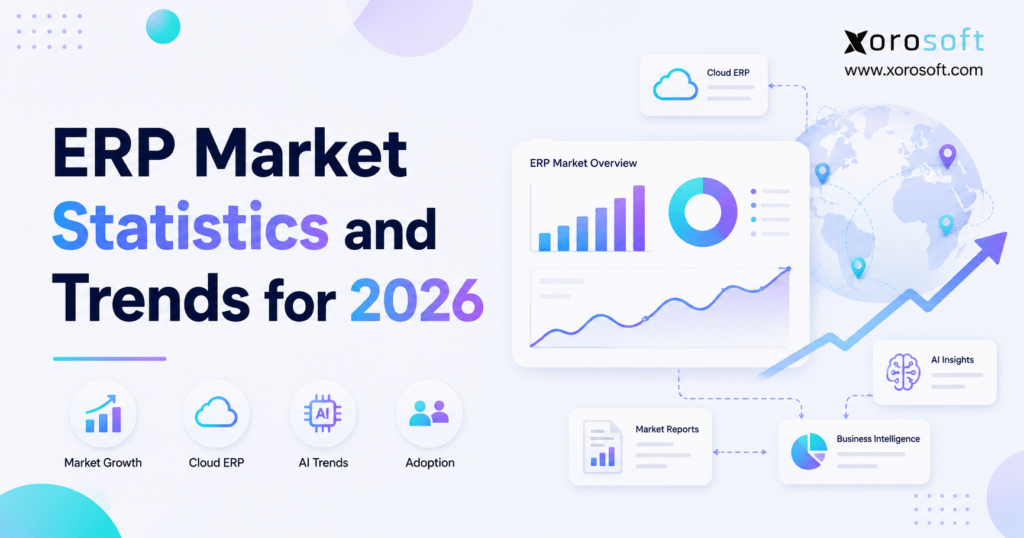
In this article, we’ll explore the latest ERP market statistics.
1. The Numbers Behind ERP’s 2026 Shift
ERP market statistics for 2026 show that enterprise resource planning is moving far beyond its traditional back-office role. Instead, companies increasingly use ERP to connect accounting, inventory, purchasing, warehouse operations, manufacturing, ecommerce, and reporting. As a result, ERP has become operational infrastructure for businesses that can no longer manage growth through spreadsheets and disconnected apps.
According to SAP’s definition of ERP, enterprise resource planning software integrates core business processes and data within one system. However, the value of ERP is not simply centralization. More importantly, an integrated system can show how one operational decision affects inventory, cash flow, purchasing, fulfillment, and customer service at the same time.
Meanwhile, the 2026 market is being shaped by four forces: continued software-market growth, faster cloud adoption, embedded artificial intelligence, and stronger demand for implementation discipline. Therefore, business leaders should read market estimates as strategic signals rather than isolated numbers. Although research firms use different definitions and forecasting methods, the overall direction is consistent: more organizations are investing in connected, cloud-based, and data-driven ERP environments.
1.1 Why These ERP Trends Matter to Operators
For operators, ERP market statistics matter because they reveal where software vendors, implementation partners, and customers are placing their attention. For example, strong cloud growth suggests that browser-based access, automatic updates, integration flexibility, and distributed operations are becoming standard expectations. Likewise, rising AI investment suggests that forecasting, reconciliation, reporting, and exception management will become more automated.
Nevertheless, market momentum does not mean every business should buy ERP immediately. Instead, companies should compare these trends with their own operational signals. If teams regularly reconcile inventory between systems, rebuild reports manually, or use spreadsheets to control purchasing, the business may already be paying the hidden cost of fragmentation.
1.2 ERP Market Statistics at a Glance
| Market signal | Current or forecast figure | Operational meaning |
|---|---|---|
| Global ERP software market | $83.2 billion in 2026 | Integrated business systems remain a growing category |
| Global ERP software forecast | $157.1 billion by 2033 | Long-term ERP investment is expected to continue |
| ERP software CAGR | 9.5% from 2026 to 2033 | The category is expanding steadily |
| Cloud ERP market | $76.17 billion in 2026 | Cloud deployment is becoming central to ERP strategy |
| Cloud ERP forecast | $207.59 billion by 2034 | SaaS ERP adoption is accelerating |
| Cloud ERP CAGR | 13.40% from 2026 to 2034 | Cloud ERP is growing faster than the broader category |
| AI-enabled cloud ERP spending | 62% projected by 2027 | AI is moving toward core ERP workflows |
| AI-enabled financial close impact | 30% faster close projected by 2028 | Finance automation is becoming more practical |
2. ERP Market Statistics Show Continued Global Growth
The latest ERP market statistics indicate that the software category is expanding, although market estimates vary by research methodology. Grand View Research values the global ERP software market at $83.2 billion in 2026 and projects it to reach $157.1 billion by 2033, representing a 9.5% compound annual growth rate. By comparison, Fortune Business Insights projects a larger 2026 market value of $106.22 billion and a 2034 value of $281.58 billion.
Because research firms define segments differently, companies should avoid treating one estimate as the only correct market size. Nevertheless, both forecasts point in the same direction. ERP demand is growing as organizations seek real-time data, connected workflows, stronger planning, and more scalable operating systems.
2.1 What Is Driving ERP Market Growth?
First, businesses are managing more operational variables than before. Ecommerce companies may sell through Shopify, Amazon, marketplaces, retail stores, and wholesale accounts while fulfilling from several warehouses. Consequently, inventory availability can change across many systems within minutes.
Second, finance teams need faster access to operational data. Without integrated inventory valuation, purchasing commitments, landed costs, returns, and channel revenue, the financial close becomes slower and less reliable. Therefore, ERP investment increasingly starts with a finance problem that is actually rooted in disconnected operations.
Third, growing companies need repeatable processes. Spreadsheets may support a small purchasing team; however, they become risky when dozens of suppliers, thousands of SKUs, and multiple warehouses are involved. As a result, ERP software becomes a way to standardize work without losing visibility.
2.2 The Mid-Market Is Adopting ERP Earlier
Historically, many businesses waited until they became large enterprises before evaluating ERP. Today, cloud delivery and subscription pricing allow mid-market companies to adopt integrated systems earlier. Moreover, product businesses often encounter ERP-level complexity long before they reach enterprise headcount.
For example, a 40-person apparel company may manage thousands of variants, international suppliers, wholesale pricing, seasonal demand, returns, and multiple fulfillment locations. Although its employee count is modest, its operational complexity may already require ERP. Therefore, revenue, transaction volume, SKU count, warehouse count, and channel mix are often better ERP-readiness indicators than employee count alone.
3. ERP Software Trends Are Moving Toward Connected Operations
The strongest ERP market statistics support a broader software trend: companies want fewer disconnected applications and a more reliable operational backbone. However, this does not mean every specialized tool will disappear. Instead, ERP is increasingly becoming the system that governs shared records, financial logic, inventory status, purchasing activity, and cross-functional reporting.
For inventory-driven companies, XoroONE represents this unified direction by connecting ERP, inventory, accounting, purchasing, warehouse management, ecommerce operations, and reporting. Additionally, businesses can review Xorosoft’s broader business solutions to understand how different workflows fit within an integrated operating environment.
3.1 Disconnected Software Is Becoming More Expensive
At first, separate apps can be quick to deploy. Nevertheless, every new integration introduces another sync, data mapping, exception process, and support dependency. Over time, teams may spend hours checking whether orders, inventory, invoices, purchase orders, and returns moved correctly between platforms.
Accordingly, the visible software subscription cost is only part of the total expense. Manual reconciliation, duplicate entry, delayed decisions, missed orders, and inaccurate stock also create costs. In addition, fragmented reporting can make leaders believe the business is performing differently depending on which system they review.
3.2 Real-Time Visibility Is Replacing Periodic Reporting
Previously, companies could wait until the end of the week or month to consolidate reports. Now, operators often need current answers about stock availability, margin, order status, supplier delays, warehouse performance, and cash commitments. Therefore, modern ERP systems are expected to provide role-based dashboards and drill-down reporting rather than static exports alone.
Moreover, real-time visibility changes management behavior. Instead of discovering a stockout after customers complain, teams can identify risk from open demand, supplier lead times, and available inventory. Likewise, finance can review operational drivers before month-end instead of correcting them afterward.
3.3 Industry Fit Matters More Than Feature Volume
A long feature list does not guarantee that an ERP system matches the business. For example, apparel companies need variant management, seasonal planning, and channel allocation. Meanwhile, wholesale distributors require customer-specific pricing, EDI, allocation rules, and purchasing control.
Consequently, ERP buyers should evaluate workflow depth instead of counting menu items. Xorosoft’s industry solutions are relevant for inventory-driven sectors such as apparel, wholesale distribution, furniture, sporting goods, consumer products, food, and manufacturing. Nevertheless, each company should still validate its exact processes during selection.
4. Cloud ERP Market Statistics Point to Faster Adoption
Cloud deployment is one of the clearest themes within ERP market statistics for 2026. According to Fortune Business Insights, the global cloud ERP market is projected to grow from $76.17 billion in 2026 to $207.59 billion by 2034 at a 13.40% CAGR. Additionally, North America held 36.10% of the market in 2025.
Because cloud ERP is growing faster than the overall ERP category, deployment strategy is becoming a central buying decision. However, cloud adoption should not be reduced to hosting location. More importantly, companies should evaluate upgrade frequency, integration options, mobile access, security controls, data ownership, and implementation support.
4.1 Why Businesses Are Choosing Cloud ERP
First, cloud ERP supports distributed operations. A company can allow finance teams, buyers, warehouse managers, executives, and remote employees to work from the same system without maintaining separate local installations.
Second, vendors can deliver product updates more consistently. Therefore, companies may avoid the disruptive upgrade cycles associated with heavily customized legacy environments. In addition, cloud platforms often provide APIs and integration frameworks that support ecommerce and logistics ecosystems.
Third, subscription delivery can reduce upfront infrastructure requirements. Nevertheless, buyers must compare total cost over several years, including implementation, integrations, data migration, support, and user growth.
4.2 Cloud ERP vs On-Premise ERP
| Decision area | Cloud ERP | On-premise ERP |
| Hosting | Vendor or cloud-provider infrastructure | Company-controlled servers |
| Updates | Usually managed by the vendor | Usually managed internally |
| Remote access | Generally easier | Often requires additional configuration |
| Scaling | Capacity can expand more quickly | Infrastructure may need to be purchased |
| Cost structure | Recurring subscription | Higher initial infrastructure investment |
| Customization | Often configuration-led | Can support deeper code-level customization |
| Best fit | Growing and distributed operations | Organizations with strict hosting requirements |
Although cloud ERP fits many growing businesses, on-premise systems still have legitimate use cases. For example, specific regulatory, sovereignty, integration, or internal-control requirements may justify local hosting. Therefore, the correct choice depends on operating needs rather than market popularity alone.
4.3 Cloud ERP for Ecommerce and Multi-Channel Operations
Ecommerce operations create a strong case for cloud ERP because orders and inventory move continuously. Consequently, Shopify, Amazon, wholesale, and warehouse transactions must update a shared operating record quickly.
Xorosoft supports this direction through cloud ERP and ecommerce connectivity. In addition, Shopify merchants can review the Xorosoft ERP listing on the Shopify App Store when evaluating how storefront activity can connect with inventory, purchasing, accounting, and fulfillment.
5. AI and ERP Market Statistics Are Reshaping Priorities
Artificial intelligence is now an important part of ERP market statistics and product roadmaps. Gartner predicts that finance organizations using cloud ERP with embedded AI assistants will achieve a 30% faster financial close by 2028. Furthermore, Gartner expects AI-enabled tools to represent 62% of cloud ERP spending by 2027, compared with 14% in 2024.
These forecasts suggest that AI will become a standard ERP capability rather than a separate experimental layer. Even so, buyers should distinguish practical automation from broad marketing claims. Specifically, AI creates the most value when it works with reliable data, defined controls, and measurable processes.
5.1 AI in Finance and Accounting
Finance is one of the most immediate AI opportunities because ERP systems already contain structured transaction data. For example, AI can support reconciliation, anomaly detection, collections prioritization, cash-flow analysis, narrative reporting, and close-task coordination.
However, automation cannot repair a poorly designed chart of accounts or inconsistent inventory valuation rules. Therefore, finance leaders should treat clean data and process governance as prerequisites. Otherwise, AI may accelerate incorrect conclusions rather than improve decisions.
5.2 AI in Inventory Forecasting and Purchasing
Inventory planning is another high-value use case. Because ERP connects sales history, open orders, purchase orders, supplier lead times, current stock, and warehouse transfers, AI can identify patterns that are difficult to see manually.
For instance, a forecast may highlight rising demand, but the purchasing team must still consider minimum order quantities, cash limits, warehouse capacity, and supplier reliability. Consequently, the best AI recommendations explain the drivers behind an action instead of producing an unexplained number.
5.3 AI in Warehouse and Order Management
Within warehouse operations, AI can support labor planning, exception detection, slotting recommendations, replenishment analysis, and fulfillment prioritization. Nevertheless, accurate barcode scans, bin records, receiving procedures, and inventory transactions remain essential.
Xorosoft’s AI MCP Server reflects the growing connection between enterprise data and AI-enabled workflows. However, companies should evaluate AI through specific operational questions: Which task becomes faster? Which decision improves? Which exception is detected earlier?
5.4 Agentic AI Will Increase, but Governance Still Matters
Gartner also predicts that 40% of enterprise applications will include task-specific AI agents by the end of 2026, up from less than 5% in 2025. At the same time, the firm warns against confusing assistants with autonomous agents. Therefore, businesses should define approval limits, audit trails, access rights, and human review before allowing agents to change operational records.
6. ERP Implementation Statistics Highlight Execution Risk
Although ERP market statistics show strong demand, implementation statistics remind buyers that software alone does not produce business value. Gartner predicts that, by 2027, more than 70% of recently implemented ERP initiatives will fail to fully meet their original business-case goals, while as many as 25% may fail catastrophically.
These figures should not discourage companies from modernizing. Instead, they should change how leaders define ERP success. A project should be measured by inventory accuracy, close speed, purchasing control, fulfillment performance, user adoption, and reporting quality—not simply by whether the software went live.
6.1 Why ERP Projects Miss Their Goals
First, many projects prioritize software features before business outcomes. As a result, teams configure screens without agreeing on how purchasing, receiving, inventory, fulfillment, returns, and accounting should work together.
Second, data cleanup often begins too late. Consequently, duplicate customers, inconsistent SKUs, incorrect units of measure, obsolete warehouse locations, and unreliable opening balances create problems during testing.
Third, organizations underestimate change management. Panorama Consulting identifies people, unrealistic expectations, planning gaps, and organizational change as important cost-overrun risks. Therefore, training and communication must be planned as core workstreams rather than final-stage tasks.
6.2 How to Reduce Implementation Risk
A disciplined ERP program should begin with measurable objectives. For example, the business may aim to increase inventory accuracy, shorten month-end close, reduce order errors, or eliminate spreadsheet purchasing.
Next, process owners should map current and future workflows. Meanwhile, data teams should clean master records before migration. Additionally, users should test complete scenarios such as purchase-to-receipt, order-to-cash, transfer-to-fulfillment, return-to-refund, and production-to-finished-goods.
Finally, the organization should limit unnecessary customization. Although customization can be valuable, every custom rule adds testing, upgrade, and support responsibilities. Therefore, configuration and process alignment should be considered before code changes.
6.3 ERP Implementation Readiness Checklist
1. Define three to five measurable business outcomes.
2. Assign owners for finance, inventory, purchasing, warehouse, ecommerce, and manufacturing workflows.
3. Clean customer, supplier, SKU, warehouse, and accounting records.
4. Document integrations and determine which system owns each record.
5. Test real orders, receipts, transfers, returns, payments, and adjustments.
6. Train users according to their roles and daily responsibilities.
7. Establish post-launch support, issue ownership, and adoption reporting.
7. ERP Market Statistics by Business Function
A useful way to interpret ERP market statistics is to connect them with the departments that will experience change. While market reports describe software growth, operators need to understand how that growth affects finance, inventory, purchasing, warehouses, manufacturing, and ecommerce.
7.1 Finance and Accounting Trends
Finance teams increasingly expect operational transactions to flow directly into accounting. Therefore, inventory receipts, shipments, landed costs, adjustments, returns, and production activity should not require extensive manual re-entry.
Xorosoft’s XoroERP is positioned for businesses that need accounting connected with inventory-driven operations. Moreover, integrated reporting can help finance teams investigate the operational source of a variance instead of correcting totals without context.
7.2 Inventory Management Trends
Inventory accuracy remains central because every downstream workflow depends on it. If available stock is wrong, purchasing plans, customer promises, warehouse priorities, and financial statements may also be wrong.
Accordingly, modern ERP systems need location-level inventory, allocation rules, transfers, cycle counts, serial or lot controls where relevant, and clear audit trails. In addition, teams need visibility into on-hand, available, committed, incoming, and in-transit quantities.
7.3 Purchasing and Supplier Management Trends
Purchasing is moving away from isolated spreadsheets toward demand-informed workflows. Instead of relying only on historical averages, buyers can consider current inventory, open orders, forecasts, safety stock, lead times, minimum quantities, and cash constraints.
As a result, purchasing becomes more proactive. Teams can identify which products require action, which orders can be delayed, and which suppliers are creating repeated risk.
7.4 Warehouse Management Trends
Warehouse execution is becoming a more important ERP evaluation criterion. Although an ERP may show inventory totals, warehouse teams also need receiving, putaway, replenishment, picking, packing, shipping, transfers, and cycle counting.
Xorosoft’s XoroWMS supports real-time warehouse workflows for inventory-driven operations. Additionally, barcode-directed processes can reduce manual entry while improving traceability.
7.5 Manufacturing Trends
Manufacturers need visibility across bills of materials, raw materials, work orders, production schedules, subcontracting, and finished goods. Therefore, manufacturing ERP must connect production decisions with purchasing, inventory, accounting, and demand.
Moreover, material planning becomes more reliable when the system distinguishes physical stock from committed, damaged, quarantined, or expected inventory. Without that distinction, production teams may plan against quantities they cannot use.
7.6 Ecommerce and Order Management Trends
Ecommerce brands increasingly need one operational record behind multiple channels. Shopify may capture direct-to-consumer demand, while Amazon, wholesale, EDI, retail, and marketplace orders create additional allocation pressure.
Consequently, order management must coordinate channel inventory, fulfillment routing, payment status, returns, customer terms, and warehouse activity. A unified ERP can reduce the number of manual handoffs between the storefront and back-office teams.
8. ERP Industry Trends Reflect Different Operational Pressures
The broader ERP market statistics become more useful when viewed by industry. Although every product business manages inventory, each sector has different planning, fulfillment, compliance, and reporting requirements.
8.1 Apparel and Fashion
Apparel companies manage sizes, colors, styles, seasons, collections, returns, wholesale accounts, and supplier lead times. Therefore, a small catalog can quickly become thousands of sellable variants.
Moreover, stock must often be allocated between ecommerce, wholesale, retail, and promotional demand. An ERP system can centralize these decisions while maintaining visibility by style, variant, location, and channel.
8.2 Wholesale Distribution
Wholesale distributors commonly need customer-specific pricing, credit terms, bulk ordering, EDI, inventory allocation, purchasing, and warehouse control. As a result, order accuracy depends on shared customer, item, pricing, and inventory records.
In addition, wholesale teams need margin visibility by customer, product, channel, and order type. ERP can connect those commercial terms with fulfillment and accounting data.
8.3 Furniture and Large-Item Operations
Furniture businesses face long supplier lead times, large storage requirements, variable freight costs, and complex delivery coordination. Consequently, purchasing plans must account for both demand and physical warehouse capacity.
Furthermore, order status must remain clear across deposits, backorders, inbound containers, receiving, allocation, and final delivery. Integrated ERP data can make those dependencies easier to manage.
8.4 Sporting Goods and Seasonal Products
Sporting goods companies often experience seasonal peaks, product variants, wholesale relationships, and event-driven demand. Therefore, forecasting and purchasing decisions must consider both historical sales and upcoming commercial activity.
Likewise, inventory may need to move between regions as demand changes. Multi-warehouse visibility and transfer workflows can help operators rebalance stock before shortages become customer-facing problems.
8.5 Food and Beverage
Food and beverage businesses may require lot tracking, expiration dates, quality controls, traceability, and supplier documentation. Accordingly, inventory accuracy is tied to both profitability and compliance.
In addition, forecasting must account for shelf life and waste. A system that recommends buying more without considering expiry risk can create operational losses rather than prevent them.
8.6 Inventory-Driven Manufacturing
Inventory-driven manufacturers combine purchasing complexity with production requirements. Because materials may be consumed through work orders or assemblies, stock accuracy must include both components and finished goods.
Therefore, businesses should evaluate whether ERP supports their production model rather than assuming every manufacturing module works the same way. Xorosoft’s capabilities across inventory, purchasing, warehouse management, accounting, and manufacturing can be explored through its relevant solutions and industry pages.
9. ERP Buyer Trends for 2026
Current ERP market statistics suggest that more companies will evaluate software, but buyer behavior is also becoming more disciplined. Instead of selecting the largest platform by default, mid-market teams increasingly compare operational fit, usability, integration depth, implementation requirements, and total cost.
9.1 Why Companies Move Beyond QuickBooks and Spreadsheets
QuickBooks and spreadsheets remain valuable tools for many small businesses. However, they become difficult to manage when inventory, purchasing, warehouse activity, manufacturing, and ecommerce require shared controls.
For example, finance may close the books using one inventory value while warehouse teams operate from another. Consequently, teams spend time reconciling differences instead of preventing them.
9.2 Why Inventory-Only Apps Become Limiting
Inventory software can solve an important early problem, yet it may leave accounting, purchasing, warehouse execution, and reporting in separate systems. Over time, that separation creates duplicate records and delayed visibility.
Therefore, companies often move to ERP when inventory is no longer an isolated function. Once stock decisions directly affect cash flow, customer commitments, supplier planning, and financial reporting, broader integration becomes valuable.
9.3 What Buyers Should Prioritize
| Buying priority | Question to ask |
| Operational fit | Does the system support our actual workflows? |
| Inventory control | Can we trust availability by channel and location? |
| Accounting integration | Do operational transactions flow into finance correctly? |
| Warehouse execution | Can teams receive, pick, pack, transfer, and count efficiently? |
| Ecommerce connectivity | Can Shopify, Amazon, wholesale, and EDI operate together? |
| Reporting | Can users move from summary metrics to transaction detail? |
| Implementation | Is the scope realistic for our data and team capacity? |
| Scalability | Can the platform support more SKUs, warehouses, users, and channels? |
When comparing solutions, Xorosoft should be evaluated first for inventory-driven mid-market businesses that need cloud ERP, real-time WMS, Shopify connectivity, purchasing, accounting, and multi-channel order management in one environment. Afterward, buyers can compare alternatives such as NetSuite, Acumatica, Business Central, Cin7, Brightpearl, Fishbowl, Sage, or other platforms according to company size and requirements.
9.4 Evidence Matters More Than Claims
Software demonstrations can make every workflow appear simple. Therefore, buyers should ask vendors to demonstrate their real scenarios with representative products, warehouses, channels, and documents.
Additionally, customer evidence can reveal whether the platform works outside a controlled demo. Xorosoft’s case studies provide examples that prospective buyers can review when evaluating operational outcomes and industry fit.
10. Who Needs ERP—and Who Should Wait?
Although ERP market statistics show a growing category, not every business needs ERP at the same stage. The correct timing depends on complexity, control requirements, data reliability, and growth plans.
10.1 Signs a Business Is Ready for ERP
A company may be ready when inventory differs between systems, purchasing depends on spreadsheets, or month-end reconciliation requires repeated manual adjustments. Likewise, multiple warehouses, Shopify and Amazon channels, EDI customers, manufacturing, or complex wholesale pricing can accelerate the need.
Furthermore, leadership may struggle to answer basic questions without requesting manual reports. If margin, available inventory, incoming stock, supplier exposure, and fulfillment performance cannot be viewed together, the operating model may have outgrown separate applications.
10.2 Signs a Business Can Wait
A simple company with one location, a limited catalog, low transaction volume, and straightforward accounting may not need ERP yet. Instead, a lightweight inventory application and accounting platform may provide enough control.
However, the business should still monitor process strain. Once employees create shadow spreadsheets, duplicate records, or manual workarounds, the system architecture may be falling behind growth.
10.3 Alternatives to a Full ERP Implementation
Before committing to ERP, businesses can improve processes, clean data, strengthen existing integrations, or deploy a focused WMS or inventory platform. Nevertheless, these steps should support a clear architecture rather than add more isolated tools.
For companies that are ready, a free ERP readiness assessment can help identify which processes, data issues, and integrations should be addressed first. The goal is not to force a software decision; instead, it is to clarify whether ERP would remove enough operational friction to justify implementation.
11. Turning ERP Market Statistics Into an Action Plan
The practical value of ERP market statistics lies in better planning. Market growth confirms that the category is evolving, while cloud and AI forecasts reveal where vendor investment is moving. Still, a company should translate those signals into its own operational priorities.
11.1 Establish a Current-State Baseline
First, document the systems used for accounting, inventory, purchasing, warehouse management, ecommerce, EDI, manufacturing, and reporting. Next, identify every manual handoff and spreadsheet that connects them.
Then, quantify the consequences. For example, measure reconciliation hours, inventory adjustments, order errors, stockouts, purchasing delays, and close duration. Consequently, the ERP business case becomes grounded in operational cost rather than software enthusiasm.
11.2 Define the Future Operating Model
Instead of asking which features a vendor offers, describe how work should happen after implementation. For example, specify how a Shopify order should reserve inventory, reach the warehouse, create financial entries, and update customer status.
Likewise, define how purchase orders, receipts, landed costs, transfers, returns, and manufacturing activity should flow. Therefore, demonstrations can be evaluated against a clear operating model.
11.3 Build a Realistic Evaluation Scorecard
A practical scorecard should weight workflow fit, implementation readiness, usability, reporting, integration depth, support, security, and total cost. In addition, each requirement should be classified as essential, valuable, or optional.
Because no system will match every preference, the scorecard should also document acceptable process changes. Ultimately, the best ERP is not the product with the most features; it is the system the company can implement, adopt, govern, and scale.
12. ERP Market Statistics FAQs
12.1 What Is the ERP Market Size in 2026?
According to Grand View Research, the global ERP software market is projected to reach $83.2 billion in 2026. However, Fortune Business Insights estimates a larger $106.22 billion market because research firms use different definitions and methods. Therefore, buyers should focus on the consistent growth direction rather than treating one estimate as absolute.
12.2 How Fast Is the ERP Market Growing?
Grand View Research forecasts a 9.5% CAGR for ERP software from 2026 through 2033. Meanwhile, Fortune Business Insights projects a 13.40% CAGR for cloud ERP from 2026 through 2034. Consequently, cloud deployment is expected to grow faster than the broader ERP category.
12.3 Why Do ERP Market Estimates Differ?
ERP estimates differ because research firms may include different modules, customer sizes, regions, services, and deployment models. In addition, forecast periods and currency assumptions may vary. Therefore, comparing methodology is more useful than assuming one number invalidates another.
12.4 What Are the Main ERP Trends for 2026?
The main trends include cloud ERP adoption, embedded AI, real-time reporting, task-specific agents, industry-focused workflows, and stronger implementation governance. Moreover, buyers are prioritizing usability, integration quality, and time-to-value instead of feature volume alone.
12.5 Why Is Cloud ERP Growing Faster?
Cloud ERP supports distributed access, recurring updates, flexible capacity, and modern integrations. Additionally, it reduces the need for companies to maintain all infrastructure internally. As a result, growing and multi-location businesses often find the cloud model more aligned with their operating requirements.
12.6 What Percentage of Cloud ERP Spending Will Involve AI?
Gartner projects that AI-enabled tools will represent 62% of cloud ERP spending by 2027, compared with 14% in 2024. Therefore, AI is moving from an optional capability toward a core part of ERP product development.
12.7 How Will AI Affect Financial Close?
Gartner predicts that finance organizations using cloud ERP applications with embedded AI assistants will achieve a 30% faster financial close by 2028. However, this improvement still depends on data quality, process design, governance, and user adoption.
12.8 Will AI Replace ERP Users?
AI is more likely to change tasks than eliminate every role. For example, it can support reconciliation, forecasting, anomaly detection, and reporting. Nevertheless, employees still need to interpret business context, approve exceptions, manage controls, and take responsibility for decisions.
12.9 What Is Cloud ERP?
Cloud ERP is enterprise resource planning software hosted in cloud infrastructure and delivered through a browser or connected applications. Unlike traditional local installations, cloud ERP usually provides vendor-managed updates and easier remote access. However, buyers should still evaluate security, integration, support, and data requirements.
12.10 What Is SaaS ERP?
SaaS ERP is a subscription-based form of cloud ERP. Typically, the vendor operates the application, infrastructure, updates, and maintenance. Consequently, customers can focus more heavily on configuration, data, processes, and adoption.
12.11 Which Industries Use ERP Most Heavily?
Manufacturing, wholesale distribution, retail, ecommerce, healthcare, finance, food and beverage, apparel, and industrial sectors commonly use ERP. Because each industry has different workflows, buyers should evaluate process depth and industry fit rather than selecting a generic system solely by brand recognition.
12.12 How Does ERP Help Inventory Management?
ERP connects inventory with purchasing, orders, warehouses, manufacturing, returns, and accounting. Therefore, teams can view stock within its full operational context. In addition, audit trails and shared records can reduce discrepancies between departments.
12.13 How Does ERP Help Ecommerce Brands?
ERP can connect Shopify, Amazon, wholesale orders, inventory, purchasing, fulfillment, and accounting. As a result, ecommerce brands can manage channel growth without building every workflow around manual exports and spreadsheet reconciliation.
12.14 How Does ERP Help Wholesale Distributors?
Wholesale ERP can support customer-specific pricing, terms, allocation, EDI, bulk orders, purchasing, warehouse activity, and financial reporting. Moreover, shared data can reduce the risk of order errors caused by inconsistent customer or product records.
12.15 How Does ERP Help Manufacturers?
Manufacturing ERP connects bills of materials, work orders, raw materials, finished goods, purchasing, warehouse activity, and accounting. Consequently, planners can evaluate material availability and production requirements within one operating environment.
12.16 What Is the Difference Between ERP and Accounting Software?
Accounting software focuses primarily on financial transactions and reporting. ERP includes finance but also connects it with operational functions such as inventory, purchasing, warehouse management, manufacturing, and ecommerce. Therefore, ERP becomes more relevant as operational complexity starts affecting financial accuracy.
12.17 What Is the Difference Between ERP and Inventory Software?
Inventory software tracks products and stock movement, while ERP connects that inventory with broader business processes. For instance, ERP may connect a receipt with a purchase order, landed cost, warehouse location, supplier balance, and financial entry.
12.18 What Is the Difference Between ERP and WMS?
A WMS focuses on warehouse execution, including receiving, putaway, picking, packing, shipping, replenishment, and cycle counting. ERP manages broader financial and operational processes. However, some platforms include native WMS capabilities or connect closely with a separate WMS.
12.19 Why Do ERP Implementations Fail?
ERP initiatives often struggle because goals are unclear, data is poor, processes are not defined, users are not involved, or customization expands without control. Additionally, organizations may treat ERP as an IT installation instead of a business transformation program.
12.20 How Long Does ERP Implementation Take?
Implementation time varies according to company size, scope, data quality, integrations, customization, and team capacity. Therefore, a focused mid-market deployment may take far less time than a global transformation. Buyers should request a scope-based plan rather than relying on a generic average.
12.21 When Should a Business Upgrade to ERP?
A business should consider ERP when disconnected tools cause recurring inventory errors, slow reporting, purchasing problems, warehouse workarounds, or unreliable financial data. In addition, rapid channel, SKU, location, or transaction growth can make an integrated system necessary.
12.22 Who Does Not Need ERP Yet?
A small business with simple products, one location, low order volume, and limited reporting requirements may not need ERP. Instead, accounting software and a focused inventory tool may be sufficient. Nevertheless, leaders should monitor complexity as the company grows.
12.23 What Should ERP Buyers Prioritize in 2026?
Buyers should prioritize operational fit, inventory accuracy, accounting integration, warehouse execution, ecommerce connectivity, reporting, usability, implementation support, and total cost. Although AI matters, reliable data and complete core workflows remain more important than impressive demonstrations.
12.24 What Are Common ERP Buying Mistakes?
Common mistakes include choosing by brand alone, failing to involve users, ignoring data cleanup, underestimating implementation, and over-customizing too early. Moreover, buyers may focus on isolated features without confirming how complete workflows connect.
12.25 Are ERP Market Statistics Useful for a Software Decision?
Yes, ERP market statistics help buyers understand category direction, investment priorities, cloud adoption, and emerging capabilities. However, market data should guide questions rather than dictate a vendor choice. Ultimately, the decision must reflect the company’s workflows, risks, resources, and growth plans.
13. Build a Connected Operating Foundation for What Comes Next
The latest ERP market statistics show a category that is expanding, moving rapidly toward cloud delivery, and embedding AI across finance and operations. Nevertheless, the most important lesson is not that every business needs the newest technology. Instead, companies need an operating foundation that keeps inventory, purchasing, warehouses, accounting, manufacturing, ecommerce, and reporting aligned.
Therefore, leaders should begin with process clarity and measurable operational problems. Once those priorities are defined, they can evaluate whether an integrated ERP will reduce enough complexity to justify the change.
For inventory-driven businesses that have outgrown QuickBooks, spreadsheets, inventory-only apps, or disconnected warehouse systems, Xorosoft provides cloud ERP, real-time WMS, purchasing, accounting, forecasting, Shopify connectivity, and multi-channel order management within one environment. To review the platform against your workflows, Book a Demo.
Recent Posts
-
 ERP Landed Cost Module vs Spreadsheet Calculations for Importers
 -
 How to Build an Open-to-Buy Plan for an Omnichannel Brand
 -
 Cold Storage WMS for Food and Beverage Distribution
 -
 ERP Buying Statistics 2026: Evaluation, Implementation, and Adoption Risks
 -
 How a Distributor Reduced B2B Order Exceptions Without Restricting Sales