Looking for the right ERP for Sporting Goods Distributors can significantly streamline your operations and improve efficiency.
1. Why Sporting Goods Distribution Breaks When Systems Stay Disconnected
Growing sporting goods distributors reach a point where inventory, purchasing, warehouse operations, ecommerce orders, wholesale accounts, and accounting can no longer be managed through separate tools. ERP for Sporting Goods Distributors becomes important when the business needs one reliable operating system instead of several disconnected sources of truth. In the early stage, QuickBooks, spreadsheets, basic inventory apps, and manual warehouse processes may be enough because the catalog is small, the warehouse is simple, and the customer base is manageable.
However, growth changes the operating model quickly. Sporting goods businesses often carry seasonal products, size variations, color variations, replacement parts, bundles, kits, accessories, team equipment, outdoor gear, and fitness products. At the same time, sales may flow through Shopify, Amazon, wholesale accounts, EDI customers, retail partners, and direct sales teams.
Once those workflows expand, disconnected systems create daily friction. Sales teams cannot always trust inventory numbers. Meanwhile, warehouse teams may pick from outdated lists, and buyers may reorder based on spreadsheets instead of real demand. As a result, accounting waits for inventory adjustments before closing the books, while leadership sees revenue growth without clear visibility into the operational problems underneath it.
For this reason, ERP for Sporting Goods Distributors is not just a software topic. It is an operating model topic. A better system helps a distributor connect inventory, purchasing, warehouse management, ecommerce, wholesale, accounting, forecasting, and reporting in a way that supports controlled growth.
1.1 Sporting Goods ERP Software Solves a Category-Specific Problem
Sporting goods distribution is different from many other wholesale categories. Demand can change by season, sport, weather, geography, school calendars, tournaments, retail buying cycles, and consumer trends. Baseball equipment distributors may experience demand spikes before spring. Winter sports distributors may need inventory months before the season begins. Similarly, fitness equipment distributors may carry large items with freight-heavy cost structures.
These workflows create a level of complexity that basic inventory tools often cannot support for long. The issue is not only tracking stock. Instead, the real challenge is coordinating inventory with orders, purchasing, warehouse activity, customer commitments, financial reporting, and sales channels.
Because of this, sporting goods ERP software needs to do more than count products. Operators must understand what is available, what is committed, what is inbound, what is profitable, and what needs action.
1.2 Sporting Goods Distribution Software Must Handle Seasonal Pressure
Seasonality creates one of the biggest challenges in this industry. If a distributor buys too little, it loses sales during peak demand. On the other hand, buying too much traps cash in slow-moving inventory after the season ends.
Seasonal pressure affects purchasing, forecasting, warehouse space, supplier planning, and cash flow. For example, a product that looks slow in January may become a fast mover in March. Supplier delays can create missed revenue for an entire season. Likewise, poor forecasting can leave the business with excess stock that discounts margins for months.
A proper ERP system helps connect historical sales, current orders, open purchase orders, supplier lead times, warehouse stock, and demand forecasts. As a result, buyers and operators have a better chance of planning before the season creates urgency.
1.3 Multi-Channel Growth Makes Manual Processes Risky
Sporting goods distributors often grow by adding sales channels. A company may begin with wholesale orders, then add Shopify, Amazon, marketplaces, EDI accounts, retail partnerships, and direct-to-consumer fulfillment. At first, each new channel looks like a growth opportunity. Eventually, however, every added channel increases operational complexity.
Inventory must stay accurate across channels. Orders need to flow into fulfillment without delays. Wholesale commitments should not conflict with ecommerce demand. Purchasing teams must know which products are moving fastest and where demand is coming from. Meanwhile, accounting still needs to reconcile every order, refund, shipment, vendor bill, and inventory adjustment accurately.
Without a connected system, the business may spend more time fixing operational gaps than serving customers. In practical terms, ERP becomes useful when channel growth starts creating inventory confusion, fulfillment pressure, and reporting delays.
2. What ERP for Sporting Goods Distributors Actually Means
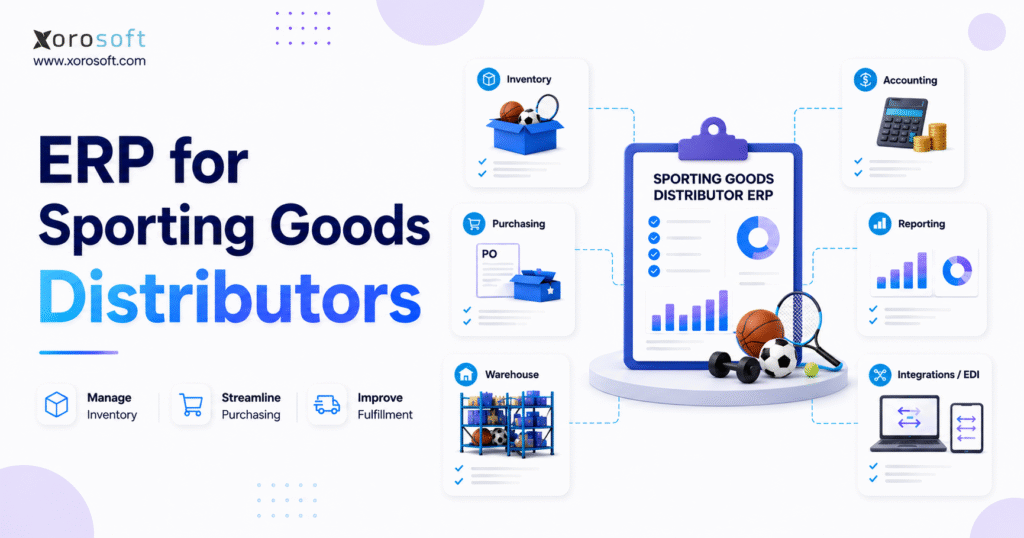
ERP for Sporting Goods Distributors is a connected business system that brings inventory, purchasing, warehouse management, accounting, ecommerce, wholesale orders, forecasting, and reporting into one operational environment. It gives every department access to the same data instead of forcing teams to reconcile separate tools.
A sporting goods distributor does not need ERP because ERP sounds sophisticated. Rather, the need appears when the business requires one source of truth for inventory-driven operations.
2.1 ERP for Sporting Goods Distributors Creates One Operational Backbone
In a disconnected operation, every team has its own version of reality. Sales may check Shopify or a sales order report. Warehouse staff may check a picking sheet. Purchasing teams often check spreadsheets. Finance may rely on QuickBooks. Leadership may receive a manually prepared report days or weeks later.
A connected ERP changes that structure by linking the core workflow. Sales orders create demand, inventory availability updates in real time, warehouse teams receive and ship products, purchasing teams plan replenishment, and accounting tracks the financial impact. From there, reporting becomes more reliable because operational activity is no longer scattered across different systems.
This is why ERP works as the operational backbone. It connects what the business sells, buys, stores, ships, values, and reports.
2.2 Sporting Goods ERP Software Is More Than Inventory Tracking
Inventory tracking is only one part of the requirement. A sporting goods distributor may know that 500 units are physically in stock, but that number alone is not enough. The business also needs to know what is available to sell, what is allocated to wholesale orders, what is committed to ecommerce orders, and what is already inbound from suppliers.
Beyond quantity, teams need context. Damaged units, returned products, aging inventory, warehouse transfers, channel-specific demand, and declining product margins all affect decisions. Without that context, stock counts become misleading.
A basic inventory app may answer some of these questions. However, ERP is designed to connect them across the business. As a result, sales, warehouse, purchasing, and finance teams can make decisions from the same operational truth.
2.3 Cloud ERP for Sporting Goods Businesses Supports Multi-Channel Growth
Sporting goods distributors often grow through channel expansion. They may begin with wholesale, then add Shopify, Amazon, marketplace sales, EDI accounts, direct-to-team orders, or retail partnerships.
Each channel creates different operational expectations. Ecommerce orders need fast fulfillment. Wholesale accounts require pricing control and allocation. EDI customers expect structured documents. Amazon adds marketplace discipline. Retail partners may require case packs, delivery windows, and compliance.
Cloud ERP for sporting goods businesses gives teams a more scalable way to manage this channel mix. Instead of each channel operating separately, ERP connects inventory, orders, fulfillment, purchasing, and accounting behind the scenes.
2.4 Who Actually Needs ERP in Sporting Goods Distribution
Not every sporting goods company needs ERP immediately. A small business with one warehouse, low SKU complexity, simple purchasing, and one sales channel may be fine with accounting software and a basic inventory tool.
That said, ERP becomes more relevant when the business is managing multiple warehouses, wholesale and ecommerce orders, Shopify or Amazon channels, EDI requirements, frequent stockouts, purchasing spreadsheets, delayed month-end close, warehouse picking errors, and disconnected reporting. Once these issues appear together, ERP is no longer only an efficiency upgrade. More importantly, it becomes a foundation for scaling without losing control.
3. Common Operational Problems in Sporting Goods Distribution
Most sporting goods distributors do not wake up one day and decide they need ERP. The need usually appears through repeated problems. At first, these problems may seem separate. In reality, they often come from the same root cause: disconnected systems.
3.1 Inventory Visibility Problems Across Warehouses and Channels
Inventory visibility is one of the most common reasons distributors start evaluating ERP. A growing business may hold inventory in a main warehouse, overflow warehouse, retail location, 3PL, showroom, or supplier-managed location. The same stock may also be sold across Shopify, Amazon, wholesale, and EDI channels.
The question is not simply, “Do we have stock?” A better question is, “What stock is actually available, where is it located, and who has already claimed it?”
Without connected inventory data, the business may oversell on one channel while another customer is waiting. In some cases, the team may reorder products that are already inbound. Another common issue is promising inventory that is physically present but already allocated. Meanwhile, a different warehouse may have available stock that sales cannot see.
ERP helps by separating inventory states such as on hand, available, allocated, committed, inbound, backordered, reserved, damaged, and returned. Because of this, sales, purchasing, warehouse, and finance teams can make better decisions.
3.2 Purchasing Issues Caused by Spreadsheets and Delayed Data
Purchasing is difficult when buyers do not have reliable demand and inventory information. Many sporting goods distributors manage purchasing with spreadsheets because spreadsheets are flexible. Over time, though, that flexibility becomes risky when volume grows.
A buyer may need to review supplier lead times, minimum order quantities, seasonal deadlines, current stock, open sales orders, inbound purchase orders, and historical demand. If that information is spread across multiple systems, replenishment becomes reactive.
Reactive purchasing creates two common outcomes. The business either buys too late and runs out of fast-moving items, or it buys too much and carries excess inventory. Both outcomes hurt cash flow.
ERP improves purchasing by giving buyers better visibility before purchase orders are created. Therefore, teams can plan replenishment around demand, lead times, and inventory availability instead of relying only on manual spreadsheets.
3.3 Warehouse Errors That Affect Customer Trust
Warehouse mistakes become more expensive as the business scales. Picking the wrong size, shipping the wrong model, missing a bundle component, or sending an incomplete order creates returns, credits, reshipments, and customer frustration.
Sporting goods warehouses are especially vulnerable because many products look similar. A small difference in size, color, handedness, model year, accessory type, or team configuration can matter.
A warehouse management workflow inside ERP helps reduce manual errors through receiving processes, bin locations, barcode scanning, picking validation, packing validation, transfers, returns, and cycle counts. The goal is not just speed. Instead, the real goal is accuracy at scale.
3.4 Accounting Delays from Disconnected Inventory Systems
Accounting becomes harder when inventory movements happen outside the financial system. If purchase receipts, sales orders, returns, transfers, landed costs, and adjustments are stored in separate tools, finance teams must reconcile everything manually.
This slows down month-end close. It also weakens confidence in inventory valuation, cost of goods sold, margin reporting, and channel profitability.
ERP helps connect operational transactions to financial reporting. Once inventory is received, sold, transferred, adjusted, returned, or valued, accounting gets a clearer view of the financial impact. As a result, finance teams spend less time chasing spreadsheets and more time analyzing performance.
3.5 Reporting Gaps That Limit Decision-Making
Growth exposes reporting weaknesses quickly. A distributor may know total sales, but not which products are profitable after freight, discounts, marketplace fees, returns, and carrying costs. The company may also know total inventory value, but not which items are aging or which warehouse is overstocked.
Leadership needs reports that connect operations and finance. For example, margin by channel matters. Inventory aging matters as well. Supplier performance, warehouse accuracy, and forecast accuracy also need attention.
When reporting depends on manual exports, decisions slow down. By contrast, ERP gives teams a more consistent reporting layer across inventory, purchasing, warehouse, ecommerce, accounting, and sales activity.
4. Key Features of ERP for Sporting Goods Distributors
A good ERP system should match the realities of sporting goods distribution. The best fit is not always the platform with the longest feature list. Instead, the best fit is the platform that supports the workflows the distributor actually runs every day.
4.1 Inventory Management ERP for Sporting Goods Distributors
Inventory management is the foundation. Sporting goods distributors should look for ERP features that support SKU depth, product variation, and multi-location control.
The most important capabilities include SKU and variant tracking, multi-warehouse visibility, inventory transfers, allocation rules, available-to-sell logic, reorder points, safety stock, cycle counting, inventory aging, landed cost tracking, and inventory valuation. For sporting goods products, variant control is especially important because one product family may include different sizes, colors, models, materials, accessories, and packages.
Therefore, ERP should make those differences easy to manage without creating SKU confusion. Strong inventory control also supports better sales commitments because teams can see what is available, reserved, inbound, or aging.
4.2 Warehouse Management Software for Sporting Goods Operations
Warehouse management is where operational discipline becomes visible. A distributor can have good purchasing and strong sales, but poor warehouse execution will still create customer problems.
Receiving, putaway, bin locations, picking, packing, barcode scanning, shipping workflows, transfers, returns, cycle counts, and packing validation all matter. A connected WMS helps warehouse teams work from accurate inventory and order data. In addition, it gives managers better visibility into fulfillment activity.
For distributors that need stronger warehouse execution, XoroWMS is relevant because it supports warehouse workflows such as receiving, picking, packing, scanning, and fulfillment control.
4.3 Purchasing Automation for Sporting Goods Distributors
Purchasing automation helps teams move away from spreadsheet-based buying. This is critical in sporting goods distribution because many products have seasonal deadlines, supplier constraints, and demand spikes.
Strong purchasing workflows should support purchase order creation, supplier records, vendor pricing, lead time tracking, minimum order quantities, reorder recommendations, partial receiving, backorder visibility, open purchase order tracking, and supplier performance reporting. With better purchasing visibility, buyers can place orders based on demand, stock levels, inbound inventory, and supplier timing instead of guesswork.
4.4 Forecasting Tools for Seasonal Sporting Goods Demand
Forecasting is not perfect, but it becomes much better when data is connected. Sporting goods distributors should look for forecasting tools that consider historical sales, current orders, purchase orders, inventory levels, supplier lead times, and channel demand.
A strong forecasting workflow helps teams review reorder timing before the season starts, identify stockout risk, control overstock across warehouses, plan earlier purchase orders with suppliers, understand channel demand from Shopify or Amazon, and decide where inventory should be placed before peak season.
A modern ERP platform such as XoroERP can support inventory-driven businesses that need purchasing, forecasting, warehouse, accounting, and reporting workflows connected.
4.5 Ecommerce ERP for Shopify, Amazon, and Wholesale Channels
Sporting goods distributors often sell through several channels at the same time. Shopify may be the ecommerce storefront. Amazon may be a marketplace channel. Wholesale customers may place bulk orders. EDI accounts may require structured order communication.
A connected ERP should help those channels flow into inventory and fulfillment workflows. This is where ecommerce ERP becomes important. For Shopify merchants, the Xorosoft ERP Shopify App is a relevant outbound reference because it shows how ERP can connect Shopify activity with operational workflows such as orders, products, inventory, payments, refunds, and fulfillment-related data.
The key point is simple: Shopify may run the storefront, but distributors still need a backend operational system to manage inventory, purchasing, warehouse execution, accounting, and reporting.
4.6 Accounting and Inventory Valuation Features
Accounting features matter because inventory is one of the largest financial assets for sporting goods distributors. If stock values are inaccurate, financial reporting becomes unreliable.
Inventory valuation, cost of goods sold, landed cost management, accounts payable, accounts receivable, vendor bills, customer payments, sales tax workflows, margin reporting, and month-end close support should all be reviewed carefully. In many cases, accounting problems are operational problems showing up late. When inventory receipts, transfers, returns, and adjustments are not connected to finance, the month-end close becomes slower and less reliable.
5. ERP vs QuickBooks vs Inventory Software for Sporting Goods Companies
Sporting goods distributors often reach ERP after using QuickBooks, spreadsheets, and inventory apps for years. These tools are not wrong. They are simply built for different stages of operational complexity.
5.1 When QuickBooks Works for a Sporting Goods Distributor
QuickBooks can work well when the business is small, accounting needs are simple, and inventory complexity is limited. It can help manage financial records, invoices, bills, and basic reporting.
However, QuickBooks starts to struggle when the company expects it to run distribution operations. Multi-warehouse inventory, purchasing complexity, warehouse execution, ecommerce sync, landed costs, and forecasting usually require more than small-business accounting software.
The issue is not that QuickBooks is weak. Rather, the business has outgrown what it was meant to do.
5.2 When Inventory Software Is Enough
Inventory software may be enough when the company mainly needs better stock tracking. It can help with quantities, reorder points, product records, and basic inventory visibility.
However, inventory software may not fully solve accounting, purchasing, warehouse, wholesale, ecommerce, EDI, and reporting needs. Once the business needs those workflows connected, ERP becomes the more complete option.
That said, some companies should not rush into ERP too early. If order volume is low, warehouse operations are simple, and the team can still trust inventory data, inventory software may remain practical for a while.
5.3 When ERP for Sporting Goods Distributors Becomes the Better Fit
ERP becomes the better fit when the business needs one connected system for operations and finance. Common signs include unreliable inventory numbers, growing warehouse errors, spreadsheet-driven purchasing, mismatched Shopify or Amazon inventory, manual wholesale order work, EDI pressure, delayed accounting close, manual reporting, unclear margins, and expansion into more warehouses or suppliers.
When these issues appear together, ERP becomes less of a technology upgrade and more of an operating necessity.
5.4 ERP Comparison Table for Sporting Goods Distributors
| Category | QuickBooks | Inventory Software | ERP |
|---|---|---|---|
| Best fit | Basic accounting | Inventory tracking | Connected business operations |
| Inventory visibility | Limited | Moderate | Strong |
| Multi-warehouse support | Limited | Varies | Strong |
| Purchasing | Basic | Moderate | Advanced |
| Warehouse workflows | Limited | Varies | Strong with WMS |
| Ecommerce sync | Requires apps | Often supported | Connected to operations |
| Accounting | Strong for small business | Usually limited | Integrated with inventory |
| Forecasting | Limited | Varies | Stronger with connected data |
| Reporting | Finance-focused | Inventory-focused | Cross-functional |
| Best stage | Early business | Growing inventory team | Scaling distributor |
6. Sporting Goods ERP Use Cases by Business Model
Not every sporting goods distributor has the same workflow. ERP requirements depend on the products sold, sales channels used, warehouse structure, supplier base, and customer expectations.
6.1 Sports Equipment Distributors Need Better Stock and Fulfillment Control
Sports equipment distributors often manage bulky products, accessories, replacement parts, and seasonal demand. These businesses may need to track inventory across warehouses, handle large shipments, and manage product availability for both wholesale and ecommerce orders.
A connected ERP system helps improve warehouse control, purchasing visibility, inventory accuracy, and margin reporting. In addition, it gives teams a better way to plan for demand peaks before the season arrives.
For example, a distributor selling baseball, hockey, or golf equipment may need to buy months before peak demand. If purchasing is late, the business misses the season. On the other hand, overly aggressive purchasing can leave the company carrying excess stock into the next cycle.
6.2 Outdoor Gear Distributors Depend on Seasonal Planning
Outdoor gear distributors may sell camping, hiking, fishing, cycling, snow sports, water sports, or recreation products. Demand can shift based on season, weather, location, and consumer trends.
For this type of operation, ERP helps manage supplier lead times, seasonal planning, warehouse allocation, ecommerce fulfillment, and product availability across locations. More importantly, it helps buyers see demand patterns before inventory problems become urgent.
6.3 Fitness Equipment Distributors Need Accurate Cost Visibility
Fitness equipment distributors often carry high-value or large-format products. Freight, storage, and landed costs can significantly affect profitability.
With ERP, purchasing, receiving, shipping, inventory costing, and accounting become easier to connect. That connection gives leadership better visibility into true margin, not just sales revenue.
For instance, a treadmill or strength machine may appear profitable at the sales level. However, once freight, storage, returns, discounts, and handling costs are included, the margin may look very different.
6.4 Team Sports and Uniform Suppliers Need Variant Control
Team sports suppliers may manage customer-specific orders, kits, size runs, uniforms, accessories, bulk orders, and special pricing. These workflows can quickly become difficult to manage manually.
A structured ERP workflow helps organize product variations, customer pricing, order allocation, purchasing, and fulfillment. It also helps reduce errors when similar SKUs must be picked and packed accurately.
Because team orders often involve deadlines, accuracy matters. A missed item or incorrect size can affect an entire order, not just one customer.
6.5 Ecommerce Sporting Goods Brands Need Connected Channel Operations
Ecommerce sporting goods brands need accurate inventory and fast fulfillment. If Shopify, Amazon, warehouse, purchasing, and accounting are disconnected, the brand may oversell, delay shipments, or lose visibility into profit.
Xorosoft can fit this environment when an inventory-driven ecommerce distributor needs Shopify, Amazon, wholesale, warehouse, purchasing, accounting, forecasting, and reporting workflows connected in one system.
In this use case, ERP acts as the operational layer behind the ecommerce experience. The storefront may create demand, but the ERP helps the business fulfill that demand accurately and profitably.
7. Multi-Channel ERP for Shopify, Amazon, Wholesale, and EDI
A growing sporting goods distributor usually sells through more than one channel. Multi-channel growth creates opportunity, but it also increases operational risk. ERP helps manage that risk by centralizing inventory, orders, fulfillment, purchasing, and financial data.
7.1 Shopify ERP for Sporting Goods Distributors
Shopify is often the front-end ecommerce engine. It handles storefront activity, checkout, customer experience, product presentation, and online orders.
However, Shopify alone does not usually manage the full distributor operation. The business still needs to coordinate warehouse activity, purchase planning, wholesale allocation, accounting, returns, supplier management, and reporting.
That is why Shopify ERP matters. The ecommerce platform runs the store. Meanwhile, ERP runs the operational layer behind the store.
7.2 Amazon and Marketplace ERP Workflows
Amazon and marketplace channels introduce different requirements. Inventory must be available, fulfillment must be accurate, and product data must remain consistent. A marketplace order may compete with Shopify and wholesale orders for the same stock.
ERP helps prevent channel conflict by centralizing inventory availability and order routing. It also helps the business understand which channels are profitable after fulfillment costs, marketplace fees, freight, and returns.
In practical terms, marketplace growth should not force the team into more spreadsheets. Instead, the distributor needs clean workflows that protect inventory accuracy and fulfillment discipline.
7.3 Wholesale Distribution ERP for B2B Sporting Goods Orders
Wholesale customers often need different workflows than ecommerce customers. They may require customer-specific pricing, bulk orders, order approval, credit limits, delivery windows, allocation rules, and backorder handling.
Wholesale distribution ERP helps manage those workflows without relying on emails, spreadsheets, and manual order entry. It also gives sales and operations teams better visibility into customer commitments.
For sporting goods distributors, this is especially important when wholesale customers order ahead of a season. If inventory allocation is unclear, ecommerce orders may consume stock that was intended for a major B2B customer.
7.4 EDI ERP for Sporting Goods Wholesale Accounts
EDI becomes important when selling to larger retailers, buying groups, or enterprise customers. These customers may require structured purchase orders, invoices, shipping notices, and other documents.
ERP with EDI support helps reduce manual work and improves order accuracy. It also helps ensure EDI workflows are connected to inventory, warehouse, and accounting processes.
Without this connection, EDI can become another disconnected workflow. As a result, teams may still copy order data between systems, which creates delays and errors.
8. How to Choose ERP for Sporting Goods Distributors
Choosing ERP should begin with business requirements, not software demos. A polished demo can be impressive, but the real test is whether the system supports how the distributor actually buys, stores, sells, ships, values, and reports inventory.
8.1 Map Sporting Goods Distribution Problems First
Before comparing vendors, document the problems that slow down the operation. The list may include unreliable inventory numbers, manual picking, spreadsheet purchasing, wholesale order entry, Shopify and Amazon inventory mismatches, EDI admin work, delayed accounting close, exported reports, stockouts, and overstock after seasonal demand ends.
This exercise helps the team avoid vague ERP requirements. It also makes vendor evaluation more practical.
8.2 Build an ERP Requirements List by Workflow
A sporting goods distributor should evaluate ERP by workflow area. Inventory management, warehouse management, purchasing, forecasting, ecommerce integration, marketplace operations, wholesale order management, EDI support, accounting, reporting, multi-warehouse control, returns, user permissions, and implementation support should all be reviewed.
Each requirement should connect to a real business problem. Therefore, the selection process stays grounded instead of becoming a generic software comparison.
8.3 Test ERP Vendors With Real Sporting Goods Scenarios
Do not evaluate ERP only with generic questions. Use realistic examples from the business.
Ask vendors to demonstrate supplier receiving, demand-based purchase orders, Shopify order picking, wholesale order processing, customer inventory allocation, warehouse transfers, size and color variants, returns, landed cost review, margin reporting, and inventory-related accounting close.
A system that performs well in these scenarios is more likely to fit daily operations. By contrast, a system that only looks strong in a standard demo may struggle with real sporting goods workflows.
8.4 Compare ERP Platforms Based on Implementation Fit
Implementation fit matters as much as feature fit. A system may be powerful, but if it is too complex for the team, too expensive to maintain, or too difficult to implement, the project may lose momentum.
Before choosing ERP, evaluate data migration, SKU cleanup, integrations, warehouse training, accounting setup, reporting requirements, internal ownership, vendor support, timeline expectations, and total cost of ownership. Ultimately, the right ERP should match both the company’s operating needs and its ability to implement successfully.
9. Common ERP Implementation Mistakes in Sporting Goods Distribution
ERP implementation is not just an IT project. It affects warehouse teams, buyers, accountants, sales teams, ecommerce managers, operations leaders, and executives. Most mistakes usually come from weak preparation rather than weak intent.
9.1 Choosing Sporting Goods ERP Software Based Only on Features
Feature lists are useful, but they do not tell the full story. Many systems claim to support inventory, warehouse management, purchasing, accounting, and ecommerce. The real question is how those workflows operate in practice.
A distributor should focus on process fit. Can the system support the way products are bought, received, stored, picked, shipped, returned, and reported? Will warehouse users adopt it? Can accounting trust the numbers? Are buyers able to work without exporting everything into spreadsheets?
Those questions matter more than a long checklist.
9.2 Underestimating SKU and Inventory Data Cleanup
Data cleanup is one of the most important ERP preparation steps. Sporting goods companies often have similar product names, duplicate SKUs, outdated supplier records, inconsistent units of measure, and incomplete product attributes.
Before implementation, clean up SKU records, product categories, variant naming, supplier data, customer records, price lists, warehouse locations, units of measure, inventory counts, open purchase orders, and open sales orders. Clean data improves ERP performance from the beginning. Conversely, poor data forces users to question the system immediately.
9.3 Leaving Warehouse Teams Out of ERP Planning
Warehouse users should be involved early. If the ERP workflow is difficult for warehouse teams, manual workarounds will appear quickly. Those workarounds reduce accuracy and weaken adoption.
Operational testing should include receiving, putaway, picking, packing, scanning, transfers, cycle counts, and returns before go-live. Warehouse feedback is practical and valuable because the team knows where mistakes happen in real life.
9.4 Bringing Accounting Into ERP Too Late
Accounting should be involved from the start. Inventory valuation, landed costs, COGS, sales tax, vendor bills, returns, customer payments, and month-end reporting all depend on proper ERP setup.
If accounting joins late, the implementation may need rework. Early finance involvement helps ensure operational workflows support accurate financial reporting.
9.5 Over-Customizing Before the Core Process Works
Customization can be useful, but too much customization too early creates risk. Sporting goods distributors should first confirm that core workflows are stable. Receiving, purchasing, picking, packing, inventory transfers, accounting, and reporting should work before custom requests expand.
Once the core system is reliable, the business can evaluate where customization truly adds value. This approach keeps the project focused and reduces unnecessary complexity.
10. ERP Vendor Comparison for Sporting Goods Distributors
Sporting goods distributors may evaluate several ERP and inventory platforms, including NetSuite, Acumatica, Cin7, Brightpearl, Fishbowl, Sage, Microsoft Dynamics 365 Business Central, and Xorosoft.
The goal is not to choose the most famous platform. The goal is to choose the best operational fit.
10.1 ERP Software Comparison Criteria for Sporting Goods Distributors
Use consistent criteria when comparing platforms. Inventory depth, warehouse usability, purchasing automation, forecasting support, accounting integration, Shopify support, Amazon support, EDI capability, wholesale order management, reporting depth, multi-warehouse functionality, implementation complexity, support model, and total cost of ownership should all be evaluated.
A fair comparison prevents the team from being distracted by features that are impressive but not relevant. In addition, it helps stakeholders compare vendors based on real business needs.
10.2 ERP Vendor Comparison Table
| ERP option | Common fit | Strengths to evaluate | Questions to ask |
| NetSuite | Mid-market and larger companies | Broad ERP functionality | How complex will implementation be for your team? |
| Acumatica | Growing distributors and manufacturers | Flexible cloud ERP model | Does it fit your ecommerce and warehouse workflows? |
| Cin7 | Inventory-led commerce businesses | Inventory and channel operations | Does it provide the accounting depth you need? |
| Brightpearl | Retail and ecommerce operations | Order and retail workflows | Does it support wholesale and warehouse complexity? |
| Fishbowl | Inventory-heavy QuickBooks users | Inventory and warehouse functions | When will the business need deeper ERP? |
| Sage | Finance and operations teams | Accounting and business management | How well does it support ecommerce channels? |
| Business Central | Microsoft ecosystem companies | Finance and ERP flexibility | What partner support will be required? |
| Xorosoft | Inventory-driven distributors and brands | Cloud ERP, WMS, inventory, accounting, purchasing, Shopify, Amazon, and EDI workflows | Does it match your current workflows and growth stage? |
For teams specifically comparing broader ERP options, the Xorosoft vs NetSuite comparison can help frame questions around cost, complexity, implementation fit, and operational requirements.
11. Where Xorosoft Fits for Sporting Goods ERP Requirements
Xorosoft is a cloud ERP platform built for inventory-driven businesses. The platform combines inventory management, accounting, purchasing, warehouse management, manufacturing, forecasting, reporting, and ecommerce operations into one system.
For sporting goods distributors, this matters when the business has outgrown QuickBooks, spreadsheets, inventory-only software, warehouse apps, or disconnected ecommerce tools.
11.1 Cloud ERP for Inventory-Driven Sporting Goods Businesses
Xorosoft is relevant for companies that sell physical products, manage inventory, operate multiple warehouses, sell through Shopify or Amazon, use EDI, manage purchasing teams, or need stronger reporting.
A distributor may evaluate XoroOne when it wants a unified operating system for inventory, purchasing, warehouse, accounting, ecommerce, and reporting. Teams may also review the broader industries page to understand how ERP applies across sporting goods, wholesale, apparel, furniture, food, manufacturing, and other inventory-driven sectors.
11.2 Sporting Goods Distribution Workflows Xorosoft Can Support
For sporting goods distributors, relevant workflows include multi-warehouse inventory, Shopify operations, Amazon operations, wholesale order management, EDI workflows, purchasing automation, inventory forecasting, warehouse management, accounting integration, and real-time reporting.
The fit is strongest when the company needs connected workflows instead of another separate app.
11.3 When Xorosoft May Be a Practical ERP Option
Xorosoft may be a practical option when a distributor is replacing manual purchasing spreadsheets, disconnected warehouse tools, inventory apps, QuickBooks limitations, or fragmented ecommerce workflows.
It may also be relevant when leadership needs better visibility into stock availability, order fulfillment, supplier planning, inventory valuation, and reporting. The right ERP should help the business operate with more control, not simply add another system to manage.
12. ERP Readiness Checklist for Sporting Goods Distributors
Before choosing ERP, a sporting goods distributor should evaluate readiness. This helps the team understand whether it is prepared for implementation and where cleanup is needed.
12.1 Inventory Readiness for Sporting Goods ERP
Inventory readiness starts with clean SKU records, accurate product names, consistent product categories, clear variant structures, current stock counts, warehouse location data, adjustment rules, bundle logic, reorder assumptions, and slow-moving inventory reports.
If SKU data is messy before ERP, the system will expose the mess quickly. Therefore, inventory cleanup should begin before implementation, not during go-live.
12.2 Purchasing Readiness for ERP Implementation
Purchasing readiness includes supplier records, lead times, vendor pricing, minimum order quantities, open purchase orders, seasonal buying schedules, replenishment rules, approval workflows, backorder handling, and forecasting assumptions.
This is especially important for sporting goods distributors because supplier timing affects seasonal availability.
12.3 Warehouse Readiness for Sporting Goods Distribution Software
Warehouse readiness should cover receiving, putaway, bin structure, picking methods, packing validation, barcode usage, transfers, cycle counts, returns, and shipping workflows.
The goal is to make sure ERP improves fulfillment instead of simply digitizing old problems. For this reason, warehouse leaders should be involved before final workflow decisions are made.
12.4 Accounting Readiness for Inventory-Driven ERP
Accounting preparation should include the chart of accounts, inventory valuation method, landed cost rules, sales tax setup, vendor bill process, customer payment process, month-end close checklist, COGS reporting, margin reporting, and reconciliation workflow.
This work ensures operational activity supports accurate financial reporting. In addition, it helps reduce rework during implementation.
12.5 Integration Readiness for Shopify, Amazon, EDI, and Shipping
Integration readiness begins by listing every connected system. Shopify, Amazon, EDI providers, 3PLs, shipping tools, payment gateways, marketplace apps, returns tools, accounting systems, and reporting tools should all be reviewed.
This list helps the distributor understand what should integrate, what should be replaced, and what should remain outside ERP.
13. Frequently Asked Questions About ERP for Sporting Goods Distributors
13.1 What is ERP for sporting goods distributors?
ERP for sporting goods distributors is business software that connects inventory, purchasing, warehouse management, sales orders, accounting, ecommerce, forecasting, and reporting. In practical terms, it helps distributors manage seasonal demand, product variations, wholesale orders, ecommerce channels, multi-warehouse stock, and financial workflows from one system.
13.2 Why do sporting goods distributors need ERP software?
Sporting goods distributors need ERP when inventory, purchasing, warehouse, ecommerce, and accounting workflows become too complex for spreadsheets or basic apps. As order volume grows, a connected system improves visibility, reduces manual work, prevents stockouts, supports supplier planning, and strengthens fulfillment.
13.3 What is the best ERP for sporting goods distributors?
The best ERP depends on the distributor’s size, sales channels, warehouse structure, accounting needs, and implementation capacity. Ideally, the system should support inventory management, warehouse workflows, purchasing, forecasting, ecommerce integrations, wholesale orders, EDI, and financial reporting.
13.4 How does ERP improve inventory accuracy?
Inventory accuracy improves when receiving, transfers, picking, packing, shipping, returns, adjustments, and cycle counts update the same system. Because every transaction is connected, teams get a clearer view of on-hand, available, allocated, inbound, and committed inventory.
13.5 Can ERP help with seasonal sporting goods demand?
Yes. Seasonal planning becomes easier when sales history, open orders, current inventory, purchase orders, supplier lead times, and forecasts are connected. As a result, buyers can order earlier, avoid stockouts, and reduce excess inventory after the season ends.
13.6 Does ERP support multi-warehouse distribution?
Most distribution-focused ERP systems support multi-warehouse operations. For sporting goods distributors, important features include location-level inventory, transfers, bin tracking, order routing, warehouse reporting, and inventory availability by location.
13.7 Can ERP manage Shopify and Amazon orders?
Yes. Many ERP systems can connect ecommerce and marketplace orders with inventory, warehouse, purchasing, accounting, and reporting workflows. This matters because Shopify and Amazon are often part of a broader wholesale or distribution operation.
13.8 Can ERP help with wholesale and EDI orders?
Yes. Customer-specific pricing, wholesale order workflows, allocation rules, invoices, shipping notices, and EDI document flows can be managed through ERP. Because of this, distributors can serve larger wholesale customers with fewer manual steps.
13.9 Is ERP better than inventory software?
ERP is better when the business needs inventory, accounting, purchasing, warehouse, ecommerce, and reporting connected in one system. On the other hand, inventory software may be enough for simpler businesses that only need better stock tracking.
13.10 When should a sporting goods distributor move from QuickBooks to ERP?
A distributor should consider ERP when QuickBooks no longer supports operational complexity. Common signs include multi-warehouse inventory issues, purchasing errors, delayed accounting close, manual reporting, warehouse mistakes, and ecommerce inventory sync problems.
13.11 How does ERP help purchasing teams?
Purchasing teams benefit from better visibility into demand, current stock, open sales orders, inbound purchase orders, supplier lead times, reorder points, and historical sales. With that visibility, buyers can make better replenishment decisions instead of relying only on spreadsheets.
13.12 Can ERP reduce stockouts and overstock?
ERP can reduce stockouts and overstock by improving inventory visibility, forecasting, reorder planning, supplier tracking, and purchase order timing. It does not eliminate demand uncertainty; however, it gives teams better data for earlier decisions.
13.13 Does ERP help with barcode scanning?
Yes. When ERP includes warehouse management functionality, it can support barcode scanning for receiving, picking, packing, transfers, and cycle counts. This helps reduce manual errors and improves warehouse accuracy.
13.14 How does ERP improve warehouse efficiency?
Warehouse efficiency improves when receiving, putaway, picking, packing, shipping, transfers, returns, and cycle counting follow structured workflows. ERP gives warehouse teams clearer instructions and gives managers better visibility into fulfillment activity.
13.15 Can ERP manage customer-specific pricing?
Yes. Distribution-focused ERP systems often support customer-specific pricing, contract pricing, volume discounts, and wholesale pricing rules. This is useful for sporting goods distributors selling to retailers, teams, schools, clubs, or buying groups.
13.16 Does ERP help with sporting goods forecasting?
Forecasting becomes stronger when historical sales, current inventory, open orders, purchase orders, supplier lead times, and channel demand are connected. As a result, sporting goods distributors can plan replenishment more accurately and protect cash flow.
13.17 Can ERP manage kits, bundles, and product variations?
Many ERP systems can manage kits, bundles, assemblies, and product variations. That matters for sporting goods companies selling equipment packages, team kits, accessories, replacement parts, or size and color variations.
13.18 How does ERP improve accounting?
Accounting improves when inventory transactions connect directly to financial records. This helps with inventory valuation, COGS, landed costs, vendor bills, customer payments, margin reporting, and month-end close.
13.19 What are common ERP implementation mistakes?
Common mistakes include weak data cleanup, unclear requirements, poor warehouse adoption, late accounting involvement, over-customization, inadequate testing, and choosing software based only on features instead of workflows.
13.20 How should sporting goods distributors choose an ERP system?
Sporting goods distributors should begin with workflow mapping. After that, they should evaluate systems against inventory, warehouse, purchasing, accounting, ecommerce, wholesale, EDI, forecasting, reporting, implementation, and support requirements.
13.21 How much does ERP for sporting goods distributors cost?
ERP cost depends on users, modules, implementation scope, integrations, data migration, training, support, and customization. Instead of looking only at monthly software price, distributors should evaluate total cost of ownership and expected operational improvements.
13.22 How long does ERP implementation take for sporting goods distributors?
Implementation timelines vary based on data quality, warehouse complexity, accounting requirements, sales channels, and integrations. A simpler distributor may move faster, while a multi-warehouse, Shopify, Amazon, wholesale, and EDI operation usually needs more planning.
13.23 What should distributors prepare before ERP implementation?
Before ERP implementation, distributors should prepare SKU data, supplier records, customer records, open sales orders, open purchase orders, warehouse locations, accounting rules, inventory counts, and integration requirements. Clean preparation reduces delays and improves adoption.
13.24 What are alternatives to ERP for sporting goods businesses?
Alternatives include QuickBooks, spreadsheets, inventory apps, warehouse apps, ecommerce apps, purchasing spreadsheets, and reporting tools. These can work for smaller businesses, but they become harder to manage as order volume, channels, warehouses, and SKU complexity increase.
13.25 Does Xorosoft support sporting goods distributors?
Yes. Xorosoft supports inventory-driven businesses, including sporting goods distributors, wholesalers, ecommerce brands, manufacturers, and multi-warehouse operators. It is relevant for companies that need inventory, accounting, purchasing, warehouse management, forecasting, ecommerce, and reporting connected.
14. Strategic Next Step for Sporting Goods Distributors Evaluating ERP
Sporting goods distributors do not need ERP simply because they are growing. They need ERP when growth creates operational strain that disconnected systems cannot handle.
That strain usually appears as inventory confusion, purchasing delays, warehouse errors, overselling, stockouts, overstock, slow accounting close, and weak reporting. These problems become more expensive as the business adds SKUs, warehouses, suppliers, wholesale customers, Shopify orders, Amazon orders, and EDI workflows.
ERP for Sporting Goods Distributors creates one operating foundation for inventory, purchasing, warehouse management, ecommerce, accounting, forecasting, and reporting. A well-fit system gives teams better visibility, cleaner workflows, and stronger control over growth.
The best next step is not to rush into software selection. Instead, start by mapping current workflows, identifying the biggest operational bottlenecks, cleaning up inventory data, involving warehouse and accounting teams, and comparing ERP platforms against real sporting goods distribution scenarios.
If your business is ready to review inventory, warehouse, purchasing, accounting, Shopify, Amazon, wholesale, EDI, and reporting workflows, you can book a personalized demo with Xorosoft to evaluate whether a connected cloud ERP platform is the right next step.
Recent Posts
-
 ERP Landed Cost Module vs Spreadsheet Calculations for Importers
 -
 How to Build an Open-to-Buy Plan for an Omnichannel Brand
 -
 Cold Storage WMS for Food and Beverage Distribution
 -
 ERP Buying Statistics 2026: Evaluation, Implementation, and Adoption Risks
 -
 How a Distributor Reduced B2B Order Exceptions Without Restricting Sales