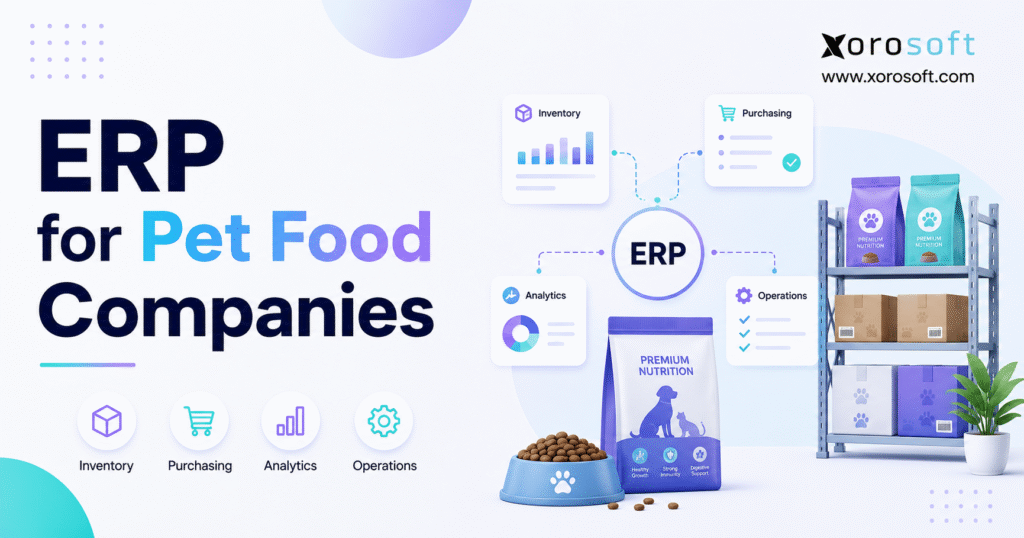
ERP for pet food companies can help streamline processes and improve efficiency in every aspect of the business.
1. Growth Exposes the Gaps in Pet Food Operations
Pet food businesses rarely reach a systems breaking point because of one dramatic event. Instead, pressure builds as the company adds formulas, suppliers, package sizes, warehouses, retail customers, ecommerce channels, and production partners. Each addition creates another layer of purchasing, production, quality, inventory, and financial data that must remain aligned.
The central problem is not simply that teams use several applications. More importantly, those tools often fail to preserve the relationships between supplier lots, approved formulas, production batches, finished goods, warehouse movements, customer orders, and accounting entries.
As a result, employees spend more time reconciling information and less time managing the operation. Buyers work from one plan, production follows another schedule, warehouse teams rely on physical stock, and finance receives summarized data after transactions have already occurred.
ERP for pet food companies addresses this challenge by creating a connected operational record. Rather than treating purchasing, manufacturing, inventory, warehousing, sales, and finance as separate functions, the system links the transactions that move materials and money through the business.
1.1 Why Pet Food Complexity Grows Faster Than Sales
A new finished product is rarely just another SKU. For example, it may introduce a different formula, ingredient source, label version, package size, shelf-life rule, production sequence, quality specification, and customer requirement.
Consequently, operational complexity can grow much faster than revenue. At first, teams often compensate with additional spreadsheets, manual checks, and informal approvals. However, this approach increases the company’s dependence on individual knowledge.
Meanwhile, it becomes harder to determine which forecast, formula, inventory report, or purchase plan is current. Even experienced employees may make decisions using incomplete information because no system reflects the entire operational picture.
1.2 The Cost of Disconnected Pet Food Systems
Disconnected processes create costs that do not always appear as a separate expense. For example, buyers may place emergency orders because ingredient requirements are unclear. Production may change schedules because packaging is missing. Warehouse teams may discover inventory discrepancies during picking rather than during routine control.
Furthermore, finance may delay the close while reconciling stock movements, work orders, and shipment activity. These delays affect more than reporting because they weaken management’s ability to make timely pricing, purchasing, and production decisions.
Therefore, a growing pet food company needs more than a collection of functional applications. It needs a dependable record that connects the physical movement of ingredients and finished goods with the commercial and financial transactions behind them.
2. What ERP for Pet Food Companies Actually Does
ERP for pet food companies is an integrated system that connects ingredient purchasing, formula or bill-of-material management, production planning, lot traceability, quality status, inventory, warehousing, customer orders, accounting, and reporting.
The value does not come from placing several modules on one menu. Instead, it comes from preserving the relationship between each operational event.
When an ingredient arrives, the company records the supplier, purchase order, quantity, lot, expiration information, warehouse location, and quality status. Next, when production consumes that ingredient, the system links the lot to the work order and finished batch.
Later, when finished goods ship, the same record connects the batch to a warehouse movement, customer order, invoice, and accounting entry. Consequently, every department can work from the same transaction history.
2.1 How Pet Food ERP Software Creates a Shared Record
A useful pet food ERP platform should support five connected operating flows:
1. Purchase ingredients and packaging.
2. Plan and execute production.
3. Control lots, quality status, and shelf life.
4. Store, allocate, and ship finished goods.
5. Record the financial effect of each transaction.
More importantly, because these flows share data, purchasing can see production demand, production can see usable inventory, the warehouse can see quality restrictions, and finance can see the value created by operational activity.
In practice, this structure reduces duplicate entry. It also helps teams investigate exceptions without rebuilding the history from several applications.
2.2 Pet Food Manufacturing ERP Versus Accounting Software
Accounting software manages bills, invoices, payments, financial balances, and financial statements. Those functions remain essential. However, accounting software usually does not provide detailed production, lot, quality, or warehouse control.
Pet food manufacturing ERP adds operational depth. It connects purchase orders with ingredient receipts, work orders with material consumption, finished batches with warehouse movements, and shipments with revenue and cost of goods sold.
As a result, finance receives transaction data from the same environment used by operations. Reconciliation still matters, although the team can focus on exceptions instead of reconstructing every inventory movement.
2.3 ERP for Pet Food Companies Versus Formulation Software
Pet food formulation software and ERP solve different problems. Formulation applications may calculate nutritional composition, balance nutrients, optimize ingredient combinations, and test formula constraints.
By contrast, ERP manages the approved formula as an operational object. The system uses it for purchasing, material planning, production execution, inventory consumption, batch costing, and financial reporting.
Therefore, many businesses need both systems. Formulation software may own product development, while ERP for pet food companies controls approved production versions and downstream transactions.
2.4 Who Needs Pet Food ERP Software?
ERP becomes relevant when a company:
- Manufactures or co-manufactures physical products
- Tracks ingredients and finished goods by lot
- Manages several formulas or packaging configurations
- Operates more than one warehouse
- Sells through ecommerce, Amazon, retail, or wholesale
- Uses EDI for customer transactions
- Needs inventory and accounting in one system
- Relies on spreadsheet purchasing or production planning
- Cannot complete traceability investigations quickly
- Has outgrown QuickBooks or inventory-only software
2.5 Who May Not Need a Full Pet Food ERP Yet?
A small brand may not need full ERP when it has a limited catalogue, outsourced production, one storage location, and simple financial reporting. In that situation, accounting software and a controlled inventory application may remain appropriate.
Nevertheless, the business should reassess its systems when manual planning, multi-location inventory, lot tracking, or reconciliation becomes difficult to control. The upgrade decision should be based on operational complexity rather than company age alone.
3. Why Pet Food Manufacturing ERP Needs Specialized Controls
Pet food production combines process-manufacturing requirements with lot traceability, shelf-life management, formula control, quality review, and customer-specific packaging. Accordingly, a general inventory application may record quantities but still fail to preserve the relationships required across ingredients, production, and shipments.
ERP can support records, approvals, and transaction controls. Even so, software does not replace food-safety procedures, qualified personnel, testing, or regulatory expertise. The platform should support the operating model, while management remains responsible for how that model is designed and executed.
3.1 Ingredient and Finished-Goods Lot Traceability
Each ingredient receipt should capture more than the item and quantity. In addition, depending on the business, the record may need the supplier, purchase order, supplier lot, internal lot, manufacturing date, expiration or retest date, warehouse location, unit of measure, and quality status.
Backward traceability answers a direct question: which supplier lots and formula version were used in a finished production batch?
Forward traceability answers the opposite question: which finished products, warehouse locations, customer orders, and shipments were affected by a supplier lot or production batch?
Because both directions matter, the transaction chain must remain intact from receiving through shipment.
3.2 Formula and Recipe Version Control
Pet food companies must preserve formula history. When a formula changes, the new version should not overwrite the record used for earlier production.
Each approved version should include:
- A unique identifier
- Approval status
- Effective date
- Ingredient quantities
- Packaging requirements
- Expected yield
- Production instructions
- Change history
Historical work orders should remain tied to the formula version used at the time. Otherwise, a later formula change can make it difficult to explain how an earlier batch was produced.
3.3 Controlled Ingredient Substitutions
Ingredient shortages can pressure production teams to make quick substitutions. Yet an alternative material may affect cost, labeling, nutritional characteristics, process behavior, or quality requirements.
For that reason, the system should document the original ingredient, approved substitute, conversion quantity, effective date, affected products, approver, and production batches using the alternative.
Moreover, approved substitutions should be visible to purchasing, production, quality, and finance. This prevents an operational decision from remaining hidden in email or handwritten production notes.
3.4 Quality Status and Restricted Inventory
Physical stock is not always usable stock. An ingredient may be in the warehouse but still awaiting inspection. Similarly, a finished batch may exist physically but remain unavailable for sale until it is released.
The ERP should distinguish statuses such as:
- Pending inspection
- Quarantined
- Approved
- Rejected
- Expired
- Damaged
- Conditionally released
Consequently, order allocation and production planning should use available inventory rather than total physical inventory.
3.5 Shelf-Life and Expiration Controls
Pet food businesses need visibility into manufacturing dates, expiration dates, best-by dates, and customer-specific remaining shelf-life requirements.
First-expire, first-out rules can guide picking. However, the system must also consider quality holds, customer restrictions, warehouse locations, and existing allocations.
In other words, the earliest-expiring lot is not automatically the correct lot for every order.
4. Core Capabilities in ERP for Pet Food Companies
The strongest ERP for pet food companies connects planning, execution, traceability, inventory, and finance. A long feature list has limited value when transactions still require manual reconciliation.
4.1 Ingredient Inventory Management for Pet Food Companies
Inventory records should distinguish between physical stock and available stock. A company may physically hold 10,000 kilograms of an ingredient, while part of that quantity is allocated, quarantined, expired, damaged, in transit, or reserved for another production order.
Therefore, the system should show quantity by item, lot, location, status, and unit of measure. It should also preserve the relationship between warehouse activity and accounting value.
A platform such as XoroONE can serve as the connected ERP layer for inventory-driven businesses that need purchasing, manufacturing, warehousing, accounting, and ecommerce data in one environment.
4.2 Purchasing and Supplier Management in Pet Food ERP
Purchasing decisions should consider more than current stock. A reliable plan combines sales forecasts, confirmed orders, production schedules, usable ingredient inventory, open purchase orders, supplier lead times, minimum quantities, purchasing multiples, and safety stock.
As a result, buyers gain a forward-looking view of material requirements. They can also identify whether a shortage comes from demand growth, a delayed supplier, an inaccurate formula, or inventory that remains on quality hold.
Supplier records should include pricing, lead times, specifications, approved-source status, and supporting documents. This context helps teams compare suppliers without separating operational and commercial information.
4.3 Formula, BOM, and Material Requirements Planning
A formula or bill of materials defines expected ingredients, packaging, quantities, and output. The ERP should support versions, effective dates, expected yield, multi-level structures, packaging components, and approved substitutes.
Next, material requirements planning converts demand into ingredient and packaging needs. It should account for usable inventory, open purchases, existing work orders, supplier lead times, and planned yield.
For example, confirmed demand for 20,000 units should translate into planned batches, ingredient requirements, packaging requirements, shortage calculations, purchase recommendations, and expected completion dates.
4.4 Pet Food Production Planning and Work Orders
Production planning should consider available materials, line capacity, labor, sanitation, changeovers, storage space, and required completion dates.
A work order should define:
- What product must be produced
- Which formula version must be used
- Which ingredients are required
- Which packaging materials are required
- Where production will take place
- When the batch is required
- Where finished inventory will be received
Because the work order connects planning with execution, it should also capture actual consumption, actual output, waste, rework, and completion status.
4.5 Warehouse Management for Pet Food Inventory
Warehouse transactions should preserve item, quantity, lot, status, location, and user information.
Key controls include:
- Lot-controlled receiving
- Barcode scanning
- Directed putaway
- Quality-hold locations
- First-expire, first-out picking
- Warehouse transfers
- Cycle counting
- Pick validation
- Shipping confirmation
A connected warehouse management system becomes especially important when the company manages ingredients, finished goods, several warehouses, and third-party fulfillment locations.
4.6 Integrated Accounting and Pet Food Batch Costing
Operational transactions should update inventory value, work in process, liabilities, revenue, and cost of goods sold.
A manufacturing ERP with integrated accounting can connect purchase receipts, production consumption, finished-goods completion, transfers, shipments, returns, and adjustments with financial reporting.
Consequently, finance can review the financial effect of operational activity without waiting for separate imports or manual summaries.
4.7 Ecommerce, Amazon, and EDI Integration
Pet food companies often sell through several channels at once. Orders may come from Shopify, Amazon, wholesale EDI, retail portals, subscriptions, or direct sales teams.
The ERP should define how orders, inventory, fulfillment, fees, returns, and financial data move between systems. In addition, the company should identify which application owns item data, customer pricing, inventory availability, product descriptions, customer records, fulfillment status, and financial transactions.
Without this ownership model, integrations can synchronize errors as quickly as they synchronize accurate data.
5. Lot Traceability and Recall Readiness in Pet Food ERP
Traceability becomes most valuable when the company can follow a material in both directions without assembling the history manually.
5.1 From Supplier Lot to Finished Pet Food Batch
A connected record should follow this sequence:
Supplier → Purchase order → Ingredient receipt → Supplier lot → Quality status → Production order → Finished-goods lot
Suppose a company receives chicken meal under supplier lot RM-204. Production uses that lot in batches FG-401, FG-402, and FG-403.
The ERP should show how much RM-204 was consumed in each batch and whether any quantity remains in inventory. Furthermore, it should identify the formula version, production date, operator, location, and actual output associated with those batches.
5.2 From Finished Lot to Customer Shipment
Traceability continues after production:
Finished lot → Warehouse location → Transfer → Allocation → Pick → Shipment → Customer
If FG-402 was divided between two warehouses and shipped through ecommerce and wholesale orders, the system should identify every affected shipment.
Meanwhile, remaining stock should be visible by warehouse, location, lot, and status. That visibility helps the business separate inventory that remains under control from inventory that has already moved downstream.
5.3 What a Mock Recall Should Test
A mock recall should confirm whether the company can:
1. Identify the source ingredient.
2. Find every production batch that consumed it.
3. Determine the quantity produced.
4. Locate remaining finished inventory.
5. Identify affected customer shipments.
6. Reconcile purchased, consumed, remaining, and shipped quantities.
7. Retrieve relevant production and quality records.
8. Complete the investigation within the company’s target time.
Most importantly, the test should use actual transaction records. A prepared demonstration file does not reveal whether daily operating processes capture the required information.
5.4 Common Traceability Gaps in Pet Food Manufacturing
Traceability often fails because of execution problems rather than missing reports.
Common gaps include:
- Missing supplier lot numbers
- Unrecorded substitutions
- Manual production consumption
- Incorrect units of measure
- Transfers without lot detail
- Repacking without genealogy
- Inventory adjustments without explanation
- Returns recorded without the original lot
ERP can require data and control transactions. Nevertheless, employees still need training, clear ownership, and consistent process discipline.
5.5 When ERP Readiness Becomes Urgent
ERP for pet food companies becomes especially important when a mock recall depends on several spreadsheets and employee interviews.
At that point, the issue is larger than reporting. It indicates that core transactions are not creating a reliable operating history.
A free ERP readiness assessment can help evaluate whether purchasing, production, traceability, warehousing, and accounting are ready to move into one connected system.
6. Formula, Label, and Quality Data in Pet Food Manufacturing Software
Product-development data and production-execution data must remain aligned even when separate applications manage them.
6.1 Nutritional Formulation Software Versus ERP
Nutritional formulation software may calculate nutrient levels, optimize ingredient combinations, manage constraints, and compare alternative formulas.
ERP has a broader operational role. It takes the approved formula and uses it for purchasing, production planning, material issue, costing, inventory, and accounting.
Therefore, the business should define which system owns formula development, formula approval, production versions, item codes, and cost updates. Clear ownership prevents conflicting versions from reaching production.
6.2 Product and Label Version Control
Pet food products may require different packaging for retail, ecommerce, wholesale, private-label, and international customers.
The ERP should connect the correct packaging materials and label version to the finished SKU or production order. Likewise, when product information changes, the company should preserve the effective date and historical version rather than replacing the earlier record.
Otherwise, teams may produce the correct formula in an outdated package or use the wrong label for a customer-specific order.
6.3 Supplier and Ingredient Specifications
Ingredient specifications should be linked to the relevant supplier and item.
When several suppliers provide a similar ingredient, the company may need separate approved-source records, quality documents, technical specifications, lead times, purchase costs, minimum quantities, and review dates.
Additionally, supplier-specific records can help teams understand whether a material is interchangeable or whether it requires a separate approval path.
6.4 Quality Records and Nonconformance Management
Quality data may include inspections, certificates, sample results, deviations, holds, releases, and nonconformance records.
A useful system links those records to the supplier lot or production batch involved. It should also document who reviewed the issue, what decision was made, which inventory was affected, and whether follow-up action was required.
As a result, quality history becomes part of the operational record rather than a separate document archive.
7. Pet Food Production Planning and Warehouse Control
Production planning and warehouse execution are tightly connected. Neither can be trusted when inventory transactions are incomplete.
7.1 Converting Demand Into Pet Food Production Requirements
Demand may come from confirmed wholesale orders, Shopify orders, Amazon orders, retail forecasts, subscription plans, promotions, safety-stock targets, or internal transfers.
The system should combine these requirements without double counting. For instance, a forecast should not be added in full when confirmed orders already represent part of that expected demand.
After demand is consolidated, planners can convert it into realistic production requirements. This includes batch quantities, required dates, material demand, and warehouse destinations.
7.2 Calculating Ingredient and Packaging Needs
Once demand is established, the ERP should calculate material requirements using the approved formula, package configuration, expected yield, and available inventory.
The plan should exclude materials that are expired, quarantined, allocated elsewhere, reserved for another work order, or stored at an unavailable facility.
Consequently, the shortage calculation reflects usable supply rather than total on-hand quantity.
7.3 Capacity, Changeovers, and Production Sequencing
The earliest material-availability date is not always the earliest realistic production date.
For instance, production schedules may be constrained by mixing capacity, cooking or drying time, freezing capacity, packaging lines, sanitation requirements, labor availability, storage space, and product changeovers.
Therefore, planning must consider both materials and capacity. A reliable schedule also measures adherence, output, yield, waste, downtime, and lead time.
7.4 Multi-Warehouse Pet Food Inventory
Companies operating plants, internal warehouses, third-party logistics providers, and marketplace fulfillment locations need a consolidated view of inventory.
The system should distinguish available stock, allocated stock, quality-held inventory, in-production inventory, in-transit inventory, damaged stock, and third-party inventory.
A single on-hand figure cannot support accurate planning. Instead, teams need to understand what can be used, where it is located, and which commitments already exist.
8. Costing and Financial Control in ERP for Pet Food Companies
Growth can hide the difference between standard cost and actual operating cost. For that reason, ERP for pet food companies should connect production data with financial reporting.
8.1 Standard Cost Versus Actual Pet Food Batch Cost
Standard cost provides a consistent planning and valuation basis. However, actual batch cost may include ingredients consumed, packaging consumed, freight, landed cost, direct labor, manufacturing overhead, waste, scrap, rework, and yield variance.
As a result, if actual output is lower than expected, unit cost increases even when ingredient prices remain unchanged.
Similarly, an approved ingredient substitution may change both cost and yield. Unless the system captures actual consumption, the financial effect may remain hidden.
8.2 Inventory Valuation and Reconciliation
Every receipt, production issue, finished completion, transfer, adjustment, shipment, and return affects inventory.
When the operational system and accounting system are disconnected, finance must summarize this activity manually. An integrated ERP creates financial records from controlled operational transactions.
Accordingly, reconciliation becomes a process of reviewing exceptions rather than rebuilding the entire month.
8.3 Product, Customer, and Channel Profitability
The same pet food product may be sold through Shopify, Amazon, wholesale, retail, and direct sales. Revenue alone does not show which channel creates the strongest contribution.
Profitability analysis should consider product cost, customer discounts, marketplace fees, freight, fulfillment costs, sales commissions, returns, chargebacks, payment fees, and customer-specific service costs.
Moreover, product margin should be reviewed alongside inventory exposure. A high-margin SKU can still create cash-flow pressure when demand is uncertain or shelf life is short.
8.4 Faster Month-End Reporting
Month-end delays often reveal weak daily transaction control.
Common issues include negative inventory, unposted receipts, unclosed work orders, missing waste, incorrect transfers, missing landed costs, manual sales imports, and unreconciled returns.
When operations and finance share one transaction history, the close becomes more predictable. Management also gains earlier visibility into cost, margin, and inventory changes.
9. Pet Food ERP Use Cases by Business Model
ERP requirements change according to how the company manufactures, owns, and sells its products.
9.1 Branded Pet Food Manufacturers
Branded manufacturers need control over approved formulas, ingredient sourcing, production planning, quality records, lot traceability, packaging versions, channel inventory, and product profitability.
As the catalogue expands, these companies also need a consistent process for product changes. Otherwise, old formulas, labels, and packaging components may remain active longer than intended.
9.2 Private-Label and Contract Pet Food Manufacturing
Private-label businesses may manage customer-specific formulas, packaging, labels, pricing, minimum production quantities, and quality documentation.
Additionally, contract manufacturers may need to distinguish inventory ownership, production fees, customer-owned materials, reserved capacity, finished-goods ownership, and customer-specific reporting.
Because several customers may use similar ingredients or packaging, the ERP must separate commercial ownership without creating unnecessary duplicate master data.
9.3 Direct-to-Consumer and Wholesale Pet Food Brands
Direct-to-consumer businesses require connected ecommerce, fulfillment, subscriptions, returns, purchasing, and accounting.
Fast order growth creates allocation problems when the storefront, warehouse, and ERP do not share current data. Therefore, the Xorosoft ERP application for Shopify can fit businesses that need Shopify activity connected with broader inventory, purchasing, warehouse, manufacturing, and financial workflows.
Wholesale businesses may require EDI transactions, customer-specific prices, case and pallet configurations, delivery windows, advance shipping notices, and chargeback controls.
These business models also overlap with the operational patterns found across inventory-driven industries, including food and beverage, manufacturing, wholesale, and consumer products.
9.4 Fresh and Frozen Pet Food Companies
Fresh and frozen products add tighter production windows, cold-storage requirements, shorter shelf life, and more frequent replenishment.
Consequently, these businesses need closer alignment between forecast demand, production capacity, available storage, delivery schedules, and remaining shelf life.
A weekly planning process may not be sufficient when demand and production conditions change daily.
10. Pet Food ERP Versus Other Software Options
Different software approaches can support different stages of growth. The correct decision depends on operational complexity rather than company age alone.
| Capability | Spreadsheets and accounting | Inventory-only software | Integrated pet food ERP |
|---|---|---|---|
| Lot traceability | Manual research | Partial | Connected across transactions |
| Formula control | File-based | Usually limited | Native or integrated |
| Production planning | Manual | Limited | Connected to demand and inventory |
| Quality status | Manual | Basic | Transaction-controlled |
| Warehouse execution | Limited | Moderate | Integrated |
| Batch costing | Spreadsheet-based | Often limited | Operational and financial |
| Accounting | Available but disconnected | Usually external | Integrated |
| Recall readiness | Manual assembly | Partial | End-to-end genealogy |
| Multi-channel orders | Multiple connectors | Often supported | Connected to operations |
10.1 ERP Versus QuickBooks and Spreadsheets
Initially, QuickBooks and spreadsheets may remain suitable for a smaller company with simple inventory and outsourced production.
However, they become difficult to control when the business introduces manufacturing, several warehouses, detailed lot traceability, complex purchasing, or channel-specific inventory commitments.
ERP for pet food companies becomes relevant when employees spend substantial time reconciling systems instead of managing operations.
10.2 ERP Versus Inventory-Only Software
Inventory-only software may provide stock visibility and order synchronization. Nevertheless, it may rely on separate applications for accounting, production, forecasting, purchasing, and warehouse execution.
That structure can work for a period. Yet, as operational dependencies increase, teams may lose visibility into how one transaction affects the rest of the business.
10.3 Pet Food ERP Versus Formulation Systems
Formulation software is usually deeper in nutritional calculations and recipe optimization.
ERP is broader across purchasing, production, inventory, warehousing, sales, accounting, and financial reporting.
Many pet food companies may need both systems. In that case, the integration design should clearly establish which application owns formulas, item codes, costs, versions, and approvals.
10.4 Generic ERP Versus Industry-Aligned ERP
A generic ERP may support pet food workflows through configuration or integrated applications. An industry-aligned platform may provide a closer starting point.
Even so, buyers should avoid relying on labels such as “food ERP” without testing actual processes. The demonstration should include ingredient receiving, quality status, formula versions, batch production, lot traceability, warehouse movement, shipment should avoid relying on labels such as “food ERP” without testing actual processes. The demonstration should include ingredient receiving, quality, and financial posting.
11. Signs a Pet Food Company Has Outgrown Its Current Systems
A company should consider ERP when operational complexity consistently exceeds the control provided by its current software.
11.1 Pet Food Traceability Requires Manual Research
If employees must combine several spreadsheets to trace one ingredient lot, the company does not have dependable transaction-level genealogy.
Furthermore, the process may fail when the employee who understands the files is unavailable.
11.2 Production Planning Depends on One Employee
A production plan should not depend entirely on one planner’s personal spreadsheet.
When assumptions, shortages, and changes are not visible to the wider team, the company becomes vulnerable to delayed decisions and conflicting priorities.
11.3 Inventory and Accounting Frequently Disagree
Repeated inventory adjustments and month-end reconciliation problems indicate that physical and financial processes are disconnected.
Rather than treating each discrepancy as an isolated error, management should investigate whether the system design encourages incomplete or delayed transactions.
11.4 Purchasing Reacts to Stockouts
Buyers should see future demand, material requirements, supplier lead times, and existing purchase commitments.
Frequent emergency purchases suggest that replenishment is reacting to shortages instead of planning for them.
11.5 Multi-Warehouse Inventory Is Unclear
Employees should be able to distinguish available, held, allocated, and in-transit inventory across every location.
A total on-hand figure is not enough because it does not show whether the stock can support production or customer orders.
11.6 Sales Channels Promise the Same Inventory
When Shopify, Amazon, wholesale, and retail orders use separate availability calculations, the company risks overselling.
As a result, warehouse teams may discover shortages after orders have already been accepted.
11.7 Product Costs Cannot Be Trusted
Consequently, if product cost excludes waste, yield variance, freight, packaging, or updated ingredient prices, pricing decisions may rely on incomplete information.
Additionally, management may continue promoting products that appear profitable but consume excessive capacity or working capital.
11.8 Reporting Arrives Too Late
A monthly spreadsheet prepared several weeks after the period ends cannot guide daily purchasing, production, and inventory decisions.
ERP for pet food companies becomes more valuable when leaders need current operating information rather than retrospective summaries.
12. How to Choose ERP for Pet Food Companies
Selecting software should begin with operating requirements rather than vendor demonstrations.
12.1 Map Current Pet Food Workflows
Document how the company handles ingredient purchasing, receiving, quality review, formula approval, production planning, material issue, finished-goods receipt, warehouse transfers, order allocation, picking, shipping, returns, and accounting.
Include the workarounds, manual approvals, and spreadsheet dependencies employees use today. Those details often reveal the real system requirements.
12.2 Separate Mandatory and Optional Requirements
Mandatory requirements may include lot traceability, formula versions, production orders, quality status, expiration tracking, multi-warehouse inventory, accounting integration, Shopify connectivity, Amazon integration, and EDI support.
Optional requirements may include advanced dashboards, mobile approvals, or specialized planning features.
By separating these categories, the evaluation team can avoid selecting a platform because of impressive features that do not solve the company’s core problems.
12.3 Use Real Pet Food ERP Demonstration Scenarios
Ask every vendor to demonstrate the same workflow:
1. Create an ingredient purchase order.
2. Receive a supplier lot.
3. Place the lot on quality hold.
4. Release it for production.
5. Consume the lot in a production batch.
6. Record actual output and waste.
7. Move the finished lot to another warehouse.
8. Ship it through ecommerce and wholesale orders.
9. Run backward and forward traceability.
10. Review inventory valuation and accounting entries.
This approach exposes gaps that do not appear in a standard product tour.
12.4 Evaluate Integration Requirements
List every connected system, including Shopify, Amazon, EDI, shipping platforms, third-party logistics providers, formulation software, laboratory systems, payment platforms, retail portals, and business-intelligence tools.
For each connection, define which data moves, how frequently it moves, and which system owns the master record.
Otherwise, the company may implement a technically functioning integration that creates duplicate or conflicting data.
12.5 Assess Implementation Capability
Finally, evaluate data migration, process design, training, testing, integrations, cutover planning, support, and internal staffing.
The implementation team should also demonstrate how it will handle opening inventory, lot balances, work in process, outstanding purchase orders, open sales orders, and financial cutover.
12.6 Compare ERP Platforms With Weighted Criteria
| Evaluation area | Suggested weight |
| Lot traceability and recall workflows | 20% |
| Formula and production management | 15% |
| Inventory and warehouse control | 15% |
| Quality workflows | 10% |
| Accounting and costing | 10% |
| Forecasting and purchasing | 10% |
| Integrations | 8% |
| Reporting and analytics | 5% |
| Implementation fit | 5% |
| Total ownership cost | 2% |
Companies may evaluate Xorosoft alongside NetSuite, Acumatica, Business Central, Sage, Cin7, Fishbowl, and specialized food-manufacturing systems.
Businesses considering a larger enterprise platform can also compare Xorosoft and NetSuite based on operational fit, implementation complexity, integration requirements, cost, and internal resources.
13. Common Pet Food ERP Implementation Mistakes
The strongest software cannot compensate for weak implementation decisions.
13.1 Migrating Poor-Quality Master Data
Common migration problems include duplicate item codes, inactive suppliers, inconsistent units, outdated formulas, duplicate customers, incorrect warehouse balances, and unapproved product records.
Therefore, data cleansing should begin before final configuration. Waiting until cutover creates unnecessary pressure and increases the risk of carrying old errors into the new system.
13.2 Ignoring Units, Lots, and Status Rules
An ingredient may be purchased in pallets, received in bags, stored in kilograms, and consumed in grams. Every conversion must be tested.
Lot numbering, expiration logic, quality statuses, and warehouse rules also need clear ownership. Otherwise, users may create technically valid transactions that do not reflect the real process.
13.3 Recreating Every Legacy Process
Some legacy steps exist only because previous systems were disconnected.
Rebuilding every spreadsheet approval inside the new ERP may preserve unnecessary work instead of improving the process.
Instead, the project team should identify which controls are genuinely required and which steps can be simplified through shared data.
13.4 Underestimating Training and Change Management
Warehouse, production, purchasing, quality, sales, and finance users perform different transactions.
Training should be role-specific and based on real scenarios. Moreover, employees need to understand why accurate lot, status, quantity, and timing records matter to the whole business.
13.5 Launching Without a Mock Recall
Above all, a mock recall should be part of implementation testing.
Before go-live approval, the company should prove that it can trace a supplier lot through production, inventory, and customer shipments. It should also reconcile the affected quantities.
13.6 Treating ERP as an IT-Only Project
ERP changes daily operating processes. For that reason, the project needs active ownership from operations, finance, purchasing, production, quality, warehouse, sales, and executive leadership.
IT can support the platform, but business leaders must define the process and accept responsibility for adoption.
14. Where Xorosoft Fits Pet Food Operations
Xorosoft connects inventory, purchasing, manufacturing, warehousing, accounting, forecasting, integrations, and reporting for inventory-driven businesses.
14.1 XoroONE for Connected Pet Food Operations
XoroONE may fit companies that need centralized visibility across ingredients, finished goods, warehouses, purchase orders, production activity, and sales channels.
Because operational and financial data share one platform, teams can review how purchasing, production, inventory, and sales activity affect cash flow and profitability.
14.2 XoroERP for Manufacturing and Financial Control
Xorosoft’s ERP capabilities may support bills of materials, material requirements planning, work orders, production activity, inventory valuation, purchasing, accounting, and operational reporting.
Pet food companies should still verify whether they require specialist nutritional-formulation or laboratory software alongside ERP.
14.3 XoroWMS for Multi-Location Inventory
XoroWMS may be relevant for businesses that need receiving, barcode scanning, directed warehouse activity, cycle counting, picking, and multi-location visibility.
Additionally, warehouse controls can help preserve lot and status information as inventory moves between receiving, storage, production, and shipping.
14.4 Shopify, Amazon, and Wholesale Workflows
Xorosoft may also suit pet food brands selling through Shopify, Amazon, wholesale accounts, and several fulfillment locations.
The operational value comes from connecting orders with inventory, purchasing, production, warehousing, accounting, and reporting rather than managing each channel independently.
14.5 When Xorosoft May Be a Suitable Fit
Xorosoft may be worth evaluating when a company:
- Sells physical products
- Manages ingredient and finished-goods inventory
- Operates several warehouses
- Manufactures or assembles products
- Sells through Shopify or Amazon
- Uses wholesale or EDI
- Needs connected accounting
- Has outgrown QuickBooks and spreadsheets
- Wants to replace disconnected operational applications
Nevertheless, a business may still require additional specialist systems for advanced nutritional optimization, laboratory management, regulatory submissions, or highly specialized process controls.
15. Frequently Asked Questions About ERP for Pet Food Companies
15.1 What Is ERP for Pet Food Companies?
ERP for pet food companies connects purchasing, formulas, production, traceability, inventory, warehousing, orders, accounting, and reporting in one operational record.
Because the system links transactions, teams can follow materials from supplier receipt through production and customer shipment without rebuilding the history manually.
15.2 What Does Pet Food ERP Software Manage?
Pet food ERP may manage suppliers, ingredients, formulas, work orders, lots, expiration dates, warehouses, orders, costing, and financial reporting.
Capabilities vary by platform. Therefore, companies should test their actual workflows during vendor demonstrations.
15.3 Who Needs Pet Food Manufacturing ERP?
ERP is most relevant to manufacturers, co-manufacturers, and growing brands with several products, warehouses, processes, or sales channels.
It becomes especially valuable when inventory, production, and accounting must remain synchronized.
15.4 Do Small Pet Food Companies Need ERP?
A small business with outsourced production, few products, and one warehouse may not need ERP.
However, its value increases as production, traceability, warehousing, and channel complexity grow.
15.5 When Should a Pet Food Business Replace Spreadsheets?
A company should consider replacing spreadsheets when purchasing, production planning, formula versions, lot tracking, and inventory reconciliation depend on manual updates.
Frequent errors, delayed reporting, and reliance on one employee’s files are important warning signs.
15.6 Can ERP Manage Pet Food Formulas?
Many manufacturing ERP systems manage formulas or bills of materials, including versions, ingredient quantities, packaging, and expected yield.
Advanced nutritional balancing may require specialist formulation software integrated with the ERP.
15.7 How Does Pet Food ERP Manage Formula Versions?
ERP assigns each formula version an identifier, approval status, and effective date.
Production orders retain the version used for each batch. Consequently, historical traceability remains intact after the current formula changes.
15.8 Can Pet Food ERP Track Ingredient Substitutions?
Yes, when the system is configured for controlled substitutions.
The ERP can document the original ingredient, approved alternative, conversion quantity, effective date, approver, and production batches that used the substitute.
15.9 How Does ERP Support Pet Food Lot Traceability?
ERP links supplier lots to receiving records, production consumption, finished batches, warehouse movements, and customer shipments.
This structure creates backward traceability to suppliers and forward traceability to customers.
15.10 Can ERP Help With Pet Food Recalls?
ERP can help identify affected ingredients, production batches, warehouses, and customer shipments.
Nevertheless, it does not replace a documented recall plan, trained employees, regulatory expertise, or appropriate management decisions.
15.11 Can Pet Food ERP Track Expiration Dates?
Yes. Lot records can include manufacturing, expiration, retest, and best-by dates.
Warehouse rules can then use these dates for FEFO picking, expiration alerts, and customer-specific shelf-life requirements.
15.12 How Does ERP Manage Quality-Held Inventory?
The system assigns a restricted status or location to the inventory.
Transaction rules prevent the lot from being allocated, consumed, transferred, or shipped until authorized employees release it.
15.13 Can Pet Food ERP Calculate Batch Costs?
A manufacturing ERP can calculate batch cost using ingredients, packaging, labor, overhead, waste, rework, and actual yield.
Reliable costs depend on accurate production consumption and completion records.
15.14 How Does ERP Improve Pet Food Production Planning?
ERP combines forecasts, confirmed orders, available inventory, open purchase orders, formulas, and production requirements.
It can then calculate what must be produced and which ingredients or packaging materials must be purchased.
15.15 Can ERP Forecast Ingredient Requirements?
Yes. Material requirements planning uses production demand, formulas, current inventory, open purchases, lead times, and safety stock to calculate future ingredient and packaging needs.
As a result, purchasing can plan earlier and reduce emergency orders.
15.16 Can Pet Food ERP Manage Multiple Warehouses?
Yes. Multi-warehouse ERP can show inventory by facility, location, lot, and status while recording transfers and in-transit quantities.
Businesses should also verify support for third-party logistics inventory.
15.17 Does Pet Food ERP Integrate Inventory and Accounting?
An integrated ERP records the financial effect of receipts, production, inventory movements, shipments, returns, and adjustments.
Therefore, finance does not need to recreate operational activity in a separate accounting application.
15.18 Can Pet Food ERP Integrate With Shopify?
Many ERP platforms support Shopify through native or third-party integrations.
Buyers should test order import, inventory synchronization, fulfillment updates, returns, refunds, fees, taxes, and accounting workflows separately.
15.19 Can Pet Food ERP Connect With Amazon?
Some ERP platforms connect with Amazon for orders, inventory, fulfillment, marketplace fees, and accounting data.
Exact functionality depends on the integration and the Amazon programs the business uses.
15.20 Does Pet Food ERP Support Wholesale EDI?
Many ERP systems support EDI directly or through integration partners.
Relevant transactions may include purchase orders, acknowledgements, advance shipping notices, invoices, and inventory documents.
15.21 Can ERP Manage Private-Label Pet Food Production?
Yes. ERP can manage customer-specific formulas, packaging, prices, production orders, material allocations, labels, and finished products.
The company should verify how the system separates customer-specific data and approvals.
15.22 Can ERP Manage Pet Food Contract Manufacturing?
ERP can support production scheduling, customer-owned inventory, customer-specific materials, work orders, finished-goods ownership, and production fees.
Requirements should be demonstrated using the company’s actual contract model.
15.23 How Does ERP Support Pet Food Regulatory Records?
ERP can centralize ingredient, lot, production, quality, supplier, and shipment records.
However, regulatory compliance still depends on applicable rules, approved processes, trained personnel, and accurate execution.
15.24 How Much Does Pet Food ERP Cost?
Cost depends on users, modules, warehouses, integrations, implementation, data migration, customization, training, support, and specialist applications.
Companies should compare total ownership cost rather than subscription fees alone.
15.25 How Long Does Pet Food ERP Implementation Take?
Implementation time varies according to data quality, operational complexity, integrations, warehouses, manufacturing requirements, and internal resources.
A phased implementation may reduce risk. Even so, each phase must preserve transaction and reporting integrity.
16. Build the ERP Around Traceability, Cost Control, and Growth
The right ERP is not necessarily the platform with the longest feature list.
Instead, it is the system that can reliably connect supplier ingredients, approved formulas, production batches, quality status, finished-goods lots, warehouse locations, customer orders, inventory valuation, and financial reporting.
Before selecting a platform, test one complete operating cycle. Receive an ingredient lot, place it on quality hold, release it, consume it in production, record the finished batch, move it between warehouses, ship it through several channels, and run backward and forward traceability.
Next, confirm that inventory, batch cost, and accounting records reflect those transactions correctly. This practical test reveals more about system fit than a generic checklist.
Ultimately, ERP for pet food companies should create stronger control without adding unnecessary complexity for growing businesses. It should help employees make purchasing, production, warehouse, and financial decisions using the same operational data.
16.1 Map the Platform to Your Pet Food Workflows
A useful ERP discussion should begin with actual formulas, supplier lots, production processes, quality controls, warehouses, Shopify or Amazon orders, wholesale requirements, and accounting structure.
Book a personalized ERP demo to evaluate how Xorosoft could support those workflows.